hill BMW 330xi SEDAN 2002 E46 Owner's Manual
[x] Cancel search | Manufacturer: BMW, Model Year: 2002, Model line: 330xi SEDAN, Model: BMW 330xi SEDAN 2002 E46Pages: 155, PDF Size: 2.24 MB
Page 5 of 155

5n
OverviewControlsMaintenanceRepairsDataIndex
Controls and features
Operation, maintenance
Hill Descent Control (HDC)77
Tire Pressure Monitor (RDC)78
Flat Tire Monitor80
Lamps:
Parking lamps/Low beams82
Instrument lighting83
High beams/Standing lamps83
Fog lamps83
Interior lamps84
Controlling the climate for
pleasant driving:
Air conditioning85
Automatic climate control88
Roller sun blind91
Interior conveniences:
Premium sound system91
Glove compartment92
Storage compartments92
Cellular phone94
Ashtray, front95
Ashtray, rear95
Loading and transporting:
Through-loading system96
Ski bag97
Cargo loading99
Roof-mounted luggage rack100
Special operating instructions:
Break-in procedures104
Driving notes105
Antilock Brake System
(ABS)105
Brake system106
Wheels and tires:
Tire inflation pressures107
Tire condition107
Tire replacement108
Wheel and tire
combinations110
Winter tires111
In the engine compartment:
Hood112
Engine compartment
essentials113
Washer fluids114
Engine oil115
Coolant117
Brake fluid118
Maintenance:
The BMW Maintenance
System119
Laws and regulations:
Technical modifications120
California Proposition
65 Warning120
OBD interface socket121
Page 57 of 155
57n
OverviewControlsMaintenanceRepairsDataIndex
Starting the engine Switching off the engine
Do not actuate the starter for too
short a time, but do not actuate it
for more than approx. 20 seconds.
Release the ignition key immediately
when the engine starts.
Do not allow the engine to warm up by
leaving it running while the vehicle
remains stationary. Instead, drive off
immediately at a moderate engine
speed.<
If the engine does not start on the first
attempt (if it is very hot or cold, for
instance):
>Press the accelerator pedal halfway
down while engaging the starter.
Cold starts at extremely low tempera-
tures of roughly +5 7 (Ð15 6) or below
and at altitudes of over 3,300 ft
(1,000 m):
>On the first start attempt, engage the
starter for a longer period (approx.
10 seconds)
>Press the accelerator pedal halfway
down while engaging the starter.
Engine idle speed is controlled by the
engine computer system. Increased
speeds at startup are normal and
should decrease as the engine warms
up. If engine speed does not decrease,
service is required.
To prevent the battery from discharging,
always deactivate electrical devices
that are not in use. Switch the ignition
off when the vehicle is not being driven.
Extended starting attempts, char-
acterized by excessively frequent
or long periods with the starter
engaged, can lead to catalyst
damage.<
Turn the ignition key to position 1 or 0.
You should never remove the igni-
tion key when the vehicle is in
motion, as the steering lock could
engage.
When you leave the vehicle, always
remove the ignition key and engage the
steering lock.
Vehicles with manual transmission:
Always engage the parking brake when
parking on hills and slopes, as first gear
or reverse may not provide adequate
resistance to rolling.
Vehicles with automatic transmission:
Place the selector lever in "Park."<
Page 58 of 155
58n
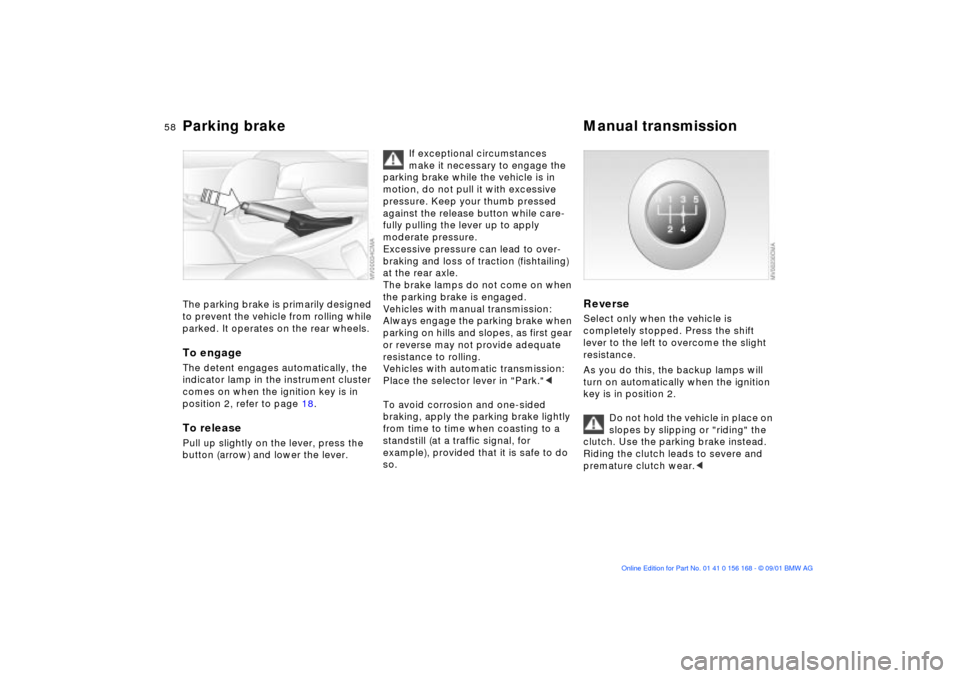
Parking brake Manual transmission The parking brake is primarily designed
to prevent the vehicle from rolling while
parked. It operates on the rear wheels.To engageThe detent engages automatically, the
indicator lamp in the instrument cluster
comes on when the ignition key is in
position 2, refer to page 18.To releasePull up slightly on the lever, press the
button (arrow) and lower the lever.
If exceptional circumstances
make it necessary to engage the
parking brake while the vehicle is in
motion, do not pull it with excessive
pressure. Keep your thumb pressed
against the release button while care-
fully pulling the lever up to apply
moderate pressure.
Excessive pressure can lead to over-
braking and loss of traction (fishtailing)
at the rear axle.
The brake lamps do not come on when
the parking brake is engaged.
Vehicles with manual transmission:
Always engage the parking brake when
parking on hills and slopes, as first gear
or reverse may not provide adequate
resistance to rolling.
Vehicles with automatic transmission:
Place the selector lever in "Park."<
To avoid corrosion and one-sided
braking, apply the parking brake lightly
from time to time when coasting to a
standstill (at a traffic signal, for
example), provided that it is safe to do
so.
Reverse Select only when the vehicle is
completely stopped. Press the shift
lever to the left to overcome the slight
resistance.
As you do this, the backup lamps will
turn on automatically when the ignition
key is in position 2.
Do not hold the vehicle in place on
slopes by slipping or "riding" the
clutch. Use the parking brake instead.
Riding the clutch leads to severe and
premature clutch wear.<
Page 64 of 155

64n
Cruise control
*
You can store and automatically main-
tain any desired vehicle speed above
approx. 20 mph (30 km/h).
The cruise control is available whenever
the engine is running and the system
has been activated.
To activate the systemIn ignition key position 2:
Press the button and the indicator lamp
on the instrument cluster will come on,
refer to page 20. You can now use the
cruise control.
Do not use cruise control on
twisting roads, when high traffic
density prevents driving at a constant
speed, or when the road surface is slick
(snow, rain, ice) or loose (rocks or
gravel, sand).
cluster goes out.
Cruise control is also deactivated when
the ignition key is in position 0.
The speed stored in memory is deleted.
To store and maintain speed
or to acceleratePress button (+) briefly:
The system registers and maintains the
current vehicle speed. Every time you
tap the button, the speed increases by
approx. 0.6 mph (1 km/h).
Press and hold button (+):
The vehicle accelerates without pres-
sure on the accelerator pedal. When
you release the button, the system
registers and maintains the current
speed.
If, on a downhill gradient, the
engine braking effect is not suffi-
cient, the preset speed can be
exceeded. Speed can drop on uphill
grades if the engine output is insuffi-
cient.<
Page 77 of 155
77n
OverviewControlsMaintenanceRepairsDataIndex
Hill Descent Control (HDC)* Ð BMW 325xi, 330xiThe conceptBy reducing the vehicle's speed on
steep downhill stretches, HDC main-
tains predictable vehicle handling
response to provide you with even
greater control of your BMW during
extreme descents.
The vehicle slows to a pace just slightly
faster than walking speed.
HDC is available for activation at
vehicle speeds below approx. 22 mph
(35 km/h). When driving down steep
hills, the vehicle reduces speed auto-
matically down to slightly more than
double walking speed (approx. 8 mph/
12 km/h) and then maintains this speed
at a constant.
You can use the accelerator or brakes
to vary this automatically controlled
speed within a range extending from
approx. 3 mph (5 km/h) to 15 mph
(25 km/h).
In conjunction with the multifunction
steering wheel, you can use the
+/Ð button to set the cruise control to a
target speed in the range from approx.
3 mph (5 km/h) to 15 mph (25 km/h).
HDC is automatically deactivated once
vehicle speed again exceeds approx.
35 mph (60 km/h).
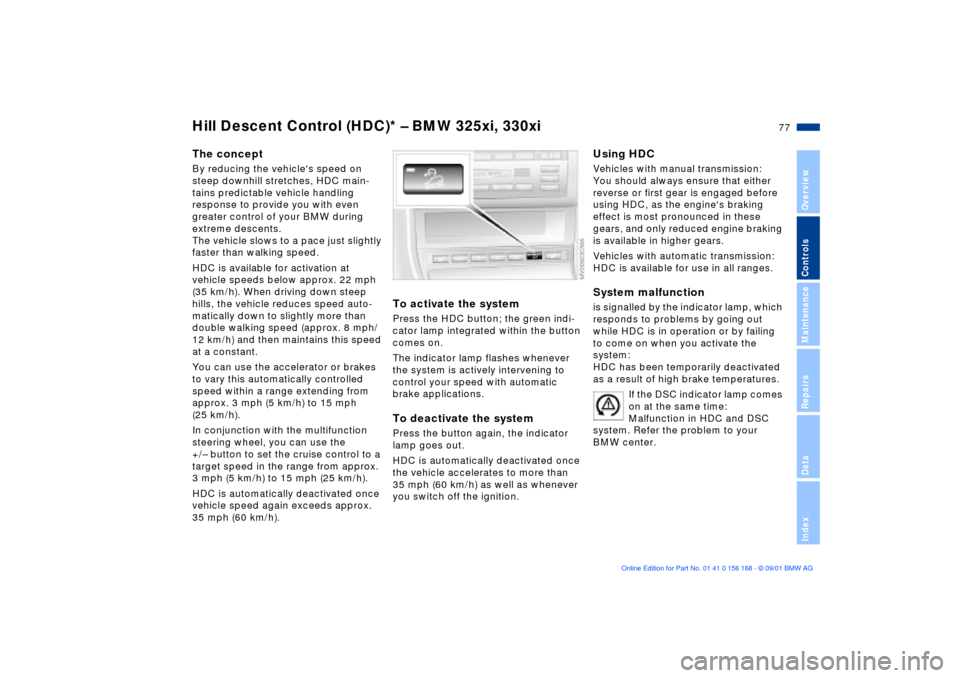
To activate the systemPress the HDC button; the green indi-
cator lamp integrated within the button
comes on.
The indicator lamp flashes whenever
the system is actively intervening to
control your speed with automatic
brake applications.To deactivate the systemPress the button again, the indicator
lamp goes out.
HDC is automatically deactivated once
the vehicle accelerates to more than
35 mph (60 km/h) as well as whenever
you switch off the ignition.
Using HDCVehicles with manual transmission:
You should always ensure that either
reverse or first gear is engaged before
using HDC, as the engine's braking
effect is most pronounced in these
gears, and only reduced engine braking
is available in higher gears.
Vehicles with automatic transmission:
HDC is available for use in all ranges.System malfunctionis signalled by the indicator lamp, which
responds to problems by going out
while HDC is in operation or by failing
to come on when you activate the
system:
HDC has been temporarily deactivated
as a result of high brake temperatures.
If the DSC indicator lamp comes
on at the same time:
Malfunction in HDC and DSC
system. Refer the problem to your
BMW center.
Page 106 of 155

106n
Brake systemBrake fluid level If the brake fluid level is too low and
brake pedal travel has become longer,
there may be a defect in one of the
brake system's hydraulic circuits.
Proceed to the nearest BMW
center. It may be necessary to
apply higher levels of pressure to the
pedal when stopping and braking
distances may also be longer. Please
remember to adapt your driving style
accordingly.
and operating conditions in which
braking is restricted to gentle, low-
pressure applications will all increase
the tendency for corrosion to form on
the rotors; this is often accompanied by
a simultaneous accumulation of
contamination on the brake pads. The
pads must exert a certain minimal level
of pressure against the rotors for the
disc brakes' inherent self-cleaning
effect to remain effective; the pressure
available under the above conditions
may not provide adequate cleansing.
If the brake rotors are corroded, they
will tend to respond to braking with a
pulsating effect that even extended
brake applications will fail to cure.
When driving in heavy rain and on wet
roads it is a good idea to apply light
pressure to the brake pedal every few
miles. Monitor traffic conditions to
ensure that this maneuver does not
pose a hazard to you or to other road
users. The heat generated in this
process helps dry the pads and rotors
to ensure that your brake system will
respond with undiminished efficiency
when you need it.
When descending steep hills and
extended grades, downshift to a gear
that will allow you to continue safely
with only a minimal amount of braking.
By minimizing the loads placed on the
brake system, this strategy helps
ensure that optimal brake system
response will remain available at all
times. Use care to avoid exceeding the
approved engine-speed range, refer to
page 66.Do not coast with the clutch
depressed or with the transmis-
sion in neutral. Do not coast with the
engine shut off. The engine provides no
braking effect when the clutch is
depressed and there is no power-assist
for braking or steering when the engine
is not running.
BMW 325xi, 330xi: always refer all
brake inspection and service work to
your BMW center, as failure to observe
the special procedures could result in
damage to brake system components.
Never allow floor mats, carpets or any
other objects to protrude into the area
around the accelerator, clutch and
brake pedals and obstruct their move-
ment.<
Brake pads
For your own safety: use only
brake pads that the manufacturer
has released for your particular vehicle
model. The manufacturer cannot eval-
uate non-approved brake pads to
determine if they are suited for use, and
therefore cannot ensure the operating
safety of the vehicle if they are
installed.<
Page 148 of 155

Everything from A to ZDoor mirror48
Doors
electrical malfunction31
locking and unlocking29
manual operation31
DOT Quality Grades108
Draft-free ventilation87, 90
Drive belt17
defect17
Driving notes105
DSC (Dynamic Stability
Control)73
indicator lamp19
Dynamic Brake Control
(DBC)73, 74
Dynamic Stability Control
(DSC)73
indicator lamp19 E
Electric power windows37
Electrical malfunction
doors31
fuel filler door22
luggage compartment
lid33
sliding/tilt sunroof40 Elements of operation14
Emergency release of
luggage compartment lid
from luggage
compartment's interior35
Energy control66
Engine compartment
essentials113
Engine coolant, refer to
Coolant117
Engine data140
Engine oil
add115
capacity143
consumption115
level19
level, check115
level, indicator lamp17
pressure17
pressure, indicator
lamp17
Engine, starting56
Engine, switching off57
Exterior mirrors48
F
Failure messages68
Filling capacities143
Fittings, tow starting and
towing135
Flat tire132
Flat Tire
Monitor80, 109, 132
warning lamp17
Flat tires107, 129
Fog lamps83
Follow me home lamps82
Front seat adjustment41
Fuel consumption70
display67
Fuel filler door22
electrical malfunction22
manual operation22
Fuel gauge67
Fuel reserve indicator
lamp67
Fuel specifications23
Fuel tank capacity143
Fuel tank gauge67
Fuel-injection system140
Fuses133
G
Gasoline gauge67
Glove compartment92
Grilles88
Gross vehicle weight142 H
Handbrake58
Hands-free system94
Hazard warning triangle22
HDC (Hill Descent
Control)77
Head restraints44
Headlamp flasher61, 83
Headlamp washer
system114
Headlight control82
Headrests44
Heated seats47
Heavy cargo99
Height141
High beams20, 61, 83
bulb replacement125
Hill Descent Control
(HDC)77
Holder for canned
beverages93
Hood112
Horn14