lift BMW 5 SERIES 1990 E34 Owner's Manual
[x] Cancel search | Manufacturer: BMW, Model Year: 1990, Model line: 5 SERIES, Model: BMW 5 SERIES 1990 E34Pages: 228, PDF Size: 7.04 MB
Page 83 of 228
3-Series models
14Remove the radiator grille assembly (see
Chapter 11).
15Unbolt and remove the fan bracket and
shroud assembly from the radiator (see
Section 5).
16Remove the radiator (see Section 4).
17Unbolt the air conditioning condenser
mounting bolts, where applicable. Do not
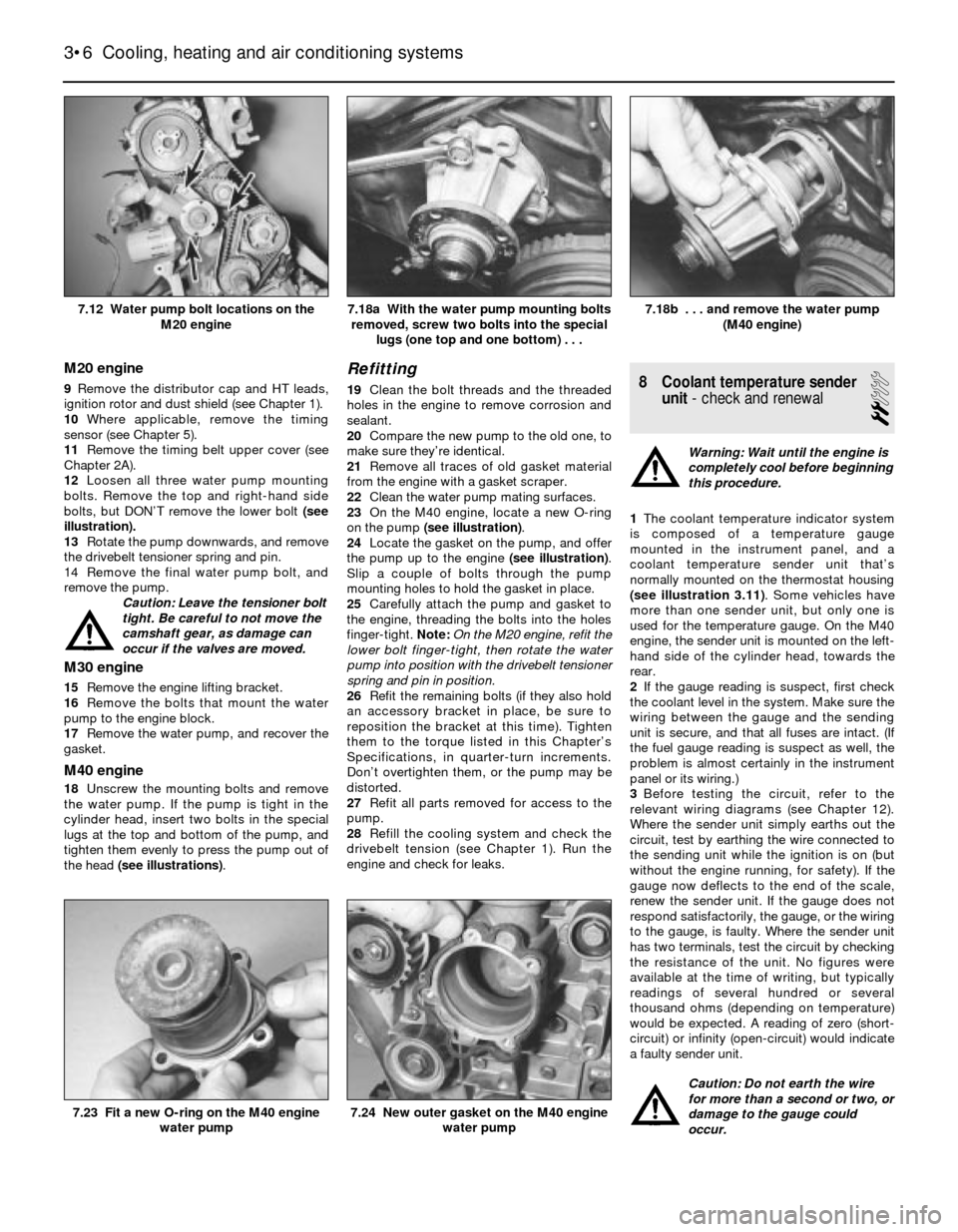
remove the condenser or disconnect any
refrigerant lines from the condenser.
18Carefully pull the condenser back towards
the engine, slightly, to gain access to lift the
auxiliary fan.
19Disconnect the fan motor electrical
connection and remove the auxiliary fan.
20Refitting is the reverse of removal.
5-Series models
21Remove the screws and trim panel in front
of the radiator.
22Unbolt the fan assembly from the
condenser mounting points.
23Disconnect the fan electrical connector.
24Remove the fan and housing from the car,
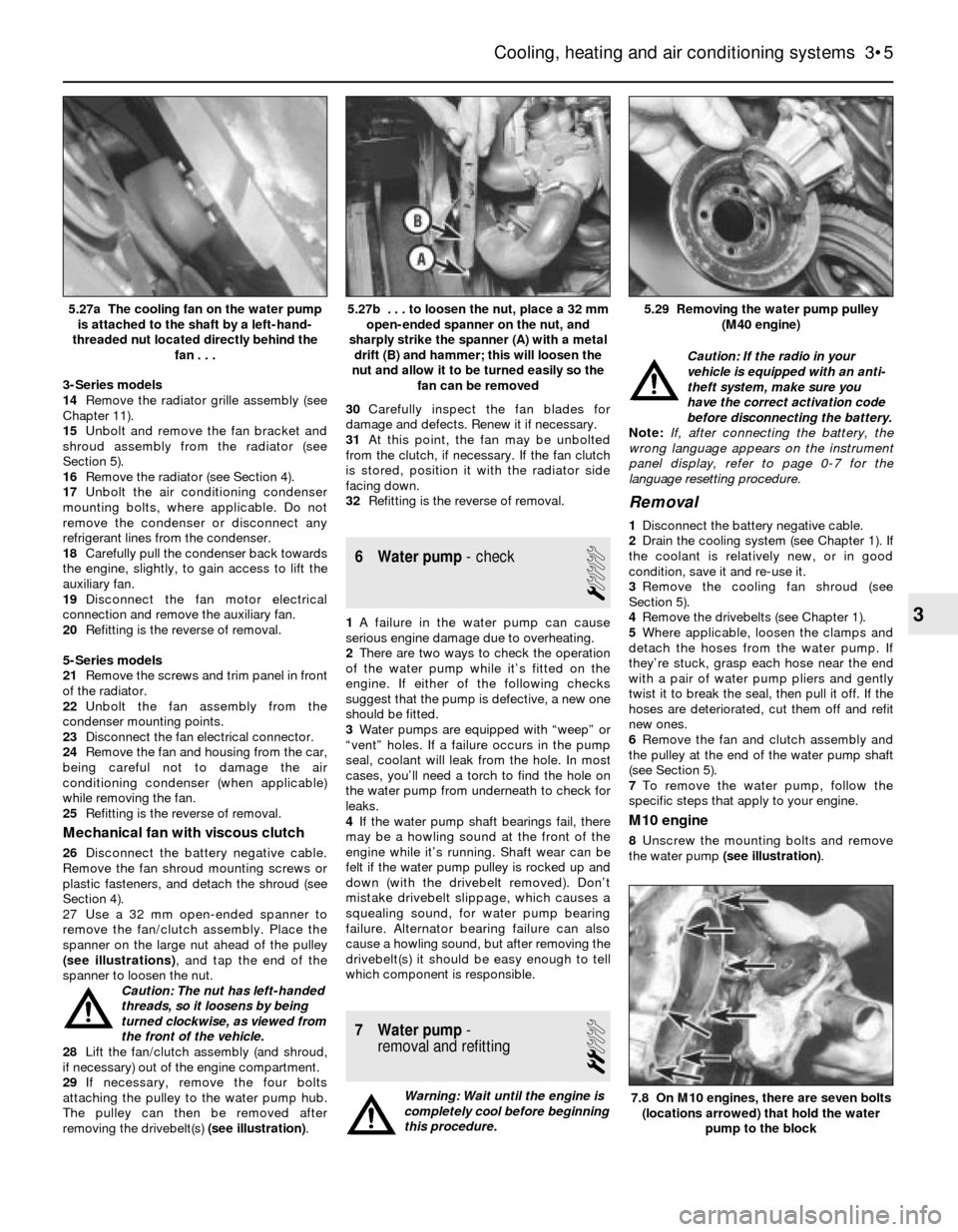
being careful not to damage the air
conditioning condenser (when applicable)
while removing the fan.
25Refitting is the reverse of removal.
Mechanical fan with viscous clutch
26Disconnect the battery negative cable.
Remove the fan shroud mounting screws or
plastic fasteners, and detach the shroud (see
Section 4).
27 Use a 32 mm open-ended spanner to
remove the fan/clutch assembly. Place the
spanner on the large nut ahead of the pulley
(see illustrations), and tap the end of the
spanner to loosen the nut.
Caution: The nut has left-handed
threads, so it loosens by being
turned clockwise, as viewed from
the front of the vehicle.
28Lift the fan/clutch assembly (and shroud,
if necessary) out of the engine compartment.
29If necessary, remove the four bolts
attaching the pulley to the water pump hub.
The pulley can then be removed after
removing the drivebelt(s) (see illustration).30Carefully inspect the fan blades for
damage and defects. Renew it if necessary.
31At this point, the fan may be unbolted
from the clutch, if necessary. If the fan clutch
is stored, position it with the radiator side
facing down.
32Refitting is the reverse of removal.
6 Water pump- check
1
1A failure in the water pump can cause
serious engine damage due to overheating.
2There are two ways to check the operation
of the water pump while it’s fitted on the
engine. If either of the following checks
suggest that the pump is defective, a new one
should be fitted.
3Water pumps are equipped with “weep” or
“vent” holes. If a failure occurs in the pump
seal, coolant will leak from the hole. In most
cases, you’ll need a torch to find the hole on
the water pump from underneath to check for
leaks.
4If the water pump shaft bearings fail, there
may be a howling sound at the front of the
engine while it’s running. Shaft wear can be
felt if the water pump pulley is rocked up and
down (with the drivebelt removed). Don’t
mistake drivebelt slippage, which causes a
squealing sound, for water pump bearing
failure. Alternator bearing failure can also
cause a howling sound, but after removing the
drivebelt(s) it should be easy enough to tell
which component is responsible.
7 Water pump-
removal and refitting
2
Warning: Wait until the engine is
completely cool before beginning
this procedure.Caution: If the radio in your
vehicle is equipped with an anti-
theft system, make sure you
have the correct activation code
before disconnecting the battery.
Note: If, after connecting the battery, the
wrong language appears on the instrument
panel display, refer to page 0-7 for the
language resetting procedure.
Removal
1Disconnect the battery negative cable.
2Drain the cooling system (see Chapter 1). If
the coolant is relatively new, or in good
condition, save it and re-use it.
3Remove the cooling fan shroud (see
Section 5).
4Remove the drivebelts (see Chapter 1).
5Where applicable, loosen the clamps and
detach the hoses from the water pump. If
they’re stuck, grasp each hose near the end
with a pair of water pump pliers and gently
twist it to break the seal, then pull it off. If the
hoses are deteriorated, cut them off and refit
new ones.
6Remove the fan and clutch assembly and
the pulley at the end of the water pump shaft
(see Section 5).
7To remove the water pump, follow the
specific steps that apply to your engine.
M10 engine
8Unscrew the mounting bolts and remove
the water pump (see illustration).
Cooling, heating and air conditioning systems 3•5
5.29 Removing the water pump pulley
(M40 engine)5.27b . . . to loosen the nut, place a 32 mm
open-ended spanner on the nut, and
sharply strike the spanner (A) with a metal
drift (B) and hammer; this will loosen the
nut and allow it to be turned easily so the
fan can be removed5.27a The cooling fan on the water pump
is attached to the shaft by a left-hand-
threaded nut located directly behind the
fan . . .
7.8 On M10 engines, there are seven bolts
(locations arrowed) that hold the water
pump to the block
3
Page 84 of 228
M20 engine
9Remove the distributor cap and HT leads,
ignition rotor and dust shield (see Chapter 1).
10Where applicable, remove the timing
sensor (see Chapter 5).
11Remove the timing belt upper cover (see
Chapter 2A).
12Loosen all three water pump mounting
bolts. Remove the top and right-hand side
bolts, but DON’T remove the lower bolt (see
illustration).
13Rotate the pump downwards, and remove
the drivebelt tensioner spring and pin.
14 Remove the final water pump bolt, and
remove the pump.
Caution: Leave the tensioner bolt
tight. Be careful to not move the
camshaft gear, as damage can
occur if the valves are moved.
M30 engine
15Remove the engine lifting bracket.
16Remove the bolts that mount the water
pump to the engine block.
17Remove the water pump, and recover the
gasket.
M40 engine
18Unscrew the mounting bolts and remove
the water pump. If the pump is tight in the
cylinder head, insert two bolts in the special
lugs at the top and bottom of the pump, and
tighten them evenly to press the pump out of
the head (see illustrations).
Refitting
19Clean the bolt threads and the threaded
holes in the engine to remove corrosion and
sealant.
20Compare the new pump to the old one, to
make sure they’re identical.
21Remove all traces of old gasket material
from the engine with a gasket scraper.
22Clean the water pump mating surfaces.
23On the M40 engine, locate a new O-ring
on the pump (see illustration).
24Locate the gasket on the pump, and offer
the pump up to the engine (see illustration).
Slip a couple of bolts through the pump
mounting holes to hold the gasket in place.
25Carefully attach the pump and gasket to
the engine, threading the bolts into the holes
finger-tight.Note:On the M20 engine, refit the
lower bolt finger-tight, then rotate the water
pump into position with the drivebelt tensioner
spring and pin in position.
26Refit the remaining bolts (if they also hold
an accessory bracket in place, be sure to
reposition the bracket at this time). Tighten
them to the torque listed in this Chapter’s
Specifications, in quarter-turn increments.
Don’t overtighten them, or the pump may be
distorted.
27Refit all parts removed for access to the
pump.
28Refill the cooling system and check the
drivebelt tension (see Chapter 1). Run the
engine and check for leaks.8 Coolant temperature sender
unit- check and renewal
2
Warning: Wait until the engine is
completely cool before beginning
this procedure.
1The coolant temperature indicator system
is composed of a temperature gauge
mounted in the instrument panel, and a
coolant temperature sender unit that’s
normally mounted on the thermostat housing
(see illustration 3.11). Some vehicles have
more than one sender unit, but only one is
used for the temperature gauge. On the M40
engine, the sender unit is mounted on the left-
hand side of the cylinder head, towards the
rear.
2If the gauge reading is suspect, first check
the coolant level in the system. Make sure the
wiring between the gauge and the sending
unit is secure, and that all fuses are intact. (If
the fuel gauge reading is suspect as well, the
problem is almost certainly in the instrument
panel or its wiring.)
3Before testing the circuit, refer to the
relevant wiring diagrams (see Chapter 12).
Where the sender unit simply earths out the
circuit, test by earthing the wire connected to
the sending unit while the ignition is on (but
without the engine running, for safety). If the
gauge now deflects to the end of the scale,
renew the sender unit. If the gauge does not
respond satisfactorily, the gauge, or the wiring
to the gauge, is faulty. Where the sender unit
has two terminals, test the circuit by checking
the resistance of the unit. No figures were
available at the time of writing, but typically
readings of several hundred or several
thousand ohms (depending on temperature)
would be expected. A reading of zero (short-
circuit) or infinity (open-circuit) would indicate
a faulty sender unit.
Caution: Do not earth the wire
for more than a second or two, or
damage to the gauge could
occur.
3•6 Cooling, heating and air conditioning systems
7.24 New outer gasket on the M40 engine
water pump7.23 Fit a new O-ring on the M40 engine
water pump
7.18b . . . and remove the water pump
(M40 engine)7.18a With the water pump mounting bolts
removed, screw two bolts into the special
lugs (one top and one bottom) . . .7.12 Water pump bolt locations on the
M20 engine
Page 85 of 228
4If a new sender unit is to be fitted, make
sure the engine is completely cool. There will
be some coolant loss when the unit is
unscrewed, so be prepared to catch it, or
have the new unit ready to fit immediately the
old one is removed. Disconnect the wiring,
then unscrew the old unit from the engine,
and fit the new one. Use sealant on the
threads. Reconnect the wiring, and check the
coolant level on completion.
9 Heater and air conditioning
blower motor- removal,
testing and refitting
1
Removal
Note: The 3-Series models covered by this
manual have always used a single blower
motor for ventilation, heating and air
conditioning. “Old-shape” (E28) 5-Series
models use two separate blower motors: one
for ventilation and heating, and another for air
conditioning. “New-shape” (E34) 5-Series
models have a single blower motor, like the 3-
Series. The removal and refitting of the single
blower motor, and the old-shape 5-Series
vent/heat motor, is described below. The
removal and refitting of the old-shape 5-Series
air conditioning blower motor is described in
Section 14 of this Chapter.
Caution: If the radio in your
vehicle is equipped with an anti-
theft system, make sure you have
the correct activation code
before disconnecting the battery.
Note: If, after connecting the battery, the
wrong language appears on the instrument
panel display, refer to page 0-7 for the
language resetting procedure.
1Disconnect the battery negative cable.
2The blower motor is located behind the
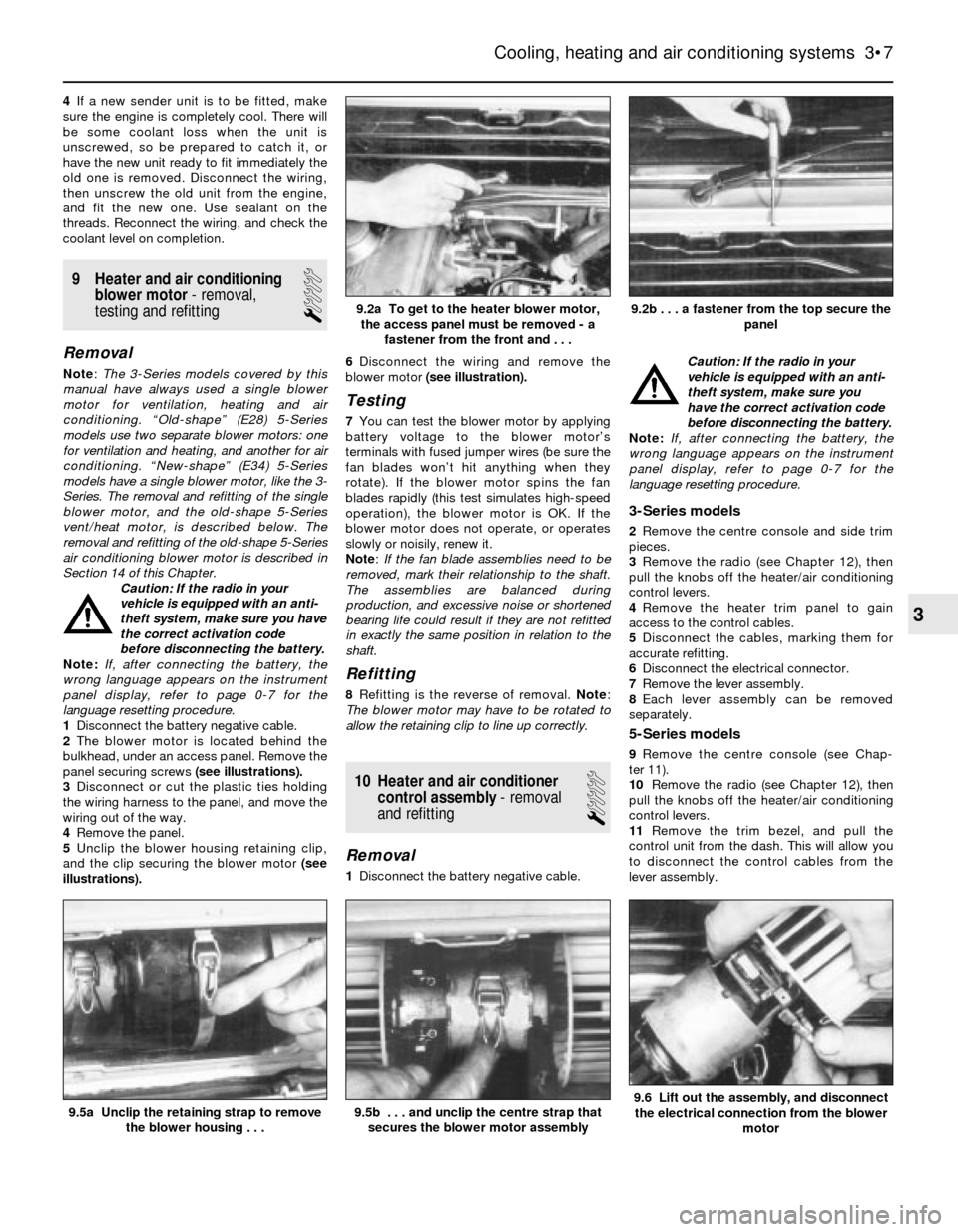
bulkhead, under an access panel. Remove the
panel securing screws (see illustrations).
3Disconnect or cut the plastic ties holding
the wiring harness to the panel, and move the
wiring out of the way.
4Remove the panel.
5Unclip the blower housing retaining clip,
and the clip securing the blower motor (see
illustrations).6Disconnect the wiring and remove the
blower motor (see illustration).
Testing
7You can test the blower motor by applying
battery voltage to the blower motor’s
terminals with fused jumper wires (be sure the
fan blades won’t hit anything when they
rotate). If the blower motor spins the fan
blades rapidly (this test simulates high-speed
operation), the blower motor is OK. If the
blower motor does not operate, or operates
slowly or noisily, renew it.
Note: If the fan blade assemblies need to be
removed, mark their relationship to the shaft.
The assemblies are balanced during
production, and excessive noise or shortened
bearing life could result if they are not refitted
in exactly the same position in relation to the
shaft.
Refitting
8Refitting is the reverse of removal. Note:
The blower motor may have to be rotated to
allow the retaining clip to line up correctly.
10 Heater and air conditioner
control assembly- removal
and refitting
1
Removal
1Disconnect the battery negative cable. Caution: If the radio in your
vehicle is equipped with an anti-
theft system, make sure you
have the correct activation code
before disconnecting the battery.
Note: If, after connecting the battery, the
wrong language appears on the instrument
panel display, refer to page 0-7 for the
language resetting procedure.
3-Series models
2Remove the centre console and side trim
pieces.
3Remove the radio (see Chapter 12), then
pull the knobs off the heater/air conditioning
control levers.
4Remove the heater trim panel to gain
access to the control cables.
5Disconnect the cables, marking them for
accurate refitting.
6Disconnect the electrical connector.
7Remove the lever assembly.
8Each lever assembly can be removed
separately.
5-Series models
9Remove the centre console (see Chap-
ter 11).
10Remove the radio (see Chapter 12), then
pull the knobs off the heater/air conditioning
control levers.
11Remove the trim bezel, and pull the
control unit from the dash. This will allow you
to disconnect the control cables from the
lever assembly.
Cooling, heating and air conditioning systems 3•7
9.5a Unclip the retaining strap to remove
the blower housing . . .
9.2b . . . a fastener from the top secure the
panel9.2a To get to the heater blower motor,
the access panel must be removed - a
fastener from the front and . . .
9.6 Lift out the assembly, and disconnect
the electrical connection from the blower
motor9.5b . . . and unclip the centre strap that
secures the blower motor assembly
3
Page 86 of 228
12Disconnect the cables from the clips
securing them to the lever assembly, marking
them for accurate refitting.
13Disconnect the electrical connection from
the control assembly.
14Remove the screws attaching the bezel to
the control assembly, and remove the control
assembly.
Refitting
15Refitting is the reverse of the removal
procedure.
11 Heater matrix-
removal and refitting
1
Caution: If the radio in your
vehicle is equipped with an anti-
theft system, make sure you
have the correct activation code
before disconnecting the battery.
Note: If, after connecting the battery, the
wrong language appears on the instrument
panel display, refer to page 0-7 for the
language resetting procedure.
1Disconnect the battery negative cable.
2Drain the cooling system (see Chapter 1).
3Remove the centre console (see Chap-
ter 11). Spread an old blanket over the front
carpeting; this will prevent stains if any
residual coolant spills.
Removal
3-Series models
4Remove the left-hand side heater ducting,
and set it aside.
5Remove the heater valve clamp.
6Remove the screws and detach the flange
where the two coolant lines enter the heater
matrix case. Be careful; some coolant may
spill.
7Remove the two screws holding the heater
matrix case to the heater main assembly.
8Slide the heater matrix out of the mounting.
Be careful not to spill any of the remaining
coolant in the heater matrix when removing it.
5-Series models
9Disconnect the temperature sensor
electrical connectors.
10Disconnect the straps holding the wiring
to the case, and set the wiring out of the way.
11Unfasten the cover fasteners.
12Remove the screws holding the cover in
place, then remove the cover.
13Disconnect all heater pipe connections
attached to the heater matrix. Be careful;
some coolant may spill.
14Lifting on the right side of the heater
matrix first, remove the heater matrix.
Refitting
Note: Always use new O-rings when attaching
the coolant lines to the heater matrix.15Refitting is the reverse of removal. Refill
the cooling system (see Chapter 1), then run
the engine with the heater on, and check for
correct operation and leaks.
12 Air conditioning system-
precautions and maintenance
1
Precautions
Warning: The air conditioning
system is under high pressure.
DO NOT loosen any hose or line
fittings, or remove any
components, until after the system has
been discharged. Air conditioning
refrigerant should be properly discharged
by a qualified refrigeration engineer. The
refrigerant used in the system must not be
allowed into contact with your skin or
eyes, or there is a risk of frostbite. Should
the refrigerant come into contact with a
naked flame, a poisonous gas will be
produced. Smoking in the presence of
refrigerant is therefore highly dangerous,
particularly if refrigerant vapour is inhaled
through a lighted cigarette. The refrigerant
is heavier than air, and it may cause
suffocation if discharged in an enclosed
space such as a domestic garage.
Finally, uncontrolled release of the
refrigerant causes environmental damage,
by contributing to the “greenhouse
effect”.
Maintenance
1The following maintenance checks should
be performed on a regular basis to ensure the
air conditioner continues to operate at peak
efficiency:
a) Check the drivebelt. If it’s worn or
deteriorated, renew it (see Chapter 1).
b) Check the system hoses. Look for cracks,
bubbles, hard spots and deterioration.
Inspect the hoses and all fittings for oil
bubbles and seepage. If there’s any
evidence of wear, damage or leaks, have
new hose(s) fitted.
c) Inspect the condenser fins for leaves, flies
and other debris. Use a “fin comb” or
compressed air to clean the condenser.
d) Make sure the system has the correct
refrigerant charge, as described below.
2It’s a good idea to operate the system for
about 10 minutes at least once a month,
particularly during the winter. Long-term non-
use can cause hardening, and subsequent
failure, of the seals.
3Because of the complexity of the air
conditioning system and the special
equipment necessary to service it, in-depth
fault diagnosis and repair procedures are not
included in this manual. However, simple
checks and component renewal procedures
are provided in this Chapter.
4The most common cause of poor cooling issimply a low system refrigerant charge. If a
noticeable loss of cool air output occurs, the
following quick check may help you determine
if the refrigerant level is low.
5Warm the engine up to normal operating
temperature.
6Set the air conditioning temperature
selector at the coldest setting, and put the
blower at the highest setting. Open the doors
(to make sure the air conditioning system
doesn’t switch off as soon as it cools the
passenger compartment).
7With the compressor engaged - the
compressor clutch will make an audible click,
and the centre of the clutch will rotate - feel
the tube located adjacent to the right front
frame rail, near the radiator.
8If a significant temperature drop is noticed,
the refrigerant level is probably OK.
9If the inlet line has frost accumulation, or
feels cooler than the receiver-drier surface,
the refrigerant charge is low. Recharging the
system should be carried out by a qualified
refrigeration engineer.
13 Air conditioning compressor
- removal and refitting
5
Warning: Due to the potential
dangers associated with the
system, you are strongly advised
to have any work on the air
conditioning system carried out by a BMW
dealer or air conditioning specialist. At the
very least, DO NOT dismantle any part of
the system (hoses, compressor, line
fittings, etc.) until after the system has
been discharged by a qualified engineer.
Refer to the precautions given at the start
of Section 12.
Note: If a new compressor is fitted, the
receiver-drier (see Section 16) should also be
renewed.
Removal
1Have the air conditioning system
discharged (see Warning above).
2Disconnect the battery negative cable.
Caution: If the radio in your
vehicle is equipped with an anti-
theft system, make sure you
have the correct activation code
before disconnecting the battery.
Note: If, after connecting the battery, the
wrong language appears on the instrument
panel display, refer to page 0-7 for the
language resetting procedure.
3Disconnect the compressor clutch wiring
harness.
4Remove the drivebelt (see Chapter 1).
5Disconnect the refrigerant lines from the
rear of the compressor. Plug the open fittings
to prevent entry of dirt and moisture.
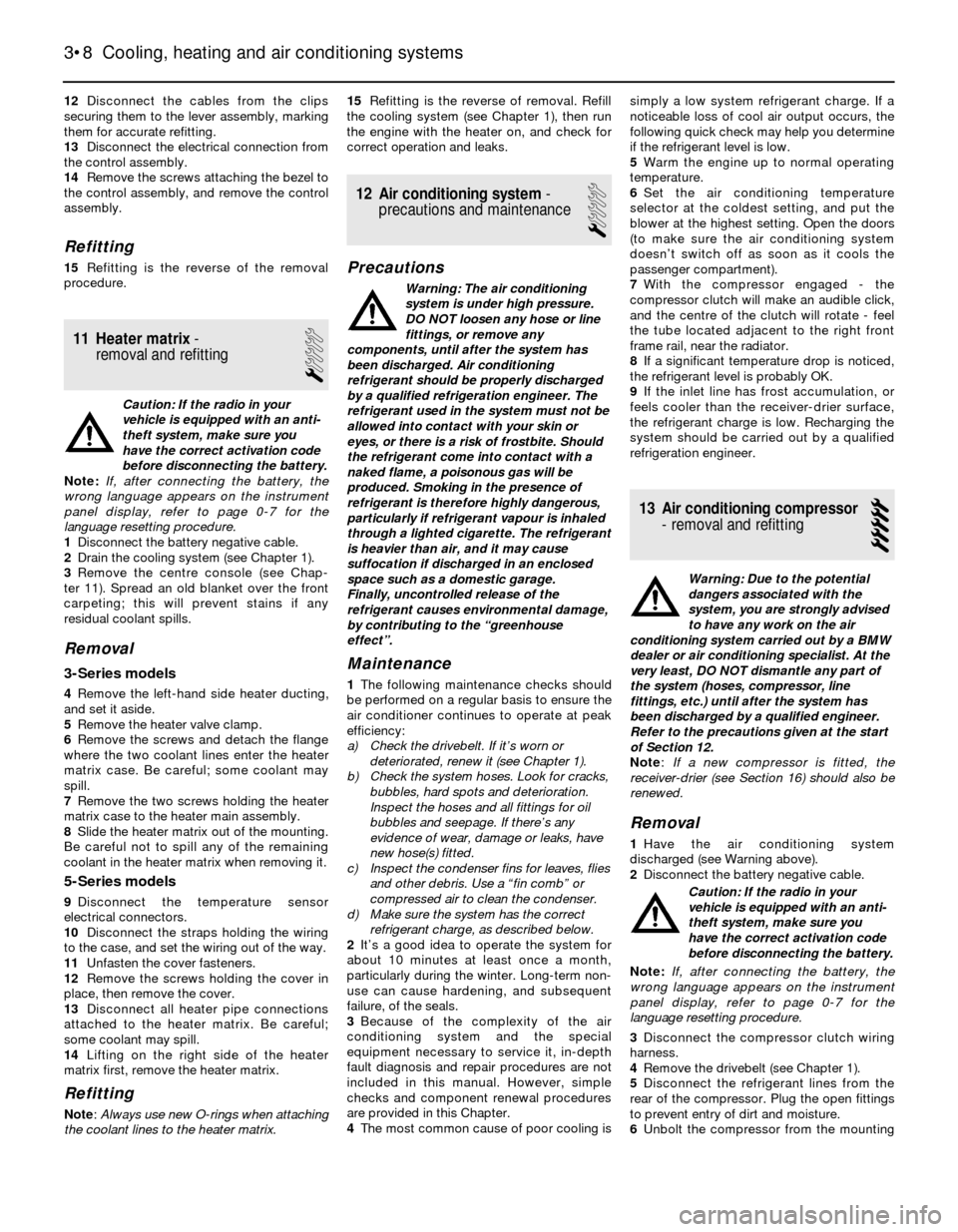
6Unbolt the compressor from the mounting
3•8 Cooling, heating and air conditioning systems
Page 87 of 228
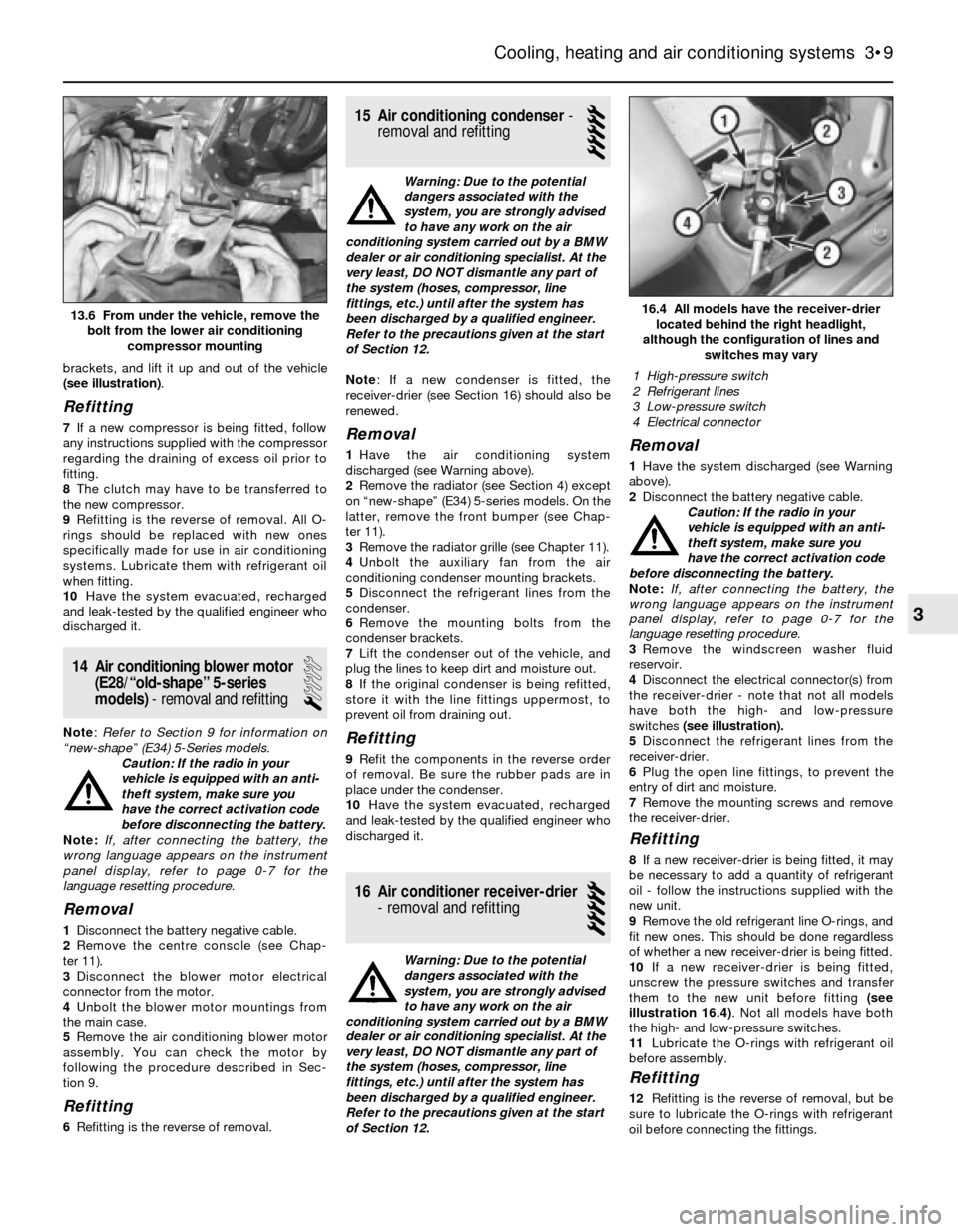
brackets, and lift it up and out of the vehicle
(see illustration).
Refitting
7If a new compressor is being fitted, follow
any instructions supplied with the compressor
regarding the draining of excess oil prior to
fitting.
8The clutch may have to be transferred to
the new compressor.
9Refitting is the reverse of removal. All O-
rings should be replaced with new ones
specifically made for use in air conditioning
systems. Lubricate them with refrigerant oil
when fitting.
10Have the system evacuated, recharged
and leak-tested by the qualified engineer who
discharged it.
14 Air conditioning blower motor
(E28/“old-shape” 5-series
models)- removal and refitting
1
Note: Refer to Section 9 for information on
“new-shape” (E34) 5-Series models.
Caution: If the radio in your
vehicle is equipped with an anti-
theft system, make sure you
have the correct activation code
before disconnecting the battery.
Note: If, after connecting the battery, the
wrong language appears on the instrument
panel display, refer to page 0-7 for the
language resetting procedure.
Removal
1Disconnect the battery negative cable.
2Remove the centre console (see Chap-
ter 11).
3Disconnect the blower motor electrical
connector from the motor.
4Unbolt the blower motor mountings from
the main case.
5Remove the air conditioning blower motor
assembly. You can check the motor by
following the procedure described in Sec-
tion 9.
Refitting
6Refitting is the reverse of removal.
15 Air conditioning condenser-
removal and refitting
5
Warning: Due to the potential
dangers associated with the
system, you are strongly advised
to have any work on the air
conditioning system carried out by a BMW
dealer or air conditioning specialist. At the
very least, DO NOT dismantle any part of
the system (hoses, compressor, line
fittings, etc.) until after the system has
been discharged by a qualified engineer.
Refer to the precautions given at the start
of Section 12.
Note: If a new condenser is fitted, the
receiver-drier (see Section 16) should also be
renewed.
Removal
1Have the air conditioning system
discharged (see Warning above).
2Remove the radiator (see Section 4) except
on “new-shape” (E34) 5-series models. On the
latter, remove the front bumper (see Chap-
ter 11).
3Remove the radiator grille (see Chapter 11).
4Unbolt the auxiliary fan from the air
conditioning condenser mounting brackets.
5Disconnect the refrigerant lines from the
condenser.
6Remove the mounting bolts from the
condenser brackets.
7Lift the condenser out of the vehicle, and
plug the lines to keep dirt and moisture out.
8If the original condenser is being refitted,
store it with the line fittings uppermost, to
prevent oil from draining out.
Refitting
9Refit the components in the reverse order
of removal. Be sure the rubber pads are in
place under the condenser.
10Have the system evacuated, recharged
and leak-tested by the qualified engineer who
discharged it.
16 Air conditioner receiver-drier
- removal and refitting
5
Warning: Due to the potential
dangers associated with the
system, you are strongly advised
to have any work on the air
conditioning system carried out by a BMW
dealer or air conditioning specialist. At the
very least, DO NOT dismantle any part of
the system (hoses, compressor, line
fittings, etc.) until after the system has
been discharged by a qualified engineer.
Refer to the precautions given at the start
of Section 12.
Removal
1Have the system discharged (see Warning
above).
2Disconnect the battery negative cable.
Caution: If the radio in your
vehicle is equipped with an anti-
theft system, make sure you
have the correct activation code
before disconnecting the battery.
Note: If, after connecting the battery, the
wrong language appears on the instrument
panel display, refer to page 0-7 for the
language resetting procedure.
3Remove the windscreen washer fluid
reservoir.
4Disconnect the electrical connector(s) from
the receiver-drier - note that not all models
have both the high- and low-pressure
switches (see illustration).
5Disconnect the refrigerant lines from the
receiver-drier.
6Plug the open line fittings, to prevent the
entry of dirt and moisture.
7Remove the mounting screws and remove
the receiver-drier.
Refitting
8If a new receiver-drier is being fitted, it may
be necessary to add a quantity of refrigerant
oil - follow the instructions supplied with the
new unit.
9Remove the old refrigerant line O-rings, and
fit new ones. This should be done regardless
of whether a new receiver-drier is being fitted.
10If a new receiver-drier is being fitted,
unscrew the pressure switches and transfer
them to the new unit before fitting (see
illustration 16.4). Not all models have both
the high- and low-pressure switches.
11Lubricate the O-rings with refrigerant oil
before assembly.
Refitting
12Refitting is the reverse of removal, but be
sure to lubricate the O-rings with refrigerant
oil before connecting the fittings.
Cooling, heating and air conditioning systems 3•9
16.4 All models have the receiver-drier
located behind the right headlight,
although the configuration of lines and
switches may vary
3
13.6 From under the vehicle, remove the
bolt from the lower air conditioning
compressor mounting
1 High-pressure switch
2 Refrigerant lines
3 Low-pressure switch
4 Electrical connector
Page 94 of 228
and clamps, and remove the fuel pump from
the under the vehicle.
13Refitting is the reverse of removal.
In-tank fuel pump or transfer pump
14On some models, access to the fuel pump
is gained by removing the rear seat cushion.
On other models, access is gained by
removing the carpet from the luggage
compartment.
15Remove the screws from the fuel pump
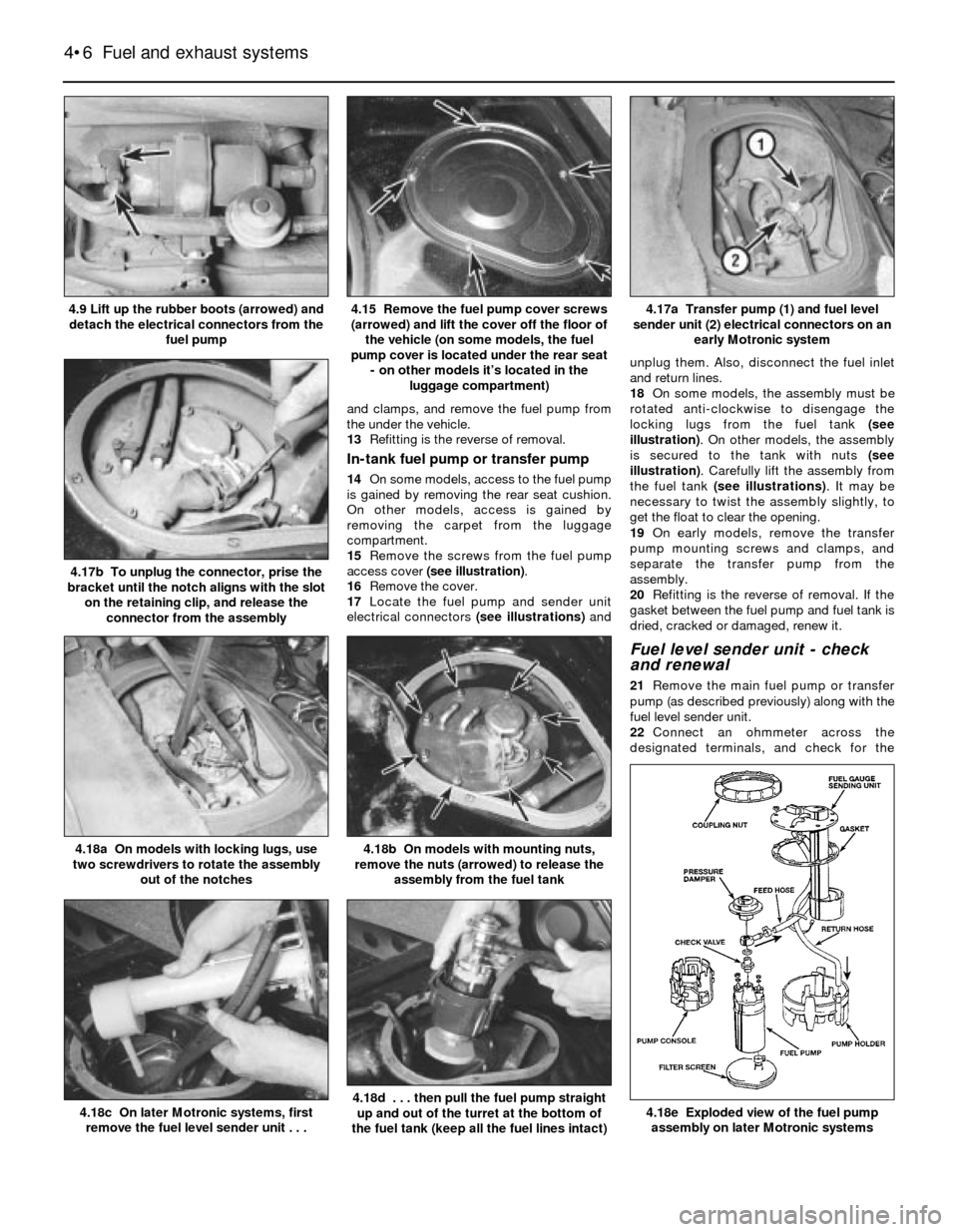
access cover (see illustration).
16Remove the cover.
17Locate the fuel pump and sender unit
electrical connectors (see illustrations)andunplug them. Also, disconnect the fuel inlet
and return lines.
18On some models, the assembly must be
rotated anti-clockwise to disengage the
locking lugs from the fuel tank (see
illustration). On other models, the assembly
is secured to the tank with nuts (see
illustration). Carefully lift the assembly from
the fuel tank (see illustrations). It may be
necessary to twist the assembly slightly, to
get the float to clear the opening.
19On early models, remove the transfer
pump mounting screws and clamps, and
separate the transfer pump from the
assembly.
20Refitting is the reverse of removal. If the
gasket between the fuel pump and fuel tank is
dried, cracked or damaged, renew it.
Fuel level sender unit - check
and renewal
21Remove the main fuel pump or transfer
pump (as described previously) along with the
fuel level sender unit.
22Connect an ohmmeter across the
designated terminals, and check for the
4•6 Fuel and exhaust systems
4.18e Exploded view of the fuel pump
assembly on later Motronic systems4.18d . . . then pull the fuel pump straight
up and out of the turret at the bottom of
the fuel tank (keep all the fuel lines intact)4.18c On later Motronic systems, first
remove the fuel level sender unit . . .
4.18b On models with mounting nuts,
remove the nuts (arrowed) to release the
assembly from the fuel tank4.18a On models with locking lugs, use
two screwdrivers to rotate the assembly
out of the notches
4.17b To unplug the connector, prise the
bracket until the notch aligns with the slot
on the retaining clip, and release the
connector from the assembly
4.17a Transfer pump (1) and fuel level
sender unit (2) electrical connectors on an
early Motronic system4.15 Remove the fuel pump cover screws
(arrowed) and lift the cover off the floor of
the vehicle (on some models, the fuel
pump cover is located under the rear seat
- on other models it’s located in the
luggage compartment)4.9 Lift up the rubber boots (arrowed) and
detach the electrical connectors from the
fuel pump
Page 96 of 228
Position a block of wood between the jack
head and the fuel tank to protect the tank.
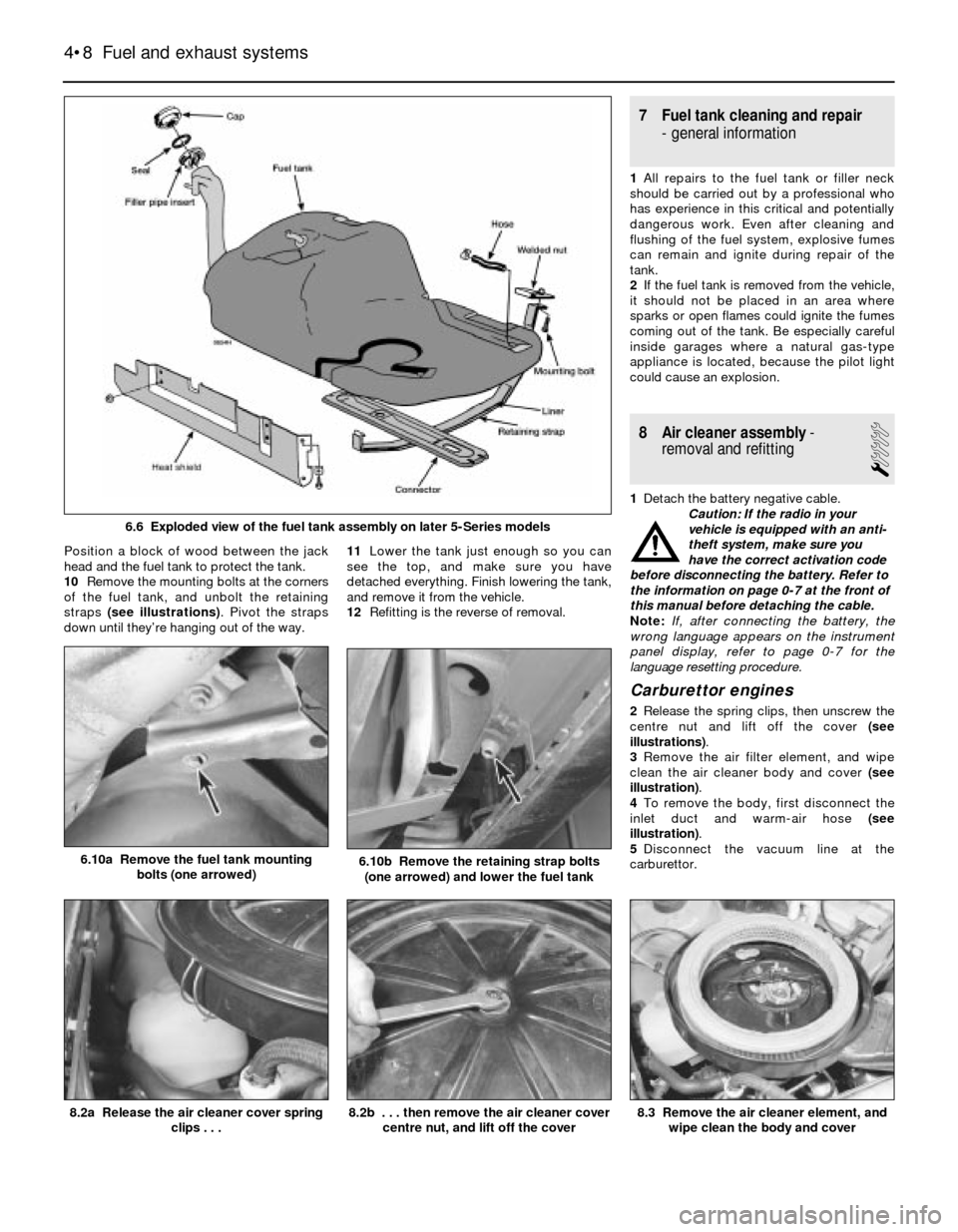
10Remove the mounting bolts at the corners
of the fuel tank, and unbolt the retaining
straps (see illustrations). Pivot the straps
down until they’re hanging out of the way.11Lower the tank just enough so you can
see the top, and make sure you have
detached everything. Finish lowering the tank,
and remove it from the vehicle.
12Refitting is the reverse of removal.
7 Fuel tank cleaning and repair
- general information
1All repairs to the fuel tank or filler neck
should be carried out by a professional who
has experience in this critical and potentially
dangerous work. Even after cleaning and
flushing of the fuel system, explosive fumes
can remain and ignite during repair of the
tank.
2If the fuel tank is removed from the vehicle,
it should not be placed in an area where
sparks or open flames could ignite the fumes
coming out of the tank. Be especially careful
inside garages where a natural gas-type
appliance is located, because the pilot light
could cause an explosion.
8 Air cleaner assembly-
removal and refitting
1
1Detach the battery negative cable.
Caution: If the radio in your
vehicle is equipped with an anti-
theft system, make sure you
have the correct activation code
before disconnecting the battery. Refer to
the information on page 0-7 at the front of
this manual before detaching the cable.
Note: If, after connecting the battery, the
wrong language appears on the instrument
panel display, refer to page 0-7 for the
language resetting procedure.
Carburettor engines
2Release the spring clips, then unscrew the
centre nut and lift off the cover (see
illustrations).
3Remove the air filter element, and wipe
clean the air cleaner body and cover (see
illustration).
4To remove the body, first disconnect the
inlet duct and warm-air hose (see
illustration).
5Disconnect the vacuum line at the
carburettor.
4•8 Fuel and exhaust systems
8.3 Remove the air cleaner element, and
wipe clean the body and cover8.2b . . . then remove the air cleaner cover
centre nut, and lift off the cover8.2a Release the air cleaner cover spring
clips . . .
6.10a Remove the fuel tank mounting
bolts (one arrowed)6.10b Remove the retaining strap bolts
(one arrowed) and lower the fuel tank
6.6 Exploded view of the fuel tank assembly on later 5-Series models
Page 97 of 228
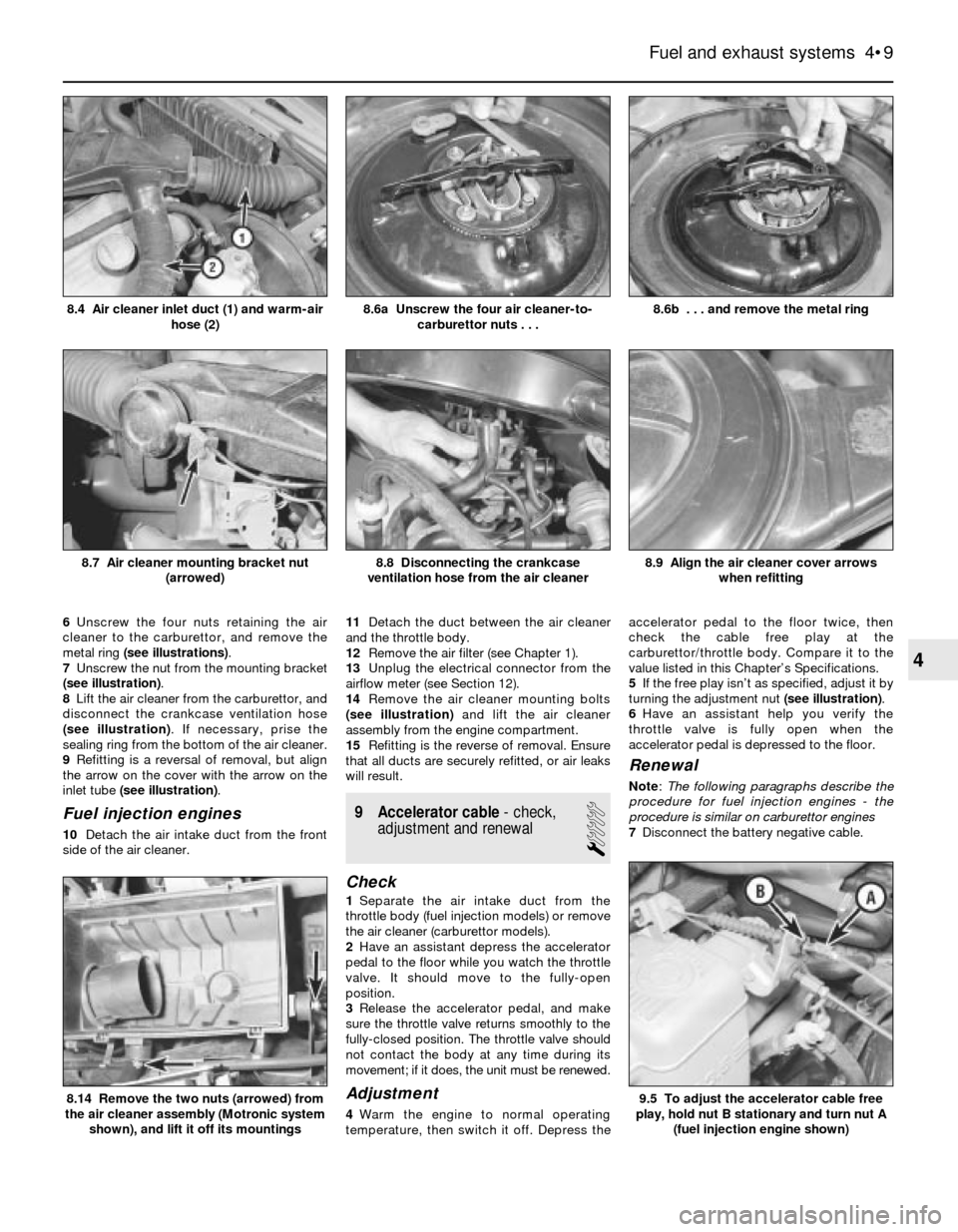
6Unscrew the four nuts retaining the air
cleaner to the carburettor, and remove the
metal ring (see illustrations).
7Unscrew the nut from the mounting bracket
(see illustration).
8Lift the air cleaner from the carburettor, and
disconnect the crankcase ventilation hose
(see illustration). If necessary, prise the
sealing ring from the bottom of the air cleaner.
9Refitting is a reversal of removal, but align
the arrow on the cover with the arrow on the
inlet tube (see illustration).
Fuel injection engines
10Detach the air intake duct from the front
side of the air cleaner.11Detach the duct between the air cleaner
and the throttle body.
12Remove the air filter (see Chapter 1).
13Unplug the electrical connector from the
airflow meter (see Section 12).
14Remove the air cleaner mounting bolts
(see illustration)and lift the air cleaner
assembly from the engine compartment.
15Refitting is the reverse of removal. Ensure
that all ducts are securely refitted, or air leaks
will result.
9 Accelerator cable- check,
adjustment and renewal
1
Check
1Separate the air intake duct from the
throttle body (fuel injection models) or remove
the air cleaner (carburettor models).
2Have an assistant depress the accelerator
pedal to the floor while you watch the throttle
valve. It should move to the fully-open
position.
3Release the accelerator pedal, and make
sure the throttle valve returns smoothly to the
fully-closed position. The throttle valve should
not contact the body at any time during its
movement; if it does, the unit must be renewed.
Adjustment
4Warm the engine to normal operating
temperature, then switch it off. Depress theaccelerator pedal to the floor twice, then
check the cable free play at the
carburettor/throttle body. Compare it to the
value listed in this Chapter’s Specifications.
5If the free play isn’t as specified, adjust it by
turning the adjustment nut (see illustration).
6Have an assistant help you verify the
throttle valve is fully open when the
accelerator pedal is depressed to the floor.
Renewal
Note:The following paragraphs describe the
procedure for fuel injection engines - the
procedure is similar on carburettor engines
7Disconnect the battery negative cable.
Fuel and exhaust systems 4•9
8.6b . . . and remove the metal ring8.6a Unscrew the four air cleaner-to-
carburettor nuts . . .8.4 Air cleaner inlet duct (1) and warm-air
hose (2)
9.5 To adjust the accelerator cable free
play, hold nut B stationary and turn nut A
(fuel injection engine shown)8.14 Remove the two nuts (arrowed) from
the air cleaner assembly (Motronic system
shown), and lift it off its mountings
8.8 Disconnecting the crankcase
ventilation hose from the air cleaner8.7 Air cleaner mounting bracket nut
(arrowed)8.9 Align the air cleaner cover arrows
when refitting
4
Page 99 of 228
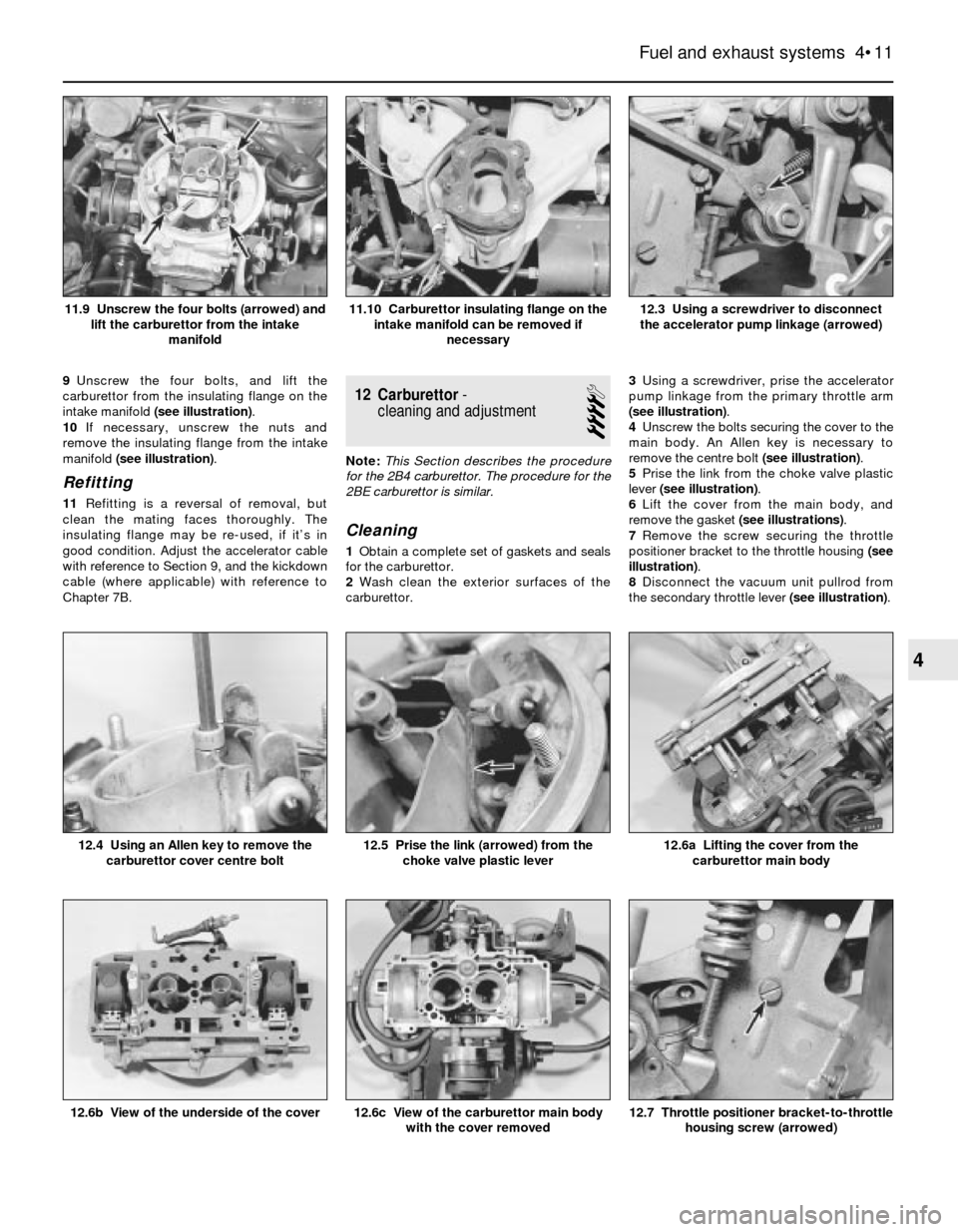
9Unscrew the four bolts, and lift the
carburettor from the insulating flange on the
intake manifold (see illustration).
10If necessary, unscrew the nuts and
remove the insulating flange from the intake
manifold (see illustration).
Refitting
11Refitting is a reversal of removal, but
clean the mating faces thoroughly. The
insulating flange may be re-used, if it’s in
good condition. Adjust the accelerator cable
with reference to Section 9, and the kickdown
cable (where applicable) with reference to
Chapter 7B.
12 Carburettor-
cleaning and adjustment
4
Note:This Section describes the procedure
for the 2B4 carburettor. The procedure for the
2BE carburettor is similar.
Cleaning
1Obtain a complete set of gaskets and seals
for the carburettor.
2Wash clean the exterior surfaces of the
carburettor.3Using a screwdriver, prise the accelerator
pump linkage from the primary throttle arm
(see illustration).
4Unscrew the bolts securing the cover to the
main body. An Allen key is necessary to
remove the centre bolt (see illustration).
5Prise the link from the choke valve plastic
lever (see illustration).
6Lift the cover from the main body, and
remove the gasket (see illustrations).
7Remove the screw securing the throttle
positioner bracket to the throttle housing (see
illustration).
8Disconnect the vacuum unit pullrod from
the secondary throttle lever (see illustration).
Fuel and exhaust systems 4•11
12.3 Using a screwdriver to disconnect
the accelerator pump linkage (arrowed)11.10 Carburettor insulating flange on the
intake manifold can be removed if
necessary11.9 Unscrew the four bolts (arrowed) and
lift the carburettor from the intake
manifold
12.7 Throttle positioner bracket-to-throttle
housing screw (arrowed)12.6c View of the carburettor main body
with the cover removed12.6b View of the underside of the cover
12.6a Lifting the cover from the
carburettor main body12.5 Prise the link (arrowed) from the
choke valve plastic lever12.4 Using an Allen key to remove the
carburettor cover centre bolt
4
Page 100 of 228
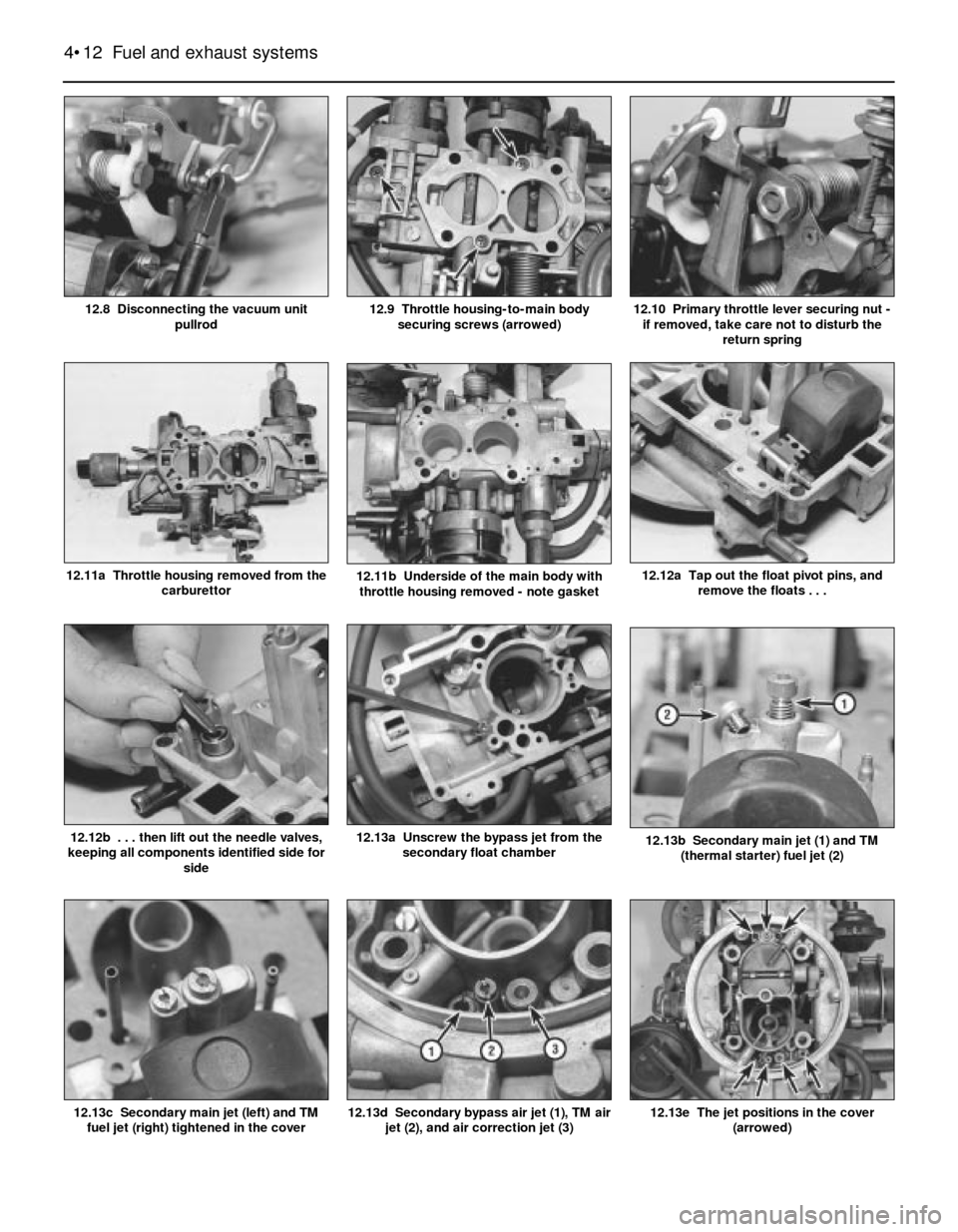
12.13e The jet positions in the cover
(arrowed)
4•12 Fuel and exhaust systems
12.13d Secondary bypass air jet (1), TM air
jet (2), and air correction jet (3)12.13c Secondary main jet (left) and TM
fuel jet (right) tightened in the cover
12.13b Secondary main jet (1) and TM
(thermal starter) fuel jet (2)12.13a Unscrew the bypass jet from the
secondary float chamber12.12b . . . then lift out the needle valves,
keeping all components identified side for
side
12.12a Tap out the float pivot pins, and
remove the floats . . .12.11a Throttle housing removed from the
carburettor12.11b Underside of the main body with
throttle housing removed - note gasket
12.10 Primary throttle lever securing nut -
if removed, take care not to disturb the
return spring12.9 Throttle housing-to-main body
securing screws (arrowed)12.8 Disconnecting the vacuum unit
pullrod