Settings BMW 5 SERIES 1991 E34 Workshop Manual
[x] Cancel search | Manufacturer: BMW, Model Year: 1991, Model line: 5 SERIES, Model: BMW 5 SERIES 1991 E34Pages: 228, PDF Size: 7.04 MB
Page 13 of 228

Tyre pressures (cold) - bars (psi)Front Rear
3-Series, E30
316 . . . . . . . . . . . . . . . . . . . . . . . . . . . . . . . . . . . . . . . . . . . . . . . . . . . 1.9 (28) 2.1 (30)
316i
Saloon . . . . . . . . . . . . . . . . . . . . . . . . . . . . . . . . . . . . . . . . . . . . . . . 2.0 (29) 2.1 (30)
Estate . . . . . . . . . . . . . . . . . . . . . . . . . . . . . . . . . . . . . . . . . . . . . . . 2.0 (29) 2.2 (32)
318i . . . . . . . . . . . . . . . . . . . . . . . . . . . . . . . . . . . . . . . . . . . . . . . . . . . 1.8 (26) 1.9 (28)
320i . . . . . . . . . . . . . . . . . . . . . . . . . . . . . . . . . . . . . . . . . . . . . . . . . . . 1.9 (28) 2.0 (29)
325i . . . . . . . . . . . . . . . . . . . . . . . . . . . . . . . . . . . . . . . . . . . . . . . . . . . 2.2 (32) 2.3 (33)
5-Series, E28 (“old-shape”)
518 and 518i . . . . . . . . . . . . . . . . . . . . . . . . . . . . . . . . . . . . . . . . . . . . 2.0 (29) 2.0 (29)
525i and 528i . . . . . . . . . . . . . . . . . . . . . . . . . . . . . . . . . . . . . . . . . . . 2.2 (32) 2.2 (32)
535i and M535i . . . . . . . . . . . . . . . . . . . . . . . . . . . . . . . . . . . . . . . . . . 2.3 (33) 2.5 (36)
5-Series, E34 (“new-shape”)
518i . . . . . . . . . . . . . . . . . . . . . . . . . . . . . . . . . . . . . . . . . . . . . . . . . . . 2.0 (29) 2.0 (29)
520i . . . . . . . . . . . . . . . . . . . . . . . . . . . . . . . . . . . . . . . . . . . . . . . . . . . 2.2 (32) 2.1 (30)
525i, 530i and 535i . . . . . . . . . . . . . . . . . . . . . . . . . . . . . . . . . . . . . . . 2.0 (29) 2.3 (33)
Torque wrench settingsNm
Automatic transmission sump bolts
Three-speed . . . . . . . . . . . . . . . . . . . . . . . . . . . . . . . . . . . . . . . . . . . . 8 to 9
Four-speed . . . . . . . . . . . . . . . . . . . . . . . . . . . . . . . . . . . . . . . . . . . . . 5 to 7
Spark plugs
M10 engines . . . . . . . . . . . . . . . . . . . . . . . . . . . . . . . . . . . . . . . . . . . . 20 to 30
Except M10 engines . . . . . . . . . . . . . . . . . . . . . . . . . . . . . . . . . . . . . . 30 to 33
Oxygen sensor . . . . . . . . . . . . . . . . . . . . . . . . . . . . . . . . . . . . . . . . . . . . 30 to 33
Wheel bolts . . . . . . . . . . . . . . . . . . . . . . . . . . . . . . . . . . . . . . . . . . . . . . . 100
Lubricants and fluids
Component or system Lubricant type/specification
Engine . . . . . . . . . . . . . . . . . . . . . . . . . . . . . . . . . . . . . . . . . . . . . . . . . . Multigrade engine oil, viscositySAE 10W/40 to 20W/50, to API SG
Cooling system . . . . . . . . . . . . . . . . . . . . . . . . . . . . . . . . . . . . . . . . . . . Ethylene glycol-based antifreeze with corrosion inhibitors
Manual transmission* . . . . . . . . . . . . . . . . . . . . . . . . . . . . . . . . . . . . . . Gear oil, viscosity SAE 80 to API-GL4, or single-grade mineral-based
engine oil, viscosity SAE 20, 30 or 40 to API-SG
Automatic transmission . . . . . . . . . . . . . . . . . . . . . . . . . . . . . . . . . . . . Dexron ll type ATF
Final drive . . . . . . . . . . . . . . . . . . . . . . . . . . . . . . . . . . . . . . . . . . . . . . . BMW-approved hypoid gear oil, viscosity SAE 90**
Brake and clutch hydraulic systems . . . . . . . . . . . . . . . . . . . . . . . . . . Hydraulic brake fluid to SAE J 1703 or DOT 4
Power steering . . . . . . . . . . . . . . . . . . . . . . . . . . . . . . . . . . . . . . . . . . . Dexron ll type ATF
* E34 520i & 525i with air conditioning, E34 530i & 535i - Dexron II type ATF)
** Only available in bulk; refer to your BMW dealer
Capacities*
1•3
1
Engine oil
M10 engines . . . . . . . . . . . . . . . . . . . . . . . . . . . . . . 4.0 litres
M20 engines . . . . . . . . . . . . . . . . . . . . . . . . . . . . . . 4.3 litres
M30 engines . . . . . . . . . . . . . . . . . . . . . . . . . . . . . . 5.8 litres
M40 engines . . . . . . . . . . . . . . . . . . . . . . . . . . . . . . 4.0 litres
Cooling system
M10 engines . . . . . . . . . . . . . . . . . . . . . . . . . . . . . . 7.0 litres
M20 engines . . . . . . . . . . . . . . . . . . . . . . . . . . . . . . 10.5 litres
M30 engines . . . . . . . . . . . . . . . . . . . . . . . . . . . . . . 12.0 litres
M40 engines . . . . . . . . . . . . . . . . . . . . . . . . . . . . . . 7.0 litres
Fuel tank
3-Series, E30
Saloon . . . . . . . . . . . . . . . . . . . . . . . . . . . . . . . . 55 litres (early),
64 litres (later)
Estate . . . . . . . . . . . . . . . . . . . . . . . . . . . . . . . . . 63 litres (early),
70 litres (later)
5-Series
E28 (“old-shape”) . . . . . . . . . . . . . . . . . . . . . . . . 70 litres
E34 (“new-shape”) . . . . . . . . . . . . . . . . . . . . . . . 81 litresManual transmission
ZF . . . . . . . . . . . . . . . . . . . . . . . . . . . . . . . . . . . . . . 1.2 litres
Getrag . . . . . . . . . . . . . . . . . . . . . . . . . . . . . . . . . . 1.0 to 1.5 litres
Automatic transmission (refill)
3-speed . . . . . . . . . . . . . . . . . . . . . . . . . . . . . . . . . 2.0 litres
4-speed . . . . . . . . . . . . . . . . . . . . . . . . . . . . . . . . . 3.0 litres
Final drive capacity (drain and refill)
3-Series, E30 . . . . . . . . . . . . . . . . . . . . . . . . . . . . . 0.9 litres
5-Series, E28 (“old-shape”) . . . . . . . . . . . . . . . . . . 0.9 litres
5-Series, E34 (“new-shape”) . . . . . . . . . . . . . . . . . 1.7 litres
*All capacities approximate
Servicing Specifications
Page 38 of 228

Torque wrench settingsNm
Timing chain tensioner plug . . . . . . . . . . . . . . . . . . . . . . . . . . . . . . . . . . 35
Timing belt tensioner bolts . . . . . . . . . . . . . . . . . . . . . . . . . . . . . . . . . . . 22
Camshaft sprocket-to-camshaft bolt
M10 and M30 engines . . . . . . . . . . . . . . . . . . . . . . . . . . . . . . . . . . . . 10
M20 and M40 engines . . . . . . . . . . . . . . . . . . . . . . . . . . . . . . . . . . . . 65
Flange to camshaft (M30 engine) . . . . . . . . . . . . . . . . . . . . . . . . . . . . 145
Timing chain or belt covers-to-engine
M6 bolts . . . . . . . . . . . . . . . . . . . . . . . . . . . . . . . . . . . . . . . . . . . . . . . 10
M8 bolts . . . . . . . . . . . . . . . . . . . . . . . . . . . . . . . . . . . . . . . . . . . . . . . 22
M10 (bolt size) bolts . . . . . . . . . . . . . . . . . . . . . . . . . . . . . . . . . . . . . . 47
Crankshaft pulley bolts . . . . . . . . . . . . . . . . . . . . . . . . . . . . . . . . . . . . . . 22
Crankshaft hub bolt or nut
M10 engine . . . . . . . . . . . . . . . . . . . . . . . . . . . . . . . . . . . . . . . . . . . . . 190
M20 engine . . . . . . . . . . . . . . . . . . . . . . . . . . . . . . . . . . . . . . . . . . . . . 410
M30 engine . . . . . . . . . . . . . . . . . . . . . . . . . . . . . . . . . . . . . . . . . . . . . 440
M40 engine . . . . . . . . . . . . . . . . . . . . . . . . . . . . . . . . . . . . . . . . . . . . . 310
Cylinder head bolts*
M10 four-cylinder engine
Stage 1 . . . . . . . . . . . . . . . . . . . . . . . . . . . . . . . . . . . . . . . . . . . . . . 60
Stage 2 (wait 15 minutes) . . . . . . . . . . . . . . . . . . . . . . . . . . . . . . . . Angle-tighten an additional 33°
Stage 3 (engine at normal operating temperature) . . . . . . . . . . . . . Angle-tighten an additional 25°
M20 six-cylinder engine with hex-head bolts
Stage 1 . . . . . . . . . . . . . . . . . . . . . . . . . . . . . . . . . . . . . . . . . . . . . . 40
Stage 2 (wait 15 minutes) . . . . . . . . . . . . . . . . . . . . . . . . . . . . . . . . 60
Stage 3 (engine at normal operating temperature) . . . . . . . . . . . . . Angle-tighten an additional 25°
M20 six-cylinder engine with Torx-head bolts
Stage 1 . . . . . . . . . . . . . . . . . . . . . . . . . . . . . . . . . . . . . . . . . . . . . . 30
Stage 2 . . . . . . . . . . . . . . . . . . . . . . . . . . . . . . . . . . . . . . . . . . . . . . Angle-tighten an additional 90°
Stage 3 . . . . . . . . . . . . . . . . . . . . . . . . . . . . . . . . . . . . . . . . . . . . . . Angle-tighten an additional 90°
M30 six-cylinder engine (up to and including 1987 model year)
Stage 1 . . . . . . . . . . . . . . . . . . . . . . . . . . . . . . . . . . . . . . . . . . . . . . 60
Stage 2 (wait 15 minutes) . . . . . . . . . . . . . . . . . . . . . . . . . . . . . . . . Angle-tighten an additional 33°
Stage 3 (engine at normal operating temperature) . . . . . . . . . . . . . Angle-tighten an additional 33°
M30 six-cylinder engine (from 1988 model year)
Stage 1 . . . . . . . . . . . . . . . . . . . . . . . . . . . . . . . . . . . . . . . . . . . . . . 60
Stage 2 (wait 20 minutes) . . . . . . . . . . . . . . . . . . . . . . . . . . . . . . . . 80
Stage 3 (engine at normal operating temperature) . . . . . . . . . . . . . Angle-tighten an additional 35°
M40 four-cylinder engine
Stage 1 . . . . . . . . . . . . . . . . . . . . . . . . . . . . . . . . . . . . . . . . . . . . . . 30
Stage 2 . . . . . . . . . . . . . . . . . . . . . . . . . . . . . . . . . . . . . . . . . . . . . . Angle-tighten an additional 90°
Stage 3 . . . . . . . . . . . . . . . . . . . . . . . . . . . . . . . . . . . . . . . . . . . . . . Angle-tighten an additional 90°
Intake manifold-to-cylinder head bolts
M8 bolt . . . . . . . . . . . . . . . . . . . . . . . . . . . . . . . . . . . . . . . . . . . . . . . . 22
M7 bolt . . . . . . . . . . . . . . . . . . . . . . . . . . . . . . . . . . . . . . . . . . . . . . . . 15
M6 bolt . . . . . . . . . . . . . . . . . . . . . . . . . . . . . . . . . . . . . . . . . . . . . . . . 10
Exhaust manifold-to-cylinder head nuts
M6 nut . . . . . . . . . . . . . . . . . . . . . . . . . . . . . . . . . . . . . . . . . . . . . . . . . 10
M7 nut . . . . . . . . . . . . . . . . . . . . . . . . . . . . . . . . . . . . . . . . . . . . . . . . . 15
Flywheel/driveplate bolts
Manual transmission . . . . . . . . . . . . . . . . . . . . . . . . . . . . . . . . . . . . . . 105
Automatic transmission . . . . . . . . . . . . . . . . . . . . . . . . . . . . . . . . . . . 120
Intermediate shaft sprocket bolt (M20 engines) . . . . . . . . . . . . . . . . . . . 60
Sump-to-block bolts . . . . . . . . . . . . . . . . . . . . . . . . . . . . . . . . . . . . . . . . 9 to 11
Oil pump bolts (except M40 engines) . . . . . . . . . . . . . . . . . . . . . . . . . . . 22
Oil pump sprocket bolts (M10 and M30 engines) . . . . . . . . . . . . . . . . . 10
Oil pump cover plate-to-engine front end cover (M40 engines) . . . . . . . 9
Front end cover-to-engine bolts (M20 and M40 engines)
M6 bolts . . . . . . . . . . . . . . . . . . . . . . . . . . . . . . . . . . . . . . . . . . . . . . . 10
M8 bolts . . . . . . . . . . . . . . . . . . . . . . . . . . . . . . . . . . . . . . . . . . . . . . . 22
Crankshaft rear oil seal retainer-to-block bolts
M6 bolts . . . . . . . . . . . . . . . . . . . . . . . . . . . . . . . . . . . . . . . . . . . . . . . 9
M8 bolts . . . . . . . . . . . . . . . . . . . . . . . . . . . . . . . . . . . . . . . . . . . . . . . 22
* BMW recommend that the cylinder head bolts are renewed as a matter of course.
2A•2 In-car engine repair procedures
Page 54 of 228
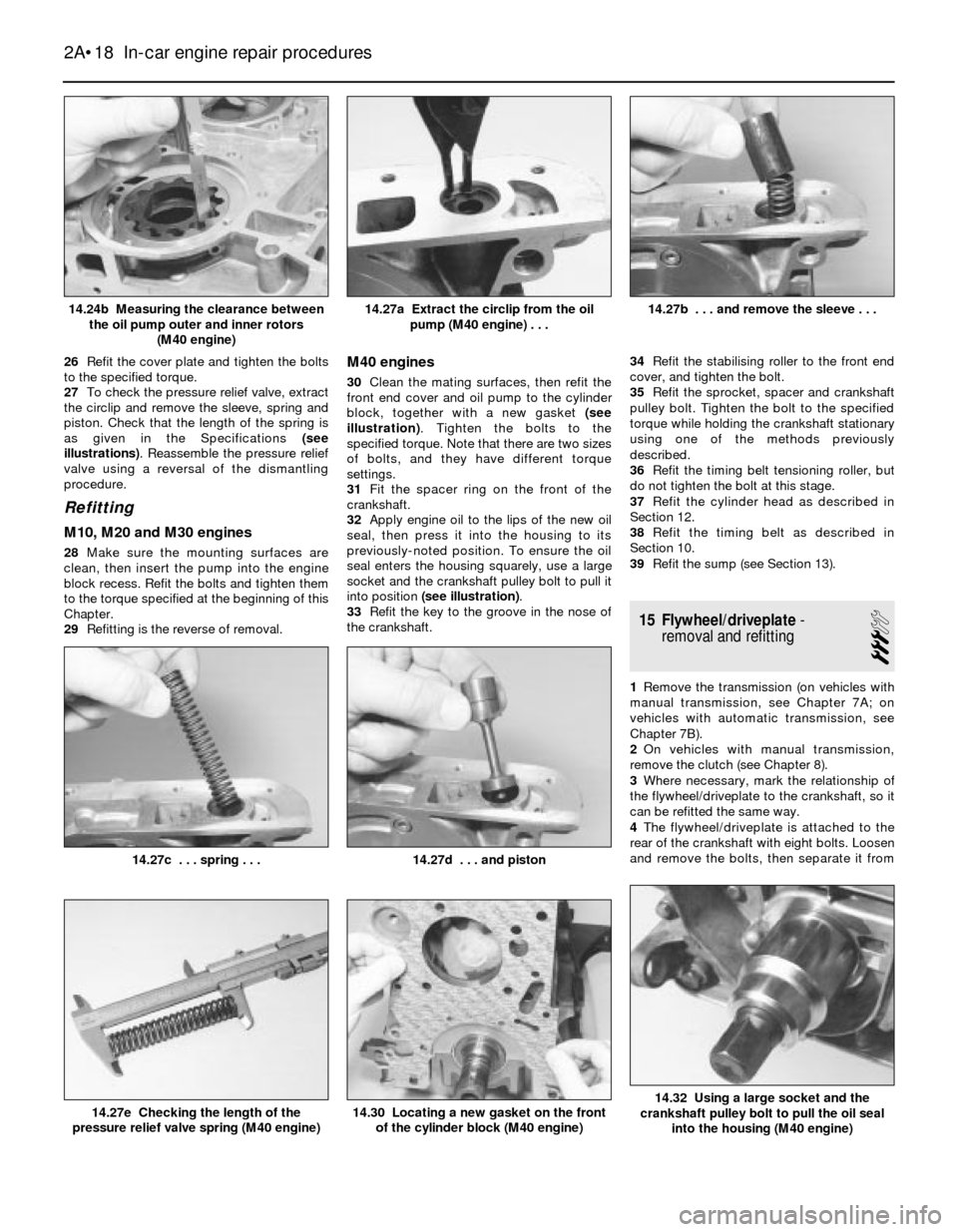
26Refit the cover plate and tighten the bolts
to the specified torque.
27To check the pressure relief valve, extract
the circlip and remove the sleeve, spring and
piston. Check that the length of the spring is
as given in the Specifications (see
illustrations). Reassemble the pressure relief
valve using a reversal of the dismantling
procedure.
Refitting
M10, M20 and M30 engines
28Make sure the mounting surfaces are
clean, then insert the pump into the engine
block recess. Refit the bolts and tighten them
to the torque specified at the beginning of this
Chapter.
29Refitting is the reverse of removal.
M40 engines
30Clean the mating surfaces, then refit the
front end cover and oil pump to the cylinder
block, together with a new gasket (see
illustration). Tighten the bolts to the
specified torque. Note that there are two sizes
of bolts, and they have different torque
settings.
31Fit the spacer ring on the front of the
crankshaft.
32Apply engine oil to the lips of the new oil
seal, then press it into the housing to its
previously-noted position. To ensure the oil
seal enters the housing squarely, use a large
socket and the crankshaft pulley bolt to pull it
into position (see illustration).
33Refit the key to the groove in the nose of
the crankshaft.34Refit the stabilising roller to the front end
cover, and tighten the bolt.
35Refit the sprocket, spacer and crankshaft
pulley bolt. Tighten the bolt to the specified
torque while holding the crankshaft stationary
using one of the methods previously
described.
36Refit the timing belt tensioning roller, but
do not tighten the bolt at this stage.
37Refit the cylinder head as described in
Section 12.
38Refit the timing belt as described in
Section 10.
39Refit the sump (see Section 13).
15 Flywheel/driveplate-
removal and refitting
3
1Remove the transmission (on vehicles with
manual transmission, see Chapter 7A; on
vehicles with automatic transmission, see
Chapter 7B).
2On vehicles with manual transmission,
remove the clutch (see Chapter 8).
3Where necessary, mark the relationship of
the flywheel/driveplate to the crankshaft, so it
can be refitted the same way.
4The flywheel/driveplate is attached to the
rear of the crankshaft with eight bolts. Loosen
and remove the bolts, then separate it from
2A•18 In-car engine repair procedures
14.32 Using a large socket and the
crankshaft pulley bolt to pull the oil seal
into the housing (M40 engine)14.30 Locating a new gasket on the front
of the cylinder block (M40 engine)14.27e Checking the length of the
pressure relief valve spring (M40 engine)
14.27d . . . and piston14.27c . . . spring . . .
14.27b . . . and remove the sleeve . . .14.27a Extract the circlip from the oil
pump (M40 engine) . . .14.24b Measuring the clearance between
the oil pump outer and inner rotors
(M40 engine)
Page 59 of 228

Pistons and piston rings
Piston diameter (standard)
M10 engines . . . . . . . . . . . . . . . . . . . . . . . . . . . . . . . . . . . . . . . . . . . . 88.97 mm
M20 engines
B20 . . . . . . . . . . . . . . . . . . . . . . . . . . . . . . . . . . . . . . . . . . . . . . . . . 79.98 mm
B25 . . . . . . . . . . . . . . . . . . . . . . . . . . . . . . . . . . . . . . . . . . . . . . . . . 83.98 mm
M30 engines
B30M
Alcan . . . . . . . . . . . . . . . . . . . . . . . . . . . . . . . . . . . . . . . . . . . . . . 88.970 mm
KS . . . . . . . . . . . . . . . . . . . . . . . . . . . . . . . . . . . . . . . . . . . . . . . . 88.980 mm
B35M
Alcan . . . . . . . . . . . . . . . . . . . . . . . . . . . . . . . . . . . . . . . . . . . . . . 91.972 mm
Mahle . . . . . . . . . . . . . . . . . . . . . . . . . . . . . . . . . . . . . . . . . . . . . . 91.980 mm
M40 engines
Factory stage 0 . . . . . . . . . . . . . . . . . . . . . . . . . . . . . . . . . . . . . . . . 83.985 mm
Factory stage 00 . . . . . . . . . . . . . . . . . . . . . . . . . . . . . . . . . . . . . . . 84.065 mm
Piston-to-cylinder wall clearance
New
M10 and M30 engines . . . . . . . . . . . . . . . . . . . . . . . . . . . . . . . . . . 0.02 to 0.05 mm
M20 and M40 engines . . . . . . . . . . . . . . . . . . . . . . . . . . . . . . . . . . 0.01 to 0.04 mm
Service limit
Except B25 engine . . . . . . . . . . . . . . . . . . . . . . . . . . . . . . . . . . . . . 0.15 mm
B25 engine . . . . . . . . . . . . . . . . . . . . . . . . . . . . . . . . . . . . . . . . . . . 0.12 mm
Piston ring end gap
M10 engine
Top compression ring . . . . . . . . . . . . . . . . . . . . . . . . . . . . . . . . . . . 0.30 to 0.70 mm
Second compression ring . . . . . . . . . . . . . . . . . . . . . . . . . . . . . . . . 0.20 to 0.40 mm
Oil ring . . . . . . . . . . . . . . . . . . . . . . . . . . . . . . . . . . . . . . . . . . . . . . . 0.25 to 0.50 mm
M20 engine
All rings . . . . . . . . . . . . . . . . . . . . . . . . . . . . . . . . . . . . . . . . . . . . . . 0.20 to 0.50 mm
M30 engine
Top compression ring . . . . . . . . . . . . . . . . . . . . . . . . . . . . . . . . . . . 0.20 to 0.45 mm
Second compression ring . . . . . . . . . . . . . . . . . . . . . . . . . . . . . . . . 0.40 to 0.65 mm
Oil ring . . . . . . . . . . . . . . . . . . . . . . . . . . . . . . . . . . . . . . . . . . . . . . . 0.30 to 0.60 mm
M40 engine
Top compression ring . . . . . . . . . . . . . . . . . . . . . . . . . . . . . . . . . . . 0.20 to 1.00 mm
Second compression ring . . . . . . . . . . . . . . . . . . . . . . . . . . . . . . . . 0.20 to 1.00 mm
Oil ring
B16 engine . . . . . . . . . . . . . . . . . . . . . . . . . . . . . . . . . . . . . . . . . 0.20 to 1.00 mm
B18 engine . . . . . . . . . . . . . . . . . . . . . . . . . . . . . . . . . . . . . . . . . 0.40 to 1.40 mm
Piston ring side clearance
M10 engine
Top compression ring . . . . . . . . . . . . . . . . . . . . . . . . . . . . . . . . . . . 0.06 to 0.09 mm
Second compression ring . . . . . . . . . . . . . . . . . . . . . . . . . . . . . . . . 0.03 to 0.072 mm
Oil ring . . . . . . . . . . . . . . . . . . . . . . . . . . . . . . . . . . . . . . . . . . . . . . . 0.02 to 0.06 mm
M20 engine
Top compression ring . . . . . . . . . . . . . . . . . . . . . . . . . . . . . . . . . . . 0.04 to 0.08 mm
Second compression ring . . . . . . . . . . . . . . . . . . . . . . . . . . . . . . . . 0.03 to 0.07 mm
Oil ring . . . . . . . . . . . . . . . . . . . . . . . . . . . . . . . . . . . . . . . . . . . . . . . 0.02 to 0.05 mm
M30 engine
Top compression ring . . . . . . . . . . . . . . . . . . . . . . . . . . . . . . . . . . . 0.04 to 0.072 mm
Second compression ring . . . . . . . . . . . . . . . . . . . . . . . . . . . . . . . . 0.03 to 0.062 mm
Oil ring . . . . . . . . . . . . . . . . . . . . . . . . . . . . . . . . . . . . . . . . . . . . . . . 0.02 to 0.055 mm
M40 engine
Top compression ring . . . . . . . . . . . . . . . . . . . . . . . . . . . . . . . . . . . 0.02 to 0.20 mm
Second compression ring . . . . . . . . . . . . . . . . . . . . . . . . . . . . . . . . 0.02 to 0.10 mm
Oil ring
B16 engine . . . . . . . . . . . . . . . . . . . . . . . . . . . . . . . . . . . . . . . . . 0.02 to 0.10 mm
B18 engine . . . . . . . . . . . . . . . . . . . . . . . . . . . . . . . . . . . . . . . . . Not measured
Torque wrench settingsNm
Main bearing cap-to-engine block bolts*
M10, M20 and M30 engines . . . . . . . . . . . . . . . . . . . . . . . . . . . . . . . . 60
M40 engines
Stage 1 . . . . . . . . . . . . . . . . . . . . . . . . . . . . . . . . . . . . . . . . . . . . . . . . 20
Stage 2 . . . . . . . . . . . . . . . . . . . . . . . . . . . . . . . . . . . . . . . . . . . . . . . . Angle-tighten an additional 50°
General engine overhaul procedures 2B•3
2B
Page 60 of 228
Torque wrench settings (continued)Nm
Connecting rod cap bolts/nuts
M10 and M30 engines . . . . . . . . . . . . . . . . . . . . . . . . . . . . . . . . . . . . 55
M20 and M40 engines
Stage 1 . . . . . . . . . . . . . . . . . . . . . . . . . . . . . . . . . . . . . . . . . . . . . . 20
Stage 2 . . . . . . . . . . . . . . . . . . . . . . . . . . . . . . . . . . . . . . . . . . . . . . Angle-tighten an additional 70°
Camshaft bearing caps (M40 engine) . . . . . . . . . . . . . . . . . . . . . . . . . . . 10
Intermediate shaft sprocket-to-shaft bolt (M20 engine) . . . . . . . . . . . . . 60
Oil supply tube bolt(s)
M6 (normal) and M8 (banjo) . . . . . . . . . . . . . . . . . . . . . . . . . . . . . . . . 10
M5 . . . . . . . . . . . . . . . . . . . . . . . . . . . . . . . . . . . . . . . . . . . . . . . . . . 5
* BMW recommend that the main bearing bolts are renewed as a matter of course.
2B•4 General engine overhaul procedures
1 General information
Included in this Part of Chapter 2 are the
general overhaul procedures for the cylinder
head and engine internal components.
The information ranges from advice
concerning preparation for an overhaul and
the purchase of new parts to detailed,
paragraph-by-paragraph procedures covering
removal and refitting of internal components
and the inspection of parts.
The following Sections have been written
based on the assumption that the engine has
been removed from the vehicle. For
information concerning in-vehicle engine
repair, as well as removal and refitting of the
external components necessary for the
overhaul, see Chapter 2A, and Section 7 of
this Part.
The Specifications included in this Part are
only those necessary for the inspection and
overhaul procedures which follow. Refer to
Part A for additional Specifications.
2 Engine overhaul-
general information
It’s not always easy to determine when, or
if, an engine should be completely
overhauled, as a number of factors must be
considered.
High mileage is not necessarily an
indication that an overhaul is needed, while
low mileage doesn’t preclude the need for an
overhaul. Frequency of servicing is probably
the most important consideration. An engine
that’s had regular and frequent oil and filter
changes, as well as other required
maintenance, will most likely give many
thousands of miles of reliable service.
Conversely, a neglected engine may require
an overhaul very early in its life.
Excessive oil consumption is an indication
that piston rings, valve seals and/or valve
guides are in need of attention. Make sure
that oil leaks aren’t responsible before
deciding that the rings and/or guides are
worn. Perform a cylinder compression check
to determine the extent of the work required
(see Section 3).Check the oil pressure: Unscrew the oil
pressure sender unit, and connect an oil
pressure gauge in its place. Measure the oil
pressure with the engine at its normal
operating temperature. Compare your
readings to the oil pressures listed in this
Chapter’s Specifications. If the readings are
significantly below these (and if the oil and oil
filter are in good condition), the crankshaft
bearings and/or the oil pump are probably
worn out. On M10 and M30 engines, the oil
pressure sender unit is located high on the left
rear of the cylinder head. On M20 engines, the
sender unit is threaded into the side of the
engine block, below the oil filter. On M40
engines, the sender unit is threaded into the
rear of the oil filter housing.
Loss of power, rough running, knocking or
metallic engine noises, excessive valve train
noise and high fuel consumption may also
point to the need for an overhaul, especially if
they’re all present at the same time. If a
complete tune-up doesn’t remedy the
situation, major mechanical work is the only
solution.
An engine overhaul involves restoring the
internal parts to the specifications of a new
engine. During an overhaul, new piston rings
are fitted and the cylinder walls are
reconditioned (rebored and/or honed). If a
rebore is done by an engineering works, new
oversize pistons will also be fitted. The main
bearings and connecting big-end bearings are
generally renewed and, if necessary, the
crankshaft may be reground to restore the
journals. Generally, the valves are serviced as
well, since they’re usually in less-than-perfect
condition at this point. While the engine is
being overhauled, other components, such as
the distributor, starter and alternator, can be
rebuilt as well. The end result should be a like-
new engine that will give many thousands of
trouble-free miles. Note: Critical cooling
system components such as the hoses,
drivebelts, thermostat and water pump MUST
be renewed when an engine is overhauled.
The radiator should be checked carefully, to
ensure that it isn’t clogged or leaking (see
Chapters 1 or 3). Also, we don’t recommend
overhauling the oil pump - always fit a new
one when an engine is rebuilt.
Before beginning the engine overhaul, read
through the entire procedure to familiarise
yourself with the scope and requirements ofthe job. Overhauling an engine isn’t difficult if
you follow all of the instructions carefully,
have the necessary tools and equipment and
pay close attention to all specifications;
however, it is time consuming. Plan on the
vehicle being tied up for a minimum of two
weeks, especially if parts must be taken to an
automotive machine shop for repair or recon-
ditioning. Check on availability of parts and
make sure that any necessary special tools
and equipment are obtained in advance. Most
work can be done with typical hand tools,
although a number of precision measuring
tools are required for inspecting parts to
determine if they must be replaced. Often an
automotive machine shop will handle the
inspection of parts and offer advice
concerning reconditioning and renewal. Note:
Always wait until the engine has been
completely disassembled and all components,
especially the engine block, have been
inspected before deciding what service and
repair operations must be performed by an
automotive machine shop. Since the block’s
condition will be the major factor to consider
when determining whether to overhaul the
original engine or buy a rebuilt one, never
purchase parts or have machine work done on
other components until the block has been
thoroughly inspected. As a general rule, time
is the primary cost of an overhaul, so it doesn’t
pay to refit worn or substandard parts.
As a final note, to ensure maximum life and
minimum trouble from a rebuilt engine,
everything must be assembled with care, in a
spotlessly-clean environment.
3 Compression check
2
1A compression check will tell you what
mechanical condition the upper end (pistons,
rings, valves, head gaskets) of your engine is
in. Specifically, it can tell you if the
compression is down due to leakage caused
by worn piston rings, defective valves and
seats, or a blown head gasket. Note:The
engine must be at normal operating
temperature, and the battery must be fully-
charged, for this check.
2Begin by cleaning the area around the
spark plugs before you remove them
(compressed air should be used, if available,
Page 79 of 228

3General
Coolant capacity . . . . . . . . . . . . . . . . . . . . . . . . . . . . . . . . . . . . . . . . . . . See Chapter 1
Thermostat rating
Opening temperature . . . . . . . . . . . . . . . . . . . . . . . . . . . . . . . . . . . . . 80°C (176°F)
Fully open at . . . . . . . . . . . . . . . . . . . . . . . . . . . . . . . . . . . . . . . . . . . . 100°C (212°F)
Cooling fan thermo-switch - switching temperatures
Low-speed . . . . . . . . . . . . . . . . . . . . . . . . . . . . . . . . . . . . . . . . . . . . . 91°C (196°F)
High-speed . . . . . . . . . . . . . . . . . . . . . . . . . . . . . . . . . . . . . . . . . . . . . 99°C (210°F)
Torque wrench settingsNm
Mechanical cooling fan clutch-to-water pump securing
nut (left-hand thread) . . . . . . . . . . . . . . . . . . . . . . . . . . . . . . . . . . . . 40
Mechanical cooling fan-to-clutch bolts . . . . . . . . . . . . . . . . . . . . . . . . . 10
Water pump bolts
Small bolts (M6) . . . . . . . . . . . . . . . . . . . . . . . . . . . . . . . . . . . . . . . . . 10
Large bolts (M8) . . . . . . . . . . . . . . . . . . . . . . . . . . . . . . . . . . . . . . . . . 22
Thermostat housing bolts . . . . . . . . . . . . . . . . . . . . . . . . . . . . . . . . . . . . 10
Chapter 3
Cooling, heating and air conditioning systems
Air conditioner receiver-drier - removal and refitting . . . . . . . . . . . . 16
Air conditioning blower motor (E28/”old-shape” 5-series
models) - removal and refitting . . . . . . . . . . . . . . . . . . . . . . . . . . . 14
Air conditioning compressor - removal and refitting . . . . . . . . . . . . . 13
Air conditioning condenser - removal and refitting . . . . . . . . . . . . . . 15
Air conditioning system - precautions and maintenance . . . . . . . . . 12
Antifreeze - general information . . . . . . . . . . . . . . . . . . . . . . . . . . . . 2
Coolant level check . . . . . . . . . . . . . . . . . . . . . . . . . . See Chapter 1
Coolant temperature sender unit - check and renewal . . . . . . . . . . . 8
Cooling system check . . . . . . . . . . . . . . . . . . . . . . . . See Chapter 1
Cooling system servicing (draining, flushing and refilling)See Chapter 1Engine cooling fan(s) and clutch - check, removal and refitting . . . . 5
Evaporator matrix - removal and refitting . . . . . . . . . . . . . . . . . . . . . 17
General information . . . . . . . . . . . . . . . . . . . . . . . . . . . . . . . . . . . . . . 1
Heater and air conditioner control assembly - removal and refitting 10
Heater and air conditioning blower motor - removal,testing and
refitting . . . . . . . . . . . . . . . . . . . . . . . . . . . . . . . . . . . . . . . . . . . . . . 9
Heater matrix - removal and refitting . . . . . . . . . . . . . . . . . . . . . . . . 11
Radiator - removal and refitting . . . . . . . . . . . . . . . . . . . . . . . . . . . . 4
Thermostat - check and renewal . . . . . . . . . . . . . . . . . . . . . . . . . . . 3
Water pump - check . . . . . . . . . . . . . . . . . . . . . . . . . . . . . . . . . . . . . 6
Water pump - removal and refitting . . . . . . . . . . . . . . . . . . . . . . . . . 7
3•1
Easy,suitable for
novice with little
experienceFairly easy,suitable
for beginner with
some experienceFairly difficult,
suitable for competent
DIY mechanic
Difficult,suitable for
experienced DIY
mechanicVery difficult,
suitable for expert
DIY or professional
Degrees of difficulty
Specifications Contents
1 General information
Engine cooling system
All vehicles covered by this manual employ
a pressurised engine cooling system, with
thermostatically-controlled coolant circulation.
An impeller-type water pump mounted on
the front of the block pumps coolant through
the engine. The coolant flows around each
cylinder, and towards the rear of the engine.
Cast-in coolant passages direct coolantaround the intake and exhaust ports, near the
spark plug areas, and in close proximity to the
exhaust valve guides.
A wax-pellet-type thermostat is located in-
line in the bottom hose on M10 engines, in a
housing near the front of the engine on M20
and M30 engines, or behind an elbow under
the timing belt upper cover (on the front of the
cylinder head) on M40 engines. During warm-
up, the closed thermostat prevents coolant
from circulating through the radiator. As the
engine nears normal operating temperature,
the thermostat opens and allows hot coolant
to travel through the radiator, where it’s
cooled before returning to the engine.The pressure in the system raises the
boiling point of the coolant, and increases the
cooling efficiency of the radiator. The cooling
system is sealed by a pressure-type cap. If
the system pressure exceeds the cap
pressure relief value, the excess pressure in
the system forces the spring-loaded valve
inside the cap off its seat, and allows the
coolant to escape through the overflow tube.
The pressure cap on four-cylinder models is
on the top of the radiator; on six-cylinder models,
it’s on top of a translucent plastic expansion
tank. The cap pressure rating is moulded into the
top of the cap. The pressure rating is either
1.0 bar (14 psi) or 1.2 bars (17 psi).
Page 90 of 228

Carburettor (Solex 2BE)
Main jet
Stage 1 . . . . . . . . . . . . . . . . . . . . . . . . . . . . . . . . . . . . . . . . . . . . . . . . X120
Stage 2 . . . . . . . . . . . . . . . . . . . . . . . . . . . . . . . . . . . . . . . . . . . . . . . . X110
Air correction jet
Stage 1 . . . . . . . . . . . . . . . . . . . . . . . . . . . . . . . . . . . . . . . . . . . . . . . . 140
Stage 2 . . . . . . . . . . . . . . . . . . . . . . . . . . . . . . . . . . . . . . . . . . . . . . . . 70
Venturi diameter
Stage 1 . . . . . . . . . . . . . . . . . . . . . . . . . . . . . . . . . . . . . . . . . . . . . . . . 24 mm
Stage 2 . . . . . . . . . . . . . . . . . . . . . . . . . . . . . . . . . . . . . . . . . . . . . . . . 28 mm
Idle fuel jet
Stage 1 . . . . . . . . . . . . . . . . . . . . . . . . . . . . . . . . . . . . . . . . . . . . . . . . 47.5 mm
Idle air jet
Stage 2 . . . . . . . . . . . . . . . . . . . . . . . . . . . . . . . . . . . . . . . . . . . . . . . . 180
Float needle valve diameter . . . . . . . . . . . . . . . . . . . . . . . . . . . . . . . . . . 2.0 mm
Throttle positioner coil resistance . . . . . . . . . . . . . . . . . . . . . . . . . . . . . . 0.97 to 1.63 ohms
Intake air temperature resistance
-10º C . . . . . . . . . . . . . . . . . . . . . . . . . . . . . . . . . . . . . . . . . . . . . . . . . 8200 to 10 500 ohms
20º C . . . . . . . . . . . . . . . . . . . . . . . . . . . . . . . . . . . . . . . . . . . . . . . . . . 2200 to 2700 ohms
80º C . . . . . . . . . . . . . . . . . . . . . . . . . . . . . . . . . . . . . . . . . . . . . . . . . . 300 to 360 ohms
Float level
Stage 1 float chamber . . . . . . . . . . . . . . . . . . . . . . . . . . . . . . . . . . . . 27.0 to 29.0 mm
Stage 2 float chamber . . . . . . . . . . . . . . . . . . . . . . . . . . . . . . . . . . . . 29.0 to 31.0 mm
Fuel pressure checks (carburettor engines)
Fuel pump delivery pressure (engine idling) . . . . . . . . . . . . . . . . . . . . . . 0.1 to 0.3 bars
Fuel pressure checks (fuel injection engines)
Fuel system pressure (relative to intake manifold pressure)
3-Series (E30)
316i with M40/B16 engine . . . . . . . . . . . . . . . . . . . . . . . . . . . . . . . 3.0 ± 0.06 bars
318i with M10/B18 engine . . . . . . . . . . . . . . . . . . . . . . . . . . . . . . . 2.5 to 3.0 bars
318i with M40/B18 engine . . . . . . . . . . . . . . . . . . . . . . . . . . . . . . . 3.0 ± 0.06 bars
320i with M20/B20 engine (L-Jetronic) . . . . . . . . . . . . . . . . . . . . . . 2.5 to 3.0 bars
320i with M20/B20 engine (Motronic) . . . . . . . . . . . . . . . . . . . . . . . 2.5 ± 0.05 bars
325i with M20/B25 engine . . . . . . . . . . . . . . . . . . . . . . . . . . . . . . . 3.0 ± 0.05 bars
5-Series (E28/”old-shape”)
All models . . . . . . . . . . . . . . . . . . . . . . . . . . . . . . . . . . . . . . . . . . . . 2.5 to 3.0 bars
5-Series (E34/”new-shape”)
518i with M40/B18 engine . . . . . . . . . . . . . . . . . . . . . . . . . . . . . . . 3.0 ± 0.06 bars
All other models . . . . . . . . . . . . . . . . . . . . . . . . . . . . . . . . . . . . . . . 2.5 to 3.0 bars
Fuel system hold pressure . . . . . . . . . . . . . . . . . . . . . . . . . . . . . . . . . . . 2.1 bars
Fuel pump maximum pressure . . . . . . . . . . . . . . . . . . . . . . . . . . . . . . . . 6.3 to 6.9 bars
Fuel pump hold pressure . . . . . . . . . . . . . . . . . . . . . . . . . . . . . . . . . . . . 5.5 bars
Transfer pump pressure . . . . . . . . . . . . . . . . . . . . . . . . . . . . . . . . . . . . . 0.28 to 0.35 bars
Injectors
Injector resistance . . . . . . . . . . . . . . . . . . . . . . . . . . . . . . . . . . . . . . . . . 14.5 to 17.5 ohms
Accelerator cable free play . . . . . . . . . . . . . . . . . . . . . . . . . . . 1.0 mm
Torque wrench settingsNm
Carburettor mountings . . . . . . . . . . . . . . . . . . . . . . . . . . . . . . . . . . . . . . 10
Fuel pump to cylinder head . . . . . . . . . . . . . . . . . . . . . . . . . . . . . . . . . . 12
Throttle body nuts/bolts . . . . . . . . . . . . . . . . . . . . . . . . . . . . . . . . . . . . . 19 to 26
4•2 Fuel and exhaust systems
1 General information
With the exception of early models (316 and
518 models) all engines are equipped with
electronic fuel injection.
Early 316 and 518 models are equipped
with Solex carburettors. The carburettor fitted
is either a Solex 2B4 (early models) or
2BE (later models). The mechanical fuel pumpis driven by an eccentric lobe on the
camshaft.
Fuel injection models are equipped with
either the L-Jetronic or the Motronic fuel
injection system. From 1988, fuel injection
models are equipped with an updated version
of the Motronic system - this system is easily
distinguished from the earlier system by the
absence of a cold start injector. The electric
fuel pump is located beneath the rear of the
vehicle, or inside the fuel tank. The fuel pump
relay on Motronic systems is activated from aearth signal from the Motronic control unit
(ECU). The fuel pump operates for a few
seconds when the ignition is first switched on,
and it continues to operate only when the
engine is actually running.Air intake system
The air intake system consists of the air
filter housing, the airflow meter and throttle
body (fuel injection models), and the intake
manifold. All components except the intake
manifold are covered in this Chapter; for
Page 98 of 228
Caution: If the radio in your
vehicle is equipped with an anti-
theft system, make sure you
have the correct activation code before
disconnecting the battery. Refer to the
information on page 0-7 at the front of this
manual before detaching the cable.
Note: If, after connecting the battery, the
wrong language appears on the instrument
panel display, refer to page 0-7 for the
language resetting procedure.
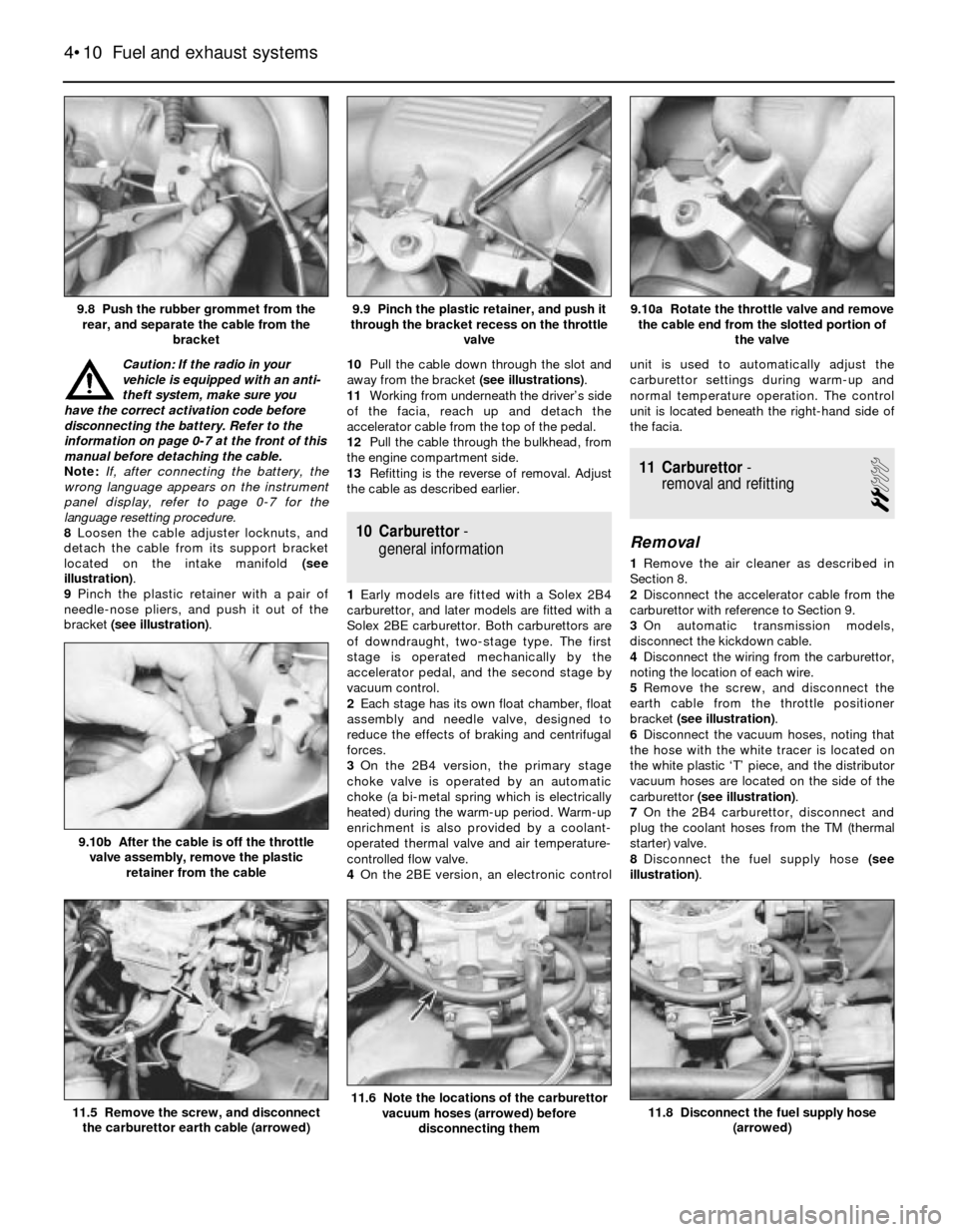
8Loosen the cable adjuster locknuts, and
detach the cable from its support bracket
located on the intake manifold (see
illustration).
9Pinch the plastic retainer with a pair of
needle-nose pliers, and push it out of the
bracket (see illustration).10Pull the cable down through the slot and
away from the bracket (see illustrations).
11Working from underneath the driver’s side
of the facia, reach up and detach the
accelerator cable from the top of the pedal.
12Pull the cable through the bulkhead, from
the engine compartment side.
13Refitting is the reverse of removal. Adjust
the cable as described earlier.
10 Carburettor-
general information
1Early models are fitted with a Solex 2B4
carburettor, and later models are fitted with a
Solex 2BE carburettor. Both carburettors are
of downdraught, two-stage type. The first
stage is operated mechanically by the
accelerator pedal, and the second stage by
vacuum control.
2Each stage has its own float chamber, float
assembly and needle valve, designed to
reduce the effects of braking and centrifugal
forces.
3On the 2B4 version, the primary stage
choke valve is operated by an automatic
choke (a bi-metal spring which is electrically
heated) during the warm-up period. Warm-up
enrichment is also provided by a coolant-
operated thermal valve and air temperature-
controlled flow valve.
4On the 2BE version, an electronic controlunit is used to automatically adjust the
carburettor settings during warm-up and
normal temperature operation. The control
unit is located beneath the right-hand side of
the facia.
11 Carburettor-
removal and refitting
2
Removal
1Remove the air cleaner as described in
Section 8.
2Disconnect the accelerator cable from the
carburettor with reference to Section 9.
3On automatic transmission models,
disconnect the kickdown cable.
4Disconnect the wiring from the carburettor,
noting the location of each wire.
5Remove the screw, and disconnect the
earth cable from the throttle positioner
bracket (see illustration).
6Disconnect the vacuum hoses, noting that
the hose with the white tracer is located on
the white plastic ‘T’ piece, and the distributor
vacuum hoses are located on the side of the
carburettor (see illustration).
7On the 2B4 carburettor, disconnect and
plug the coolant hoses from the TM (thermal
starter) valve.
8Disconnect the fuel supply hose (see
illustration).
4•10 Fuel and exhaust systems
11.8 Disconnect the fuel supply hose
(arrowed)11.6 Note the locations of the carburettor
vacuum hoses (arrowed) before
disconnecting them11.5 Remove the screw, and disconnect
the carburettor earth cable (arrowed)
9.10b After the cable is off the throttle
valve assembly, remove the plastic
retainer from the cable
9.10a Rotate the throttle valve and remove
the cable end from the slotted portion of
the valve9.9 Pinch the plastic retainer, and push it
through the bracket recess on the throttle
valve9.8 Push the rubber grommet from the
rear, and separate the cable from the
bracket
Page 101 of 228
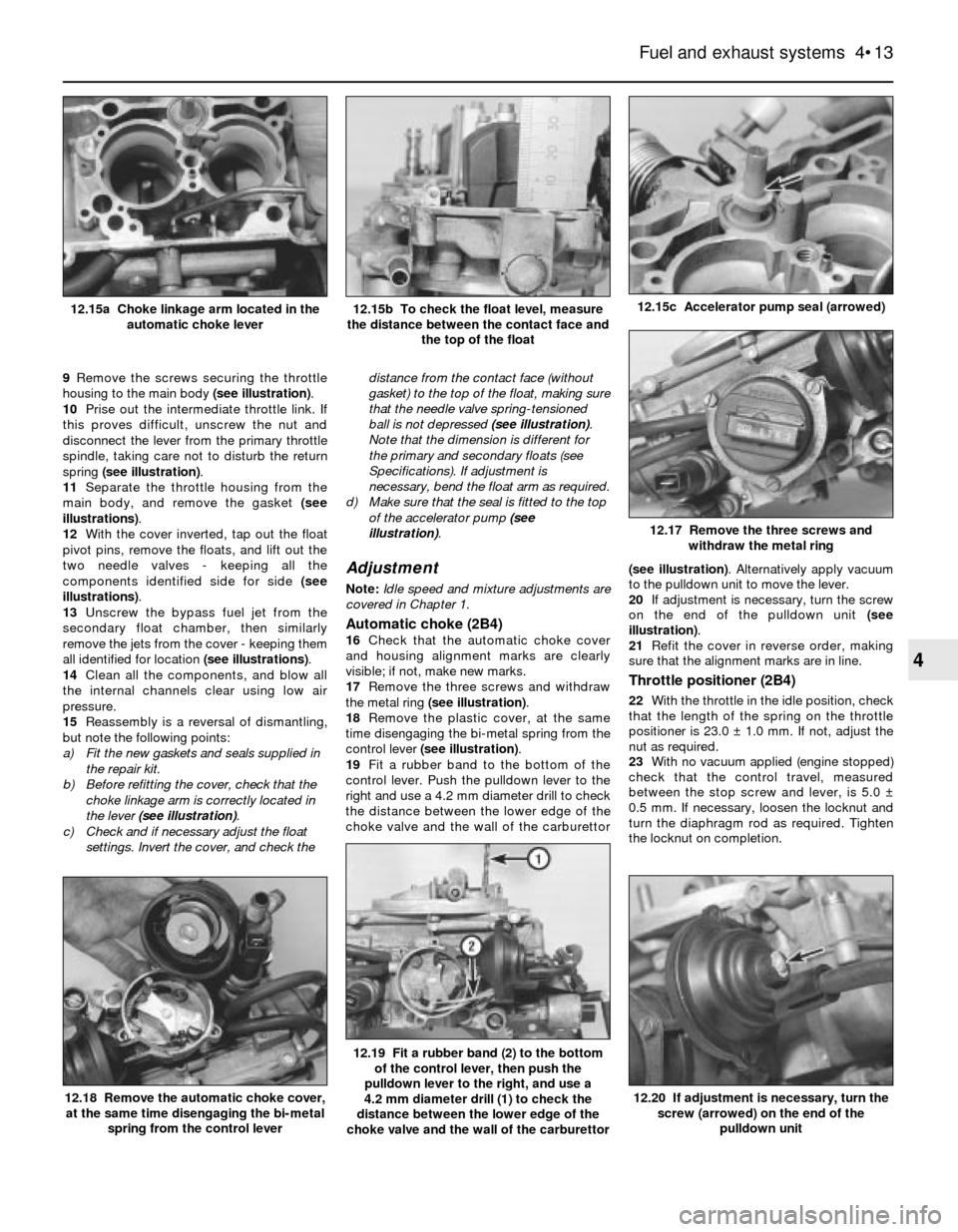
9Remove the screws securing the throttle
housing to the main body (see illustration).
10Prise out the intermediate throttle link. If
this proves difficult, unscrew the nut and
disconnect the lever from the primary throttle
spindle, taking care not to disturb the return
spring (see illustration).
11Separate the throttle housing from the
main body, and remove the gasket (see
illustrations).
12With the cover inverted, tap out the float
pivot pins, remove the floats, and lift out the
two needle valves - keeping all the
components identified side for side (see
illustrations).
13Unscrew the bypass fuel jet from the
secondary float chamber, then similarly
remove the jets from the cover - keeping them
all identified for location (see illustrations).
14Clean all the components, and blow all
the internal channels clear using low air
pressure.
15Reassembly is a reversal of dismantling,
but note the following points:
a) Fit the new gaskets and seals supplied in
the repair kit.
b) Before refitting the cover, check that the
choke linkage arm is correctly located in
the lever (see illustration).
c) Check and if necessary adjust the float
settings. Invert the cover, and check thedistance from the contact face (without
gasket) to the top of the float, making sure
that the needle valve spring-tensioned
ball is not depressed (see illustration).
Note that the dimension is different for
the primary and secondary floats (see
Specifications). If adjustment is
necessary, bend the float arm as required.
d) Make sure that the seal is fitted to the top
of the accelerator pump (see
illustration).
Adjustment
Note:Idle speed and mixture adjustments are
covered in Chapter 1.
Automatic choke (2B4)16Check that the automatic choke cover
and housing alignment marks are clearly
visible; if not, make new marks.
17Remove the three screws and withdraw
the metal ring (see illustration).
18Remove the plastic cover, at the same
time disengaging the bi-metal spring from the
control lever (see illustration).
19Fit a rubber band to the bottom of the
control lever. Push the pulldown lever to the
right and use a 4.2 mm diameter drill to check
the distance between the lower edge of the
choke valve and the wall of the carburettor(see illustration). Alternatively apply vacuum
to the pulldown unit to move the lever.
20If adjustment is necessary, turn the screw
on the end of the pulldown unit (see
illustration).
21Refit the cover in reverse order, making
sure that the alignment marks are in line.
Throttle positioner (2B4)
22With the throttle in the idle position, check
that the length of the spring on the throttle
positioner is 23.0 ± 1.0 mm. If not, adjust the
nut as required.
23With no vacuum applied (engine stopped)
check that the control travel, measured
between the stop screw and lever, is 5.0 ±
0.5 mm. If necessary, loosen the locknut and
turn the diaphragm rod as required. Tighten
the locknut on completion.
Fuel and exhaust systems 4•13
12.15b To check the float level, measure
the distance between the contact face and
the top of the float12.15a Choke linkage arm located in the
automatic choke lever
12.20 If adjustment is necessary, turn the
screw (arrowed) on the end of the
pulldown unit
12.19 Fit a rubber band (2) to the bottom
of the control lever, then push the
pulldown lever to the right, and use a
4.2 mm diameter drill (1) to check the
distance between the lower edge of the
choke valve and the wall of the carburettor
12.17 Remove the three screws and
withdraw the metal ring
12.15c Accelerator pump seal (arrowed)
12.18 Remove the automatic choke cover,
at the same time disengaging the bi-metal
spring from the control lever
4
Page 130 of 228
Torque wrench settingsNm
Front disc brake caliper
Caliper guide (mounting) bolts . . . . . . . . . . . . . . . . . . . . . . . . . . . . . . 30 to 35
Caliper bracket-to-strut housing bolts
3-Series, E30 . . . . . . . . . . . . . . . . . . . . . . . . . . . . . . . . . . . . . . . . . . 123
5-Series, E28 (“old-shape”) . . . . . . . . . . . . . . . . . . . . . . . . . . . . . . . 123
5-Series, E34 (“new-shape”) . . . . . . . . . . . . . . . . . . . . . . . . . . . . . . 110
Rear disc brake caliper
Caliper guide (mounting) bolts . . . . . . . . . . . . . . . . . . . . . . . . . . . . . . 30 to 35
Carrier-to-trailing arm bolts . . . . . . . . . . . . . . . . . . . . . . . . . . . . . . . . 67
Brake hose-to-caliper fitting . . . . . . . . . . . . . . . . . . . . . . . . . . . . . . . . . . 14 to 17
Master cylinder-to-brake servo nuts
3-Series . . . . . . . . . . . . . . . . . . . . . . . . . . . . . . . . . . . . . . . . . . . . . . . . 24
5-Series . . . . . . . . . . . . . . . . . . . . . . . . . . . . . . . . . . . . . . . . . . . . . . . . 25 to 29
Brake servo mounting nuts . . . . . . . . . . . . . . . . . . . . . . . . . . . . . . . . . . . 22 to 24
Hydraulic line-to-hydraulic brake servo threaded
fittings - 5-Series, E28 (“old-shape”) . . . . . . . . . . . . . . . . . . . . . . . . . . . 31
Wheel bolts . . . . . . . . . . . . . . . . . . . . . . . . . . . . . . . . . . . . . . . . . . . . . . . See Chapter 1
9•2 Braking system
1 General information
All 3-Series models, and 5-Series E28 (“old-
shape”) models, are equipped with front disc
brakes and either rear drum or rear disc
brakes. 5-Series E34 (“new-shape”) models
have disc brakes front and rear. Front and
rear brakes are self-adjusting on all models.
Some later models are equipped with an Anti-
lock Braking System (ABS); this is described
in Section 2.
Hydraulic system
The hydraulic system consists of two
separate circuits. The master cylinder has
separate reservoirs for the two circuits; in the
event of a leak or failure in one hydraulic
circuit, the other circuit will remain operative.
Brake servo
The vacuum brake servo, utilising engine
manifold vacuum and atmospheric pressure
to provide assistance to the hydraulically
operated brakes, is mounted on the bulkhead
in the engine compartment.
A hydraulic brake servo system is used on
5-Series E28 models. This system uses
hydraulic pressure from the power steering
pump to assist braking.
Handbrake
The handbrake operates the rear brakes,
and is cable-operated via a lever mounted in
the centre console. The handbrake assembly
on rear drum brake models is part of the rear
drum brake assembly, and is self-adjusting.
On rear disc brake models, the handbrake
uses a pair of brake shoes located inside the
centre portion of the rear brake disc, and is
manually-adjusted.
Brake pad wear warning system
The brake pad wear warning system is
linked to a red warning light in the instrumentcluster, which comes on when the brake pads
have worn down to the point at which they
require renewal. DO NOT ignore this reminder.
If you don’t renew the pads shortly after the
brake pad wear warning light comes on, the
brake discs will be damaged.
On some models, the brake pad wear
warning system also includes an early
warning light that comes on only when the
brake pedal is depressed, letting you know in
advance that the pads need to be renewed.
The wear sensor is attached to the brake
pads. The sensor is located at the left front
wheel; on some models, there is another
sensor at the right rear wheel. The wear
sensor is part of a closed circuit. Once the
pads wear down to the point at which they’re
flush with the sensor, the disc grinds away the
side of the sensor facing the disc. Thus, the
wire inside the sensor is broken, and the red
light on the instrument panel comes on.
Always check the sensor(s) when renewing
the pads. If you change the pads before the
warning light comes on, the sensor(s) may still
be good; once the light has come on, renew
the sensor.
Service
After completing any operation involving
dismantling of any part of the brake system,
always test drive the vehicle to check for
proper braking performance before resuming
normal driving. When testing the brakes, try to
select a clean, dry, road with no camber (ie as
flat as possible) and with no other traffic.
Conditions other than these can lead to
inaccurate test results.
Test the brakes at various speeds with both
light and heavy pedal pressure. The vehicle
should stop evenly, without pulling to one side
or the other. Avoid locking the brakes,
because this slides the tyres and diminishes
braking efficiency and control of the vehicle.
Tyres, vehicle load and wheel alignment are
factors which also affect braking
performance.
2 Anti-lock Braking system
(ABS)- general information
The Anti-lock Braking System is designed
to maintain vehicle control, directional stability
and optimum deceleration under severe
braking conditions on most road surfaces. It
does so by monitoring the rotational speed of
each wheel and controlling the brake line
pressure to each wheel during braking. This
prevents the wheels from locking up.
The ABS system has three main
components - the wheel speed sensors, the
electronic control unit, and the hydraulic
control unit. The sensors - one at each wheel
since 1985, but at both front wheels and one
at the rear differential on earlier models - send
a variable voltage signal to the control unit,
which monitors these signals, compares them
to its program information, and determines
whether a wheel is about to lock up. When a
wheel is about to lock up, the control unit
signals the hydraulic unit to reduce hydraulic
pressure (or not increase it further) at that
wheel’s brake caliper. Pressure modulation is
handled by electrically-operated solenoid
valves.
If a problem develops within the system, an
“ABS” warning light will glow on the
dashboard. Sometimes, a visual inspection of
the ABS system can help you locate the
problem. Carefully inspect the ABS wiring
harness. Pay particularly close attention to the
harness and connections near each wheel.
Look for signs of chafing and other damage
caused by incorrectly-routed wires. If a wheel
sensor harness is damaged, the sensor
should be renewed (the harness and sensor
are integral).
Warning: DO NOT try to repair an
ABS wiring harness. The ABS
system is sensitive to even the
smallest changes in resistance. Repairing
the harness could alter resistance values