phone BMW 5 SERIES ACTIVE HYBRID 2015 User Guide
[x] Cancel search | Manufacturer: BMW, Model Year: 2015, Model line: 5 SERIES ACTIVE HYBRID, Model: BMW 5 SERIES ACTIVE HYBRID 2015Pages: 257, PDF Size: 5.26 MB
Page 102 of 257
▷When passing buses or trucks with a
speed sticker.▷If the traffic signs are non-conforming.▷During calibration of the camera immedi‐
ately after vehicle shipment.
Selection lists in the
instrument cluster
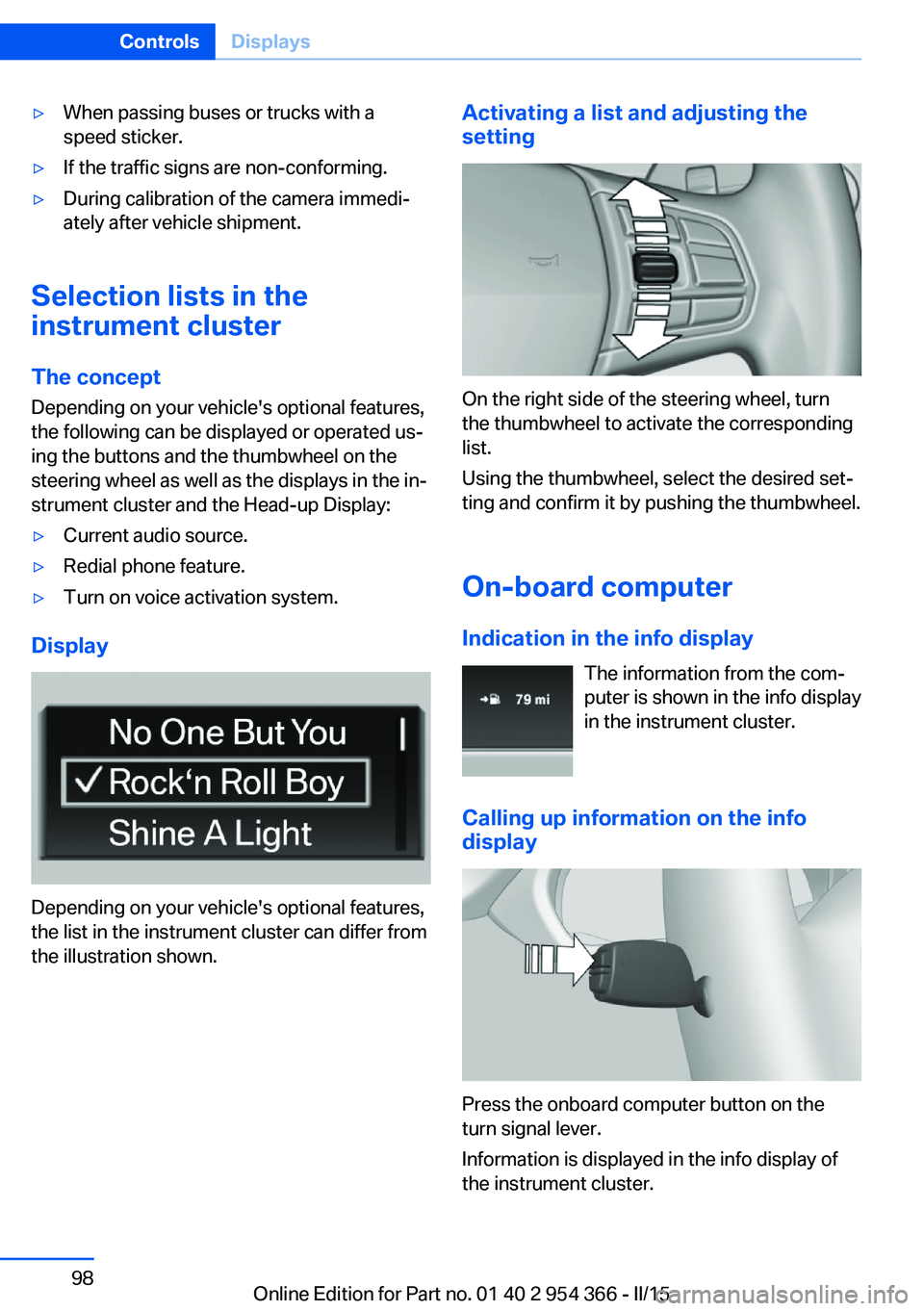
The concept Depending on your vehicle's optional features,
the following can be displayed or operated us‐
ing the buttons and the thumbwheel on the
steering wheel as well as the displays in the in‐
strument cluster and the Head-up Display:
▷Current audio source.▷Redial phone feature.▷Turn on voice activation system.
Display
Depending on your vehicle's optional features,
the list in the instrument cluster can differ from
the illustration shown.
Activating a list and adjusting the
setting
On the right side of the steering wheel, turn
the thumbwheel to activate the corresponding
list.
Using the thumbwheel, select the desired set‐
ting and confirm it by pushing the thumbwheel.
On-board computer
Indication in the info display The information from the com‐
puter is shown in the info display
in the instrument cluster.
Calling up information on the info
display
Press the onboard computer button on the
turn signal lever.
Information is displayed in the info display of
the instrument cluster.
Seite 98ControlsDisplays98
Online Edition for Part no. 01 40 2 954 366 - II/15
Page 114 of 257
Knee airbagThe knee airbag supports the legs in a frontal
impact.
Protective action
Airbags are not triggered in every impact situa‐
tion, e.g., in less severe accidents or rear-end
collisions.
Information on how to ensure the optimal
protective effect of the airbags▷Keep at a distance from the airbags.▷Always grasp the steering wheel on the
steering wheel rim, holding your hands at
the 3 o'clock and 9 o'clock positions, to
keep the risk of injury to your hands or
arms as low as possible when the airbag is
triggered.▷There should be no person, animals, or ob‐
jects between an airbag and a person.▷Do not use the cover of the front airbag on
the front passenger side as a storage area.▷Dashboard and windshield on the front
passenger side must stay clear - do not at‐
tach adhesive labels or coverings and do
not attach brackets or cables, e. g., for GPS
devices or' mobile phones.▷Make sure that the front passenger is sit‐
ting correctly, i.e., keeps his or her feet and
legs in the footwell; otherwise, leg injuries
might occur when front airbag is activated.▷Do not place slip covers, seat cushions or
other objects on the front passenger seat
that are not approved specifically for seats
with integrated side airbags.▷Do not hang pieces of clothing, such as
jackets, over the backrests.▷Make sure that occupants keep their heads
away from the side airbag and do not rest
against the head airbag; otherwise, injuries
might occur when airbag is activated.▷Do not remove the airbag system.▷Do not remove the steering wheel.▷Do not apply adhesive materials to the air‐
bag cover panels, do not cover them or
modify them in any way.▷Never modify either the individual compo‐
nents or the wiring in the airbag system.
This also applies to steering wheel covers,
the dashboard, the seats, the roof pillars
and the sides of the roofliner.◀
Even when you follow all instructions very
closely, injury from contact with the airbags
cannot be ruled out in certain situations.
The ignition and inflation noise may lead to
short-term and, in most cases, temporary
hearing impairment in sensitive individuals.
Malfunction, deactivation and after de‐
ploying the airbags
Do not touch the individual components imme‐
diately after the system has been triggered;
otherwise, you may risk burns.
Only have the airbags checked, repaired or dis‐
mantled and the airbag generator scrapped by
the service center or an authorized repair shop
for handling explosives.
Non-professional attempts to service the sys‐
tem could lead to failure in an emergency or
unintentional activation of the airbag - both
may lead to injury.◀
Warnings and information on the airbags are also found on the sun visors.
Functional readiness of the airbag
system
When the ignition is reel on, the warn‐
ing lamp in the instrument cluster lights
up briefly and thereby indicates the op‐
erational readiness of the entire airbag system
and the belt tensioner.
Airbag system malfunctioning
▷Warning lamp does not come on when the
ignition is turned on.▷The warning lamp lights up continuously.Seite 110ControlsSafety110
Online Edition for Part no. 01 40 2 954 366 - II/15
Page 189 of 257
Mobile communication devices in the
vehicle
Mobile communication devices in the ve‐
hicle
It is not recommended to use mobile phones,
such as mobile phones, in the vehicle interior
without a direct connection to an external aer‐
ial. Otherwise, the vehicle's electronics and
mobile communication devices can interfere
with each other. In addition, there is no assur‐
ance that the radiation generated during trans‐
mission will be conducted away from the vehi‐
cle interior.◀
Hydroplaning Hydroplaning
When driving on wet or slushy roads, re‐
duce your speed to prevent hydroplaning.◀
On wet or slushy roads, a wedge of water can
form between the tires and road surface.
This phenomenon is referred to as hydroplan‐
ing. It is characterized by a partial or complete
loss of contact between the tires and the road
surface, ultimately undermining your ability to
steer and brake the vehicle.
Driving through water Observe water level and speed
Do not exceed the maximum water level
and maximum speed; otherwise, the vehicle's
engine, the electrical systems and the trans‐
mission may be damaged.◀
Drive though calm water only and only if it is
not deeper than 9.8 inches/25 cm and at this
height, no faster than walking speed, up to
3 mph/5 km/h.
Braking safely
Your vehicle is equipped with ABS as a stand‐
ard feature.
Applying the brakes fully is the most effective
way of braking in situations needed.Steering is still responsive. You can still avoid
any obstacles with a minimum of steering ef‐
fort.
Pulsation of the brake pedal and sounds from
the hydraulic circuits indicate that ABS is in its
active mode.
In certain braking situations, the perforated
brake discs can cause functional problems.
However, this has no effect on the perform‐
ance and operational reliability of the brake.
Objects within the range of movement
of the pedals
No objects in the area around the pedals
Keep floor mats, carpets, and any other
objects out of the pedal area; otherwise, the
function of the pedals could be impeded while
driving and create the risk of an accident.
Do not place additional floor mats over existing
mats or other objects.
Only use floor mats that have been approved
for the vehicle and can be properly attached to
floor.
Ensure that the floor mats are securely fas‐
tened again after they were removed for clean‐
ing, e.g.◀
Driving in wet conditions When roads are wet, salted, or in heavy rain,
press brake pedal ever so gently every few
miles.
Ensure that this action does not endanger other traffic.
The heat generated in this process helps dry
the brake discs and pads.
In this way braking efficiency will be available
when you need it.Seite 185Things to remember when drivingDriving tips185
Online Edition for Part no. 01 40 2 954 366 - II/15
Page 254 of 257
Split screen 23
SPORT+ - program, Dynamic Driving Control 139
Sport displays, torque dis‐ play, performance dis‐
play 100
SPORT program, driving dy‐ namics 139
Sport program, transmis‐ sion 85
Stability control systems 136
Standing air conditioning, re‐ mote control 50
Start/Stop button 73
Start function during malfunc‐ tion 39
Starting the combustion en‐ gine 75
Status control display, tires 113
Status information, iDrive 22
Status of Owner's Manual 7
Steering wheel, adjusting 67
Steering wheel heating 68
Steering wheel memory 65
Steptronic transmission 83
Storage compartment, re‐ mote control 179
Storage compartments 176
Storage compartments, loca‐ tions 176
Storage, tires 206
Storing the vehicle 236
Suitable engine oils 215
Summer tires, tread 204
Sun visor 172
Supplementary text mes‐ sage 93
Surround View 152
Suspension settings 138
Switch for Dynamic Driving Control 138
Switch-on times, parked-car ventilation 168
Switch, refer to Cockpit 14
Symbols 6 Symbols in the status field 22
SYNC program, automatic cli‐ mate control 164
T Tachometer 94
Tail and brake lights 223
Tail lights 223
Tail lights, bulb replace‐ ment 223
Technical changes, refer to Safety 7
Technical data 240
Telephone, see user's manual for Navigation, Entertain‐
ment and Communication
Temperature, automatic cli‐ mate control 163
Temperature display for ex‐ ternal temperature 94
Temperature, engine oil 94
Terminal, starting aid 229
Text message, supplemen‐ tary 93
Theft alarm system, refer to Alarm system 51
Thermal camera, see Night Vision 127
Thigh support 59
Tilt alarm sensor 52
Time of arrival 99
Tire damage 204
Tire identification marks 202
Tire inflation pressure 200
Tire inflation pressure moni‐ tor, refer to FTM 116
Tire Pressure Monitor TPM 112
Tires, changing 205
Tire sealant 206
Tires, everything on wheels and tires 200
Tires, run-flat tires 206
Tire tread 204 Tone, see user's manual for
Navigation, Entertainment
and Communication
Tool 220
Top View 156
Total vehicle weight 241
Touchpad 21
Tow fitting 231
Towing 230
Tow lug, see Tow fitting 231
Tow-starting 230
TPM Tire Pressure Moni‐ tor 112
Traction control 137
TRACTION, driving dynam‐ ics 137
Transmission lock, electronic unlocking 86
Transmission, see Steptronic transmission 83
Transporting children safely 69
Tread, tires 204
Trip computer 99
Triple turn signal activa‐ tion 80
Trip odometer 94
Trunk lid, automatic 45
Trunk lid closing 45
Trunk lid, closing with no- touch activation 48
Trunk lid, emergency unlock‐ ing 47
Trunk lid, hotel function 46
Trunk lid opening 44
Trunk lid, opening with no- touch activation 48
Trunk lid via remote con‐ trol 42
Turning circle 240
Turning circle lines, rearview camera 154
Turn signals, operation 80
Turn signals, rear, bulb re‐ placement 223 Seite 250ReferenceEverything from A to Z250
Online Edition for Part no. 01 40 2 954 366 - II/15