phone BMW 5 SERIES GRAN TURISMO 2013 F07 User Guide
[x] Cancel search | Manufacturer: BMW, Model Year: 2013, Model line: 5 SERIES GRAN TURISMO, Model: BMW 5 SERIES GRAN TURISMO 2013 F07Pages: 255, PDF Size: 7.25 MB
Page 107 of 255
Protective action
Airbags are not triggered in every impact situa‐
tion, e.g., in less severe accidents or rear-end
collisions.
Information on how to ensure the optimal
protective effect of the airbags▷Keep at a distance from the airbags.▷Always grasp the steering wheel on the
steering wheel rim, holding your hands at
the 3 o'clock and 9 o'clock positions, to
keep the danger of injury to your hands or
arms as low as possible if the airbag is trig‐
gered.▷There should be no people, animals, or ob‐
jects between an airbag and a person.▷Do not use the cover of the front airbag on
the front passenger side as a storage area.▷Keep the dashboard and window on the
front passenger side clear, i.e., do not
cover with adhesive labels or coverings,
and do not attach holders such as for navi‐
gation instruments and mobile phones.▷Make sure that the front passenger is sit‐
ting correctly, i.e., keeps his or her feet and
legs in the footwell; otherwise, leg injuries
can occur if the front airbag is triggered.▷Do not place slip covers, seat cushions or
other objects on the front passenger seat
that are not approved specifically for seats
with integrated side airbags.▷Do not hang pieces of clothing, such as
jackets, over the backrests.▷Make sure that occupants keep their heads
away from the side airbag and do not rest
against the head airbag; otherwise, injuries
can occur if the airbags are triggered.▷Do not remove the airbag restraint system.▷Do not remove the steering wheel.▷Do not apply adhesive materials to the air‐
bag cover panels, cover them or modify
them in any way.▷Never modify either the individual compo‐
nents or the wiring in the airbag system.
This also applies to steering wheel covers,
the dashboard, the seats, the roof pillars
and the sides of the headliner.◀
Even when all instructions are followed closely,
injury from contact with the airbags cannot be
ruled out in certain situations.
The ignition and inflation noise may lead to
short-term and, in most cases, temporary
hearing impairment in sensitive individuals.
In the case of a malfunction, deactivation
and after triggering of the airbags
Do not touch the individual components imme‐
diately after the system has been triggered;
otherwise, there is the danger of burns.
Only have the airbags checked, repaired or dis‐
mantled and the airbag generator scrapped by
your service center or a workshop that has the
necessary authorization for handling explo‐
sives.
Non-professional attempts to service the sys‐
tem could lead to failure in an emergency or
undesired triggering of the airbag, either of
which could result in injury.◀
Warnings and information on the airbags are
also found on the sun visors.
Functional readiness of the airbag
system
When the ignition is switch on, the
warning lamp in the instrument cluster
lights up briefly and thereby indicates
the operational readiness of the entire airbag
system and the belt tensioner.
Airbag system malfunctioning
▷Warning lamp does not come on when the
ignition is turned on.▷The warning lamp lights up continuously.Seite 103SafetyControls103
Online Edition for Part no. 01 40 2 909 928 - VI/13
Page 189 of 255

sition mode, or when parked. Such contact
could lead to a fire, and with it the risk of seri‐
ous personal injury as well as property dam‐
age.
Do not touch hot exhaust pipes; otherwise,
there is the danger of getting burned.◀
Climate control windshield
The marked area is not covered with heat re‐
flective coating.
Use this area for garage door openers, devices
for electronic toll collection, etc.
Climate control laminated tinted
safety glass
The vehicle glass provides full protection
against the harmful effects of UV radiation on
the skin.
Mobile communication devices in thevehicle
Mobile communication devices in the ve‐
hicle
It is advised that you do not use mobile com‐
munication devices, e.g., mobile phones, in‐
side the vehicle without connecting them di‐
rectly to the external antenna. Otherwise, the
vehicle electronics and mobile communication
devices can interfere with each other. In addi‐
tion, there is no assurance that the radiation
generated during transmission will be dis‐
charged from the vehicle interior.◀
Hydroplaning
On wet or slushy roads, a wedge of water can
form between the tires and road surface.
This phenomenon is referred to as hydroplan‐
ing. It is characterized by a partial or complete
loss of contact between the tires and the road
surface, ultimately undermining your ability to
steer and brake the vehicle.
Hydroplaning
When driving on wet or slushy roads, re‐
duce your speed to prevent hydroplaning.◀
Driving through water Drive though calm water only and only if it is
not deeper than. 9.8 inches/25 cm and at this
height, no faster than walking speed, up to 6 mph/10 km/h.
Adhere to water depth and speed limita‐
tions
Do not exceed this water depth and walking
speed; otherwise, the vehicle's engine, the
electrical systems and the transmission may
be damaged.◀
Braking safely
Your vehicle is equipped with ABS as a stand‐
ard feature.
Applying the brakes fully is the most effective
way of braking in situations when this is neces‐
sary.
The vehicle maintains steering responsive‐
ness. You can still avoid any obstacles with a
minimum of steering effort.
Pulsation of the brake pedal and sounds from
the hydraulic circuits indicate that ABS is in its
active mode.Seite 185Things to remember when drivingDriving tips185
Online Edition for Part no. 01 40 2 909 928 - VI/13
Page 230 of 255
if it can be established, are transmitted to
the BMW Response Center.▷If the LED is flashing, but the BMW Re‐
sponse Center can no longer be heard via
the speaker, you can nevertheless still be
heard for the BMW Response Center.
Initiating an Emergency Request
automatically
Under certain conditions, an Emergency Re‐
quest is automatically initiated immediately af‐
ter a severe accident. Automatic Collision Noti‐
fication is not affected by pressing the SOS
button.
Warning triangle
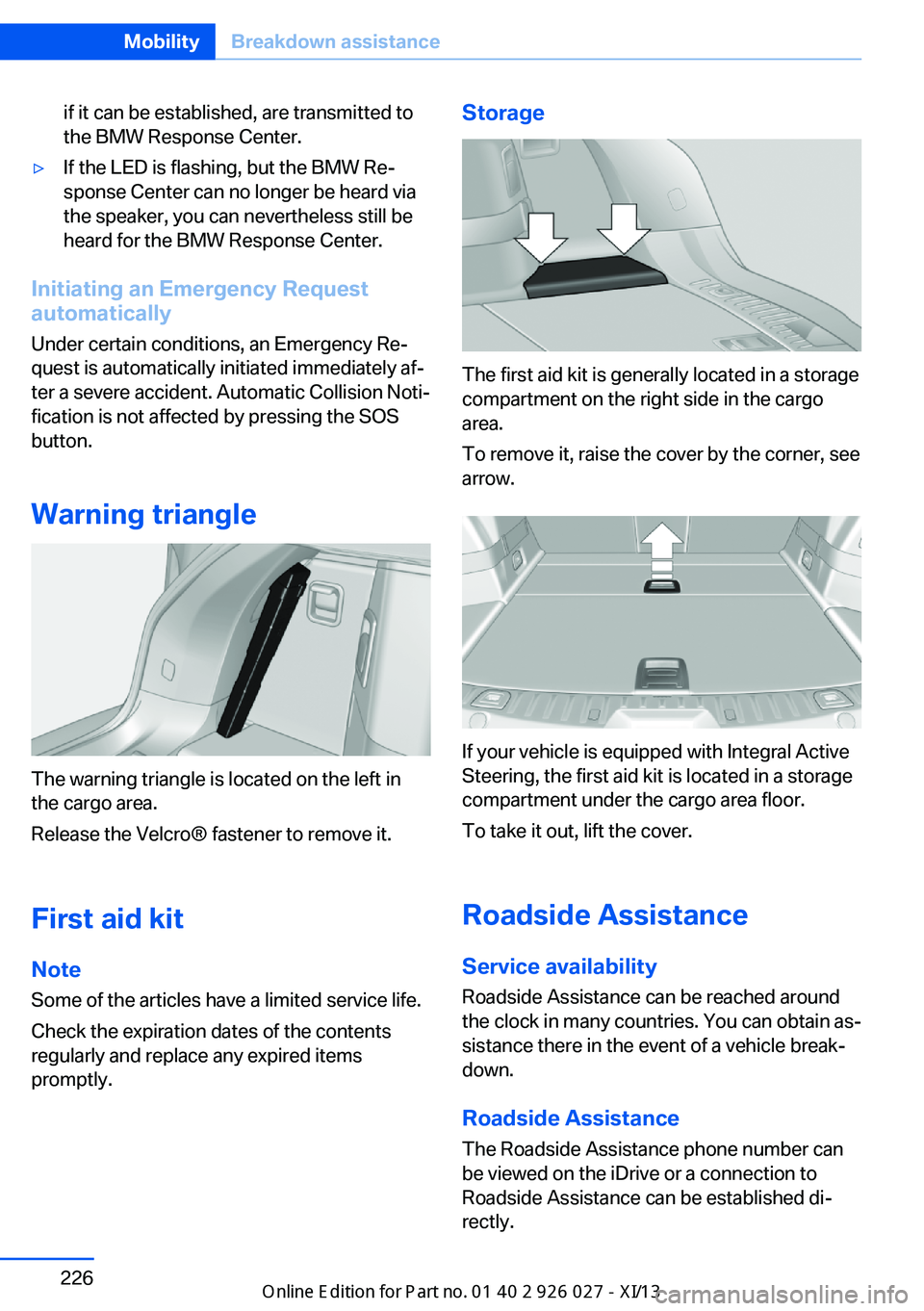
The warning triangle is located on the left in
the cargo area.
Release the Velcro® fastener to remove it.
First aid kit NoteSome of the articles have a limited service life.
Check the expiration dates of the contents
regularly and replace any expired items
promptly.
Storage
The first aid kit is generally located in a storage
compartment on the right side in the cargo
area.
To remove it, raise the cover by the corner, see
arrow.
If your vehicle is equipped with Integral Active
Steering, the first aid kit is located in a storage
compartment under the cargo area floor.
To take it out, lift the cover.
Roadside Assistance
Service availability Roadside Assistance can be reached around
the clock in many countries. You can obtain as‐
sistance there in the event of a vehicle break‐
down.
Roadside Assistance The Roadside Assistance phone number can
be viewed on the iDrive or a connection to
Roadside Assistance can be established di‐
rectly.
Seite 226MobilityBreakdown assistance226
Online Edition for Part no. 01 40 2 909 928 - VI/13
Page 252 of 255

Summer tires, tread 206
Supplementary text mes‐ sage 86
Surround View 149
Suspension settings 132
Switch for Dynamic Driving Control 132
Switch, refer to Cockpit 12
Symbols 6
SYNC program, automatic cli‐ mate control 164
T Tachometer 87
Tail and brake lamps 221
Tailgate 37
Tailgate, automatic 38
Tailgate, emergency unlock‐ ing 40
Tailgate, hotel function 40
Tailgate opening/closing with no-touch activation 41
Tailgate via remote con‐ trol 34
Tail lamps 221
Tail lamps, bulb replace‐ ment 221
Technical changes, refer to Safety 7
Technical data 236
Telephone, see user's manual for Navigation, Entertain‐
ment and Communication
Temperature, automatic cli‐ mate control 163
Temperature display, external temperature 88
Temperature, engine oil 87
Tempomat, refer to Active Cruise Control 135
Terminal, starting aid 227
Text message, supplemen‐ tary 86
Theft alarm system, refer to Alarm system 43 Theft protection, refer to
Central locking system 33
Thermal camera, refer to Night Vision 118
Thigh support 49
Through-loading system 174
Tilt alarm sensor 44
Time of arrival 94
Tire damage 206
Tire identification marks 205
Tire inflation pressure 201
Tire inflation pressure moni‐ tor, refer to FTM 105
Tire Pressure Monitor TPM 107
Tires, changing 207
Tires, everything on wheels and tires 201
Tires, run-flat tires 209
Tire tread 206
Tone, see user's manual for Navigation, Entertainment
and Communication
Tools 218
Top View 153
Total vehicle weight 237
Touchpad 18
Tow fitting 229
Towing 228
Tow-starting 228
TPM Tire Pressure Moni‐ tor 107
Traction control 128
TRACTION program, Dy‐ namic Driving Control 132
Transmission, automatic 78
Transporting children safely 61
Tread, tires 206
Trip computer 94
Triple turn signal activa‐ tion 75
Trip odometer 88
Trunk lid 37
Trunk lid, automatic 38 Trunk lid, emergency unlock‐
ing 40
Trunk lid, hotel function 40
Trunk lid opening/closing with no-touch activation 41
Trunk lid via remote con‐ trol 34
Turning circle 237
Turning circle lines, rearview camera 150
Turn signals, operation 74
Turn signals, rear, bulb re‐ placement 221
U
Unintentional alarm 44
Units of measure 95
Universal remote control 169
Unlock button, automatic transmission 78
Unlocking/locking from in‐ side 36
Unlocking/locking via door lock 35
Unlocking/locking with re‐ mote control 34
Unlocking, settings 42
Updates made after the edito‐ rial deadline 7
Upholstery care 232
USB interface 173
V
Variable button assignment for remote control 30
Variable steering, Integral Ac‐ tive Steering 131
Vehicle battery 222
Vehicle battery, replac‐ ing 223
Vehicle, breaking in 184
Vehicle care 231
Vehicle equipment 6 Seite 248ReferenceEverything from A to Z248
Online Edition for Part no. 01 40 2 909 928 - VI/13