door BMW 525I 2000 E39 Central Body Electronics ZKE Manual
[x] Cancel search | Manufacturer: BMW, Model Year: 2000, Model line: 525i, Model: BMW 525i 2000 E39Pages: 80, PDF Size: 4.14 MB
Page 44 of 80
Rear Window Child Lockout Switch: The rear window child lockout switch is incorpo-
rated in the driver's side window switch block. It provides a constant ground signal to the
GM preventing the windows from being operated from the rear door switches.
The lockout switch ground signal is overridden by the GM if the MRS crash signal is acti-
vated (MRS III equipped vehicles).
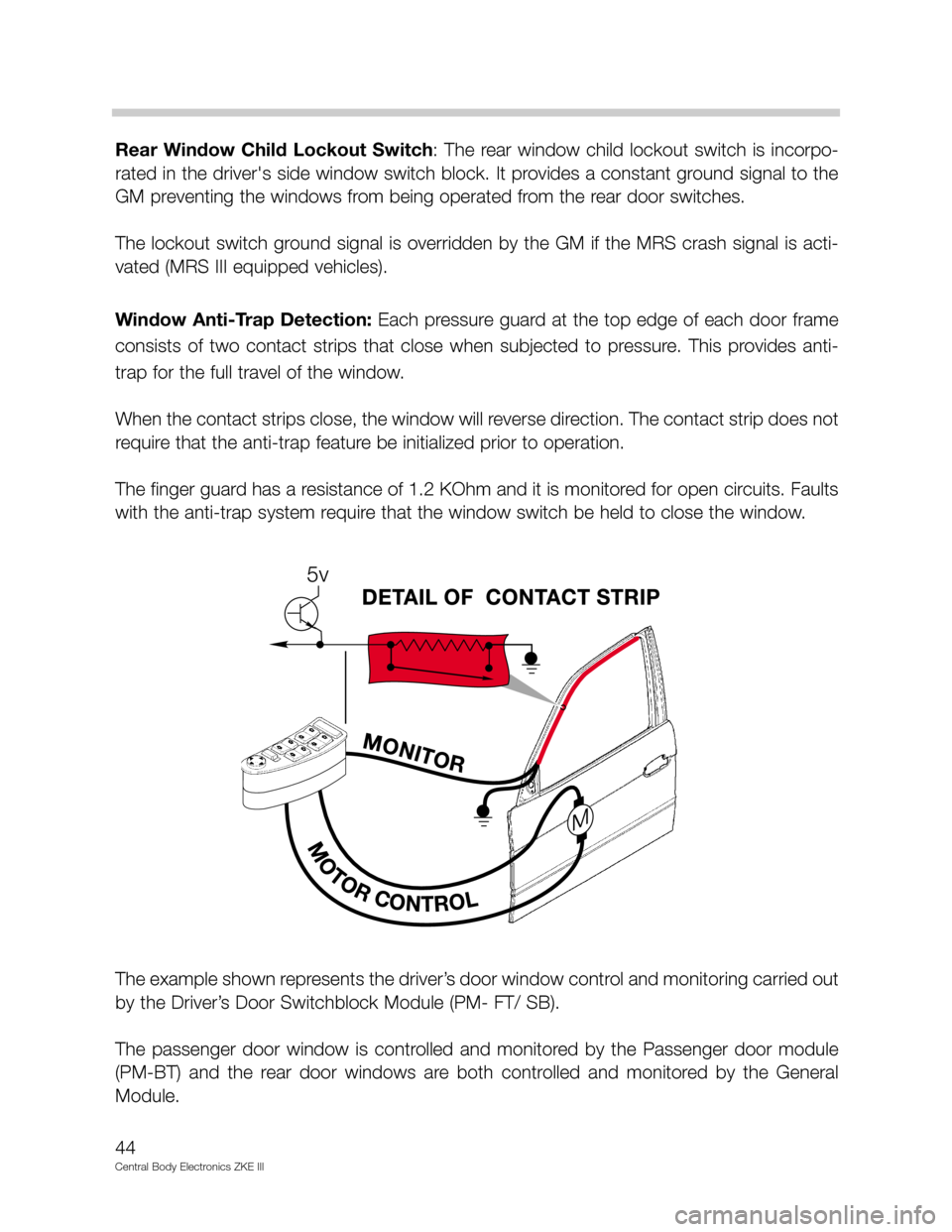
Window Anti-Trap Detection: Each pressure guard at the top edge of each door frame
consists of two contact strips that close when subjected to pressure. This provides anti-
trap for the full travel of the window.
When the contact strips close, the window will reverse direction. The contact strip does not
require that the anti-trap feature be initialized prior to operation.
The finger guard has a resistance of 1.2 KOhm and it is monitored for open circuits. Faults
with the anti-trap system require that the window switch be held to close the window.
The example shown represents the driver’s door window control and monitoring carried out
by the Driver’s Door Switchblock Module (PM- FT/ SB).
The passenger door window is controlled and monitored by the Passenger door module
(PM-BT) and the rear door windows are both controlled and monitored by the General
Module.
44
Central Body Electronics ZKE III
Page 46 of 80
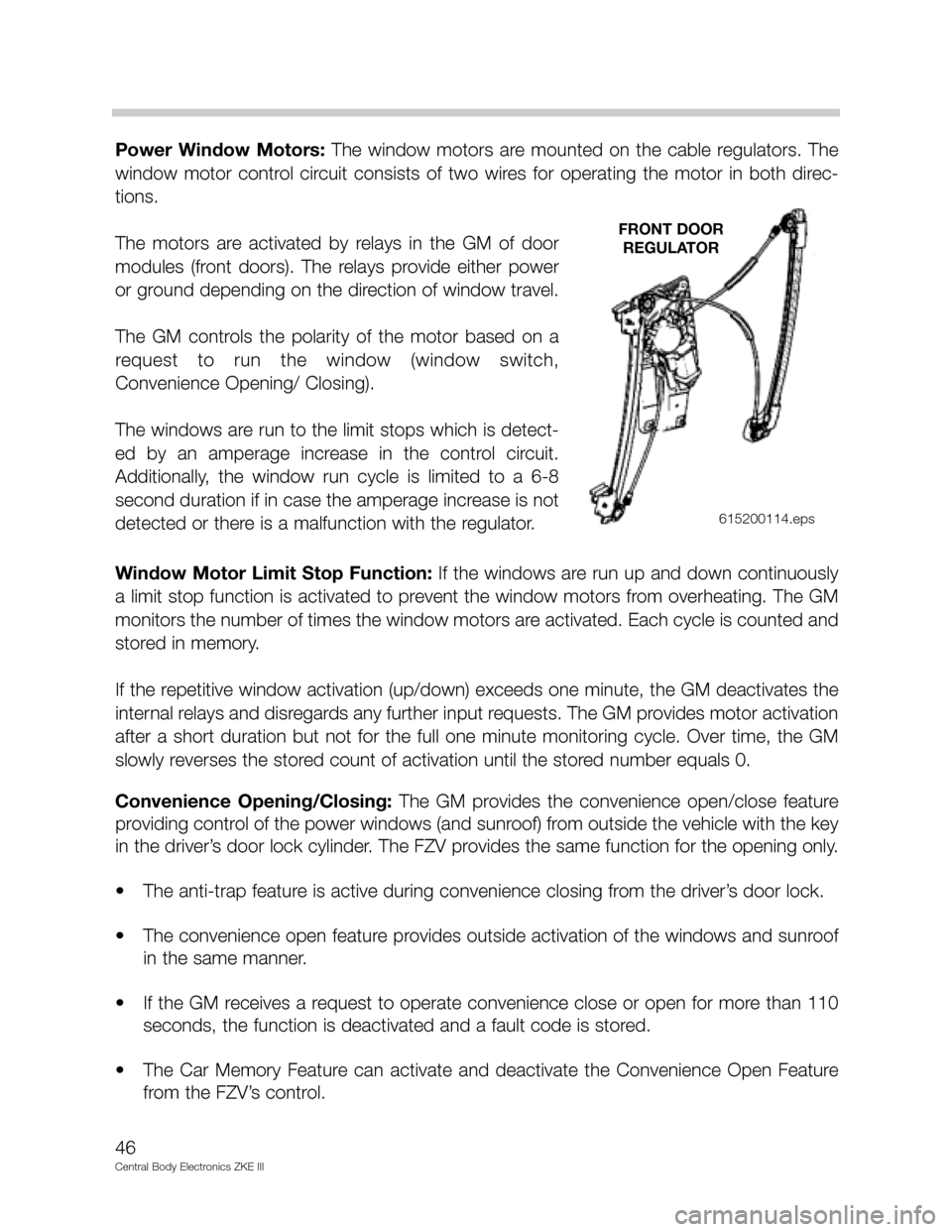
Power Window Motors: The window motors are mounted on the cable regulators. The
window motor control circuit consists of two wires for operating the motor in both direc-
tions.
The motors are activated by relays in the GM of door
modules (front doors). The relays provide either power
or ground depending on the direction of window travel.
The GM controls the polarity of the motor based on a
request to run the window (window switch,
Convenience Opening/ Closing).
The windows are run to the limit stops which is detect-
ed by an amperage increase in the control circuit.
Additionally, the window run cycle is limited to a 6-8
second duration if in case the amperage increase is not
detected or there is a malfunction with the regulator.
Window Motor Limit Stop Function: If the windows are run up and down continuously
a limit stop function is activated to prevent the window motors from overheating. The GM
monitors the number of times the window motors are activated. Each cycle is counted and
stored in memory.
If the repetitive window activation (up/down) exceeds one minute, the GM deactivates the
internal relays and disregards any further input requests. The GM provides motor activation
after a short duration but not for the full one minute monitoring cycle. Over time, the GM
slowly reverses the stored count of activation until the stored number equals 0.
Convenience Opening/Closing: The GM provides the convenience open/close feature
providing control of the power windows (and sunroof) from outside the vehicle with the key
in the driver’s door lock cylinder. The FZV provides the same function for the opening only.
• The anti-trap feature is active during convenience closing from the driver’s door lock.
• The convenience open feature provides outside activation of the windows and sunroof
in the same manner.
• If the GM receives a request to operate convenience close or open for more than 110
seconds, the function is deactivated and a fault code is stored.
• The Car Memory Feature can activate and deactivate the Convenience Open Feature
from the FZV’s control.
46
Central Body Electronics ZKE III
FRONT DOOR
REGULATOR
615200114.eps
Page 47 of 80
Sunroof
Purpose of the System
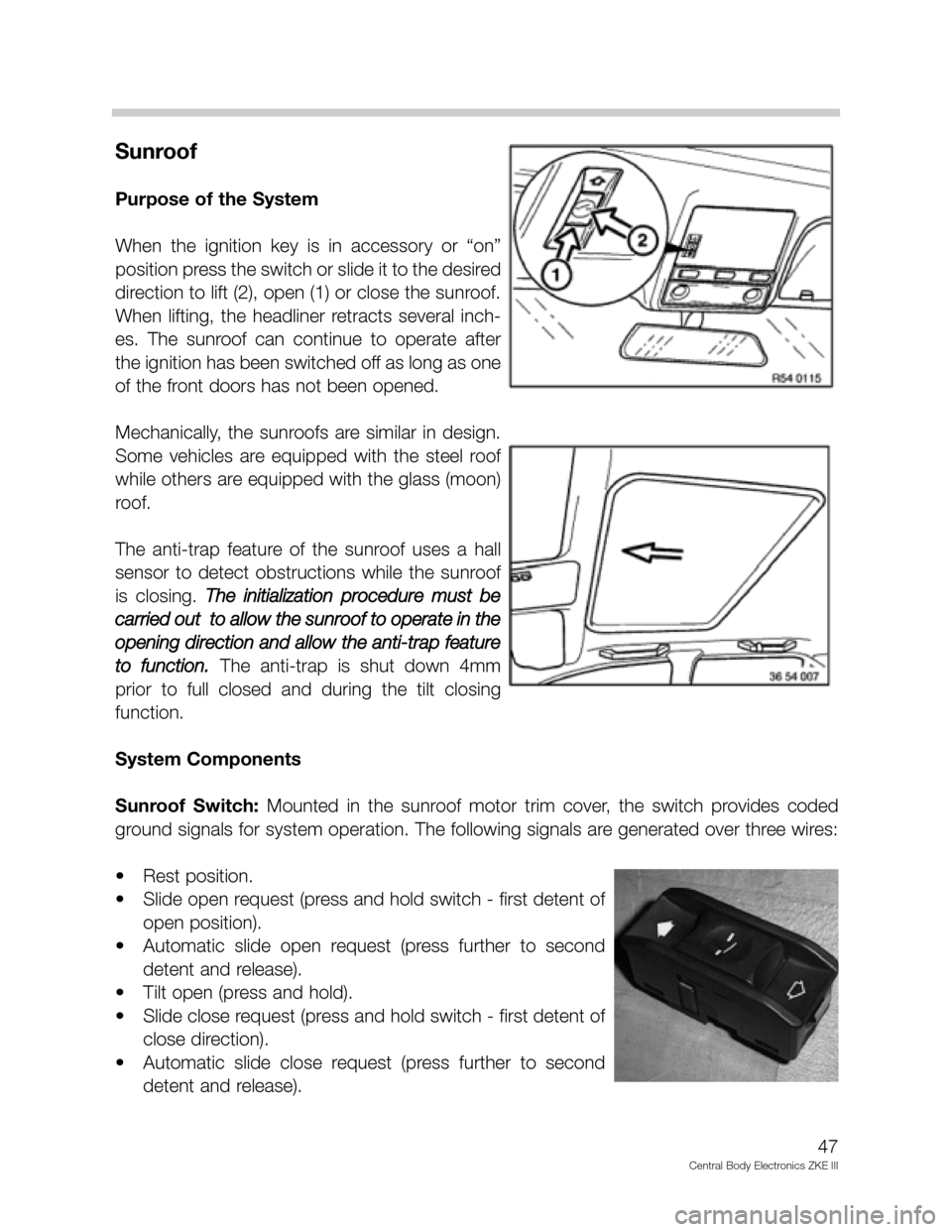
When the ignition key is in accessory or “on”
position press the switch or slide it to the desired
direction to lift (2), open (1) or close the sunroof.
When lifting, the headliner retracts several inch-
es. The sunroof can continue to operate after
the ignition has been switched off as long as one
of the front doors has not been opened.
Mechanically, the sunroofs are similar in design.
Some vehicles are equipped with the steel roof
while others are equipped with the glass (moon)
roof.
The anti-trap feature of the sunroof uses a hall
sensor to detect obstructions while the sunroof
is closing. The initialization procedure must be
carried out to allow the sunroof to operate in the
opening direction and allow the anti-trap feature
to function.
The anti-trap is shut down 4mm
prior to full closed and during the tilt closing
function.
System Components
Sunroof Switch:Mounted in the sunroof motor trim cover, the switch provides coded
ground signals for system operation. The following signals are generated over three wires:
• Rest position.
• Slide open request (press and hold switch - first detent of
open position).
• Automatic slide open request (press further to second
detent and release).
• Tilt open (press and hold).
• Slide close request (press and hold switch - first detent of
close direction).
• Automatic slide close request (press further to second
detent and release).
47
Central Body Electronics ZKE III
Page 51 of 80
Interior Lighting
Purpose of the System
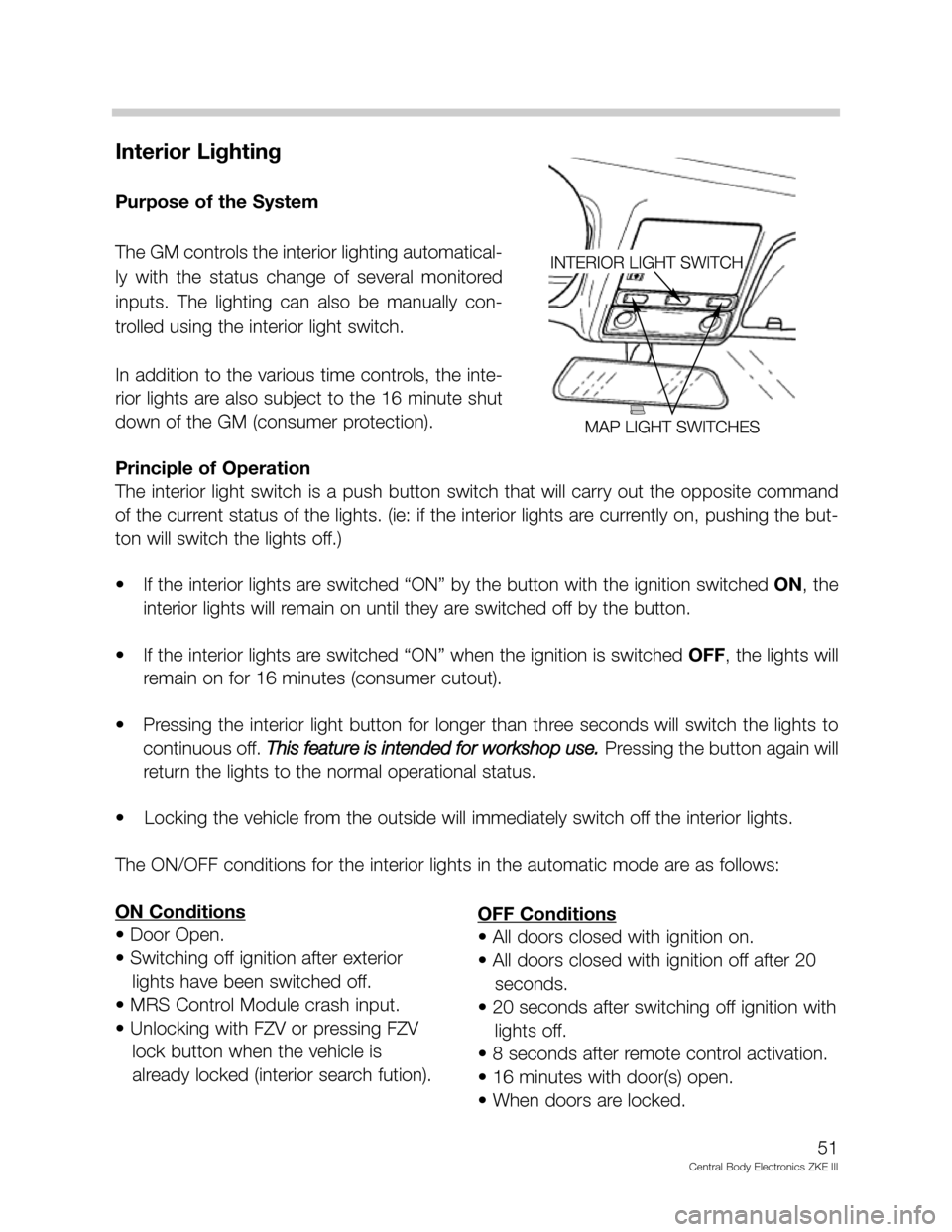
The GM controls the interior lighting automatical-
ly with the status change of several monitored
inputs. The lighting can also be manually con-
trolled using the interior light switch.
In addition to the various time controls, the inte-
rior lights are also subject to the 16 minute shut
down of the GM (consumer protection).
Principle of Operation
The interior light switch is a push button switch that will carry out the opposite command
of the current status of the lights. (ie: if the interior lights are currently on, pushing the but-
ton will switch the lights off.)
• If the interior lights are switched “ON” by the button with the ignition switched ON, the
interior lights will remain on until they are switched off by the button.
• If the interior lights are switched “ON” when the ignition is switched OFF, the lights will
remain on for 16 minutes (consumer cutout).
• Pressing the interior light button for longer than three seconds will switch the lights to
continuous off. This feature is intended for workshop use.
Pressing the button again will
return the lights to the normal operational status.
• Locking the vehicle from the outside will immediately switch off the interior lights.
The ON/OFF conditions for the interior lights in the automatic mode are as follows:
ON Conditions
• Door Open.
• Switching off ignition after exterior
lights have been switched off.
• MRS Control Module crash input.
• Unlocking with FZV or pressing FZV
lock button when the vehicle is
already locked (interior search fution).
51
Central Body Electronics ZKE III
OFF Conditions
• All doors closed with ignition on.
• All doors closed with ignition off after 20
seconds.
• 20 seconds after switching off ignition with
lights off.
• 8 seconds after remote control activation.
• 16 minutes with door(s) open.
• When doors are locked.
Page 53 of 80
System Components
Door Contacts: As mentioned in the Central Locking Section, the existing door contacts
opened/closed are also an input for the interior lighting function. The E53 uses the Hall
effect sensors for the purpose of monitoring door open/closed status (located directly
behind the rotary latch plate encased in the actuator). The sensor is activated by the rotary
latch plate's position.
• Door closed, the rotary latch plate is in the latched position. Current flow through the
hall sensor is < 5 mA.
• Door open, the rotary latch plate is in the open position. Current flow through the hall
sensor is > 12 mA.
A change in current flow informs the General module when a door is opened or closed.
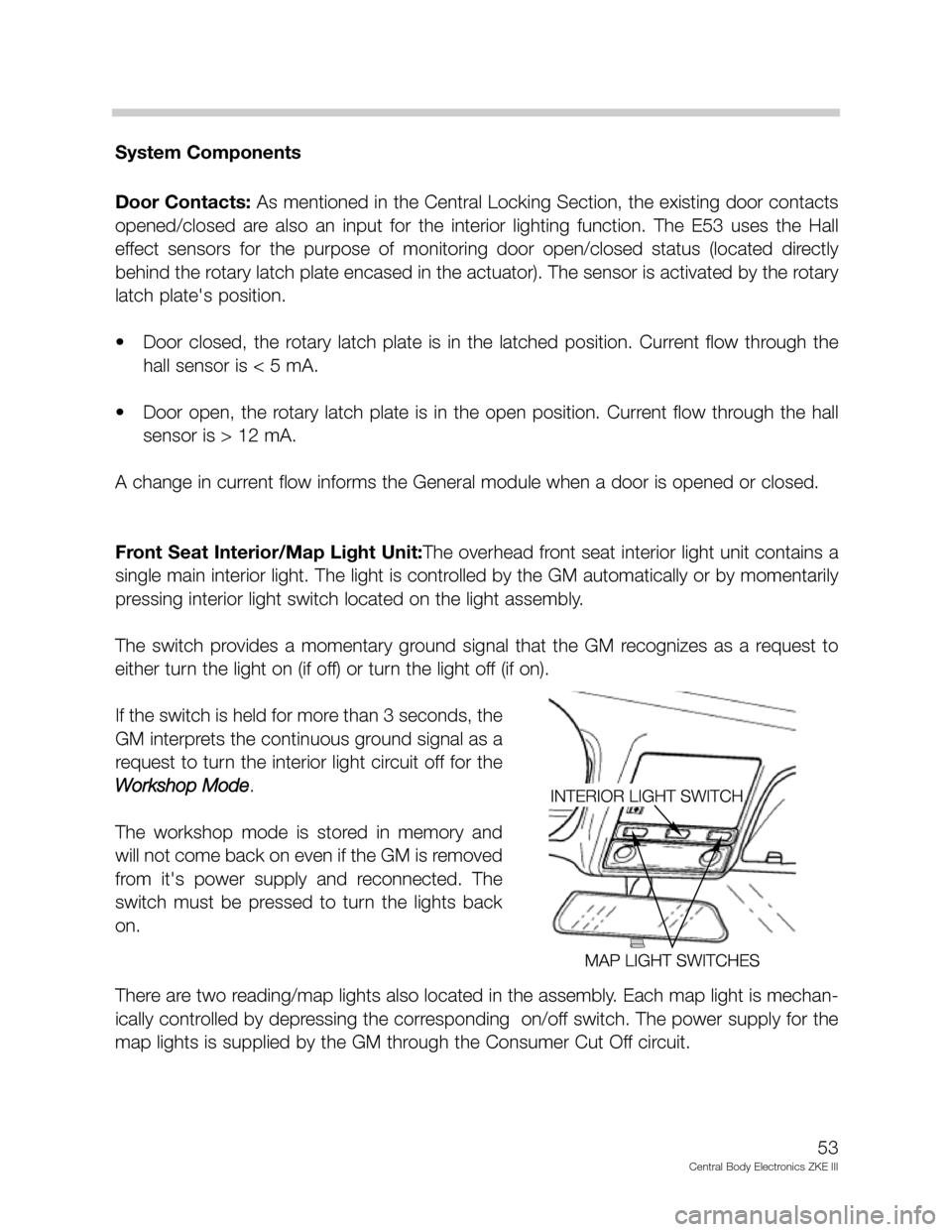
Front Seat Interior/Map Light Unit:The overhead front seat interior light unit contains a
single main interior light. The light is controlled by the GM automatically or by momentarily
pressing interior light switch located on the light assembly.
The switch provides a momentary ground signal that the GM recognizes as a request to
either turn the light on (if off) or turn the light off (if on).
If the switch is held for more than 3 seconds, the
GM interprets the continuous ground signal as a
request to turn the interior light circuit off for the
Workshop Mode
.
The workshop mode is stored in memory and
will not come back on even if the GM is removed
from it's power supply and reconnected. The
switch must be pressed to turn the lights back
on.
There are two reading/map lights also located in the assembly. Each map light is mechan-
ically controlled by depressing the corresponding on/off switch. The power supply for the
map lights is supplied by the GM through the Consumer Cut Off circuit.
53
Central Body Electronics ZKE III
Page 54 of 80
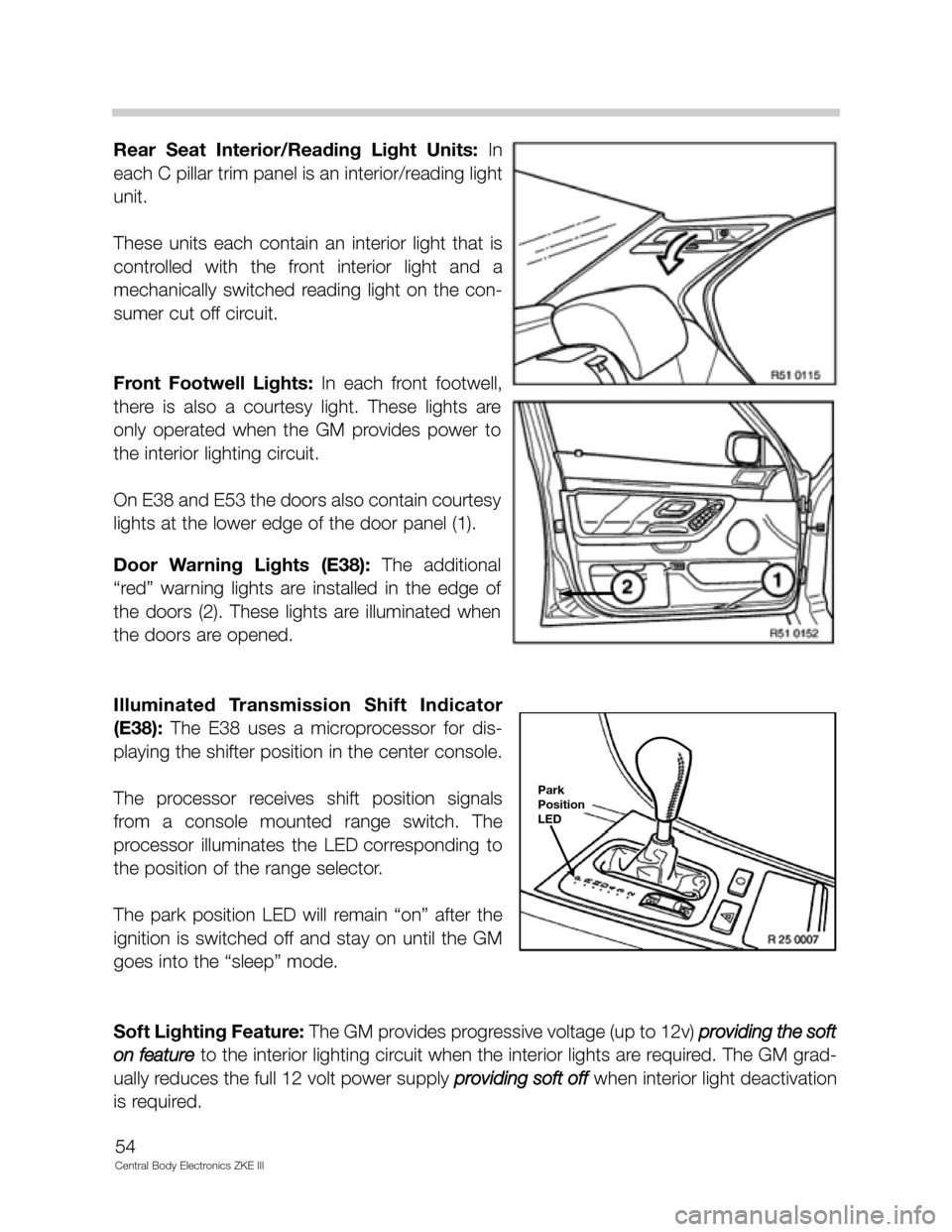
Rear Seat Interior/Reading Light Units: In
each C pillar trim panel is an interior/reading light
unit.
These units each contain an interior light that is
controlled with the front interior light and a
mechanically switched reading light on the con-
sumer cut off circuit.
Front Footwell Lights: In each front footwell,
there is also a courtesy light. These lights are
only operated when the GM provides power to
the interior lighting circuit.
On E38 and E53 the doors also contain courtesy
lights at the lower edge of the door panel (1).
Door Warning Lights (E38): The additional
“red” warning lights are installed in the edge of
the doors (2). These lights are illuminated when
the doors are opened.
Illuminated Transmission Shift Indicator
(E38): The E38 uses a microprocessor for dis-
playing the shifter position in the center console.
The processor receives shift position signals
from a console mounted range switch. The
processor illuminates the LED corresponding to
the position of the range selector.
The park position LED will remain “on” after the
ignition is switched off and stay on until the GM
goes into the “sleep” mode.
Soft Lighting Feature: The GM provides progressive voltage (up to 12v) providing the soft
on feature
to the interior lighting circuit when the interior lights are required. The GM grad-
ually reduces the full 12 volt power supply providing soft off
when interior light deactivation
is required.
54
Central Body Electronics ZKE III
Park
Position
LED
Page 55 of 80
Visual Entry Aid (E38/E53)
Purpose of the System
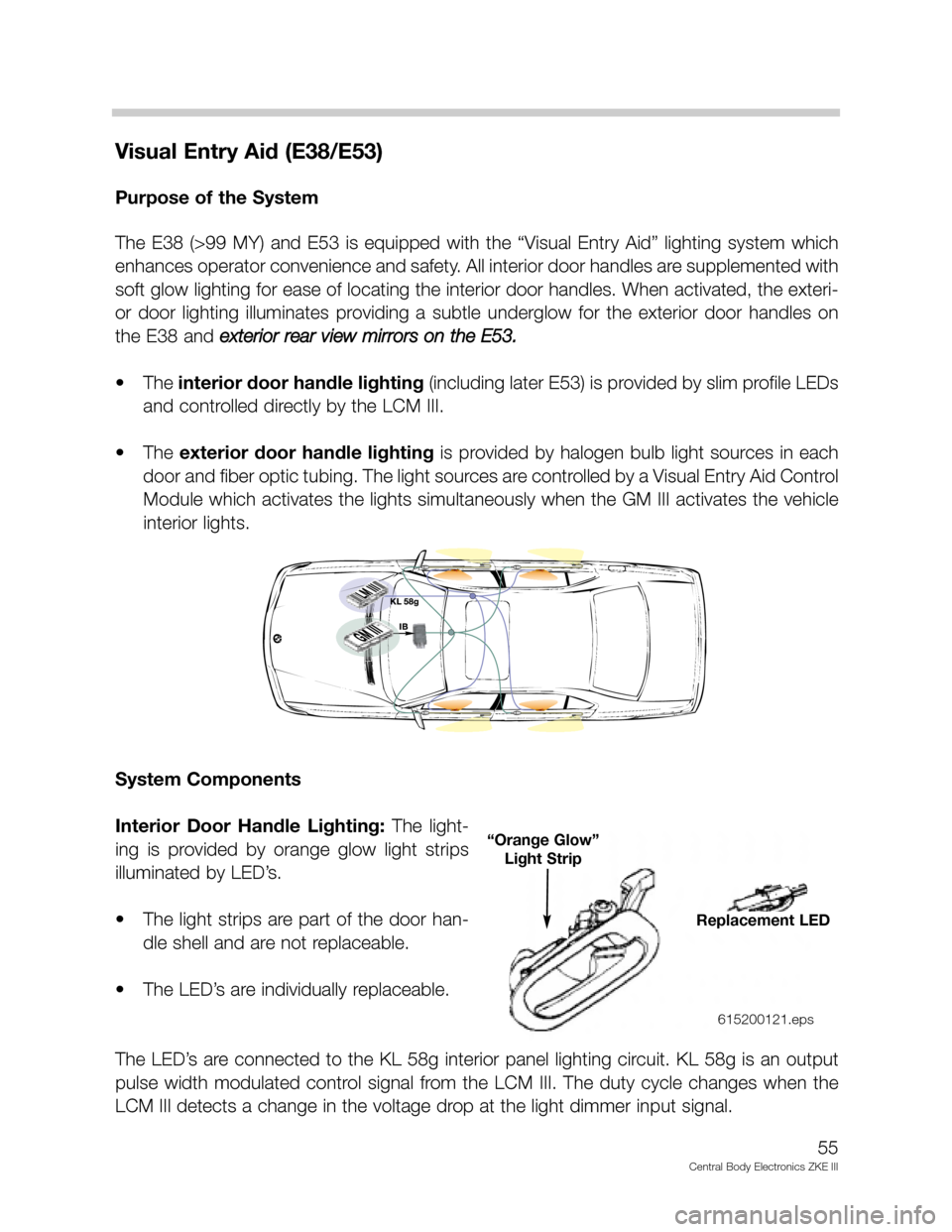
The E38 (>99 MY) and E53 is equipped with the “Visual Entry Aid” lighting system which
enhances operator convenience and safety. All interior door handles are supplemented with
soft glow lighting for ease of locating the interior door handles. When activated, the exteri-
or door lighting illuminates providing a subtle underglow for the exterior door handles on
the E38 and exterior rear view mirrors on the E53.
• The interior door handle lighting(including later E53) is provided by slim profile LEDs
and controlled directly by the LCM III.
• The exterior door handle lightingis provided by halogen bulb light sources in each
door and fiber optic tubing. The light sources are controlled by a Visual Entry Aid Control
Module which activates the lights simultaneously when the GM III activates the vehicle
interior lights.
System Components
Interior Door Handle Lighting: The light-
ing is provided by orange glow light strips
illuminated by LED’s.
• The light strips are part of the door han-
dle shell and are not replaceable.
• The LED’s are individually replaceable.
The LED’s are connected to the KL 58g interior panel lighting circuit. KL 58g is an output
pulse width modulated control signal from the LCM III. The duty cycle changes when the
LCM III detects a change in the voltage drop at the light dimmer input signal.
55
Central Body Electronics ZKE III
Replacement LED
“Orange Glow”
Light Strip
615200121.eps
Page 56 of 80
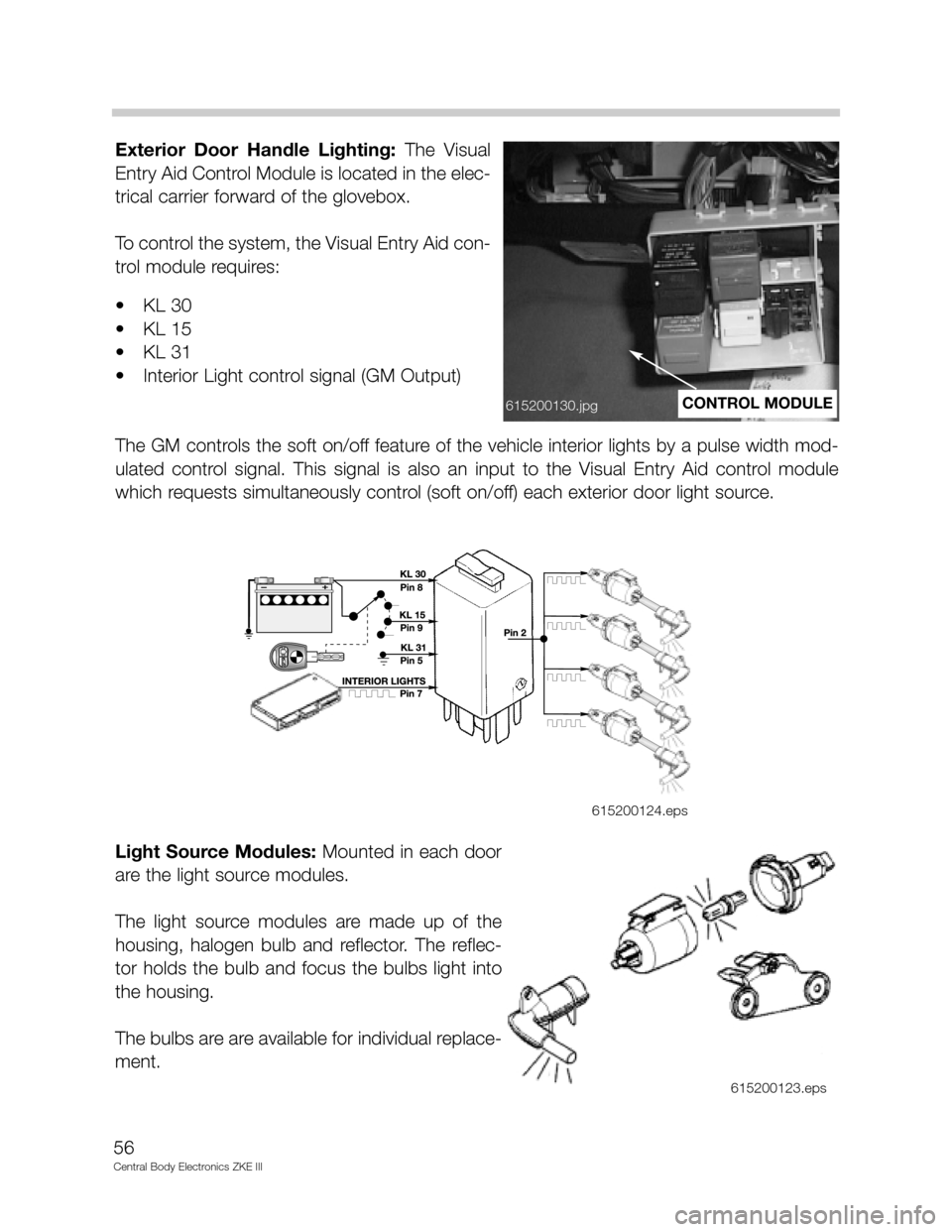
Exterior Door Handle Lighting: The Visual
Entry Aid Control Module is located in the elec-
trical carrier forward of the glovebox.
To control the system, the Visual Entry Aid con-
trol module requires:
• KL 30
• KL 15
• KL 31
• Interior Light control signal (GM Output)
The GM controls the soft on/off feature of the vehicle interior lights by a pulse width mod-
ulated control signal. This signal is also an input to the Visual Entry Aid control module
which requests simultaneously control (soft on/off) each exterior door light source.
Light Source Modules: Mounted in each door
are the light source modules.
The light source modules are made up of the
housing, halogen bulb and reflector. The reflec-
tor holds the bulb and focus the bulbs light into
the housing.
The bulbs are are available for individual replace-
ment.
56
Central Body Electronics ZKE III
CONTROL MODULE
615200123.eps 615200124.eps 615200130.jpg
Page 57 of 80
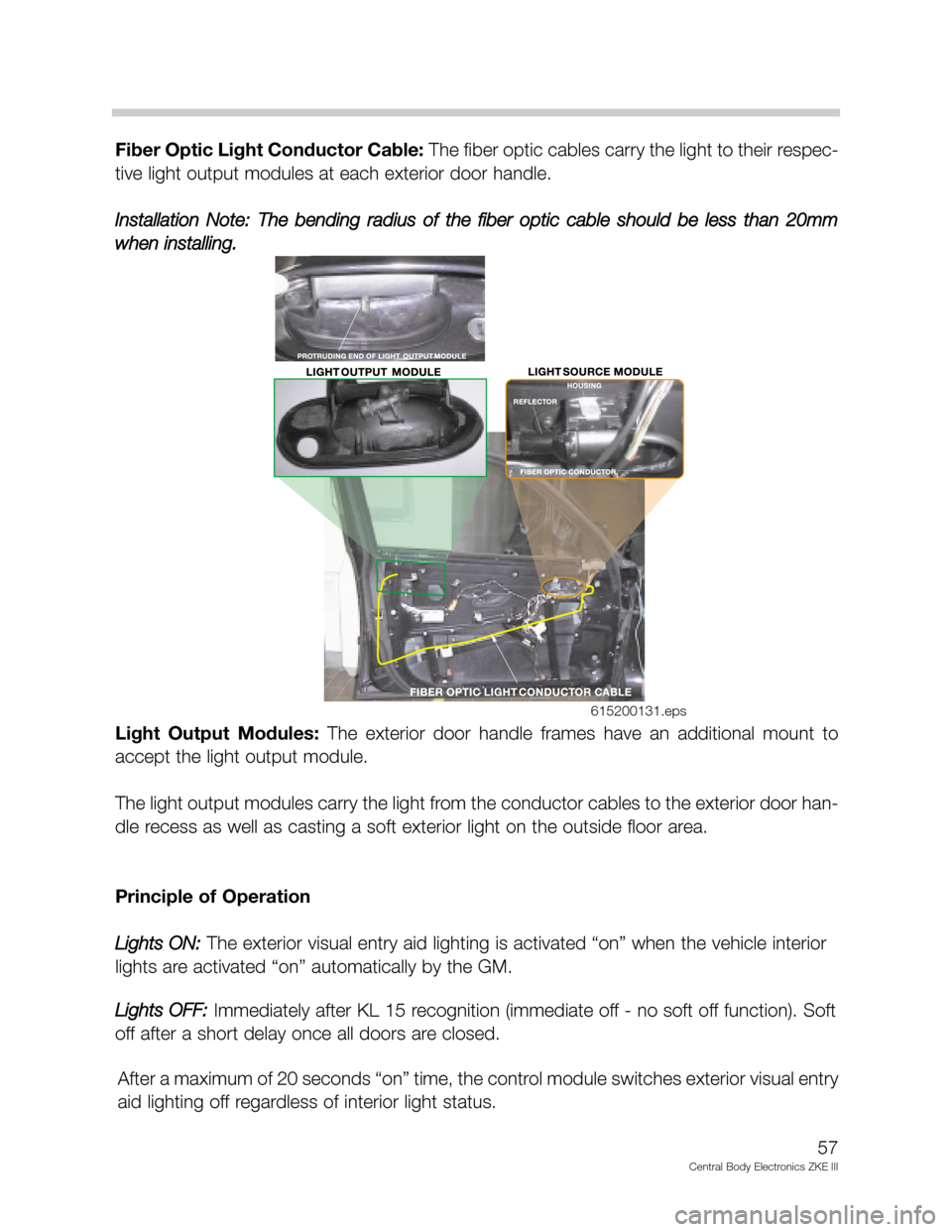
Fiber Optic Light Conductor Cable:The fiber optic cables carry the light to their respec-
tive light output modules at each exterior door handle.
Installation Note:The bending radius of the fiber optic cable should be less than 20mm
when installing.
Light Output Modules: The exterior door handle frames have an additional mount to
accept the light output module.
The light output modules carry the light from the conductor cables to the exterior door han-
dle recess as well as casting a soft exterior light on the outside floor area.
Principle of Operation
Lights ON:
The exterior visual entry aid lighting is activated “on” when the vehicle interior
lights are activated “on” automatically by the GM.
Lights OFF:
Immediately after KL 15 recognition (immediate off - no soft off function). Soft
off after a short delay once all doors are closed.
After a maximum of 20 seconds “on” time, the control module switches exterior visual entry
aid lighting off regardless of interior light status.
57
Central Body Electronics ZKE III
615200131.eps
Page 58 of 80
Seat/Mirror/Steering Column Memory
Purpose of the System
The front seats, outside rearview mirrors and steering column (if equipped) positions are
electrically adjustable. The “customized” adjustment positions can be memorized and
stored for three diferent users and recalled back to the individual positions (with the excep-
tion of the passenger seat - not in memory).
The basic features of seat/mirror/steering column operation, as well as the memory posi-
tions is integrated into the ZKE III system.
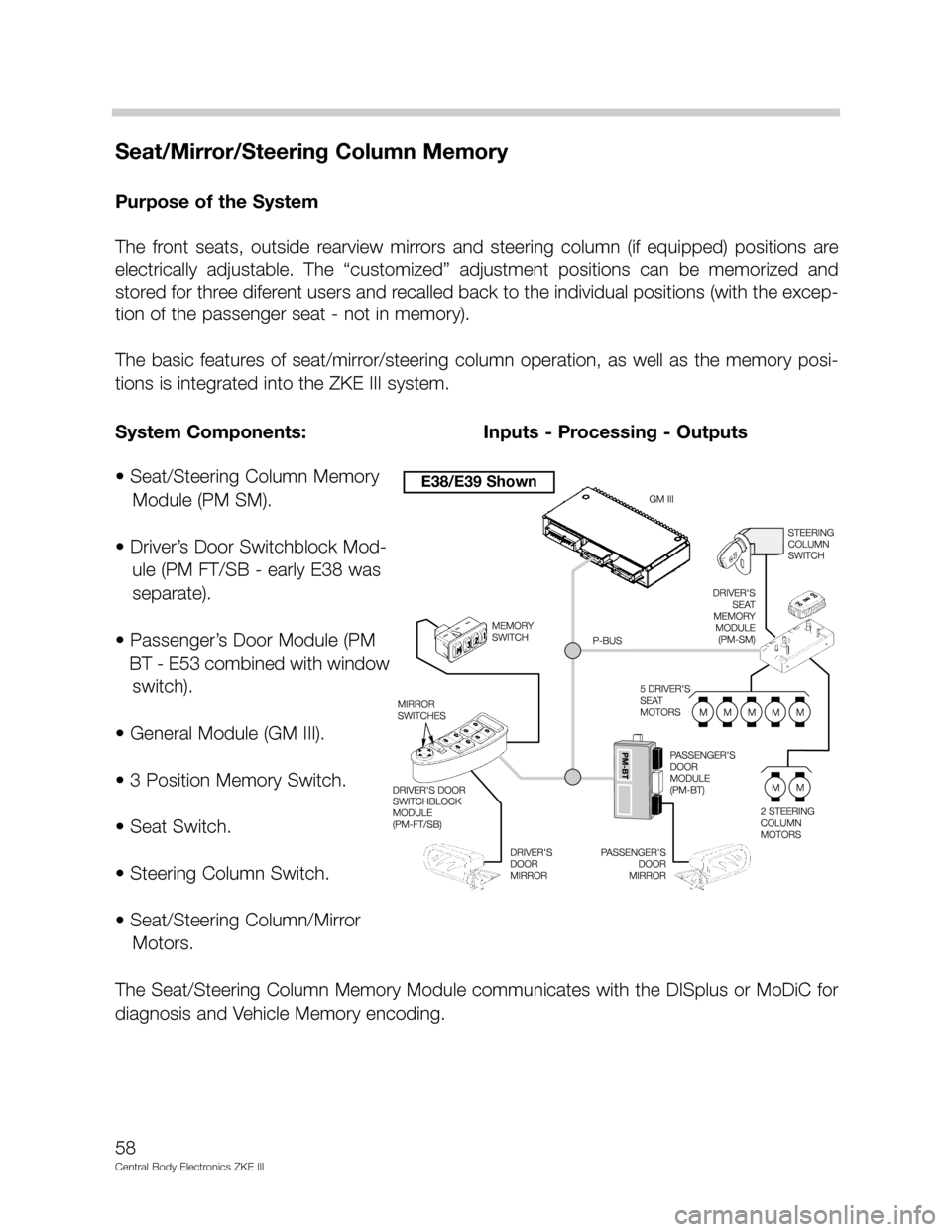
• Seat/Steering Column Memory
Module (PM SM).
• Driver’s Door Switchblock Mod-
ule (PM FT/SB - early E38 was
separate).
• Passenger’s Door Module (PM
BT - E53 combined with window
switch).
• General Module (GM III).
• 3 Position Memory Switch.
• Seat Switch.
• Steering Column Switch.
• Seat/Steering Column/Mirror
Motors.
The Seat/Steering Column Memory Module communicates with the DISplus or MoDiC for
diagnosis and Vehicle Memory encoding.
58
Central Body Electronics ZKE III
System Components: Inputs - Processing - Outputs
E38/E39 Shown