410 BMW 525i 2001 E39 User Guide
[x] Cancel search | Manufacturer: BMW, Model Year: 2001, Model line: 525i, Model: BMW 525i 2001 E39Pages: 1002
Page 260 of 1002
Downloaded from www.Manualslib.com manuals search engine
1 17-24
I Camshaft Timing Chain
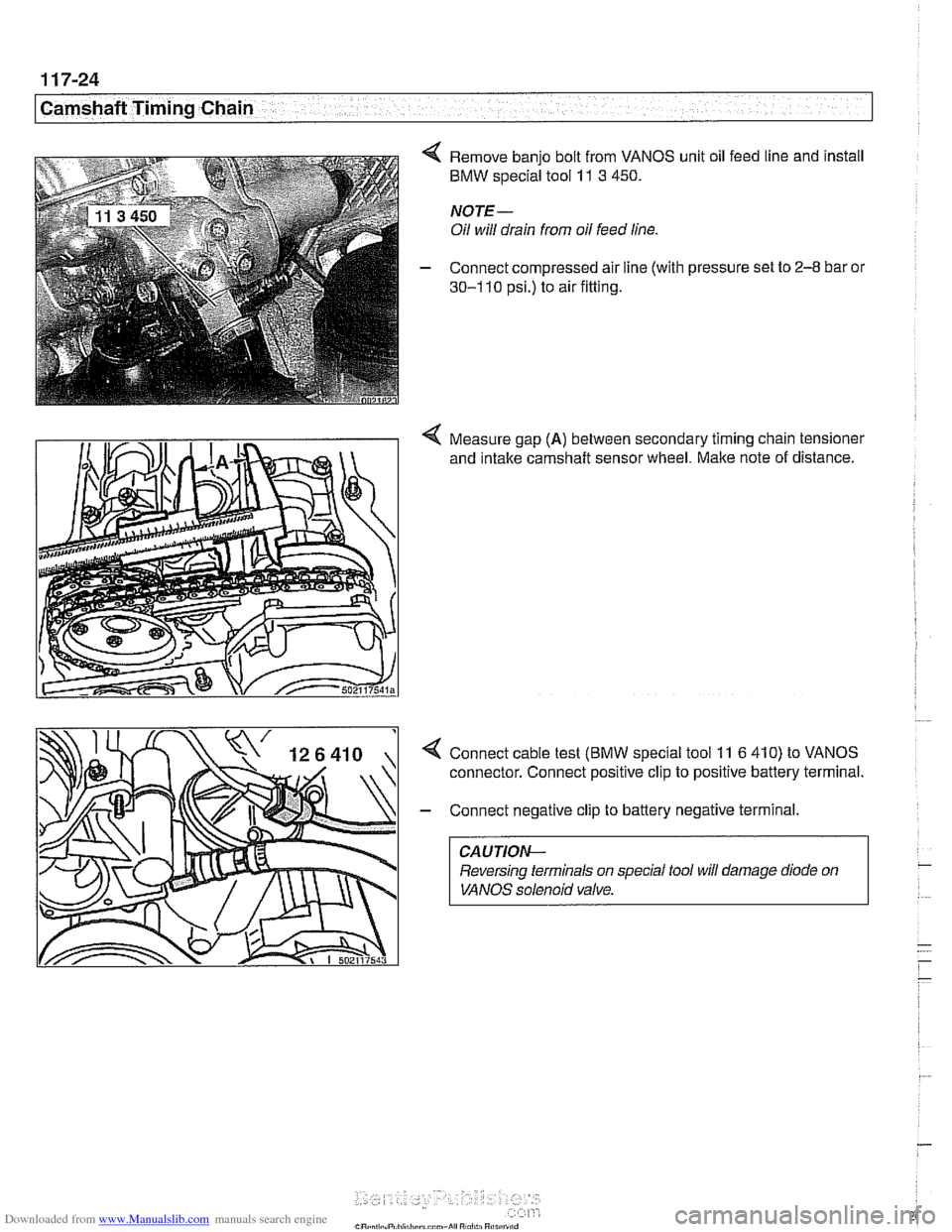
4 Remove banjo bolt from VANOS unit oil feed line and install
BMW special tool 11 3 450.
NOTE-
Oil will drain from oil feed line.
- Connect compressed air line (with pressure set to 2-8 bar or
30-1 10 psi.) to air fitting.
4 Measure gap (A) between secondary timing chain tensioner
and
intake camshaft sensor wheel. Make note of distance.
4 Connect cable test (BMW special tool 11 6 410) to VANOS
connector. Connect positive clip to positive battery terminal.
- Connect negative clip to battery negative terminal.
CAUTION-
Reversing terminals on special tool will damage diode on
VANOS solenoid valve.
Page 263 of 1002
Downloaded from www.Manualslib.com manuals search engine
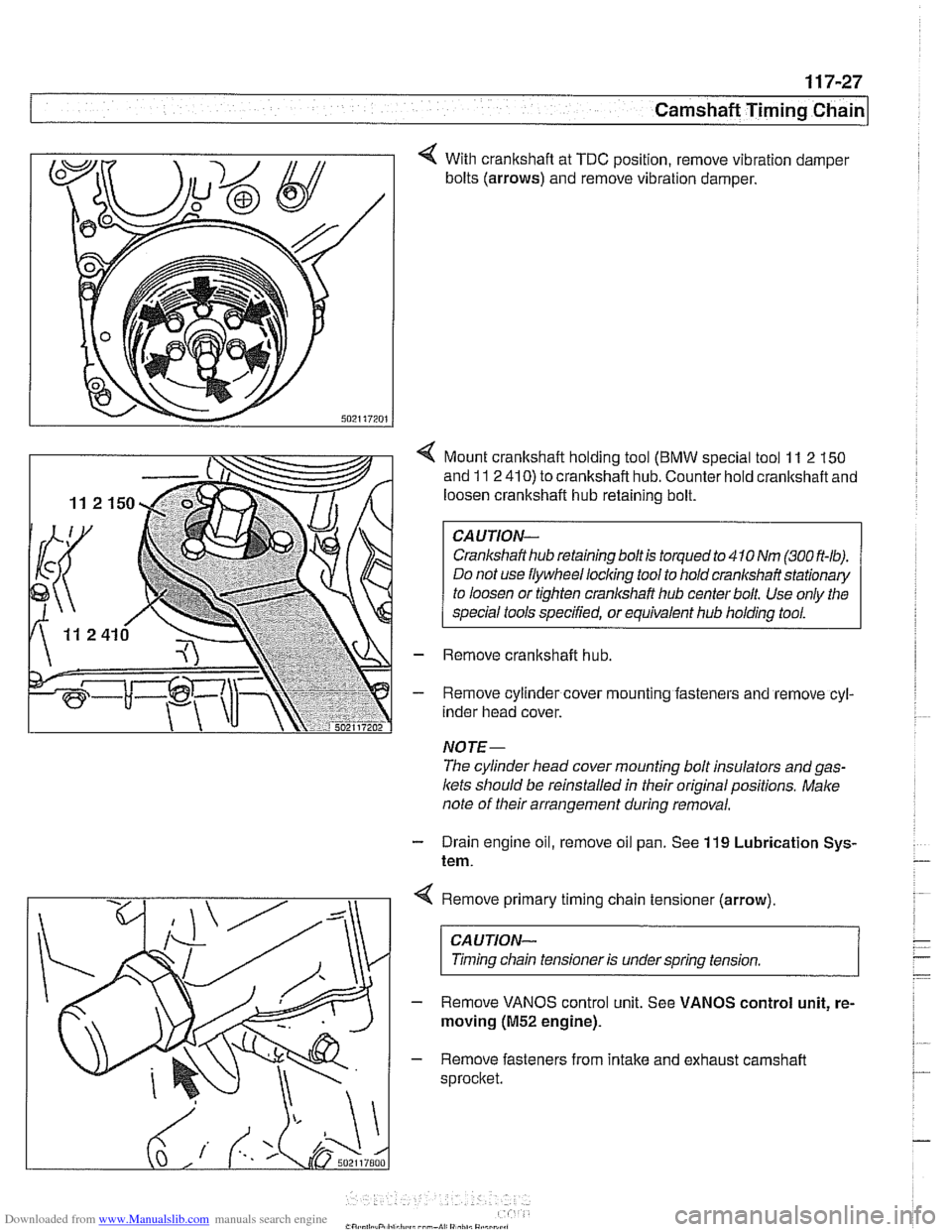
4 With crankshaft at TDC position, remove vibration damper
bolts (arrows) and remove vibration damper.
< Mount crankshaft holding tool (BMW special tool 11 2 150
and
11 2 410) to crankshaft hub. Counter hold crankshaft and
loosen crankshaft hub retaining bolt.
Crankshaft hub retaining bolt is torqued to
410 Nm (300 ft-lb).
Do not use flywheel
locliing tool to hold cranl(shait stationary
to loosen or tighten crankshaft hub center bolt. Use only the
special tools specified, or equivalent hub holding tool.
- Remove crankshaft hub.
- Remove cylinder cover mounting fasteners and remove cyl-
inder head cover.
NOTE-
The cylinder head cover mounting bolt insulators and gas-
lets should be reinstalled in their original positions. Make
note of their arrangement during removal.
- Drain engine oil, remove oil pan. See 119 Lubrication Sys-
tem.
Remove primary timing chain tensioner (arrow).
CAUTION-
Timing chain tensioner is under spring tension. I
- Remove VANOS control unit. See VANOS control unit, re-
moving
(M52 engine).
- Remove fasteners from intake and exhaust camshaft
sprocket.
Page 268 of 1002
Downloaded from www.Manualslib.com manuals search engine
-- -
Chain 1
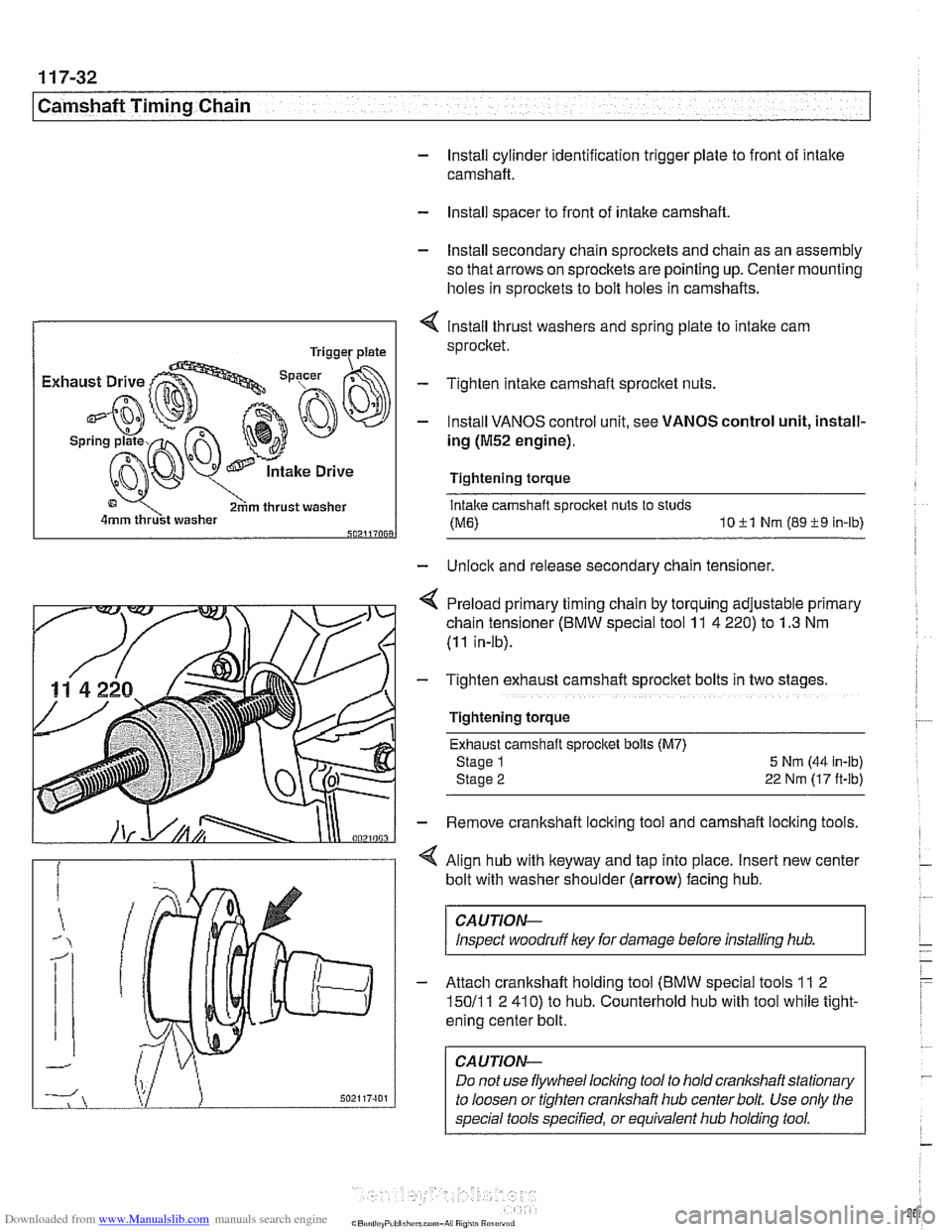
- Install cylinder identification trigger plate to front of intake
camshaft.
- Install spacer to front of intake camshaft
- Install secondary chain sprockets and chain as an assembly
so that arrows on sprockets are pointing up. Center mounting
holes in sprockets to bolt holes in camshafts.
4 lnstall thrust washers and spring plate to intake cam
sprocket.
Tighten intake camshaft sprocket nuts.
- Install VANOS control unit, see VANOS control unit, install-
ing
(M52 engine).
Tightening torque
Intake camshaft sprocket nuts to studs
(ME) 1011 Nm (8919 In-lb) 502117068
- Unlock and release secondary chain tensioner,
4 Preload primary timing chain by torquing adjustable primary
chain tensioner (BMW special tool
11 4 220) to 1.3 Nm
(11 in-lb).
- Tighten exhaust camshaft sprocket bolts in two stage
Tightening torque Exhaust camshaft sprocket bolls (M7)
Stage 1
5 Nrn (44 in-lb)
Stage
2 22 Nm (17 ft-lb)
- Remove crankshaft locking tool and camshaft locking tools.
< Align hub with keyway and tap into place. Insert new center
bolt with washer shoulder (arrow) facing hub.
CAUTION-
Inspect woodruff ley for damage before installing hub.
- Attach crankshaft holding tool (BMW special tools 11 2
15011 1 2 410) to hub. Counterhold hub with tool while tight-
ening center bolt.
CAUTION-
Do not use flywheel locling tool to hold crankshaft stationary
to loosen or tighten
cranlshaft hub center bolt. Use only the
special tools specified, or equivalent hub holding tool.
Page 269 of 1002

Downloaded from www.Manualslib.com manuals search engine
-- Camshaft Timing Chain -- -
Tightening torque
Vibration damper hub to crankshaft
410 Nm (300 ft-lb)
4 Install cranltshaft hub and vibration damper while aligning
locating hole (arrow) in damper with dowel pin in hub.
Tightening torque
Vibration damper and
pulley to
cranltshaft hub
22 Nm (17 ft-lb)
- Turn engine over by hand in direction of rotation at least two
full rotations. Reinstall camshaft and crankshaft locking
toois
to recheck engine timing. Remove locking tools if no faults
are found.
- Remove BMW special tool 11 3 390 (dummy tensioner) from
side of cyiinder head.
- Install primary chain tensionerso that cutout in tensioner pis-
ton engages chain rail.
Tightening torque
Timing chain tensioner to tensioner sleeve
70 Nm (52 ft-ib)
- Install cylinder head cover mounting studs, camshaft cover,
and cylinder head cover.
Tightening torque Cylinder head cover to cyiinder head
M6 nut 10 Nm (89 in-lb)
MB bolt 22 Nm (17 ft-lb)
- installation of remaining parts is reverse of removal, noting
the following:
When installing thermostat, make sure arrow or vent hole
faces up, if applicable.
Refill cooling system as described in
170 Radiator and
Cooling System.
Fill engine with oil and install new
oil filter as described in
020 Maintenance.
Tightening torque Upper timing chain cover to cylinder head
M6 nut 10 Nm (89 in-lb)
MB bolt 22 Nm (17 ft-lb)
VANOS oil supply pipe to VANOS control
unit banjo bolt
32 Nm (24 ft-ib)
Page 292 of 1002
Downloaded from www.Manualslib.com manuals search engine
~ ~~ ~
I Camshaft Timing Chain I --
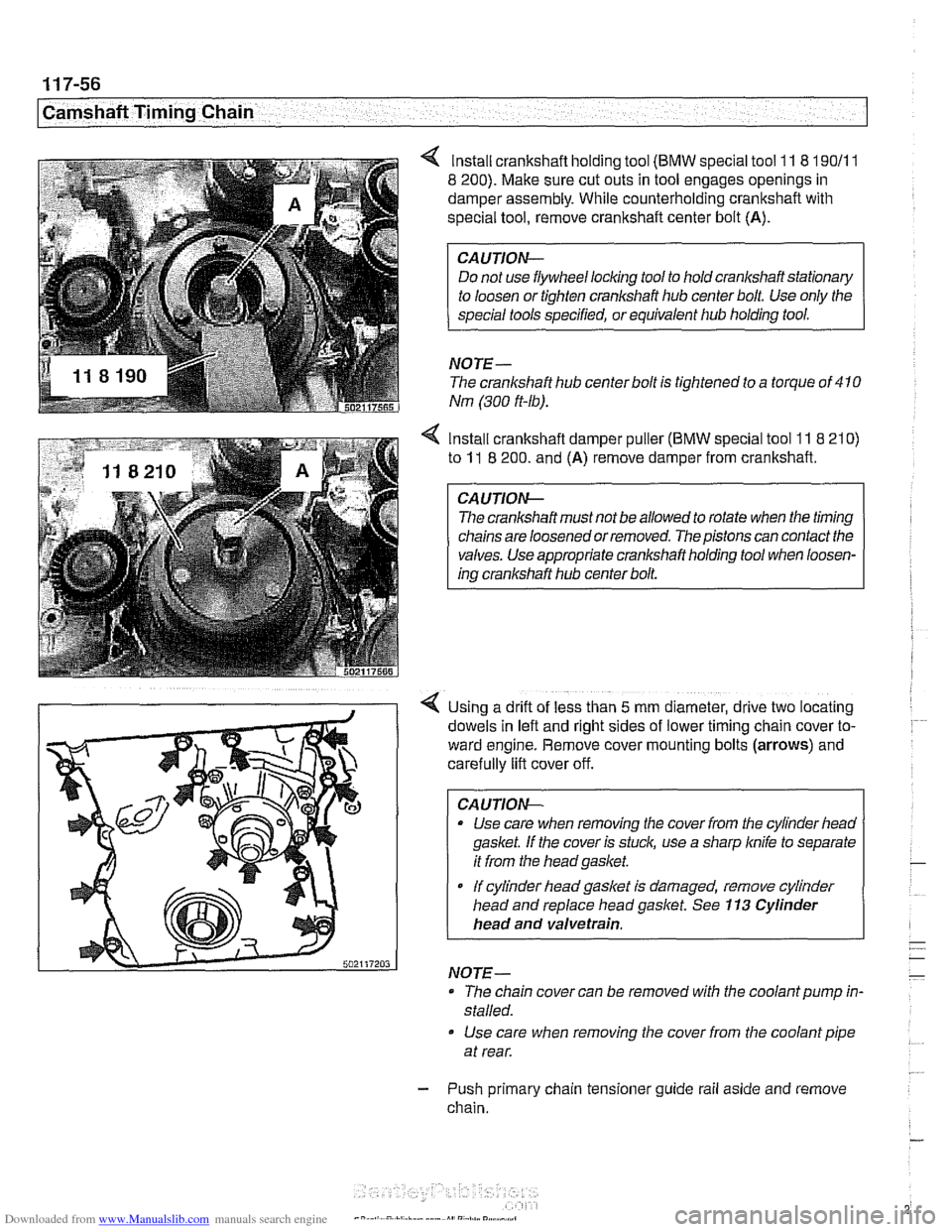
lnstall crankshaft holding tool (BMW special tool 11 8 190/11
8 200). Make sure cut outs in tool engages openings in
damper assembly. While counterholding crankshaft with
special tool, remove crankshaft center bolt (A).
CAUTION-
Do not use flywheel locking tool to hold crankshaft stationary
NOTE-
The crankshaft hub centerbolt is tightened to a torque of 410
Nm (300 ft-lb).
4 Install crankshaft damper puller (BMW special tool 11 8 210)
to 11 8 200. and (A) remove damper from crankshaft.
The crankshaft must not be allowed to rotate when the timing
chains are loosened or removed. The pistons can contact the
valves. Use appropriate crankshaft holding tool when loosen-
ing crankshaft hub center bolt.
Using a drift of less than
5 mm diameter, drive two locating
dowels in left and right sides of lower timing
cham cover to-
ward engine. Remove cover mounting bolts
(arrows) and
carefully lift cover off.
CA
UTION-
* Use care when removing the cover from the cylinder heao
gasket. If the cover is stuck, use a sharp
knife to separate
it from the headgasket.
If cylinder liead gasket Is damaged, remove cylinder
head and replace head gasket. See
113 Cylinder
head and valvetrain.
NOTE-
- The chain cover can be removed with the coolant pump in-
stalled.
Use care when removing the cover from the coolant pipe
at rear.
- Push primary chain tensioner guide rail aside and remove
chain.
Page 294 of 1002
Downloaded from www.Manualslib.com manuals search engine
(camshaft Timing Chain
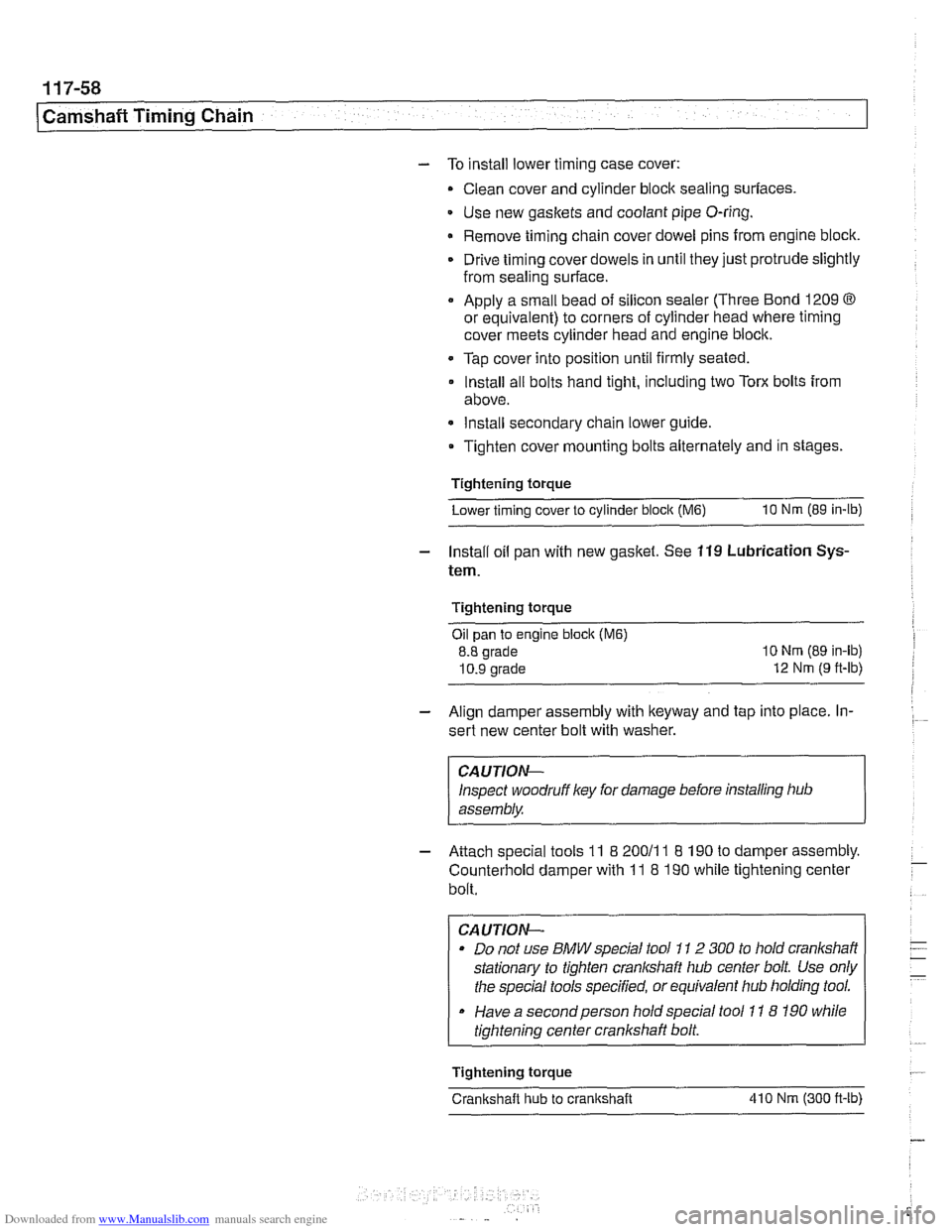
- To install lower timing case cover:
- Clean cover and cylinder block sealing surfaces
Use new
gaskets and coolant pipe O-ring.
Remove timing chain cover dowel pins from engine block.
Drive timing cover dowels in until they just protrude slightly
from sealing surface.
Apply a small bead of silicon sealer (Three Bond 1209
63
or equivalent) to corners of cylinder head where timing
cover meets cylinder head and engine block.
Tap cover into position until firmly seated.
lnstall all bolts hand tight, including two Torx bolts from
above.
Install secondary chain lower guide.
Tighten cover mounting bolts alternately and in stages.
Tightening torque
Lower timing cover to cylinder
bloclc (M6) 10 Nrn (89 in-lb)
- Install oil pan with new gasket. See 119 Lubrication Sys-
tem.
Tightening torque
Oil pan
to engine bloclc (M6)
8.8 grade
10.9 grade 10 Nrn (89 in-lb)
12 Nm
(9 ft-lb)
- Align damper assembly with lteyway and tap into place. In-
sert new center bolt with washer.
CAUTION-
Inspect woodruff key for damage before installing hub
assembly.
- Attach special tools 11 8 20011 1 8 190 to damper assembly.
Counterhold damper with
11 8 190 while tightening center
bolt.
CAUTION-
Do not use BMW special tool 1 I 2 300 to hold crankshaft
stationary to tighten cranl(shaft hub center bolt. Use only
the special tools specified, or equivalent hub holding tool.
Have a second person hold special tool
11 8 190 while
tightening center crankshaft bolt.
Tightening torque Crankshaft hub to crankshaft 410 Nrn
(300
ft-lb)
Page 305 of 1002
Downloaded from www.Manualslib.com manuals search engine
-
Camshaft Timing chain1
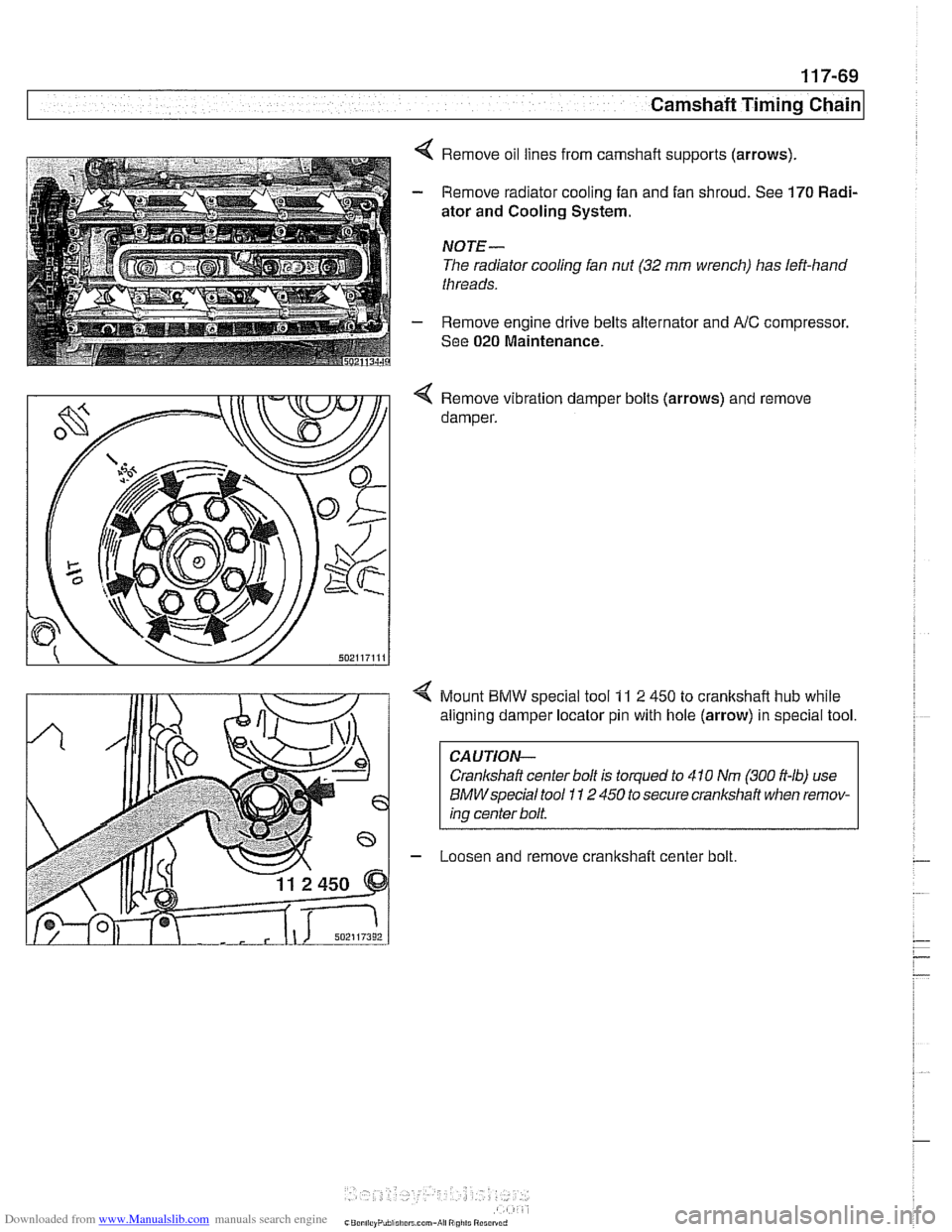
4 Remove oil lines from camshaft supports (arrows).
- Remove radiator cooling fan and fan shroud. See 170 Radi-
ator and Cooling System.
NOTE-
The radiator cooling fan nut (32 mm wrench) has left-hand
threads.
- Remove engine drive belts alternator and AlC compressor.
See
020 Maintenance.
4 Remove vibration damper bolts (arrows) and remove
damper.
4 Mount BMW special tool 11 2 450 to crankshaft hub while
aligning damper locator pin with hole (arrow) in special tool.
CAUTION-
Crankshaft center bolt is torqued to 410 Nm (300 ft-lb) use
BMWspecial tool I I 2 450 to secure crankshaft when remov-
ing center bolt.
- Loosen and remove cranltshaff center bolt.
Page 797 of 1002
Downloaded from www.Manualslib.com manuals search engine
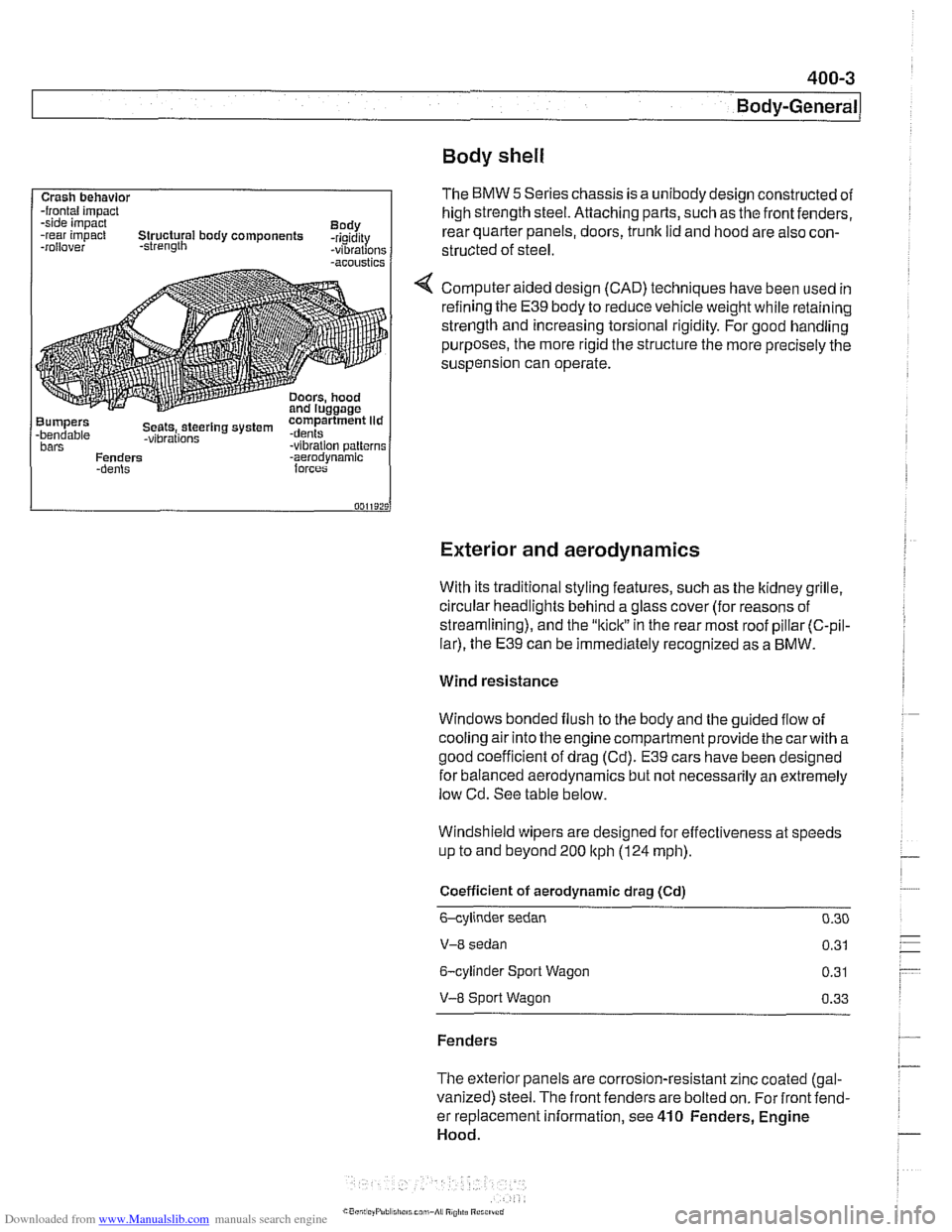
Body shell
Exterior and aerodynamics
Crash behavlor -frontal impact
-side impact
Body
-rear impact Structural body components -rigidity
-rollover -strength -vibrations -acoustics
Bumpers compartment lid -bendable Seets,.steerlng system .dents -vibrations bars -vibration patterns
Fenders -aerodvnamic
With its traditional styling features, such as the ltidney grille.
circular headlights behind a glass cover (for reasons of
streamlining), and the
"kiclt" in the rear most roof pillar (C-pil-
lar), the E39 can be immediately recognized as a BMW.
The BMW 5 Series chassis is a unibody design constructed of
high strength steel. Attaching parts, such as the front fenders,
rear quarter panels, doors,
trunk lid and hood are also con-
structed of
steel.
Computer aided design (CAD) techniques have been used in
refining the
E39 body to reduce vehicle weight while retaining
strength and increasing torsional rigidity. For good handling
purposes, the more rigid the structure the more precisely the
suspension can operate.
Wind resistance
Windows bonded flush to the body and the guided flow of
cooling air into the engine compartment provide the
carwith a
good coefficient of drag (Cd).
E39 cars have been designed
for balanced aerodynamics but not necessarily an extremely
low Cd. See table below.
Windshield wipers are designed for effectiveness at speeds
up to and beyond 200
ltph (124 mph).
Coefficient of aerodynamic drag (Cd)
6-cylinder sedan 0.30
V-8 sedan 0.31
6-cylinder Sport Wagon 0.31
V-8 Sport Wagon 0.33
Fenders
The exterior panels are corrosion-resistant zinc coated (gal-
vanized) steel. The front fenders are bolted on. For front fend-
er replacement information, see
410 Fenders, Engine
Hood.
Page 807 of 1002
Downloaded from www.Manualslib.com manuals search engine
1 410 Fenders. Engine Hood
General ........................... .41 0.2 Engine Hood ...................... 410-6
Special tools ........................ .41 0.2 Hood, raising to service position ......... 410-6
........... Hood. removing and installing 41 0-7 Front Fenders ..................... .41 0.2 Hood. aligning ....................... 41 0-8 Front fender. removing and installing ..... .41 0.2 Hood latch components ............... 41 0-10
Hood release cable and
spring pins, adjusting
................. 410-1 1
Page 994 of 1002
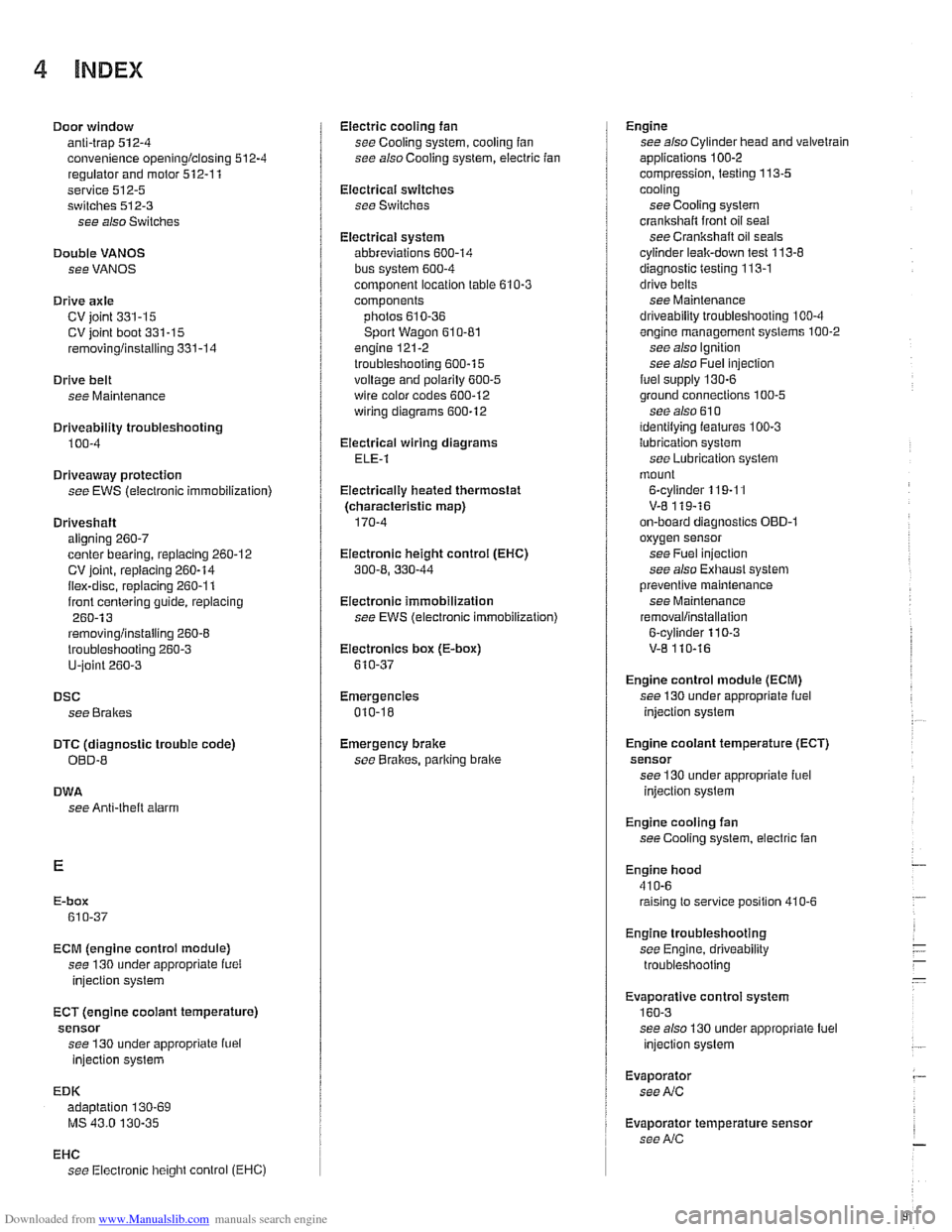
Downloaded from www.Manualslib.com manuals search engine
4 INDEX
Door window anti-trap
512-4 convenience openinglclosing 512.4
regulator and motor 512-1 1
service
512-5 switches 512-3
see also Switches
Double
VANOS see VANOS
Drive
axle
CV joint 331-15 CV joint boot 331-15
rernovinglinstalling 331-14
Drive belt
see Maintenance
Driveabiiity troubleshooting
100-4
Driveaway protection
see EWS (eiectronic immobilization)
Driveshaft aligning
260-7
center bearing, replacing 260-12 CV joint, replacing 260-14
itex-disc, replacing 260-1 1
iront centering guide, replacing 260-13
rernovinglinstailing 260-6
lroubleshooting 260-3
U-joint 260-3
DSC
see Braires
DTC (diagnostic trouble code)
OBD-8
DWA
see Anti-theft alarm
ECM (engine control module)
see 130 under appropriate
iuei
injection system
ECT (engine coolant temperature)
sensor see 130 under appropriate
iuei
injection system
EDK adaptation
130-69
MS 43.0 130-35
EHC see Electronic iieigiit control (EHC)
Electric cooling fan
see Cooling system, cooling
fan
see also Cooiing system, eiectric fan
Electrical switches
see Switches
Electrical system abbreviations
600-14 bus System 600-4
component location table 610-3
components
photos
610-36
Sport Wagon 610-81 engine 121-2
troubleshooting 600-15
voltage and polarily 600-5 wire color codes 600-12
wiring diagrams 600-12
Electrical wiring diagrams
ELE-1
Eiectricaliy heated thermostat
(characteristic map)
170-4
Eiectronic height control (EHC)
300-8, 330-44
Eiectronic immobilization
see EWS (electronic immobilization)
Eiectronics box
(E-box)
610-37
Emergencies
010-18
Emergency brake see
BraBes, parking brake Engine
see also Cylinder head and valvetrain
applications
100-2
compression, testing 113-5
cooling see Cooiing system
crankshaft front oil seai
see Crankshaft oil seals
cyiinder leak-down test 113-8
diagnostic testing 113-1
drive belts
see Maintenance
driveability troubleshooting
100-4
engine management systems 100-2
see also Ignition
see also Fuel injection
fuel supply
130-6
ground connections 100-5
see also 61 0 identilying ieatures 100-3
lubrication svstem
see
~ubricetion system
mount
on-board diagnostics
OBD-I
oxygensensor
see Fuel injection
see also Exhaust system
Dreventive maintenance
see Maintenance
removal/installation
Engine control module (ECM)
see 130 under appropriate iuel
injection system
Engine cooiant temperature (ECT)
sensor see 130 under appropriate iuel
injection
system
Engine cooling fan
see Cooiing system, electric fan
Engine hood
41
0-6 raising to service position 410-6
Engine troubleshooting
see Engine, driveability troubleshooting
EVa~oratiVe control svstem
160-3 see also 130 under aDDroDriate iuel
injection system
Evaporator see
NC
Evaporator temperature sensor see
NC