trunk BMW 525i 2001 E39 User Guide
[x] Cancel search | Manufacturer: BMW, Model Year: 2001, Model line: 525i, Model: BMW 525i 2001 E39Pages: 1002
Page 797 of 1002
Downloaded from www.Manualslib.com manuals search engine
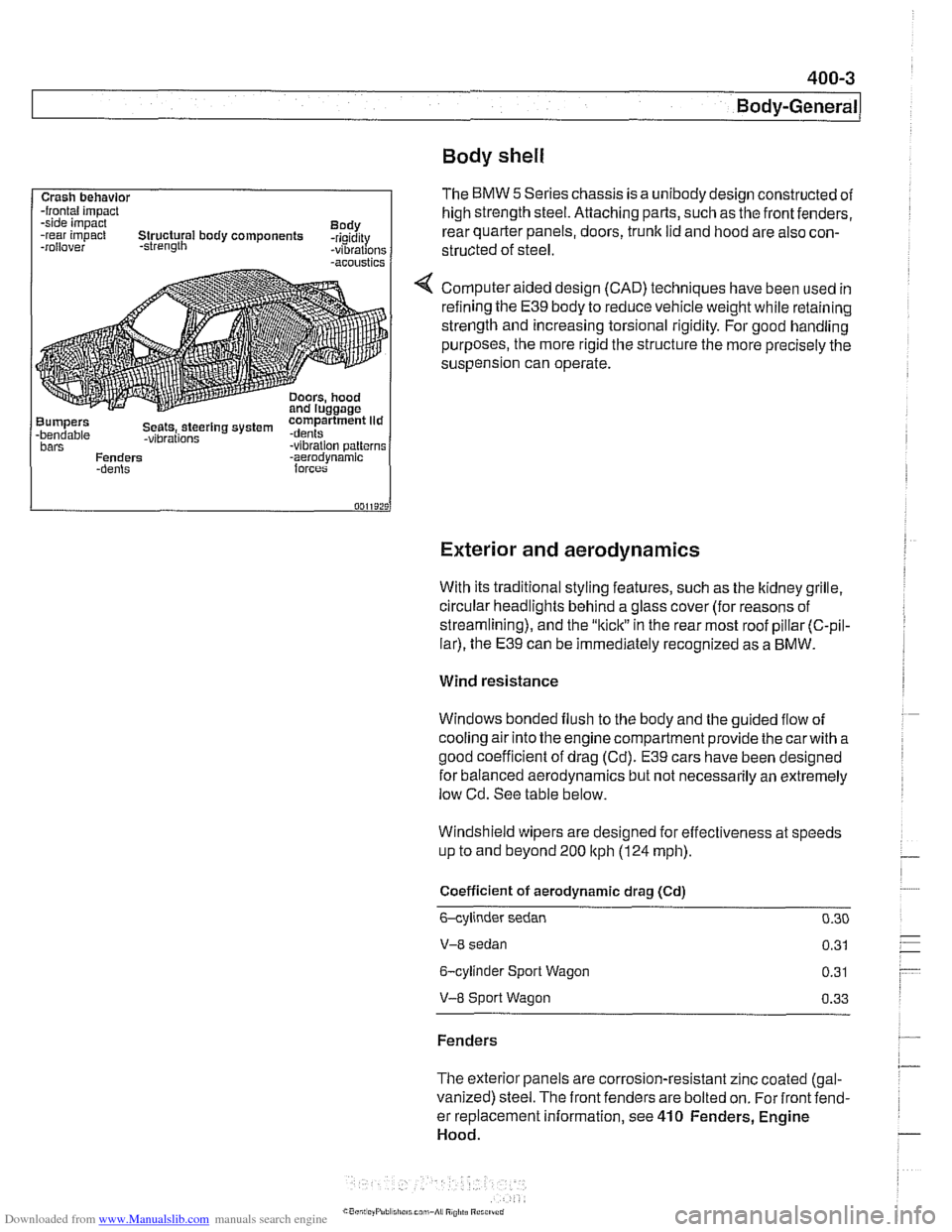
Body shell
Exterior and aerodynamics
Crash behavlor -frontal impact
-side impact
Body
-rear impact Structural body components -rigidity
-rollover -strength -vibrations -acoustics
Bumpers compartment lid -bendable Seets,.steerlng system .dents -vibrations bars -vibration patterns
Fenders -aerodvnamic
With its traditional styling features, such as the ltidney grille.
circular headlights behind a glass cover (for reasons of
streamlining), and the
"kiclt" in the rear most roof pillar (C-pil-
lar), the E39 can be immediately recognized as a BMW.
The BMW 5 Series chassis is a unibody design constructed of
high strength steel. Attaching parts, such as the front fenders,
rear quarter panels, doors,
trunk lid and hood are also con-
structed of
steel.
Computer aided design (CAD) techniques have been used in
refining the
E39 body to reduce vehicle weight while retaining
strength and increasing torsional rigidity. For good handling
purposes, the more rigid the structure the more precisely the
suspension can operate.
Wind resistance
Windows bonded flush to the body and the guided flow of
cooling air into the engine compartment provide the
carwith a
good coefficient of drag (Cd).
E39 cars have been designed
for balanced aerodynamics but not necessarily an extremely
low Cd. See table below.
Windshield wipers are designed for effectiveness at speeds
up to and beyond 200
ltph (124 mph).
Coefficient of aerodynamic drag (Cd)
6-cylinder sedan 0.30
V-8 sedan 0.31
6-cylinder Sport Wagon 0.31
V-8 Sport Wagon 0.33
Fenders
The exterior panels are corrosion-resistant zinc coated (gal-
vanized) steel. The front fenders are bolted on. For front fend-
er replacement information, see
410 Fenders, Engine
Hood.
Page 803 of 1002
Downloaded from www.Manualslib.com manuals search engine
400-9
Body-General
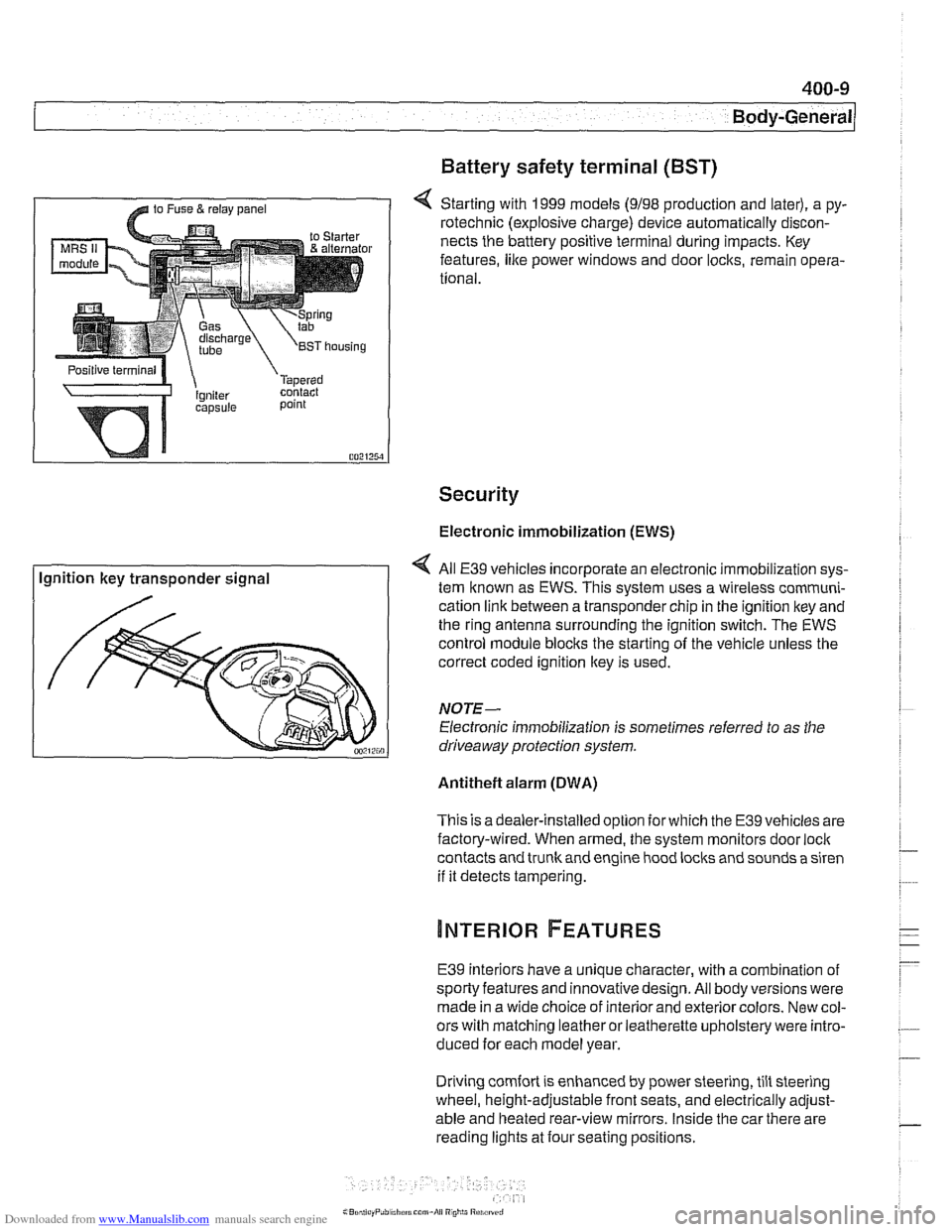
Battery safety terminal
(BST)
4 Starting with 1999 models (9198 production and later), a py-
rotechnic (explosive charge) device automatically discon-
nects the battery positive terminal during impacts. Key
features,
like power windows and door locks, remain opera-
tional.
Security
Electronic immobilization (EWS)
Ignition key transponder signal All
E39 vehicles incorporate an electronic immobilization sys-
tem known as EWS. This svstem uses a wireless comrnuni-
cation link between a transponder chip in the ignition key and
the ring antenna surrounding the ignition switch. The EWS
control module blocks the starting of the vehicle unless the
correct coded ignition key is used.
NOTE-
Electronic immobilization is sometimes referred to as the
driveaway protection system.
Antitheft alarm (DWA)
This is adealer-installed option for which the E39 vehicles are
factory-wired. When armed, the system monitors door
loci(
contacts and trunk and engine hood locks and sounds a siren
if it detects tampering.
E39 interiors have a unique character, with a combination
of
sporty features and innovativedesign. All body versions were
made in a wide choice of interior and exterior colors. New col-
ors with matching leather or leatherette upholstery were intro-
duced for each model year.
Driving
comfort is enhanced by power steering, tilt steering
wheel, height-adjustable front seats, and electrically adjust-
able and heated rear-view mirrors. Inside the car there are
reading lights at four seating positions.
Page 804 of 1002
Downloaded from www.Manualslib.com manuals search engine
400-1 0
Body-General
Seats
4 Anatomically correct seats are constructed from polyure-
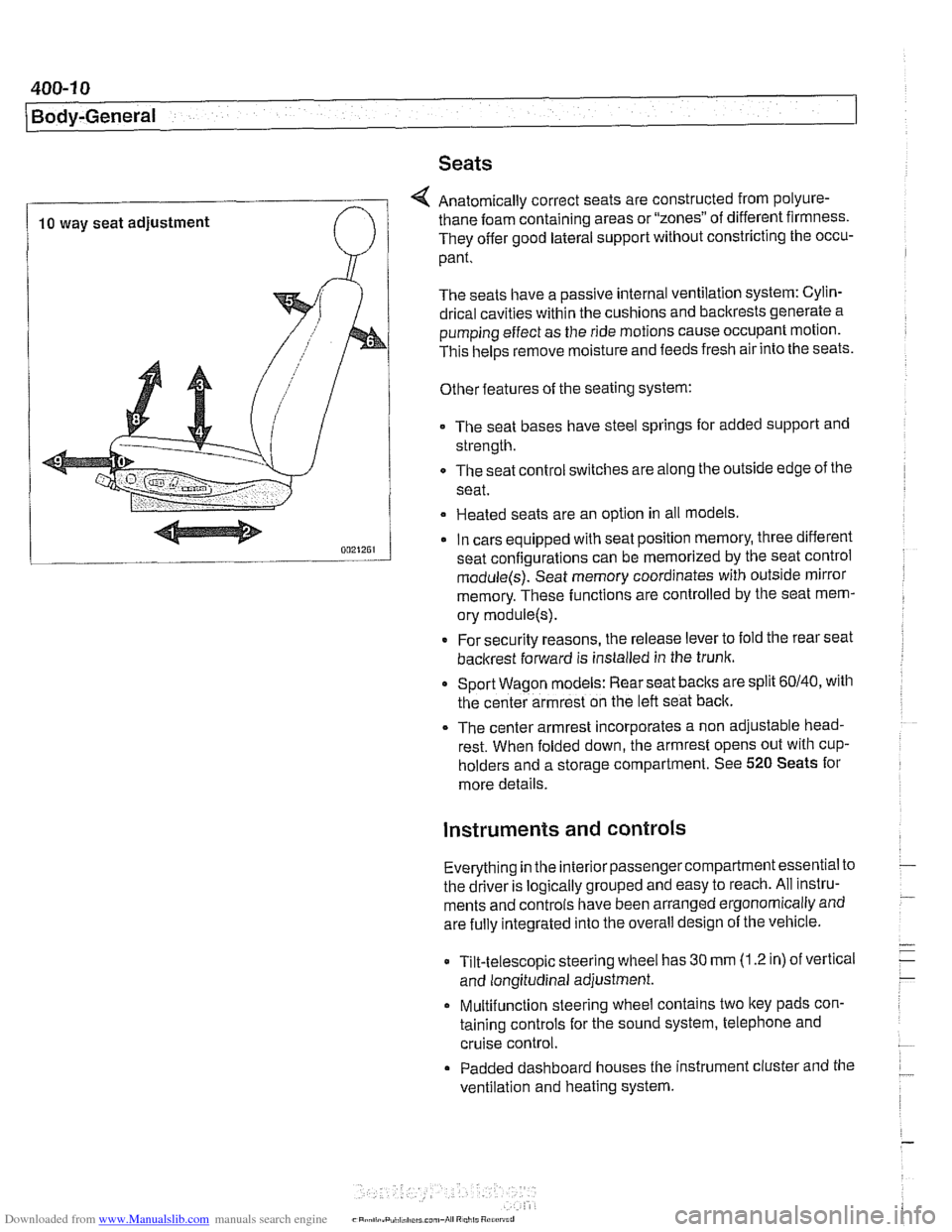
10 way seat adjustment thane foam
containing areas or "zones" of different firmness.
They offer good lateral support without constricting the occu-
pant.
The seats have a passive internal ventilation system: Cylin-
drical cavities within the cushions and backrests generate a
pumping effect as the ride motions cause occupant motion.
This
helps remove moisture and feeds fresh air into the seats.
Other features of the seating system:
The seat bases have steel springs for added support and
strength.
The seat control switches are along the outside edge of
the
seat.
Heated seats are an option in all models
In cars equipped with seat position memory, three different
seat confiaurations can be memorized by the seat control
module(s): Seat memory coordinates with outside mirror
memory. These functions are controlled by the seat mem-
ory
module(s).
* For security reasons, the release lever to fold the rear seat
backrest forward is installed in the trunk.
Sport Wagon models: Rear seat
baclts are split 60140, with
the center armrest on the left seat back.
The center armrest incorporates a non adjustable head-
rest. When folded down, the armrest opens out with
cup-
holders and a storage compartment. See 520 Seats for
more details.
instruments and controls
Everything in the interior passengercompartment essential to
the driver is logically grouped and easy to reach. All instru-
ments and controls have been arranged ergonomically and
are fully integrated into the overall design of the vehicle.
Tilt-telescopic steering wheel has
30 mm (1.2 in) of vertical
and longitudinal adjustment.
Multifunction steering wheel contains two
ltey pads con-
taining controls for the sound system, telephone and
cruise control.
Padded dashboard houses the instrument cluster and the
ventilation and heating system.
Page 829 of 1002
Downloaded from www.Manualslib.com manuals search engine
41 2 Trunk Lid. Tailgate
........................... General
......................... Trunk Lid
Trunlc lid. removing and installing ........
Trunk lid. adjusting ...................
Trunk lid support strut.
removing and installing
................
Tailgate (Sport Wagon Models) .....
Tailgate. emergency release ...........
Tailgate and window strut diagram .......
Window strut removal diagram .......... 412-8
Rear window gas strut.
removing and installing
................ 412-9
Tailgate gas strut. removing and installing
............... 412-10
Tailgate. removing and installing
........ 412-1 1
Rear window. removing and installing
.... 412-12
Rear window and tailgate. alignment
..... 412-13
Page 830 of 1002
Downloaded from www.Manualslib.com manuals search engine
41 2-2
Trunk Lid, Tailgate
This repair group covers trunk lid and tailgate removal and in-
stallation. Also included here are replacement proceduresfor
the gas-charged support struts that hold the trunk lid or tail-
gate in the open position.
NO JE -
The body is painted at the factory after assembly. Realign-
ment of body panels may expose unpainted metal. Paint all
exposed metal once the
work is complete.
Trunk lid, removing and installing
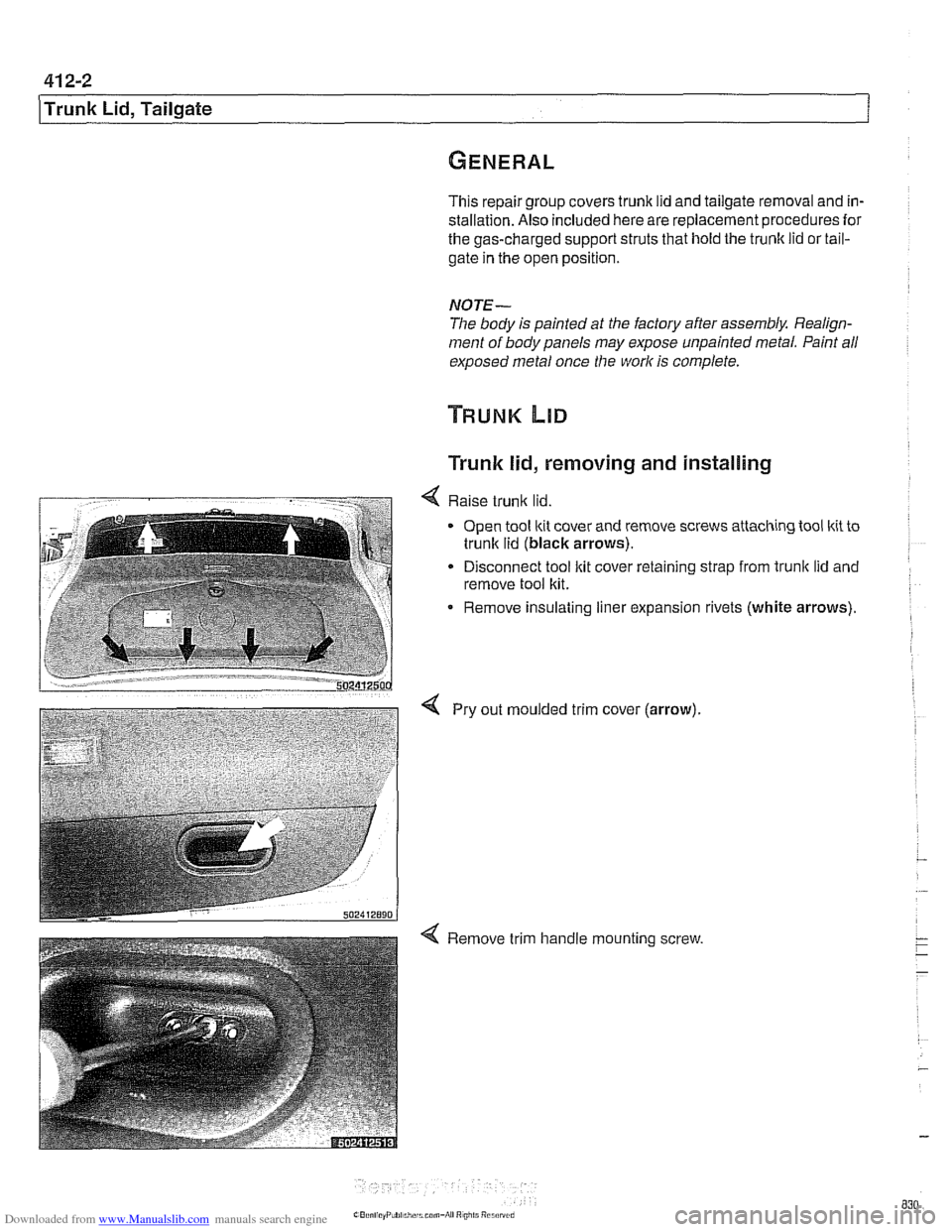
4 Raise trunlc lid.
Open tool ltit cover and remove screws attaching tool kit to
trunlc lid (black arrows).
Disconnect tool ltit cover retaining strap from
trunk lid and
remove tool kit.
Remove insulating liner expansion rivets (white arrows).
4 Pry out moulded trim cover (arrow).
Page 831 of 1002
Downloaded from www.Manualslib.com manuals search engine
Trunk Lid, Tailgate
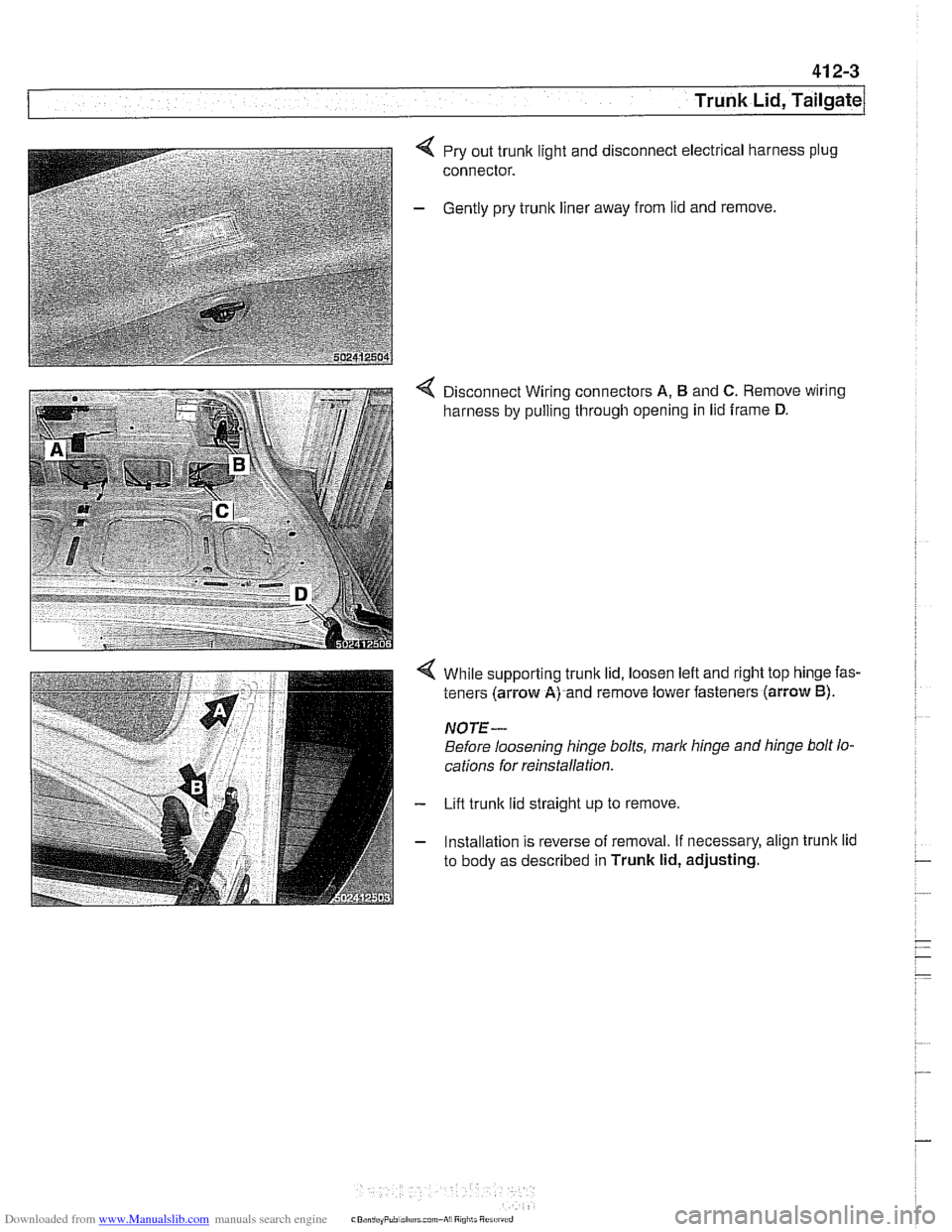
4 Pry out trunk light and disconnect electrical harness plug
connector.
- Gently pry trunk liner away from lid and remove.
4 Disconnect Wiring connectors A, B and C. Remove wiring
harness by pulling through opening in lid frame
D.
While supporting trunk lid, loosen left and right top hinge fas-
teners (arrow
A) and remove lower fasteners (arrow B).
NOTE-
Before loosening hinge bolts, mark hinge and hinge bolt lo-
cations for
reins~alla~on
Lift trunk lid straight up to remove.
Installation is reverse of removal. If necessary, align trunk lid
to body as described in
Trunk lid, adjusting.
Page 832 of 1002
Downloaded from www.Manualslib.com manuals search engine
/~runk Lid, Tailgate
Trunk lid, adjusting
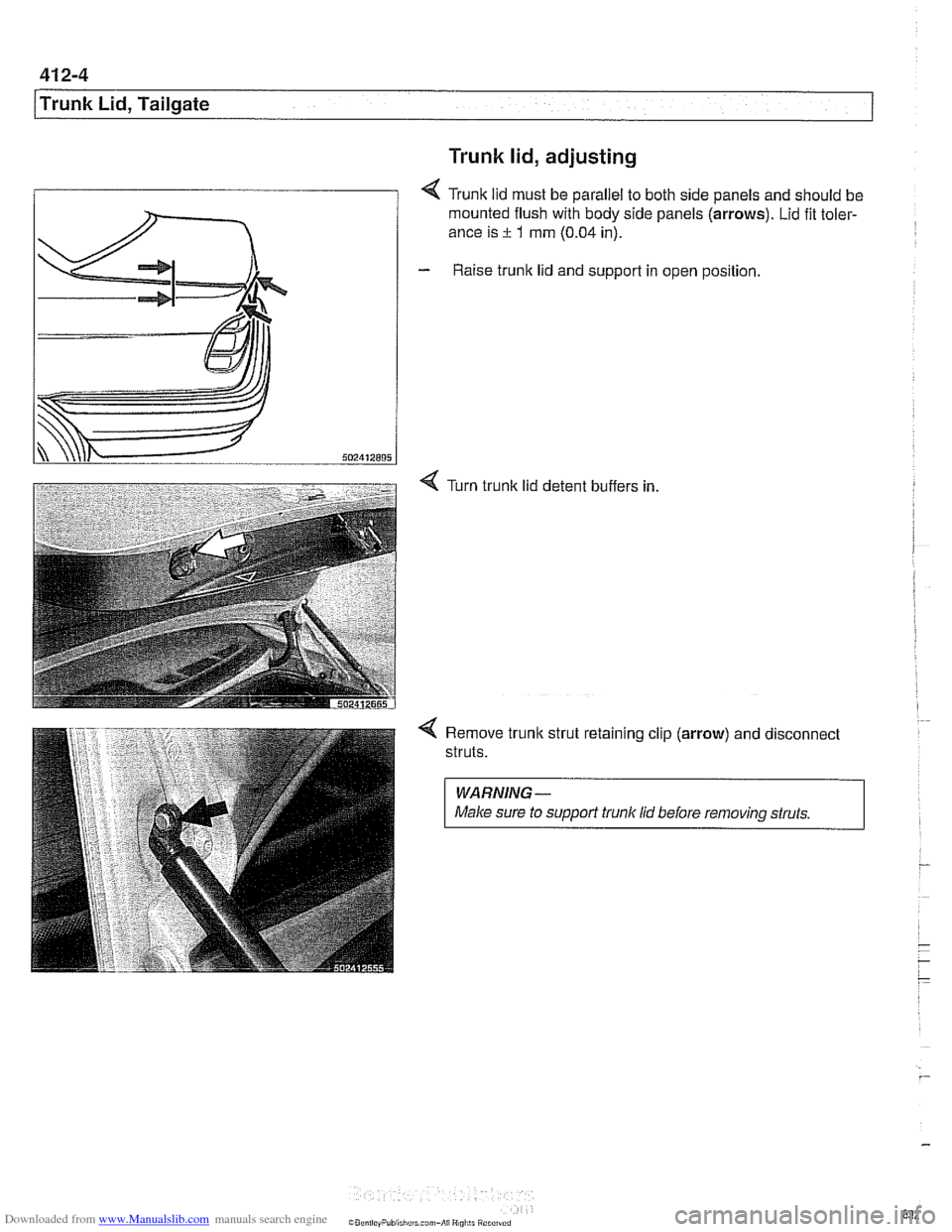
< Trunk lid must be parallel to both side panels and should be
mounted flush with body side panels
(arrows). Lid fit toler-
ance is
rt 1 mm (0.04 in).
- Raise trunlc lid and support in open position.
Turn trunk lid detent buffers in
4 Remove trunlc strut retaining clip (arrow) and disconnect
struts.
WARNING-
Make sure to suppori trunk lid before removing struts.
Page 833 of 1002
Downloaded from www.Manualslib.com manuals search engine
Trunk Lid, ~ail~atel
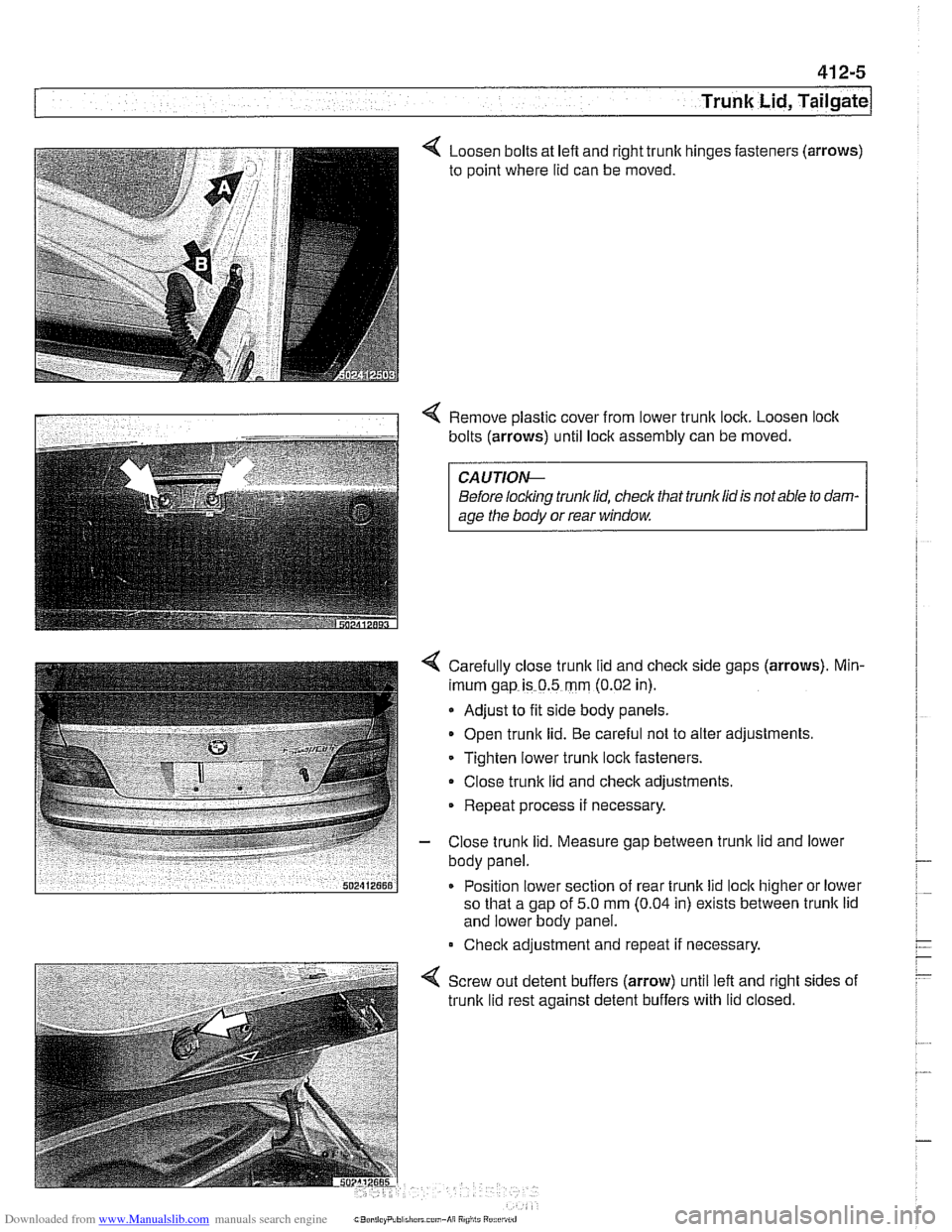
Loosen bolts at lefl and right trunk
to point where lid can be moved. hinges
fasteners (arrows)
4 Remove plastic cover from lower trunlc lock. Loosen lock
bolts (arrows) until lock assembly can be moved.
CAUTION-
Before locking trunklid, check that trunk lid is not able to dam-
age the body or rear window.
4 Carefully close trunk lid and check side gaps (arrows). Min-
imum gap is 0.5 mm (0.02 in).
Adjust to fit side body panels.
Open trunlc lid.
Be careful not to alter adjustments.
Tighten lower trunlc lock fasteners.
Close trunk lid and check adjustments.
Repeat process if necessary.
- Close trunk lid. Measure gap between trunlc lid and lower
body panel.
Position lower section of rear trunlc lid
lock higher or lower
so that a
ciao of 5.0 mm (0.04 in) exists between trunlc lid
and
lowe;body panel. '
Check adjustment and repeat if necessary,
4 Screw out detent buffers (arrow) until left and right sides of
trunk lid rest against detent buffers with lid closed.
Page 834 of 1002
Downloaded from www.Manualslib.com manuals search engine
. .- -
l~runk Lid, Tailgate
Trunk lid support strut, removing and
installing
/ Make sure to supporf trunk lid before removing struts. I
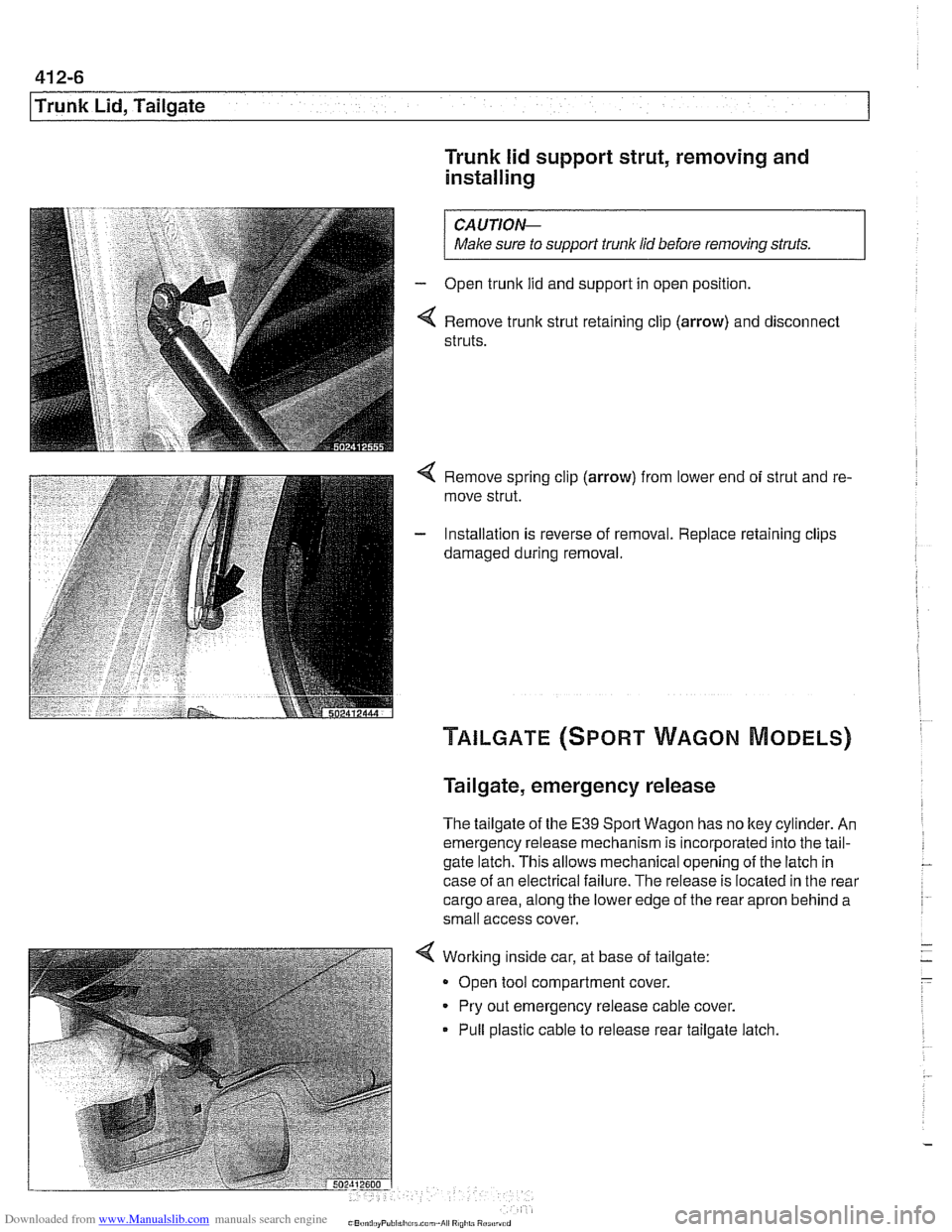
Open trunk lid and support in open position.
Remove trunk strut retaining clip
(arrow) and disconnect
struts.
4 Remove spring clip (arrow) from lower end of strut and re-
move strut.
- Installation is reverse of removal. Replace retaining clips
damaged during removal.
Tailgate, emergency release
The tailgate of the E39 Sport Wagon has no ltey cylinder. An
emergency release mechanism is incorporated into the tail-
gate latch. This allows mechanical opening of the latch in
case of an electrical failure. The release is located in the rear
cargo area, along the lower edge of the rear apron behind a
small access cover.
Working inside car, at base of tailgate:
Open tool compartment cover.
Pry out emergency release cable cover.
Pull plastic cable to release rear tailgate latch
Page 835 of 1002
Downloaded from www.Manualslib.com manuals search engine
r Trunk Lid, Tailgate
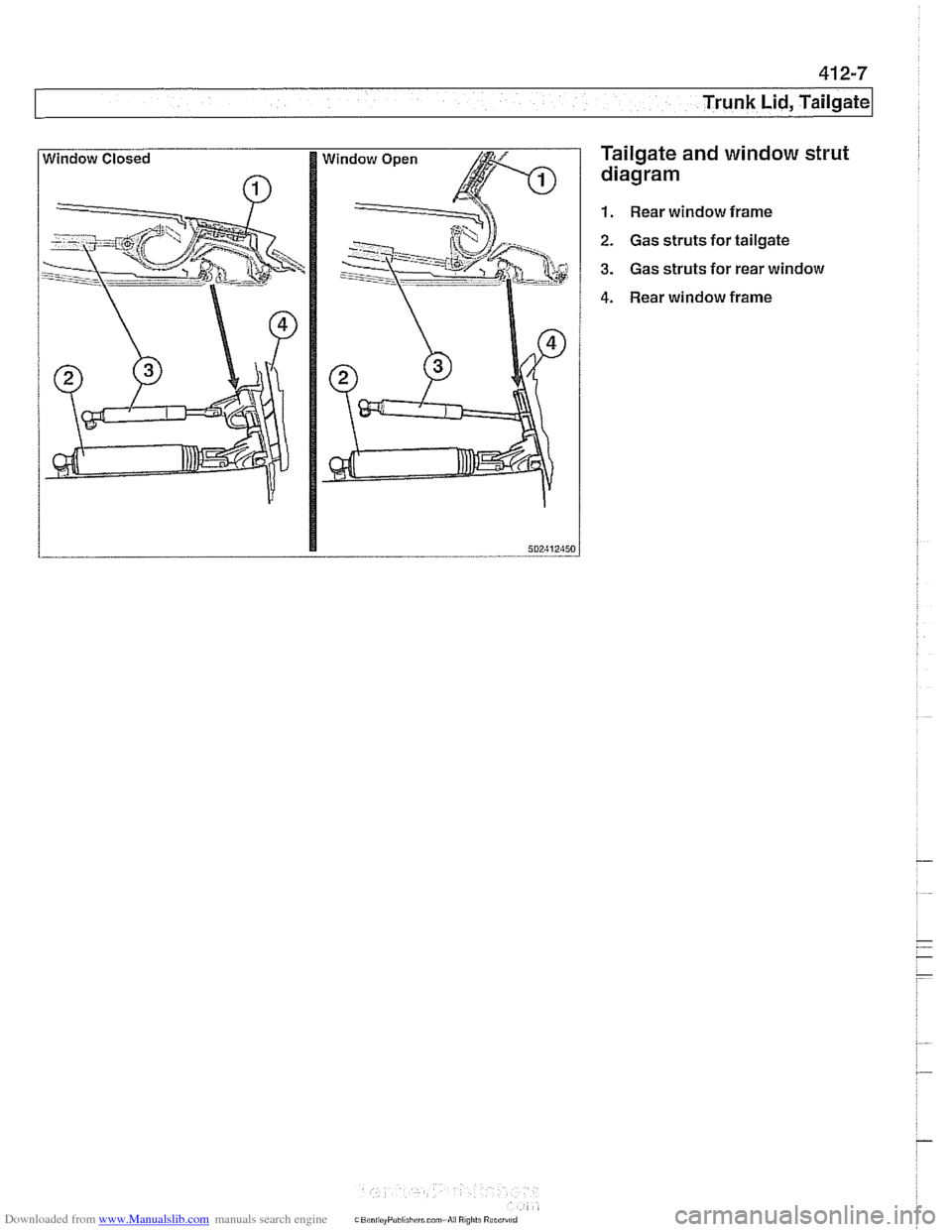
Tailgate and window strut
diagram
1. Rear window frame
2. Gas struts for tailgate
3. Gas struts for rear window
4. Rear window frame