lock BMW 525i 2001 E39 Workshop Manual
[x] Cancel search | Manufacturer: BMW, Model Year: 2001, Model line: 525i, Model: BMW 525i 2001 E39Pages: 1002
Page 751 of 1002
Downloaded from www.Manualslib.com manuals search engine
Final Drive
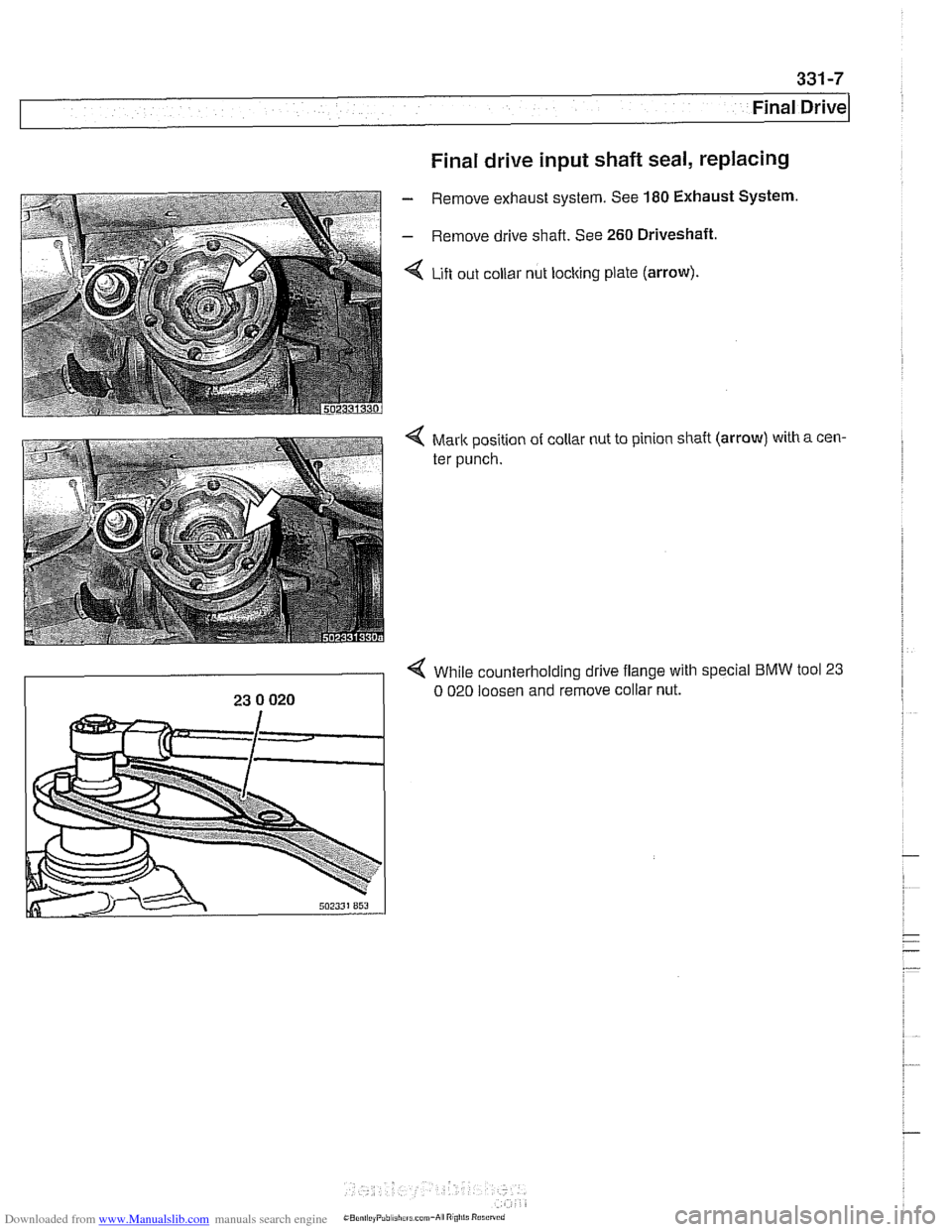
Final drive input shaft seal, replacing
- Remove exhaust system. See 180 Exhaust System
- Remove drive shaft. See 260 Driveshaft.
< Lift out collar nut locking plate (arrow).
4 While counterholding drive flange with special BMW tool 23
23 0 020 0 020 loosen and remove collar nut.
Page 753 of 1002
Downloaded from www.Manualslib.com manuals search engine
331-9
Final Drive
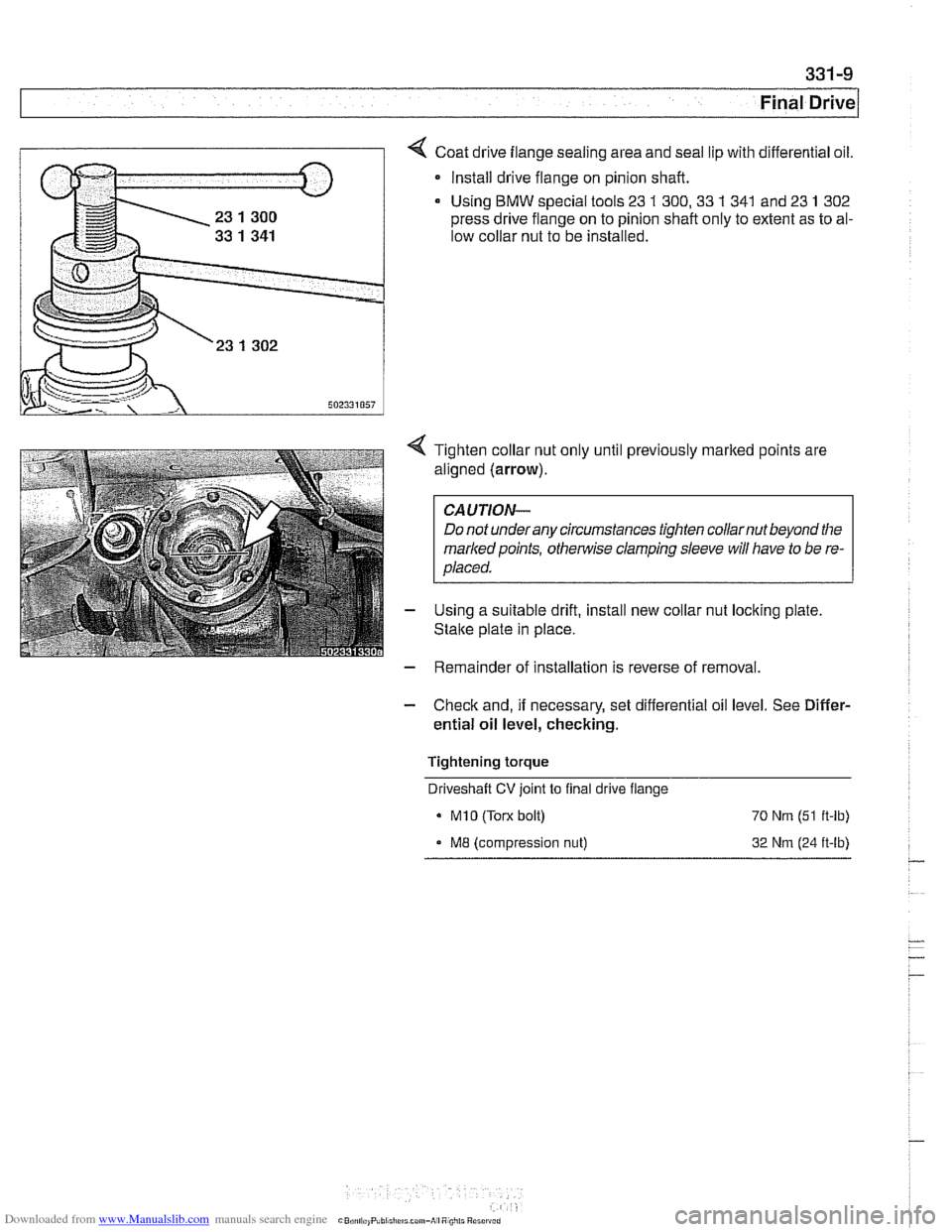
Coat drive flange sealing area and seal lip with differential oil.
* Install drive flange on pinion shaft.
Using
BMW special tools 23 1 300,33 1 341 and 23 1 302
press drive flange on to pinion shaft only to extent as to al-
low collar nut to be installed.
4 Tighten collar nut only until previously marked points are
aligned (arrow).
CAUTION-
Do not underany circumstances tighten collarnut beyond the
markedpoints,
othe~lise clamping sleeve will have to be re-
placed.
- Using a suitable drift, install new collar nut locking plate
Stalte plate in place.
- Remainder of installation is reverse of removal.
- Check and, if necessary, set differential oil level. See Differ-
ential oil level, checking.
Tightening torque Driveshaft
CV joint to final drive flange
MI0 (Torx bolt) 70 Nrn (51 ft-lb)
ME (compression nut) 32 Nrn (24 ft-lb)
Page 762 of 1002
Downloaded from www.Manualslib.com manuals search engine
I Final Drive
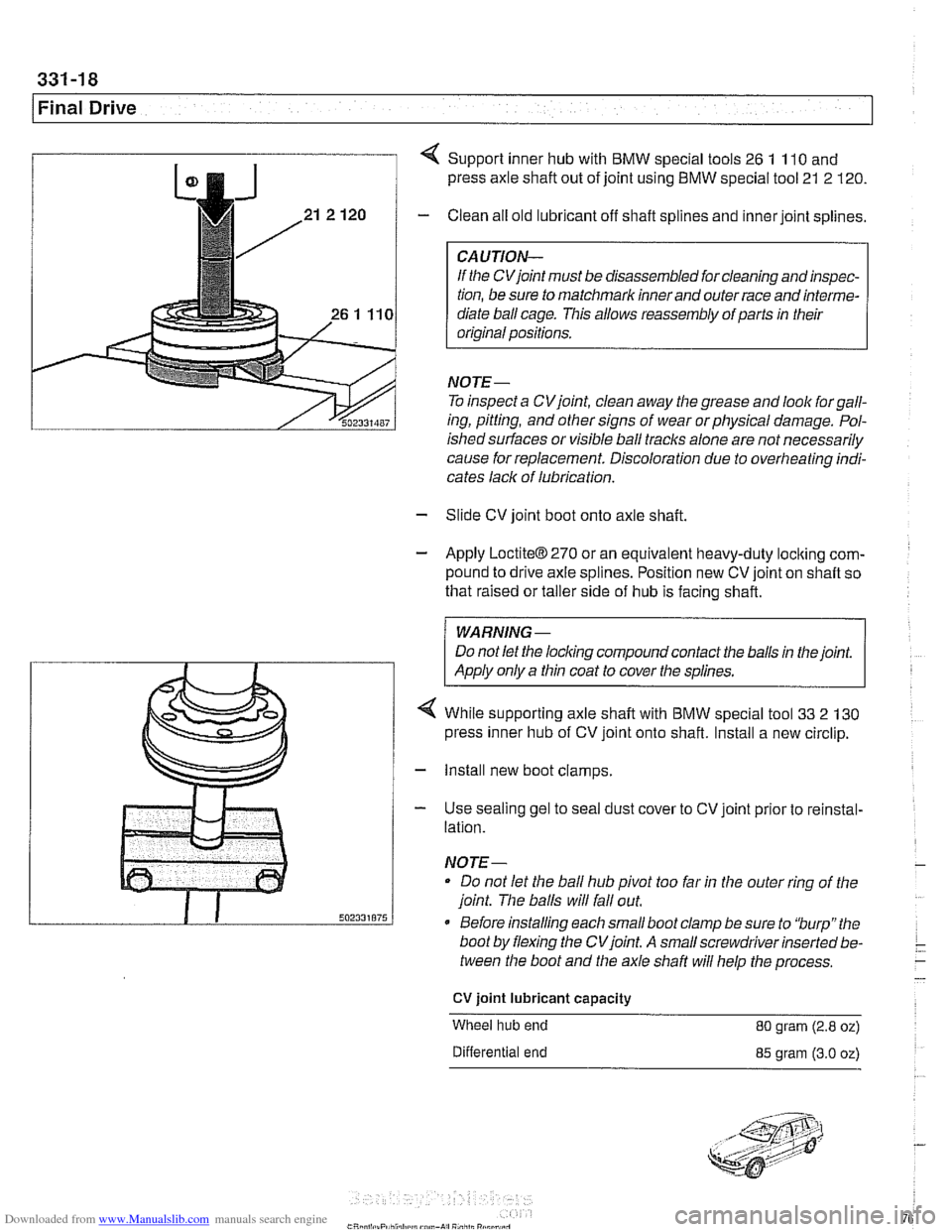
4 Support inner hub with BMW special tools 26 1 110 and
press axle shaft out of joint using BMW special tool 21 2 120.
- Clean all old lubricant off shaft splines and inner joint splines.
If the CVjoint must be disassembled for cleaning and inspec-
tion, be sure to matchmark inner and outer race and interme-
diate ball cage. This allows reassembly
ofparfs in their
original positions.
NOTE-
To inspect a CVjoint, clean away the grease and loolc forgall-
ing, pitting, and other signs of wear orphysical damage. Pol-
ishedsurfaces or visible ball traclts alone are not necessarily
cause forreplacement. Discoloration due to overheating indi-
cates
laclt of lubrication.
- Slide CV joint boot onto axle shaft
- Apply LoctiteO270 or an equivalent heavy-duty loclting corn-
pound to drive axle splines. Position new CV joint on shaft so
that raised or taller side of hub is facing shaft.
WARNING-
Do not let the locking compound contact the balls in the joint.
Apply only a thin coat to cover the splines.
While supporting axle shaft with BMW special tool
33 2 130
press inner hub of CV joint onto shaft. Install a new circlip.
- Install new boot clamps.
- Use sealing gel to seal dust cover to CV joint prior to reinstal-
lation.
NOTE-
* Do not let the ball hub pivot too far in the outer ring of the
joint.
Tlie balls will fa1 out.
Before installing each small boot clamp be sure to
'burp"the
boot by flexing the CVjoint. A small screwdriver inserted be-
tween the boot and the axle shafl will help the process.
CV joint lubricant capacity
Wheel hub end
80 gram (2.8 oz)
Differential end
85 gram (3.0 oz)
Page 766 of 1002
Downloaded from www.Manualslib.com manuals search engine
E39 brake system
BMW E39 models are equipped with vacuum power-assisted
four-wheel disc brakes with an integral
Antilock Brake System
(ABS). Single-piston calipers act on vented front and rear ro-
tors. A brake pad wear sensor for each axle indicates when
brake pads need replacement. The dual drum-type parking
brake system is integrated with the rear brake rotors.
Electronic braking and stability control
E39 models were introduced with Automatic Stability Control,
a computer controlled traction control system that uses the
AB5 system in conjunction with engine management controls
to control wheel spin during take-off and maintain vehicle sta-
bility while braking.
Added in the
1998 model year was Dynamic Stability Control
(DSC). This system implements wheel speed modulation
throughout all stages of driving. For example, DSC is able to
reduce understeer by applying differing amounts of braking
force to each wheel, or it can override the engine manage-
ment system during hard cornering.
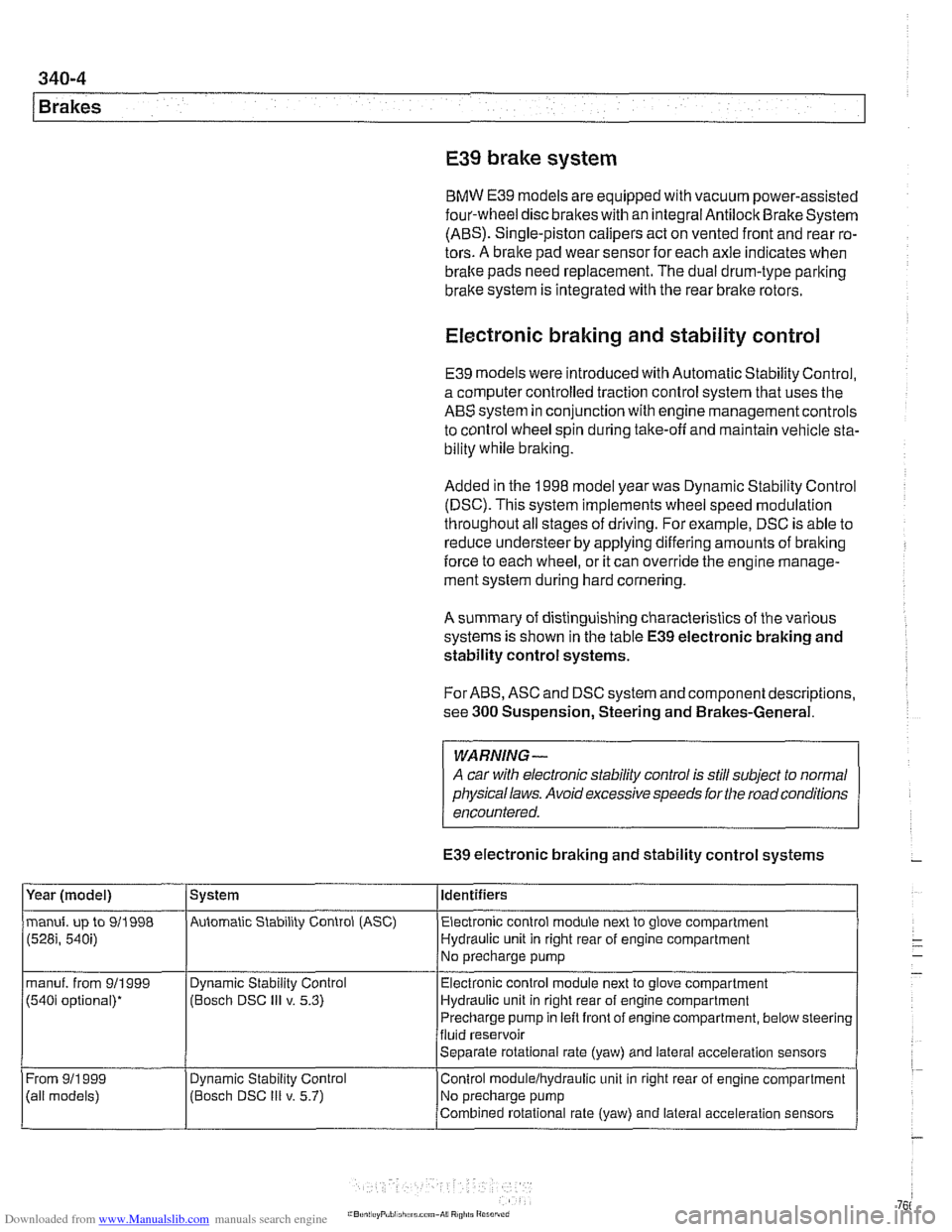
A summary of distinguishing characteristics of the various
systems is shown in the table
E39 electronic braking and
stability control systems.
For ABS, ASC and DSC system and component descriptions,
see
300 Suspension, Steering and Brakes-General.
WARNING-
A car with electronic stability control is still subject to normal
physical laws. Avoid excessive speeds for the road conditions
encountered.
E39 electronic braking and stability control systems
Year (model)
manuf. up to 911998
(528i, 540i)
manuf. from 911999
(540i optional)*
From
911 999
(ail models) System
Automatic Stability Control (ASC) Identifiers
Electronic control module next to glove compartment
Hydraulic unit in right rear of engine compartment
No precharge pump
Dynamic Stability Control
(Bosch DSC
Ill v. 5.3)
Dynamic
Stabil~ty Control
(Bosch DSC
Ill v. 5.7) Electronic
control module next to glove compartment
Hydraulic unit in right rear of engine compartment
Precharge pump in left front of engine compartment, below steering
fluid reservoir
Separate rotational rate (yaw) and lateral acceleration sensors
Control
modulelhydraulic unit in right rear of engine compartment
No precharge pump
Combined rotational rate (yaw) and lateral acceleration sensors
Page 769 of 1002
Downloaded from www.Manualslib.com manuals search engine
Brakes
Warnings and cautions
WARNING-
. E39 cars require special BMWsen/ice equipment toprop-
erly bleed the brake hydraulic system. See Bleeding
Brakes for additional information.
Semi-metallic and metallic brake friction materials in
brake pads or shoes may produce dangerous dust.
Brake fluid is poisonous, corrosive and dangerous to
the environment. Wear safety glasses and rubber
gloves when worliing with
bralie fluid. Do not siphon
brake fluid with your mouth. Dispose of brake fluid
properly
Do not reuse self-locking nuts, bolts or fasteners. They
are designed to be used only once and may fail if re-
used. Always replace them with new self-locliing fas-
teners.
CAUTlOI\C
Immediately clean bralie fluid spilled on painted surfaces
and wash with water, as
bralie fluid will remove paint.
Always use new brake fluid from a fresh, unopened
container.
Brake fluid will absorb moisture from the air.
This can lead to corrosion problems in the
braking sys-
tem, and will also lower the fluid boiling point.
. Plug open lines and brake fluid ports to prevent con-
tamination.
Only tighten brake hoses on front wheels
with wheels
in straight ahead position.
If carrying out electric welding
worlc, be sure to discon-
nect electrical harness connector from electronic con-
trol module.
Do not expose electronic control modules to high sus-
tained heat, such as in a paint drying booth. Maximum
heat exposure:-95°C (203
OF) for short periods of time-
85'C (185°F) for Ions periods of time (approx. 2 hours)
Page 771 of 1002
Downloaded from www.Manualslib.com manuals search engine
Brakes
Brakes, bleeding
The procedure below requires a BMW Service Tester (DIS-
pluslGTl/MoDiC).
- Determine type of traction control (ASC, DSC with precharge
pump, DSC without precharge pump). Be sure to use correct
specification brake fluid, according to application table below.
Brake fluid applications
ABS I ASC and ABS / DSC models DOT 4 brake fluid
with precharge pump (to 911998)
ABS I DSC models without precharge DOT 4 low viscosity
pump (911998 and later) brake
fluid
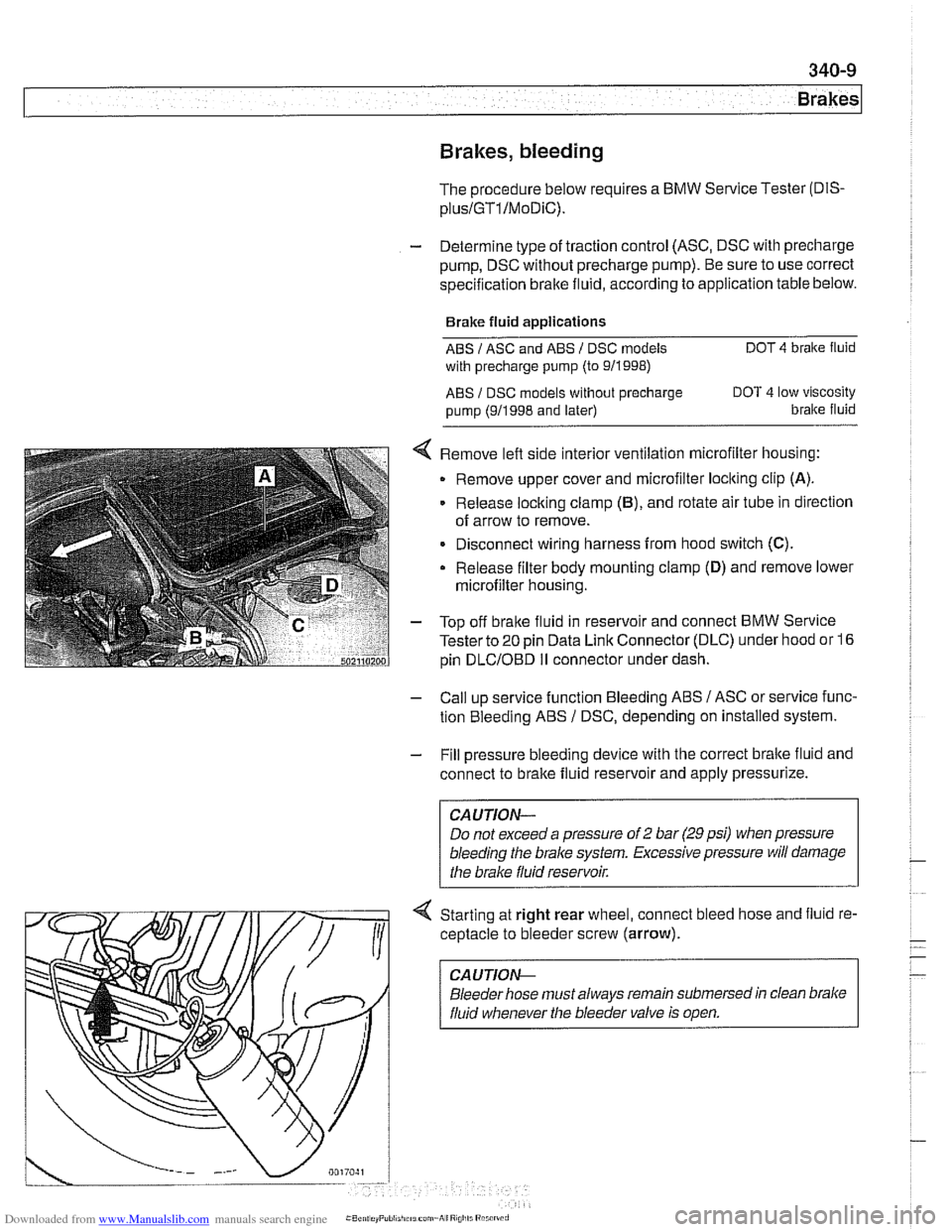
< Remove left side interior ventilation microfilter housing:
Remove upper cover and microfilter loclting clip
(A).
Release locking clamp (B), and rotate air tube in direction
of arrow to remove.
Disconnect wiring harness from hood switch
(C).
Release filter body mounting clamp (D) and remove lower
microfilter housing.
- Top off bralte fluid in reservoir and connect BMW Service
Tester to
20 pin Data Link Connector (DLC) under hood or 16
pin
DLCIOBD I1 connector under dash.
- Call up service function Bleeding ABS / ASC or service func-
tion Bleeding ABS
/ DSC, depending on installed system.
- Fill pressure bleeding device with the correct brake fluid and
connect to brake fluid reservoir and apply pressurize.
Do not exceed a pressure of
2 bar (29 psi) when pressure
bleeding the
brake system. Excessive pressure will damage
4 Starting at right rear wheel, connect bleed hose and fluid re-
ceptacle to bleeder screw (arrow).
CA UTlON-
Bleeder hose must always remain submersed in clean brake
fluid whenever the bleeder valve is open.
Page 776 of 1002
Downloaded from www.Manualslib.com manuals search engine
340-1 4
Brakes
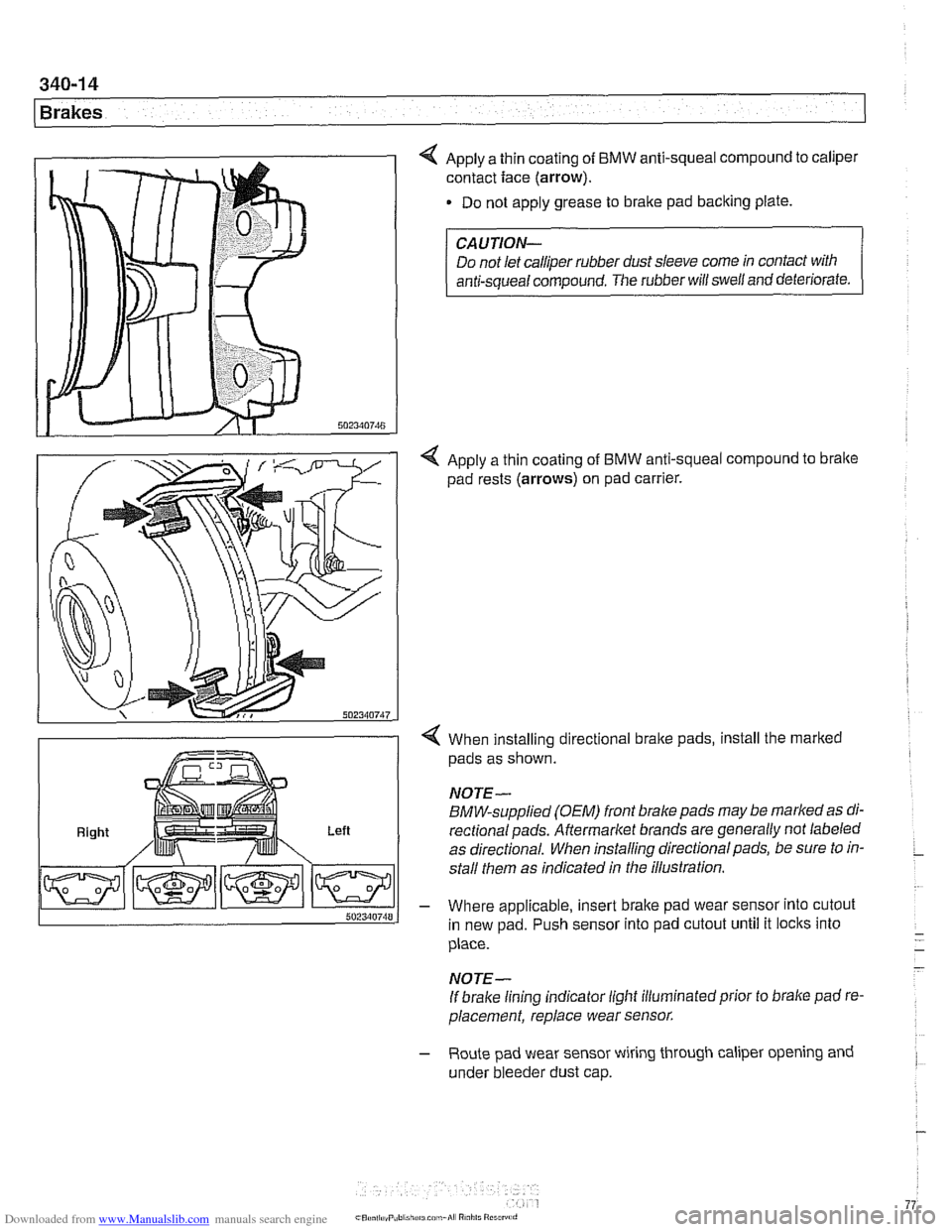
4 Apply a thin coating of BMW anti-squeal compound to caliper
contact face
(arrow).
Do not apply grease to brake pad backing plate.
Right Left
CAUTION-
Do not let calliper rubber dust sleeve come in contact with
anti-squeal compound. The rubber will swell and deteriorate.
4 Apply a thin coating of BMW anti-squeal compound to bralte
pad rests (arrows) on pad carrier.
4 When installing directional brake pads, install the marked
pads as shown.
NOTE-
BMW-supplied (OEM) front brake pads may be marked as di-
rectionalpads. Aftermarket brands are generally not labeled
as directional. When installing directional pads, be sure to in-
stall them as indicated in the illustration.
- Where applicable, insert brake pad wear sensor into cutout
in new pad. Push sensor into pad cutout until it locks into
place.
- -
- NOTE-
If brake lining indicator light illuminatedprior to brake pad re-
placement, replace wear sensor.
- Route pad wear sensor wiring through caliper opening and
under bleeder dust cap.
Page 778 of 1002
Downloaded from www.Manualslib.com manuals search engine
1 Brakes
Max. machine limit per
friction ring side 0.8 mm (0.03
in) I
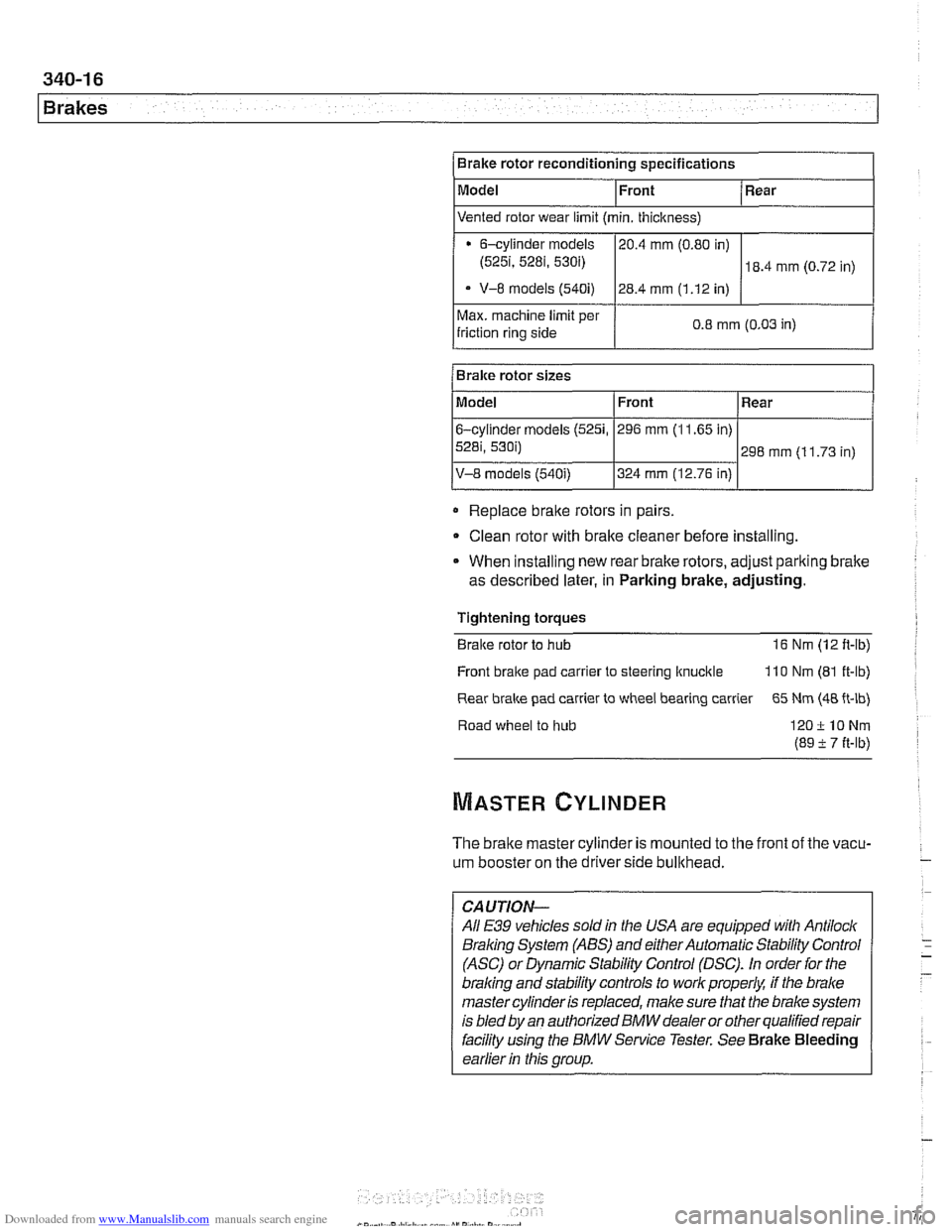
Brake rotor reconditioning specifications
Model
Replace
braite rotors in pairs
Bralre rotor sizes
Clean rotor with brake cleaner before installing.
Front
Model
6-cylinder
models (5251,
5281, 530i)
V-8 models (540i)
* When installing new rear brake rotors, adjust pariting brake
as described later, in Parking brake, adjusting. Rear
Vented rotor wear limit (min. thickness)
Tightening torques
Braite rotor to hub 16 Nm (12 ft-lb)
6-cylinder models
(525i, 5281, 530i)
- V-8 models (540i)
Front
296 mm (1 1.65 in)
324 mm (12.76 in)
Front bralte pad
carrler to steering ltnucitle 110 Nm (81 ft-lb)
Rear
298 mm (1 1.73 in)
Rear
brake pad carrier to wheel bearing carrier 65 Nm (48 ft-lb)
20.4
mm (0.80 in)
28.4 mm (1.12 in)
Road wheel to hub
120ilONm
(89 -t 7 it-lb)
18.4 mm (0.72 in)
The brake master cylinder is mounted to the front of the vacu-
um booster on the driverside bullthead.
-
CAUTION-
All E39 vehicles soldin the USA are equipped with Antilock
Braling System (ABS) and either Automatic Stability Control
(ASC) or Dynamic Stability Control (DSC).
In order for the
braling and stability controls to work properk if the brake
master cylinder is replaced, make sure that the brake system
is bled
by an authorized BMW dealer or other qualified repair
facility
using the BMW Service Tester. See Brake Bleeding
earlier
in this group.
Page 779 of 1002
Downloaded from www.Manualslib.com manuals search engine
Brakes
Master cylinder, removing and installing
CAUTlOI\C
Brake fluid is highly corrosive and dangerous to the environ-
ment. Dispose of it properly.
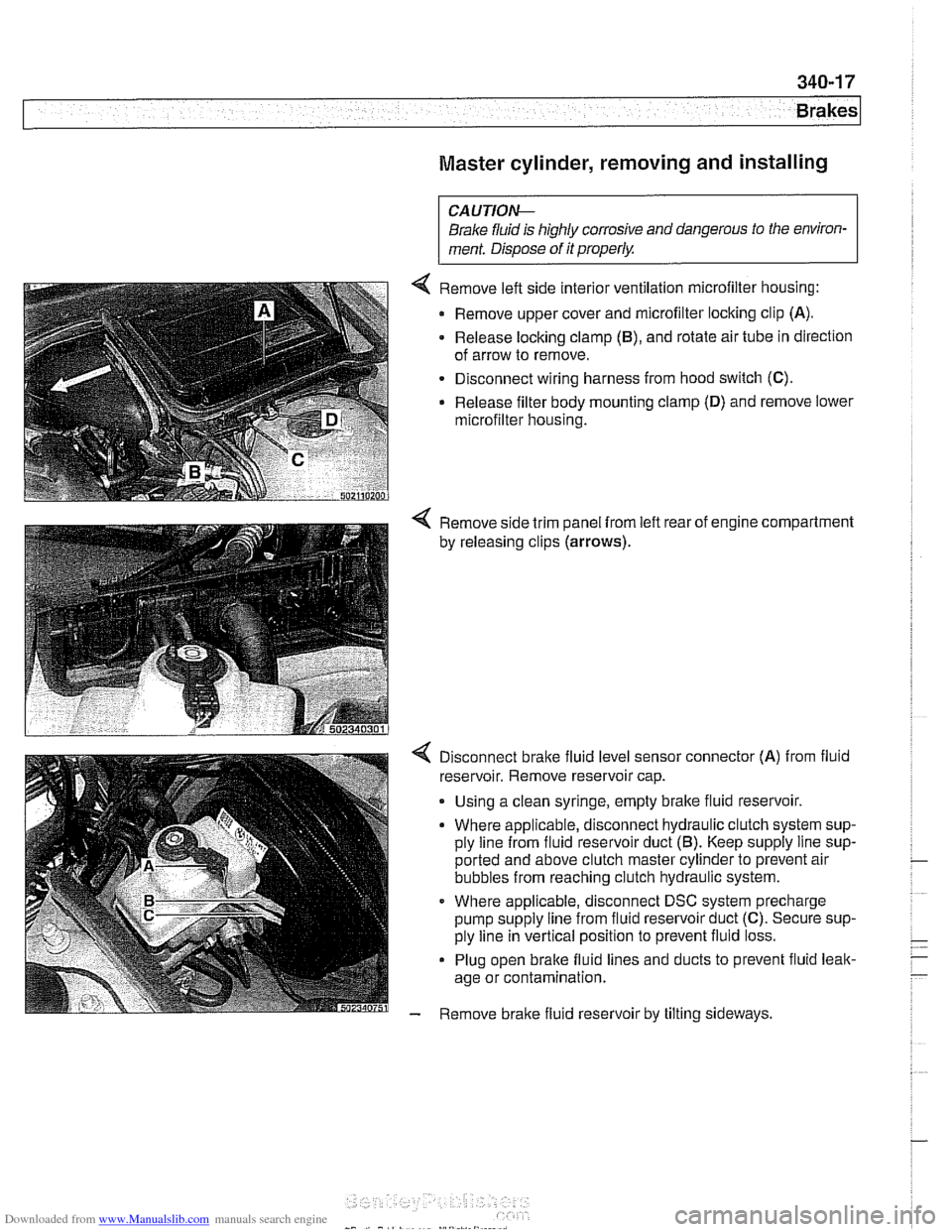
4 Remove left side interior ventilation microfilter housing:
Remove upper cover and microfilter locking clip
(A).
- Release locking clamp (B), and rotate air tube in direction
of arrow to remove.
Disconnect wiring harness from hood switch
(C).
Release filter body mounting clamp (D) and remove lower
microfilter housing.
4 Remove side trim panel from left rear of engine compartment
by releasing clips
(arrows).
4 Disconnect bralte fluid level sensor connector (A) from fluid
reservoir. Remove reservoir cap.
. Using a clean syringe, empty bralte fluid reservoir.
Where applicable, disconnect hydraulic clutch system sup-
ply line from fluid reservoir duct
(5). Keep supply line sup-
ported and above clutch master cylinder to prevent air
bubbles from reaching clutch hydraulic system.
Where applicable, disconnect DSC system precharge
pump supply line from fluid reservoir duct
(C). Secure sup-
ply line in vertical position to prevent fluid loss.
Plug open brake fluid lines and ducts to prevent fluid leak-
age or contamination.
- Remove brake fluid reservoir by tilting sideways.
Page 780 of 1002
Downloaded from www.Manualslib.com manuals search engine
.- -
Brakes
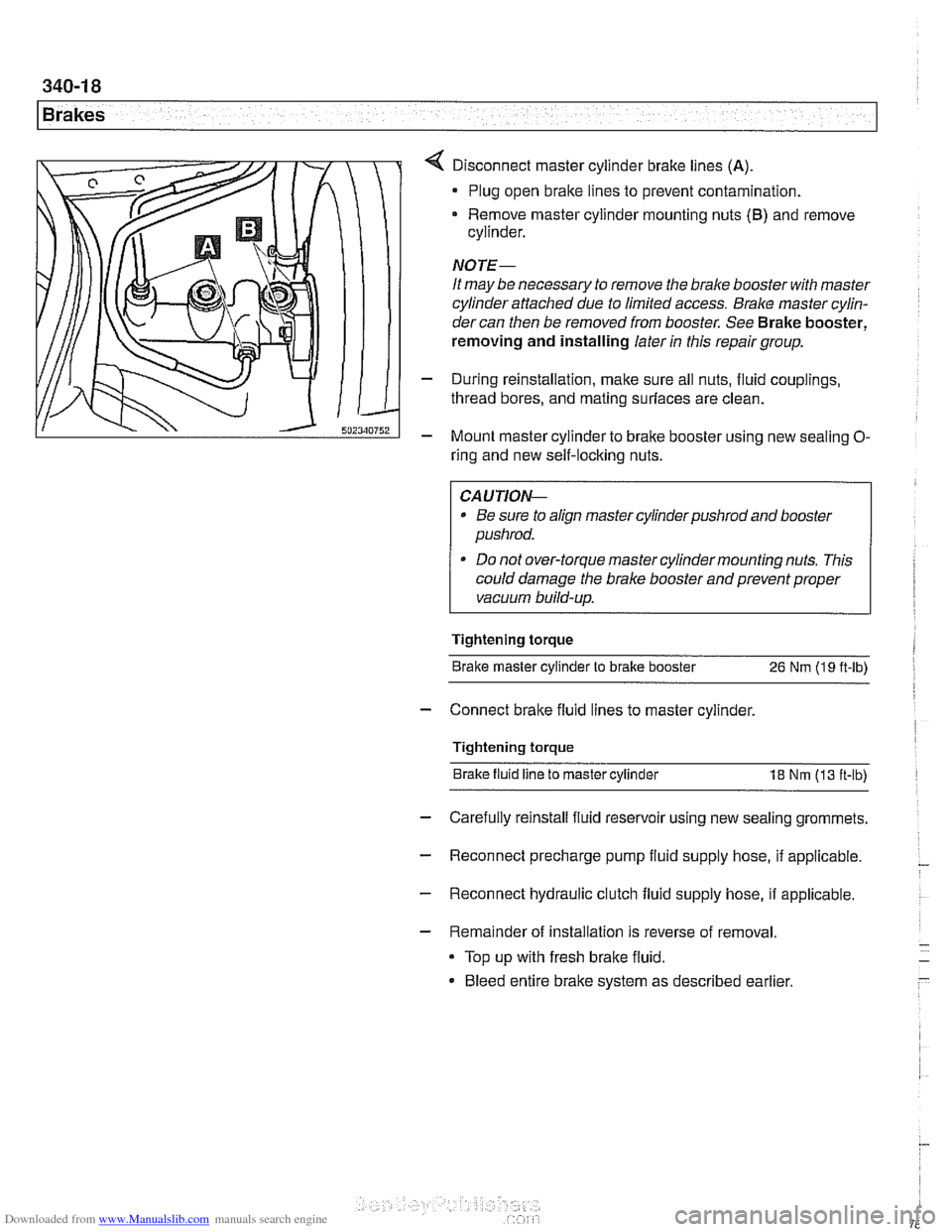
Disconnect master cylinder brake lines (A)
Plug open brake lines to prevent contamination.
Remove master cylinder mounting nuts
(6) and remove
cylinder.
NOTE-
It may be necessary to remove the brake booster with master
cylinder attached due to limited access.
Bralce master cylin-
dercan then be removed from booster. See Brake booster,
removing and installing later
in this repair group.
- During reinstallation, make sure all nuts, fluid couplings,
thread bores, and mating surfaces are clean.
- Mount master cylinder to bralte booster using new sealing O-
ring and new self-locking nuts.
CAUTIOI\C
* Be sure to align master cylinderpushrod and booster
pushrod.
* Do not over-torque master cylinder mounting nuts. This
could damage the brake booster and prevent proper
vacuum build-up.
Tightening torque Brake master cylinder to brake booster
26 Nm (19 ft-lb)
- Connect bralte fluid lines to master cylinder.
Tightening torque Brake fluid line to master cylinder
18 Nm (13 ft-lb)
- Carefully reinstall fluid reservoir using new sealing grommets.
- Reconnect precharge pump fluid supply hose, if applicable. -
- Reconnect hydraulic clutch fluid supply hose, if applicable.
- Remainder of installation is reverse of removal.
Top up with fresh brake fluid.
Bleed entire brake system as described earlier