power steering BMW 528i 2000 E39 Owner's Manual
[x] Cancel search | Manufacturer: BMW, Model Year: 2000, Model line: 528i, Model: BMW 528i 2000 E39Pages: 1002
Page 677 of 1002
Downloaded from www.Manualslib.com manuals search engine
i Steering and Wheel Alignment
RACK AND PINION STEERING
(6-CYLINDER MODELS)
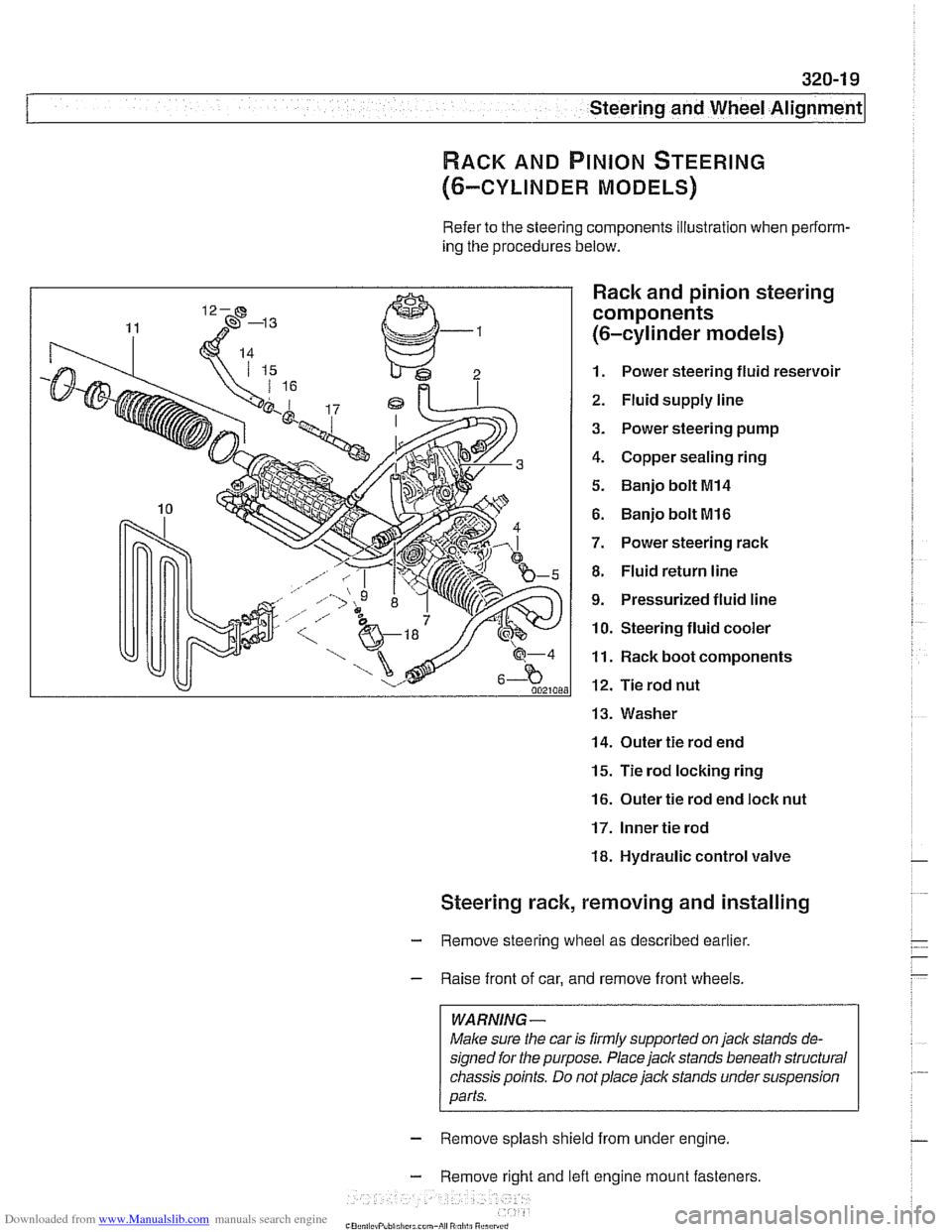
Refer to the steering components illustration when perform-
ing the procedures below.
Rack and pinion steering
components
(6-cylinder models)
1. Power steering fluid reservoir
2. Fluid supply line
3. Power steering pump
4. Copper sealing ring
5. Banjo bolt MI4
6. Banjo bolt MI6
7. Power steering rack
8. Fluid return line
9. Pressurized fluid line
10. Steering fluid cooler
11. Rack boot components
12. Tie rod nut
13. Washer
14. Outer tie rod end
15. Tie rod locking ring
16. Outer tie rod end loclc nut
17. Inner tie rod
18. Hydraulic control valve
Steering rack, removing and installing
- Remove steering wheel as described earlier.
- Raise front of car, and remove front wheels.
WARNING -
Male sure the car is firmly supported on jack stands de-
signed for the purpose. Place jack stands beneath structural
chassis points. Do
not place jack stands under suspension
parts.
- Remove splash shield from under engine.
- Remove right and lefl engine mount fasteners
-" ., - , . ,
Page 678 of 1002
Downloaded from www.Manualslib.com manuals search engine
/steering and Wheel Alignment
Raise engine approximately 40 mm (1.6 in). See 110 Engine
Removal and installation.
Remove right and left engine mounts and remove mount
brackets from subframe.
Empty power steering fluid reservoir using a clean syringe.
Do not reuse power steering fluid.
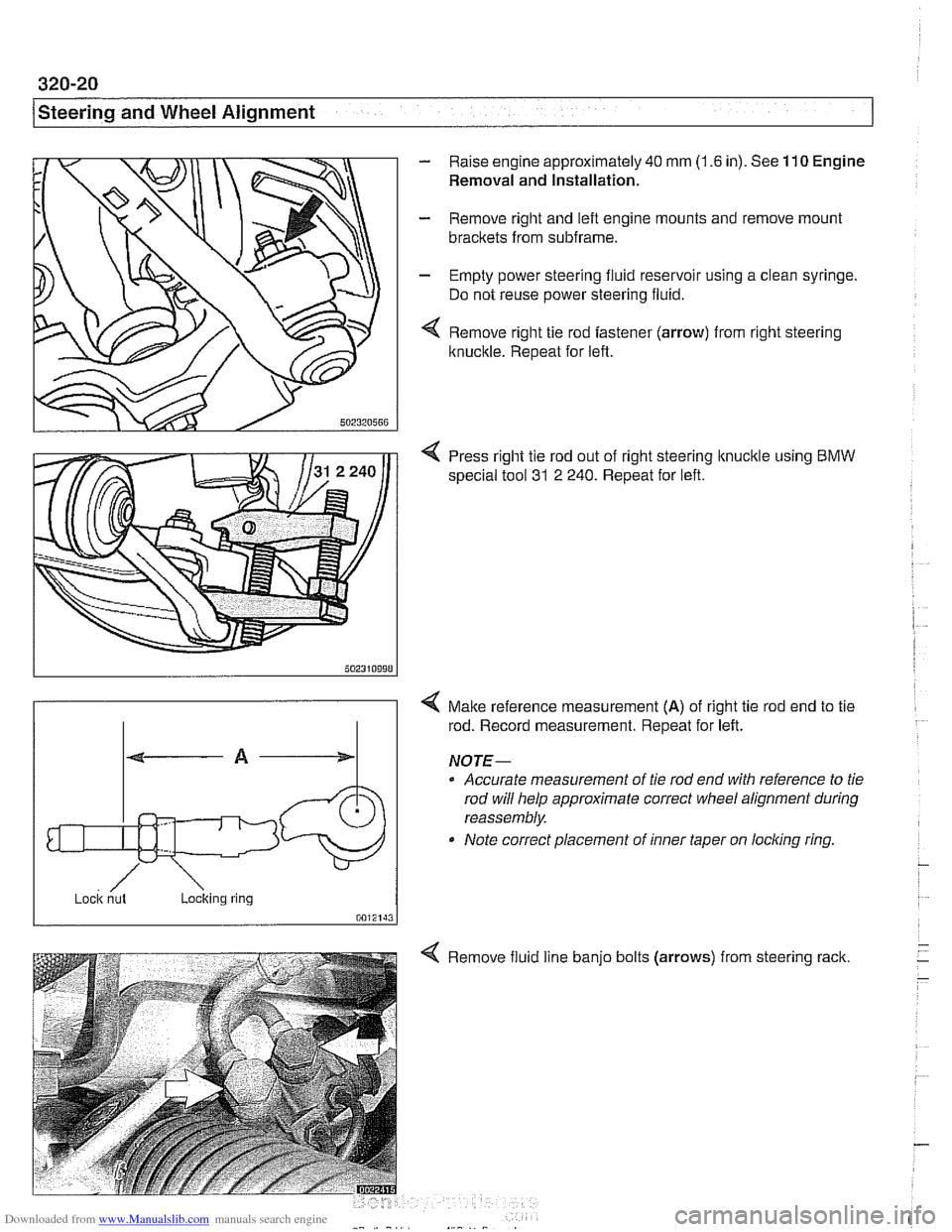
Remove right tie rod fastener (arrow) from right steering
Itnuckle. Repeat for left.
4 Press right tie rod out of right steering knucltle using BMW
special tool 31
2 240. Repeat for left.
/ ~ock nut Loclting ring
0012143
4 Malte reference measurement (A) of right tie rod end to tie
rod. Record measurement. Repeat for left.
NOJE-
0 Accurate measurement of tie rod end with reference to tie
rod will help approximate correct wheel alignment during
reassembly.
Note correct placement of inner taper on
locling ring
Remove fluid line
banjo bolts (arrows)
from steering rack.
Page 679 of 1002
Downloaded from www.Manualslib.com manuals search engine
Steering and Wheel ~lignmentl
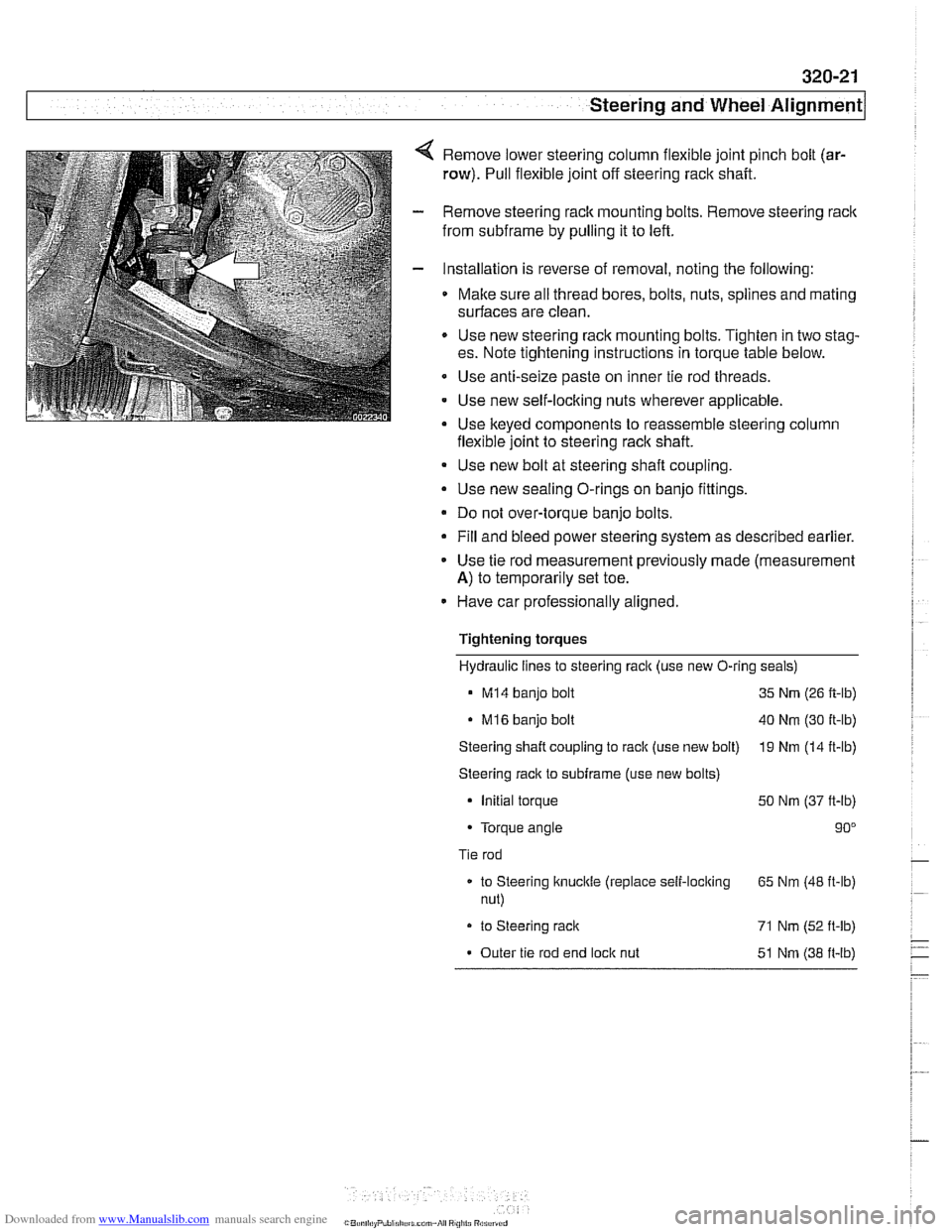
Remove lower steering column flexible joint pinch bolt (ar-
row). Pull flexible joint off steering rack shaft.
Remove steering rack mounting bolts. Remove steering
raclc
from subframe by pulling it to left.
Installation is reverse of removal, noting the following:
Make sure all thread bores, bolts, nuts, splines and mating
surfaces are clean.
Use new steering rack mounting bolts. Tighten in two stag-
es. Note tightening instructions in torque table below.
Use anti-seize paste on inner tie rod threads.
Use new self-loclting nuts wherever applicable.
Use keved
comDonents to reassemble steerino column
flexible\oint to ;teering raclt shaft. u
Use new bolt at steering shaft coupling.
Use new sealing O-rings on banjo fittings.
Do not over-torque banjo bolts.
Fill and bleed power steering system as described earlier.
Use tie rod measurement previously made (measurement
A) to temporarily set toe.
Have car professionally aligned.
Tightening torques Hydraulic lines to steering rack (use new O-ring
seals)
M14 banjo bolt 35 Nrn (26 ft-lb)
. M16 banjo bolt 40 Nm (30 ft-lb)
Steering shaft coupling
to rack (use new bolt) 19 Nm (14 it-lb)
Steering rack to subframe (use new bolts)
- initial torque 50 Nm (37 ft-lb)
Torque angle 90"
Tie rod
to Steering knuckle (replace self-locking
65 Nm (48 ft-lb)
nut)
- to Steering rack 71 Nm (52 ft-ib)
Outer tie rod end lock nut
51 Nm (38 ft-lb)
Page 682 of 1002
Downloaded from www.Manualslib.com manuals search engine
Steering and Wheel Alignment
Tightening torques
Tie rod
to Steering knuckle (replace self-locking nut) 65 Nm (48 it-lb)
to Steering rack 71 Nrn (52 ft-lb)
Outer tie rod end lock nut 51 Nrn (38 ft-lb)
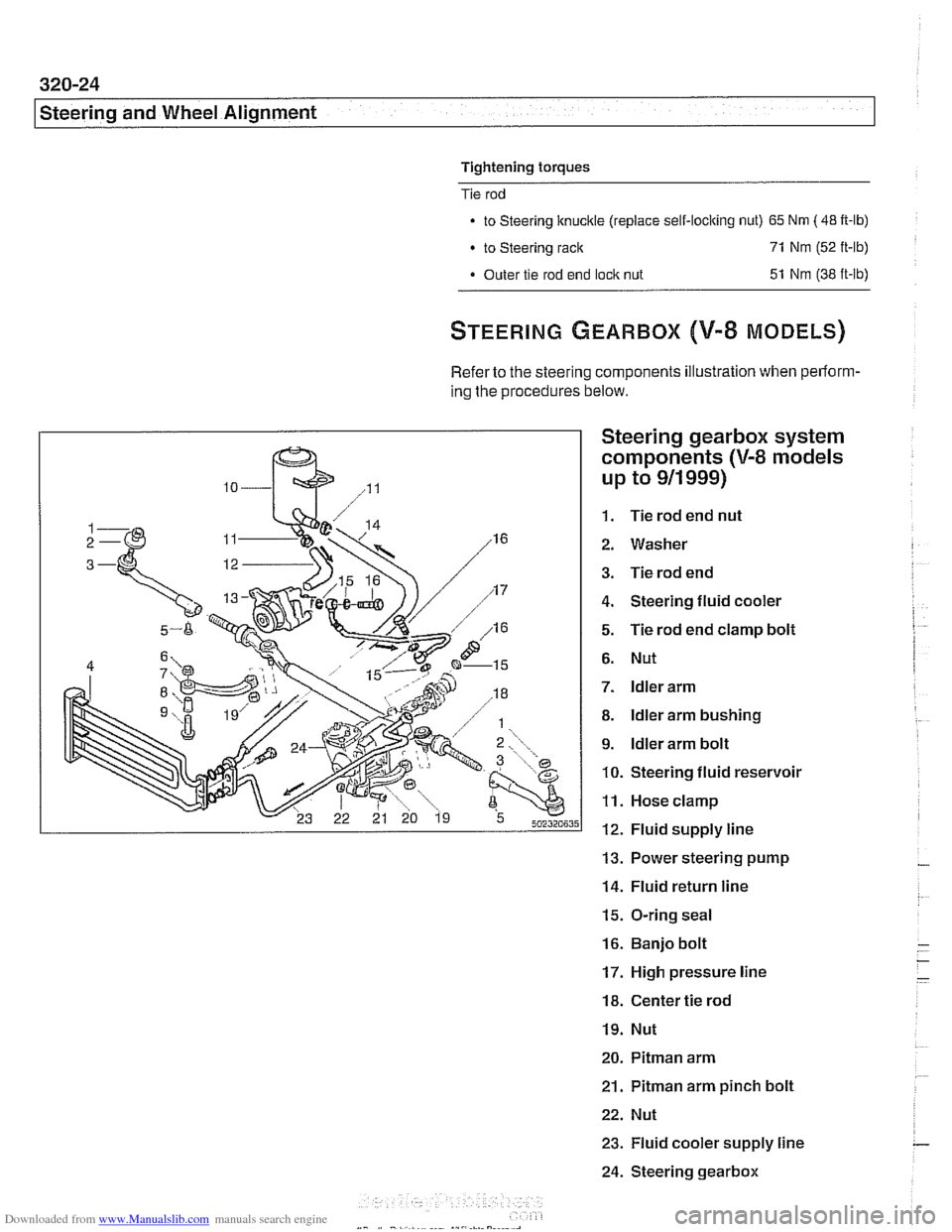
Refer to the steering components illustration when perform-
ing the procedures below.
Steering gearbox system
components
(V-8 models
up to
911 999)
1. Tie rod end nut
2. Washer
3. Tie rod end
4. Steering fluid cooler
5. Tie rod end clamp bolt
6. Nut
7. ldler arm
8. ldler arm bushing
9. ldler arm bolt
10. Steering fluid reservoir
11. Hose clamp
12. Fluid supply line
13. Power steering pump
14. Fluid return line
15. O-ring seal
16. Banjo bolt
17. High pressure line
18. Center tie rod
19. Nut
20. Pitman arm
21.
Pitman arm pinch bolt
22. Nut
23. Fluid cooler supply line
24. Steering gearbox
Page 683 of 1002
Downloaded from www.Manualslib.com manuals search engine
Steering and Wheel ~li~nrnentl
Steering gearbox, removing and installing
- Disconnect negative (-) battery cable. See 020 Mainte-
nance.
CAUTION-
Prior to disconnecting the battew read the battery discon-
nection cautions given in
001 General Cautions and
Warnings.
- Remove airbag unit from steering wheel. See 721 Airbag
System (SRS).
WARNING -
Improper handling of the airbag could cause serious injury
Store the
airbag with the horn pad facing up. If stored lacing
down, accidental deployment couldpropel it violently info the
air, causing
injuv
- Remove steering wheel as described earlier.
- Drain power steering system reservoir.
- Raise front of car.
WARNING -
Make sure the car is firmly supported on jack stands de-
signed for the purpose. Place jack stands beneath structural
chassis points. Do not place jack stands under suspension
Darts.
- Remove heat shield from left side of subframe.
- Remove fluid hoses from top of steering gearbox. Immedi-
ately plug all fluid openings.
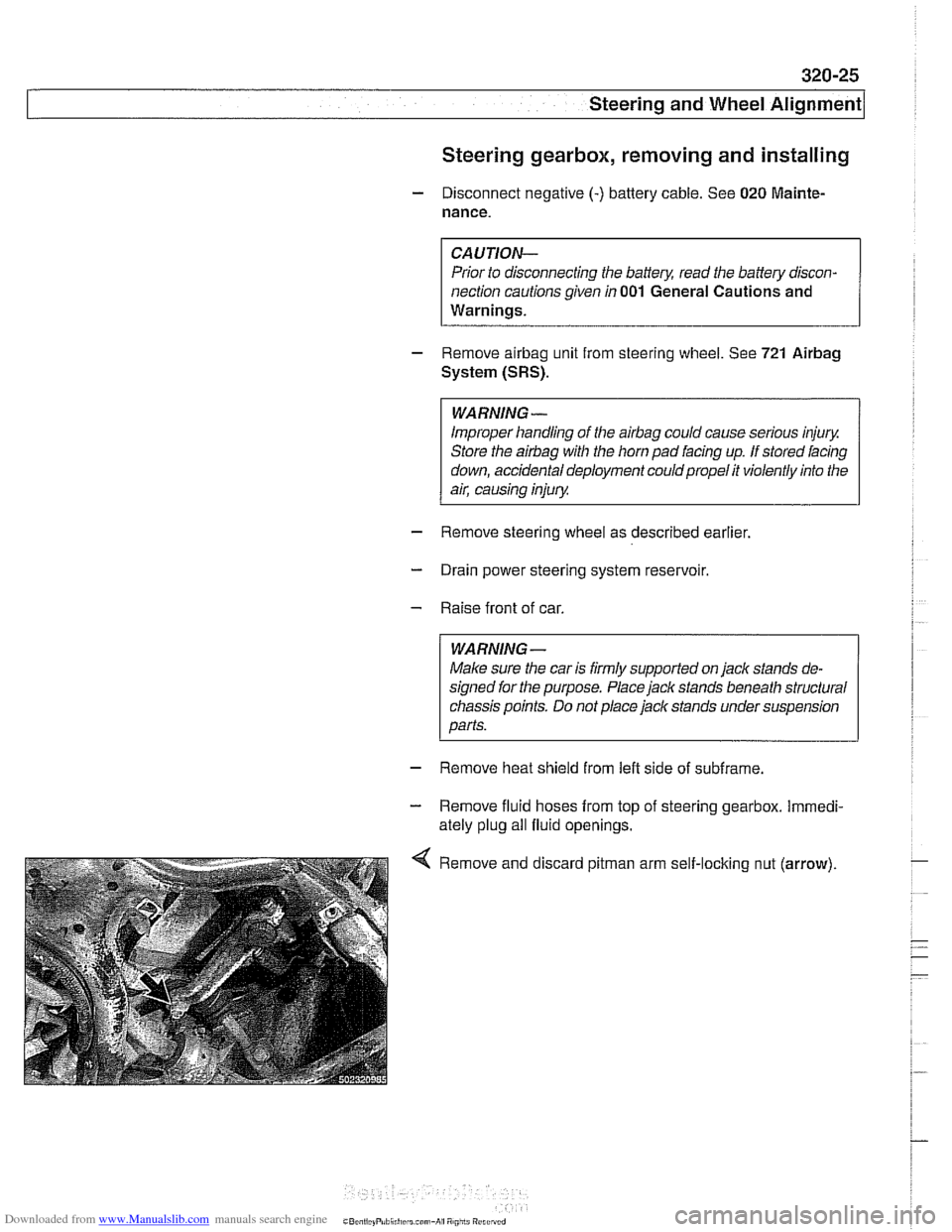
Remove and discard
pitman arm self-loclting nut (arrow).
Page 685 of 1002
Downloaded from www.Manualslib.com manuals search engine
L.. Steering and Wheel ~li~nrnentl ~
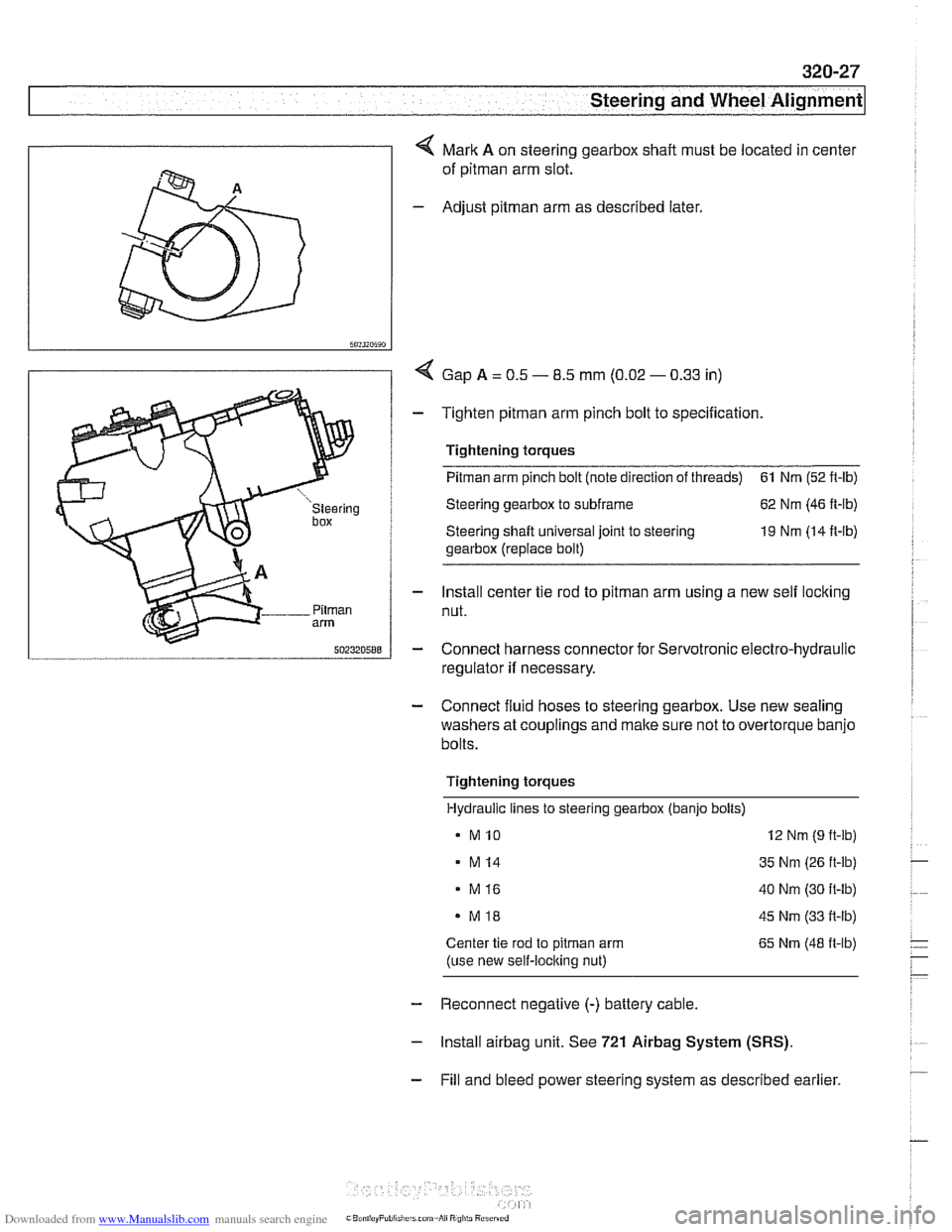
4 Mark A on steering gearbox shaft must be located in center
of
pitman arm slot.
- Adjust pitman arm as described later.
I 5"?~~5~"
I / < Gap A = 0.5 - 8.5 mm (0.02 - 0.33 in)
- Tighten pitman arm pinch bolt to specification.
' 1 Tightening torques
I u "steering Steering gearbox to subframe 62 Nm (46 ft-lb)
box Steering shaft universal joint to steering 19 Nm (14 It-lb)
gearbox (replace bolt)
- Install center tie rod to pitman arm using a new self locking
Pilrnan nut. arm
5nz3zn588 - Connect harness connector for Servotronic electro-hydraulic
regulator
if necessary.
- Connect fluid hoses to steering gearbox. Use new sealing
washers at couplings and make sure not to overtorque banjo
bolts.
Tightening torques Hydraulic lines to steering gearbox (banjo bolts)
MI0 12 Nm (9 ft-lb)
- M14 35 Nm (26 ft-lb)
. M16 40 Nm (30 ft-lb)
MI8 45 Nm (33 it-lb)
Center tie rod to pitrnan arm 65 Nm (48 it-lb)
(use new self-loclting nut)
- Reconnect negative (-) battery cable.
- lnstall airbag unit. See 721 Airbag System (SRS).
- Fill and bleed power steering system as described earlier.
Page 693 of 1002
Downloaded from www.Manualslib.com manuals search engine
Steering and Wheel Alignment
- Tighten nut while counterholding adjusting bolt,
- Tighten nut only after car has been lowered to ground and
suspension has settled.
Preparing for alignment
- The following conditions are necessary prior to wheel align-
ment:
Correct wheels and tires are installed, in good condition,
and are at the correct inflation pressures.
All steering and suspension parts and bushings are un-
damaged and show no signs of abnormal wear. Wheel
bearings are in good condition.
Ride height is in accordance with specifications. See
300
Suspension, Steering and Brakes-General.
Car is in normal loaded position. See below.
* Cars with air suspension: Remove air suspension power
fuse.
Normal loaded position
Each front seat
68 Kg (I50 lb)
Center of rear seat
Trunlc
Fuel tank
68 Kg (150 lb)
21 Kg (46 lb)
Full
Alignment specifications tables
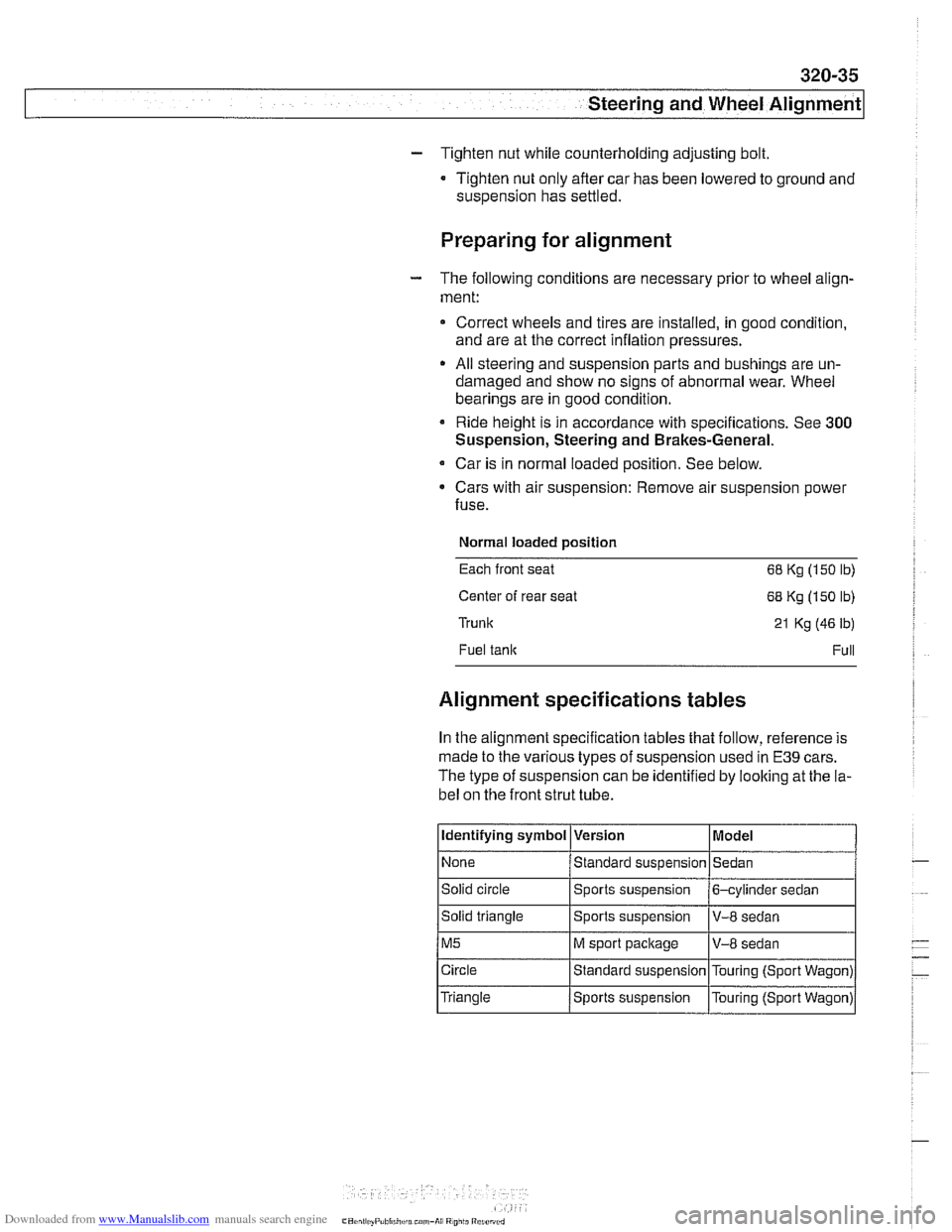
In the alignment specification tables that follow, reference is
made to the various types of suspension used in
E39 cars.
The type of suspension can be identified by loolting at the la-
bel on the front strut tube.
Identifying symbol
None
Solid circle
Solid triangle
M5
Circle
Triangle Version
Standard suspension
Sports
suspension
Sports suspension
M sport package
Standard suspension
Sports suspension Model
Sedan
6-cylinder sedan
V-8 sedan
V-8 sedan
Touring (Sport Wagon)
Touring (Sport Wagon)
Page 766 of 1002
Downloaded from www.Manualslib.com manuals search engine
E39 brake system
BMW E39 models are equipped with vacuum power-assisted
four-wheel disc brakes with an integral
Antilock Brake System
(ABS). Single-piston calipers act on vented front and rear ro-
tors. A brake pad wear sensor for each axle indicates when
brake pads need replacement. The dual drum-type parking
brake system is integrated with the rear brake rotors.
Electronic braking and stability control
E39 models were introduced with Automatic Stability Control,
a computer controlled traction control system that uses the
AB5 system in conjunction with engine management controls
to control wheel spin during take-off and maintain vehicle sta-
bility while braking.
Added in the
1998 model year was Dynamic Stability Control
(DSC). This system implements wheel speed modulation
throughout all stages of driving. For example, DSC is able to
reduce understeer by applying differing amounts of braking
force to each wheel, or it can override the engine manage-
ment system during hard cornering.
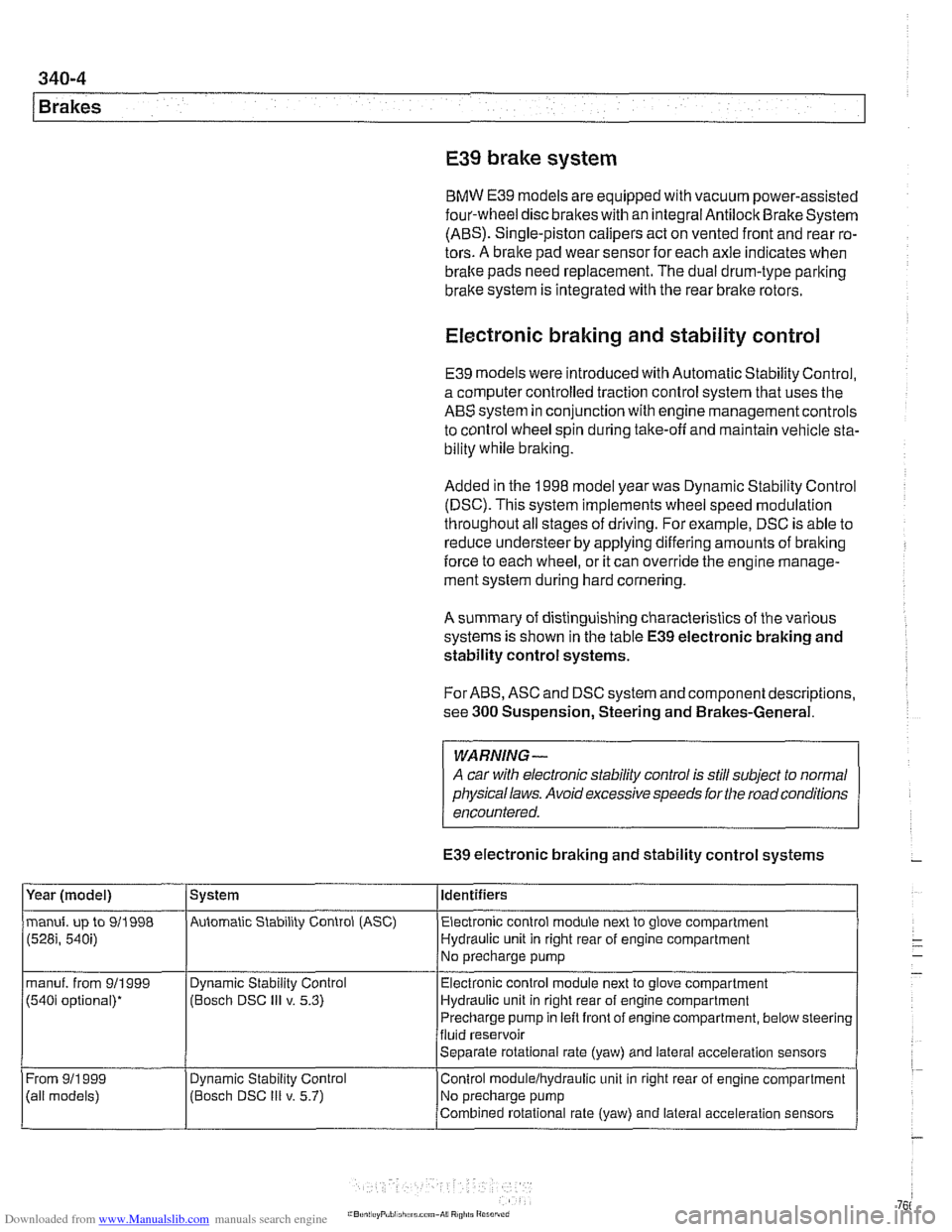
A summary of distinguishing characteristics of the various
systems is shown in the table
E39 electronic braking and
stability control systems.
For ABS, ASC and DSC system and component descriptions,
see
300 Suspension, Steering and Brakes-General.
WARNING-
A car with electronic stability control is still subject to normal
physical laws. Avoid excessive speeds for the road conditions
encountered.
E39 electronic braking and stability control systems
Year (model)
manuf. up to 911998
(528i, 540i)
manuf. from 911999
(540i optional)*
From
911 999
(ail models) System
Automatic Stability Control (ASC) Identifiers
Electronic control module next to glove compartment
Hydraulic unit in right rear of engine compartment
No precharge pump
Dynamic Stability Control
(Bosch DSC
Ill v. 5.3)
Dynamic
Stabil~ty Control
(Bosch DSC
Ill v. 5.7) Electronic
control module next to glove compartment
Hydraulic unit in right rear of engine compartment
Precharge pump in left front of engine compartment, below steering
fluid reservoir
Separate rotational rate (yaw) and lateral acceleration sensors
Control
modulelhydraulic unit in right rear of engine compartment
No precharge pump
Combined rotational rate (yaw) and lateral acceleration sensors
Page 798 of 1002
Downloaded from www.Manualslib.com manuals search engine
400-4
I Bodv-General
Bumpers
The front and rear bumpers are clad in high quality
deform-
able plastic and, at solid barrier impact speeds of 4 kph (2.5
mph), provide protection with virtually no damage to the
bumper
orthe vehicle. In addition to hydraulic dampeners.
which absorb the initial impact energy, these bumpers are
backed by compressible tubes. These deform in a controlled
manner at impact speeds greaterthan that
forwhich bumpers
and hydraulic dampeners are designed. This helps avoid ex-
pensive damage to the body at impact speeds up to 14 kph (9
mph).
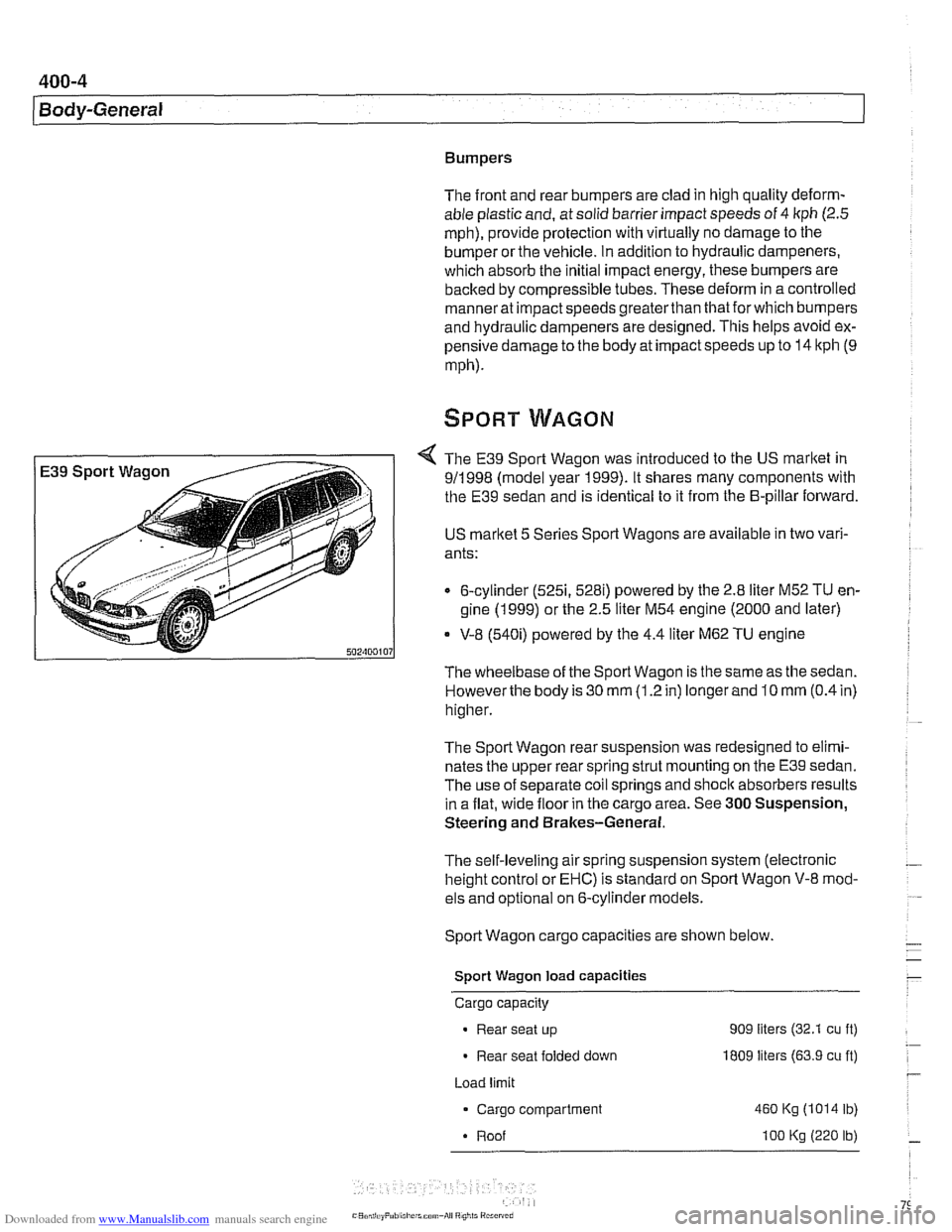
The E39 Sport Wagon was introduced to the US market in
911 998 (model year 1999). It shares many components with
the E39 sedan and is identical to it from the B-pillar forward.
US
marltet 5 Series Sport Wagons are available in two vari-
ants:
6-cylinder
(5251, 528i) powered by the 2.8 liter M52 TU en-
gine (1 999) or the 2.5 liter M54 engine (2000 and later)
* V-8 (540i) powered by the 4.4 liter M62 TU engine
The wheelbase of the Sport Wagon is the same as the sedan.
Howeverthe body is 30
mm (1.2 in) longer and 10 mm (0.4 in)
higher.
The Sport Wagon rear suspension was redesigned to elimi-
nates the upper rear spring strut mounting on the E39 sedan.
The use of separate coil springs and
shoclc absorbers results
in a flat, wide floor in the cargo area. See
300 Suspension,
Steering and Brakes-General.
The self-leveling air spring suspension system (electronic
height control or EHC) is standard on Sport Wagon V-8 mod-
els and optional on 6-cylinder models.
Sport Wagon cargo capacities are shown below.
Sport Wagon load capacities
Cargo capacity
Rear seat up 909 liters (32.1 cu ft)
Rear seat folded down I809 liters (63.9 cu ft)
Load limit
Cargo compartment
460 Kg (1014 lb)
Roof
I00 Kg (220 lb)
Page 803 of 1002
Downloaded from www.Manualslib.com manuals search engine
400-9
Body-General
Battery safety terminal
(BST)
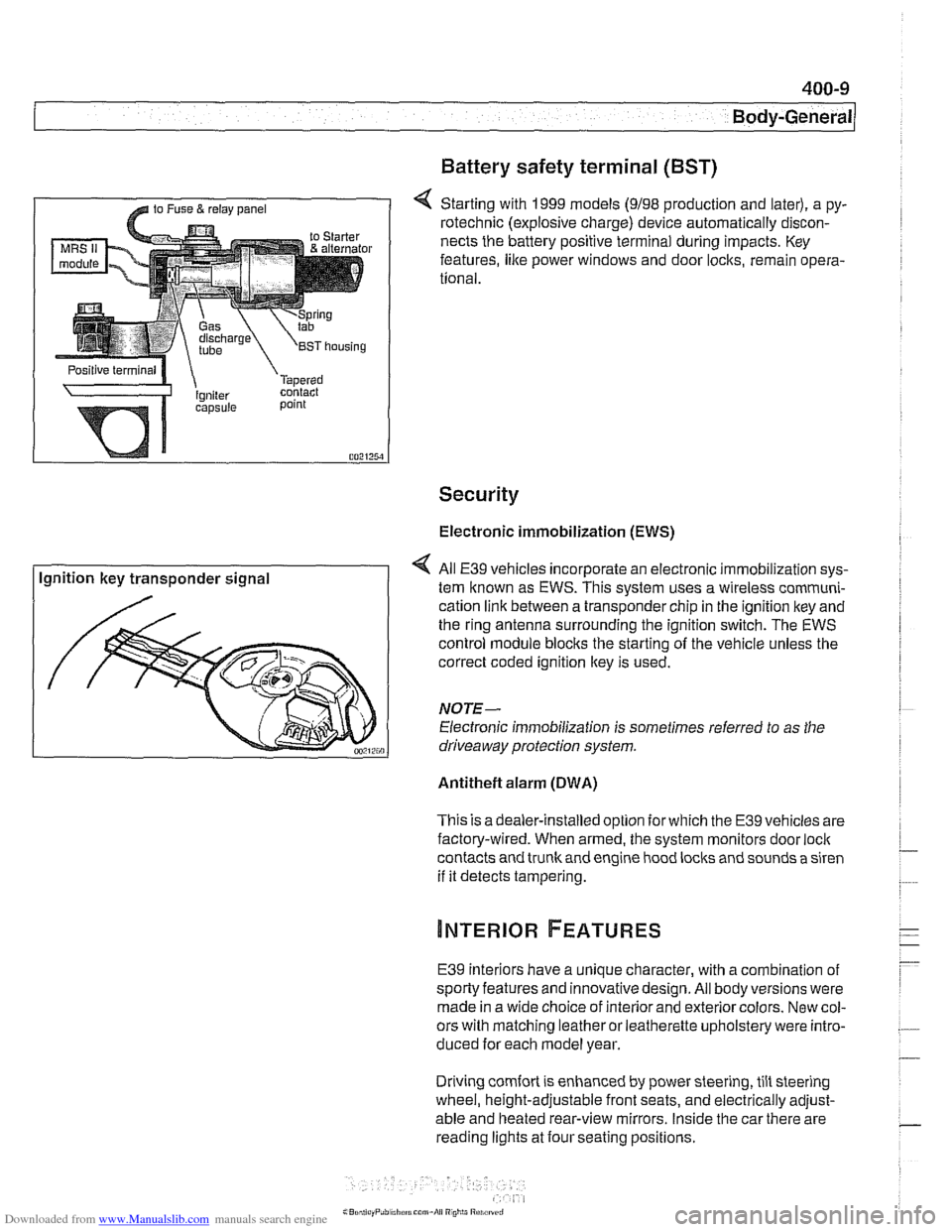
4 Starting with 1999 models (9198 production and later), a py-
rotechnic (explosive charge) device automatically discon-
nects the battery positive terminal during impacts. Key
features,
like power windows and door locks, remain opera-
tional.
Security
Electronic immobilization (EWS)
Ignition key transponder signal All
E39 vehicles incorporate an electronic immobilization sys-
tem known as EWS. This svstem uses a wireless comrnuni-
cation link between a transponder chip in the ignition key and
the ring antenna surrounding the ignition switch. The EWS
control module blocks the starting of the vehicle unless the
correct coded ignition key is used.
NOTE-
Electronic immobilization is sometimes referred to as the
driveaway protection system.
Antitheft alarm (DWA)
This is adealer-installed option for which the E39 vehicles are
factory-wired. When armed, the system monitors door
loci(
contacts and trunk and engine hood locks and sounds a siren
if it detects tampering.
E39 interiors have a unique character, with a combination
of
sporty features and innovativedesign. All body versions were
made in a wide choice of interior and exterior colors. New col-
ors with matching leather or leatherette upholstery were intro-
duced for each model year.
Driving
comfort is enhanced by power steering, tilt steering
wheel, height-adjustable front seats, and electrically adjust-
able and heated rear-view mirrors. Inside the car there are
reading lights at four seating positions.