cruise control BMW 528I 2013 User Guide
[x] Cancel search | Manufacturer: BMW, Model Year: 2013, Model line: 528I, Model: BMW 528I 2013Pages: 246, PDF Size: 5.39 MB
Page 128 of 246
It is displayed in the speedometer and briefly
displayed in the instrument cluster, Displays in
the instrument cluster, refer to page 129.
When cruise control is maintained or stored,
DSC Dynamic Stability Control is switched on, if
necessary.
Changing, maintaining, and storing the
speed
The rocker switch can be pressed while the sys‐
tem is interrupted to maintain and store the cur‐
rent speed. DSC Dynamic Stability Control is
switched on, if necessary.
Adapting the desired speed
Adapt the desired speed to the road con‐
ditions and be ready to brake at all times; other‐
wise, there is the danger of an accident occur‐
ring.◀
Speed differences
Large differences in speed relative to ve‐
hicles ahead of the vehicle cannot be compen‐
sated by the system for example in the following
situations:▷When catching up rapidly with a truck.▷When another vehicle suddenly swerves
into the wrong lane.◀
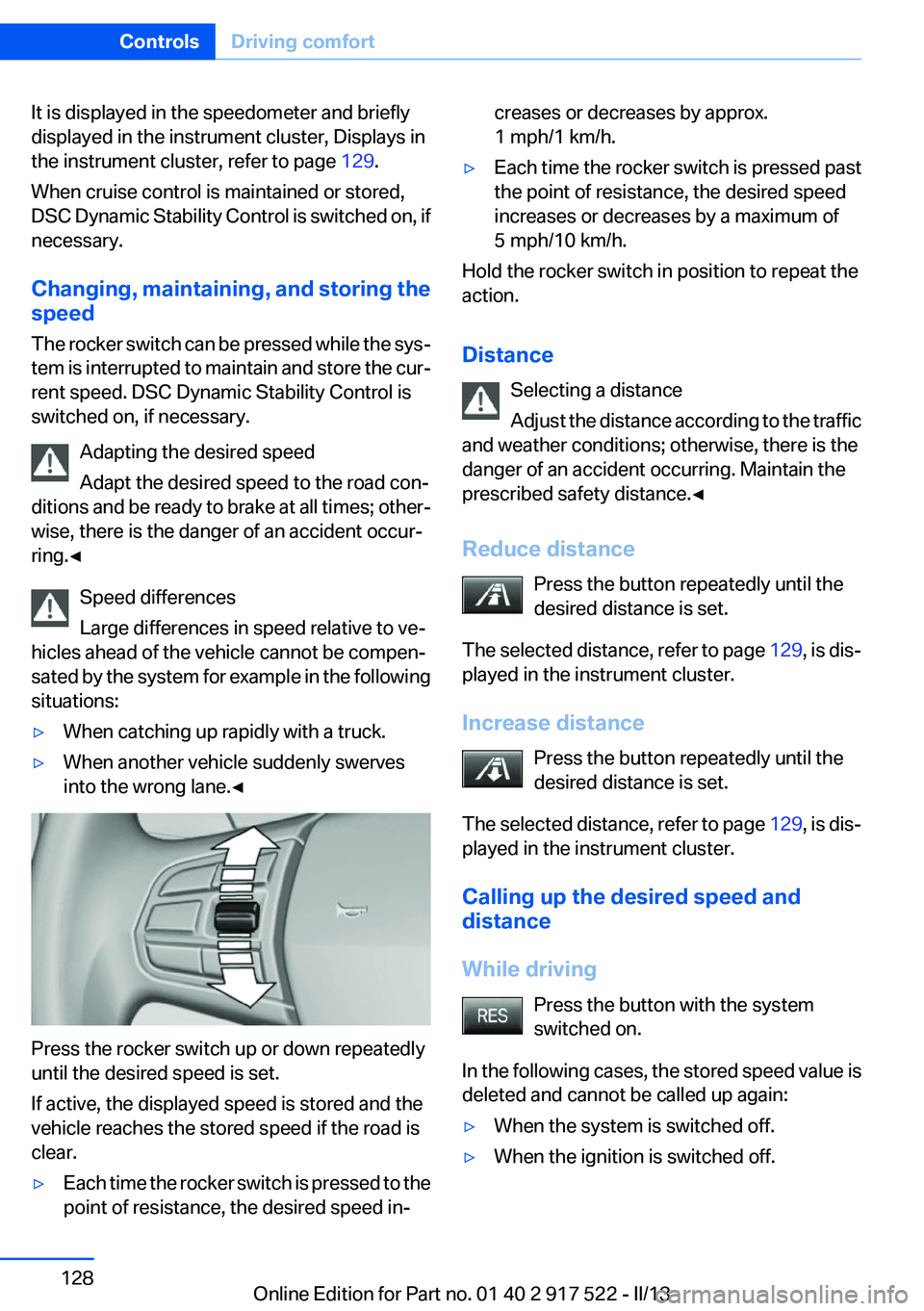
Press the rocker switch up or down repeatedly
until the desired speed is set.
If active, the displayed speed is stored and the
vehicle reaches the stored speed if the road is
clear.
▷Each time the rocker switch is pressed to the
point of resistance, the desired speed in‐creases or decreases by approx.
1 mph/1 km/h.▷Each time the rocker switch is pressed past
the point of resistance, the desired speed
increases or decreases by a maximum of
5 mph/10 km/h.
Hold the rocker switch in position to repeat the
action.
Distance Selecting a distance
Adjust the distance according to the traffic
and weather conditions; otherwise, there is the
danger of an accident occurring. Maintain the
prescribed safety distance.◀
Reduce distance Press the button repeatedly until the
desired distance is set.
The selected distance, refer to page 129, is dis‐
played in the instrument cluster.
Increase distance Press the button repeatedly until the
desired distance is set.
The selected distance, refer to page 129, is dis‐
played in the instrument cluster.
Calling up the desired speed and
distance
While driving Press the button with the system
switched on.
In the following cases, the stored speed value is
deleted and cannot be called up again:
▷When the system is switched off.▷When the ignition is switched off.Seite 128ControlsDriving comfort128
Online Edition for Part no. 01 40 2 917 522 - II/13
Page 130 of 246
Indicator/warning lampsPersonal responsibility
The indicator and warning lamps do not
relieve the driver of the responsibility to adapt
his or her desired driving speed and style to the
traffic conditions.◀
The vehicle symbol lights up orange:
A vehicle has been detected ahead of
you.
The vehicle symbol flashes orange:
The conditions are not adequate for op‐
erating the system.
The system was deactivated but applies the
brakes until you actively assume control by
pressing on the brake pedal or accelerator.
The vehicle symbol flashes red and an
acoustic signal sounds:
You are requested to intervene by brak‐
ing or making an evasive maneuver.
Displays in the Head-up Display
The information from Active Cruise Control can
also be displayed in the Head-up Display.
Adjusting the Head-up Display, refer to
page 146.
System limits
Speed range
Best results are achieved when using the sys‐
tem on well-developed roads and highways.
The desired speed can be selected between
20 mph/30 km/h to 110 mph/180 km/h.
The system can also be activated when station‐
ary.
Comply with the legal speed limit in every situa‐
tion when using the system.Detection range
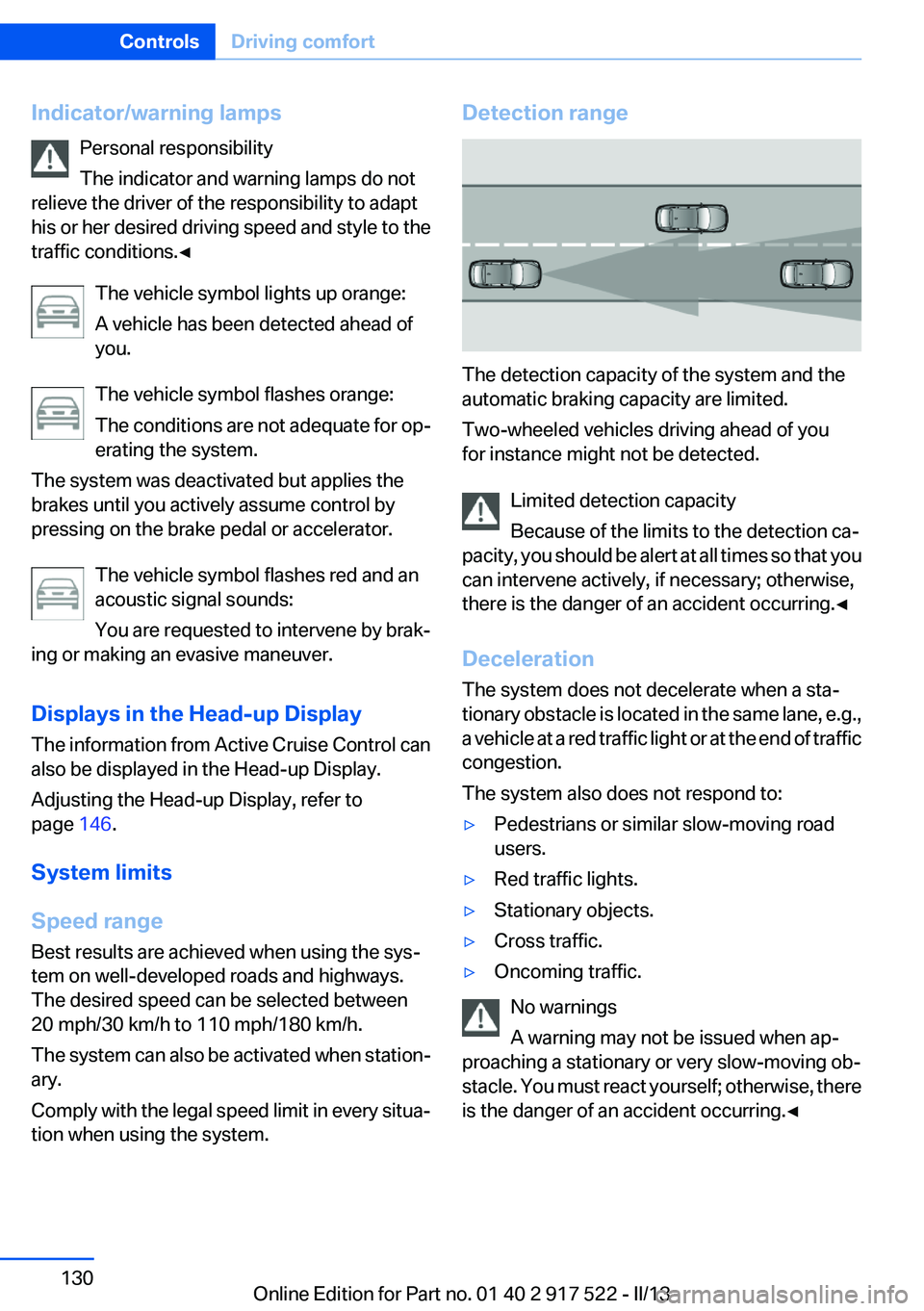
The detection capacity of the system and the
automatic braking capacity are limited.
Two-wheeled vehicles driving ahead of you
for instance might not be detected.
Limited detection capacity
Because of the limits to the detection ca‐
pacity, you should be alert at all times so that you
can intervene actively, if necessary; otherwise,
there is the danger of an accident occurring.◀
Deceleration
The system does not decelerate when a sta‐
tionary obstacle is located in the same lane, e.g.,
a vehicle at a red traffic light or at the end of traffic
congestion.
The system also does not respond to:
▷Pedestrians or similar slow-moving road
users.▷Red traffic lights.▷Stationary objects.▷Cross traffic.▷Oncoming traffic.
No warnings
A warning may not be issued when ap‐
proaching a stationary or very slow-moving ob‐
stacle. You must react yourself; otherwise, there
is the danger of an accident occurring.◀
Seite 130ControlsDriving comfort130
Online Edition for Part no. 01 40 2 917 522 - II/13
Page 132 of 246
Radar sensor
For US owners only
The transmitter and receiver units comply with
part 15 of the FCC/Federal Communication
Commission regulations. Operation is governed
by the following:
FCC ID:▷OAYARS3-A
Compliance statement:
This device complies with part 15 of the FCC
Rules. Operation is subject to the following two
conditions:
▷This device may not cause harmful interfer‐
ence, and▷this device must accept any interference re‐
ceived, including interference that may
cause undesired operation.
Any unauthorized modifications or changes to
these devices could void the user's authority to
operate this equipment.
Malfunction
The system cannot be activated if the radar sen‐
sor is not aligned correctly. This may be caused
by damage incurred during parking, for example.
A Check Control message is displayed if the
system fails.
Cruise control
The concept
The system is functional at speeds beginning at
approx. 20 mph/30 km/h.
It maintains the speed that was set using the
control elements on the steering wheel.
The system brakes on downhill gradients if en‐
gine braking action is insufficient.
Unfavorable conditions
Do not use the system if unfavorable con‐
ditions make it impossible to drive at a constant
speed, for instance:▷On curvy roads.▷In heavy traffic.▷On slippery roads, in fog, snow or rain, or on
a loose road surface.
Otherwise, you could lose control of the vehicle
and cause an accident.◀
Controls
At a glance
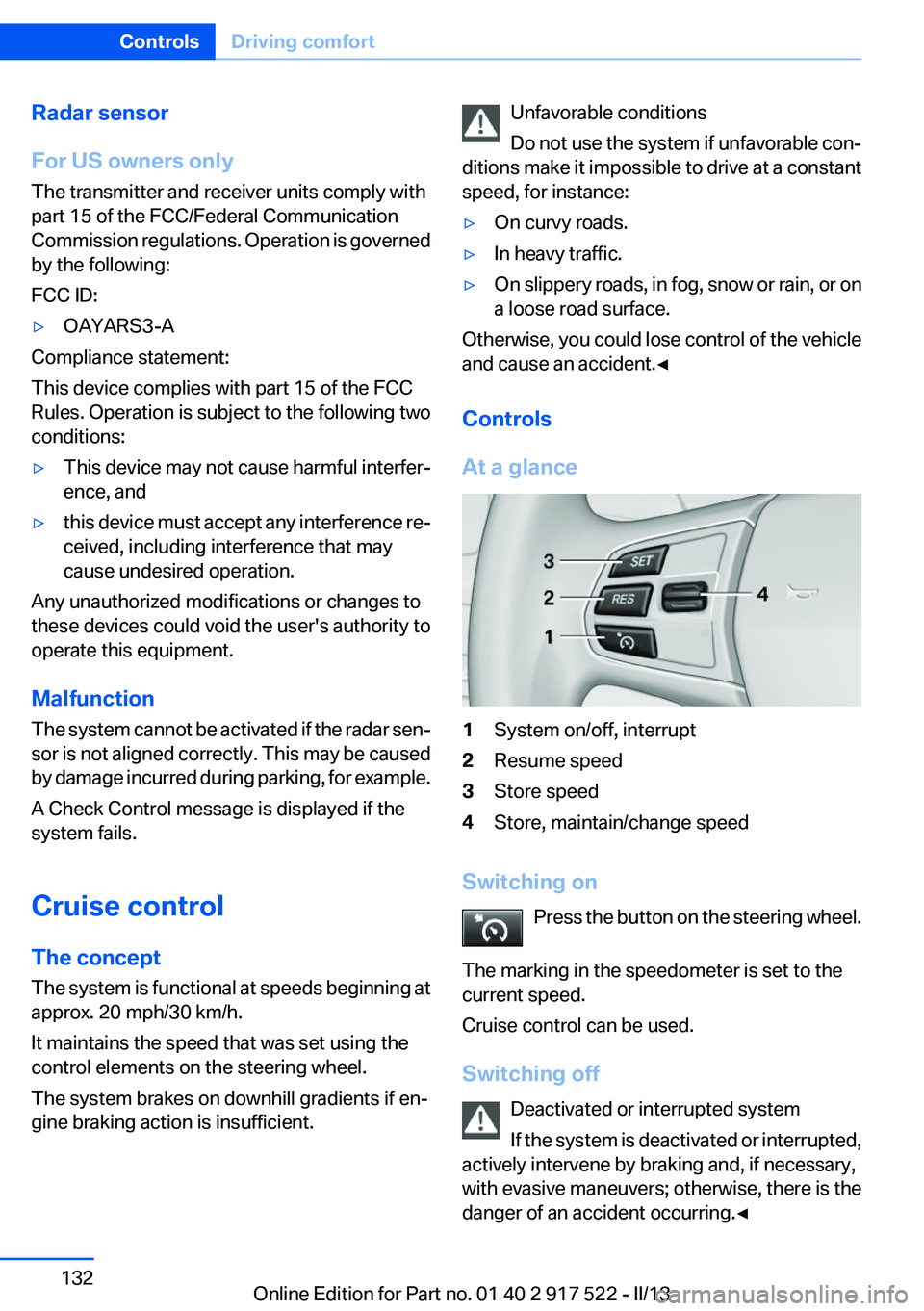
1System on/off, interrupt2Resume speed3Store speed4Store, maintain/change speed
Switching on Press the button on the steering wheel.
The marking in the speedometer is set to the
current speed.
Cruise control can be used.
Switching off Deactivated or interrupted system
If the system is deactivated or interrupted,
actively intervene by braking and, if necessary,
with evasive maneuvers; otherwise, there is the
danger of an accident occurring.◀
Seite 132ControlsDriving comfort132
Online Edition for Part no. 01 40 2 917 522 - II/13
Page 133 of 246
Press the button on the steering wheel.▷If active: press twice.▷If interrupted: press once.
The displays go out. The stored desired speed
is deleted.
Interrupting the system When active, press the button.
The system is automatically interrupted if:
▷The brakes are applied.▷The clutch pedal is depressed for a few sec‐
onds or released while a gear is not en‐
gaged.▷The transmission position D is disengaged.▷DTC Dynamic Traction Control is activated
or DSC is deactivated.▷DSC is actively controlling stability.▷HDC is activated.
Maintaining/storing the current speed
Press the button.
Or:
Press the rocker switch while the system is in‐
terrupted.
When the system is switched on, the current
speed is maintained and stored as the desired
speed.
It is displayed in the speedometer and briefly
displayed in the instrument cluster, Displays in
the speedometer, refer to page 134.
When cruise control is maintained or stored,
DSC Dynamic Stability Control is switched on, if
necessary.
Changing/maintaining speed
The rocker switch can be pressed while the sys‐
tem is interrupted in order to maintain and store
the current speed.
Adapting the desired speed
Adapt the desired speed to the road con‐
ditions and be ready to brake at all times; other‐
wise, there is the danger of an accident occur‐
ring.◀
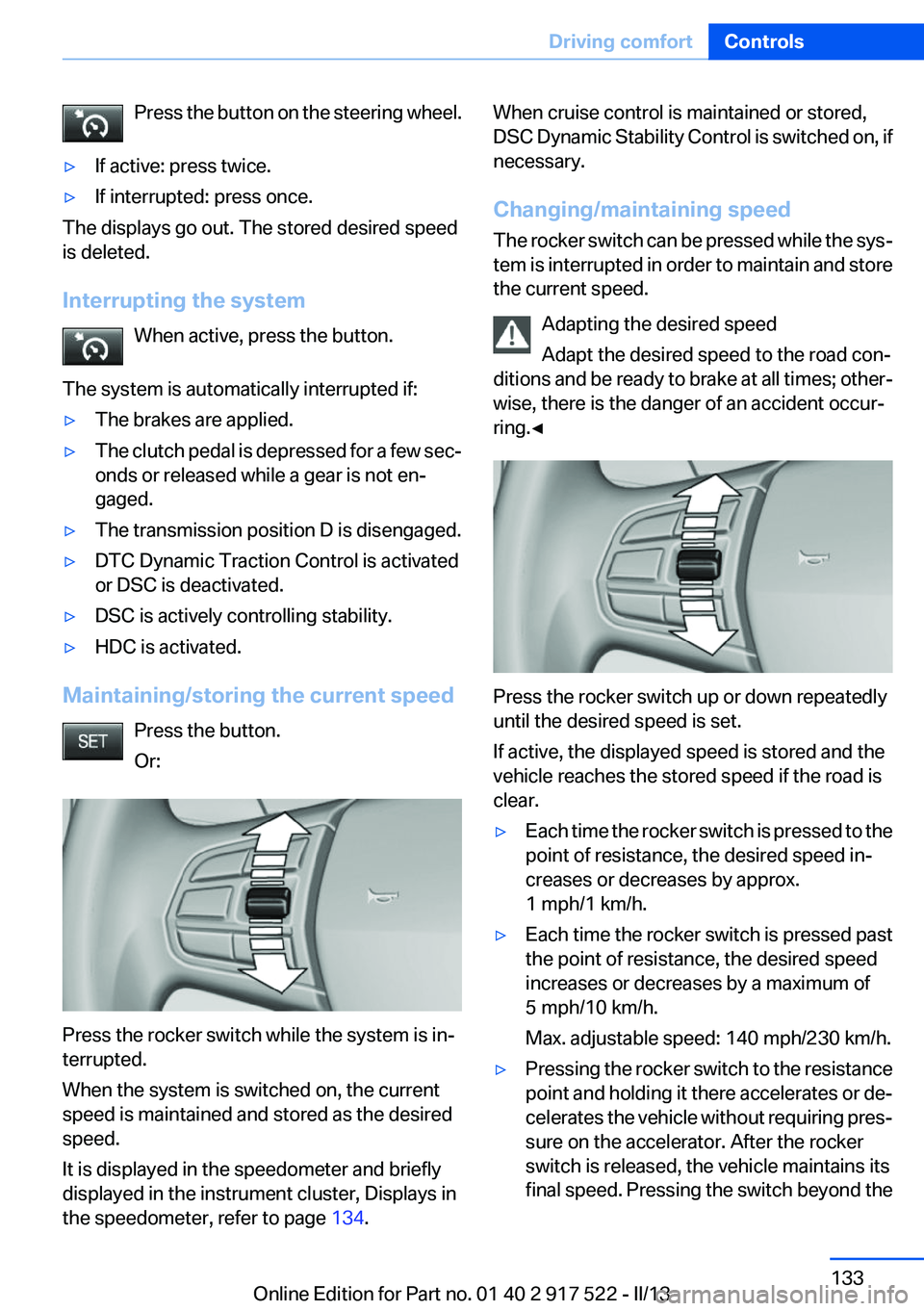
Press the rocker switch up or down repeatedly
until the desired speed is set.
If active, the displayed speed is stored and the
vehicle reaches the stored speed if the road is
clear.
▷Each time the rocker switch is pressed to the
point of resistance, the desired speed in‐
creases or decreases by approx.
1 mph/1 km/h.▷Each time the rocker switch is pressed past
the point of resistance, the desired speed
increases or decreases by a maximum of
5 mph/10 km/h.
Max. adjustable speed: 140 mph/230 km/h.▷Pressing the rocker switch to the resistance
point and holding it there accelerates or de‐
celerates the vehicle without requiring pres‐
sure on the accelerator. After the rocker
switch is released, the vehicle maintains its
final speed. Pressing the switch beyond theSeite 133Driving comfortControls133
Online Edition for Part no. 01 40 2 917 522 - II/13
Page 146 of 246
Limits of ultrasonic measurement
The detection of objects can reach the physical
limits of ultrasonic measurement, e.g., in the fol‐
lowing circumstances:▷With tow bars and trailer hitches.▷With thin or wedge-shaped objects.▷With elevated, protruding objects such as
ledges or cargo.▷With objects with corners and sharp edges.▷With objects with a fine surface structure,
such as fences.
Low objects already displayed, e.g., curbs, can
move into the blind area of the sensors before or
after a continuous tone sounds.
High, protruding objects such as ledges may not
be detected.
The parking assistant may identify parking
spaces that are not suitable for parking.
Malfunction
A Check Control message is displayed.
The parking assistant failed. Have the system
checked.
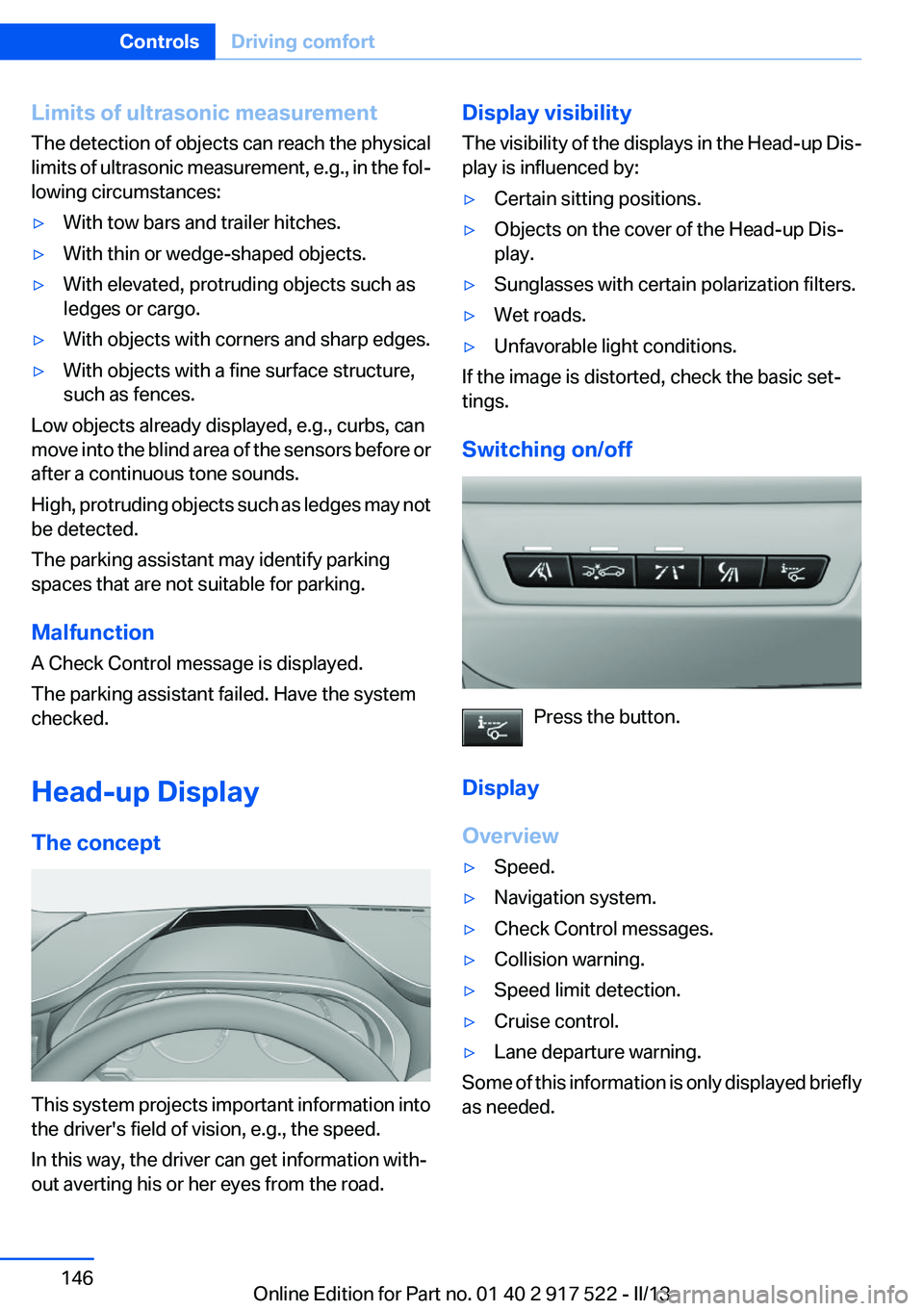
Head-up Display
The concept
This system projects important information into
the driver's field of vision, e.g., the speed.
In this way, the driver can get information with‐
out averting his or her eyes from the road.
Display visibility
The visibility of the displays in the Head-up Dis‐
play is influenced by:▷Certain sitting positions.▷Objects on the cover of the Head-up Dis‐
play.▷Sunglasses with certain polarization filters.▷Wet roads.▷Unfavorable light conditions.
If the image is distorted, check the basic set‐
tings.
Switching on/off
Press the button.
Display
Overview
▷Speed.▷Navigation system.▷Check Control messages.▷Collision warning.▷Speed limit detection.▷Cruise control.▷Lane departure warning.
Some of this information is only displayed briefly
as needed.
Seite 146ControlsDriving comfort146
Online Edition for Part no. 01 40 2 917 522 - II/13
Page 236 of 246
Everything from A to Z
IndexA
ABS, Antilock Brake Sys‐ tem 119
ACC, Active Cruise Control with Stop & Go 126
Activated-charcoal filter 151
Active Blind Spot Detec‐ tion 115
Active Cruise Control with Stop & Go, ACC 126
Active Protection 117
Active seat, front 49
Active seat ventilation, front 50
Active Steering, integral 122
Adaptive brake assistant 119
Adaptive brake lights, refer to Brake force display 117
Adaptive drive 122
Adaptive light control 96
Additives, oil 207
Adjustments, seats/head re‐ straints 47
After washing vehicle 227
Airbags 99
Airbags, indicator/warning light 100
Air circulation, refer to Recir‐ culated-air mode 150
Air, dehumidifying, refer to Cooling function 150
Air distribution, manual 149
Air flow, automatic climate control 149
Air pressure, tires 189
Air vents, refer to Ventila‐ tion 151
Alarm system 42
Alarm, unintentional 43 All around the center con‐
sole 14
All around the headliner 15
All around the steering wheel 12
ALL program, automatic cli‐ mate control 150
All-season tires, refer to Win‐ ter tires 201
All-wheel-drive 121
Alternating-code hand-held transmitter 156
Alternative oil types 207
Ambient light 98
Antifreeze, washer fluid 71
Antilock Brake System, ABS 119
Anti-slip control, refer to DSC 119
Approved axle load 233
Approved engine oils 207
Armrest, refer to Center arm‐ rest 165
Arrival time 90
Ashtray 157
Ashtray, front 157, 158
Ashtray, rear 158
Assistance, Roadside Assis‐ tance 221
Assistance when driving off 119
AUTO H button, refer to Auto‐ matic Hold 67
AUTO intensity 149
Automatic car wash 226
Automatic climate con‐ trol 148
Automatic Cruise Control with Stop & Go 126
Automatic Curb Monitor 56 Automatic deactivation, front
passenger airbags 101
Automatic headlamp con‐ trol 95
Automatic Hold 67
Automatic locking 37
Automatic recirculated-air control 150
Automatic Soft Closing, doors 37
Automatic tailgate 38
Automatic transmission with Steptronic 72
AUTO program, automatic cli‐ mate control 149
AUTO program, intensity 149
Auto Start/Stop function 64
Average fuel consumption 89
Average speed 89
Axle loads, weights 233
B
Backrest curvature, refer to Lumbar support 49
Backup camera 136
Band-aids, refer to First aid kit 221
Bar for tow-starting/tow‐ ing 224
Battery replacement, vehicle battery 218
Battery replacement, vehicle remote control 30
Battery, vehicle 218
Belts, safety belts 51
Beverage holder, cu‐ pholder 166
Blinds, sun protection 44
BMW Assist, see user's manual for Navigation, Enter‐Seite 236ReferenceEverything from A to Z236
Online Edition for Part no. 01 40 2 917 522 - II/13
Page 238 of 246
Corrosion on brake discs 174
Cruise control 132
Cruise control, active with Stop & Go 126
Cruising range 85
Cupholder 166
Current fuel consumption 85
D
Damage, tires 200
Damping control, dy‐ namic 122
Data, technical 232
Date 85
Daytime running lights 95
Defrosting, refer to Windows, defrosting 149
Dehumidifying, air 150
Destination distance 89
Digital clock 84
Dimensions 232
Dimmable exterior mirrors 56
Dimmable interior rearview mirror 56
Direction indicator, refer to Turn signals 69
Display, electronic, instrument cluster 77
Display in windshield 146
Display lighting, refer to Instru‐ ment lighting 98
Displays 75, 78
Displays, cleaning 229
Disposal, coolant 209
Disposal, vehicle battery 219
Distance control, refer to PDC 134
Distance, selecting for ACC 128
Distance to destination 89
Divided screen view, split screen 20
Door lock, refer to Remote control 30 Doors, Automatic Soft Clos‐
ing 37
Downhill control 121
Drive-off assistant 119
Drive-off assistant, refer to DSC 119
Driving 0
Driving Dynamics Control 123
Driving instructions, breaking in 172
Driving mode 123
Driving notes, general 172
Driving stability control sys‐ tems 119
Driving tips 172
DSC Dynamic Stability Con‐ trol 119
DTC driving dynamics 120
DTC Dynamic Traction Con‐ trol 120
Dynamic Damping Con‐ trol 122
Dynamic Drive 122
Dynamic Stability Control DSC 119
Dynamic Traction Control DTC 120
E
ECO PRO 179
ECO PRO, bonus range 180
ECO PRO display 179
ECO PRO driving mode 179
ECO PRO mode 179
ECO PRO Tip - driving instruc‐ tion 181
EfficientDynamics 181
Electronic displays, instru‐ ment cluster 77
Electronic Stability Program ESP, refer to DSC 119
Emergency detection, remote control 31
Emergency release, door lock 37 Emergency release, fuel filler
flap 186
Emergency Request 220
Emergency service, refer to Roadside Assistance 221
Emergency start function, en‐ gine start 31
Emergency unlocking, trunk lid 40
Energy Control 85
Energy recovery 85
Engine, automatic Start/Stop function 64
Engine, automatic switch- off 64
Engine compartment 204
Engine compartment, working in 204
Engine coolant 209
Engine oil 206
Engine oil, adding 207
Engine oil additives 207
Engine oil change 207
Engine oil filler neck 207
Engine oil temperature 84
Engine oil types, alterna‐ tive 207
Engine oil types, ap‐ proved 207
Engine start during malfunc‐ tion 31
Engine start, jump-start‐ ing 221
Engine start, refer to Starting the engine 63
Engine stop 63
Engine temperature 84
Entering a car wash 226
Equipment, interior 155
ESP Electronic Stability Pro‐ gram, refer to DSC 119
Exchanging wheels/tires 201
Exhaust system 173
Exterior mirror, automatic dim‐ ming feature 56
Exterior mirrors 55 Seite 238ReferenceEverything from A to Z238
Online Edition for Part no. 01 40 2 917 522 - II/13
Page 243 of 246
Smallest turning circle 233
Smoker's package 157
Snow chains 202
Socket 159
Socket, OBD Onboard Diag‐ nostics 211
SOS button 220
Spare fuse 219
Speaker lighting 98
Specified engine oil types 207
Speed, average 89
Speed limit detection, on‐ board computer 90
Speed limiter, display 86
Speed Limit Information 86
Speed limit in the com‐ puter 90
Split screen 20
SPORT+ - program, Dynamic Driving Control 124
Sport automatic transmis‐ sion 74
SPORT program, Dynamic Driving Control 124
Sport program, transmis‐ sion 73
Stability control systems 119
Start/stop, automatic func‐ tion 64
Start/Stop button 62
Start function during malfunc‐ tion 31
Starting the engine 63
Status display, tires 102
Status information, iDrive 19
Status of Owner's Manual 6
Steering, Integral Active Steering 122
Steering wheel, adjusting 57
Steering wheel heating 57
Steering wheel memory 54
Steptronic, automatic trans‐ mission 72
Stopping the engine 63 Storage compartment, remote
control 167
Storage compartments 164
Storage compartments, loca‐ tions 164
Storage, tires 202
Storing the vehicle 229
Summer tires, tread 200
Supplementary text mes‐ sage 83
Surround View 136
Suspension settings 123
Switch for Dynamic Driving Control 123
Switch-on times, parked-car ventilation 154
Switch, refer to Cockpit 12
Symbols 6
T
Tachometer 84
Tail and brake lamps 217
Tailgate 37
Tailgate, automatic 38
Tailgate opening with no- touch activation 41
Tailgate via remote control 35
Tail lamps 216
Tail lamps, bulb replace‐ ment 217
Technical changes, refer to Safety 7
Technical data 232
Telephone, see user's manual for Navigation, Entertain‐
ment and Communication
Temperature, automatic cli‐ mate control 149
Temperature display, external temperature 84
Temperature, engine oil 84
Tempomat, refer to Active Cruise Control 126
Terminal, jump-starting 222 Text message, supplemen‐
tary 83
Theft alarm system, refer to Alarm system 42
Theft protection, refer to Cen‐ tral locking system 33
Thermal camera, refer to Night Vision 111
Through-loading system 160
Tilt alarm sensor 43
Time of arrival 90
Tire damage 200
Tire identification marks 198
Tire inflation pressure 189
Tire inflation pressure monitor, refer to FTM 105
Tire Pressure Monitor TPM 102
Tires, changing 201
Tires, everything on wheels and tires 189
Tires, run-flat tires 202
Tire tread 200
Tone, see user's manual for Navigation, Entertainment
and Communication
Tools 212
Top View 139
Total vehicle weight 233
Tow fitting 224
Towing 223
Tow-starting 223
Tow truck 223
TPM Tire Pressure Moni‐ tor 102
Traction control 120
Transmission, automatic 72
Transmission, manual 72
Transporting children safely 58
Tread, tires 200
Trip computer 90
Triple turn signal activa‐ tion 69
Trip odometer 84 Seite 243Everything from A to ZReference243
Online Edition for Part no. 01 40 2 917 522 - II/13