wheel size BMW 528I 2014 User Guide
[x] Cancel search | Manufacturer: BMW, Model Year: 2014, Model line: 528I, Model: BMW 528I 2014Pages: 267, PDF Size: 5.88 MB
Page 217 of 267
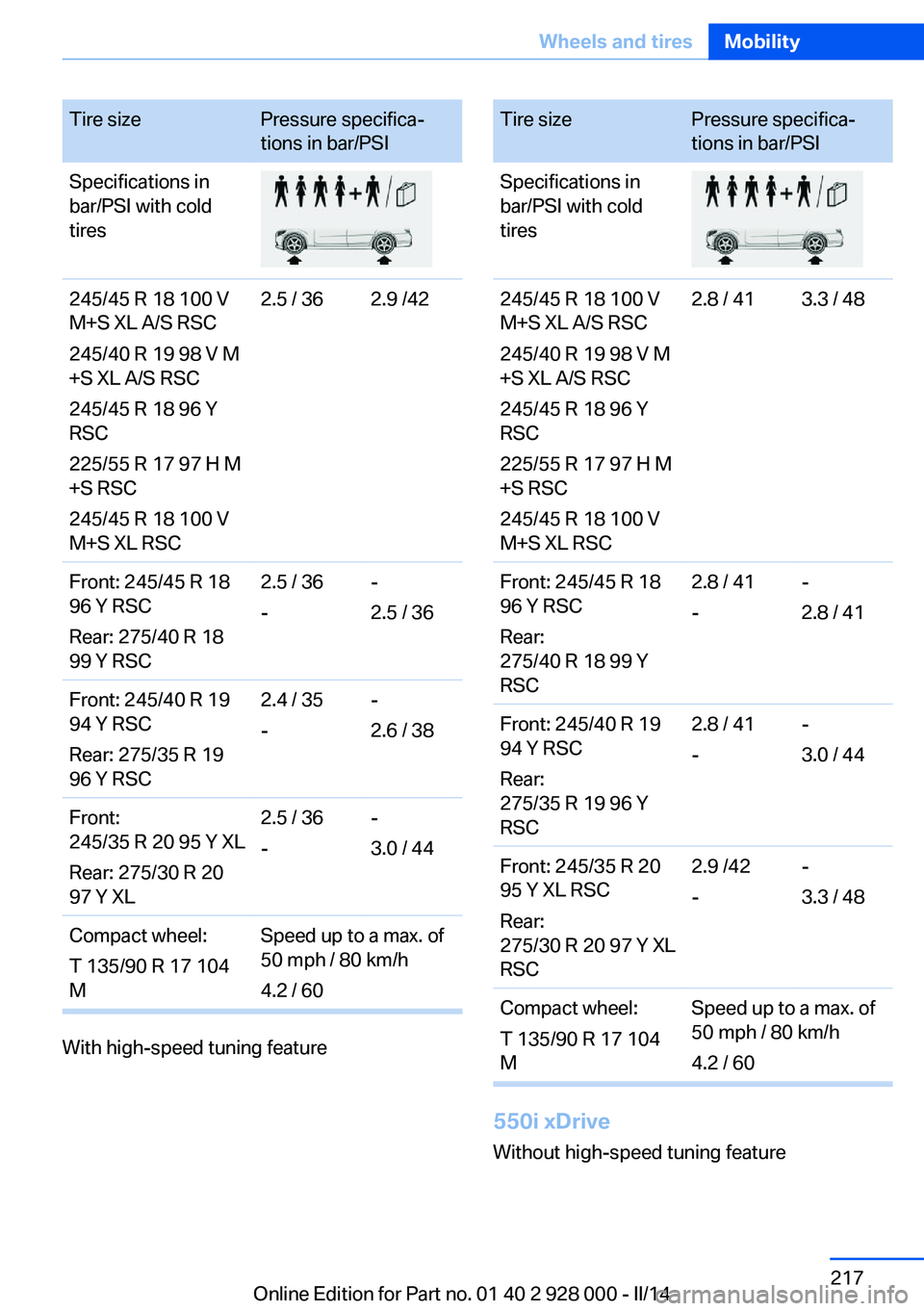
Tire sizePressure specifica‐
tions in bar/PSISpecifications in
bar/PSI with cold
tires245/45 R 18 100 V
M+S XL A/S RSC
245/40 R 19 98 V M
+S XL A/S RSC
245/45 R 18 96 Y
RSC
225/55 R 17 97 H M
+S RSC
245/45 R 18 100 V
M+S XL RSC2.5 / 362.9 /42Front: 245/45 R 18
96 Y RSC
Rear: 275/40 R 18
99 Y RSC2.5 / 36
--
2.5 / 36Front: 245/40 R 19
94 Y RSC
Rear: 275/35 R 19
96 Y RSC2.4 / 35
--
2.6 / 38Front:
245/35 R 20 95 Y XL
Rear: 275/30 R 20
97 Y XL2.5 / 36
--
3.0 / 44Compact wheel:
T 135/90 R 17 104
MSpeed up to a max. of
50 mph / 80 km/h
4.2 / 60
With high-speed tuning feature
Tire sizePressure specifica‐
tions in bar/PSISpecifications in
bar/PSI with cold
tires245/45 R 18 100 V
M+S XL A/S RSC
245/40 R 19 98 V M
+S XL A/S RSC
245/45 R 18 96 Y
RSC
225/55 R 17 97 H M
+S RSC
245/45 R 18 100 V
M+S XL RSC2.8 / 413.3 / 48Front: 245/45 R 18
96 Y RSC
Rear:
275/40 R 18 99 Y
RSC2.8 / 41
--
2.8 / 41Front: 245/40 R 19
94 Y RSC
Rear:
275/35 R 19 96 Y
RSC2.8 / 41
--
3.0 / 44Front: 245/35 R 20
95 Y XL RSC
Rear:
275/30 R 20 97 Y XL
RSC2.9 /42
--
3.3 / 48Compact wheel:
T 135/90 R 17 104
MSpeed up to a max. of
50 mph / 80 km/h
4.2 / 60
550i xDrive Without high-speed tuning feature
Seite 217Wheels and tiresMobility217
Online Edition for Part no. 01 40 2 928 000 - II/14
Page 218 of 267
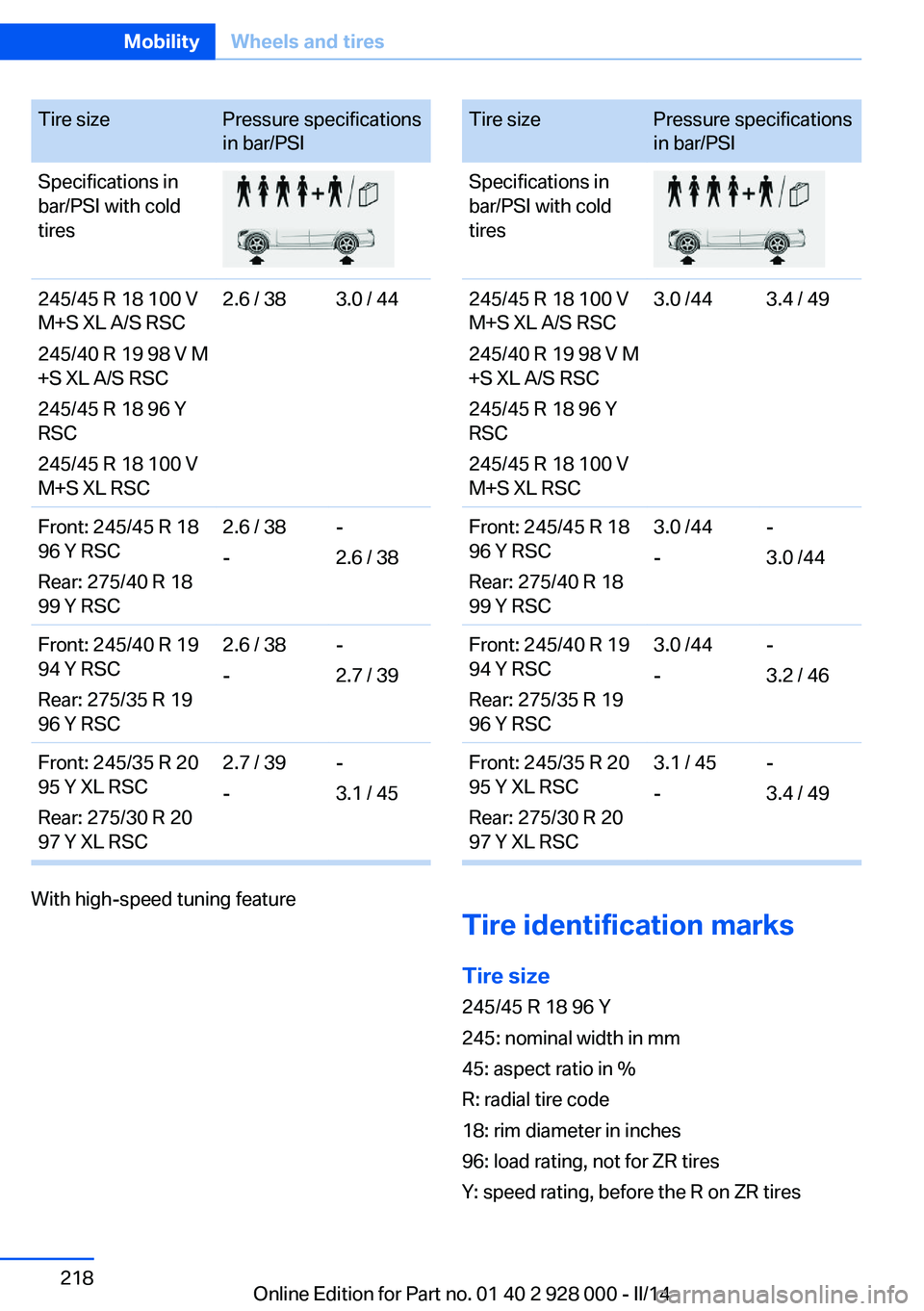
Tire sizePressure specifications
in bar/PSI
Specifications in
bar/PSI with cold
tires
245/45 R 18 100 V
M+S XL A/S RSC
245/40 R 19 98 V M
+S XL A/S RSC
245/45 R 18 96 Y
RSC
245/45 R 18 100 V
M+S XL RSC
2.6 / 383.0 / 44Front: 245/45 R 18
96 Y RSC
Rear: 275/40 R 18
99 Y RSC
2.6 / 38
-
-
2.6 / 38
Front: 245/40 R 19
94 Y RSC
Rear: 275/35 R 19
96 Y RSC
2.6 / 38
-
-
2.7 / 39
Front: 245/35 R 20
95 Y XL RSC
Rear: 275/30 R 20
97 Y XL RSC
2.7 / 39
-
-
3.1 / 45
With high-speed tuning feature
Tire sizePressure specifications
in bar/PSI
Specifications in
bar/PSI with cold
tires
245/45 R 18 100 V
M+S XL A/S RSC
245/40 R 19 98 V M
+S XL A/S RSC
245/45 R 18 96 Y
RSC
245/45 R 18 100 V
M+S XL RSC
3.4 / 49Front: 245/45 R 18
96 Y RSC
Rear: 275/40 R 18
99 Y RSC
-
-Front: 245/40 R 19
94 Y RSC
Rear: 275/35 R 19
96 Y RSC
-
-
3.2 / 46
Front: 245/35 R 20
95 Y XL RSC
Rear: 275/30 R 20
97 Y XL RSC
3.1 / 45
-
-
3.4 / 49
Tire identification marks
Tire size
245/45 R 18 96 Y
245: nominal width in mm
45: aspect ratio in %
R: radial tire code
18: rim diameter in inches
96: load rating, not for ZR tires
Y: speed rating, before the R on ZR tires
Seite 218MobilityWheels and tires218
Online Edition for Part no. 01 40 2 928 000 - II/14
3.0 /44
3.0 /44
3.0 /443.0 /44
Page 219 of 267
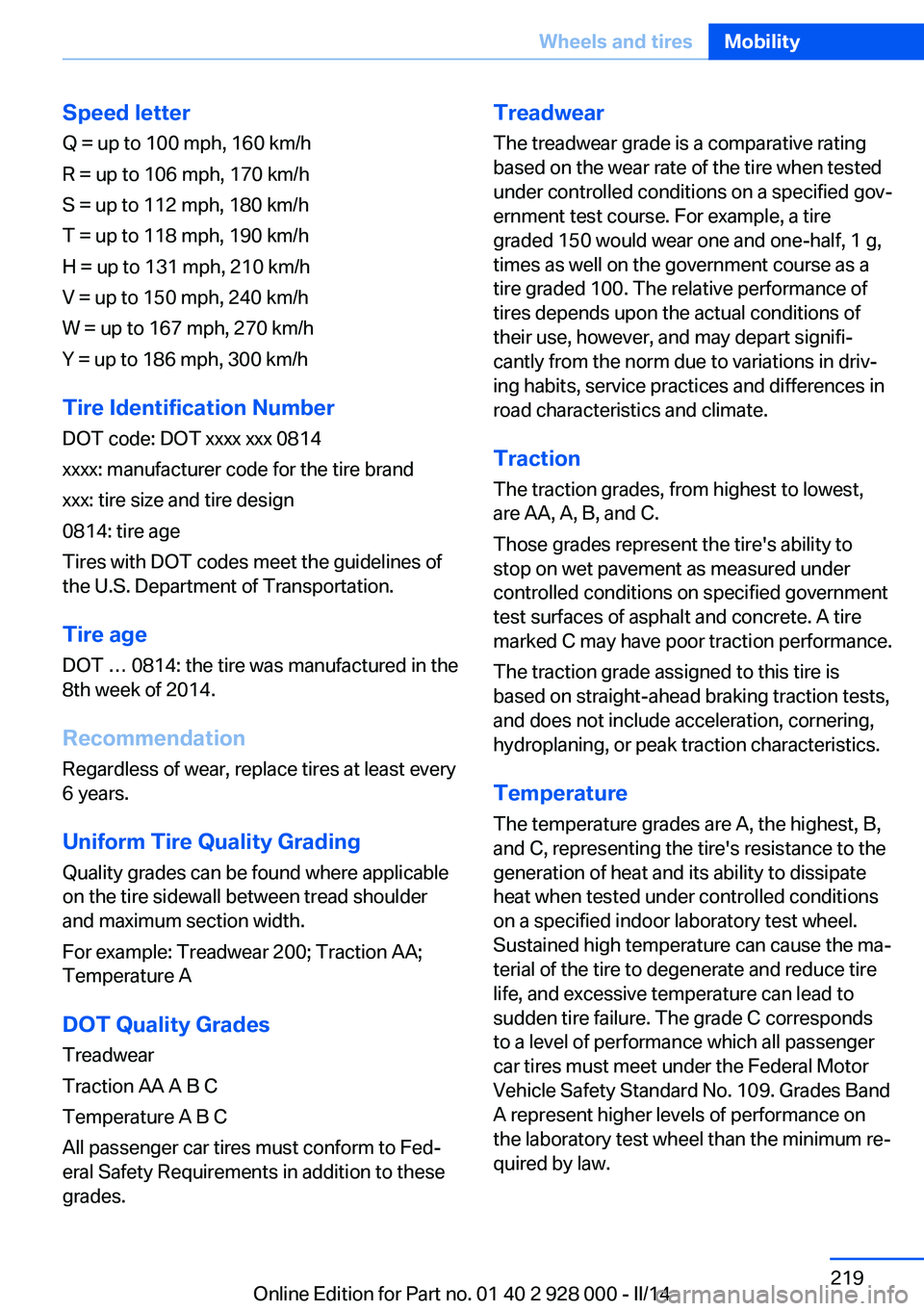
Speed letter
Q = up to 100 mph, 160 km/h
R = up to 106 mph, 170 km/h
S = up to 112 mph, 180 km/h
T = up to 118 mph, 190 km/h
H = up to 131 mph, 210 km/h
V = up to 150 mph, 240 km/h
W = up to 167 mph, 270 km/h
Y = up to 186 mph, 300 km/h
Tire Identification NumberDOT code: DOT xxxx xxx 0814
xxxx: manufacturer code for the tire brand
xxx: tire size and tire design
0814: tire age
Tires with DOT codes meet the guidelines of
the U.S. Department of Transportation.
Tire age DOT … 0814: the tire was manufactured in the
8th week of 2014.
Recommendation
Regardless of wear, replace tires at least every
6 years.
Uniform Tire Quality Grading Quality grades can be found where applicable
on the tire sidewall between tread shoulder
and maximum section width.
For example: Treadwear 200; Traction AA;
Temperature A
DOT Quality Grades Treadwear
Traction AA A B C
Temperature A B C
All passenger car tires must conform to Fed‐
eral Safety Requirements in addition to these
grades.Treadwear
The treadwear grade is a comparative rating
based on the wear rate of the tire when tested
under controlled conditions on a specified gov‐
ernment test course. For example, a tire graded 150 would wear one and one-half, 1 g,
times as well on the government course as a
tire graded 100. The relative performance of
tires depends upon the actual conditions of
their use, however, and may depart signifi‐
cantly from the norm due to variations in driv‐
ing habits, service practices and differences in
road characteristics and climate.
Traction
The traction grades, from highest to lowest,
are AA, A, B, and C.
Those grades represent the tire's ability to
stop on wet pavement as measured under
controlled conditions on specified government
test surfaces of asphalt and concrete. A tire
marked C may have poor traction performance.
The traction grade assigned to this tire is
based on straight-ahead braking traction tests,
and does not include acceleration, cornering,
hydroplaning, or peak traction characteristics.
Temperature
The temperature grades are A, the highest, B,
and C, representing the tire's resistance to the
generation of heat and its ability to dissipate
heat when tested under controlled conditions
on a specified indoor laboratory test wheel.
Sustained high temperature can cause the ma‐
terial of the tire to degenerate and reduce tire
life, and excessive temperature can lead to
sudden tire failure. The grade C corresponds
to a level of performance which all passenger
car tires must meet under the Federal Motor
Vehicle Safety Standard No. 109. Grades Band
A represent higher levels of performance on
the laboratory test wheel than the minimum re‐
quired by law.Seite 219Wheels and tiresMobility219
Online Edition for Part no. 01 40 2 928 000 - II/14
Page 221 of 267
In case of tire damage
If there are indications of tire damage, re‐
duce your speed immediately and have the
wheels and tires checked right away; other‐
wise, there is the increased risk of an accident.
Drive carefully to the nearest service center.
Have the vehicle towed or transported there.
Otherwise, tire damage can become life threat‐
ening for vehicle occupants and also other
road users.◀
Repair of tire damage
For safety reasons, the manufacturer of
your vehicle recommends that you do not have
damaged tires repaired; they should be re‐
placed. Otherwise, damage can occur as a re‐
sult.◀
Changing wheels and tires
Mounting Information on mounting tires
Have mounting and balancing performed
only by a service center.
If this work is not carried out properly, there is
the danger of subsequent damage and related
safety hazards.◀
Wheel and tire combination
You can ask the service center about the right
wheel/tire combination and wheel rim versions
for the vehicle.
Incorrect wheel and tire combinations impair
the function of a variety of systems such as
ABS or DSC.
To maintain good handling and vehicle re‐
sponse, use only tires with a single tread con‐
figuration from a single manufacturer.
Following tire damage, have the original wheel
and tire combination remounted on the vehicle
as soon as possible.Approved wheels and tires
You should only use wheels and tires
that have been approved by the vehicle manu‐
facturer for your vehicle type; otherwise, for
example, despite having the same official size
ratings, variations can lead to body contact and
with it, the risk of severe accidents
The manufacturer of your vehicle cannot eval‐
uate non-approved wheels and tires to deter‐
mine if they are suited for use, and therefore
cannot ensure the operating safety of the vehi‐
cle if they are mounted.◀
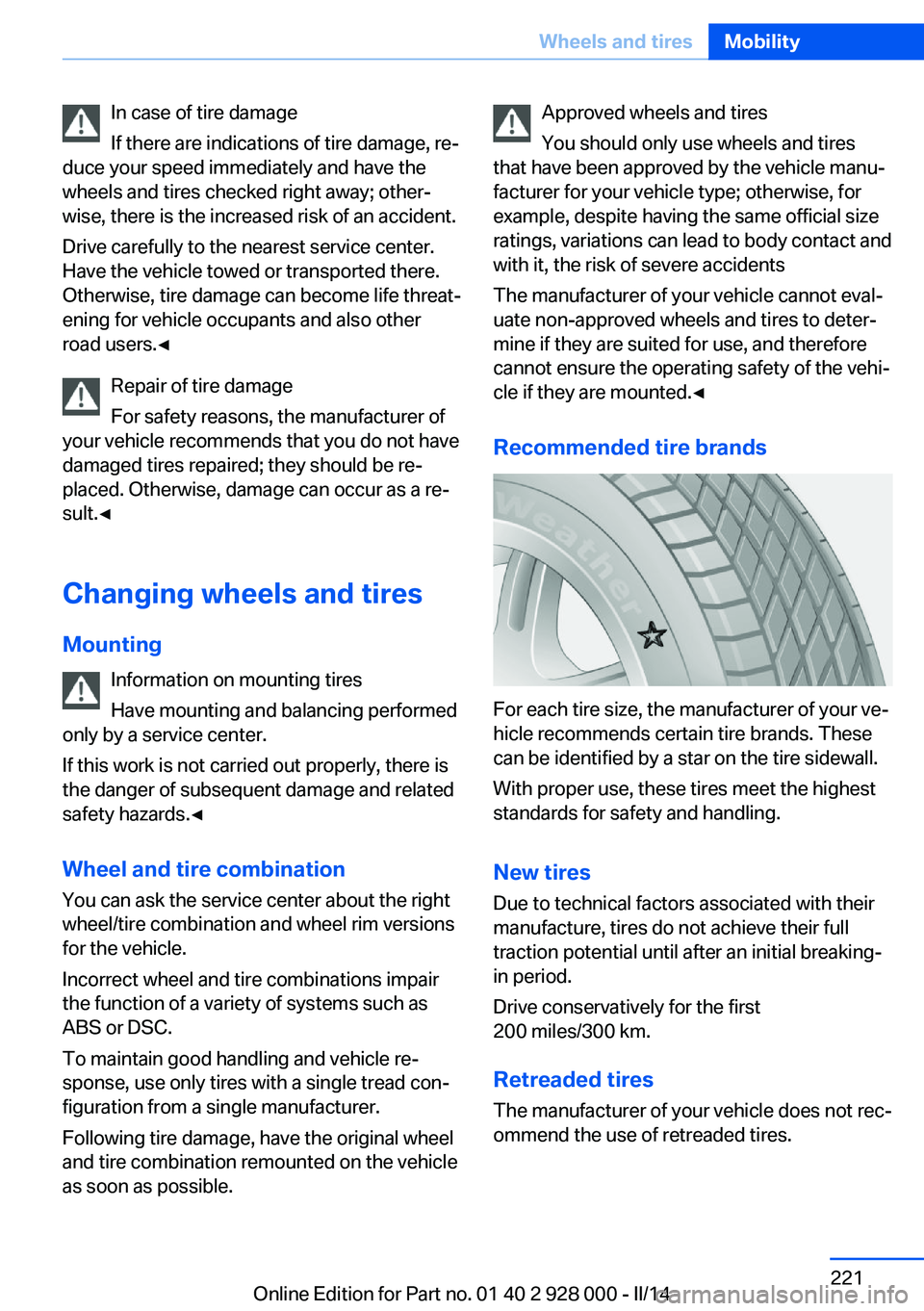
Recommended tire brands
For each tire size, the manufacturer of your ve‐
hicle recommends certain tire brands. These
can be identified by a star on the tire sidewall.
With proper use, these tires meet the highest
standards for safety and handling.
New tires Due to technical factors associated with their
manufacture, tires do not achieve their full
traction potential until after an initial breaking-
in period.
Drive conservatively for the first
200 miles/300 km.
Retreaded tires
The manufacturer of your vehicle does not rec‐
ommend the use of retreaded tires.
Seite 221Wheels and tiresMobility221
Online Edition for Part no. 01 40 2 928 000 - II/14
Page 222 of 267
Retreaded tires
Possibly substantial variations in the de‐
sign and age of the tire casing structures can
limit service life and have a negative impact on
road safety.◀
Winter tires
Winter tires are recommended for operating on
winter roads.
Although so-called all-season M+S tires do
provide better winter traction than summer tires, they do not provide the same level of per‐
formance as winter tires.
Maximum speed of winter tires If the maximum speed of the vehicle is higher
than the permissible speed for the winter tires,
then display a corresponding sign in the field
of vision. You can obtain this sign from the tire
specialist or from your service center.
Maximum speed for winter tires
Do not exceed the maximum speed for
the respective winter tires; otherwise, tire dam‐
age and accidents can occur.◀
Run-flat tires If you are already using run-flat tires, for your
own safety you should replace them only with
the same kind. No spare tire is available in the
case of a flat tire. Your service center will be
glad to advise you.
Rotating wheels between axles Different wear patterns can occur on the front
and rear axles depending on individual driving
conditions. The tires can be rotated between
the axles to achieve even wear. Your service
center will be glad to advise you. After rotating,
check the tire pressure and correct if neces‐
sary.
Rotating the tires is not permissible on vehi‐
cles with different tire sizes on the front andrear axles, i.e. when using different types of
tires.
Storage
Store wheels and tires in a cool, dry place with
as little exposure to light as possible.
Always protect tires against all contact with oil,
grease and fuels.
Do not exceed the maximum tire inflation pres‐
sure indicated on the side wall of the tire.
Run-flat tires
Label
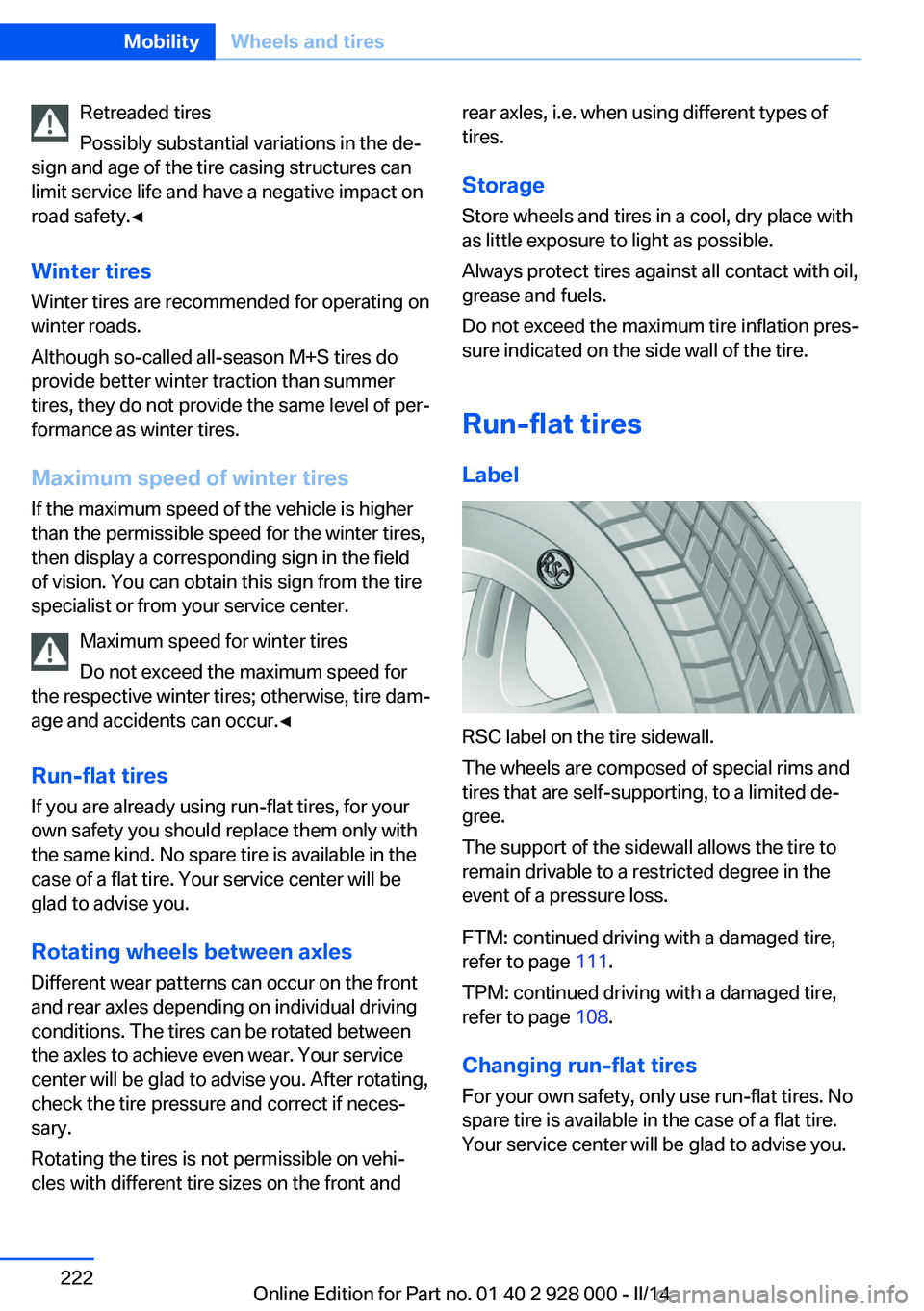
RSC label on the tire sidewall.
The wheels are composed of special rims and
tires that are self-supporting, to a limited de‐
gree.
The support of the sidewall allows the tire to
remain drivable to a restricted degree in the
event of a pressure loss.
FTM: continued driving with a damaged tire,
refer to page 111.
TPM: continued driving with a damaged tire,
refer to page 108.
Changing run-flat tires
For your own safety, only use run-flat tires. No
spare tire is available in the case of a flat tire.
Your service center will be glad to advise you.
Seite 222MobilityWheels and tires222
Online Edition for Part no. 01 40 2 928 000 - II/14
Page 223 of 267
Snow chains
Fine-link snow chains Only certain types of fine-link snow chains
have been tested by the manufacturer of the
vehicle, classified as road-safe and approved.
Information about the approved snow chains
are available from the service center.
Use Use only in pairs on the rear wheels, equipped
with the tires of the following size:▷225/55 R 17.▷245/45 R 18.▷245/40 R 19.
Follow the chain manufacturer's instructions.
Make sure that the snow chains are always
sufficiently tight. Retighten as needed accord‐
ing to the chain manufacturer's instructions.
Do not initialize the Flat Tire Monitor after
mounting snow chains, as doing so may result
in incorrect readings.
Do not initialize the Tire Pressure Monitor after
mounting snow chains, as doing so may result
in incorrect readings.
When driving with snow chains, briefly activate
Dynamic Traction Control if necessary.
Maximum speed with snow chains Do not exceed a speed of 30 mph/50 km/h
when using snow chains.
Snow chain detection
The concept When using snow chains, settings should be
made via the iDrive for the snow chains being
applied.
The snow chain detection system supports
you by automatically showing the detected
state on the Control Display.
When snow chains are in use, the rear axle
steering of the Integral Active Steering is deac‐
tivated automatically.
At speeds above the maximum permitted
speed with snow chains of 30 mph/50 km/h,
the rear axle steering is activated again auto‐
matically.
Activating the status1."Settings"2."Tire chains"3."Tire chains installed"
Automatic detection If functioning properly:
▷Snow chains are mounted. The setting is
not activated
.
After you drive a short distance, a Check
Control message is shown and the state is
activated automatically.
Confirm the automatic activation.
▷Snow chains are not mounted. The setting
is activated
.
At speeds above 30 mph/50 km/h, a Check
Control message is displayed. Deactivate
the status manually.
If not functioning properly:
▷Snow chains are mounted. The setting is
not activated
.
A Check Control message is not displayed.
The automatic detection system is mal‐
functioning. Activate the status manually.
Activating/deactivating rear axle
steering
If the status indicating that snow chains are in
use is activated, the rear axle steering is deac‐
tivated automatically.
At speeds above 30 mph/50 km/h, the rear axle
steering is activated again, even though snow
chains are in use.
Seite 223Wheels and tiresMobility223
Online Edition for Part no. 01 40 2 928 000 - II/14
Page 263 of 267
Roller sunblinds 44
Roll stabilization, refer to Adaptive Drive 132
Roll stabilization, refer to Dy‐ namic Drive 132
RON recommended fuel grade 204
Roof load capacity 252
Roof-mounted luggage rack 191
Rope for tow-starting/ towing 244
RSC Run Flat System Com‐ ponent, refer to Run-flat
tires 222
Rubber components, care 248
Run-flat tires 222
S Safe braking 188
Safety 7
Safety belt reminder for driv‐ er's seat and front passen‐
ger seat 52
Safety belts 51
Safety belts, care 248
Safety Package, refer to Ac‐ tive Protection 126
Safety switch, windows 44
Safety systems, airbags 103
Saving fuel 193
Screen, refer to Control Dis‐ play 16
Screwdriver, see Onboard ve‐ hicle tool kit 233
Screw thread for tow fit‐ ting 245
Seat belts, refer to Safety belts 51
Seat heating, front 50
Seat heating, rear 50
Seating position for chil‐ dren 59 Seat, mirror, and steering
wheel memory 54
Seats 47
Seat ventilation, front 51
Selection list in instrument cluster 91
Selector lever, automatic transmission 74
Sensors, care 249
Service and warranty 8
Service requirements, Condi‐ tion Based Service
CBS 231
Service requirements, dis‐ play 88
Service, Roadside Assis‐ tance 241
Services, ConnectedDrive
Settings, locking/unlock‐ ing 41
Settings on Control Dis‐ play 94
Settings, storing for seat, mir‐ rors, steering wheel 54
Shifting, automatic transmis‐ sion 74
Shifting, manual transmis‐ sion 73
Shift Lights 84
Shift paddles on steering wheel 76
Shoulder support 50
Side airbags 103
Side View 154
Signaling, horn 12
Signals when unlocking 41
Sitting safely 47
Size 252
Ski bag 177
Slide/tilt glass roof 45
Smallest turning circle 252
Smoker's package 172
Snow chains 223
Socket 174
Socket, OBD Onboard Diag‐ nostics 231 Soot particulate filter 187
SOS button 240
Spare fuse 239
Speaker lighting 102
Specified engine oil types 228
Speed, average 93
Speed limit detection, on‐ board computer 93
Speed limiter, display 90
Speed Limit Information 90
Speed warning 94
Split screen 21
SPORT+ - program, Dynamic Driving Control 134
Sport automatic transmis‐ sion 76
Sport displays, torque dis‐ play, performance dis‐
play 94
SPORT program, driving dy‐ namics 134
Sport program, transmis‐ sion 75
Stability control systems 129
Start/stop, automatic func‐ tion 65
Start/Stop button 63
Start function during malfunc‐ tion 31
Starting the engine 64
Status control display, tires 106
Status information, iDrive 20
Status of Owner's Manual 6
Steering, Integral Active Steering 133
Steering wheel, adjusting 57
Steering wheel heating 58
Steering wheel memory 54
Steptronic, automatic trans‐ mission 74
Stopping the engine 65
Storage compartment, re‐ mote control 182
Storage compartments 179 Seite 263Everything from A to ZReference263
Online Edition for Part no. 01 40 2 928 000 - II/14