E53 BMW 530I 2003 E39 Central Body Electronics ZKE Manual
[x] Cancel search | Manufacturer: BMW, Model Year: 2003, Model line: 530I, Model: BMW 530I 2003 E39Pages: 80, PDF Size: 4.14 MB
Page 23 of 80
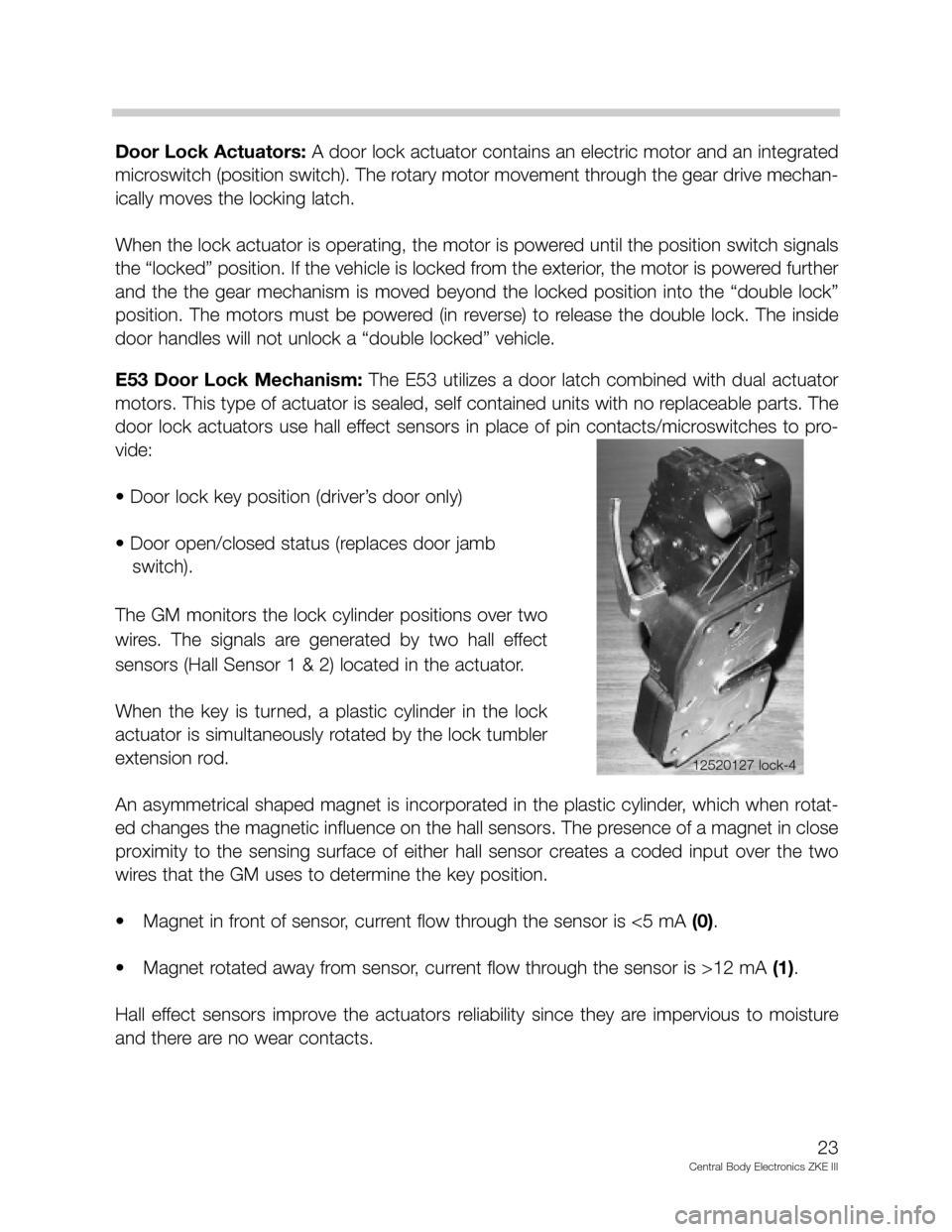
Door Lock Actuators: A door lock actuator contains an electric motor and an integrated
microswitch (position switch). The rotary motor movement through the gear drive mechan-
ically moves the locking latch.
When the lock actuator is operating, the motor is powered until the position switch signals
the “locked” position. If the vehicle is locked from the exterior, the motor is powered further
and the the gear mechanism is moved beyond the locked position into the “double lock”
position. The motors must be powered (in reverse) to release the double lock. The inside
door handles will not unlock a “double locked” vehicle.
E53 Door Lock Mechanism: The E53 utilizes a door latch combined with dual actuator
motors. This type of actuator is sealed, self contained units with no replaceable parts. The
door lock actuators use hall effect sensors in place of pin contacts/microswitches to pro-
vide:
• Door lock key position (driver’s door only)
• Door open/closed status (replaces door jamb
switch).
The GM monitors the lock cylinder positions over two
wires. The signals are generated by two hall effect
sensors (Hall Sensor 1 & 2) located in the actuator.
When the key is turned, a plastic cylinder in the lock
actuator is simultaneously rotated by the lock tumbler
extension rod.
An asymmetrical shaped magnet is incorporated in the plastic cylinder, which when rotat-
ed changes the magnetic influence on the hall sensors. The presence of a magnet in close
proximity to the sensing surface of either hall sensor creates a coded input over the two
wires that the GM uses to determine the key position.
• Magnet in front of sensor, current flow through the sensor is <5 mA (0).
• Magnet rotated away from sensor, current flow through the sensor is >12 mA (1).
Hall effect sensors improve the actuators reliability since they are impervious to moisture
and there are no wear contacts.
23
Central Body Electronics ZKE III
12520127 lock-4
Page 25 of 80
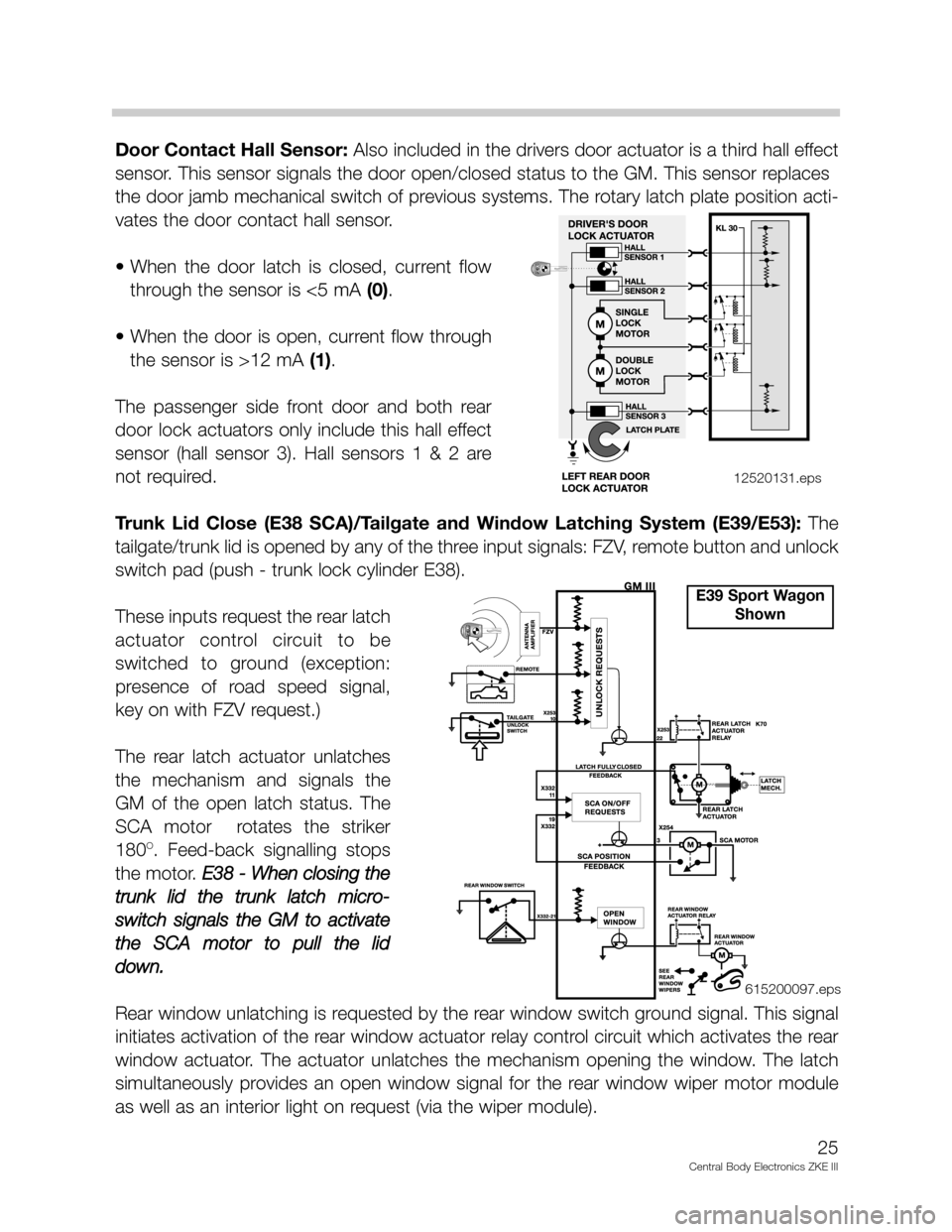
Door Contact Hall Sensor: Also included in the drivers door actuator is a third hall effect
sensor. This sensor signals the door open/closed status to the GM. This sensor replaces
the door jamb mechanical switch of previous systems. The rotary latch plate position acti-
vates the door contact hall sensor.
• When the door latch is closed, current flow
through the sensor is <5 mA (0).
• When the door is open, current flow through
the sensor is >12 mA (1).
The passenger side front door and both rear
door lock actuators only include this hall effect
sensor (hall sensor 3). Hall sensors 1 & 2 are
not required.
Trunk Lid Close (E38 SCA)/Tailgate and Window Latching System (E39/E53): The
tailgate/trunk lid is opened by any of the three input signals: FZV, remote button and unlock
switch pad (push - trunk lock cylinder E38).
These inputs request the rear latch
actuator control circuit to be
switched to ground (exception:
presence of road speed signal,
key on with FZV request.)
The rear latch actuator unlatches
the mechanism and signals the
GM of the open latch status. The
SCA motor rotates the striker
180
O. Feed-back signalling stops
the motor. E38 - When closing the
trunk lid the trunk latch micro-
switch signals the GM to activate
the SCA motor to pull the lid
down.
Rear window unlatching is requested by the rear window switch ground signal. This signal
initiates activation of the rear window actuator relay control circuit which activates the rear
window actuator. The actuator unlatches the mechanism opening the window. The latch
simultaneously provides an open window signal for the rear window wiper motor module
as well as an interior light on request (via the wiper module).
25
Central Body Electronics ZKE III
12520131.eps
E39 Sport Wagon
Shown
615200097.eps
Page 37 of 80
• Signal "NG"; switched ground output signal provided to the GM. The signal is used for
two purposes,
1. As a momentary acknowledgment that the tilt sensor received STDWA and is cur-
rently monitoring the vehicle angle.
2. If the tilt sensor detects a change in the vehicle's angle when DWA is armed, signal
NG is switched to inform the GM to activate the siren.
When the tilt sensor receives the STDWA signal from the GM it memorizes the vehicle's
parked angle. The angle of the vehicle is monitored by the solid state electronics. Once
armed, if the angle changes, the tilt sensor provides a switched ground signal to the GM
to activate DWA.
As with the interior sensor, the tilt sensor is also switched OFF when the vehicle is locked
two times within ten seconds. The LED will flash one time for confirmation. This allows the
sensor to be switched OFF for transportation purposes.
Glass Breakage Sensors (Early E38 - before FIS Sensor): The door windows (includ-
ing the rear quarter glass wire loop) are monitored by inductive sensors mounted on the
inside of the door behind the trim panel. A closed window is recognized by a magnetic plate
on the glass lining up with the sensor.
If the glass is broken, the plate falls away and the signal from the sensor changes and the
GM will activate the alarm.
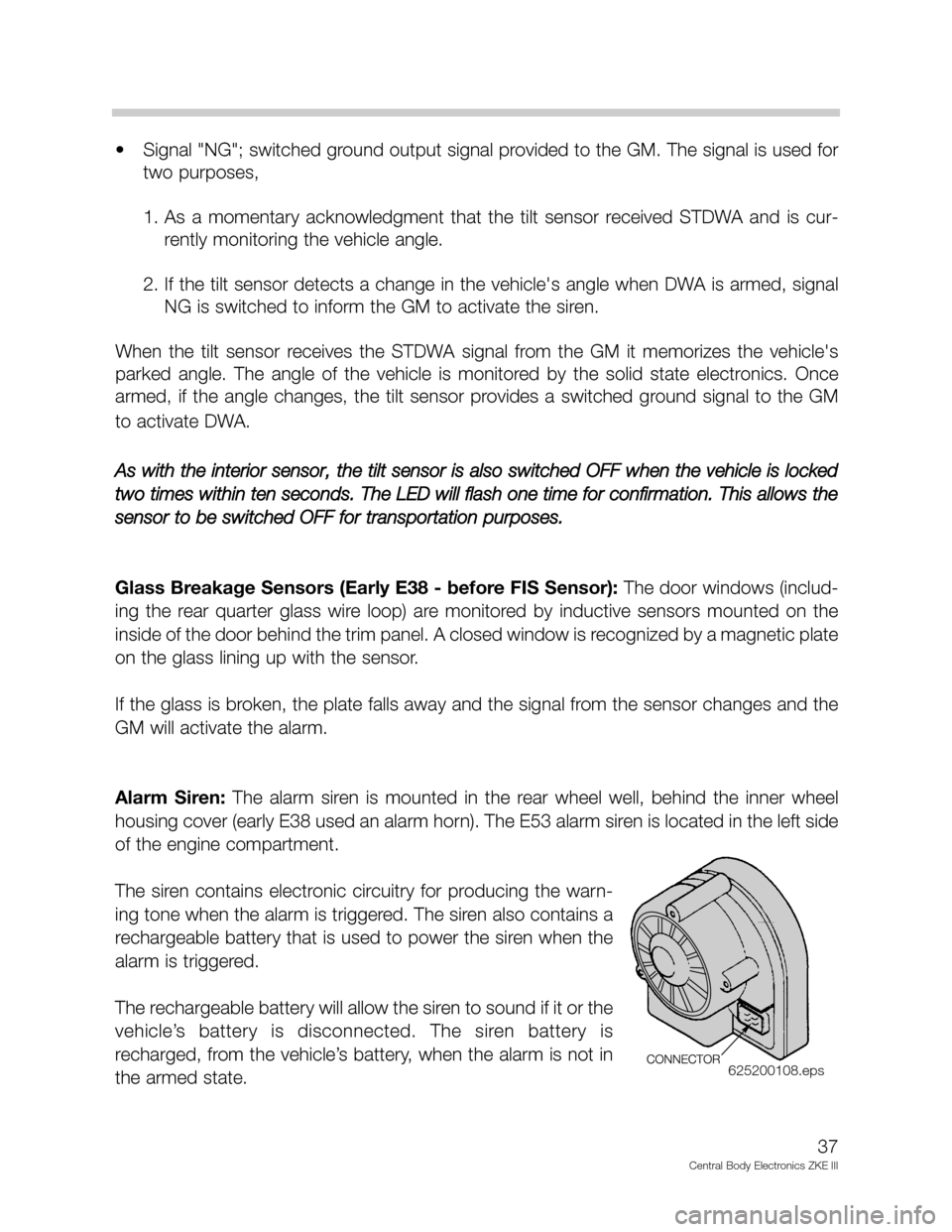
Alarm Siren: The alarm siren is mounted in the rear wheel well, behind the inner wheel
housing cover (early E38 used an alarm horn). The E53 alarm siren is located in the left side
of the engine compartment.
The siren contains electronic circuitry for producing the warn-
ing tone when the alarm is triggered. The siren also contains a
rechargeable battery that is used to power the siren when the
alarm is triggered.
The rechargeable battery will allow the siren to sound if it or the
vehicle’s battery is disconnected. The siren battery is
recharged, from the vehicle’s battery, when the alarm is not in
the armed state.
37
Central Body Electronics ZKE III
625200108.eps
Page 43 of 80
All window operations signals are digital inputs to the door module and GM III.
• Comfort closing/opening of the windows from the driver’s lock cylinder. The remote key
provides opening only.
• When the ignition key is in accessory or “on” position press the switch to open or close
the windows. Window operation is possible with the ignition switched off until a front
door is opened or 16 minutes (maximum) has elapsed.
• Window load switching is through relays. The front window control relays are located in
the door modules, the rear window relays are in the GM III. The GM III monitors the cur-
rent draw for end limit position. The maximum run time for the window motors is limit-
ed to 6 seconds in the one-touch mode. This allows the motors to be switched off if the
end limit load sensing fails.
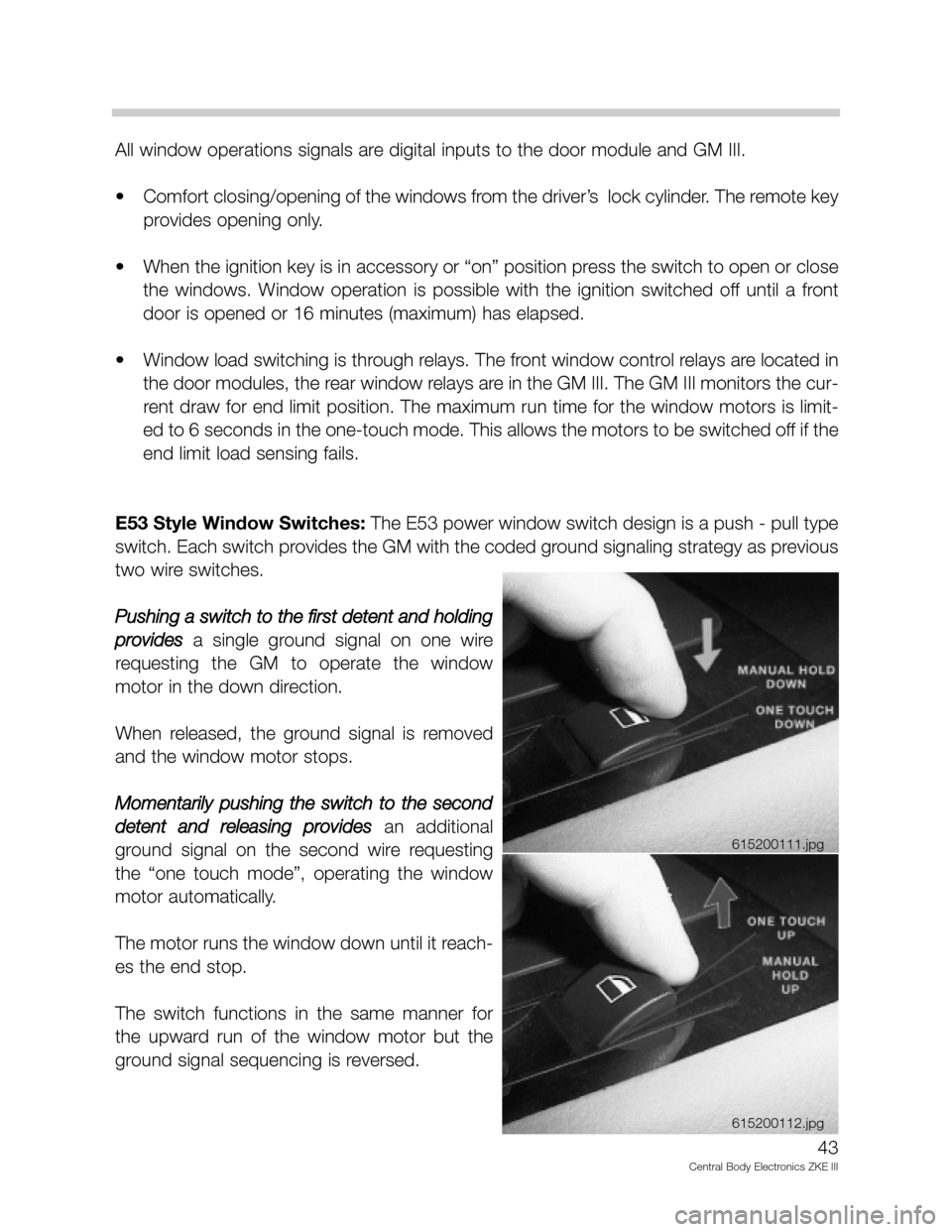
E53 Style Window Switches:The E53 power window switch design is a push - pull type
switch. Each switch provides the GM with the coded ground signaling strategy as previous
two wire switches.
Pushing a switch to the first detent and holding
provides
a single ground signal on one wire
requesting the GM to operate the window
motor in the down direction.
When released, the ground signal is removed
and the window motor stops.
Momentarily pushing the switch to the second
detent and releasing provides
an additional
ground signal on the second wire requesting
the “one touch mode”, operating the window
motor automatically.
The motor runs the window down until it reach-
es the end stop.
The switch functions in the same manner for
the upward run of the window motor but the
ground signal sequencing is reversed.
43
Central Body Electronics ZKE III
615200111.jpg
615200112.jpg
Page 53 of 80
System Components
Door Contacts: As mentioned in the Central Locking Section, the existing door contacts
opened/closed are also an input for the interior lighting function. The E53 uses the Hall
effect sensors for the purpose of monitoring door open/closed status (located directly
behind the rotary latch plate encased in the actuator). The sensor is activated by the rotary
latch plate's position.
• Door closed, the rotary latch plate is in the latched position. Current flow through the
hall sensor is < 5 mA.
• Door open, the rotary latch plate is in the open position. Current flow through the hall
sensor is > 12 mA.
A change in current flow informs the General module when a door is opened or closed.
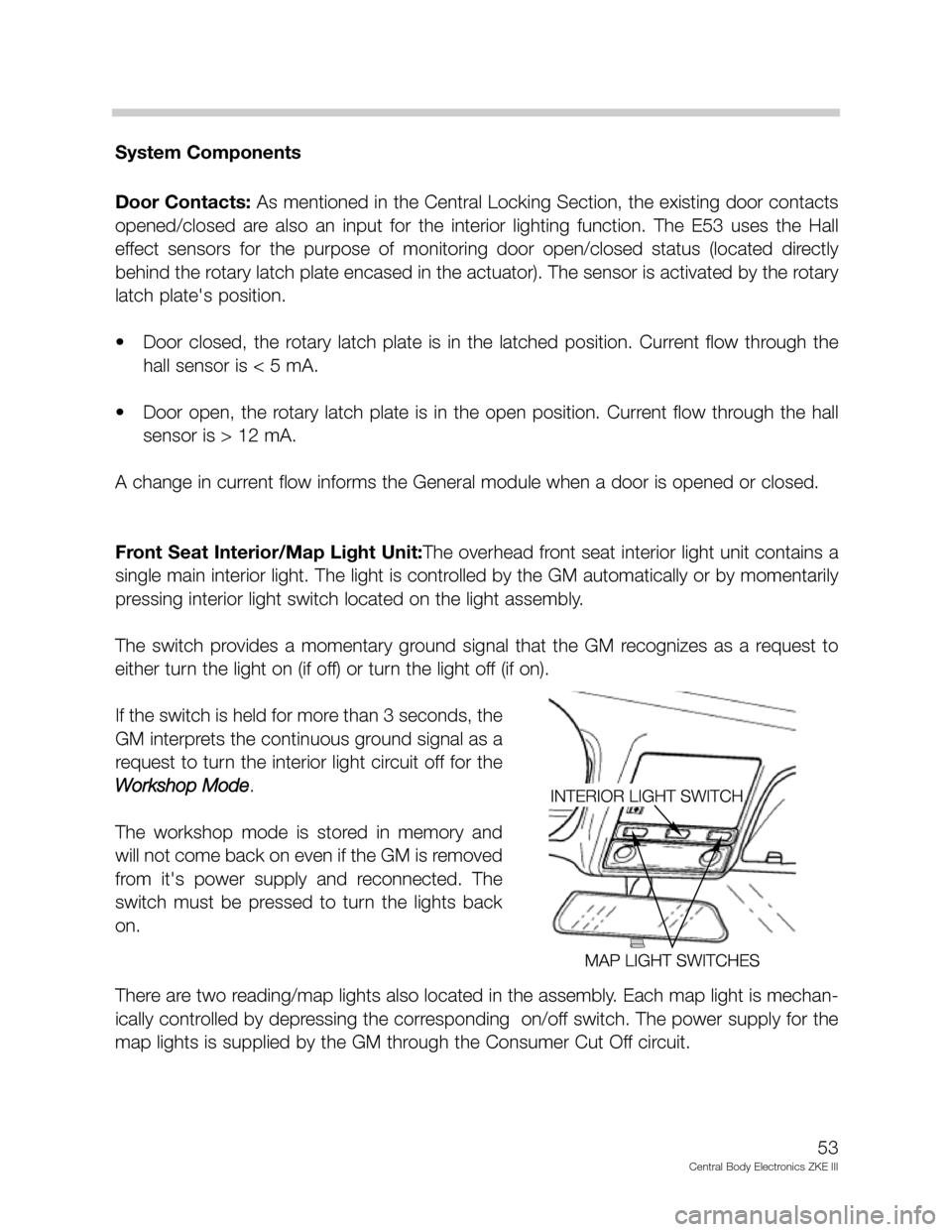
Front Seat Interior/Map Light Unit:The overhead front seat interior light unit contains a
single main interior light. The light is controlled by the GM automatically or by momentarily
pressing interior light switch located on the light assembly.
The switch provides a momentary ground signal that the GM recognizes as a request to
either turn the light on (if off) or turn the light off (if on).
If the switch is held for more than 3 seconds, the
GM interprets the continuous ground signal as a
request to turn the interior light circuit off for the
Workshop Mode
.
The workshop mode is stored in memory and
will not come back on even if the GM is removed
from it's power supply and reconnected. The
switch must be pressed to turn the lights back
on.
There are two reading/map lights also located in the assembly. Each map light is mechan-
ically controlled by depressing the corresponding on/off switch. The power supply for the
map lights is supplied by the GM through the Consumer Cut Off circuit.
53
Central Body Electronics ZKE III
Page 54 of 80
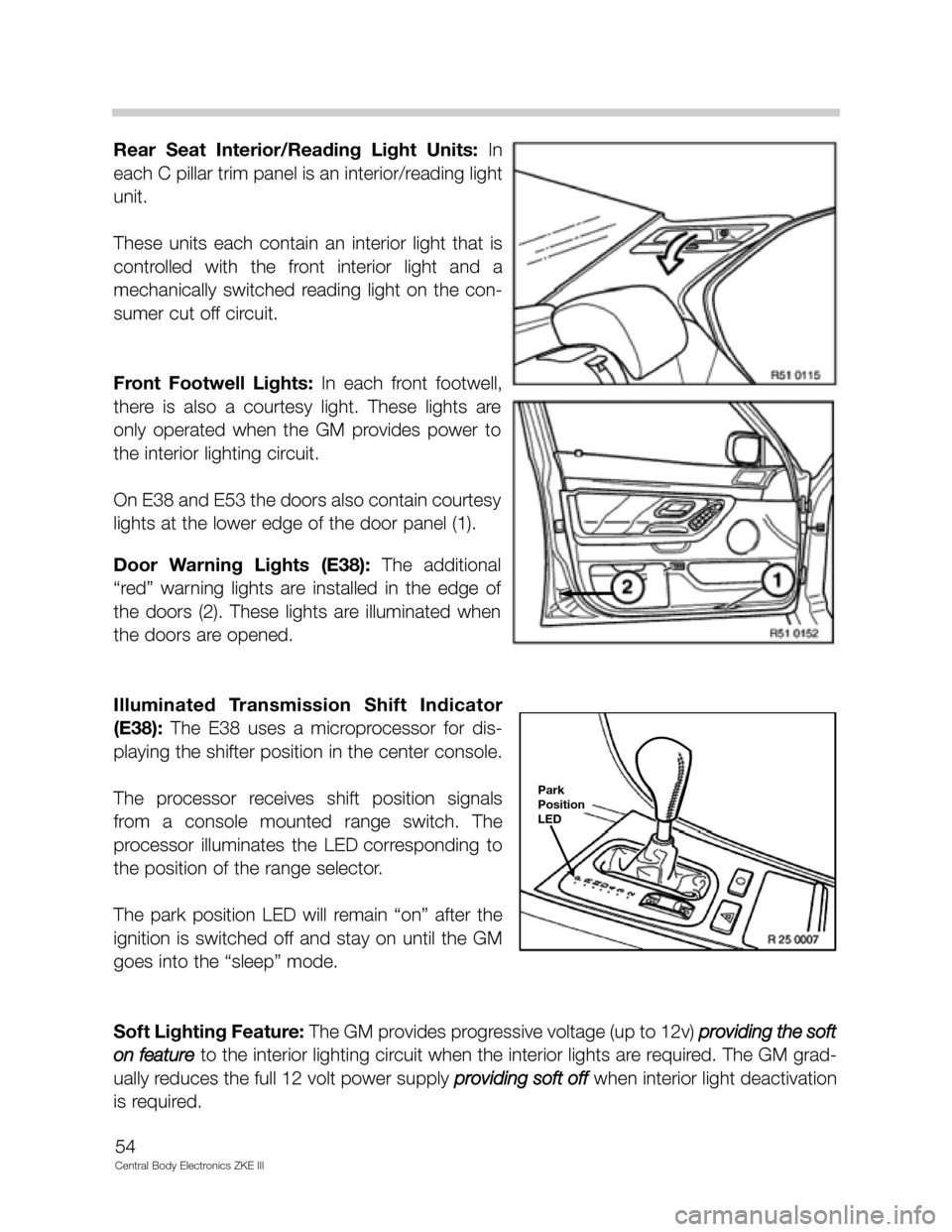
Rear Seat Interior/Reading Light Units: In
each C pillar trim panel is an interior/reading light
unit.
These units each contain an interior light that is
controlled with the front interior light and a
mechanically switched reading light on the con-
sumer cut off circuit.
Front Footwell Lights: In each front footwell,
there is also a courtesy light. These lights are
only operated when the GM provides power to
the interior lighting circuit.
On E38 and E53 the doors also contain courtesy
lights at the lower edge of the door panel (1).
Door Warning Lights (E38): The additional
“red” warning lights are installed in the edge of
the doors (2). These lights are illuminated when
the doors are opened.
Illuminated Transmission Shift Indicator
(E38): The E38 uses a microprocessor for dis-
playing the shifter position in the center console.
The processor receives shift position signals
from a console mounted range switch. The
processor illuminates the LED corresponding to
the position of the range selector.
The park position LED will remain “on” after the
ignition is switched off and stay on until the GM
goes into the “sleep” mode.
Soft Lighting Feature: The GM provides progressive voltage (up to 12v) providing the soft
on feature
to the interior lighting circuit when the interior lights are required. The GM grad-
ually reduces the full 12 volt power supply providing soft off
when interior light deactivation
is required.
54
Central Body Electronics ZKE III
Park
Position
LED
Page 55 of 80
Visual Entry Aid (E38/E53)
Purpose of the System
The E38 (>99 MY) and E53 is equipped with the “Visual Entry Aid” lighting system which
enhances operator convenience and safety. All interior door handles are supplemented with
soft glow lighting for ease of locating the interior door handles. When activated, the exteri-
or door lighting illuminates providing a subtle underglow for the exterior door handles on
the E38 and exterior rear view mirrors on the E53.
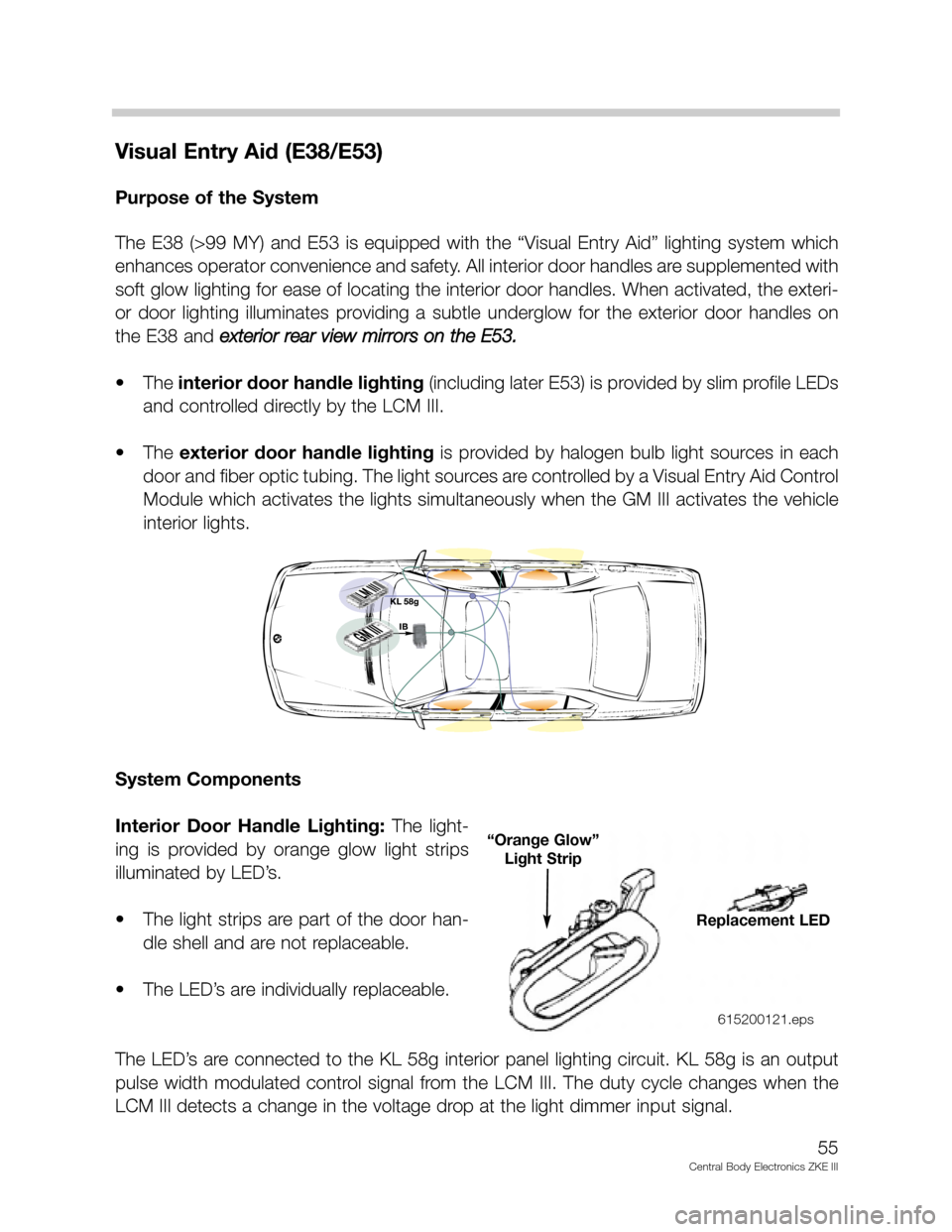
• The interior door handle lighting(including later E53) is provided by slim profile LEDs
and controlled directly by the LCM III.
• The exterior door handle lightingis provided by halogen bulb light sources in each
door and fiber optic tubing. The light sources are controlled by a Visual Entry Aid Control
Module which activates the lights simultaneously when the GM III activates the vehicle
interior lights.
System Components
Interior Door Handle Lighting: The light-
ing is provided by orange glow light strips
illuminated by LED’s.
• The light strips are part of the door han-
dle shell and are not replaceable.
• The LED’s are individually replaceable.
The LED’s are connected to the KL 58g interior panel lighting circuit. KL 58g is an output
pulse width modulated control signal from the LCM III. The duty cycle changes when the
LCM III detects a change in the voltage drop at the light dimmer input signal.
55
Central Body Electronics ZKE III
Replacement LED
“Orange Glow”
Light Strip
615200121.eps
Page 58 of 80
Seat/Mirror/Steering Column Memory
Purpose of the System
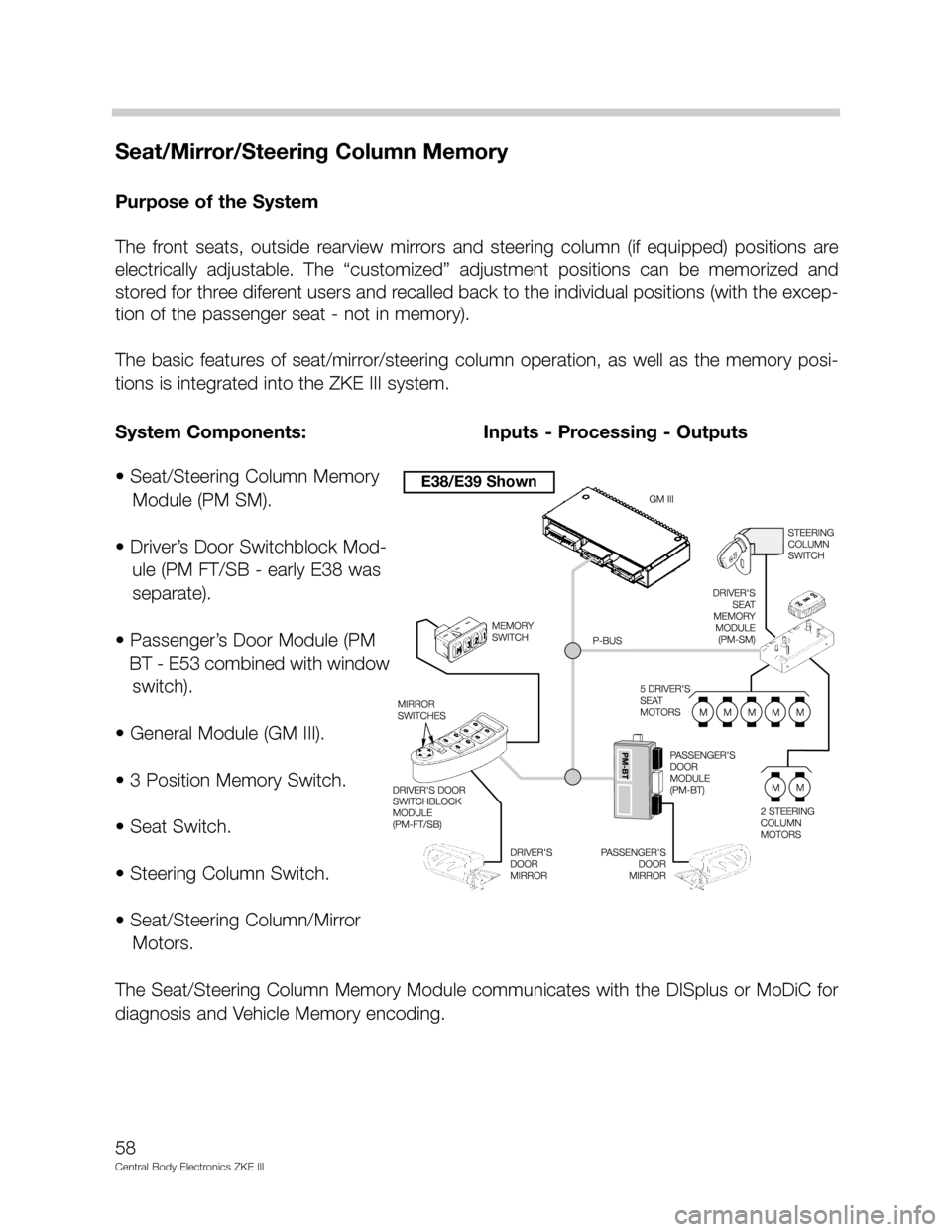
The front seats, outside rearview mirrors and steering column (if equipped) positions are
electrically adjustable. The “customized” adjustment positions can be memorized and
stored for three diferent users and recalled back to the individual positions (with the excep-
tion of the passenger seat - not in memory).
The basic features of seat/mirror/steering column operation, as well as the memory posi-
tions is integrated into the ZKE III system.
• Seat/Steering Column Memory
Module (PM SM).
• Driver’s Door Switchblock Mod-
ule (PM FT/SB - early E38 was
separate).
• Passenger’s Door Module (PM
BT - E53 combined with window
switch).
• General Module (GM III).
• 3 Position Memory Switch.
• Seat Switch.
• Steering Column Switch.
• Seat/Steering Column/Mirror
Motors.
The Seat/Steering Column Memory Module communicates with the DISplus or MoDiC for
diagnosis and Vehicle Memory encoding.
58
Central Body Electronics ZKE III
System Components: Inputs - Processing - Outputs
E38/E39 Shown
Page 59 of 80
59
Central Body Electronics ZKE III
System Components
- with Principle of Operation
Manual Operation:The manual adjustments of the seat, mirrors and steering column are
carried out with the respective switches as with the previous systems.
The mirror adjustment switch is located in the driver’s switch block. The mirror operation
input is a digital signal that is processed by each respective module for mirror positioning.
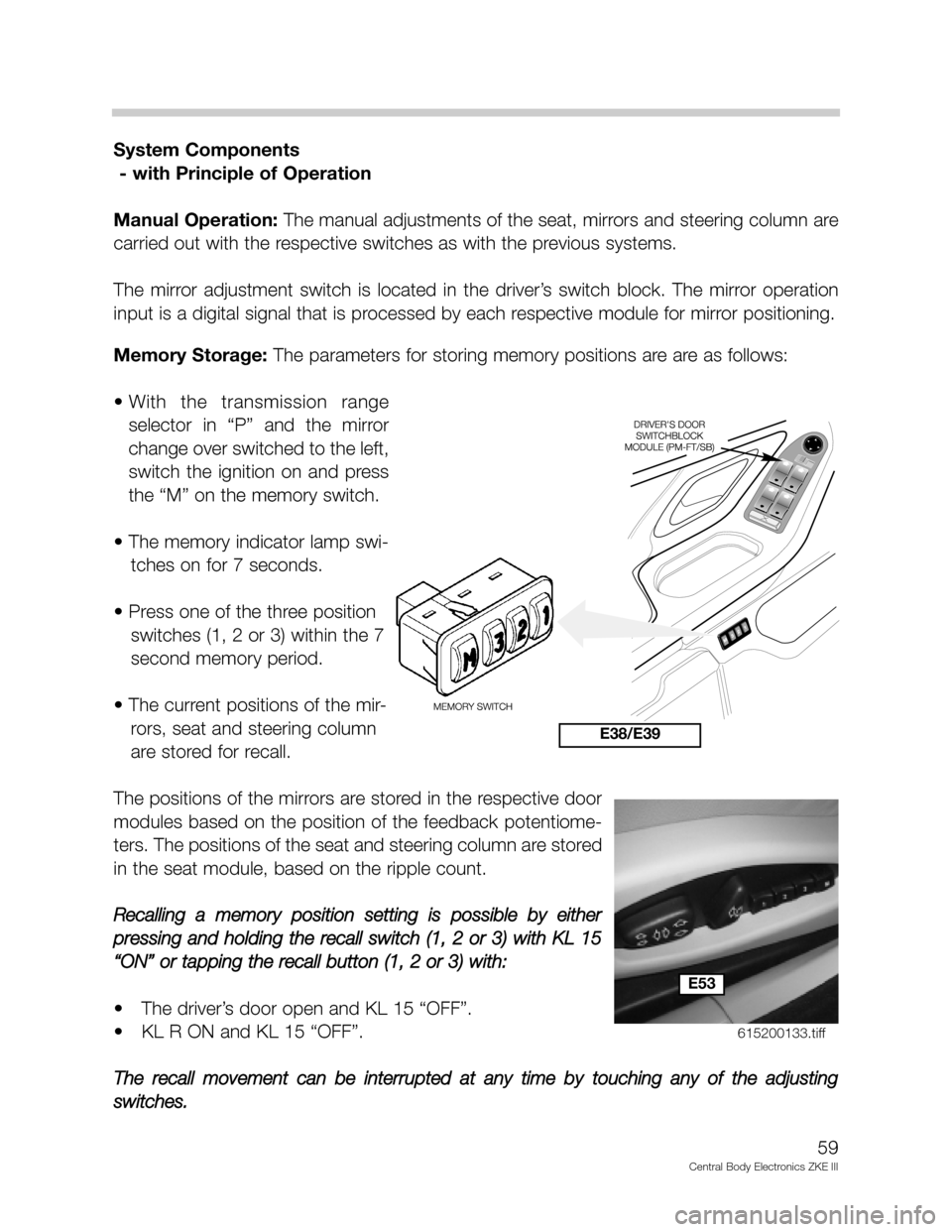
Memory Storage: The parameters for storing memory positions are are as follows:
• With the transmission range
selector in “P” and the mirror
change over switched to the left,
switch the ignition on and press
the “M” on the memory switch.
• The memory indicator lamp swi-
tches on for 7 seconds.
• Press one of the three position
switches (1, 2 or 3) within the 7
second memory period.
• The current positions of the mir-
rors, seat and steering column
are stored for recall.
The positions of the mirrors are stored in the respective door
modules based on the position of the feedback potentiome-
ters. The positions of the seat and steering column are stored
in the seat module, based on the ripple count.
Recalling a memory position setting is possible by either
pressing and holding the recall switch (1, 2 or 3) with KL 15
“ON” or tapping the recall button (1, 2 or 3) with:
• The driver’s door open and KL 15 “OFF”.
• KL R ON and KL 15 “OFF”.
The recall movement can be interrupted at any time by touching any of the adjusting
switches.
E38/E39
E53
615200133.tiff
Page 68 of 80
68
Central Body Electronics ZKE III
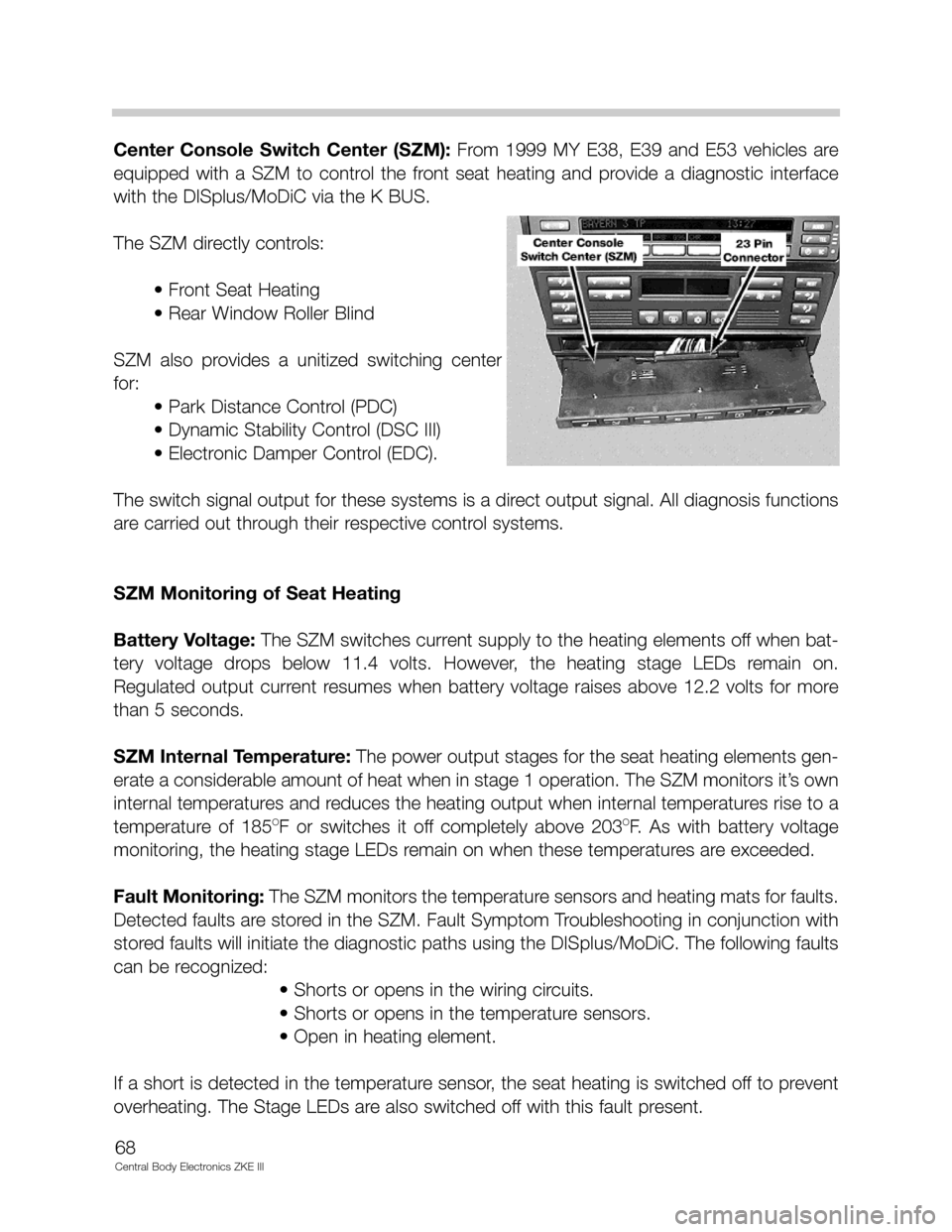
Center Console Switch Center (SZM): From 1999 MY E38, E39 and E53 vehicles are
equipped with a SZM to control the front seat heating and provide a diagnostic interface
with the DISplus/MoDiC via the K BUS.
The SZM directly controls:
• Front Seat Heating
• Rear Window Roller Blind
SZM also provides a unitized switching center
for:
• Park Distance Control (PDC)
• Dynamic Stability Control (DSC III)
• Electronic Damper Control (EDC).
The switch signal output for these systems is a direct output signal. All diagnosis functions
are carried out through their respective control systems.
SZM Monitoring of Seat Heating
Battery Voltage:The SZM switches current supply to the heating elements off when bat-
tery voltage drops below 11.4 volts. However, the heating stage LEDs remain on.
Regulated output current resumes when battery voltage raises above 12.2 volts for more
than 5 seconds.
SZM Internal Temperature: The power output stages for the seat heating elements gen-
erate a considerable amount of heat when in stage 1 operation. The SZM monitors it’s own
internal temperatures and reduces the heating output when internal temperatures rise to a
temperature of 185
OF or switches it off completely above 203OF. As with battery voltage
monitoring, the heating stage LEDs remain on when these temperatures are exceeded.
Fault Monitoring:The SZM monitors the temperature sensors and heating mats for faults.
Detected faults are stored in the SZM. Fault Symptom Troubleshooting in conjunction with
stored faults will initiate the diagnostic paths using the DISplus/MoDiC. The following faults
can be recognized:
• Shorts or opens in the wiring circuits.
• Shorts or opens in the temperature sensors.
• Open in heating element.
If a short is detected in the temperature sensor, the seat heating is switched off to prevent
overheating. The Stage LEDs are also switched off with this fault present.