start stop button BMW 530I TOURING 2006 E61 User Guide
[x] Cancel search | Manufacturer: BMW, Model Year: 2006, Model line: 530I TOURING, Model: BMW 530I TOURING 2006 E61Pages: 259, PDF Size: 8.9 MB
Page 92 of 259
Technology for comfort, convenience and safety
90 The initialization must be repeated after
each time the tire inflation pressure is cor-
rected and after every tire or wheel change.<
System limits
The Flat Tire Monitor cannot indicate
sudden severe tire damage caused by
outside factors and does not detect a natural,
even pressure drop in all four tires.<
In the following situations, the system could be
delayed or malfunction:
>System has not been initialized
>Driving on snowy or slippery road surface
>Sporty driving style: slip in the drive wheels,
high lateral acceleration
>Driving with snow chains
*
When you are driving with the compact wheel*
the Flat Tire Monitor is unable to function.
Initializing system
The initialization finishes during driving,
which can be interrupted at any time.
When driving resumes, the initialization is con-
tinued automatically. Do not initialize the sys-
tem when driving with snow chains
* or com-
pact wheel
*.<
iDrive, for explanation of principle, refer to
page16.
1.Press the button.
This opens the start menu.
2.Press the controller to open the menu.
3.Select "Vehicle settings" and press the
controller.
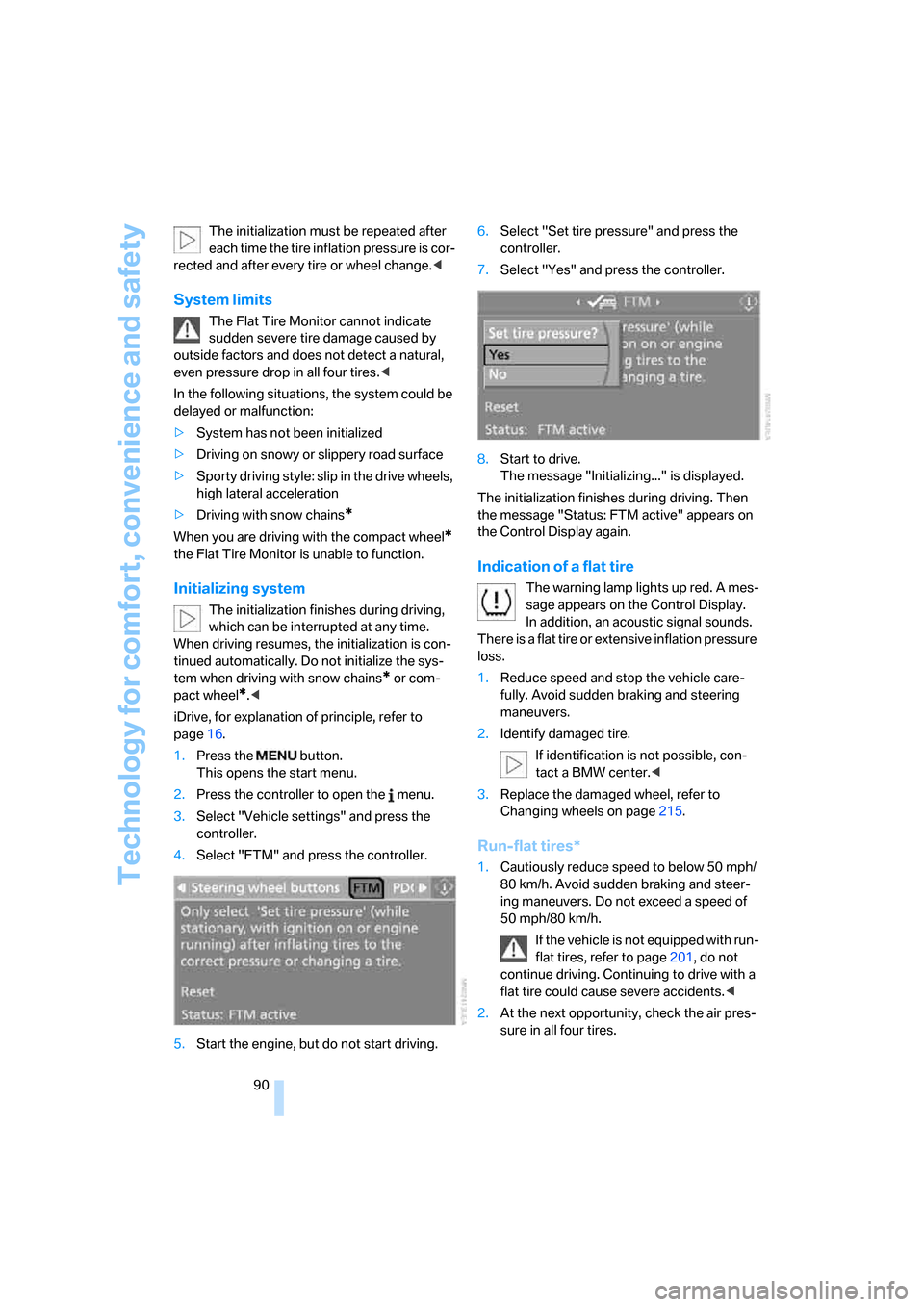
4.Select "FTM" and press the controller.
5.Start the engine, but do not start driving.6.Select "Set tire pressure" and press the
controller.
7.Select "Yes" and press the controller.
8.Start to drive.
The message "Initializing..." is displayed.
The initialization finishes during driving. Then
the message "Status: FTM active" appears on
the Control Display again.
Indication of a flat tire
The warning lamp lights up red. A mes-
sage appears on the Control Display.
In addition, an acoustic signal sounds.
There is a flat tire or extensive inflation pressure
loss.
1.Reduce speed and stop the vehicle care-
fully. Avoid sudden braking and steering
maneuvers.
2.Identify damaged tire.
If identification is not possible, con-
tact a BMW center.<
3.Replace the damaged wheel, refer to
Changing wheels on page215.
Run-flat tires*
1.Cautiously reduce speed to below 50 mph/
80 km/h. Avoid sudden braking and steer-
ing maneuvers. Do not exceed a speed of
50 mph/80 km/h.
If the vehicle is not equipped with run-
flat tires, refer to page201, do not
continue driving. Continuing to drive with a
flat tire could cause severe accidents.<
2.At the next opportunity, check the air pres-
sure in all four tires.
Page 94 of 259
Technology for comfort, convenience and safety
92
All wheels are yellow
Flat tire or a major drop in inflation pressure in
several tires. A message appears on the Control
Display.
Gray
The system cannot detect a flat tire.
Reasons for this can be:
>TPM is being reset
>Temporary interference due to systems or
devices which use the same radio fre-
quency
>Malfunction
Resetting system
Reset the system again after each correc-
tion of the tire inflation pressure and after
every tire or wheel change.<
Resetting finishes during driving, which can be
interrupted at any time. When driving resumes,
resetting is continued automatically. Do not
reset the system when driving with a compact
wheel
*.
iDrive, for explanation of principle, refer to
page16.
1.Press the button.
This opens the start menu.
2.Press the controller to open the menu.
3.Select "Vehicle settings" and press the
controller.
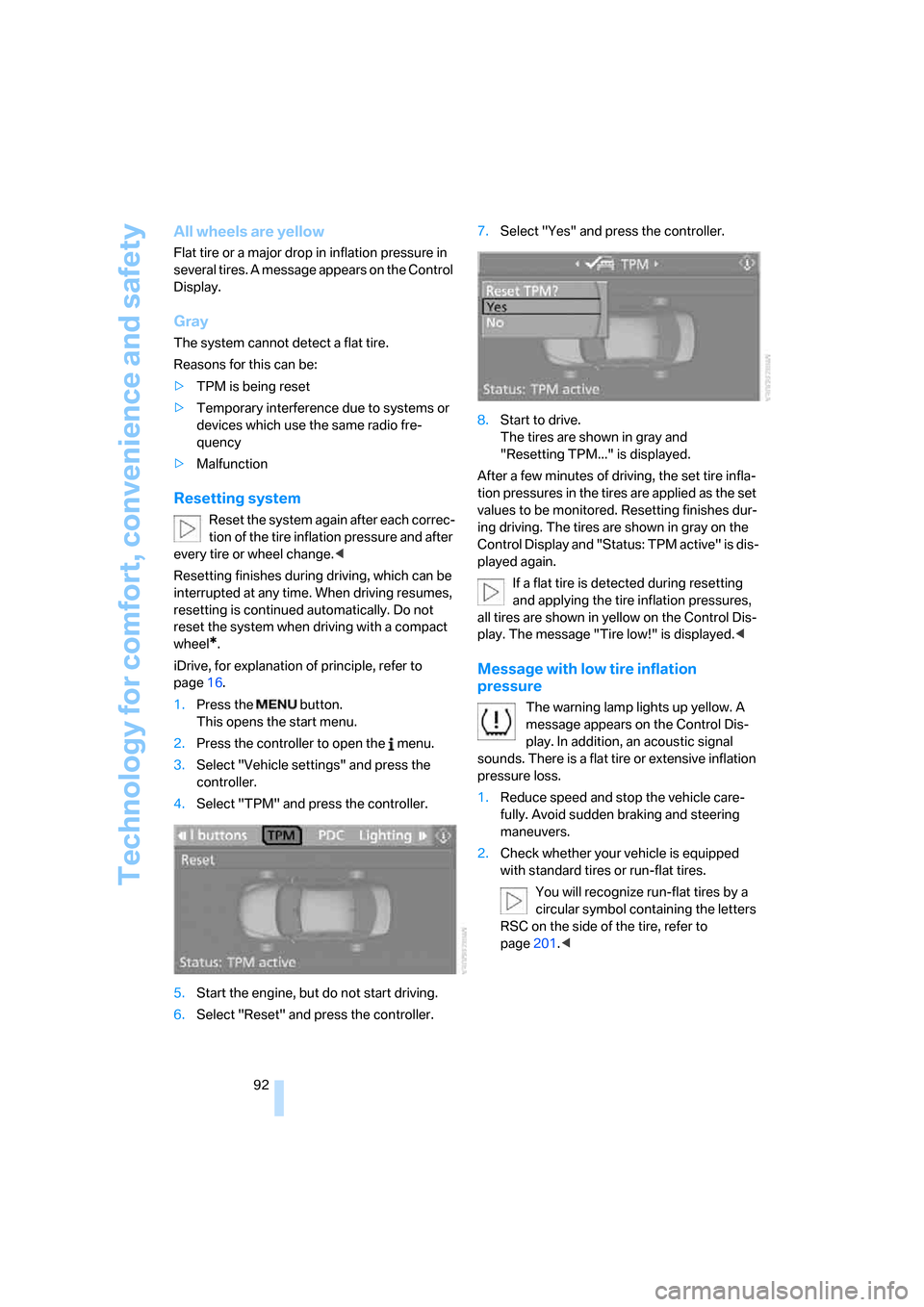
4.Select "TPM" and press the controller.
5.Start the engine, but do not start driving.
6.Select "Reset" and press the controller.7.Select "Yes" and press the controller.
8.Start to drive.
The tires are shown in gray and
"Resetting TPM..." is displayed.
After a few minutes of driving, the set tire infla-
tion pressures in the tires are applied as the set
values to be monitored. Resetting finishes dur-
ing driving. The tires are shown in gray on the
Control Display and "Status: TPM active" is dis-
played again.
If a flat tire is detected during resetting
and applying the tire inflation pressures,
all tires are shown in yellow on the Control Dis-
play. The message "Tire low!" is displayed.<
Message with low tire inflation
pressure
The warning lamp lights up yellow. A
message appears on the Control Dis-
play. In addition, an acoustic signal
sounds. There is a flat tire or extensive inflation
pressure loss.
1.Reduce speed and stop the vehicle care-
fully. Avoid sudden braking and steering
maneuvers.
2.Check whether your vehicle is equipped
with standard tires or run-flat tires.
You will recognize run-flat tires by a
circular symbol containing the letters
RSC on the side of the tire, refer to
page201.<
Page 106 of 259
Lamps
104
Fog lamps*
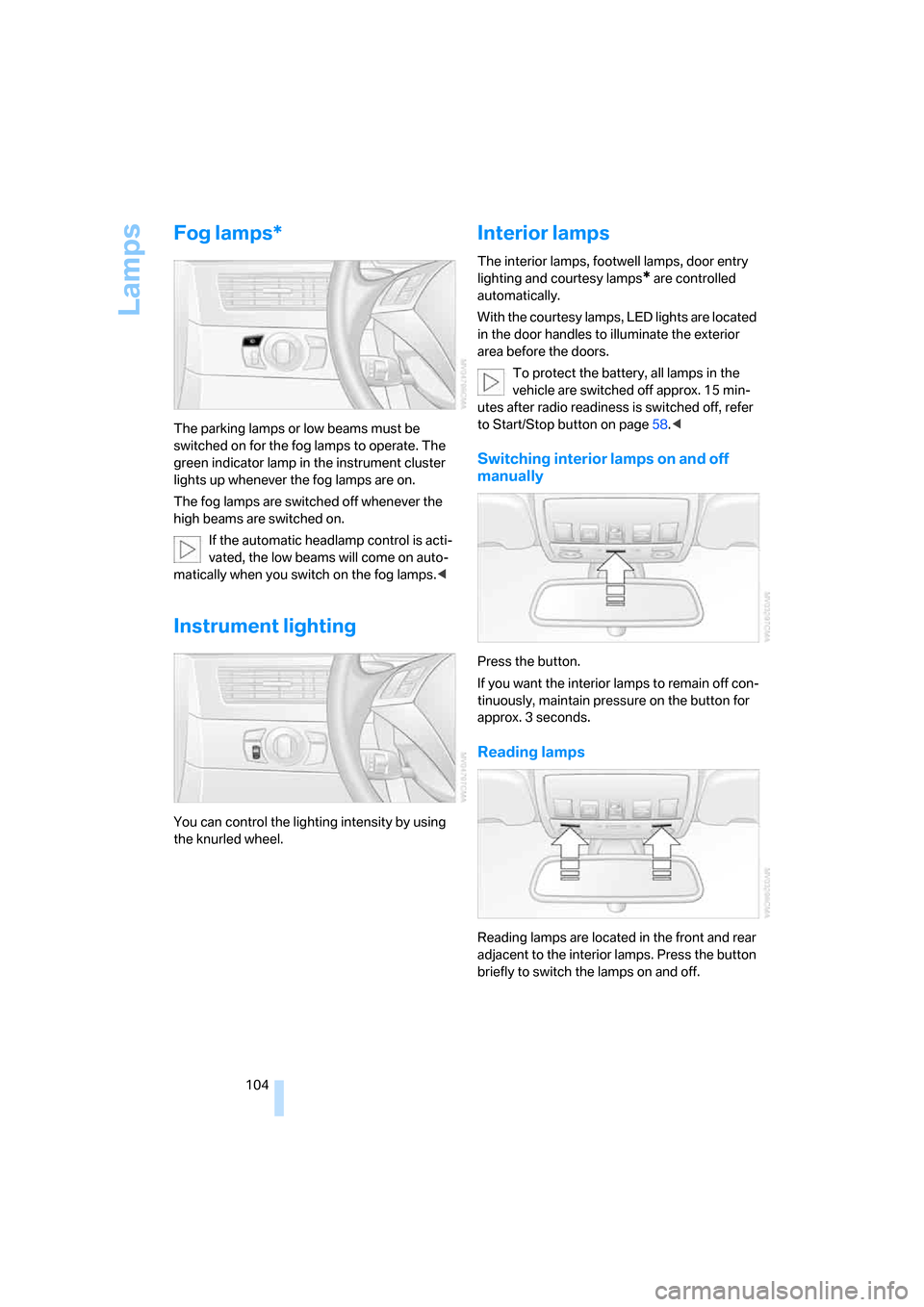
The parking lamps or low beams must be
switched on for the fog lamps to operate. The
green indicator lamp in the instrument cluster
lights up whenever the fog lamps are on.
The fog lamps are switched off whenever the
high beams are switched on.
If the automatic headlamp control is acti-
vated, the low beams will come on auto-
matically when you switch on the fog lamps.<
Instrument lighting
You can control the lighting intensity by using
the knurled wheel.
Interior lamps
The interior lamps, footwell lamps, door entry
lighting
and courtesy lamps* are controlled
automatically.
With the courtesy lamps, LED lights are located
in the door handles to illuminate the exterior
area before the doors.
To protect the battery, all lamps in the
vehicle are switched off approx. 15 min-
utes after radio readiness is switched off, refer
to Start/Stop button on page58.<
Switching interior lamps on and off
manually
Press the button.
If you want the interior lamps to remain off con-
tinuously, maintain pressure on the button for
approx. 3 seconds.
Reading lamps
Reading lamps are located in the front and rear
adjacent to the interior lamps. Press the button
briefly to switch the lamps on and off.
Page 110 of 259
Climate
108 body. Therefore, open these vents for maxi-
mum cooling.
AUC Automatic recirculated-air
control/recirculated-air mode
You can respond to pollutants or
unpleasant odors in the immediate
environment by suspending the
supply of outside air. The system then recircu-
lates the air currently within the vehicle. During
AUC operation, a sensor detects pollutants in
the outside air and controls the shut-off auto-
matically.
By pressing the button repeatedly, you can
request three operating modes:
>LED off: outside air flows in continuously.
>Right LED on, AUC mode: the system
detects pollutants in the outside air and
shuts off the supply as needed.
>Left LED on, recirculated-air mode: the
supply of outside air is permanently shut off.
If condensation starts to form on the
inside window surfaces during operation
in the recirculated-air mode, you should switch
it off while also increasing the air volume as
required.
The recirculated-air mode should not be used
over an extended period of time, as the air qual-
ity inside the vehicle deteriorates continu-
ously.<
Residual heat
The heat stored in the engine is
used to heat the passenger com-
partment, e.g. while stopped at a
school to pick up a child.
The function can be switched on when the fol-
lowing conditions are met:
>up to 15 minutes after switching off the
engine
>with engine at operating temperature
>with sufficient battery voltage
>at an outside temperature below 777/
256The LED lights up when the function is
switched on.
From radio readiness the interior temperature,
the air volume and the air distribution can be
set.
Switching off automatic climate control
The air volume, the heater and the
cooling function are all switched
off.
You can restart the automatic cli-
mate control by pressing any of its buttons
except the REST button.
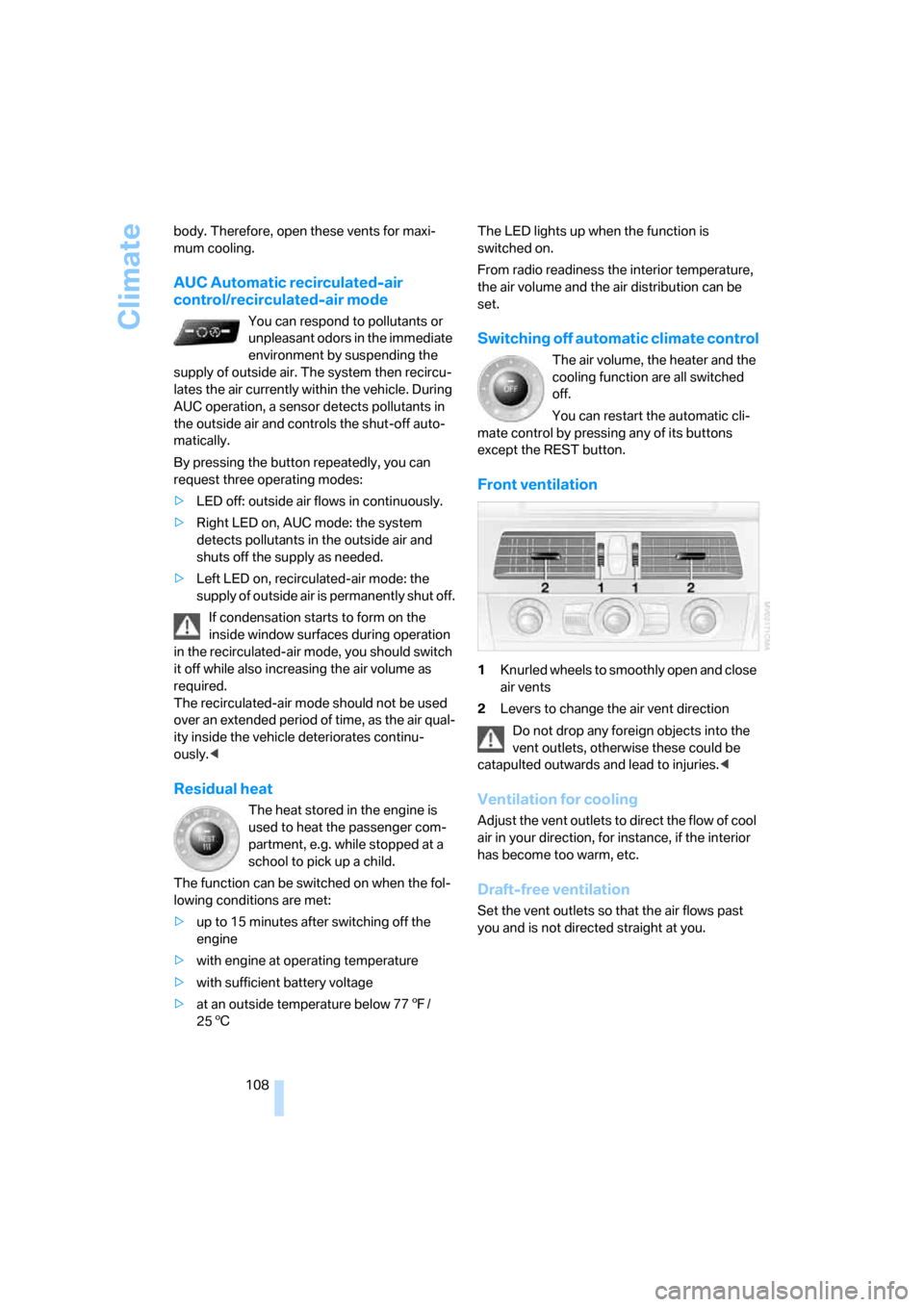
Front ventilation
1Knurled wheels to smoothly open and close
air vents
2Levers to change the air vent direction
Do not drop any foreign objects into the
vent outlets, otherwise these could be
catapulted outwards and lead to injuries.<
Ventilation for cooling
Adjust the vent outlets to direct the flow of cool
air in your direction, for instance, if the interior
has become too warm, etc.
Draft-free ventilation
Set the vent outlets so that the air flows past
you and is not directed straight at you.
Page 177 of 259
175
Entertainment
Reference
At a glance
Controls
Driving tips Communications
Navigation
Mobility
Making calls with car phone:
BMW Assist calls
You can use the car phone via the hands-free
system for BMW Assist calls.
When the status information "Communication"
or "BMW Assist" is displayed in "BMW Ser-
vice", only BMW Assist calls are possible.
It may not be possible to establish a telephone
connection using the mobile phone while a con-
nection is being established to BMW Assist or
while a call to BMW Assist is already in
progress. If this happens, you must log off the
mobile phone from the vehicle if you wish to
place a call with the mobile phone.
Commissioning
Logging on mobile phone on vehicle
The following prerequisites must be met:
>The mobile phone is ready to operate.
>The Bluetooth link on the vehicle, refer to
page177, and on the mobile phone is
active.
>Depending on the mobile phone, preset-
tings on the mobile phone are necessary:
e.g. via the menu item Bluetooth activated
or the menu item Connection not with con-
firmation.
>For logging on, specify any desired number
as the Bluetooth passkey, e.g. 1. This Blue-
tooth passkey is no longer required follow-
ing successful logon.
>The ignition is switched on.
Only log on the mobile phone with the
vehicle stopped, otherwise the passen-
gers and other road user can be endangered
due to a lack of attentiveness on the part of the
driver.<
Switching on ignition
1.Insert the remote control as far as possible
into the ignition lock.
2.S w i t c h o n t h e s w i t c h o n i g n i t i o n b y p r e s s i n g
the Start/Stop button without depressing
the brake or clutch pedal.
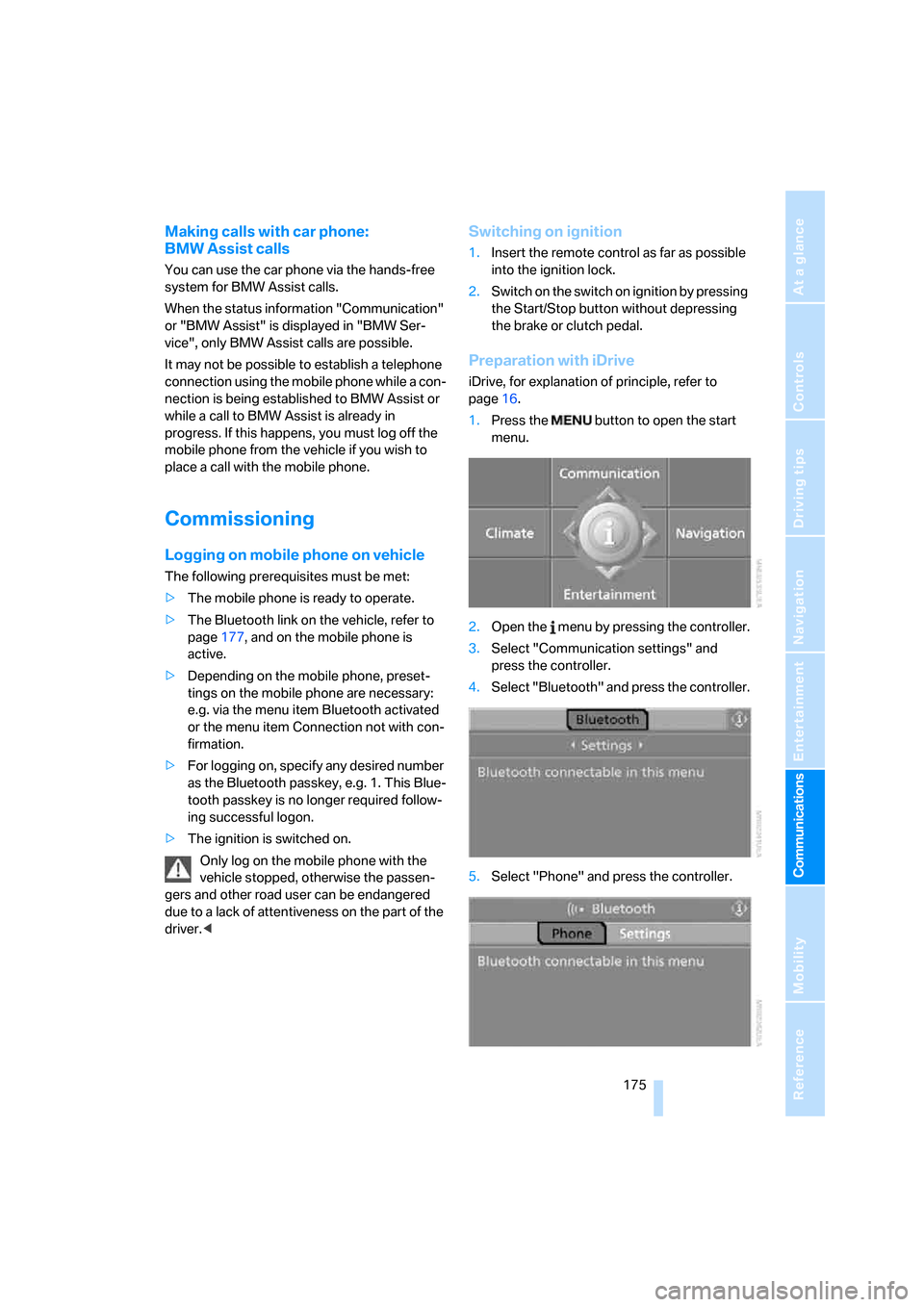
Preparation with iDrive
iDrive, for explanation of principle, refer to
page16.
1.Press the button to open the start
menu.
2.Open the menu by pressing the controller.
3.Select "Communication settings" and
press the controller.
4.Select "Bluetooth" and press the controller.
5.Select "Phone" and press the controller.
Page 207 of 259
Mobility
205Reference
At a glance
Controls
Driving tips
Communications
Navigation
Entertainment
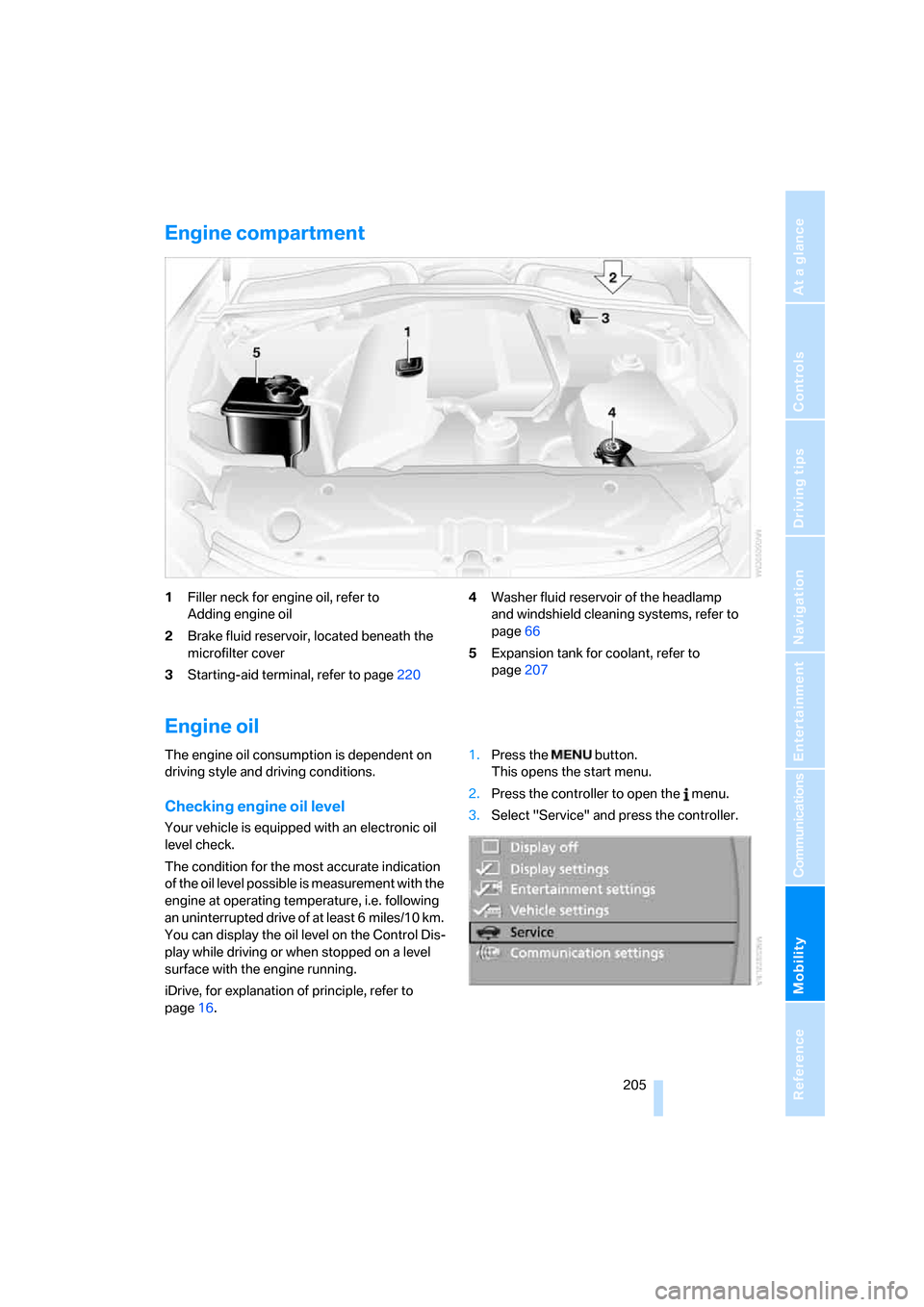
Engine compartment
1Filler neck for engine oil, refer to
Adding engine oil
2Brake fluid reservoir, located beneath the
microfilter cover
3Starting-aid terminal, refer to page2204Washer fluid reservoir of the headlamp
and windshield cleaning systems, refer to
page66
5Expansion tank for coolant, refer to
page207
Engine oil
The engine oil consumption is dependent on
driving style and driving conditions.
Checking engine oil level
Your vehicle is equipped with an electronic oil
level check.
The condition for the most accurate indication
of the oil level possible is measurement with the
engine at operating temperature, i.e. following
an uninterrupted drive of at least 6 miles/10 km.
You can display the oil level on the Control Dis-
play while driving or when stopped on a level
surface with the engine running.
iDrive, for explanation of principle, refer to
page16.1.Press the button.
This opens the start menu.
2.Press the controller to open the menu.
3.Select "Service" and press the controller.
Page 250 of 259
Everything from A to Z
248 Radio position, refer to Radio
readiness58
Radio readiness58
– switched off58
– switched on58
– with comfort access39
Rain sensor65
"Random", random play
sequence168
"Random all" in audio
mode169
"Random directory" in audio
mode169
"RDS"159
Reading lamps104
Rear armrest, refer to Center
armrest, rear116
Rear lamps, refer to Tail
lamps213
– replacing bulbs213
Rear seat back,
folding116,117
Rear seats
– adjusting head restraints49
– folding over
backrest116,117
– heating50
Rear ventilation109
Rearview mirror51
Rear window
– changing wiper blade211
– heating107
– opening and closing on
Sports Wagon34
– roller sun blind, refer to Sun
blinds112
– window wiper on Sports
Wagon66,126
Rear window safety switch41
"Received calls"180
Reception
– quality159
– radio stations159
– regional station157
Reception level of mobile
phone, refer to Status
information20Rechargeable flashlight113
Recirculated-air mode
– air recirculation108
– AUC Automatic recircu-
lated-air control108
Reclining seat, refer to
Backrest46
Recording times, refer to
Stopwatch81
"Redial" for mobile phone180
Reflectors, refer to Tail
lamps213
Refueling194
Releasing, hood204
"Relock door if not
opened"33
Remaining distance, refer to
Cruising range75
Remaining distance to desti-
nation, refer to Computer76
Remote control28
– battery replacement40
– comfort access38
– garage door opener111
– luggage compartment lid31
– malfunction31,40
– tailgate31
Removing condensation on
the windows107
"Repeat directory" in audio
mode168
"Repeat" in audio mode168
"Repeat track" in audio
mode168
Replacement fuses218
Replacement of tires, refer to
Changing wheels215
Replacing bulbs, refer to
Lamps and bulbs212
Replacing tires202
Replacing wheels/tires, refer
to New wheels and tires201
Reporting an accident, refer
Initiating an emergency
call219
Reporting safety defects7Reserve warning, refer to Fuel
gauge75
Reservoir for washer
systems66
"Reset"92
– stopwatch82
– tone settings155
Reset, refer to Resetting tone
settings155
Residual heat108
Restraint systems
– for children54
– refer to Safety belts49
Retaining straps, refer to
Storage area package119
Retreaded tires202
Reverse, fast
– CD changer169
– CD player169
Reverse gear
– automatic transmission with
Steptronic63
– manual transmission61
– SMG Sequential Manual
Transmission61
Road map146
"Roadside
Assistance"182
,189
Roadside Assistance220
Roadside parking lamps102
– replacing bulbs213
Roller sun blind, refer to Sun
blinds112
Roll-up cover, Sports
Wagon117
Roof load capacity229
Roof-mounted luggage
rack128
Rope, refer to Tow-starting
and towing221
Rotary pushbutton, refer to
iDrive16
Page 252 of 259
Everything from A to Z
250 Settings
– BMW Night Vision99
– changing on Control
Display82
– clock, 12h/24h mode83
– configuring, refer to
Personal Profile29
Setting speed limit81
Setting time, refer to Prese-
lecting activation time109
"Set tire pressure"90
Shifting gears
– automatic transmission with
Steptronic64
– SMG Sequential Manual
Transmission62
Shiftlock
– automatic transmission with
Steptronic63
– SMG Sequential Manual
Transmission61
Shift paddles62
Short commands of voice
command system231
"Short route" for
navigation143
Short route in navigation, refer
to Selecting route142
Shoulder support46
"Show current position"138
"Show destination
position"138
Shuffled, refer to Random
– CD changer168
– CD player168
Side airbags94
Side marker lamps, replacing
bulbs213
Side turn signals, replacing
bulbs213
Side window blinds, refer to
Sun blinds112
Signal horn, refer to Horn10
Sitting safely45
– with airbags45
– with head restraint45
– with safety belts45
Ski bag120Sliding/tilt sunroof
– refer to Glass sunroof,
electric41
– refer to Panorama glass
sunroof43
Slope assistant, refer to
Starting assistant125
SMG Sequential Manual
Transmission61
– acceleration assistant63
– breaking-in124
– Dynamic Driving Control62
– gear display61
– kick-down62
– shiftlock61
– towing222
– tow-starting223
Snow chains203
Socket for Onboard
Diagnostics interface210
Socket for remote control,
refer to Ignition lock58
Sockets, refer to Connecting
electrical devices115
Soft closure aid, refer to
Automatic soft closing33
Song search with CD, refer to
Playing a track167
SOS, refer to Initiating an
emergency call219
Spare fuses218
Spare key28
– adapter28
Spare remote control28
Spare wheel
– refer to Changing
wheels215
– refer to Compact wheel216
Special oils, refer to Approved
engine oils206
Specified oil grades, refer to
Approved engine oils206
Speed
– with compact wheel217
– with winter tires202
Speed-dependent
volume154
Speed limit warning, refer to
Speed limit81Speedometer12
"Speed volume", refer to Tone
control154
"Sport", active backrest width
adjustment47
Sport program, refer to
Dynamic Driving Control62
Sports Wagon
– automatic roll-up cover117
– automatic tailgate
operation36
– compartments in cargo
area118
– increasing cargo area117
– opening rear window34
– opening tailgate35
– panorama glass sunroof43
– rear window wiper66
– rear window wiper, changing
wiper blade211
– releasing fuel filler door in
event of electrical
malfunction194
– roll-up cover117
– roll-up cover for cargo
area117
– self-leveling suspension89
– separation net118
– socket in cargo area116
– storage area package119
– tail lamps, replacing
bulbs214
Stability control, refer to
Driving stability control
systems86
"Star button"53
Star button53
Start/Stop button58
"Start" for stopwatch82
"Start guidance"136,144
Starting, refer to Starting
engine59
Starting assistance, refer to
Jump starting220
Starting assistant125
Starting difficulties
– jump starting220
– refer to Special starting
conditions59
Page 253 of 259
Reference 251
At a glance
Controls
Driving tips
Communications
Navigation
Entertainment
Mobility
Starting off on slopes, refer to
Starting assistant125
Start menu, iDrive17
"Start route guidance"138
"Start service"189
"State / Province" for desti-
nation entry134
"State inspection"78
Station, refer to Radio156
"Stations", presets163
"Status"78
Status of this Owner's Manual
at time of printing5
Steering wheel
– adjustment52
– buttons on steering
wheel11
– easy entry/exit52
– heating52
– lock58
– locking58
– memory47
– programmable buttons53
"Steering wheel buttons"53
Steering-wheel shift buttons,
refer to Shift paddles62
Steering with variable ratio,
refer to Active steering93
Steptronic, refer to Automatic
transmission with
Steptronic63
"Stop" for stopwatch82
"Stopwatch"82
Stopwatch81
Storage area package119
Storage compartments114
"Store in address book" for
navigation system140
"Store" on the radio158,163
Storing current position140
Storing radio stations158
Storing sitting position, refer
to Seat, mirror and steering
wheel memory47
Storing tires202
Straps, refer to Loading128
"Street" for destination
entry135Summer tires, refer to Wheels
and tires196
Sun blinds112
"Surround Settings", refer to
Tone control154
SW, waveband156
Switches, refer to Cockpit10
Switching between high
beams and low beams,
automatic, refer to High-
beam assistant103
Switching cooling function on
and off107
Switching off engine60
Switching off tilt alarm
sensor38
Switching on
– audio152
– CD changer152
– CD player152
– radio152
Switching on hour signal83
Swiveling headlamps, refer to
Adaptive Head Light102
Symbols4
– indicator/warning lamps13
T
Tachometer74
"Tailgate"36
Tailgate33,35
– automatic operation36
– locking and unlocking from
inside32
– opening from inside, Sports
Wagon35
Tail lamps213
– replacing bulbs213
Tank contents, refer to
Capacities230
Target cursor for
navigation138
Technical alterations, refer to
For your own safety5
Technical data226
Telematic, refer to
TeleService,
BMW Assist187Telephone, refer to Mobile
phone174
"Telephone list"53
TeleService187
– enabling187
– services offered188
Temperature
– adjusting in upper body
region106
– adjusting with automatic
climate control106
– of coolant, refer to Coolant
temperature74
Temperature display
– outside temperature74
– setting units84
– temperature warning74
Temperature warning74
Tempomat, refer to Cruise
control66
"Terminate services"190
"Text language"84
"Theater", refer to Tone
control154
The individual vehicle5
Third brake lamp, refer to
Center brake lamp214
Through-loading system116
Tightening torque of the lug
bolts, refer to After
mounting217
Tilting down passenger-side
exterior mirror52
"Time"83
"Time format"83
Timer, refer to Preselecting
activation time109
"Timer 1" for parked car
ventilation110
"Timer 2" for parked car
ventilation110
Tire inflation pressures196
Tire pressure loss90,91
Tire pressure monitoring,
refer to Flat Tire Monitor89
Tire Pressure Monitor
TPM91
Tire Quality Grading200