check engine BMW 535I GRAN TURISMO 2012 Owner's Manual
[x] Cancel search | Manufacturer: BMW, Model Year: 2012, Model line: 535I GRAN TURISMO, Model: BMW 535I GRAN TURISMO 2012Pages: 321, PDF Size: 12.7 MB
Page 286 of 321
Do not touch live parts
To avoid the risk of potentially fatal injury,
always avoid all contact with electrical compo‐
nents while the engine is running.◀
Preparation1.Check whether the battery of the other ve‐
hicle has a voltage of 12 volts. This informa‐
tion can be found on the battery.2.Switch off the engine of the assisting vehi‐
cle.3.Switch off any electronic systems/power
consumers in both vehicles.
Bodywork contact between vehicles
Make sure that there is no contact be‐
tween the bodywork of the two vehicles; other‐
wise, there is the danger of short circuits.◀
Starting aid terminals Connecting order
Connect the jumper cables in the correct
order; otherwise, there is the danger of injury
from sparking.◀
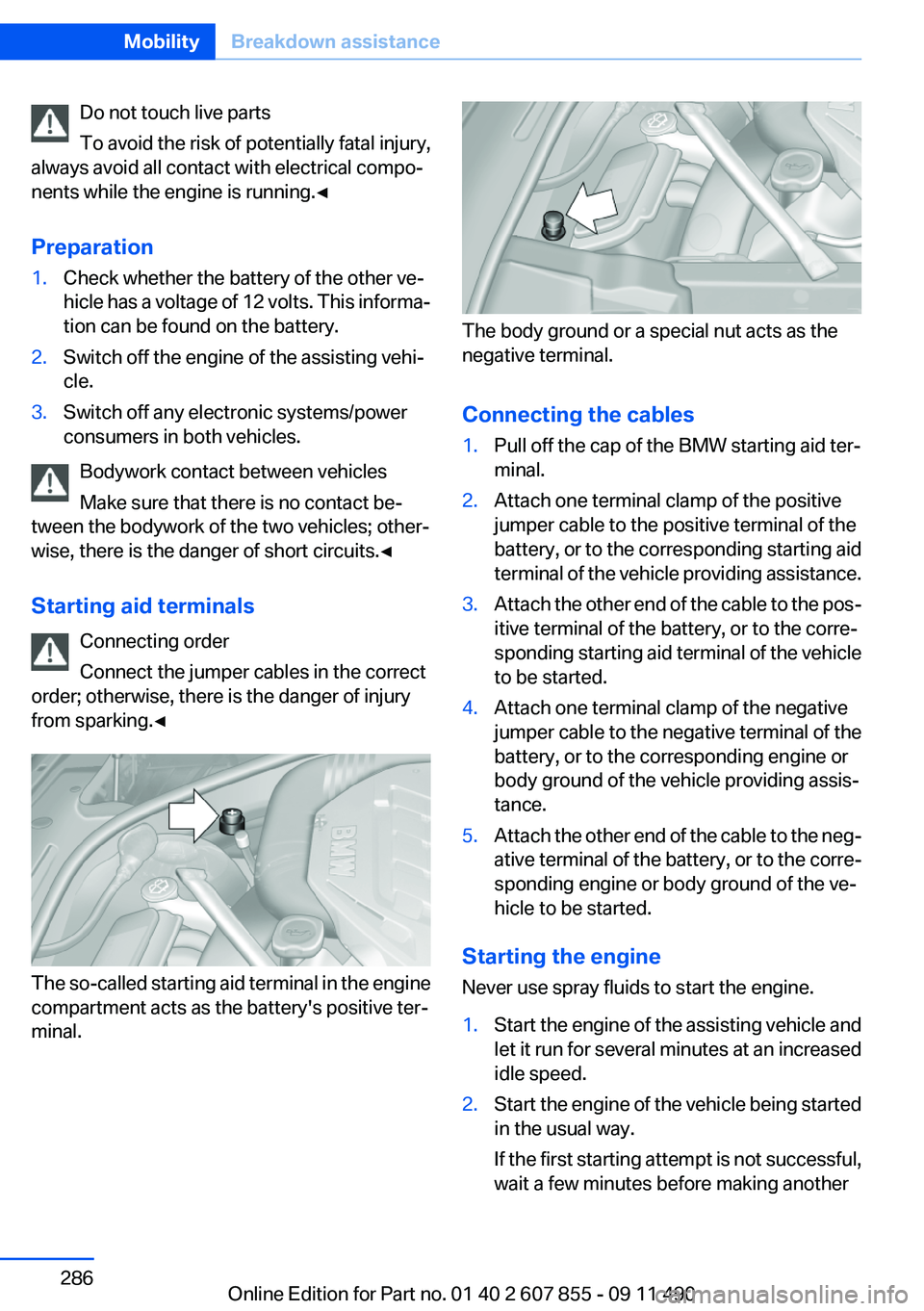
The so-called starting aid terminal in the engine
compartment acts as the battery's positive ter‐
minal.
The body ground or a special nut acts as the
negative terminal.
Connecting the cables
1.Pull off the cap of the BMW starting aid ter‐
minal.2.Attach one terminal clamp of the positive
jumper cable to the positive terminal of the
battery, or to the corresponding starting aid
terminal of the vehicle providing assistance.3.Attach the other end of the cable to the pos‐
itive terminal of the battery, or to the corre‐
sponding starting aid terminal of the vehicle
to be started.4.Attach one terminal clamp of the negative
jumper cable to the negative terminal of the
battery, or to the corresponding engine or
body ground of the vehicle providing assis‐
tance.5.Attach the other end of the cable to the neg‐
ative terminal of the battery, or to the corre‐
sponding engine or body ground of the ve‐
hicle to be started.
Starting the engine
Never use spray fluids to start the engine.
1.Start the engine of the assisting vehicle and
let it run for several minutes at an increased
idle speed.2.Start the engine of the vehicle being started
in the usual way.
If the first starting attempt is not successful,
wait a few minutes before making anotherSeite 286MobilityBreakdown assistance286
Online Edition for Part no. 01 40 2 607 855 - 09 11 490
Page 287 of 321
attempt in order to allow the discharged bat‐
tery to recharge.3.Let both engines run for several minutes.4.Disconnect the jumper cables in the reverse
order.
Check the battery and recharge if necessary.
Tow-starting and towing
Transporting your vehicle
Note
Your vehicle is not permitted to be towed.
Therefore, contact a service center in the event
of a breakdown.
Do not have the vehicle towed
Have your vehicle transported on a loading
platform only; otherwise, damage may occur.◀
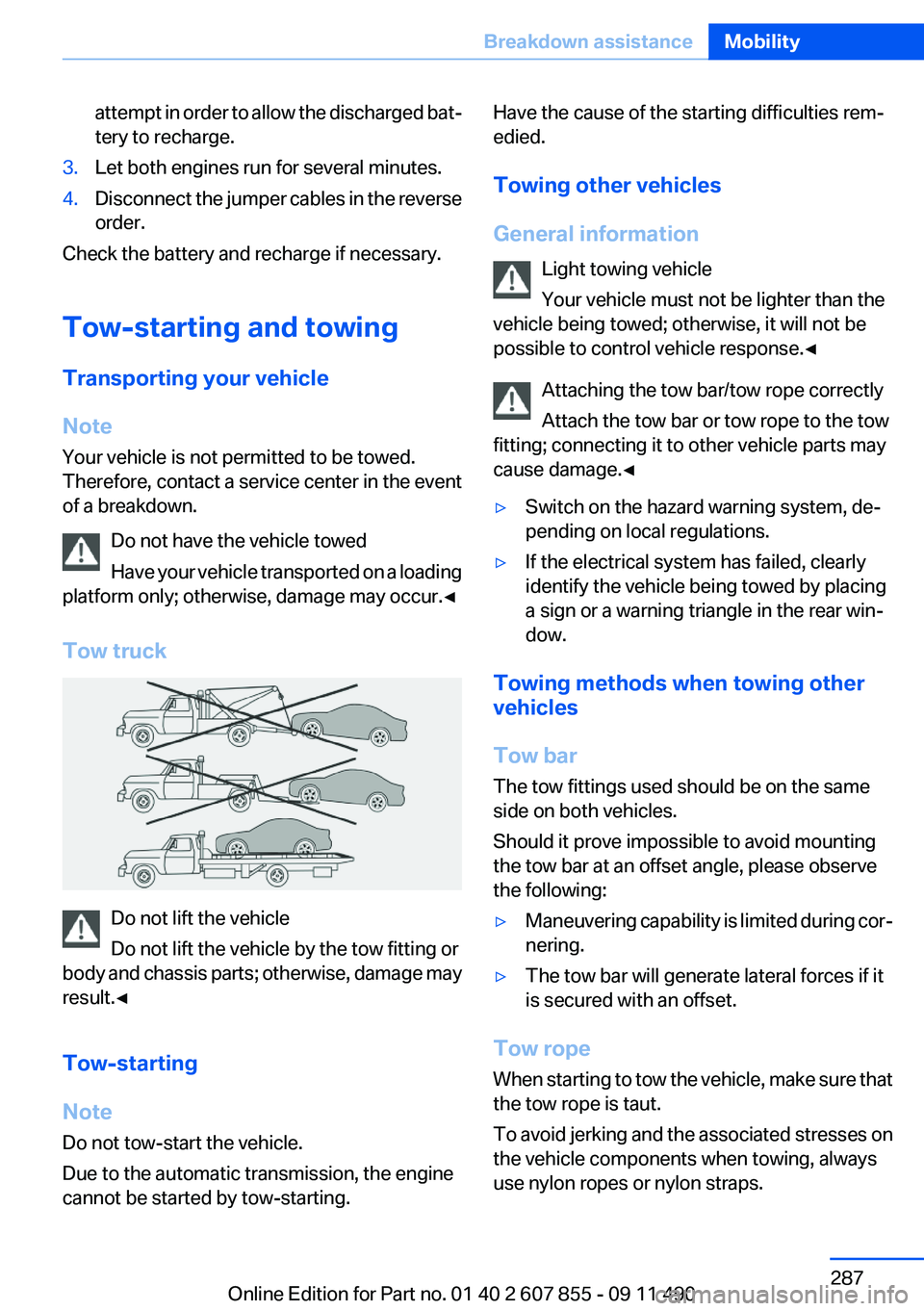
Tow truck
Do not lift the vehicle
Do not lift the vehicle by the tow fitting or
body and chassis parts; otherwise, damage may
result.◀
Tow-starting
Note
Do not tow-start the vehicle.
Due to the automatic transmission, the engine
cannot be started by tow-starting.
Have the cause of the starting difficulties rem‐
edied.
Towing other vehicles
General information Light towing vehicle
Your vehicle must not be lighter than the
vehicle being towed; otherwise, it will not be
possible to control vehicle response.◀
Attaching the tow bar/tow rope correctly
Attach the tow bar or tow rope to the tow
fitting; connecting it to other vehicle parts may
cause damage.◀▷Switch on the hazard warning system, de‐
pending on local regulations.▷If the electrical system has failed, clearly
identify the vehicle being towed by placing
a sign or a warning triangle in the rear win‐
dow.
Towing methods when towing other
vehicles
Tow bar
The tow fittings used should be on the same
side on both vehicles.
Should it prove impossible to avoid mounting
the tow bar at an offset angle, please observe
the following:
▷Maneuvering capability is limited during cor‐
nering.▷The tow bar will generate lateral forces if it
is secured with an offset.
Tow rope
When starting to tow the vehicle, make sure that
the tow rope is taut.
To avoid jerking and the associated stresses on
the vehicle components when towing, always
use nylon ropes or nylon straps.
Seite 287Breakdown assistanceMobility287
Online Edition for Part no. 01 40 2 607 855 - 09 11 490
Page 289 of 321
CareVehicle equipment
All standard, country-specific and optional
equipment that is offered in the model series is
described in this chapter. Therefore, equipment
is also described that is not available in a vehicle,
e. g., because of the selected optional equip‐
ment or country variant. This also applies for
safety-related functions and systems.
Car washes
Notes Steam jets or high-pressure washers
When using steam jets or high-pressure
washers, hold them a sufficient distance away
and use a maximum temperature of 140 ℉/
60 ℃.
Holding them too close or using excessively
high pressures or temperatures can cause dam‐
age or preliminary damage that may then lead to
long-term damage.
Follow the operating instructions for the high-
pressure washer.◀
Cleaning sensors/cameras with high-
pressure washers
When using high-pressure washers, do not
spray the exterior sensors and cameras, e.g.,
Park Distance Control, for extended periods of
time and only from a distance of at least 12 in/
30 cm.◀
Wash your vehicle frequently, particularly in win‐
ter.
Intense soiling and road salt can damage the ve‐
hicle.Washing in automatic car washes
Give preference to cloth car washes or those
that use soft brushes in order to avoid paint
damage.
Notes
Note the following:▷Make sure that the wheels and tires are not
damaged by the transport mechanisms.▷Fold in the exterior mirrors; otherwise, they
may be damaged, depending on the width of
the vehicle.▷Deactivate the rain sensor, refer to page 73,
to avoid unintentional wiper activation.▷In some cases, an unintentional alarm can be
triggered by the interior motion sensor of the
alarm system. Follow the instructions on
avoiding an unintentional alarm, refer to
page 44.
Guide rails in car washes
Avoid car washes with guide rails higher
than 4 in/10 cm; otherwise, the vehicle body
could be damaged.◀
Before driving into a car wash
In order to ensure that the vehicle can roll in a car
wash, take the following steps:
1.Release the parking brake, refer to page 69,
and deactivate Automatic Hold, refer to
page 71.2.Drive into the car wash.3.Depress the brake pedal as needed.4.Engage transmission position N.5.Switch the engine off. In this way, the igni‐
tion remains switched on, and a Check-Con‐
trol message is displayed.Seite 289CareMobility289
Online Edition for Part no. 01 40 2 607 855 - 09 11 490
Page 313 of 321
Engine oil additives 274
Engine oil change 274
Engine oil filler neck 273
Engine oil temperature 81
Engine oil types, alterna‐ tive 274
Engine oil types, ap‐ proved 274
Engine start during malfunc‐ tion 31
Engine start, refer to Starting the engine 68
Engine start, Starting aid 285
Engine stop 68
Engine temperature 81
Entering a car wash 289
Equalizer 186
Equipment, interior 143
ESP Electronic Stability Pro‐ gram, refer to DSC 106
Exchanging wheels/tires 267
Exhaust system 158
Exterior mirror, automatic dim‐ ming feature 61
Exterior mirrors 60
External devices 208
External start 285
External temperature dis‐ play 82
External temperature warn‐ ing 82
Eyes for securing cargo 162
F
Fader 186
Failure message, refer to Check Control 79
False alarm, refer to Uninten‐ tional alarm 44
Fan, refer to Air volume 137
Fault displays, refer to Check Control 79
Filler neck for engine oil 273
Fine wood, care 291
First aid kit 285 Fitting for towing, refer to Tow
fitting 288
Flat tire, changing wheels 282
Flat Tire Monitor FTM 100
Flat tire, Tire Pressure Monitor TPM 97
Flat tire, warning lamp 98, 101
Flooding 159
Floor carpet, care 291
Floor mats, care 291
FM/AM station 188
Fold-out position, windshield wipers 74
Foot brake 159
Front airbags 94
Front fog lamps 92
Front fog lamps, front, bulb re‐ placement 280
Front lamps 279
Front passenger airbags, au‐ tomatic deactivation 96
Front passenger airbags, indi‐ cator lamp 96
FTM Flat Tire Monitor 100
Fuel cap 258
Fuel consumption, current 83
Fuel consumption, refer to Average fuel consump‐
tion 85
Fuel filler flap 258
Fuel gauge 81
Fuel quality 260
Fuel, tank capacity 299
Fuse 283
G
Garage door opener, refer to Integrated universal remote
control 143
Gas station recommenda‐ tion 178
Gear change, automatic trans‐ mission 75
General driving notes 158 Glass sunroof, refer to Panor‐
amic glass sunroof 46
Glove compartment 150
Gong, volume equaliza‐ tion 187
GPS navigation, refer to Navi‐ gation system 168
Gray display of the map 181
Gross vehicle weight, ap‐ proved 298
Gross weight, permissible for trailer towing 298
H
Hand brake, refer to Parking brake 69
Hand-held transmitter, alter‐ nating code 144
Hazard warning flashers 284
HDC Hill Descent Control 108
HD Radio 189
Head airbags 94
Headlamp control, auto‐ matic 90
Headlamp courtesy delay fea‐ ture 90
Headlamp courtesy delay fea‐ ture via remote control 35
Headlamp flasher 73
Headlamp glass 279
Headlamps 279
Headlamps, care 290
Headlamp washer system 73
Headliner 15
Headphones, rear entertain‐ ment 221
Head restraints 49
Head restraints, front 57
Head restraints, rear 58
Head-up Display 134
Head-up Display, care 292
Heavy cargo, stowing 162
Height with roof-mounted aer‐ ial, vehicle 296
High-beam Assistant 91 Seite 313Everything from A to ZReference313
Online Edition for Part no. 01 40 2 607 855 - 09 11 490