sensor BMW 535I GRAN TURISMO 2013 Owner's Manual
[x] Cancel search | Manufacturer: BMW, Model Year: 2013, Model line: 535I GRAN TURISMO, Model: BMW 535I GRAN TURISMO 2013Pages: 240, PDF Size: 5.49 MB
Page 147 of 240
▷When parking in parking spaces on the driv‐
er's side, the corresponding turn signal must
be set.
Suitable parking space
▷Gap between two objects with a minimum
length of approx. 5 ft/1.5 m.▷Minimum length of the gap: own vehicle's
length plus approx 4 ft/1.2 m.▷Minimum depth: approx. 5 ft/1.5 m.
For parking procedure
Closed doors.
At a glance
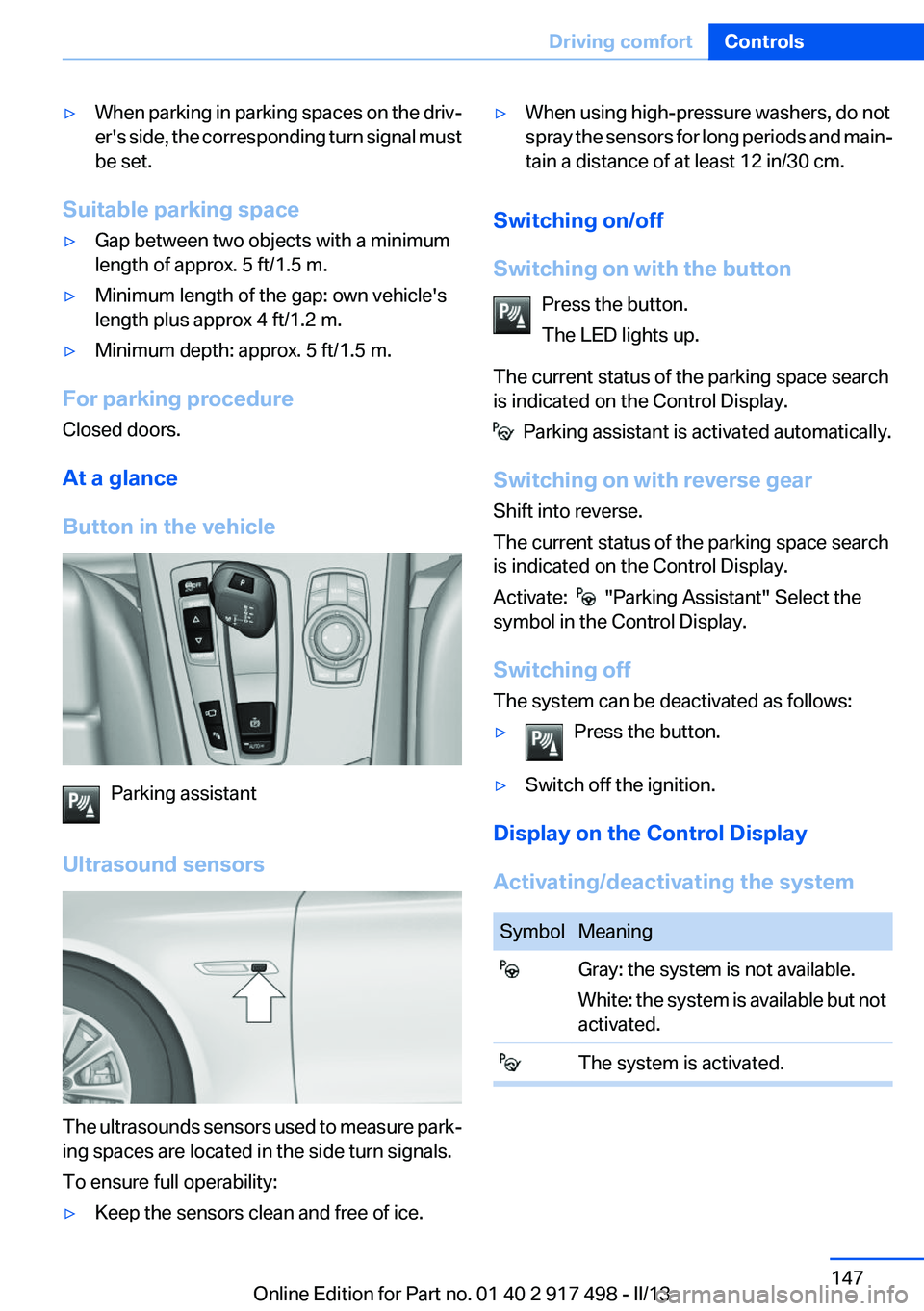
Button in the vehicle
Parking assistant
Ultrasound sensors
The ultrasounds sensors used to measure park‐
ing spaces are located in the side turn signals.
To ensure full operability:
▷Keep the sensors clean and free of ice.▷When using high-pressure washers, do not
spray the sensors for long periods and main‐
tain a distance of at least 12 in/30 cm.
Switching on/off
Switching on with the button Press the button.
The LED lights up.
The current status of the parking space search
is indicated on the Control Display.
Parking assistant is activated automatically.
Switching on with reverse gear
Shift into reverse.
The current status of the parking space search
is indicated on the Control Display.
Activate:
"Parking Assistant" Select the
symbol in the Control Display.
Switching off
The system can be deactivated as follows:
▷Press the button.▷Switch off the ignition.
Display on the Control Display
Activating/deactivating the system
SymbolMeaning Gray: the system is not available.
White: the system is available but not
activated. The system is activated.Seite 147Driving comfortControls147
Online Edition for Part no. 01 40 2 917 498 - II/13
Page 149 of 240
The status of the parking space search is in‐
dicated on the Control Display.2.Follow the instructions on the Control Dis‐
play.
To achieve the best possible parking posi‐
tion, wait for the automatic steering wheel
movement after the gear change when the
vehicle is stationary.
The end of the parking procedure is indi‐
cated on the Control Display.3.Adjust the parking position yourself if nec‐
essary.
Interrupting manually
The parking assistant can be interrupted at any
time:
▷ " Parking Assistant" Select the symbol on
the Control Display.▷Press the button.
Interrupting automatically
The system is interrupted automatically in the
following situations:
▷If the driver grasps the steering wheel or if
he takes over steering.▷If a gear is selected that does not match the
instruction on the Control Display.▷If a turn signal is activated in the opposite
direction to the desired side for parking.▷If the vehicle speed exceeds approx.
6 mph/10 km/h.▷On snow-covered or slippery road surfaces
if necessary.▷If doors are open.▷If a maximum number of parking attempts or
the time taken for parking is exceeded.
A Check Control message is displayed.
Resume
An interrupted parking procedure can be con‐
tinued if necessary.
Follow the instructions on the Control Display to
do this.
System limits
No parking assistance
The parking assistant does not offer assistance
in the following situations:▷In tight curves.
Functional limitations
The system may not be fully functional in the
following situations:
▷When sensors are dirty or iced over.▷In heavy fog, rain or snowfall.▷On bumpy road surfaces such as gravel
roads.▷When leaves or snow has collected in the
parking space.
Limits of ultrasonic measurement
The detection of objects can reach the physical
limits of ultrasonic measurement, e.g., in the fol‐
lowing circumstances:
▷With tow bars and trailer hitches.▷With thin or wedge-shaped objects.▷With elevated, protruding objects such as
ledges or cargo.▷With objects with corners and sharp edges.▷With objects with a fine surface structure,
such as fences.
Low objects already displayed, e.g., curbs, can
move into the blind area of the sensors before or
after a continuous tone sounds.
High, protruding objects such as ledges may not
be detected.
The parking assistant may identify parking
spaces that are not suitable for parking.
Malfunction
A Check Control message is displayed.
Seite 149Driving comfortControls149
Online Edition for Part no. 01 40 2 917 498 - II/13
Page 153 of 240
Climate control functions in detail
Manual air distribution Press the button repeatedly to select a
program:▷Upper body region.▷Upper body region and footwell.▷Footwell.▷Windows and footwell: driver's side only.▷Windows, upper body region and footwell:
driver's side only.
If the windows are fogged over, press the AUTO
button on the driver's side to utilize the conden‐
sation sensor.
Temperature Turn the wheel to set the desired
temperature.
The automatic climate control achieves this
temperature as quickly as possible, if necessary
with the maximum cooling or heating capacity,
and then keeps it constant.
Avoid rapidly switching between different tem‐
perature settings. The automatic climate control
will not have sufficient time to adjust the set
temperature.
AUTO program Press the button.
Air flow, air distribution, and tempera‐
ture are controlled automatically.
Depending on the selected temperature, AUTO
intensity, and outside influences, the air is di‐
rected to the windshield, side windows, upper
body, and into the footwell.
The cooling function, refer to page 154, is
switched on automatically with the AUTO pro‐
gram.
At the same time, a condensation sensor con‐
trols the program so as to prevent window con‐
densation as much as possible.
Intensity of the AUTO program
With the AUTO program switched on, automatic
control of the air flow and air distribution can be
adjusted.
Press the left or right side of the button:
decrease or increase the intensity.
The selected intensity is shown on the display
of the automatic climate control.
Air flow, manual
To be able to manually adjust the air flow, switch
off the AUTO program first.
Press the left or right side of the button:
decrease or increase air flow.
The selected air flow is shown on the display of
the automatic climate control.
The air flow of the automatic climate control may
be reduced automatically to save battery power.
Defrosting windows and removing
condensation
Press the button.
Ice and condensation are quickly re‐
moved from the windshield and the front side
windows.
The air flow can be adjusted when the program
is active.
If the windows are fogged over, you can also
switch on the cooling function or press the
AUTO button to utilize the condensation sensor.
Maximum cooling Press the button.
The system is set to the lowest tem‐
perature, maximum air flow and recirculated-air
mode.Seite 153Climate controlControls153
Online Edition for Part no. 01 40 2 917 498 - II/13
Page 154 of 240
Air flows out of the vents for the upper body re‐
gion. The vents need to be open for this.
Air is cooled as quickly as possible:▷At an external temperature of approx.
32 ℉/0 ℃.▷When the engine is running.
The air flow can be adjusted when the program
is active.
Automatic recirculated-air control/
recirculated-air mode
You can respond to unpleasant odors or pollu‐
tants in the immediate environment by tempo‐
rarily suspending the supply of outside air. The
system then recirculates the air currently within
the vehicle.
Press the button repeatedly to select
an operating mode:
▷LEDs off: outside air flows in continuously.▷Left LED on, automatic recirculated-air con‐
trol: a sensor detects pollutants in the out‐
side air and controls the shutoff automati‐
cally.▷Right LED on, recirculated-air mode: the
supply of outside air into the vehicle is per‐
manently blocked.
If the windows are fogged over, switch off the
recirculated-air mode and press the AUTO but‐
ton on the driver's side to utilize the condensa‐
tion sensor. Make sure that air can flow onto the
windshield.
Continuous recirculated-air mode
The recirculated-air mode should not be
used for an extended period of time, as the air
quality inside the vehicle deteriorates steadily. ◀
Cooling function
The passenger compartment can only be
cooled with the engine running.
Press the button.
The air is cooled and dehumidified and, depend‐
ing on the temperature setting, warmed again.
Depending on the weather, the windshield may
fog up briefly when the engine is started.
The cooling function is switched on automati‐
cally with the AUTO program.
When using the automatic climate control, con‐
densation water, refer to page 176, develops
that exits underneath the vehicle.
Rear window defroster Press the button.
The rear window defroster switches off
automatically after a certain period of time.
ALL program The current settings on the driver's side
for temperature, air flow, air distribu‐
tion, and AUTO program are transferred to the
front passenger side and to the left and right
rear.
The program is switched off if the settings on
the front passenger side or in the rear are
changed.
Residual heat
The heat stored in the engine is used to heat the
interior.
Functional requirement▷Up to 20 minutes after the engine has been
switched off.▷Warm engine.▷The battery is sufficiently charged.▷External temperature below 77 ℉/25 ℃.
Switching on
1.Switch off the ignition.2. Press the right side of the button on
the driver's side.
Seite 154ControlsClimate control154
Online Edition for Part no. 01 40 2 917 498 - II/13
Page 206 of 240
MaintenanceVehicle equipment
All standard, country-specific and optional
equipment that is offered in the model series is
described in this chapter. Therefore, equipment
is also described that is not available in a vehicle,
e. g., because of the selected optional equip‐
ment or country variant. This also applies for
safety-related functions and systems.
BMW Maintenance System
The maintenance system directs you to re‐
quired maintenance measures and thereby sup‐
ports you in maintaining road safety and the op‐
erational reliability of the vehicle.
Condition Based Service CBS
Sensors and special algorithms take into ac‐
count the driving conditions of your vehicle.
Based on this, Condition Based Service deter‐
mines the maintenance requirements.
The system makes it possible to adapt the
amount of maintenance you need to your user
profile.
Details on the service requirements, refer to
page 89, can be displayed on the Control Dis‐
play.
Service data in the remote control
Information on the required maintenance is con‐
tinuously stored in the remote control. Your
service center will read out this data and suggest
the right array of service procedures for your ve‐
hicle.
Therefore, hand your service specialist the re‐
mote control that you used most recently.Storage periods
Storage periods during which the vehicle bat‐
tery was disconnected are not taken into ac‐
count.
If this occurs, have a service center update the
time-dependent maintenance procedures,
such as checking brake fluid and, if necessary,
changing the engine oil and the microfilter/acti‐
vated-charcoal filter.
Service and Warranty
Information Booklet for US
models and Warranty and
Service Guide Booklet for
Canadian models
Please consult your Service and Warranty Infor‐
mation Booklet for US models and Warranty and
Service Guide Booklet for Canadian models for
additional information on service requirements.
Maintenance and repair should be performed by
your service center. Make sure to have regular
maintenance procedures recorded in the vehi‐
cle's Service and Warranty Information Booklet
for US models, and in the Warranty and Service
Guide Booklet for Canadian models. These en‐
tries are proof of regular maintenance.Seite 206MobilityMaintenance206
Online Edition for Part no. 01 40 2 917 498 - II/13
Page 220 of 240
CareVehicle equipment
All standard, country-specific and optional
equipment that is offered in the model series is
described in this chapter. Therefore, equipment
is also described that is not available in a vehicle,
e. g., because of the selected optional equip‐
ment or country variant. This also applies for
safety-related functions and systems.
Car washes
Hints Steam jets or high-pressure washers
When using steam jets or high-pressure
washers, hold them a sufficient distance away
and use a maximum temperature of
140 ℉/60 ℃.
Ensure that a distance of at least 31.5 in‐
ches/80 cm from the glass sunroof is maintained
at all times. Holding them too close or using ex‐
cessively high pressures or temperatures can
cause damage or preliminary damage that may
then lead to long-term damage.
Follow the user's manual for the high-pressure
washer.◀
Cleaning sensors/cameras with high-
pressure washers
When using high-pressure washers, do not
spray the exterior sensors and cameras, e.g.,
Park Distance Control, for extended periods of
time and only from a distance of at least
12 in/30 cm.◀
Regularly remove foreign items such as leaves
in the area below the windshield when the hood
is raised.
Wash your vehicle frequently, particularly in win‐
ter.Intense soiling and road salt can damage the ve‐
hicle.
Automatic car washes
Notes
Note the following:▷Give preference to cloth car washes or those
that use soft brushes in order to avoid paint
damage.▷Make sure that the wheels and tires are not
damaged by the transport mechanisms.▷Fold in the exterior mirrors; otherwise, they
may be damaged, depending on the width of
the vehicle.▷Deactivate the rain sensor, refer to
page 77,to avoid unintentional wiper activa‐
tion.▷In some cases, an unintentional alarm can be
triggered by the interior motion sensor of the
alarm system. Follow the instructions on
avoiding an unintentional alarm, refer to
page 44.
Guide rails in car washes
Avoid car washes with guide rails higher
than 4 in/10 cm; otherwise, the vehicle body
could be damaged.◀
Before driving into a car wash
In order to ensure that the vehicle can roll in a car
wash, take the following steps:
1.Release parking brake, refer to page 72, and
deactivate Automatic Hold, refer to
page 74.2.Drive into the car wash.3.Depress the brake pedal as needed.Seite 220MobilityCare220
Online Edition for Part no. 01 40 2 917 498 - II/13
Page 223 of 240
Do not place additional floor mats over existing
mats or other objects.
Only use floor mats that have been approved for
the vehicle and can be properly fixed in place.
Ensure that the floor mats are securely fastened
again after they were removed for cleaning, for
example.◀
Floor mats can be removed from the passenger
compartment for cleaning.
If the floor carpets are very dirty, clean with a
microfiber cloth and water or a textile cleaner. To
prevent matting of the carpet, rub back and forth
in the direction of travel only.
Sensors/cameras
To clean sensors and cameras, use a cloth mois‐
tened with a small amount of glass cleaner.
Displays/screens
Clean the displays with an antistatic microfiber
cloth.
Cleaning displays
Do not use chemical or household cleans‐
ers.
Keep all fluids and moisture away from the unit.
Otherwise, they could affect or damage surfa‐
ces or electrical components.
Avoid pressing too hard when cleaning and do
not use abrasive materials; otherwise, damage
can result.◀
Long-term vehicle storage
Your service center can advise you on what to
consider when storing the vehicle for longer
than three months.Seite 223CareMobility223
Online Edition for Part no. 01 40 2 917 498 - II/13
Page 234 of 240
Ignition off 68
Ignition on 68
Indication of a flat tire 106 , 108
Individual air distribution 153
Individual settings, refer to Personal Profile 31
Inflation pressure, tires 191
Inflation pressure warning FTM, tires 105
Info display, refer to Com‐ puter 92
Initialization, Integral Active Steering 126
Initialize, Tire Pressure Moni‐ tor TPM 108
Initializing, Flat Tire Monitor FTM 105
Instrument cluster 81
Instrument cluster, electronic displays 82
Instrument display, multifunc‐ tional 82
Instrument lighting 100
Integral Active Steering 125
Integrated key 30
Integrated universal remote control 159
Intensity, AUTO program 153
Interior equipment 159
Interior lamps 101
Interior lamps via remote con‐ trol 35
Interior motion sensor 44
Interior rearview mirror 61
Interior rearview mirror, auto‐ matic dimming feature 61
Internet page 6
Interval display, service re‐ quirements 89
J
Jacking points for the vehicle jack 212
Jack, refer to Vehicle jack 212 Joystick, automatic transmis‐
sion 79
Jump-starting 217
K
Key/remote control 30
Keyless Go, refer to Comfort Access 41
Key Memory, refer to Personal Profile 31
Kickdown, automatic trans‐ mission 79
Knee airbag 102
L
Lamp replacement 208
Lamp replacement, rear 211
Lamps 97
Lamps and bulbs 208
Lane departure warning 117
Lane margin, warning 117
Language on Control Dis‐ play 95
Lashing eyes, securing cargo 178
LATCH child restraint fixing system 64
Leather, care 221
LEDs, light-emitting di‐ odes 209
Length, vehicle 227
Letters and numbers, enter‐ ing 21
License plate lamp, bulb re‐ placement 211
Light-alloy wheels, care 222
Light control 99
Light-emitting diodes, LEDs 209
Lighting 97
Lighting, speaker 101
Lighting via remote control 35
Light switch 97
Load 177 Loading 177
Loading position 166
Lock, door 36
Locking/unlocking from in‐ side 37
Locking/unlocking via door lock 36
Locking/unlocking with re‐ mote control 34
Locking, automatic 37
Locking, central 34
Locking via tailgate 39
Lock, power window 46
Locks, doors, and win‐ dows 67
Low beams 97
Low beams, automatic, refer to High-beam Assistant 99
Lower back support 51
Luggage rack, refer to Roof- mounted luggage rack 178
Lumbar support 51
M
Maintenance 206
Maintenance require‐ ments 206
Maintenance, service require‐ ments 89
Maintenance system, BMW 206
Malfunction displays, refer to Check Control 85
Malfunction, self-leveling sus‐ pension 126
Manual air distribution 153
Manual air flow 153
Manual brake, refer to Parking brake 72
Manual mode, transmis‐ sion 80
Manual operation, backup camera 141
Manual operation, door lock 37 Seite 234ReferenceEverything from A to Z234
Online Edition for Part no. 01 40 2 917 498 - II/13
Page 236 of 240
People detection, refer toNight Vision 114
Personal Profile 31
Pinch protection system, glass sunroof 47
Pinch protection system, win‐ dows 45
Plastic, care 222
Power failure 213
Power windows 45
Pressure, tire air pres‐ sure 191
Pressure warning FTM, tires 105
Profile, refer to Personal Pro‐ file 31
Programmable memory but‐ tons, iDrive 20
Protective function, glass sun‐ roof 47
Protective function, win‐ dows 45
Push-and-turn switch, refer to Controller 16
R
Radiator fluid 205
Radio-operated key, refer to Remote control 30
Radio ready state 69
Radio, see user's manual for Navigation, Entertainment
and Communication
Rain sensor 77
Rear automatic climate con‐ trol 156
Rear axle steering 125
Rear lamps 211
Rear seats, adjusting 53
Rear seats, basic position 55
Rear sockets 162
Rearview mirror 60
Rear window defroster 154
Recirculated-air mode 154 Recommended tire
brands 197
Refueling 188
Remaining range 89
Remote control/key 30
Remote control, button as‐ signment 30
Remote control, malfunc‐ tion 36
Remote control, universal 159
Replacement fuse 213
Replacing parts 208
Replacing wheels/tires 197
Reporting safety defects 9
RES button 132
Reserve warning, refer to Range 89
Reset, Tire Pressure Monitor TPM 108
Residual heat, automatic cli‐ mate control 154
Retaining straps, securing cargo 178
Retreaded tires 198
Reversing lamp, bulb replace‐ ment 211
Roadside parking lamps 98
Roller sunblinds 46
Roll stabilization, refer to Adaptive Drive 125
Roll stabilization, refer to Dy‐ namic Drive 125
RON gasoline quality 190
Roof load capacity 227
Roof-mounted luggage rack 178
Rope for tow-starting/tow‐ ing 219
RSC Run Flat System Compo‐ nent, refer to Run-flat
tires 198
Rubber components, care 222
Run-flat tires 198 S
Safe braking 175
Safety 7
Safety belt reminder for driv‐ er's seat and front passenger
seat 56
Safety belts 56
Safety belts, care 222
Safety Package, refer to Active Protection 120
Safety switch, windows 46
Safety systems, airbags 102
Saving fuel 180
Screen, refer to Control Dis‐ play 16
Screwdriver 208
Screw thread for tow fit‐ ting 219
Seat belts, refer to Safety belts 56
Seat heating, front 52
Seat heating, rear 55
Seating position for chil‐ dren 63
Seat, mirror, and steering wheel memory 59
Seats 49
Seats, rear, adjusting 53
Seat ventilation, front 52
Seat ventilation, rear 55
Selection list in instrument cluster 92
Selector lever, automatic transmission 79
Self-leveling suspension, air suspension 126
Self-leveling suspension, mal‐ function 126
Sensors, care 223
Service and warranty 7
Service requirements, Condi‐ tion Based Service CBS 206
Service requirements, dis‐ play 89 Seite 236ReferenceEverything from A to Z236
Online Edition for Part no. 01 40 2 917 498 - II/13
Page 237 of 240
Service, Roadside Assis‐tance 216
Settings on Control Dis‐ play 95
Settings, storing for seat, mir‐ rors, steering wheel 59
Shifting, automatic transmis‐ sion 78
Shift paddles on steering wheel 80
Shoulder support 51
Side airbags 102
Side View 143
Signaling, horn 12
Signals when unlocking 35
Sitting safely 49
Size 226
Ski and snowboard bag 166
Slide/tilt glass roof 47
Smallest turning circle 227
Smoker's package 161
Snow chains 199
Socket 162
Socket, OBD Onboard Diag‐ nostics 207
SOS button 215
Spare fuse 213
Speaker lighting 101
Specified engine oil types 204
Speed, average 93
Speed limit detection, on‐ board computer 93
Speed limiter, display 90
Speed Limit Information 90
Speed limit in the com‐ puter 93
Split screen 20
SPORT+ - program, Dynamic Driving Control 128
Sport automatic transmis‐ sion 80
SPORT program, Dynamic Driving Control 128
Sport program, transmis‐ sion 80 Stability control systems 122
Start/stop, automatic func‐ tion 70
Start/Stop button 68
Start function during malfunc‐ tion 31
Starting the engine 69
Status display, tires 107
Status information, iDrive 19
Status of Owner's Manual 6
Steering, Integral Active Steering 125
Steering wheel, adjusting 62
Steering wheel heating 62
Steering wheel memory 59
Steptronic, automatic trans‐ mission 78
Stopping the engine 69
Storage compartment in the center console 169
Storage compartments 167
Storage compartments, loca‐ tions 167
Storage, tires 198
Storing the vehicle 223
Summer tires, tread 196
Supplementary text mes‐ sage 87
Surround View 140
Suspension settings 127
Switch for Dynamic Driving Control 127
Switch-on times, parked-car ventilation 158
Switch, refer to Cockpit 12
Symbols 6
T
Tachometer 88
Tail and brake lamps 211
Tailgate 38
Tailgate, automatic 39
Tailgate, emergency unlock‐ ing 41
Tailgate, hotel function 41 Tailgate opening with no-
touch activation 42
Tailgate via remote control 35
Tail lamps 211
Tail lamps, bulb replace‐ ment 211
Technical changes, refer to Safety 7
Technical data 226
Telephone, see user's manual for Navigation, Entertain‐
ment and Communication
Temperature, automatic cli‐ mate control 153
Temperature display, external temperature 88
Temperature, engine oil 88
Tempomat, refer to Active Cruise Control 130
Terminal, jump-starting 217
Text message, supplemen‐ tary 87
Theft alarm system, refer to Alarm system 43
Theft protection, refer to Cen‐ tral locking system 34
Thermal camera, refer to Night Vision 114
Through-loading system 164
Tilt alarm sensor 44
Time of arrival 93
Tire damage 196
Tire identification marks 195
Tire inflation pressure 191
Tire inflation pressure monitor, refer to FTM 105
Tire Pressure Monitor TPM 107
Tires, changing 197
Tires, everything on wheels and tires 191
Tires, run-flat tires 198
Tire tread 196
Tone, see user's manual for Navigation, Entertainment
and Communication Seite 237Everything from A to ZReference237
Online Edition for Part no. 01 40 2 917 498 - II/13