Rest BMW 540I 2000 E39 Central Body Electronics ZKE Manual
[x] Cancel search | Manufacturer: BMW, Model Year: 2000, Model line: 540i, Model: BMW 540i 2000 E39Pages: 80, PDF Size: 4.14 MB
Page 10 of 80
10
Central Body Electronics ZKE III
Blocking Protection = Return
Contact Signal must be
present every 16 seconds
or motor will be deactivated >98 MY
1.49v-3.5v
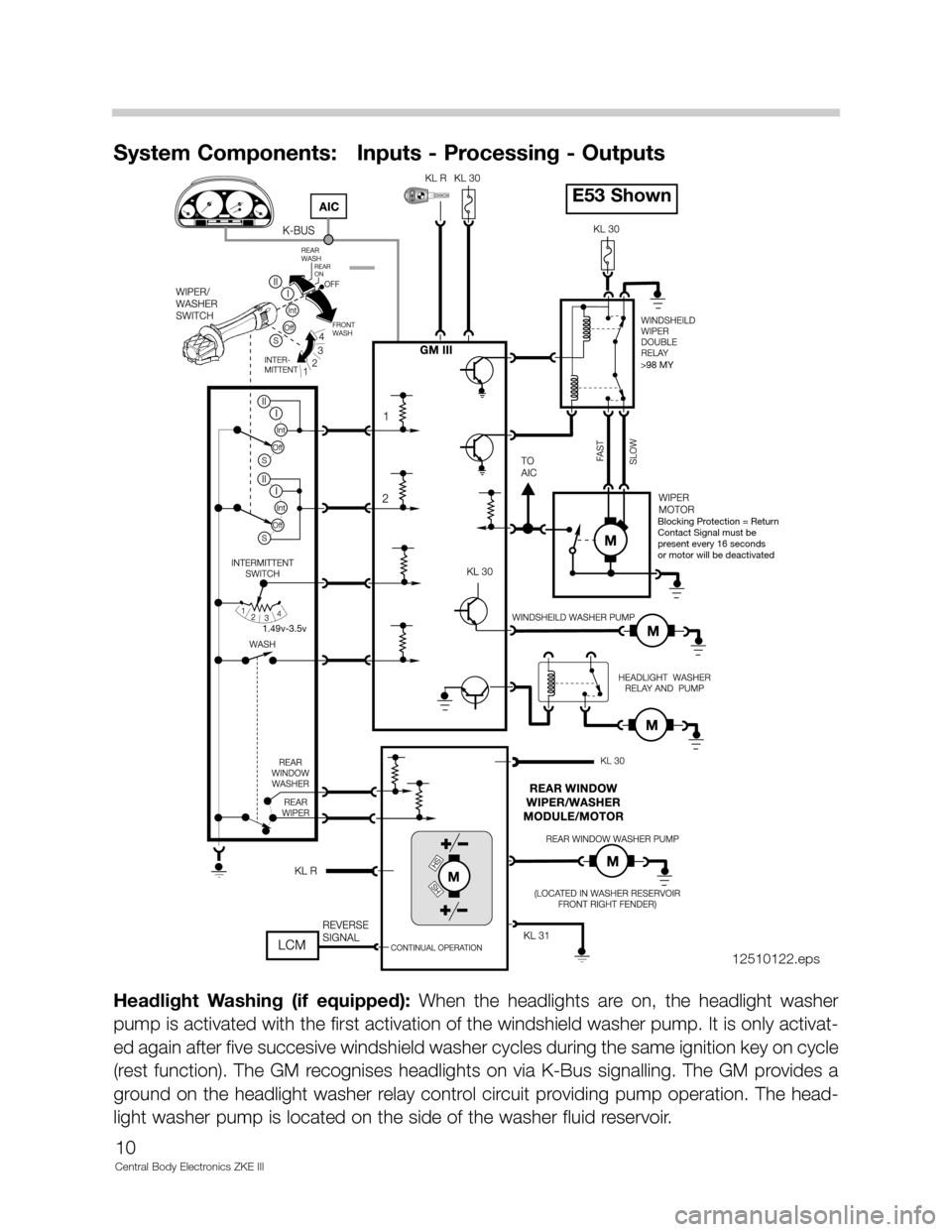
Headlight Washing (if equipped):When the headlights are on, the headlight washer
pump is activated with the first activation of the windshield washer pump. It is only activat-
ed again after five succesive windshield washer cycles during the same ignition key on cycle
(rest function). The GM recognises headlights on via K-Bus signalling. The GM provides a
ground on the headlight washer relay control circuit providing pump operation. The head-
light washer pump is located on the side of the washer fluid reservoir.
System Components: Inputs - Processing - Outputs
12510122.eps
E53 Shown
Page 19 of 80
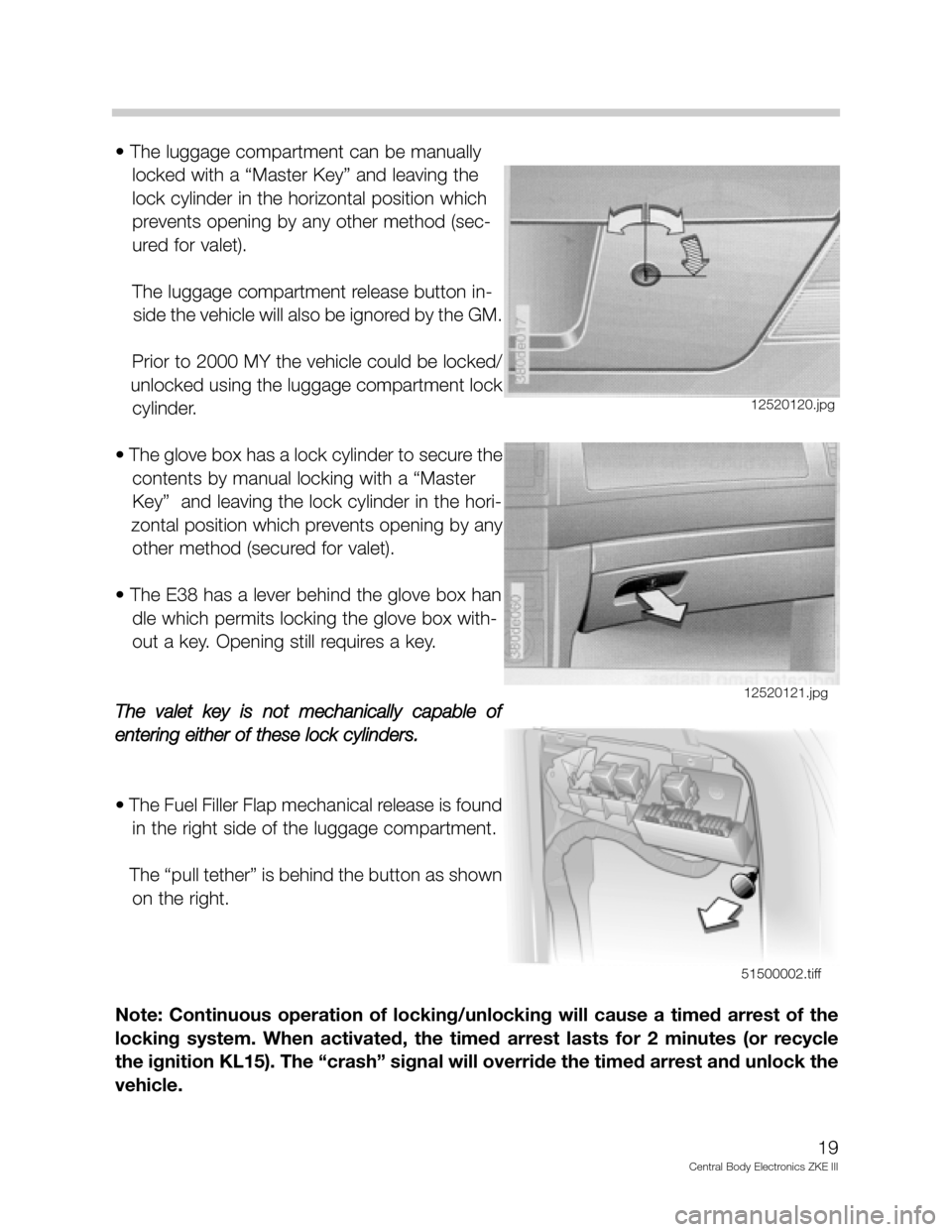
• The luggage compartment can be manually
locked with a “Master Key” and leaving the
lock cylinder in the horizontal position which
prevents opening by any other method (sec-
ured for valet).
The luggage compartment release button in-
side the vehicle will also be ignored by the GM.
Prior to 2000 MY the vehicle could be locked/
unlocked using the luggage compartment lock
cylinder.
• The glove box has a lock cylinder to secure the
contents by manual locking with a “Master
Key” and leaving the lock cylinder in the hori-
zontal position which prevents opening by any
other method (secured for valet).
• The E38 has a lever behind the glove box han
dle which permits locking the glove box with-
out a key. Opening still requires a key.
The valet key is not mechanically capable of
entering either of these lock cylinders.
• The Fuel Filler Flap mechanical release is found
in the right side of the luggage compartment.
The “pull tether” is behind the button as shown
on the right.
Note: Continuous operation of locking/unlocking will cause a timed arrest of the
locking system. When activated, the timed arrest lasts for 2 minutes (or recycle
the ignition KL15). The “crash” signal will override the timed arrest and unlock the
vehicle.
19
Central Body Electronics ZKE III
12520120.jpg
12520121.jpg
51500002.tiff
Page 21 of 80
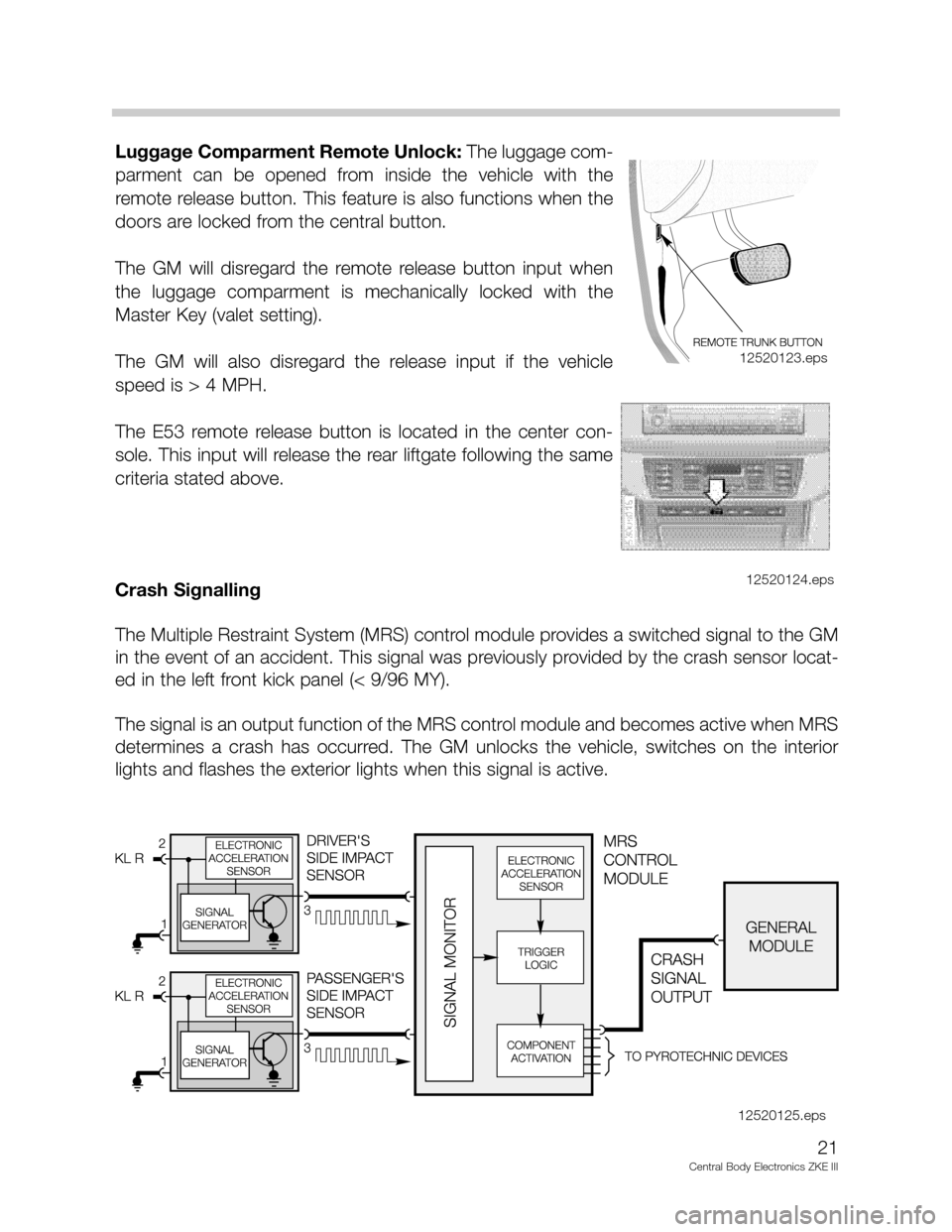
Luggage Comparment Remote Unlock: The luggage com-
parment can be opened from inside the vehicle with the
remote release button. This feature is also functions when the
doors are locked from the central button.
The GM will disregard the remote release button input when
the luggage comparment is mechanically locked with the
Master Key (valet setting).
The GM will also disregard the release input if the vehicle
speed is > 4 MPH.
The E53 remote release button is located in the center con-
sole. This input will release the rear liftgate following the same
criteria stated above.
Crash Signalling
The Multiple Restraint System (MRS) control module provides a switched signal to the GM
in the event of an accident. This signal was previously provided by the crash sensor locat-
ed in the left front kick panel (< 9/96 MY).
The signal is an output function of the MRS control module and becomes active when MRS
determines a crash has occurred. The GM unlocks the vehicle, switches on the interior
lights and flashes the exterior lights when this signal is active.
21
Central Body Electronics ZKE III
12520123.eps
12520124.eps
12520125.eps
Page 24 of 80
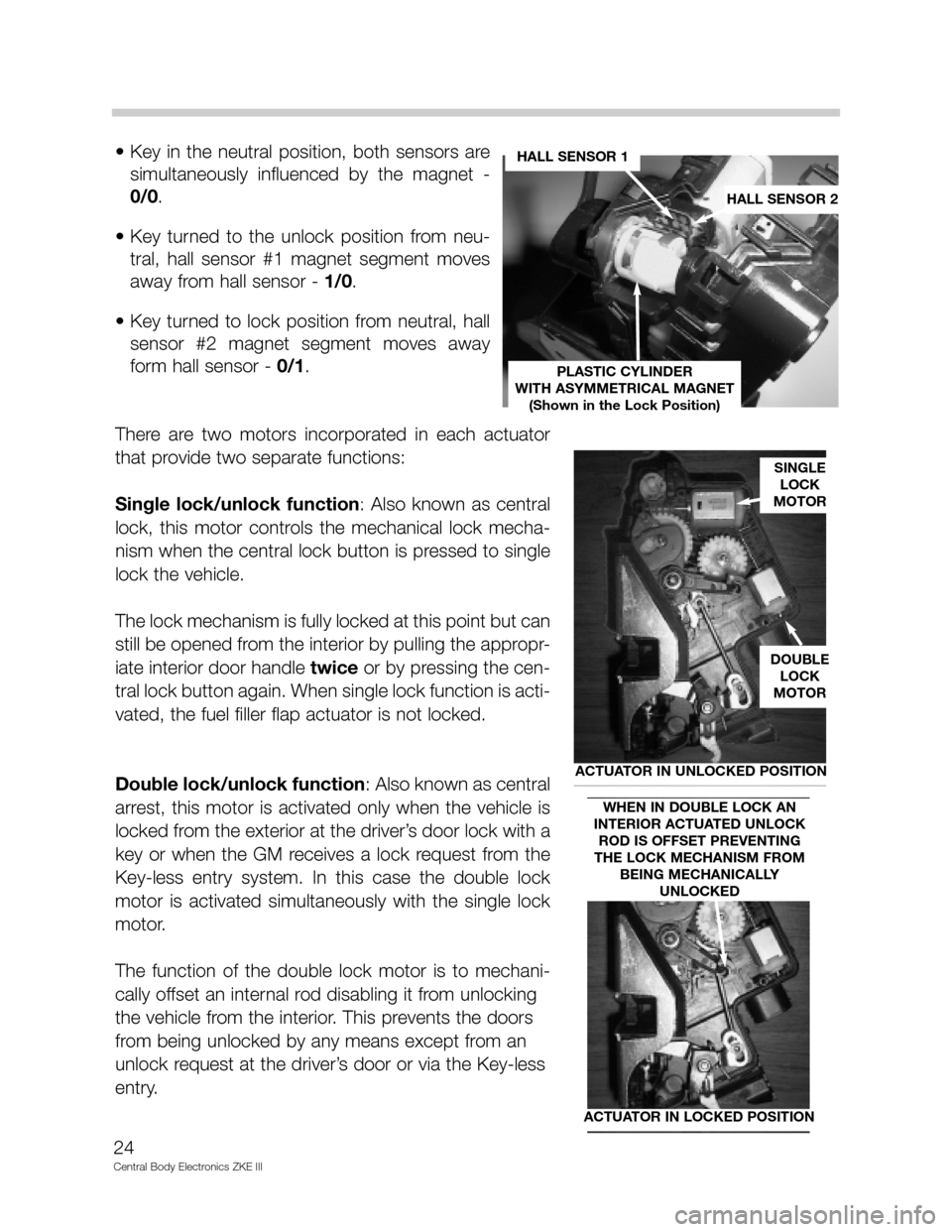
• Key in the neutral position, both sensors are
simultaneously influenced by the magnet -
0/0.
• Key turned to the unlock position from neu-
tral, hall sensor #1 magnet segment moves
away from hall sensor - 1/0.
• Key turned to lock position from neutral, hall
sensor #2 magnet segment moves away
form hall sensor - 0/1.
There are two motors incorporated in each actuator
that provide two separate functions:
Single lock/unlock function: Also known as central
lock, this motor controls the mechanical lock mecha-
nism when the central lock button is pressed to single
lock the vehicle.
The lock mechanism is fully locked at this point but can
still be opened from the interior by pulling the appropr-
iate interior door handle twice or by pressing the cen-
tral lock button again. When single lock function is acti-
vated, the fuel filler flap actuator is not locked.
Double lock/unlock function: Also known as central
arrest, this motor is activated only when the vehicle is
locked from the exterior at the driver’s door lock with a
key or when the GM receives a lock request from the
Key-less entry system. In this case the double lock
motor is activated simultaneously with the single lock
motor.
The function of the double lock motor is to mechani-
cally offset an internal rod disabling it from unlocking
the vehicle from the interior. This prevents the doors
from being unlocked by any means except from an
unlock request at the driver’s door or via the Key-less
entry.
24
Central Body Electronics ZKE III
HALL SENSOR 1
HALL SENSOR 2
PLASTIC CYLINDER
WITH ASYMMETRICAL MAGNET
(Shown in the Lock Position)
SINGLE
LOCK
MOTOR
DOUBLE
LOCK
MOTOR
ACTUATOR IN UNLOCKED POSITION
ACTUATOR IN LOCKED POSITION
WHEN IN DOUBLE LOCK AN
INTERIOR ACTUATED UNLOCK
ROD IS OFFSET PREVENTING
THE LOCK MECHANISM FROM
BEING MECHANICALLY
UNLOCKED
Page 47 of 80
Sunroof
Purpose of the System
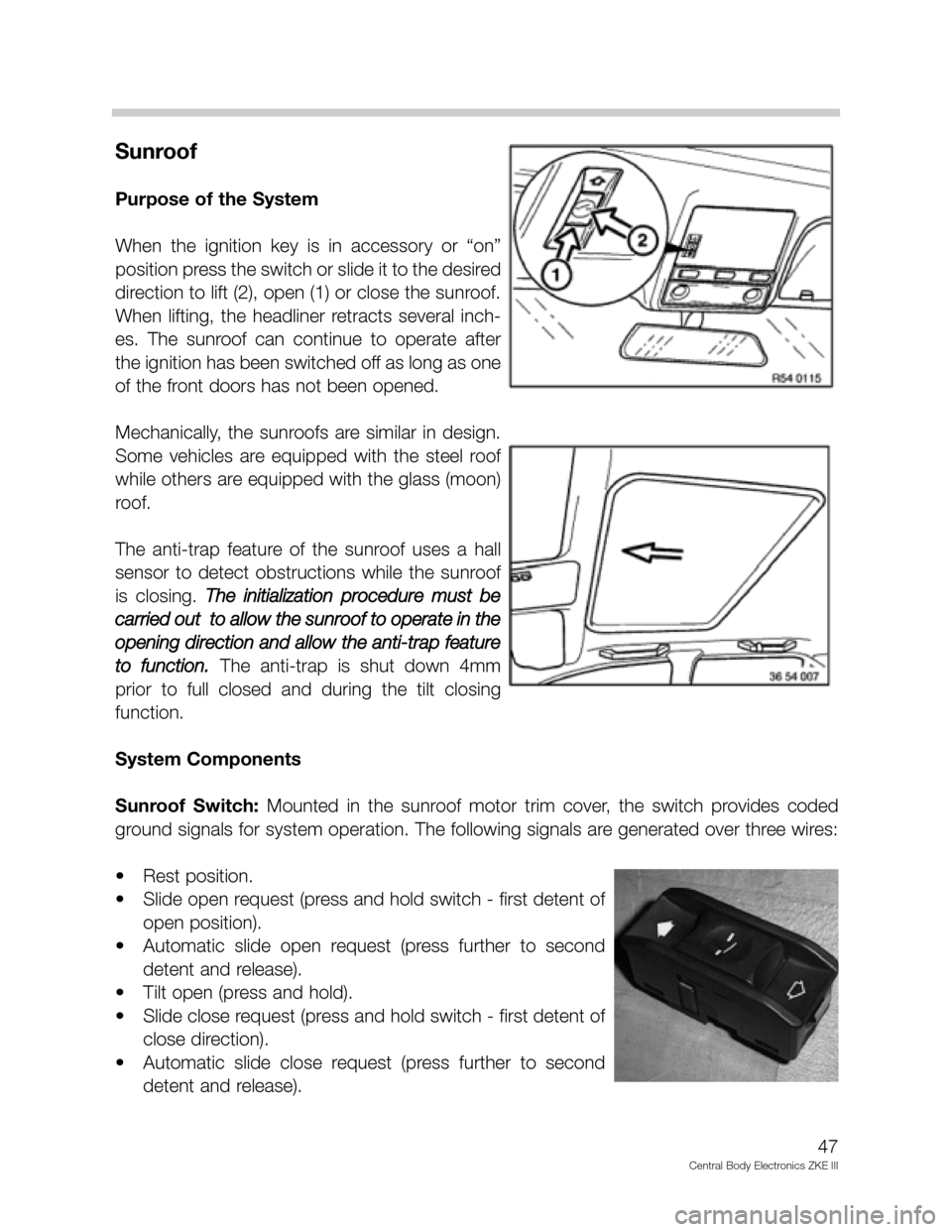
When the ignition key is in accessory or “on”
position press the switch or slide it to the desired
direction to lift (2), open (1) or close the sunroof.
When lifting, the headliner retracts several inch-
es. The sunroof can continue to operate after
the ignition has been switched off as long as one
of the front doors has not been opened.
Mechanically, the sunroofs are similar in design.
Some vehicles are equipped with the steel roof
while others are equipped with the glass (moon)
roof.
The anti-trap feature of the sunroof uses a hall
sensor to detect obstructions while the sunroof
is closing. The initialization procedure must be
carried out to allow the sunroof to operate in the
opening direction and allow the anti-trap feature
to function.
The anti-trap is shut down 4mm
prior to full closed and during the tilt closing
function.
System Components
Sunroof Switch:Mounted in the sunroof motor trim cover, the switch provides coded
ground signals for system operation. The following signals are generated over three wires:
• Rest position.
• Slide open request (press and hold switch - first detent of
open position).
• Automatic slide open request (press further to second
detent and release).
• Tilt open (press and hold).
• Slide close request (press and hold switch - first detent of
close direction).
• Automatic slide close request (press further to second
detent and release).
47
Central Body Electronics ZKE III
Page 65 of 80
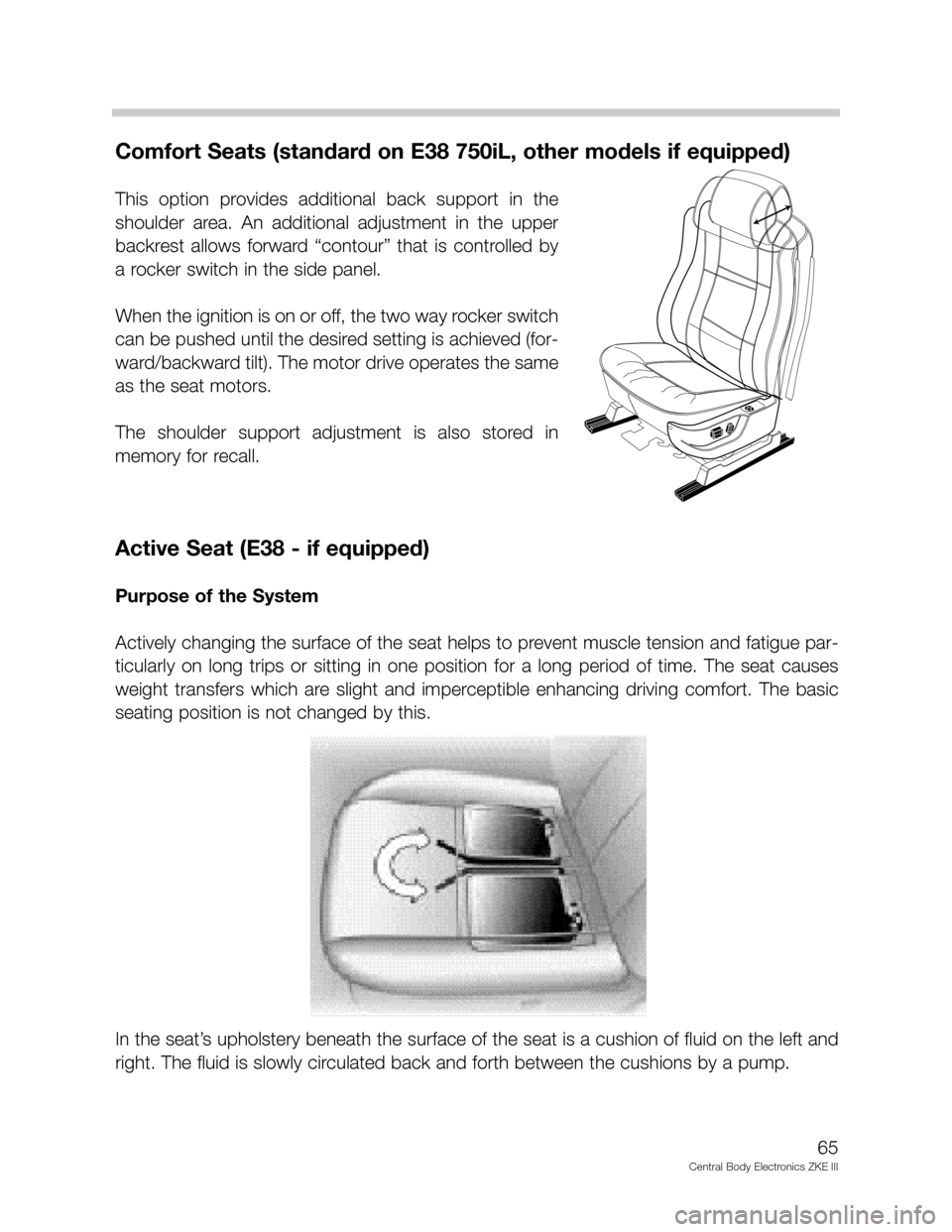
Comfort Seats (standard on E38 750iL, other models if equipped)
This option provides additional back support in the
shoulder area. An additional adjustment in the upper
backrest allows forward “contour” that is controlled by
a rocker switch in the side panel.
When the ignition is on or off, the two way rocker switch
can be pushed until the desired setting is achieved (for-
ward/backward tilt). The motor drive operates the same
as the seat motors.
The shoulder support adjustment is also stored in
memory for recall.
Active Seat (E38 - if equipped)
Purpose of the System
Actively changing the surface of the seat helps to prevent muscle tension and fatigue par-
ticularly on long trips or sitting in one position for a long period of time. The seat causes
weight transfers which are slight and imperceptible enhancing driving comfort. The basic
seating position is not changed by this.
In the seat’s upholstery beneath the surface of the seat is a cushion of fluid on the left and
right. The fluid is slowly circulated back and forth between the cushions by a pump.
65
Central Body Electronics ZKE III
Page 66 of 80
Principle of Operation
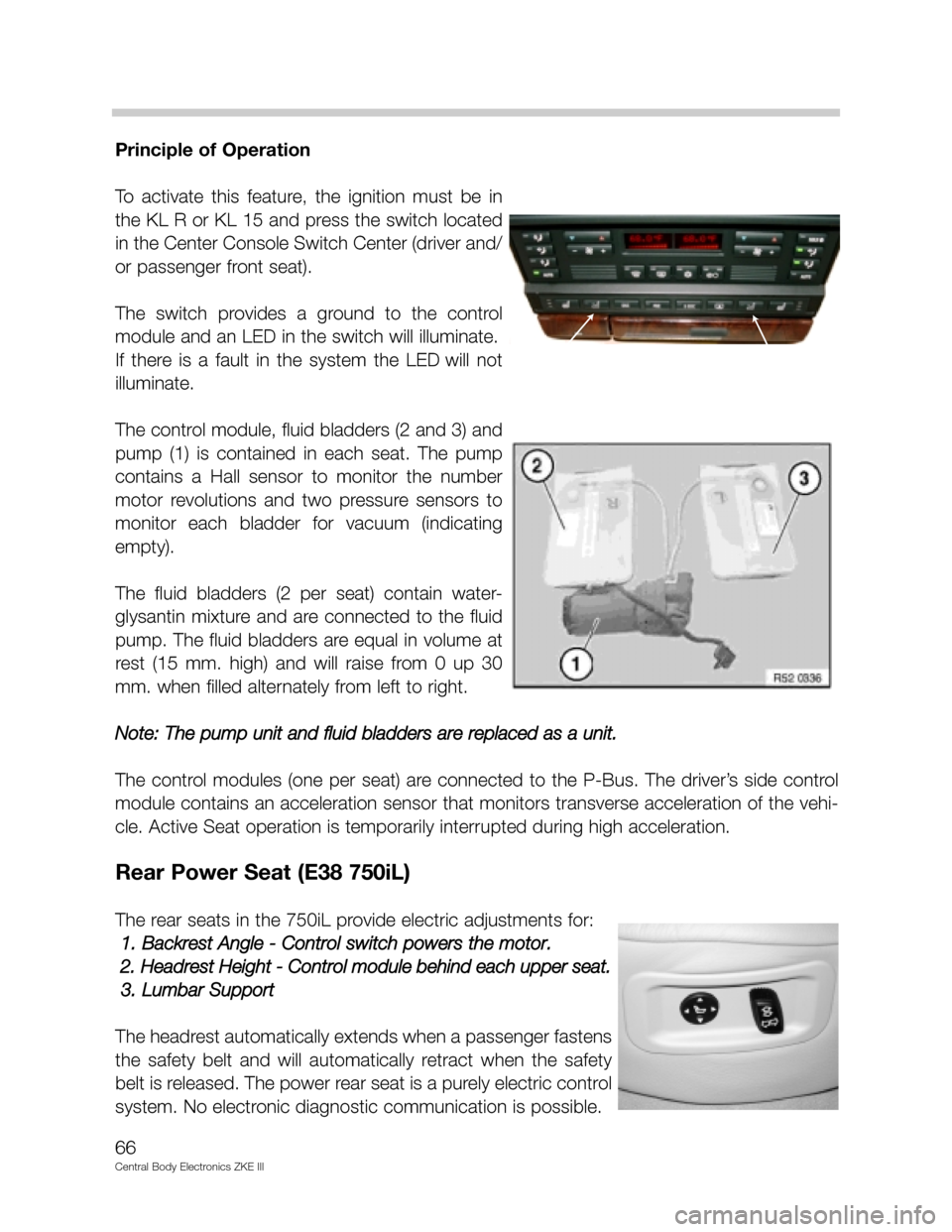
To activate this feature, the ignition must be in
the KL R or KL 15 and press the switch located
in the Center Console Switch Center (driver and/
or passenger front seat).
The switch provides a ground to the control
module and an LED in the switch will illuminate.
If there is a fault in the system the LED will not
illuminate.
The control module, fluid bladders (2 and 3) and
pump (1) is contained in each seat. The pump
contains a Hall sensor to monitor the number
motor revolutions and two pressure sensors to
monitor each bladder for vacuum (indicating
empty).
The fluid bladders (2 per seat) contain water-
glysantin mixture and are connected to the fluid
pump. The fluid bladders are equal in volume at
rest (15 mm. high) and will raise from 0 up 30
mm. when filled alternately from left to right.
Note: The pump unit and fluid bladders are replaced as a unit.
The control modules (one per seat) are connected to the P-Bus. The driver’s side control
module contains an acceleration sensor that monitors transverse acceleration of the vehi-
cle. Active Seat operation is temporarily interrupted during high acceleration.
Rear Power Seat (E38 750iL)
The rear seats in the 750iL provide electric adjustments for:
1. Backrest Angle - Control switch powers the motor.
2. Headrest Height - Control module behind each upper seat.
3. Lumbar Support
The headrest automatically extends when a passenger fastens
the safety belt and will automatically retract when the safety
belt is released. The power rear seat is a purely electric control
system. No electronic diagnostic communication is possible.
66
Central Body Electronics ZKE III
Page 73 of 80
System Components
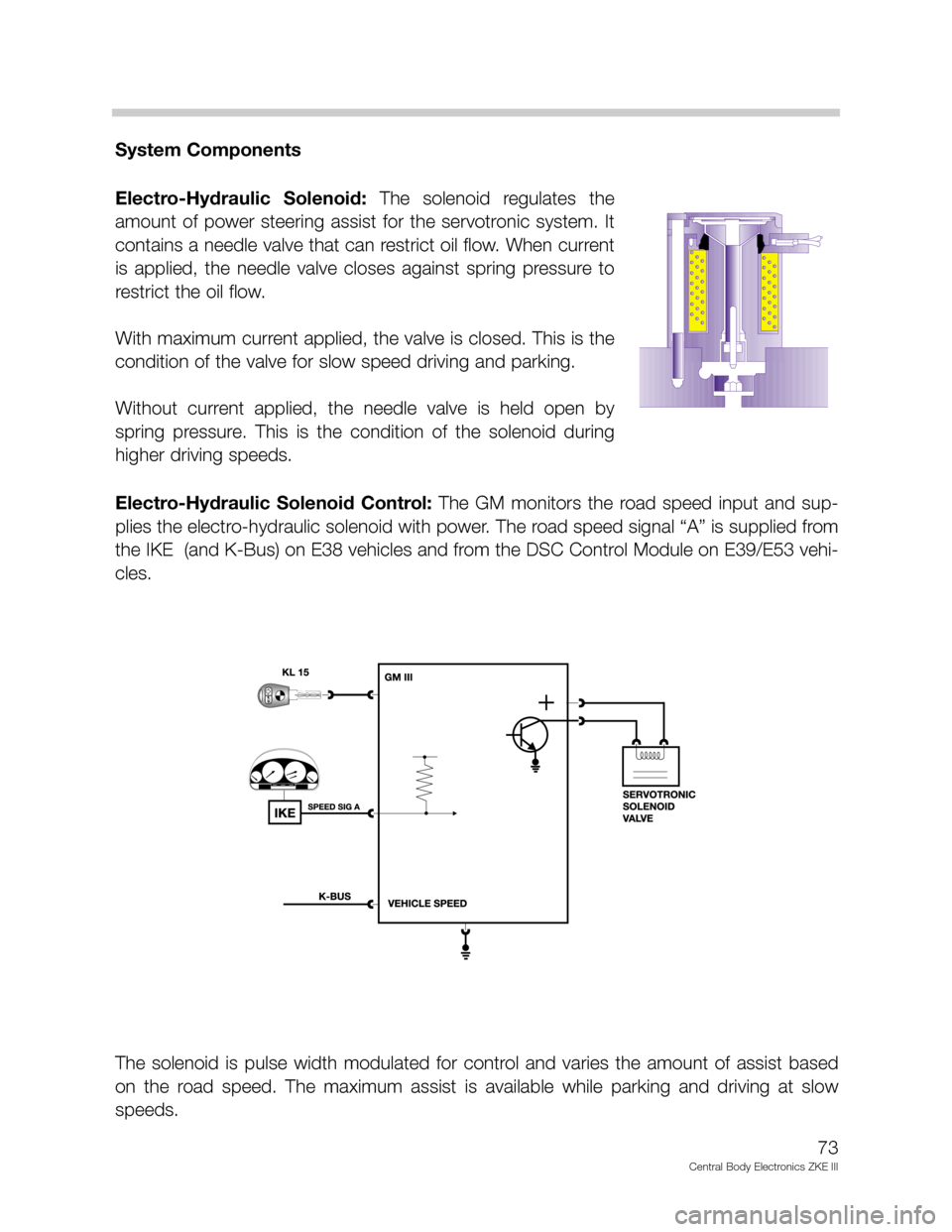
Electro-Hydraulic Solenoid: The solenoid regulates the
amount of power steering assist for the servotronic system. It
contains a needle valve that can restrict oil flow. When current
is applied, the needle valve closes against spring pressure to
restrict the oil flow.
With maximum current applied, the valve is closed. This is the
condition of the valve for slow speed driving and parking.
Without current applied, the needle valve is held open by
spring pressure. This is the condition of the solenoid during
higher driving speeds.
Electro-Hydraulic Solenoid Control: The GM monitors the road speed input and sup-
plies the electro-hydraulic solenoid with power. The road speed signal “A” is supplied from
the IKE (and K-Bus) on E38 vehicles and from the DSC Control Module on E39/E53 vehi-
cles.
The solenoid is pulse width modulated for control and varies the amount of assist based
on the road speed. The maximum assist is available while parking and driving at slow
speeds.
73
Central Body Electronics ZKE III