service indicator BMW 540I SEDAN 2000 Owners Manual
[x] Cancel search | Manufacturer: BMW, Model Year: 2000, Model line: 540I SEDAN, Model: BMW 540I SEDAN 2000Pages: 217, PDF Size: 1.69 MB
Page 10 of 217

Contents
Overview
Controls and features
Cockpit16
Instrument cluster18
Indicator and warning lamps22
Multifunction steering wheel
(MFL)25
Hazard warning flashers27
Warning triangle 27
First-aid kit 27
Refueling28
Fuel specifications29
Tire inflation pressure29
Locks and security systems:
Keys34
Electronic vehicle
immobilizer35
Central locking system36
Opening and closing Ð from the
outside36
With the key 36
Opening and closing Ð from the
inside40
Luggage compartment lid/
Tailgate41
Luggage compartment44
Alarm system45
Electric power windows47
Sliding/Tilt sunroof 48
Adjustments:
Seats 50
Steering wheel 54
Mirrors54
Seat, mirror and steering wheel
memory56
Car Memory, Key Memory58
Passenger safety systems:
Safety belts59
Airbags60
Child restraints 64
Child seat security66
Child-safety locks66
Driving:
Steering/Ignition lock67
Starting the engine68
Switching off the engine69
Parking brake69
Manual transmission70
Automatic transmission 71
Automatic transmission with
Steptronic 74
Indicator/Headlamp flasher77
Wiper/Washer system77
Rear window defroster79
Cruise control80
Everything under control:
Odometer, outside temperature
display82
Tachometer83
Energy control83
Fuel gauge83
Temperature gauge84
Service Interval Display84
Check Control85
Onboard computer88
Technology for safety and
convenience:
Park Distance Control (PDC) 90
Automatic Stability Control plus
Traction (ASC+T)/Dynamic
Stability Control (DSC) 91
Tire Pressure Control (RDC) 92
Page 15 of 217
Overview
Controls and features
Operation, care
and maintenance
Owner service procedures
Technical data
Index Advanced technology
15n
RepairsIndexOverview Controls Car care Technology Data
Cockpit16
Instrument cluster18
Indicator and warning lamps22
Multifunction steering wheel
(MFL) 25
Hazard warning flashersHazard
warning flashers27
Warning triangle 27
First-aid kit 27
Refueling28
Fuel specifications29
Tire inflation pressure29
Page 19 of 217
19n
RepairsIndexOverview Controls Car care Technology Data
Instrument cluster
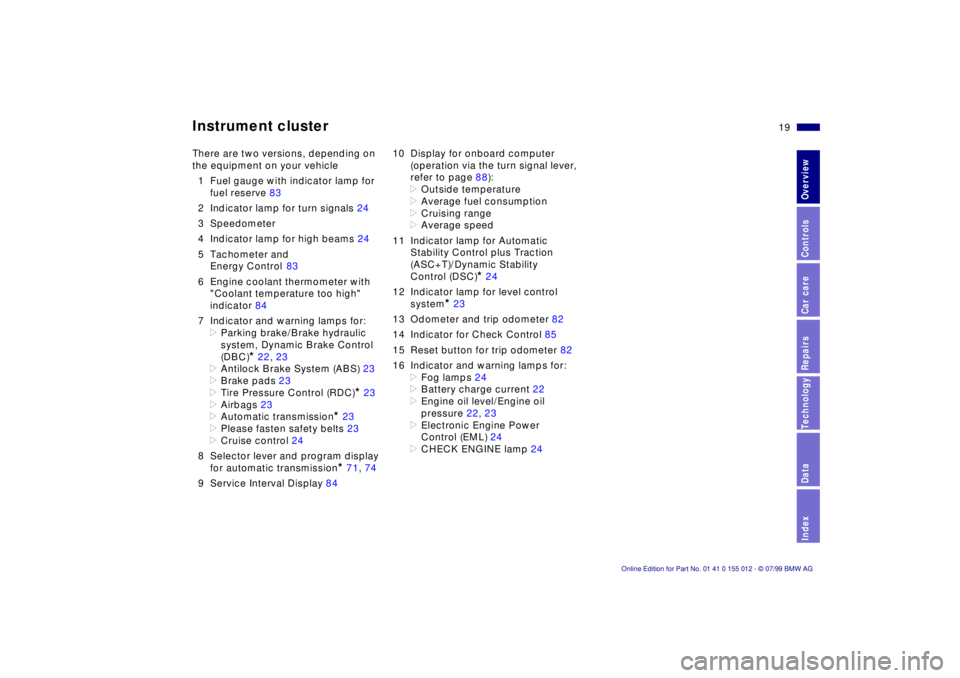
There are two versions, depending on
the equipment on your vehicle
1 Fuel gauge with indicator lamp for
fuel reserve 83
2 Indicator lamp for turn signals 24
3 Speedometer
4 Indicator lamp for high beams 24
5 Tachometer and
Energy Control 83
6 Engine coolant thermometer with
"Coolant temperature too high"
indicator 84
7 Indicator and warning lamps for:
>
Parking brake/Brake hydraulic
system, Dynamic Brake Control
(DBC)
*
22, 23
>
Antilock Brake System (ABS) 23
>
Brake pads 23
>
Tire Pressure Control (RDC)
*
23
>
Airbags 23
>
Automatic transmission
*
23
>
Please fasten safety belts 23
>
Cruise control 24
8 Selector lever and program display
for automatic transmission
*
71, 74
9 Service Interval Display 8410 Display for onboard computer
(operation via the turn signal lever,
refer to page 88):
>
Outside temperature
>
Average fuel consumption
>
Cruising range
>
Average speed
11 Indicator lamp for Automatic
Stability Control plus Traction
(ASC+T)/Dynamic Stability
Control (DSC)
*
24
12 Indicator lamp for level control
system
*
23
13 Odometer and trip odometer 82
14 Indicator for Check Control 85
15 Reset button for trip odometer 82
16 Indicator and warning lamps for:
>
Fog lamps 24
>
Battery charge current 22
>
Engine oil level/Engine oil
pressure 22, 23
>
Electronic Engine Power
Control (EML) 24
>
CHECK ENGINE lamp 24
Page 21 of 217
21n
RepairsIndexOverview Controls Car care Technology Data
Instrument cluster
*
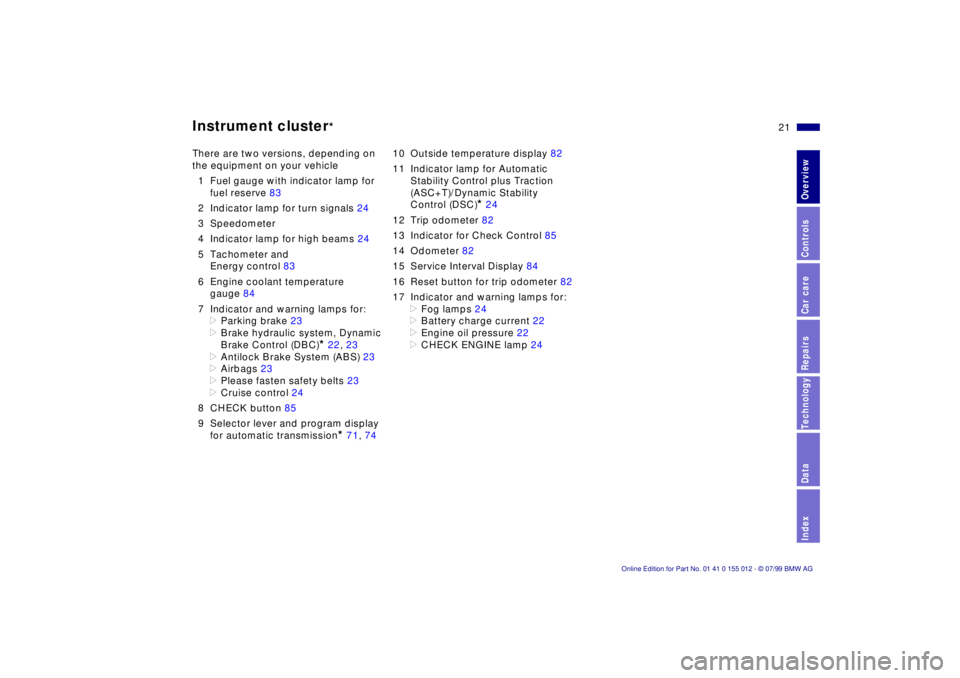
There are two versions, depending on
the equipment on your vehicle
1 Fuel gauge with indicator lamp for
fuel reserve 83
2 Indicator lamp for turn signals 24
3 Speedometer
4 Indicator lamp for high beams 24
5 Tachometer and
Energy control 83
6 Engine coolant temperature
gauge 84
7 Indicator and warning lamps for:
>
Parking brake 23
>
Brake hydraulic system, Dynamic
Brake Control (DBC)
*
22, 23
>
Antilock Brake System (ABS) 23
>
Airbags 23
>
Please fasten safety belts 23
>
Cruise control 24
8 CHECK button 85
9 Selector lever and program display
for automatic transmission
*
71, 7410 Outside temperature display 82
11 Indicator lamp for Automatic
Stability Control plus Traction
(ASC+T)/Dynamic Stability
Control (DSC)
*
24
12 Trip odometer 82
13 Indicator for Check Control 85
14 Odometer 82
15 Service Interval Display 84
16 Reset button for trip odometer 82
17 Indicator and warning lamps for:
>
Fog lamps 24
>
Battery charge current 22
>
Engine oil pressure 22
>
CHECK ENGINE lamp 24
Page 32 of 217
32n
Locks and security systems:
Keys34
Electronic vehicle
immobilizer35
Central locking system36
Opening and closing
Ð from the outside36
With the key36
Opening and closing
Ð from the inside40
Luggage compartment lid/
Tailgate41
Luggage compartment44
Alarm system45
Electric power windows47
Sliding/Tilt sunroof48
Adjustments:
Seats50
Steering wheel54
Mirrors54
Seat, mirror and steering wheel
memory56
Car Memory, Key Memory58
Passenger safety systems:
Safety belts59
Airbags60
Child restraints64
Child seat security66
Child-safety locks66Driving:
Steering/Ignition lock67
Starting the engine68
Switching off the engine69
Parking brake69
Manual transmission70
Automatic transmission71
Automatic transmission with
Steptronic74
Indicator/Headlamp flasher77
Wiper/Washer system77
Rear window defroster79
Cruise control80
Everything under control:
Odometer, outside temperature
display82
Tachometer83
Energy control83
Fuel gauge83
Temperature gauge84
Service Interval Display84
Check Control85
Onboard computer88
Technology for safety and
convenience:
Park Distance Control (PDC)90
Automatic Stability Control plus
Traction (ASC+T)/Dynamic
Stability Control (DSC)91
Tire Pressure Control (RDC)92
Page 134 of 217
134n
Information for your safety The factory-approved radial tires are
matched to the car and have been se-
lected to provide optimum safety and
driving comfort on your car.
It is not merely the tire's service life, but
also driving comfort and Ð above all else
Ð driving safety which depend on the
condition of the tires and the mainte-
nance of the specified tire pressure.
Incorrect inflation pressure is a frequent
cause of tire damage. It also signifi-
cantly influences the roadholding ability
of your BMW.
Check tire inflation pressures Ð in-
cluding the spare tire Ð regularly,
at least every two weeks and before be-
ginning a longer trip. If this is not done,
incorrect tire pressures can cause driv-
ing instability and tire damage, ulti-
mately resulting in accidents.<
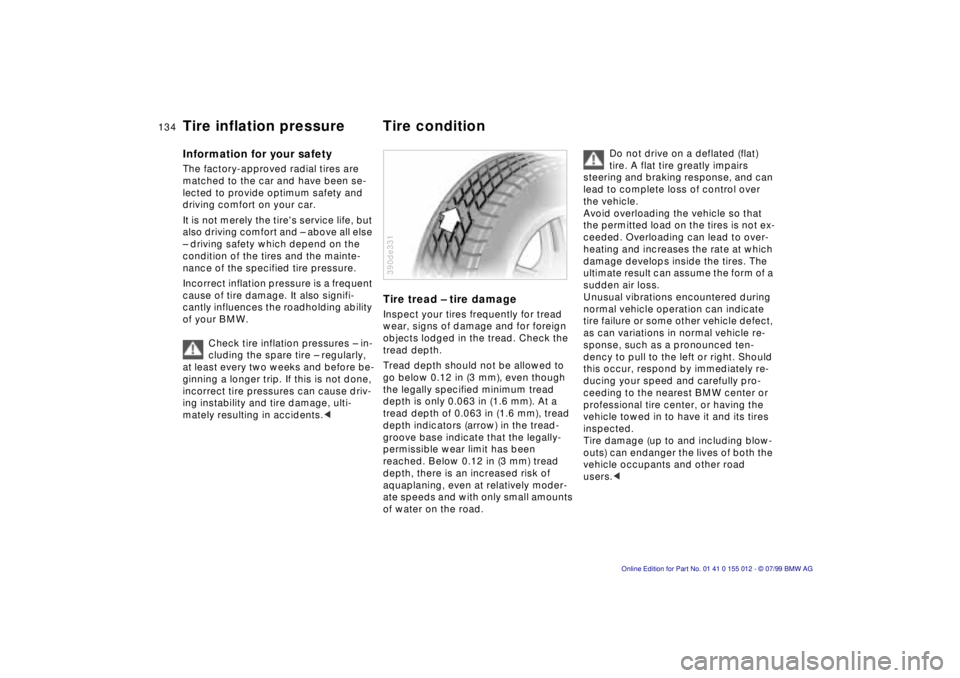
Tire tread Ð tire damageInspect your tires frequently for tread
wear, signs of damage and for foreign
objects lodged in the tread. Check the
tread depth.
Tread depth should not be allowed to
go below 0.12 in (3 mm), even though
the legally specified minimum tread
depth is only 0.063 in (1.6 mm). At a
tread depth of 0.063 in (1.6 mm), tread
depth indicators (arrow) in the tread-
groove base indicate that the legally-
permissible wear limit has been
reached. Below 0.12 in (3 mm) tread
depth, there is an increased risk of
aquaplaning, even at relatively moder-
ate speeds and with only small amounts
of water on the road.390de331
Do not drive on a deflated (flat)
tire. A flat tire greatly impairs
steering and braking response, and can
lead to complete loss of control over
the vehicle.
Avoid overloading the vehicle so that
the permitted load on the tires is not ex-
ceeded. Overloading can lead to over-
heating and increases the rate at which
damage develops inside the tires. The
ultimate result can assume the form of a
sudden air loss.
Unusual vibrations encountered during
normal vehicle operation can indicate
tire failure or some other vehicle defect,
as can variations in normal vehicle re-
sponse, such as a pronounced ten-
dency to pull to the left or right. Should
this occur, respond by immediately re-
ducing your speed and carefully pro-
ceeding to the nearest BMW center or
professional tire center, or having the
vehicle towed in to have it and its tires
inspected.
Tire damage (up to and including blow-
outs) can endanger the lives of both the
vehicle occupants and other road
users.<
Tire inflation pressure Tire condition
Page 152 of 217
152n
Coolant Brake fluidAdding coolantWait until the engine cools before re-
moving the cap from the expansion
tank. The needle of the coolant gauge
in the instrument cluster must be lo-
cated in the blue zone; otherwise, there
is a danger of scalding.
1 Start by turning the cap counter-
clockwise. Pause to allow any
accumulated pressure to escape,
then open.
2 If the coolant is low, slowly add
coolant until the correct level is
reached Ð do not overfill.
The coolant is a mixture of water and
extended-duty antifreeze with corrosion
inhibitor. Always maintain the pre-
scribed all-season 50:50 mixture ratio
for year-round protection against inter-
nal corrosion. No other additives are re-
quired.
Replace the coolant every four years.If the indicator lamp for the
brake hydraulic system appears
or if the "CHECK BRAKE FLUID"
warning appears in the Check
Control: The brake fluid level is
too low in the reservoir.
The brake fluid reservoir is located
under the microfilter housing on the
driver's side of the car. Should you de-
termine that the brake fluid is low, refer
the problem to your BMW center, who
can trace and rectify any sources of
leakage when refilling the reservoir.
Your BMW center is familiar with the
specifications for approved brake fluids
(DOT 4).
Brake fluid loss results in extended
pedal travel. For this situation, refer to
the notes on page 130.
Brake fluid is hygroscopic, that is,
it absorbs moisture from the air
over time.
In order to ensure the safety and
reliability of the brake system, have the
brake fluid changed every two years by
an authorized BMW center. Refer also
to the Service and Warranty Information
Booklet (US models) or to the Warranty
and Service Guide Booklet (Canadian
models).
Brake fluid is toxic and damages the
vehicle's paint. You should always store
it in its original container and in a loca-
tion which is out of reach of children.
Do not spill the fluid and do not fill the
brake fluid reservoir beyond the "MAX"
mark. The brake fluid could ignite upon
contact with hot engine parts and cause
serious burns.<
Comply with the applicable
environmental laws regulating the
disposal of brake fluid.<
Page 162 of 217
162n
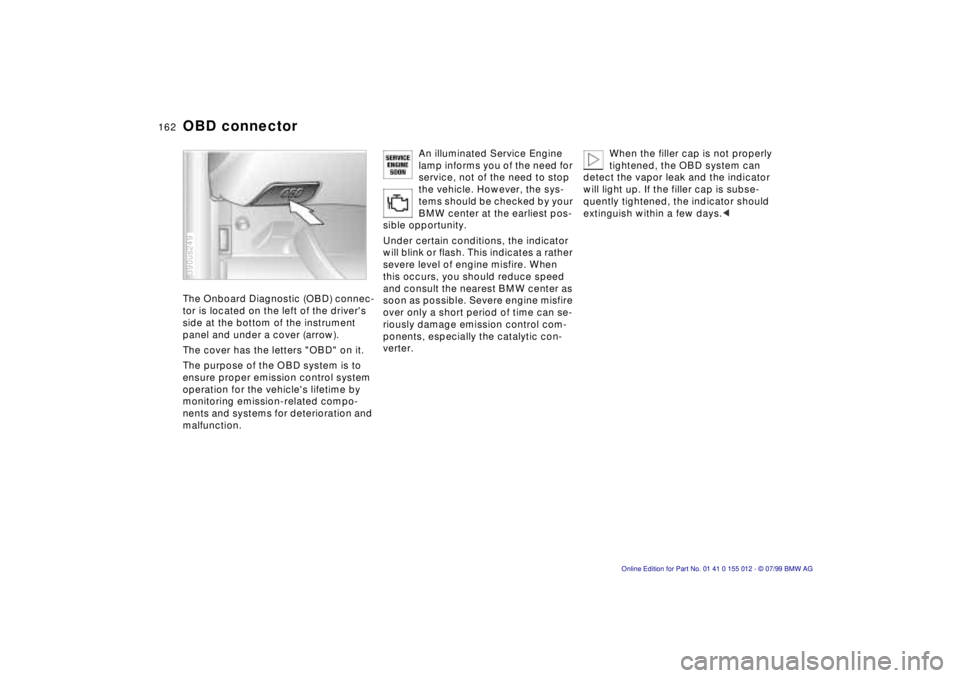
OBD connectorThe Onboard Diagnostic (OBD) connec-
tor is located on the left of the driver's
side at the bottom of the instrument
panel and under a cover (arrow).
The cover has the letters "OBD" on it.
The purpose of the OBD system is to
ensure proper emission control system
operation for the vehicle's lifetime by
monitoring emission-related compo-
nents and systems for deterioration and
malfunction.390us249
An illuminated Service Engine
lamp informs you of the need for
service, not of the need to stop
the vehicle. However, the sys-
tems should be checked by your
BMW center at the earliest pos-
sible opportunity.
Under certain conditions, the indicator
will blink or flash. This indicates a rather
severe level of engine misfire. When
this occurs, you should reduce speed
and consult the nearest BMW center as
soon as possible. Severe engine misfire
over only a short period of time can se-
riously damage emission control com-
ponents, especially the catalytic con-
verter.
When the filler cap is not properly
tightened, the OBD system can
detect the vapor leak and the indicator
will light up. If the filler cap is subse-
quently tightened, the indicator should
extinguish within a few days.<
Page 211 of 217
211n
RepairsIndexOverview Controls Car care Technology Data
Everything from A to Z
Manual operation
Doors36
Fuel filler door180
Luggage compartment lid/
Tailgate41, 181
Sliding/Tilt sunroof180
Manual transmission70
Manually controlled
recirculated-air101
Master key34
Mechanical seat52
Memory56
MFL (M Multifunction
steering wheel)26
MFL (Multifunction steering
wheel)25
Microfilter103
Mirror54
Mirror heating55
Mirror memory56
Mobile communications
systems, refer to the
separate Owner's Manual
Mobile phones133
Modifications,
technical6, 161
Multifunction steering wheel
(MFL)25
N
Navigation System, refer to
the separate Owner's
Manual
Nonsmoker equipment110
Nozzles98
O
OBD connector162
Odometer82
Oil
Additives149
Consumption149
Grades150
Oil change interval, see the
Service and Warranty
Information Booklet (US
models) or Warranty and
Service Guide Booklet
(Canadian models)
Oil dipstick149
Oil level, indicator lamp23
Oil quantity, engine203
OILSERVICE84
Old batteries177
Onboard computer88
Average fuel
consumption88
Average speed88
Cruising range88
Outside temperature88
Onboard tool kit166Open luggage compartment
lid/tailgate from
interior41
Opening and closing
From the inside38
From the outside36
Operating range88
Outside temperature88
Outside temperature
display82
P
Paint blemishes156
Paint, care156
Paintwork, minor
repairs157
Paintwork, waxing157
Park Distance Control
(PDC)90
Parking brake23, 69
Parking help90
Parking lamps95
Bulb replacement168
Parking, Winter132
PDC (Park Distance
Control)90
Playing cassettes
Refer to the Radio Owner's
Manual
Playing CDs
Refer to the Radio Owner's
Manual
Pocket light108Pollen filter103
Power output198
Power steering132
Power windows47
Safety switch48
Power-slip control
Refer to ASC+T/DSC91
Pressure, tire30, 134
Monitoring92, 194
R
Radio reception133, 190
Radio, refer to the separate
Owner's Manual
Radios133
Rain sensor155
RDC (Tire Pressure
Control)92, 194
Reading lamps96
Rear view mirror54
Rear window blind104
Rear window
defrosting79, 102
Rear window wiper79
Rear-seat backrest,
removable112
Recirculated-air control101
Reclining seat50
Refueling28
Remote control37
Removable rear-seat
backrest112
Page 214 of 217

A
Add
Antifreeze152
Brake fluid152
Coolant152
Engine coolant152
Engine oil149
Fluid, power steering152
Washer fluids148
Adjust washer nozzles148
Avoid false alarms46
B
Backup lamps, bulb
replacement169
Battery176
Charge condition177
Discharged182
Removing and
installing178
Brake lamps, bulb
replacement170
Brakes, brake faults130
Bulb replacement167
C
Car jack173
Changing tires173
Charging the battery178
Check Control85
Check engine oil level149
Check tire pressures29
Courtesy lamp, bulb
replacement172
D
Deactivating the interior
motion sensor38
Deactivating the tilt sensor
alarm system38, 46
Defrost windshields101
Difficult steering132
Doors
Manual operation36
E
Electrical defect
Fuel filler door180
Sliding/Tilt sunroof180
Emergency operation
Doors36
Fuel filler door180
Sliding/Tilt sunroof180
Tailgate181
Engine oil
specifications150
F
Failure messages85
Filling the washer
reservoir148
First-aid kit27
Fittings, tow-starting and
towing183
Flat tire173Fog lamp, replace the
bulb169
Footwell lamps, bulb
replacement172
Fuel filler door release after
electrical fault180
Fuses179
G
Glove compartment lamp,
bulb replacement172
H
Hazard warning flashers27
Hazard warning triangle27
Headlamp covers,
care155, 167
Help with jump starting182
High beams, bulb
replacement167
Hood release143
I
Indicator lamps22
Bulb replacement169
J
Jack173
Jump starting182
L
Level control system,
inactive132
License plate lamp, bulb
replacement171
Low beams, bulb
replacement167
Lug wrench174
Luggage compartment
lamps, bulb
replacement172
Luggage compartment lid/
Tailgate, unlock in case of
electrical fault41
M
Maintenance84, 154
Malfunction displays85
Manual operation
Doors36
Fuel filler door180
Sliding/Tilt sunroof180
Tailgate181
O
Oil specifications150
Onboard tool kit166
Owner service procedures