towing BMW 540I SEDAN 2000 Owners Manual
[x] Cancel search | Manufacturer: BMW, Model Year: 2000, Model line: 540I SEDAN, Model: BMW 540I SEDAN 2000Pages: 217, PDF Size: 1.69 MB
Page 12 of 217

Contents
Operation, care and maintenance
Owner service procedures
Advanced technology
Under the hood:
Hood143
Engine compartment 144
Washer fluids148
Washer nozzles148
Engine oil149
Coolant151
Brake fluid152
Vehicle Identification
Number153
Care and maintenance:
The BMW Maintenance
System154
Caring for your car155
Airbags160
Vehicle storage160
Laws and regulations:
Technical modifications161
OBD connector162
Replacement procedures:
Onboard tool kit166
Wiper blades166
Lamps and bulbs167
Changing tires173
Battery176
Fuses178
In case of electrical
malfunction:
Fuel filler door180
Sliding/Tilt sunroof180
Tailgate181
Assistance, giving and
receiving:
Jump-starting182
Towing the vehicle183Airbags188
Adaptive Transmission Control
(ATC) 188
Automatic Stability Control plus
Traction (ASC+T)/Dynamic
Stability Control (DSC) 189
Radio reception190
BMW active seat 190
Safety belt tensioner191
DSP sound system 192
Interior rearview mirror with
automatic dimmer 192
Rain sensor 193
Tire Pressure Control (RDC) 194
Integrated rear suspension194
Level control system 195
Xenon lamps 195
Page 73 of 217
73n
RepairsIndexOverview Controls Car care Technology Data
Automatic transmission
*
Electronic transmission control
module
If the indicator lamp comes on
or if the message "TRANS.
FAILSAFE PROG" appears in
the Check Control
*, there is a malfunc-
tion in the transmission system.
Bring the vehicle to a stop, select the
"Park" position, apply the parking brake
and shut the engine off (ignition key po-
sition 0). Restart the engine after a few
seconds. If the indicator lamp goes out
again after a few seconds, the normal
transmission functions have been re-
stored. You may continue to drive as
usual.
If the indicator lamp does not go out,
you can place the selector lever in all
positions. However, the vehicle will now
only drive forward with limited gear
selection.
Under these circumstances, avoid ex-
treme engine loads and consult the
nearest authorized BMW center.
Do not work in the engine com-
partment when a drive gear (for-
ward or reverse) is engaged. If you do
this, the vehicle could move.<
For jump-starting, towing and tow-
starting, refer to pages 182 and 183.
Page 76 of 217
76n
Automatic transmission with Steptronic
*
Upshifts or downshifts will be carried
out by the ATC only at appropriate en-
gine speeds and road speeds. For in-
stance, if engine speed is too high, a
downshift will not be executed. The
gear selected will appear briefly in the
instrument cluster followed by the cur-
rent gear.
If you are driving in the manual
mode and wish to accelerate rap-
idly from low road speeds (when pass-
ing, for instance), you must shift down
manually or with the kickdown func-
tion.<
You can only change from "M/S" to se-
lector lever positions "P,""R," and "N"
via the "D" position.
In the following situations, the Step-
tronic "thinks" for you in the manual
mode:
>In order to prevent engine over-
speeding, the transmission shifts au-
tomatically to the next higher gear
shortly before the RPM cutoff point
>At low speeds, the transmission shifts
down automatically Ð you do not have
to act
>In the kickdown mode, the transmis-
sion shifts down to the lowest gear
which is possible, depending on the
engine speed
>According to the situation, for
instance in wintry conditions, the
vehicle can be started in 2nd or
3rd gear.Electronic transmission control
module
If the indicator lamp comes on
or the message "TRANS.FAIL-
SAFE PROG" appears in the
Check Control
*, there is a fault in the
transmission system.
Bring the vehicle to a stop. Move the
transmission selector lever to "P." Set
the parking brake and turn the engine
off (ignition key to position 0).
Wait a few seconds, then start the
engine.
If the indicator lamp goes out after a
few seconds, normal transmission per-
formance has been restored. You may
continue to drive as usual. If the indica-
tor lamp does not go out, you can place
the selector lever in all positions. How-
ever, the vehicle will now only drive for-
ward with limited gear selection.
If this happens, avoid extreme engine
loads and consult the nearest autho-
rized BMW center.
Do not work in the engine com-
partment when a drive gear (for-
ward or reverse) is engaged. If you do
this, the vehicle could move.<
For jump-starting, towing and tow-
starting, refer to pages 182 and 183.
Page 120 of 217
120n
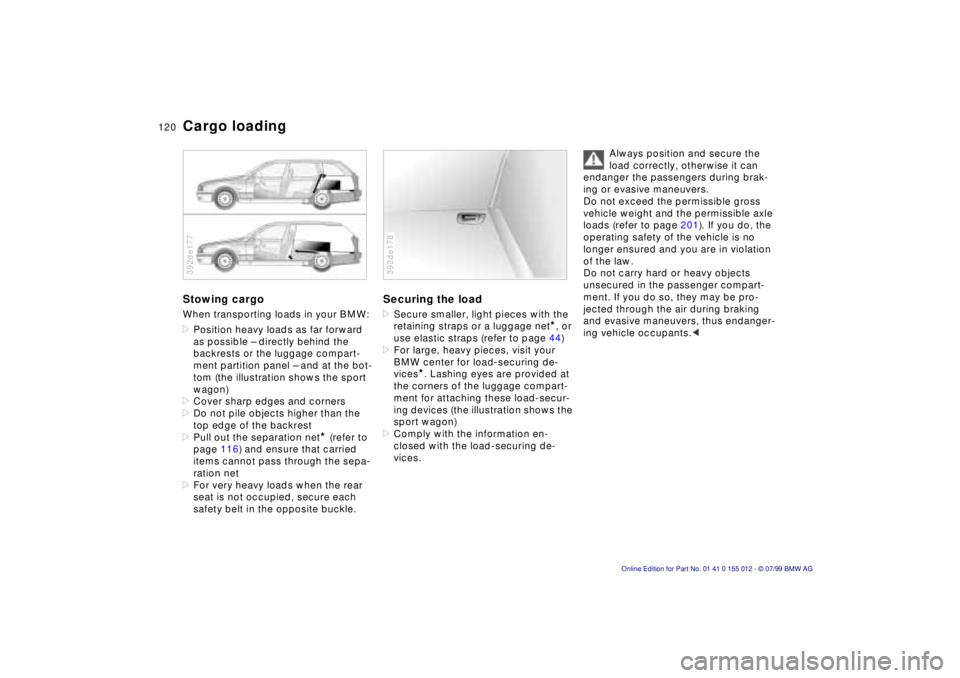
Cargo loading Stowing cargoWhen transporting loads in your BMW:
>Position heavy loads as far forward
as possible Ð directly behind the
backrests or the luggage compart-
ment partition panel Ð and at the bot-
tom (the illustration shows the sport
wagon)
>Cover sharp edges and corners
>Do not pile objects higher than the
top edge of the backrest
>Pull out the separation net
* (refer to
page 116) and ensure that carried
items cannot pass through the sepa-
ration net
>For very heavy loads when the rear
seat is not occupied, secure each
safety belt in the opposite buckle.
392de177
Securing the load >Secure smaller, light pieces with the
retaining straps or a luggage net
*, or
use elastic straps (refer to page 44)
>For large, heavy pieces, visit your
BMW center for load-securing de-
vices
*. Lashing eyes are provided at
the corners of the luggage compart-
ment for attaching these load-secur-
ing devices (the illustration shows the
sport wagon)
>Comply with the information en-
closed with the load-securing de-
vices.
392de178
Always position and secure the
load correctly, otherwise it can
endanger the passengers during brak-
ing or evasive maneuvers.
Do not exceed the permissible gross
vehicle weight and the permissible axle
loads (refer to page 201). If you do, the
operating safety of the vehicle is no
longer ensured and you are in violation
of the law.
Do not carry hard or heavy objects
unsecured in the passenger compart-
ment. If you do so, they may be pro-
jected through the air during braking
and evasive maneuvers, thus endanger-
ing vehicle occupants.<
Page 124 of 217

124n
Break-in procedureTo ensure that your vehicle provides
maximum economy throughout a long
service life, we request that you ob-
serve the following:Engine and differentialUp to 1,200 miles (2,000 km):
Drive at varying engine speeds and road
speeds, but do not exceed 4,500 rpm
and the following road speeds during
this initial period:
BMW 528i: 100 mph (160 km/h)
BMW 540i: 106 mph (170 km/h)
Obey your local and state maximum
speed limits.
Refrain from using full throttle and avoid
pressing the accelerator beyond the
kickdown point.
Once you have driven 1,200 miles
(2,000 km), engine and vehicle speeds
can gradually be increased.
You should also comply with these
break-in procedures if the engine or dif-
ferential is replaced later in the course
of the vehicle service life.
TiresDue to technical factors associated
with their manufacture, tires do not
achieve their full traction potential until
an initial break-in period has elapsed
for this reason, drive with extra care
during the initial 200 miles (300 km).
Obey your local and state maximum
speed limits.
When the vehicle is operated on
wet or slushy roads, a wedge of
water may form between the tire and
the road surface. This phenomenon is
referred to as aquaplaning, or hydro-
planing, and can lead to partial or com-
plete loss of traction, vehicle control
and braking effectiveness. Reduce your
speed on wet roads.<
Brake systemApproximately 300 miles (500 km) must
elapse before the brake pads and rotors
achieve the optimal pad-surface and
wear patterns required for trouble-free
operation and long service life later on.
To break in the separate parking brake
drums, apply the parking brake lightly
when coasting to a standstill (at a traffic
signal, for instance), provided that traf-
fic conditions allow you to do so. To
avoid corrosion, repeat this procedure
from time to time.
The brake lamps do not come on
when the parking brake is applied.
Vacuum for the brake system servo unit
on your BMW is available only when the
engine is running. When you move the
car with the engine shut off Ð when
towing, for instance Ð substantially
higher levels of pedal force will be
required to brake the vehicle.<
Page 165 of 217
Overview
Controls and features
Operation, care
and maintenance
Owner service procedures
Technical data
Index Advanced technology
165n
RepairsIndexOverview Controls Car care Technology Data
Replacement procedures:
Onboard tool kit166
Wiper blades166
Lamps and bulbs167
Changing tires173
Battery176
Fuses178
In case of electrical
malfunction:
Fuel filler door180
Sliding/Tilt sunroof180
Tailgate181
Assistance, giving and
receiving:
Jump-starting182
Towing the vehicle183
Page 183 of 217
183n
RepairsIndexOverview Controls Car care Technology Data
Jump-starting Towing the vehicle 6 Start the engine of the support
vehicle and let it run.
7 Start the engine on the vehicle need-
ing the jump-start, and allow it to run
as usual. If the first start attempt is
not successful, wait a few minutes
before another attempt in order to al-
low the discharged battery to re-
charge.
8 Before disconnecting the jumper ca-
bles from your BMW, turn on the
headlamps, the rear window de-
froster and the highest blower speed
and allow the engine to run at least
10 seconds to prevent a voltage
surge at the voltage regulator.
9 Then disconnect the jumper cables in
the opposite order.
Have the battery recharged if neces-
sary.
Tow fittingThe screw-in tow fitting is stored in the
onboard tool kit; be sure that it remains
in the vehicle at all times. This fitting
is designed for installation in the tow
sockets located at the front and rear of
the vehicle, and is intended for towing
on proper road surfaces only.
It should not be used to pull a vehicle
out of deep snow, mud, sand, etc. Al-
ways observe all applicable towing laws
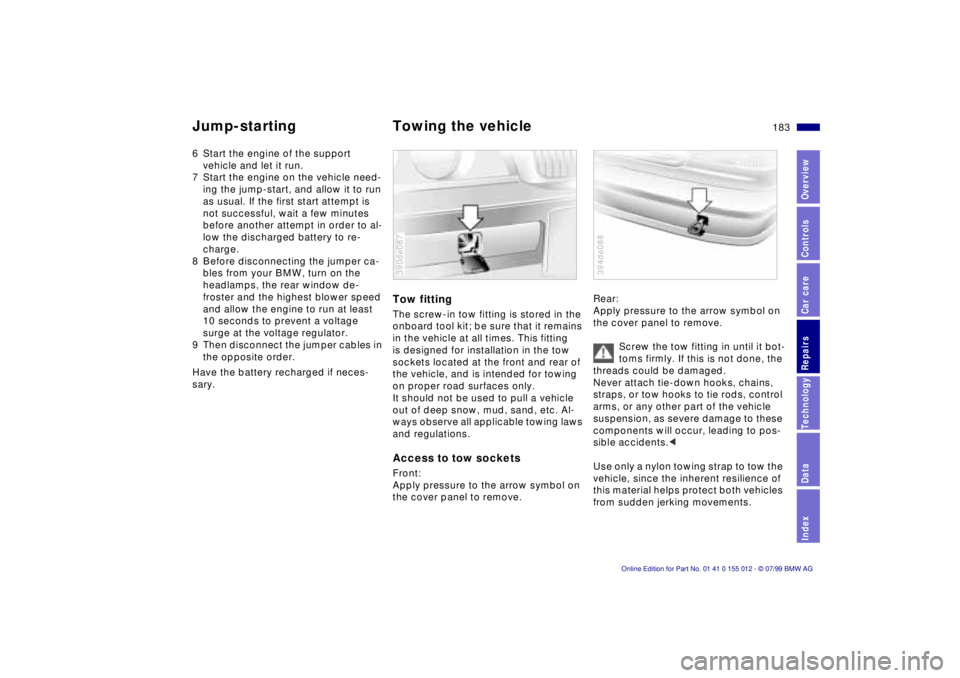
and regulations.Access to tow socketsFront:
Apply pressure to the arrow symbol on
the cover panel to remove.390de087
Rear:
Apply pressure to the arrow symbol on
the cover panel to remove.
Screw the tow fitting in until it bot-
toms firmly. If this is not done, the
threads could be damaged.
Never attach tie-down hooks, chains,
straps, or tow hooks to tie rods, control
arms, or any other part of the vehicle
suspension, as severe damage to these
components will occur, leading to pos-
sible accidents.<
Use only a nylon towing strap to tow the
vehicle, since the inherent resilience of
this material helps protect both vehicles
from sudden jerking movements.394de088
Page 184 of 217
184n
Towing the vehicle
The towed vehicle should always
be the lighter of the two vehicles.
If this is not the case, it is no longer
possible to control vehicle response.<
Tow-startingIt is not possible to start the engine of
vehicles equipped with an automatic
transmission by towing or pushing.
For instructions on jump starting, refer
to page 182.
Never attempt to use your vehicle to
push another car, since damage to the
energy-absorbing bumpers could
result.
Towing a vehicle with automatic
transmission1 Place the selector lever in position N
2 Towing speed:
Max. 45 mph (70 km/h)
3 Towing distance:
Max. 95 miles (150 km)
4 Leave the ignition key at position 1 to
ensure that the brake lamps, turn sig-
nals, horn and windshield wipers re-
main operative, and to prevent the
steering lock detent from engaging.
5 Switch on the hazard-warning system
(observe country-specific regula-
tions).
Find some means of identifying the ve-
hicle in tow, for instance, place a sign
or warning triangle in the rear window.
Make sure that the ignition key
remains in position 1 even when
the electrical system has failed to pre-
vent the steering lock from engaging.
The steering and brakes are without
power assist when the engine is off.
This means that increased effort is
required for steering and braking.<
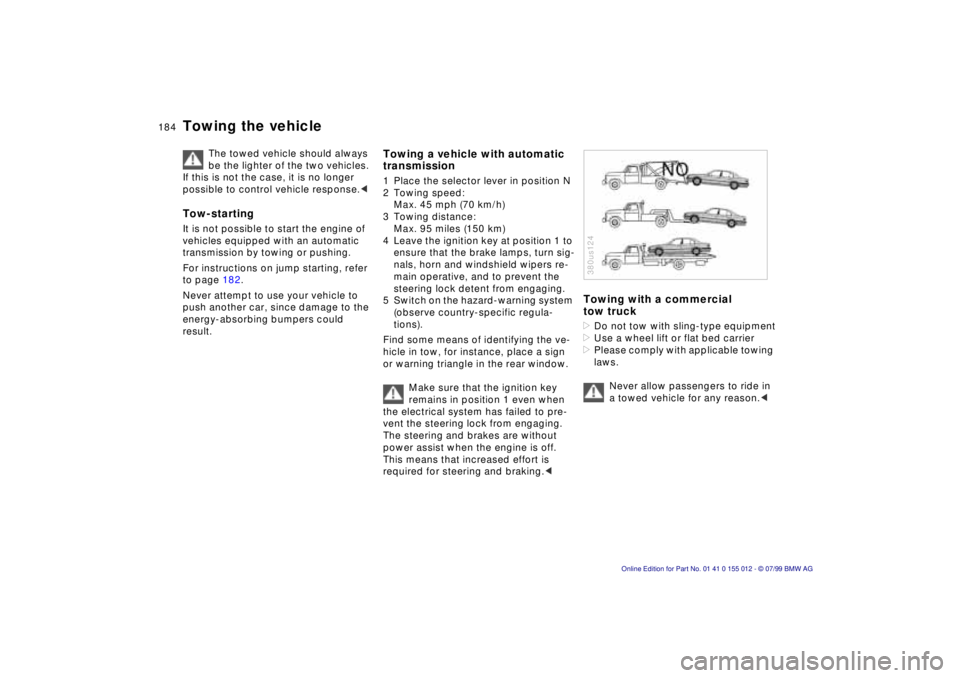
Towing with a commercial
tow truck>Do not tow with sling-type equipment
>Use a wheel lift or flat bed carrier
>Please comply with applicable towing
laws.
Never allow passengers to ride in
a towed vehicle for any reason.<380us124
Page 209 of 217

209n
RepairsIndexOverview Controls Car care Technology Data
Everything from A to Z
Clock, refer to the Radio
Owner's Manual
Cockpit16
Cold start68
Comfort seat51
Compartments108
Compression ratio198
Computer, refer to Onboard
computer88
Consumption display83
Convenience operating
mode of windows and
sliding/tilt sunroof36
Coolant130, 151
Antifreeze130
Capacity203
Temperature gauge84
Cover, sun blinds104
Cruise control80
Cruising range88
Cup holder109
Curb weight201
D
Dashboard16
Data link connector for
Onboard Diagnostics162
Daytime-driving lamp94
DBC (Dynamic Brake
Control)24, 129
Deep water125Defrost windshields101
Digital sound processor192
Dimensions199
Dipstick, engine oil149
Disc brakes124, 128
Disconnect the battery178
Displacement198
Display lighting94
Displays18
Distance warning90
Diversity Antenna
system190
Divided rear-seat
backrest112
Door keys35
Door locks, care130
Doors
Emergency release36
Manual operation36
Unlocking and locking36
Drive belts204
Driving notes125
Driving through water125
DSC (Dynamic Stability
Control)24, 91, 189
Dynamic Brake Control
(DBC)24, 129
Dynamic Stability Control
(DSC)24, 91, 189
E
Electric power seat50
Electric power windows47
Electrical defect
Fuel filler door180
Sliding/Tilt sunroof180
Tailgate181
Electrical heating exterior
mirror55
Electrical steering wheel
adjustment54
Elements of operation16
Emergency operation
Doors36
Fuel filler door180
Luggage compartment lid/
Tailgate41, 181
Sliding/Tilt sunroof180
Energy Control83
Engine
Compartment144
Coolant151
Specifications198
Engine oil
Capacity203
Consumption149
Grades150
Level23
Pressure23
Error indicators85
Exterior finish156
Exterior mirror54
Electrical heating55
F
Failure of an electrical
accessorry180
Failure warnings85
Filler cap cover28
Filling capacities203
First-aid kit27
Fittings, tow-starting and
towing183
Flashlight108
Flat tire134
Footbrake
Footwell lamps96
Forward/Back adjustment,
seat50, 52
Front fog lamps95, 169
bulb replacement169
Front seat adjustment50
Frost protection,
radiator151
Fuel29
Capacity203
Consumption indicator83
Gauge83
Quality29
Reserve203
Fuel filler door release after
electrical fault180
Fuel tank, capacity203
Fuses178
Page 213 of 217

Everything from A to Z Third brake lamp, bulb
replacement171
Through-loading
system112
Tilt alarm38
Tire134
Change173
Code137
Damage134
Inflation pressure30, 134
Monitoring inflation
pressure92, 194
Renewal135
Rotation between
axles135
Tread134
Valve caps138
Tire Pressure Control
(RDC)92, 194
Tools166
Torque198
Tow fittings183
Towing183
Tow-starting183
Track width199
Transmission70
Tread depth, tires134
Trip odometer82
Trunk, capacity201
Turn signal77
Bulb replacement169
Turning circle199
U
Universal Transmitter105
Used oil151
V
Valve caps138
Vanity mirror55
Vehicle battery176
Vehicle care, exterior156
Vehicle care, interior158
Vehicle Identification
Number153
Vehicle painting156
Vehicle removal from
service160
Vehicle storage160
Ventilation98, 102
Ventilation in the rear102
Ventilation while parked104
Ventilation, draft-free102
Vinyl upholstery, care158
Viscosity150
W
Warning lamps22
Warranty and Service Guide
Booklet (Canadian
models)154
Washer fluid reservoir
Capacity203
Filling148Washing your car155
Water on the roads125
Waxing, paintwork157
Weights201
Wheelbase199
Wheels and tires137
Width199
Windows
Convenience
operation36
Windows, convenience
operating mode36, 37
Windshield washer fluid
reservoir, capacity203
Windshield washer nozzle
adjustment148
Windshield washer reservoir,
filling148
Windshield wipers77
Winter driving130
Winter operation130
Winter tires138
Wiper blade
replacement166
Wiper/Washer system77
Work in the engine
compartment143
X
Xenon lamps94, 168, 195