sensor BMW 540I SEDAN 2001 User Guide
[x] Cancel search | Manufacturer: BMW, Model Year: 2001, Model line: 540I SEDAN, Model: BMW 540I SEDAN 2001Pages: 238, PDF Size: 2.44 MB
Page 142 of 238

142nCatalytic converter
The catalytic converter reduces harmful
exhaust emissions, and is designed for
use with unleaded fuel only.
Even minute quantities of lead would be
enough to permanently damage both
the catalytic converter and the system
oxygen sensor.
To ensure efficient, trouble-free engine
operation and avoid potential damage:
>Be sure to comply with the scheduled
maintenance requirements.
> Fill the fuel tank well before it is
empty.
> Tow-start the vehicle only when the
engine is cold, since unburned fuel
may otherwise reach the catalytic
converter. It is better to start the vehi-
cle with an outside starting aid. >
Avoid other situations in which the
fuel is not burned, or burns incom-
pletely, such as engaging the starter
frequently or for extended periods, or
repeated start attempts in which the
engine does not start (stopping and
restarting an engine which is running
properly does not present a problem).
Never let the engine run with any of
the spark plug cables disconnected. Be sure to comply with the in-
structions above to prevent un-
burned fuel from reaching the catalytic
converter. Otherwise there is danger of
overheating and damage to the cata-
lytic converter.
Extreme temperatures occur at the cat-
alytic converter on this and every cata-
lyst-equipped vehicle. Heat shields are
installed adjacent to some sections of
the exhaust system. Never remove
these shields; do not apply undercoat-
ing to their surfaces. When driving,
standing at idle, and parking the vehi-
cle, take care to avoid contact between
the exhaust system and flammable ma-
terials (grass, hay, leaves, etc.). Such
contact could lead to a fire, resulting in
personal injury and property damage. <
Page 171 of 238

Index
Data
Technology
Repairs
Car care
Controls
Overview
171nCaring for your car
Washing your car
You can have your new BMW washed
in an automatic car wash. Car wash
systems that do not employ brushes
are preferable.
Wipe away tough dirt and loosen and
remove dead insects before washing
the vehicle.
To prevent spots, avoid washing when
the hood is still warm, or immediately
after and during exposure to strong
sunlight.
When using an automatic car wash, be
sure that:
>The car wash system is suited for the
dimensions of your vehicle.
> No damage will occur on vehicles
with attached body accessories (such
as spoilers or antennas). If you are
uncertain, consult the manager of the
car wash.
> The wheels and tires of your vehicle
cannot be damaged by the convey-
ance devices of the car wash system.
> The vehicle is cleaned with minimum
brush pressure, and that ample water
is available for washing and rinsing. Vehicles with rain sensor
*:
Clean the windshield regularly. Wax
from automatic car washes or insects,
for example, can cause malfunctions in
the function of the rain sensor.
Turn the rain sensor off in auto-
matic car washes. If you do not,
damage may occur if the wipers switch
on unintentionally. <
Parts of the vehicle which are inacces-
sible to the automatic washer – such as
door sills, door and hood edges, etc. –
should be cleaned by hand.
In the winter months, it is especially im-
portant to ensure that the vehicle is
washed on a regular basis. Large quan-
tities of dirt and road salt are difficult to
remove, and they also cause damage to
the vehicle. If spray wands or high-pressure
washers are used, be sure to
maintain an adequate distance between
the spray source and the vehicle's sur-
face. Inadequate distance and exces-
sive pressure can damage or weaken
the finish, making it more susceptible to
subsequent attack. In addition, mois-
ture could penetrate to vehicle compo-
nents, leading to long-term damage. < When cleaning the headlamps,
please observe the following:
> Do not wipe dry (scratches). Never
use abrasives or strong
solvents to clean the covers
> Remove dirt and contamination (such
as insects) by soaking with BMW Car
Shampoo and then rinsing with plenty
of water
> Always use a deicer spray to remove
accumulated ice and snow – never
use an ice scraper. <
After washing the car, apply the
brakes briefly to dry them. Braking
efficiency might otherwise be reduced
by the moisture, and the brake rotors
could also be corroded. <
Page 205 of 238
Index
Data
Technology
Repairs
Car care
Controls
Overview
Overview
Controls and features Operation, care
and maintenance
Owner service procedures
Technical dataIndex
Advanced technology
205
n
Airbags 206
Adaptive Transmission Control (ATC) 207
Automatic Stability Control plus Traction (ASC+T)/Dynamic
Stability Control (DSC) 208
BMW active seat 210
Safety belt tensioner 210
DSP sound system 211
Mirrors with automatic dimmer 211
Rain sensor 212
Tire Pressure Control (RDC) 213
Integrated rear suspension 214
Level control system 214
Xenon lamps 215
Page 206 of 238
206n
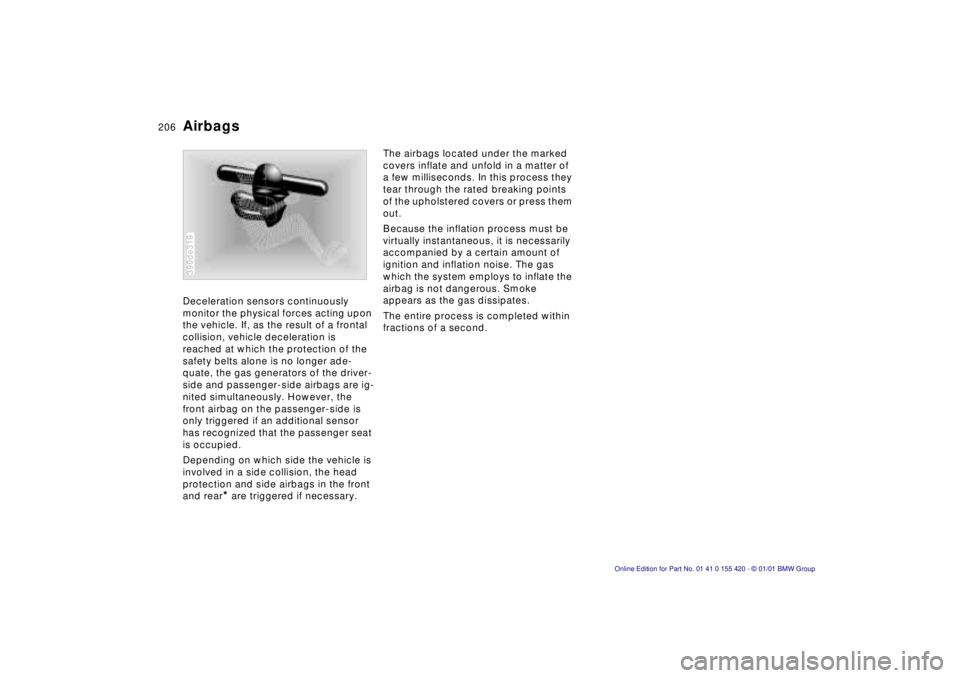
Deceleration sensors continuously
monitor the physical forces acting upon
the vehicle. If, as the result of a frontal
collision, vehicle deceleration is
reached at which the protection of the
safety belts alone is no longer ade-
quate, the gas generators of the driver-
side and passenger-side airbags are ig-
nited simultaneously. However, the
front airbag on the passenger-side is
only triggered if an additional sensor
has recognized that the passenger seat
is occupied.
Depending on which side the vehicle is
involved in a side collision, the head
protection and side airbags in the front
and rear
* are triggered if necessary.
390de319
The airbags located under the marked
covers inflate and unfold in a matter of
a few milliseconds. In this process they
tear through the rated breaking points
of the upholstered covers or press them
out.
Because the inflation process must be
virtually instantaneous, it is necessarily
accompanied by a certain amount of
ignition and inflation noise. The gas
which the system employs to inflate the
airbag is not dangerous. Smoke
appears as the gas dissipates.
The entire process is completed within
fractions of a second.
Airbags
Page 208 of 238

208nASC+T/DSC*
Precision sensors monitor the number
of revolutions of the wheels. When
equipped with DSC, they also monitor
steering angle, lateral acceleration,
brake pressure and the movement of
the vehicle around its vertical axis.
If differences in the wheel speeds
occur, the system counteracts the dan-
ger of wheelspin by reducing torque. If
necessary, the system also responds
with additional brake applications at the
rear wheels, and at all 4 wheels with
DSC.
In addition, DSC permanently monitors
the vehicle's current operating condi-
tion and compares it with an ideal con-
dition that is calculated from the sen-
sor's signals. If deviations from this
occur (understeering or oversteering,
for instance), DSC can stabilize the
vehicle in the fraction of a second by
reducing engine output and with the
assistance of braking intervention at in-
dividual wheels. As a result, dangerous
skids can be prevented even as they
are just beginning. You may need some time to become
accustomed to this system intervention.
However, it guarantees optimum drive
force and driving stability.
The braking intervention may be
accompanied by a certain degree of
noise.
Page 211 of 238
Index
Data
Technology
Repairs
Car care
Controls
Overview
211nDSP sound system*Mirrors with automatic dimmer*
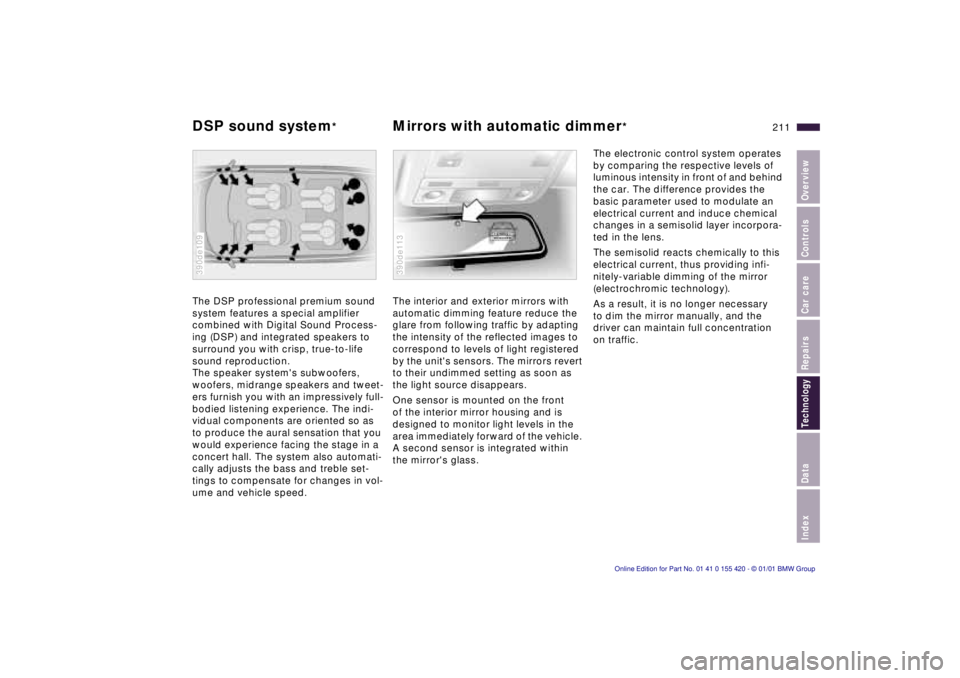
The DSP professional premium sound
system features a special amplifier
combined with Digital Sound Process-
ing (DSP) and integrated speakers to
surround you with crisp, true-to-life
sound reproduction.
The speaker system's subwoofers,
woofers, midrange speakers and tweet-
ers furnish you with an impressively full-
bodied listening experience. The indi-
vidual components are oriented so as
to produce the aural sensation that you
would experience facing the stage in a
concert hall. The system also automati-
cally adjusts the bass and treble set-
tings to compensate for changes in vol-
ume and vehicle speed.
390de109
The interior and exterior mirrors with
automatic dimming feature reduce the
glare from following traffic by adapting
the intensity of the reflected images to
correspond to levels of light registered
by the unit's sensors. The mirrors revert
to their undimmed setting as soon as
the light source disappears.
One sensor is mounted on the front
of the interior mirror housing and is
designed to monitor light levels in the
area immediately forward of the vehicle.
A second sensor is integrated within
the mirror's glass.
390de113
The electronic control system operates
by comparing the respective levels of
luminous intensity in front of and behind
the car. The difference provides the
basic parameter used to modulate an
electrical current and induce chemical
changes in a semisolid layer incorpora-
ted in the lens.
The semisolid reacts chemically to this
electrical current, thus providing infi-
nitely-variable dimming of the mirror
(electrochromic technology).
As a result, it is no longer necessary
to dim the mirror manually, and the
driver can maintain full concentration
on traffic.
Page 212 of 238

212nRain sensor*
Depending on the degree of wetness
on the windshield, the rain sensor
controls the operation of the windshield
wipers.
Infrared light is carried along the
surface of the windshield in an optical
conductor in such a manner that it is
reflected completely when the wind-
shield is dry. The quantity of reflected
light is measured.
If the window is covered with beads of
water, the amount of light that is
reflected is decreased since the infra-
red light at the surface of the wind-
shield can then escape. The quantity of
reflected light is thus a means of
gauging the degree of wetness on the
windshield.
390de133
When the system is set to the "Intermit-
tent" wiper speed, the wipers react
immediately – if water is splashed onto
the windshield by vehicles traveling
ahead of you, for example. As a result,
the rain sensor provides a contribution
to driving safety and comfort.
Page 213 of 238
Index
Data
Technology
Repairs
Car care
Controls
Overview
213nTire Pressure Control (RDC)*
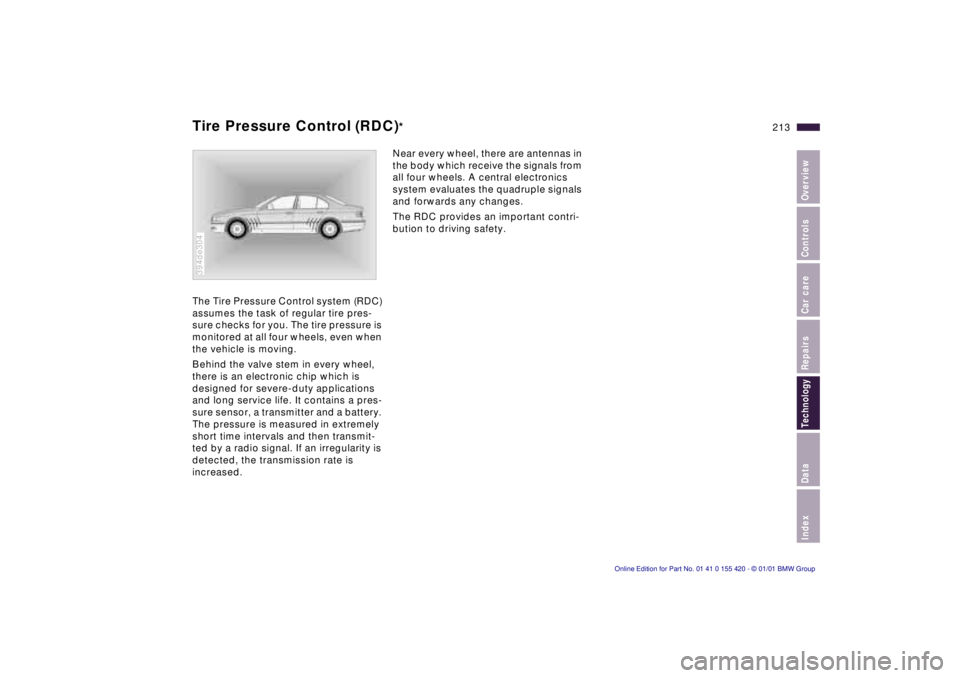
The Tire Pressure Control system (RDC)
assumes the task of regular tire pres-
sure checks for you. The tire pressure is
monitored at all four wheels, even when
the vehicle is moving.
Behind the valve stem in every wheel,
there is an electronic chip which is
designed for severe-duty applications
and long service life. It contains a pres-
sure sensor, a transmitter and a battery.
The pressure is measured in extremely
short time intervals and then transmit-
ted by a radio signal. If an irregularity is
detected, the transmission rate is
increased.
394de304
Near every wheel, there are antennas in
the body which receive the signals from
all four wheels. A central electronics
system evaluates the quadruple signals
and forwards any changes.
The RDC provides an important contri-
bution to driving safety.
Page 214 of 238
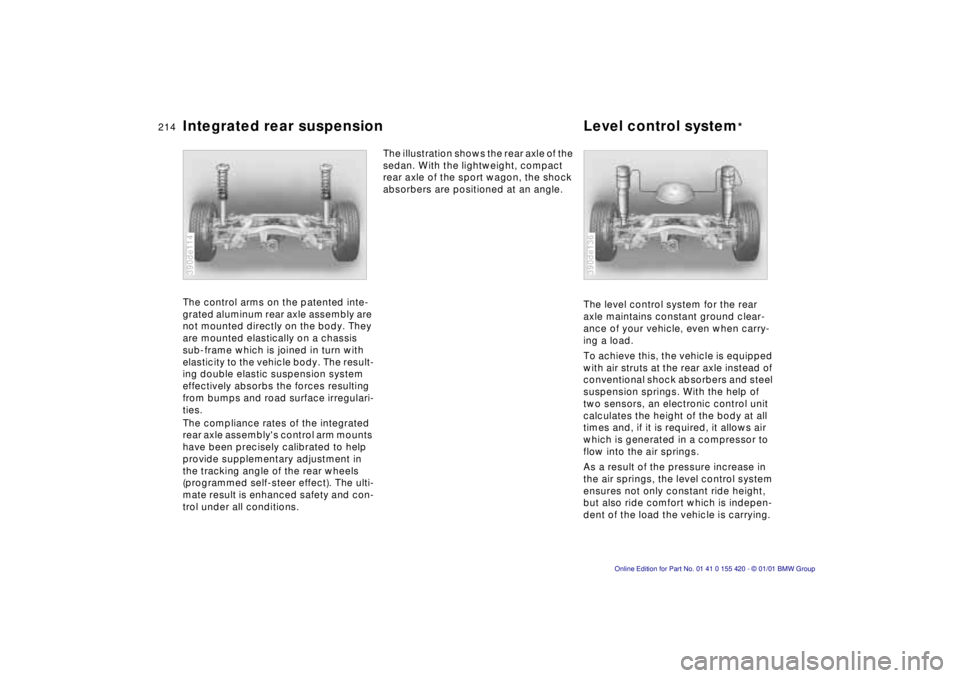
214nIntegrated rear suspension Level control system*
The control arms on the patented inte-
grated aluminum rear axle assembly are
not mounted directly on the body. They
are mounted elastically on a chassis
sub-frame which is joined in turn with
elasticity to the vehicle body. The result-
ing double elastic suspension system
effectively absorbs the forces resulting
from bumps and road surface irregulari-
ties.
The compliance rates of the integrated
rear axle assembly's control arm mounts
have been precisely calibrated to help
provide supplementary adjustment in
the tracking angle of the rear wheels
(programmed self-steer effect). The ulti-
mate result is enhanced safety and con-
trol under all conditions.
390de114
The illustration shows the rear axle of the
sedan. With the lightweight, compact
rear axle of the sport wagon, the shock
absorbers are positioned at an angle.
The level control system for the rear
axle maintains constant ground clear-
ance of your vehicle, even when carry-
ing a load.
To achieve this, the vehicle is equipped
with air struts at the rear axle instead of
conventional shock absorbers and steel
suspension springs. With the help of
two sensors, an electronic control unit
calculates the height of the body at all
times and, if it is required, it allows air
which is generated in a compressor to
flow into the air springs.
As a result of the pressure increase in
the air springs, the level control system
ensures not only constant ride height,
but also ride comfort which is indepen-
dent of the load the vehicle is carrying.
390de136
Page 229 of 238

Everything from A to Z
229n
IndexDataTechnologyRepairsCar careControlsOverview
Car jack190
t
Car keys36
Car Memory60
Car phones, refer to the
seperate Owner's Manual
Car radio reception149
Car telephone125
Car wash171
Care
vehicle exterior172
vehicle interior174
Cargo loading136
Caring for the vehicle
finish173
Catalytic converter142
Cellular phone149
Center (high-mount) brake
lamp, bulb
replacement187
Central locking
system38, 42
Changing a tire190
t
Changing a wheel190
t
Charge indicator lamp22
Charging the battery194
t
Check air pressure30
Check button86
Check Control86
t
Check engine oil
level165
t
Check tire pressures29
t
Child restraint systems62
Child seat62, 66Child seat security67
Child-safety locks67
Cigarette lighter126
Cleaning headlamps79
Cleaning windshield78, 79
Clock92
Clock, refer also to the
onboard monitor
Cockpit16
Code98
activating98
de-activating98
selecting98
Cold start69
Combination switch78
Comfort seat54
Compartments124
Computer89, 95
average fuel
consumption89
average speed89
cruising range89
outside temperature89
remote control99
Computer, refer also to the
onboard monitor Owner's
Manual
Configure settings60
Consumption display84
Consumption, fuel97
Contamination on
paintwork172Convenience operation
sliding/tilt sunroof38
windows38
Convenience starting
feature69
Coolant146, 167
antifreeze146
temperature gauge85
Copyright notice4
Courtesy lamp, bulb
replacement189
t
Cover, sun blinds120
Cruise control81
Cruising range89, 97
Cup holder125
Curb weight221
D
Dashboard16
Data link connector for
Onboard Diagnostics178
Date
calling up92
changing92
Date, refer also to the
onboard monitor Owner's
Manual
Daytime-driving lamp105
DBC (Dynamic Brake
Control)23, 100, 145Deactivating99
interior motion
sensor40, 48
tilt sensor alarm
system40, 48
Deep water141
Defrost
rear window80
t
Defrost position113, 117
Defrost
windows113, 117
t
Difficult steering148
t
Digital clock92
Digital sound
processing211
Dimensions219
Dipstick, engine oil165
t
Disc brakes144
Disconnect the
battery195
t
Displacement218
Display lighting105
Displays18, 20
Distance96
Distance warning100
Diversity Antenna
system209
Divided rear-seat
backrest128
Door keys36