traction control BMW 540I SEDAN 2001 Owners Manual
[x] Cancel search | Manufacturer: BMW, Model Year: 2001, Model line: 540I SEDAN, Model: BMW 540I SEDAN 2001Pages: 238, PDF Size: 2.44 MB
Page 11 of 238

11n
Controls and features
Operation, care and maintenance
Technology for safety and
driving convenience:
Park Distance Control
(PDC)100
Automatic Stability Control plus
Traction (ASC+T)/Dynamic
Stability Control (DSC)102
Tire Pressure Control (RDC)103
Lamps:
Parking lamps/Low beams105
Instrument lighting105
High beams/Parking lamps106
Fog lamps106
Interior lamps106
Reading lamps107
Controlling the climate for
pleasant driving:
Air conditioner108
Automatic climate control114
Seat heating119
Steering wheel heating120
Roller sun blind120
Independent ventilation
system120
Cabin convenience:
BMW Universal Transmitter121
Glove compartment124
Storage facilities124
Cellular phone125
Beverage holder 125
Ashtray, front126
Cigarette lighter126
Ashtray, rear127
Loading and transporting
cargo:
Through-loading system128
Ski bag129
sport wagon:
Luggage compartment132
Roll-up cover132
Partition net132
Storage areas in the luggage
compartment133
Cargo loading136
Roof-mounted luggage rack137
Special operating instructions:
Break-in procedure140
Driving notes141
Catalytic converter142
Antilock Brake System
(ABS)143
Disc brakes144
Brake system146
Winter operation146
Power steering148
Level control system148
Cellular phone149
Radio reception149
Wheels and tires:
Tire inflation pressure150
Tire condition150
Tire replacement151
Tire rotation152
Wheel and tire
combinations153
Winter tires154
Snow chains155
Approved wheel and tire
specifications156
Page 12 of 238

Contents
Operation, care and maintenance
Owner service procedures
Advanced technology
Under the hood:
Hood159
Engine compartment160
Washer fluids164
Washer nozzles164
Engine oil165
Coolant167
Brake fluid168
Vehicle Identification
Number169
Care and maintenance:
The BMW Maintenance
System170
Caring for your car171
Airbags176
Vehicle storage176
Laws and regulations:
Technical modifications177
California Proposition
65 Warning177
OBD interface socket178
Replacement procedures:
Onboard tool kit182
Wiper blades182
Lamps and bulbs183
Changing a wheel190
Battery193
Fuses196
In case of electrical
malfunction:
Fuel filler door198
Sliding/Tilt sunroof198
Tailgate199
Assistance, giving and
receiving:
Jump-starting200
Towing the vehicle201Airbags206
Adaptive Transmission Control
(ATC)207
Automatic Stability Control plus
Traction (ASC+T)/Dynamic
Stability Control (DSC)208
BMW active seat210
Safety belt tensioner210
DSP sound system211
Mirrors with automatic
dimmer211
Rain sensor212
Tire Pressure Control (RDC)213
Integrated rear suspension214
Level control system214
Xenon lamps215
Page 19 of 238

IndexDataTechnologyRepairsCar careControlsOverview
19n
Instrument cluster
There are two versions, depending on
the equipment on your vehicle.
1 Fuel gauge with indicator lamp for
fuel reserve84
2 Indicator lamp for turn signals24
3 Speedometer
4 Indicator lamp for high beams24
5 Tachometer and
Energy Control84
6 Coolant thermometer with
"Coolant temperature too high"
warning lamp85
7 Indicator and warning lamps for:
>
Parking brake/Brake hydraulic
system, Dynamic Brake Control
(DBC)
*
22, 23
>
Antilock Brake System (ABS)23
>
Brake pads23
>
Tire Pressure Control (RDC)
*
23
>
Airbags23
>
Automatic transmission
*
23
>
Please fasten safety belts23
>
Cruise control24
8 Selector lever and program display
for automatic transmission
*
72, 75
9 Service Interval Display8510 Display for the computer
(operation via the turn signal lever,
refer to page 89):
>
Outside temperature
>
Average fuel consumption
>
Cruising range
>
Average speed
11 Indicator lamp for Automatic
Stability Control plus Traction
(ASC+T)/Dynamic Stability
Control (DSC)
*
24
12 Indicator lamp for level control
system
*
23
13 Odometer and trip odometer83
14 Indicator for Check Control86
15 Reset button for trip odometer83
16 Indicator and warning lamps for:
>
Fog lamps24
>
Battery charge current22
>
Engine oil level/Engine oil
pressure22, 23
>
Engine electronics24
>
Service Engine Soon24
Page 21 of 238

IndexDataTechnologyRepairsCar careControlsOverview
21n
Instrument cluster
*
There are two versions, depending on
the equipment on your vehicle.
1 Fuel gauge with indicator lamp for
fuel reserve84
2 Indicator lamp for turn signals24
3 Speedometer
4 Indicator lamp for high beams24
5 Tachometer and
Energy control84
6 Coolant temperature gauge85
7 Indicator and warning lamps for:
>
Parking brake 23
>
Brake hydraulic system, Dynamic
Brake Control (DBC)
*
22, 23
>
Antilock Brake System (ABS)23
>
Airbags23
>
Please fasten safety belts23
>
Cruise control24
8 CHECK button86
9 Selector lever and program display
for automatic transmission
*
72, 7510 Outside temperature display83
11 Indicator lamp for Automatic
Stability Control plus Traction
(ASC+T)/Dynamic Stability
Control (DSC)
*
24
12 Trip odometer83
13 Check Control display86
14 Odometer83
15 Service Interval Display85
16 Reset button for trip odometer83
17 Indicator and warning lamps for:
>
Fog lamps24
>
Battery charge current22
>
Engine oil pressure22
>Service Engine Soon24
Page 24 of 238

24n
Indicator and warning lamps
Automatic Stability Control plus
Traction (ASC+T)/Dynamic Sta-
bility Control (DSC)
* l
The ASC+T/DSC has been switched off
or has been deactivated because of a
malfunction. In the event of a malfunc-
tion, have the system checked by your
BMW center.
For additional information: refer to
page 102.
Engine electronics
*
There is a fault in the engine's
electronic control system. The
electronics allow for continued driving
with reduced engine output or rpms.
Please have the system inspected by
your BMW center.
Service Engine Soon l
If the indicator lamp comes on
either continuously or intermit-
tently, this indicates a fault in the emis-
sions-related electronic systems.
Although the vehicle remains opera-
tional, you should have the systems
checked by your BMW center at the
earliest possible opportunity.
For additional information: refer to
page 178.
Service Engine Soon warning
lamp for Canadian models.
Green: for your information
Turn signal
Flashes when the turn signals
are in operation. Rapid flashing
indicates a system malfunction.
For additional information: refer to
page 78.
Cruise control
Lights up when the cruise con-
trol is activated. Available for
operation via the multifunction steering
wheel.
For additional information: refer to
page 81.
Fog lamps
Lights up whenever you switch
on the fog lamps.
For additional information: refer to
page 106.
Blue: for your information
High beams
Lights up when the high beams
are on or the headlamp flasher
is actuated.
For additional information: refer to
pages 78 and 106.
Page 35 of 238
IndexDataTechnologyRepairsCar careControlsOverview
Overview
Controls and features
Operation, care
and maintenance
Owner service procedures
Technical data
Index Advanced technology
35n
Technology for safety and
driving convenience:
Park Distance Control
(PDC)100
Automatic Stability Control plus
Traction (ASC+T)/Dynamic
Stability Control (DSC)102
Tire Pressure Control (RDC)103
Lamps:
Parking lamps/Low beams105
Instrument lighting105
High beams/Parking lamps106
Fog lamps106
Interior lamps106
Reading lamps107
Controlling the climate for
pleasant driving:
Air conditioner108
Automatic climate control114
Seat heating119
Steering wheel heating120
Roller sun blind120
Independent ventilation
system120Cabin convenience:
BMW Universal Transmitter121
Glove compartment124
Storage facilities124
Cellular phone125
Beverage holder 125
Ashtray, front126
Cigarette lighter126
Ashtray, rear127
Loading and transporting
cargo:
Through-loading system128
Ski bag129
sport wagon:
Luggage compartment132
Roll-up cover132
Partition net132
Storage areas in the luggage
compartment133
Cargo loading136
Roof-mounted luggage rack137
Page 67 of 238
IndexDataTechnologyRepairsCar careControlsOverview
67n
Transporting children safelyOlder children should be tightly secured
with a safety belt. Younger children
should be secured in an appropriate
forward-facing child restraint system
that has first been properly secured
with a safety belt. Never install a rear-
facing child restraint system in the front
passenger seat.
We strongly urge you to carefully read
and comply with the instructions for in-
stallation and use provided by the child
restraint's manufacturer whenever you
use such a device.
Be sure that all occupants (of all ages)
remain properly and securely restrained
at all times.<
All rear seating positions in your
vehicle meet the recommendations
of SAE J1819, an industry-recom-
mended practice for securing child
restraint systems in motor vehicles.
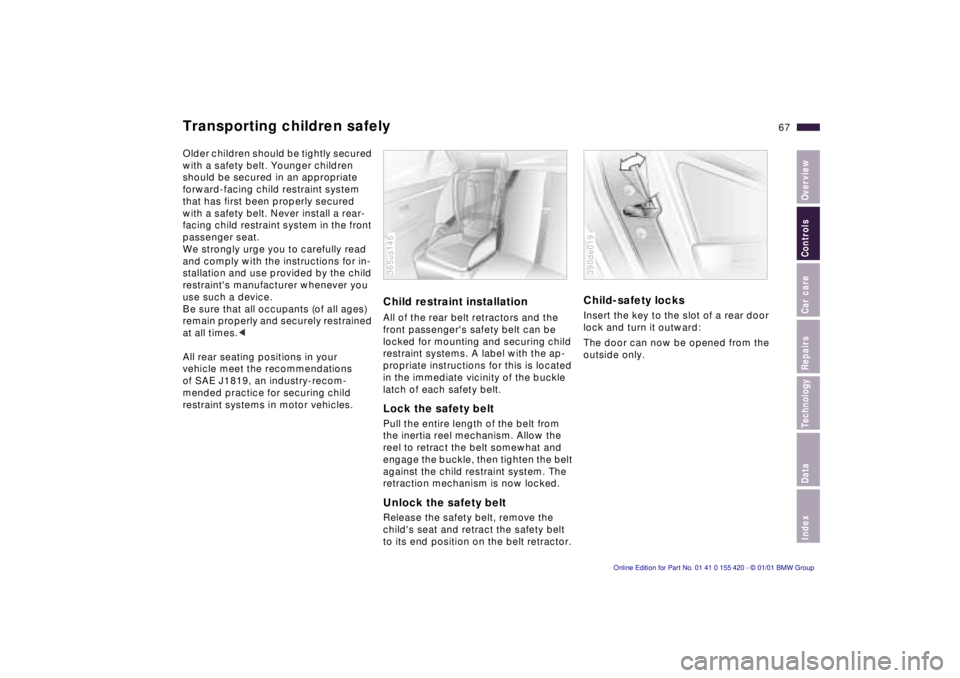
Child restraint installationAll of the rear belt retractors and the
front passenger's safety belt can be
locked for mounting and securing child
restraint systems. A label with the ap-
propriate instructions for this is located
in the immediate vicinity of the buckle
latch of each safety belt.Lock the safety beltPull the entire length of the belt from
the inertia reel mechanism. Allow the
reel to retract the belt somewhat and
engage the buckle, then tighten the belt
against the child restraint system. The
retraction mechanism is now locked.Unlock the safety beltRelease the safety belt, remove the
child's seat and retract the safety belt
to its end position on the belt retractor. 365us146
Child-safety locksInsert the key to the slot of a rear door
lock and turn it outward:
The door can now be opened from the
outside only.390de019
Page 102 of 238
102n
ASC+T/DSC
*
Automatic Stability Control plus
Traction (ASC+T)/Dynamic
Stability Control (DSC)
*
These systems contribute to additional
vehicle stability, especially during
acceleration and when cornering.
The DSC system enhances the benefits
of the ASC+T. In addition to optimizing
vehicle stability and traction during
acceleration or when starting from a
standstill, a further benefit is realized in
cornering. This, of course, is true only
within physically feasible limits.
The system activates automatically
each time you start the engine.
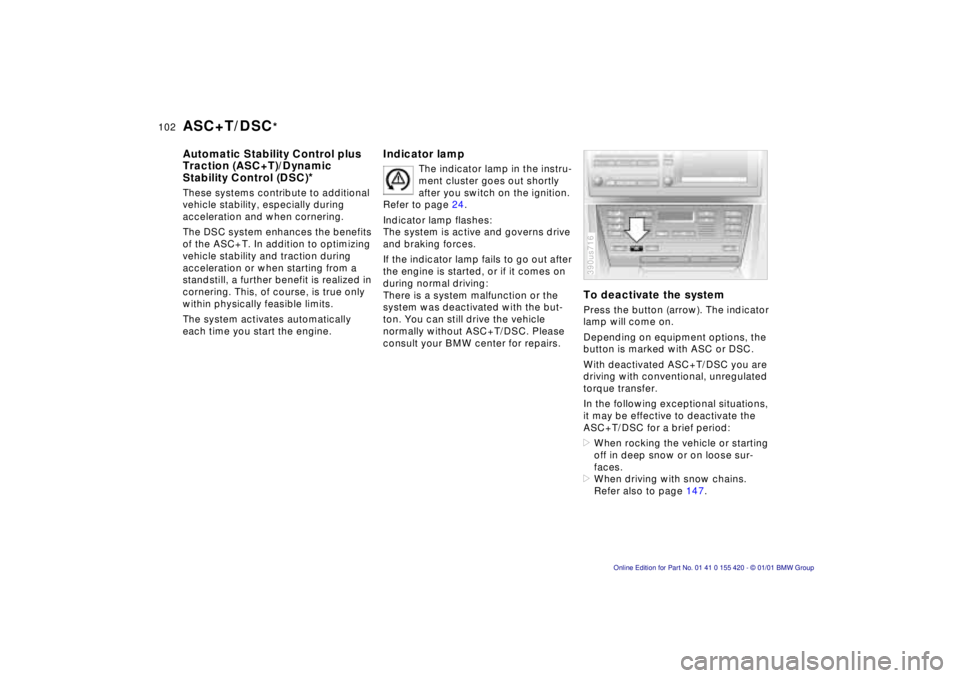
To deactivate the systemPress the button (arrow). The indicator
lamp will come on.
Depending on equipment options, the
button is marked with ASC or DSC.
With deactivated ASC+T/DSC you are
driving with conventional, unregulated
torque transfer.
In the following exceptional situations,
it may be effective to deactivate the
ASC+T/DSC for a brief period:
>When rocking the vehicle or starting
off in deep snow or on loose sur-
faces.
>When driving with snow chains.
Refer also to page 147.390us716
Indicator lamp
The indicator lamp in the instru-
ment cluster goes out shortly
after you switch on the ignition.
Refer to page 24.
Indicator lamp flashes:
The system is active and governs drive
and braking forces.
If the indicator lamp fails to go out after
the engine is started, or if it comes on
during normal driving:
There is a system malfunction or the
system was deactivated with the but-
ton. You can still drive the vehicle
normally without ASC+T/DSC. Please
consult your BMW center for repairs.
Page 140 of 238

140nBreak-in procedure
To ensure that your vehicle provides
maximum economy throughout a long
service life, we request that you ob-
serve the following.
Engine and differential
Up to 1,200 miles (2,000 km):
Drive at varying engine speeds and
road speeds, but do not exceed
4,500 rpm and the following road
speeds during this initial period:
BMW 525i, 530i: 100 mph (160 km/h)
BMW 540i: 106 mph (170 km/h)
Obey your local and state maximum
speed limits.
Refrain from using full throttle and avoid
pressing the accelerator beyond the
kickdown point.
Once you have driven 1,200 miles
(2,000 km), engine and vehicle speeds
can gradually be increased.
You should also comply with these
break-in procedures if the engine or dif-
ferential is replaced later in the course
of the vehicle service life.
Tires
Due to technical factors associated
with their manufacture, tires do not
achieve their full traction potential until
an initial break-in period has elapsed
for this reason, drive with extra care
during the initial 200 miles (300 km).
Obey your local and state maximum
speed limits.
When the vehicle is operated on
wet or slushy roads, a wedge of
water may form between the tire and
the road surface. This phenomenon is
referred to as aquaplaning, or hydro-
planing, and can lead to partial or com-
plete loss of traction, vehicle control
and braking effectiveness. Reduce your
speed on wet roads. <
Brake system
Approximately 300 miles (500 km) must
elapse before the brake pads and ro-
tors achieve the optimal pad-surface
and wear patterns required for trouble-
free operation and long service life later
on.
To break in the separate parking brake
drums, apply the parking brake lightly
when coasting to a standstill (at a traffic
signal, for instance), provided that traf-
fic conditions allow you to do so. To
avoid corrosion, repeat this procedure
from time to time.
The brake lamps do not come on
when the parking brake is applied.
Vacuum for the brake system servo unit
on your BMW is available only when the
engine is running. When you move the
car with the engine shut off – when
towing, for instance – substantially
higher levels of pedal force will be
required to brake the vehicle. <
Clutch
The clutch will also begin to function
optimally after about 300 miles
(500 km). Engage the gears carefully
during the break-in period.
Page 143 of 238

Index
Data
Technology
Repairs
Car care
Controls
Overview
143nAntilock Brake System (ABS)
The concept
ABS enhances active safety by helping
to prevent the wheels from locking un-
der braking. The reason: locked wheels
are dangerous, because the vehicle
cannot be steered when the front
wheels slip, and loss of traction at the
rear wheels can cause the rear end to
break into an uncontrolled skid.
ABS is designed to meet two essential
requirements during every brake appli-
cation:
>To help provide vehicle stability.
> To help retain steering and maneu-
vering capability on all types of road
surface (asphalt, concrete, dirt,
moisture, snow and ice).
With ABS, the shortest possible braking
distances are achieved under most
conditions (on straight-aways and in
curves, with different road surfaces).
Braking with ABS
The system becomes operative once
the vehicle exceeds a speed of approx.
6 mph (10 km/h). The ABS is deacti-
vated whenever the vehicle's speed
drops back below approx. 4 mph
(6 km/h). This means that the wheels
can lock in the final phase of a brake
application – a factor of no significance
in actual use.
The ABS system works best in situa-
tions requiring maximum pressure on
the pedal (full braking). Since the vehi-
cle maintains steering responsiveness,
you can nevertheless avoid possible
obstacles with a minimum of steering
effort.
The ABS closed-loop control circuit cy-
cles in fractions of a second. A pulsing
of the brake pedal, combined with the
sounds associated with the hydraulic
controls, tells you that the brake system
is within its maximum limit range and
reminds you that you should adapt your
vehicle's speed to road conditions. On road surfaces which have a loose
layer on a firm base (on gravel or snow,
for instance), the braking distances with
ABS may be longer than with the
wheels locked. This also applies to
driving with snow chains. However,
ABS continues to provide enhanced
vehicle stability and steering response
under these conditions.