tires BMW 540I SEDAN 2003 Owners Manual
[x] Cancel search | Manufacturer: BMW, Model Year: 2003, Model line: 540I SEDAN, Model: BMW 540I SEDAN 2003Pages: 187, PDF Size: 2.3 MB
Page 6 of 187

Contents
Operation, maintenance
Owner service procedures
Special operating instructions:
Break-in procedures132
Driving notes133
Antilock Brake System133
Brake system134
Wheels and tires:
Tire inflation pressure135
Tire condition135
Tire replacement136
Wheel and tire
combinations137
Special characteristics of winter
tires138
Snow chains138
Under the hood:
Hood139
Engine compartment
essentials140
Washer fluids141
Engine oil142
Coolant144
Brake fluid145
Maintenance:
The BMW Maintenance
System146
Laws and regulations:
Technical modifications147
California Proposition
65 Warning147
OBD interface socket148
Replacement procedures:
Onboard tool kit152
Windshield wiper blades152
Lamps and bulbs153
Changing a wheel158
Battery162
Fuses162
Assistance, giving and
receiving:
Jump-starting164
Towing the vehicle165
Page 26 of 187
26n
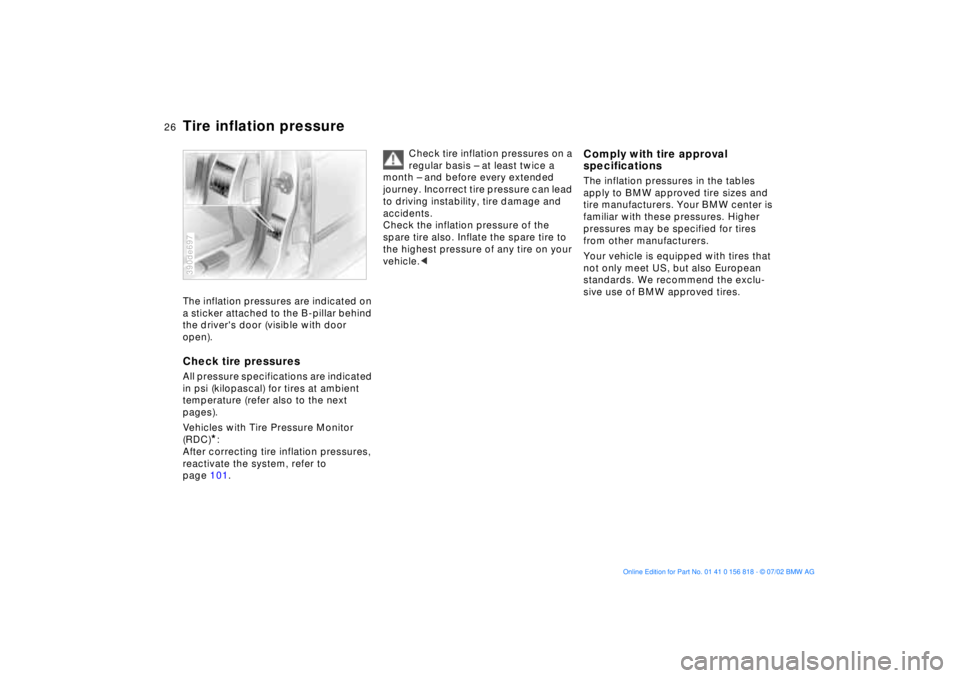
Tire inflation pressureThe inflation pressures are indicated on
a sticker attached to the B-pillar behind
the driver's door (visible with door
open).Check tire pressuresAll pressure specifications are indicated
in psi (kilopascal) for tires at ambient
temperature (refer also to the next
pages).
Vehicles with Tire Pressure Monitor
(RDC)
*:
After correcting tire inflation pressures,
reactivate the system, refer to
page 101.
390de697
Check tire inflation pressures on a
regular basis Ð at least twice a
month Ð and before every extended
journey. Incorrect tire pressure can lead
to driving instability, tire damage and
accidents.
Check the inflation pressure of the
spare tire also. Inflate the spare tire to
the highest pressure of any tire on your
vehicle.<
Comply with tire approval
specificationsThe inflation pressures in the tables
apply to BMW approved tire sizes and
tire manufacturers. Your BMW center is
familiar with these pressures. Higher
pressures may be specified for tires
from other manufacturers.
Your vehicle is equipped with tires that
not only meet US, but also European
standards. We recommend the exclu-
sive use of BMW approved tires.
Page 27 of 187
27n
OverviewControlsMaintenanceRepairsDataIndex
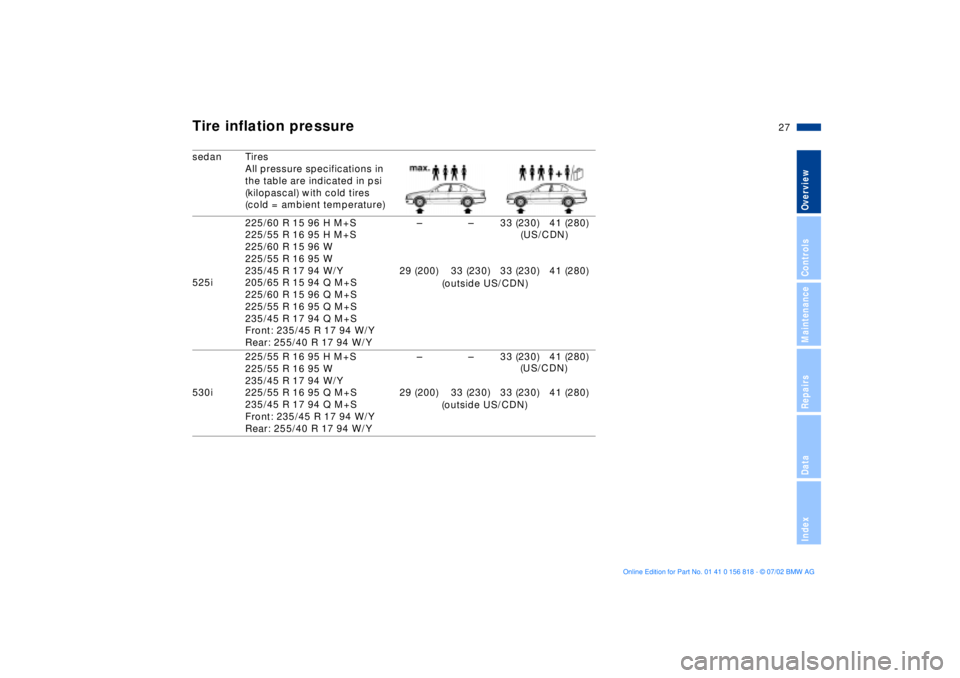
Tire inflation pressuresedan Tires
All pressure specifications in
the table are indicated in psi
(kilopascal) with cold tires
(cold = ambient temperature)
525i225/60 R 15 96 H M+S
225/55 R 16 95 H M+S
225/60 R 15 96 W
225/55 R 16 95 W
235/45 R 17 94 W/Y
205/65 R 15 94 Q M+S
225/60 R 15 96 Q M+S
225/55 R 16 95 Q M+S
235/45 R 17 94 Q M+S
Front: 235/45 R 17 94 W/Y
Rear: 255/40 R 17 94 W/YÐ
29 (200)Ð
33 (230)33 (230)
33 (230)41 (280)
41 (280)
530i225/55 R 16 95 H M+S
225/55 R 16 95 W
235/45 R 17 94 W/Y
225/55 R 16 95 Q M+S
235/45 R 17 94 Q M+S
Front: 235/45 R 17 94 W/Y
Rear: 255/40 R 17 94 W/YÐ
29 (200)Ð
33 (230)33 (230)
33 (230)41 (280)
41 (280)
(outside US/CDN)
(outside US/CDN)(US/CDN)
(US/CDN)
Page 28 of 187
28n
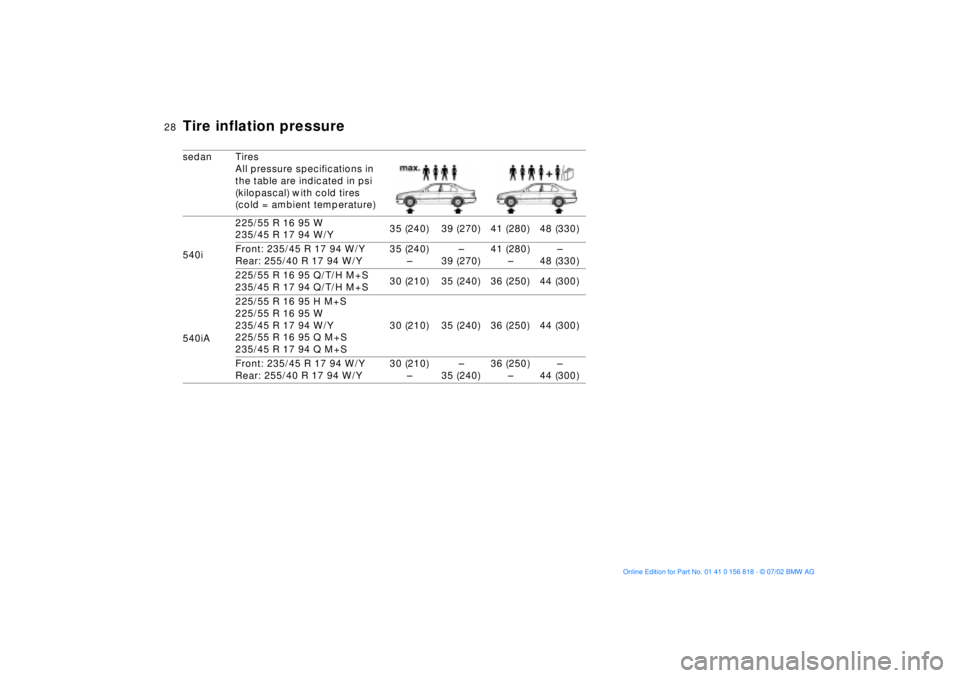
Tire inflation pressuresedan Tires
All pressure specifications in
the table are indicated in psi
(kilopascal) with cold tires
(cold = ambient temperature)
540i225/55 R 16 95 W
235/45 R 17 94 W/Y35 (240) 39 (270) 41 (280) 48 (330)
Front: 235/45 R 17 94 W/Y
Rear: 255/40 R 17 94 W/Y35 (240)
ÐÐ
39 (270)41 (280)
ÐÐ
48 (330)
225/55 R 16 95 Q/T/H M+S
235/45 R 17 94 Q/T/H M+S30 (210) 35 (240) 36 (250) 44 (300)
540iA225/55 R 16 95 H M+S
225/55 R 16 95 W
235/45 R 17 94 W/Y
225/55 R 16 95 Q M+S
235/45 R 17 94 Q M+S30 (210) 35 (240) 36 (250) 44 (300)
Front: 235/45 R 17 94 W/Y
Rear: 255/40 R 17 94 W/Y30 (210)
ÐÐ
35 (240)36 (250)
ÐÐ
44 (300)
Page 29 of 187
29n
OverviewControlsMaintenanceRepairsDataIndex
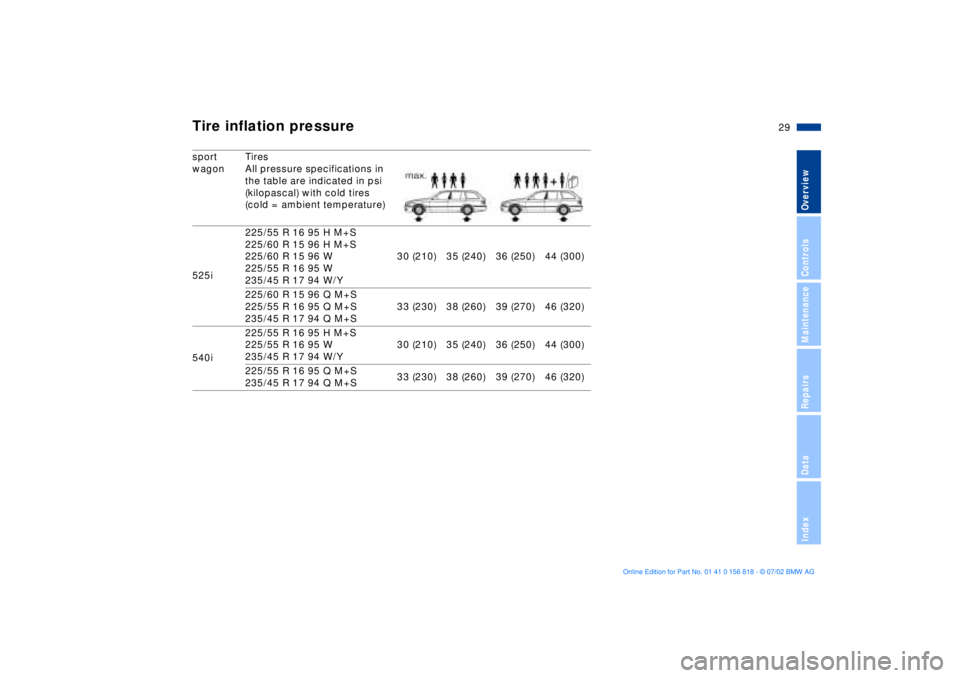
Tire inflation pressuresport
wagonTires
All pressure specifications in
the table are indicated in psi
(kilopascal) with cold tires
(cold = ambient temperature)
525i225/55 R 16 95 H M+S
225/60 R 15 96 H M+S
225/60 R 15 96 W
225/55 R 16 95 W
235/45 R 17 94 W/Y30 (210) 35 (240) 36 (250) 44 (300)
225/60 R 15 96 Q M+S
225/55 R 16 95 Q M+S
235/45 R 17 94 Q M+S33 (230) 38 (260) 39 (270) 46 (320)
540i225/55 R 16 95 H M+S
225/55 R 16 95 W
235/45 R 17 94 W/Y30 (210) 35 (240) 36 (250) 44 (300)
225/55 R 16 95 Q M+S
235/45 R 17 94 Q M+S33 (230) 38 (260) 39 (270) 46 (320)
Page 86 of 187

86n
Check Control>"RELEASE PARKINGBRAKE"
>"COOLANT TEMPERATURE"
The coolant is overheated. Stop the
vehicle immediately and switch off
the engine. Refer to pages 84
and 144
>"STOP!ENGINE OILPRESS"
The oil pressure is too low. Stop the
vehicle immediately and switch off
the engine. Refer to pages 19, 142
>"CHECK BRAKE FLUID"
Indicates that brake fluid is down to
roughly minimum level. Have the
reservoir topped up at the earliest
opportunity, refer to page 145. Have
the source of the brake fluid loss
repaired at your BMW center
>"TIRE DEFECT"
*
Reduce vehicle speed immediately
and stop the vehicle. Avoid hard
brake applications. Do not oversteer.
Refer to page 102
>"SELFLEVEL SUSP.INACT"
Please consult the nearest BMW
center. Refer to page 101
>"LIMIT"
*
Display if the programmed speed
limit has been exceeded, refer to
page 93Priority 2
These displays appear for 20 seconds
when the ignition key is turned to posi-
tion 2. The warning symbols remain
after the message disappears. You can
display the messages again by pressing
the CHECK button 3:
>"TRUNKLID OPEN"
Message appears only when the
vehicle is initially set in motion
>"DOOR OPEN"
This message appears after a defined
road speed has been exceeded
>"FASTEN SEAT BELTS"
*
In addition to this message, a
warning lamp with the safety belt icon
appears and an acoustic signal
sounds
>"WASHER FLUID LOW"
Too low; top up fluid at the next
opportunity. Refer to page 141
>"CHECK ENGINE OIL LEV"
The engine oil level is at the absolute
minimum. You should respond by
topping up the oil as soon as
possible, refer to page 142. Do not
continue for more than approx.
30 miles (50 km) before adding oil>"CHECK FILLER CAP"
Inspect the cap to make sure that it is
closed properly, refer to page 25
>"OUTSIDE TEMP. +20 7 (Ð5 6)"
This display is only an example. The
current temperature is displayed at
outside temperatures of +37.5 7
(+3 6) and below. Refer also to
page 82
>"TIRE PRESSURE SET"
*
The RDC has imported the current
inflation pressure in the tires as the
target values which the system will
monitor.
Refer to page 101
>"CHECK TIRE PRESSURE"
*
Check and correct the tire inflation
pressure to specifications at the
earliest opportunity (next stop to
refuel).
Refer to page 101
>"TIRECONTROL INACTIVE"
*
A temporary interference of the RDC
or a system fault. Refer to page 102
>"CHECK BRAKE LIGHTS"
A lamp has failed or the electrical
circuit has a fault. Refer to pages 156
and 162 or consult a BMW center
Page 101 of 187
101n
OverviewControlsMaintenanceRepairsDataIndex
Self-leveling suspension
*
Tire Pressure Monitor (RDC)
*
The warning lamp for the self-
leveling suspension comes on,
or the message "SELFLEVEL
SUSP.INACT" appears in the Check
Control: there is a malfunction in the
self-leveling suspension.
Stop and inspect the vehicle. If it is
riding significantly lower in the rear than
in the front, or if it is sitting at an incline
(left rear compared to right rear), con-
sult the nearest BMW center. Drive with
appropriate caution in the meantime.
The vehicle has reduced ground clear-
ance or driving comfort is noticeably
reduced.
Even if the attitude of the vehicle is
normal, you should consult the nearest
BMW center if the warning lamp indi-
cates a system fault.
The conceptRDC monitors the tire pressures at all
four wheels, even when the vehicle is
moving. The system provides an alert
whenever the inflation pressure drops
significantly below the specified pres-
sure in one or more tires.
In order for the system to "learn" the
correct tire inflation pressure, check the
inflation pressure in all tires. Refer to
the table of "Tire inflation pressures"
beginning on page 27 and make any
necessary corrections. Then activate
the system.
This indicator lamp in the instru-
ment cluster or the Check Con-
trol will inform you if the tire
pressure is not correct.
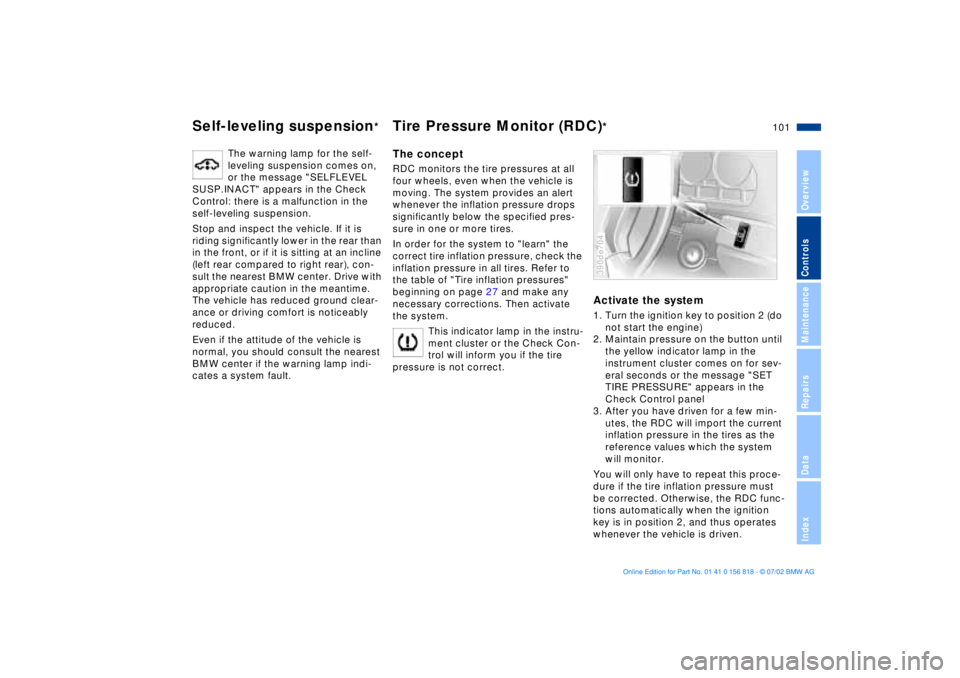
Activate the system1. Turn the ignition key to position 2 (do
not start the engine)
2. Maintain pressure on the button until
the yellow indicator lamp in the
instrument cluster comes on for sev-
eral seconds or the message "SET
TIRE PRESSURE" appears in the
Check Control panel
3. After you have driven for a few min-
utes, the RDC will import the current
inflation pressure in the tires as the
reference values which the system
will monitor.
You will only have to repeat this proce-
dure if the tire inflation pressure must
be corrected. Otherwise, the RDC func-
tions automatically when the ignition
key is in position 2, and thus operates
whenever the vehicle is driven.390de704
Page 102 of 187

102n
Tire Pressure Monitor (RDC)*Loss of tire pressureIf, after a certain period of time, the
inflation pressure has gone down sig-
nificantly (which is normal for any tire),
the yellow indicator lamp comes on or
the message "CHECK TIRE PRES-
SURE" appears in the Check Control.
This alerts you that you should have the
tires inflated to the specified pressures
as soon as possible.
If you are prompted to check the
tire pressure shortly after a cor-
rection has been made, this indicates
that the corrected values were not
accurate. Please check the inflation
pressure again and make corrections
according to the inflation pressure
table.<
Flat tireIf there is a tire failure with a loss of
inflation pressure, the red indicator
lamp comes on or the message "TIRE
DEFECT" appears in the Check Control.
In addition, a gong sounds.
If this occurs, reduce vehicle speed
immediately and stop the vehicle in a
safe location. Avoid hard brake applica-
tions. Do not oversteer. Replace the flat
tire.
The spare tire which is available in
your vehicle as standard equip-
ment is equipped with the electronics
required for RDC and, following activa-
tion of the system, is also monitored
after it is mounted.<
The RDC cannot alert you to
severe and sudden tire damage
caused by external factors.<
Have the tires changed at your
BMW center.
Your BMW center has the information
needed for working with RDC and is
equipped with the necessary special
tools.<
System interferenceDuring the period of the malfunction,
the yellow indicator lamp comes on
or the message "TIRECONTROL INAC-
TIVE" appears in the Check Control.
You will also see the same message
>in the event of a system fault
>if a wheel is mounted without the
RDC electronics
>if, in addition to the spare tire, addi-
tional wheels with RDC electronics
are on board.
Please contact your BMW center for
additional information.
Page 132 of 187

132n
Break-in proceduresTo ensure that your vehicle provides
maximum economy throughout a long
service life, we request that you
observe the following suggestions.Engine and differentialUp to 1,200 miles (2,000 km):
Drive at varying engine speeds and
road speeds, but do not exceed
4,500 rpm and the following road
speeds during this initial period:
BMW 525i, 530i: 100 mph (160 km/h)
BMW 540i: 106 mph (170 km/h).
Comply with all official speed limits.
Refrain from using full throttle and avoid
pressing the accelerator beyond the
kickdown point.
Once you have driven 1,200 miles
(2,000 km), engine and vehicle speeds
can gradually be increased.
You should also comply with these
break-in procedures if the engine or dif-
ferential is replaced later in the course
of the vehicle service life.
TiresOwing to technical factors associated
with their manufacture, tires do not
achieve their full traction potential until
an initial break-in period has elapsed.
For this reason, you should drive with
extra care during the initial 200 miles
(300 km).
Comply with all official speed limits.
When the vehicle is operated on
wet or slushy roads, a wedge of
water may form between the tire and
the road surface. This phenomenon is
referred to as aquaplaning or hydro-
planing, and can lead to partial or com-
plete loss of traction, vehicle control
and braking effectiveness. Reduce your
speed on wet roads.<
Brake systemApprox. 300 miles (500 km) must
elapse before the brake pads and
rotors achieve the optimal pad-surface
and wear patterns required for trouble-
free operation and long service life later
on.
To break-in the separate parking brake
drums, apply the parking brake lightly
when coasting to a standstill (at a traffic
signal, for instance), provided that
traffic conditions allow you to do so.
To avoid corrosion, repeat this proce-
dure from time to time.
The brake lamps do not come on
when the parking brake is applied.
Vacuum for the brake system servo unit
on your BMW is available only when the
engine is running. When you move the
vehicle with the engine switched off Ð
when towing, for instance Ð substan-
tially higher levels of pedal force will be
required to brake the vehicle.< ClutchThe clutch will also begin to function
optimally after about 300 miles
(500 km). Engage the gears carefully
during the break-in period.
Page 133 of 187

133n
OverviewControlsMaintenanceRepairsDataIndex
Driving notes Antilock Brake System
Brakes:
Do not drive with your foot resting
on the brake pedal. Even light but con-
sistent pedal pressure can lead to high
temperatures, brake wear and possibly
even brake failure.
Hydroplaning:
When driving on wet or slushy roads,
reduce vehicle speed. If you do not, a
wedge of water may form between the
tires and the road surface. This phe-
nomenon is referred to as aquaplaning
or hydroplaning. It is characterized by a
partial or complete loss of contact
between the tires and the road surface.
The ultimate results are loss of steering
and braking control.
Driving through water:
When there is water on the roads, do
not drive in it if it is deeper than
1 ft (30 cm), and even then, only at
walking speed, otherwise the vehicle
can sustain damage to the engine, the
electrical systems and the transmission.
Rear parcel tray:
Do not place heavy or hard objects on
the rear parcel tray. These objects
could endanger vehicle occupants
during heavy brake applications or eva-
sive maneuvers.
Clothes hooks:
Hang items of clothing from the hooks
so that they will not obstruct the driver's
vision. Do not hang heavy objects on
the hooks. If you do so, they could
cause personal injury during braking or
evasive maneuvers.<
The conceptThe Antilock Brake System (ABS) keeps
the wheels from locking during braking,
thereby enhancing active driving safety.
With ABS, the shortest possible braking
distances are achieved under most
conditions (on straight-aways and in
curves, on asphalt, ice, wet road sur-
faces, etc.).Braking with ABSIf you are in a situation that requires full
braking, you will exploit the full benefits
of the ABS system if you apply max-
imum pedal pressure ("panic stop").
Pulsation at the brake pedal combined
with sounds from the hydraulic circuits
indicates to the driver that ABS is in its
active mode.