traction control BMW 540I SEDAN 2003 Owners Manual
[x] Cancel search | Manufacturer: BMW, Model Year: 2003, Model line: 540I SEDAN, Model: BMW 540I SEDAN 2003Pages: 187, PDF Size: 2.3 MB
Page 5 of 187

5n
OverviewControlsMaintenanceRepairsDataIndex
Controls and features
Passenger safety systems:
Airbags59
Transporting children safely62
Vehicle Memory, Key
Memory67
Driving:
Steering/Ignition lock68
Starting the engine68
Switching off the engine70
Parking brake70
Manual transmission71
Automatic transmission72
Automatic transmission with
Steptronic75
Indicator/Headlamp flasher78
Washer/Wiper system/Rain
sensor78
Cruise control80
Everything under control:
Odometer, outside temperature
display82
Tachometer83
Energy control83
Fuel gauge83
Coolant temperature gauge84
Service Interval Display84
Check Control85
Computer88
Multi-Information Display
(MID)89
Digital clock in the MID90
Computer in the MID93
Technology for safety and
driving convenience:
Park Distance Control (PDC)98
Automatic Stability Control plus
Traction (ASC+T)/Dynamic
Stability Control (DSC)99
Self-leveling suspension 101
Tire Pressure Monitor (RDC)101
Lamps:
Parking lamps/Low beams103
Instrument lighting104
High beams/Standing
lamps104
Fog lamps104
Interior lamps105
Reading lamps105
Controlling the climate for
pleasant driving:
Air conditioning106
Automatic climate control109
Roller sun blind114
Parked-car ventilation
system114
Cabin convenience:
BMW Universal Transmitter115
Glove compartment118
Storage compartments118
Cellular phone119
Beverage holder119
Ashtray, front119
Cigarette lighter120
Ashtray, rear120
Loading and transporting
cargo:
Through-loading system121
Ski bag122
sport wagon:
Cargo area125
Roll-up cover125
Partition net125
Storage areas in the luggage
compartment126
Cargo loading128
Roof-mounted luggage rack129
Page 16 of 187
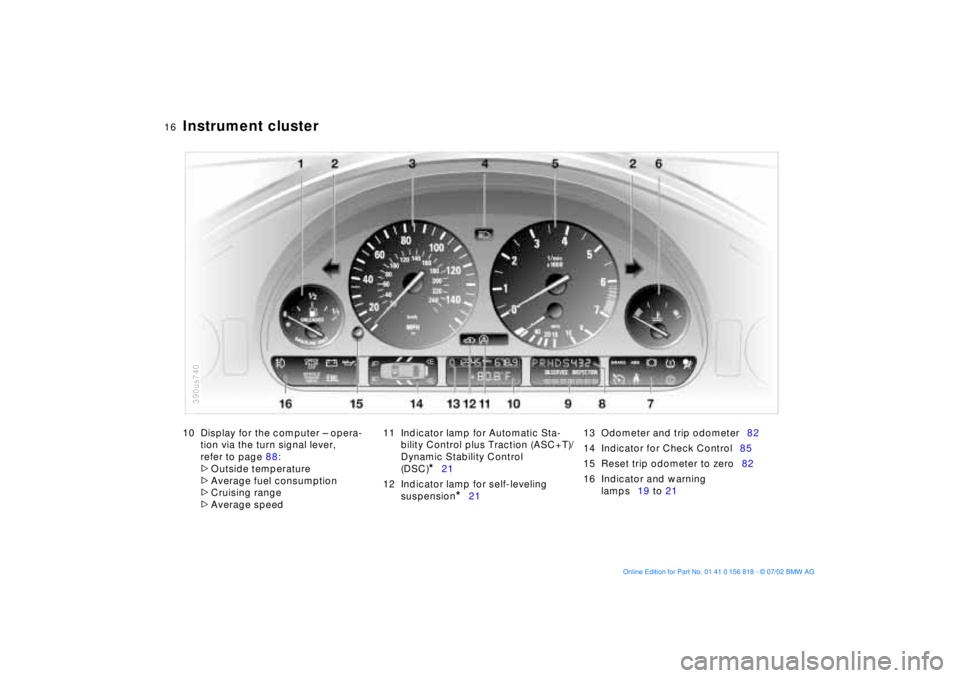
16n
Instrument cluster
10 Display for the computer Ð opera-
tion via the turn signal lever,
refer to page 88:
>
Outside temperature
>
Average fuel consumption
>
Cruising range
>
Average speed11 Indicator lamp for Automatic Sta-
bility Control plus Traction (ASC+T)/
Dynamic Stability Control
(DSC)
*
21
12 Indicator lamp for self-leveling
suspension
*
2113 Odometer and trip odometer82
14 Indicator for Check Control85
15 Reset trip odometer to zero82
16 Indicator and warning
lamps19 to 21
390us740
Page 18 of 187
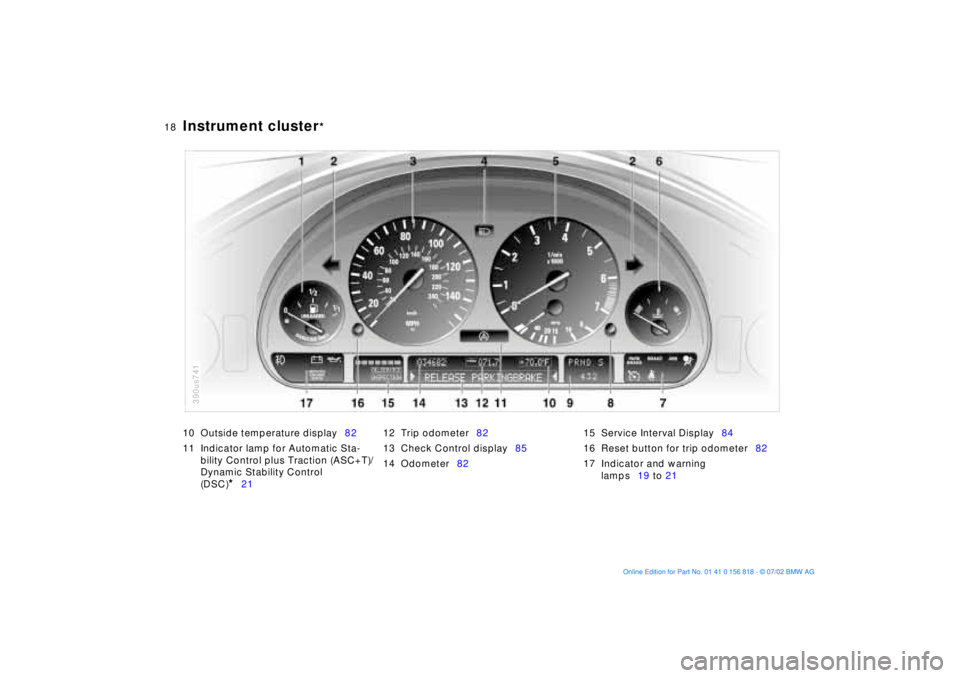
18n
Instrument cluster
*
10 Outside temperature display82
11 Indicator lamp for Automatic Sta-
bility Control plus Traction (ASC+T)/
Dynamic Stability Control
(DSC)
*
2112 Trip odometer82
13 Check Control display85
14 Odometer8215 Service Interval Display84
16 Reset button for trip odometer82
17 Indicator and warning
lamps19 to 21
390us741
Page 21 of 187
21n
OverviewControlsMaintenanceRepairsDataIndex
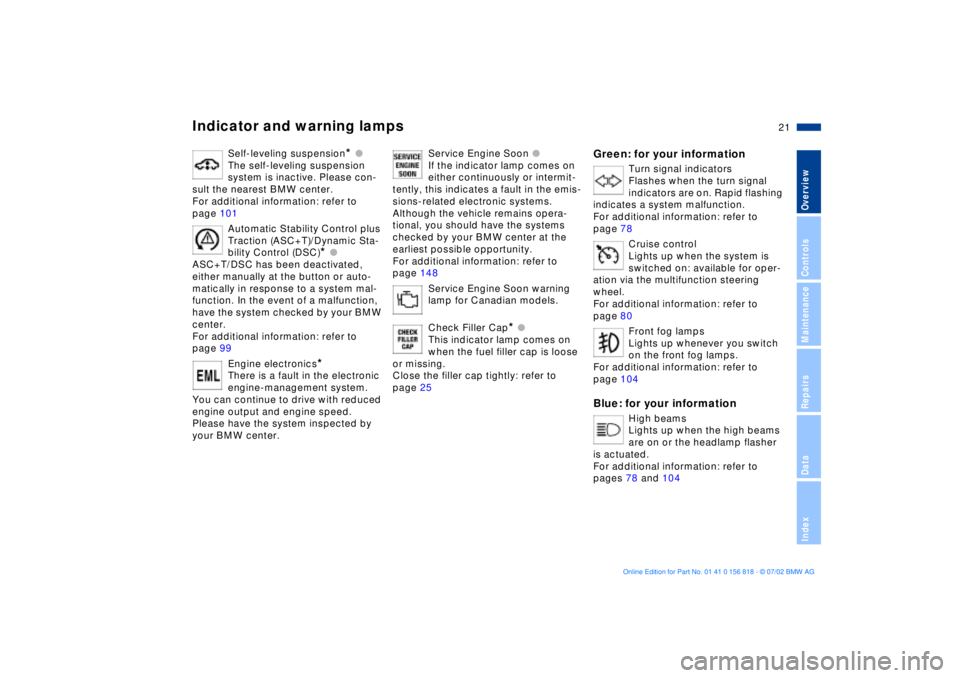
Indicator and warning lamps
Self-leveling suspension
* l
The self-leveling suspension
system is inactive. Please con-
sult the nearest BMW center.
For additional information: refer to
page 101
Automatic Stability Control plus
Traction (ASC+T)/Dynamic Sta-
bility Control (DSC)
* l
ASC+T/DSC has been deactivated,
either manually at the button or auto-
matically in response to a system mal-
function. In the event of a malfunction,
have the system checked by your BMW
center.
For additional information: refer to
page 99
Engine electronics
*
There is a fault in the electronic
engine-management system.
You can continue to drive with reduced
engine output and engine speed.
Please have the system inspected by
your BMW center.
Service Engine Soon l
If the indicator lamp comes on
either continuously or intermit-
tently, this indicates a fault in the emis-
sions-related electronic systems.
Although the vehicle remains opera-
tional, you should have the systems
checked by your BMW center at the
earliest possible opportunity.
For additional information: refer to
page 148
Service Engine Soon warning
lamp for Canadian models.
Check Filler Cap
* l
This indicator lamp comes on
when the fuel filler cap is loose
or missing.
Close the filler cap tightly: refer to
page 25
Green: for your information
Turn signal indicators
Flashes when the turn signal
indicators are on. Rapid flashing
indicates a system malfunction.
For additional information: refer to
page 78
Cruise control
Lights up when the system is
switched on: available for oper-
ation via the multifunction steering
wheel.
For additional information: refer to
page 80
Front fog lamps
Lights up whenever you switch
on the front fog lamps.
For additional information: refer to
page 104
Blue: for your information
High beams
Lights up when the high beams
are on or the headlamp flasher
is actuated.
For additional information: refer to
pages 78 and 104
Page 99 of 187

99n
OverviewControlsMaintenanceRepairsDataIndex
Park Distance Control (PDC)
*
ASC+T/DSC
*
PDC does not remove the driver's
personal responsibility for evalu-
ating the distance between the vehicle
and any obstacles. Even with the sen-
sors, there is a blind spot in which
objects cannot be detected. This
applies especially in those cases where
the system approaches the physical
limits of ultrasonic measurement, as
occurs with tow bars and trailer cou-
plings, and in the vicinity of thin or
wedge-shaped objects.
Certain sources of sound, such as a
loud radio, could drown out the PDC
signal tone.<
Keep the sensors clean and free
of ice or snow in order to ensure
that they continue to operate effec-
tively.
Do not apply high pressure spray to the
sensors for a prolonged period of time.
Maintain an adequate distance of more
than 4 in (10 cm).<
Automatic Stability Control plus
Traction (ASC+T)/Dynamic
Stability Control (DSC)
*
These systems contribute to additional
vehicle stability, especially during
acceleration and when cornering.
The DSC system enhances the benefits
of the ASC+T. In addition to optimizing
vehicle stability and traction during
acceleration or when starting from a
standstill, a further benefit is realized in
cornering. This, of course, is true only
within physically feasible limits.
The system activates automatically
each time you start the engine.
Page 132 of 187

132n
Break-in proceduresTo ensure that your vehicle provides
maximum economy throughout a long
service life, we request that you
observe the following suggestions.Engine and differentialUp to 1,200 miles (2,000 km):
Drive at varying engine speeds and
road speeds, but do not exceed
4,500 rpm and the following road
speeds during this initial period:
BMW 525i, 530i: 100 mph (160 km/h)
BMW 540i: 106 mph (170 km/h).
Comply with all official speed limits.
Refrain from using full throttle and avoid
pressing the accelerator beyond the
kickdown point.
Once you have driven 1,200 miles
(2,000 km), engine and vehicle speeds
can gradually be increased.
You should also comply with these
break-in procedures if the engine or dif-
ferential is replaced later in the course
of the vehicle service life.
TiresOwing to technical factors associated
with their manufacture, tires do not
achieve their full traction potential until
an initial break-in period has elapsed.
For this reason, you should drive with
extra care during the initial 200 miles
(300 km).
Comply with all official speed limits.
When the vehicle is operated on
wet or slushy roads, a wedge of
water may form between the tire and
the road surface. This phenomenon is
referred to as aquaplaning or hydro-
planing, and can lead to partial or com-
plete loss of traction, vehicle control
and braking effectiveness. Reduce your
speed on wet roads.<
Brake systemApprox. 300 miles (500 km) must
elapse before the brake pads and
rotors achieve the optimal pad-surface
and wear patterns required for trouble-
free operation and long service life later
on.
To break-in the separate parking brake
drums, apply the parking brake lightly
when coasting to a standstill (at a traffic
signal, for instance), provided that
traffic conditions allow you to do so.
To avoid corrosion, repeat this proce-
dure from time to time.
The brake lamps do not come on
when the parking brake is applied.
Vacuum for the brake system servo unit
on your BMW is available only when the
engine is running. When you move the
vehicle with the engine switched off Ð
when towing, for instance Ð substan-
tially higher levels of pedal force will be
required to brake the vehicle.< ClutchThe clutch will also begin to function
optimally after about 300 miles
(500 km). Engage the gears carefully
during the break-in period.
Page 136 of 187

136n
Tire replacementTo maintain good handling and vehicle
response, use only tires of a single
tread configuration from a single manu-
facturer. BMW tests wheel and tire
combinations and approves them.DOT Quality GradesTreadwear
Traction AA A B C
Temperature A B C
All passenger car tires must con-
form to Federal Safety Require-
ments in addition to these grades.
when tested under controlled condi-
tions on a specified government test
course.
For example, a tire graded 150 would
wear one and one-half (1 1/2) times as
well on the government course as a tire
graded 100. The relative performance
of tires depends upon the actual condi-
tions of their use, however, and may
depart significantly from the norm due
to variations in driving habits, service
practices and differences in road char-
acteristics and climate.
TractionThe traction grades, from highest to
lowest, are AA, A, B and C.
Those grades represent the tire's ability
to stop on wet pavement as measured
under controlled conditions on speci-
fied government test surfaces of
asphalt and concrete. A tire marked C
may have poor traction performance.
The traction grade assigned to
this tire is based on straight-
ahead braking traction tests, and does
not include acceleration, cornering,
hydroplaning, or peak traction charac-
teristics.<
TemperatureThe temperature grades are A (the
highest), B and C, representing the
tire's resistance to the generation of
heat and its ability to dissipate heat
when tested under controlled condi-
tions on a specified indoor laboratory
test wheel.
Sustained high temperature can cause
the material of the tire to degenerate
and reduce tire life, and excessive tem-
perature can lead to sudden tire failure.
The grade C corresponds to a level of
performance which all passenger car
tires must meet under the Federal
Motor Car Safety Standard No. 109.
Grades B and A represent higher levels
of performance on the laboratory test
wheel than the minimum required by
law.
The temperature grade for this tire
is established for a tire that is
properly inflated and not overloaded.
Excessive speed, underinflation, or
excessive loading, either separately or
in combination, can cause heat buildup
and possible tire failure.<
Page 137 of 187

137n
OverviewControlsMaintenanceRepairsDataIndex
Tire replacement Wheel and tire combinationsUniform Tire Quality GradingQuality grades can be found where
applicable on the tire sidewall between
tread shoulder and maximum section
width. For example:
Treadwear 200 Traction AA
Temperature A
Do not use retreaded tires, since
driving safety may be impaired.
This is due to the possible variations in
casing structures and, in some cases,
to their extreme age, which can lead to
a decrease in their durability.< Tire ageThe date on which the tire was manu-
factured is indicated by the code on the
sidewall:
DOT ... 2601 indicates that the tire was
manufactured in Week 26 of the year
2001.
Although tires may have a theoretical
service life of up to 10 years, BMW
strongly recommends that you replace
all tires after an absolute maximum of
6 years.
The right choice
Never mount wheels and tires that
have not been specifically
approved by BMW for use on your par-
ticular model. Although other wheels
and tires may theoretically have the
same dimensions, variations in factors
such as manufacturing tolerances can
result in contact between tire and body-
work, ultimately leading to serious acci-
dents. If non-approved wheels and tires
are used, BMW cannot evaluate their
suitability, and therefore cannot be held
liable for driving safety.<
BMW has tested certain tires for each
tire size, rated them according to road
safety and approved them. Your BMW
center can inform you which tires have
been tested in this way. Observe pos-
sible national guidelines, e.g. regarding
entry into vehicle documents.
The correct wheel and tire combi-
nation affects different systems
such as ABS, ATC, ASC+T/DSC.
The function of these systems is
impaired if improper wheel and tire
combinations are used.
Always ensure that all of the tires
mounted on the vehicle are the same
series, from the same manufacturer and
with the same tread pattern. If you have
to mount the spare tire in response to a
flat tire, etc., you should remount a tire
of the correct specifications as soon as
possible.<
The use of rims and wheel bolts
that do not meet the specifica-
tions of the original factory-installed
equipment will affect the safe operation
of your vehicle and may cause an acci-
dent and personal injury.
Never mix tires of different design, such
as steel-belted radials with radial bias-
belted or bias-ply tires, etc. Mixing tire
types will adversely affect roadholding
and can lead to loss of vehicle con-
trol.< Storage Store tires in a cool, dry place, pro-
tecting them against light whenever
possible. Protect the tires against con-
tact with oil, grease and fuel.
Page 178 of 187

Everything from A to ZA
ABS (Antilock Brake
System)20, 133
Accessories9
Activated-charcoal
filter114
Active seat52
Adaptive Transmission
Control (ATC)72, 75
Add
antifreeze144t
brake fluid145t
engine coolant144t
engine oil142t
washer fluid141t
Adjusting
backrest50
head restraints52
mirrors57
seats48
steering wheel56
temperature107, 111
thigh support50
Air conditioning106
Air distribution107, 111
Air outlets106, 109
Air pressure,
tires26t, 135
Air supply107, 111
Air vent106, 109
Airbags20, 59 Alarm system42
Anchorage points
child-restraint system with
tether strap62
Antifreeze, disposal144t
Antifreeze, radiator144
Antilock Brake System
(ABS)20, 133
Anti-theft alarm system42
Anti-theft protection34
Approved axle load173
Approved gross vehicle
weight173
Aquaplaning133, 135
ASC+T (Automatic Stability
Control plus Traction)21
ASC+T/DSC (Automatic
Stability Control plus
Traction/Dynamic Stability
Control)99
Ashtray, front119
Ashtray, rear120
ATC (Adaptive Transmission
Control)72, 75
Attach vacuum cleaner120
AUC (Automatic
recirculated-air
control)112 Automatic climate
control109
removing condensation
from windows111
Automatic cruise control80
Automatic curb monitor55
Automatic rear window
cleaning79
Automatic recirculated-air
control (AUC)112
Automatic Stability Control
plus Traction (ASC+T)21
Automatic Stability Control
plus Traction/Dynamic
Stability Control (ASC+T/
DSC)99
Automatic
transmission20, 72
Automatic transmission with
Steptronic20, 75
Average fuel
consumption88
Average speed88, 96
Avoiding unintentional
alarms43t, 44
B
Backrest, adjusting50
Backup lamps
bulb replacement156t Battery162
care162t
charging162t
discharged164t
disposal162t
Belts53
Beverage holder119
Blower107, 111
BMW active seat52
BMW comfort seat51
BMW Maintenance
System146t
BMW Universal
Transmitter115
Bottle holder, refer to
beverage holder119
Brake fluid145
adding145
Brake hydraulic system19
Brake lamps, bulb
replacement156t
Brake malfunctions134
Brake system134
brake fluid level134
brake pads20, 134
disc brakes134
malfunctions134
Break-in procedures132
Bulbs and lamps153t
Page 184 of 187

Everything from A to ZTire Pressure Monitor
(RDC)101
Tire Quality Grading137
Tools152t
Torque170
Tow fittings165t
Towing the vehicle165t
Track171
Traction control system,
refer to ASC+T/DSC
Transmission71, 72, 75
Transmitter key32
Transporting children
safely62
Tread depth, tires135
Trip odometer82
Trunk lid
refer to luggage
compartment lid38
Trunk, refer to luggage
compartment42
Turn signal indicator78
bulb replacement154t
Turning circle171 U
Uniform Tire Quality Grading
(UTQR)137
Universal Transmitter115
Use antifreeze,
radiator144t Used batteries,
disposal162t
Used oils, disposal143t
V
Vacuum cleaner, attach120
Valve caps161
Vehicle Memory67
Vent outlets108, 113
Ventilation106, 108, 113
draft-free108, 113
in the rear108
Viscosity ratings, oils143 W
Warm feet Ð cool
head108, 113
Warning and indicator
lamps19
Warning lamps19t
Warning messages85t
Warning triangle23
Warranty and Service Guide
Booklet (Canadian
models)146
Washer system78
Water on the roads133
Weights173
Wheel and tire
combinations137
Wheel change158t Wheelbase171
Width of vehicle171
Windshield wipers78
blade replacement152t
Winter tires138
Wiper blade
replacement152t
Wiper system78
Work in the engine
compartment139t
X
Xenon lamps154