towing BMW 550I XDRIVE GRAN TURISMO 2012 Owners Manual
[x] Cancel search | Manufacturer: BMW, Model Year: 2012, Model line: 550I XDRIVE GRAN TURISMO, Model: BMW 550I XDRIVE GRAN TURISMO 2012Pages: 321, PDF Size: 12.7 MB
Page 43 of 321
Malfunction
Comfort Access may not function properly if it
experiences interference from external sources
such as mobile phones, metal objects, overhead
power lines, transmission towers, etc.
In this case, open or close the vehicle using the
buttons on the remote control or use the
integrated key in the door lock.
To subsequently start the engine, hold the re‐
mote control against the marked area on the
steering column, refer to page 31.
Alarm system
The concept
The vehicle alarm system responds to:▷Opening of a door, the hood or the tailgate.▷Movements in the vehicle.▷Changes in the vehicle tilt, e.g., during at‐
tempts to steal a wheel or when towing the
car.▷Interruptions in battery voltage.
The alarm system briefly indicates tampering:
▷By sounding an acoustic alarm.▷By switching on the hazard warning system.▷By flashing the high beams.
Arming and disarming the alarm
system
General information
When you lock or unlock the vehicle, either with
the remote control, Comfort Access or at the
door lock the alarm system is armed or disarmed
at the same time.
Door lock and armed alarm system
Unlocking via the door lock will trigger the alarm
on some country-specific versions.
In order to terminate this alarm, unlock vehicle
with the remote control or switch on the ignition,
if necessary, by emergency detection of the re‐
mote control.
Tailgate and armed alarm system
The tailgate can be opened using the remote
control, even if the alarm system is armed.▷Press the button on the remote
control for approx. 1 second.
The large tailgate opens slightly.▷Press the button on the remote
control for approx. 1 second and re‐
lease.
The small tailgate opens slightly.
Note the opening height of the large tail‐
gate
The tailgate pivots back and up when it opens.
Ensure that there is sufficient clearance when
the large tailgate opens; otherwise, damage may
result.◀
After the tailgate is closed, it is locked and moni‐
tored again by the alarm system. The hazard
warning system flashes once.
In some vehicle equipment variants, the tailgate
can only be opened using the remote control if
the vehicle was unlocked first.
Panic mode Press the button on the remote control
for at least 3 seconds.
Switching off the alarm
▷Unlock the vehicle using the remote control.▷With Comfort Access: if you are carrying the
remote control with you, pull on the door
handle.Seite 43Opening and closingControls43
Online Edition for Part no. 01 40 2 607 855 - 09 11 490
Page 120 of 321
the device should be switched off immedi‐
ately. In this case, please contact the man‐
ufacturer and only use the product after the
problem has been corrected.3.The "legal communication" specified above
refers to communication in accordance with
telecommunication regulations. Low-power
devices should withstand interference from
legal communication and ISM devices.
Collision warning with
braking function
The concept
The system issues a two-phase warning of a
danger of collision at speeds above approx.
10 mph/15 km/h. The time of these warnings
may vary depending on the current driving sit‐
uation.
The collision warning is available even if cruise
control has been deactivated.
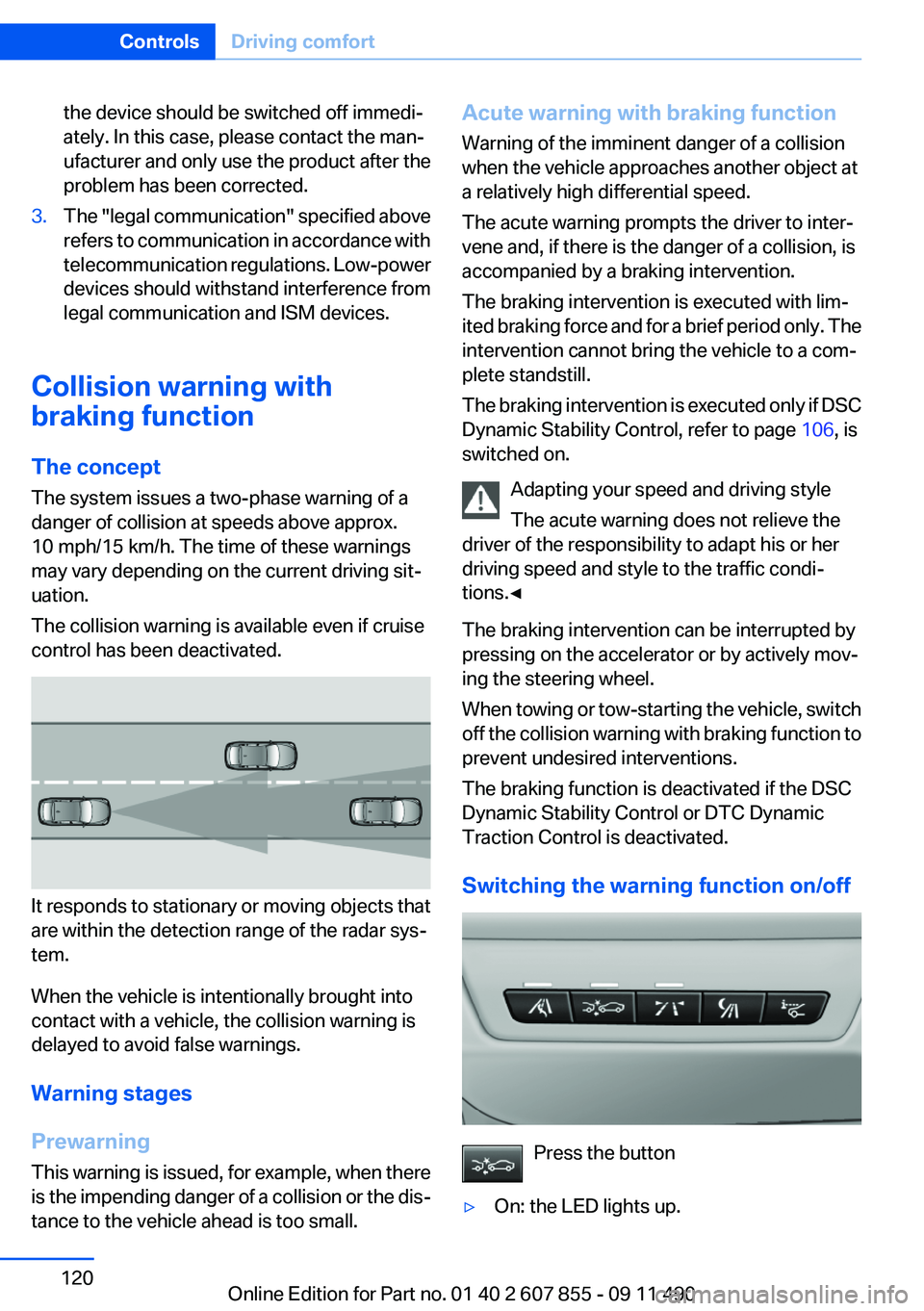
It responds to stationary or moving objects that
are within the detection range of the radar sys‐
tem.
When the vehicle is intentionally brought into
contact with a vehicle, the collision warning is
delayed to avoid false warnings.
Warning stages
Prewarning
This warning is issued, for example, when there
is the impending danger of a collision or the dis‐
tance to the vehicle ahead is too small.
Acute warning with braking function
Warning of the imminent danger of a collision
when the vehicle approaches another object at
a relatively high differential speed.
The acute warning prompts the driver to inter‐
vene and, if there is the danger of a collision, is
accompanied by a braking intervention.
The braking intervention is executed with lim‐
ited braking force and for a brief period only. The
intervention cannot bring the vehicle to a com‐
plete standstill.
The braking intervention is executed only if DSC
Dynamic Stability Control, refer to page 106, is
switched on.
Adapting your speed and driving style
The acute warning does not relieve the
driver of the responsibility to adapt his or her
driving speed and style to the traffic condi‐
tions.◀
The braking intervention can be interrupted by
pressing on the accelerator or by actively mov‐
ing the steering wheel.
When towing or tow-starting the vehicle, switch
off the collision warning with braking function to
prevent undesired interventions.
The braking function is deactivated if the DSC
Dynamic Stability Control or DTC Dynamic
Traction Control is deactivated.
Switching the warning function on/off
Press the button
▷On: the LED lights up.Seite 120ControlsDriving comfort120
Online Edition for Part no. 01 40 2 607 855 - 09 11 490
Page 162 of 321
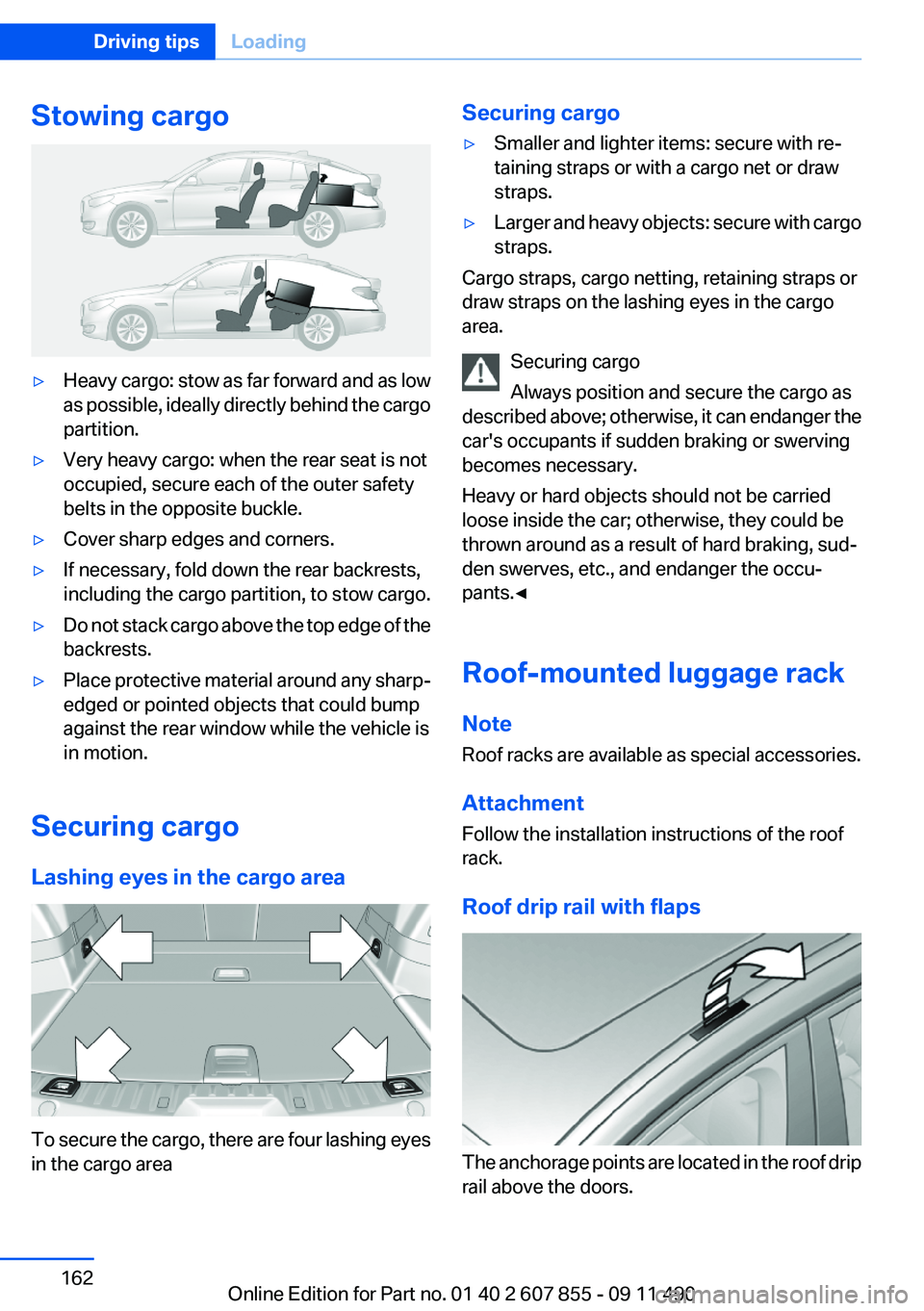
Stowing cargo▷Heavy cargo: stow as far forward and as low
as possible, ideally directly behind the cargo
partition.▷Very heavy cargo: when the rear seat is not
occupied, secure each of the outer safety
belts in the opposite buckle.▷Cover sharp edges and corners.▷If necessary, fold down the rear backrests,
including the cargo partition, to stow cargo.▷Do not stack cargo above the top edge of the
backrests.▷Place protective material around any sharp-
edged or pointed objects that could bump
against the rear window while the vehicle is
in motion.
Securing cargo
Lashing eyes in the cargo area
To secure the cargo, there are four lashing eyes
in the cargo area
Securing cargo▷Smaller and lighter items: secure with re‐
taining straps or with a cargo net or draw
straps.▷Larger and heavy objects: secure with cargo
straps.
Cargo straps, cargo netting, retaining straps or
draw straps on the lashing eyes in the cargo
area.
Securing cargo
Always position and secure the cargo as
described above; otherwise, it can endanger the
car's occupants if sudden braking or swerving
becomes necessary.
Heavy or hard objects should not be carried
loose inside the car; otherwise, they could be
thrown around as a result of hard braking, sud‐
den swerves, etc., and endanger the occu‐
pants.◀
Roof-mounted luggage rack
Note
Roof racks are available as special accessories.
Attachment
Follow the installation instructions of the roof
rack.
Roof drip rail with flaps
The anchorage points are located in the roof drip
rail above the doors.
Seite 162Driving tipsLoading162
Online Edition for Part no. 01 40 2 607 855 - 09 11 490
Page 287 of 321
attempt in order to allow the discharged bat‐
tery to recharge.3.Let both engines run for several minutes.4.Disconnect the jumper cables in the reverse
order.
Check the battery and recharge if necessary.
Tow-starting and towing
Transporting your vehicle
Note
Your vehicle is not permitted to be towed.
Therefore, contact a service center in the event
of a breakdown.
Do not have the vehicle towed
Have your vehicle transported on a loading
platform only; otherwise, damage may occur.◀
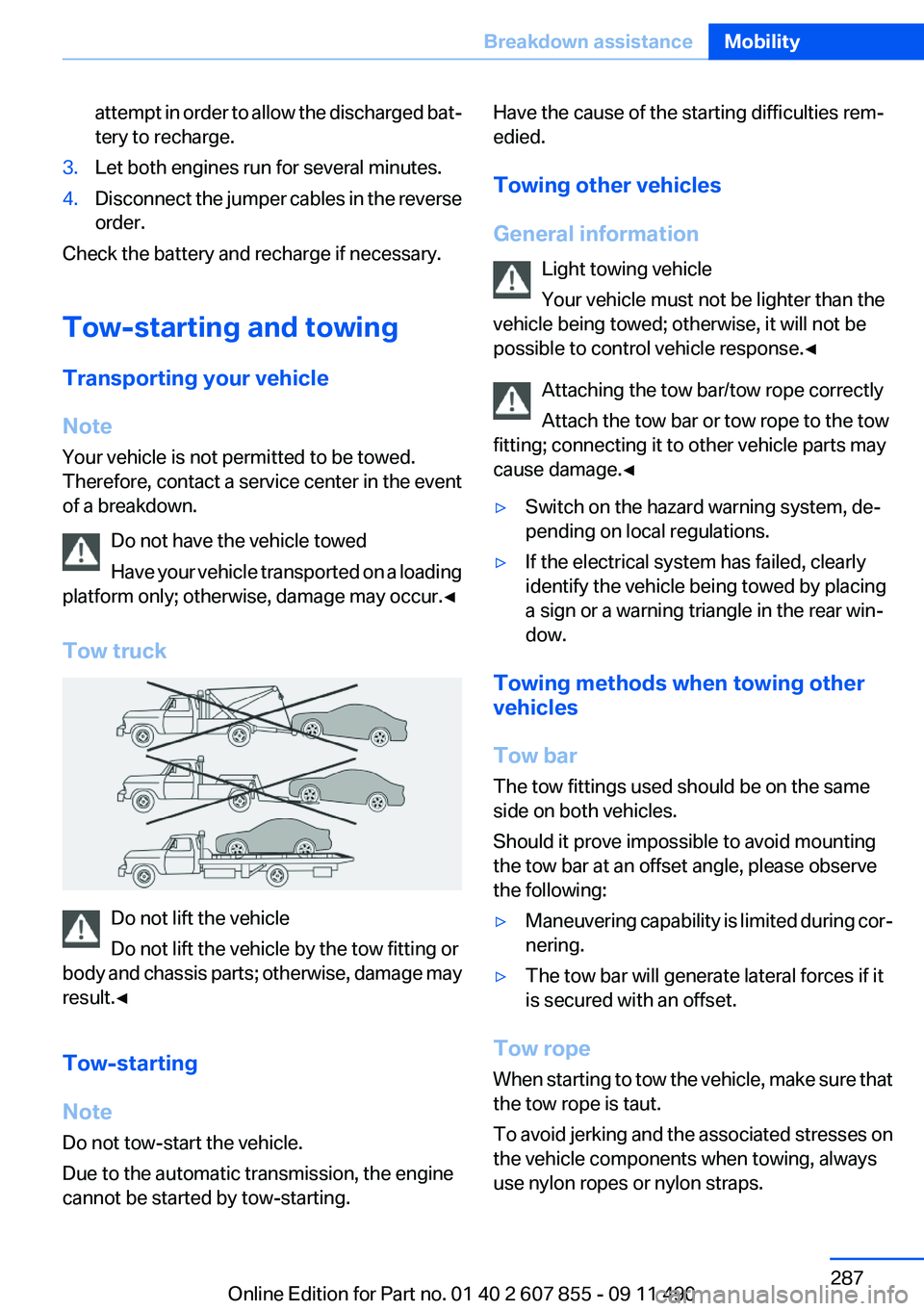
Tow truck
Do not lift the vehicle
Do not lift the vehicle by the tow fitting or
body and chassis parts; otherwise, damage may
result.◀
Tow-starting
Note
Do not tow-start the vehicle.
Due to the automatic transmission, the engine
cannot be started by tow-starting.
Have the cause of the starting difficulties rem‐
edied.
Towing other vehicles
General information Light towing vehicle
Your vehicle must not be lighter than the
vehicle being towed; otherwise, it will not be
possible to control vehicle response.◀
Attaching the tow bar/tow rope correctly
Attach the tow bar or tow rope to the tow
fitting; connecting it to other vehicle parts may
cause damage.◀▷Switch on the hazard warning system, de‐
pending on local regulations.▷If the electrical system has failed, clearly
identify the vehicle being towed by placing
a sign or a warning triangle in the rear win‐
dow.
Towing methods when towing other
vehicles
Tow bar
The tow fittings used should be on the same
side on both vehicles.
Should it prove impossible to avoid mounting
the tow bar at an offset angle, please observe
the following:
▷Maneuvering capability is limited during cor‐
nering.▷The tow bar will generate lateral forces if it
is secured with an offset.
Tow rope
When starting to tow the vehicle, make sure that
the tow rope is taut.
To avoid jerking and the associated stresses on
the vehicle components when towing, always
use nylon ropes or nylon straps.
Seite 287Breakdown assistanceMobility287
Online Edition for Part no. 01 40 2 607 855 - 09 11 490
Page 288 of 321
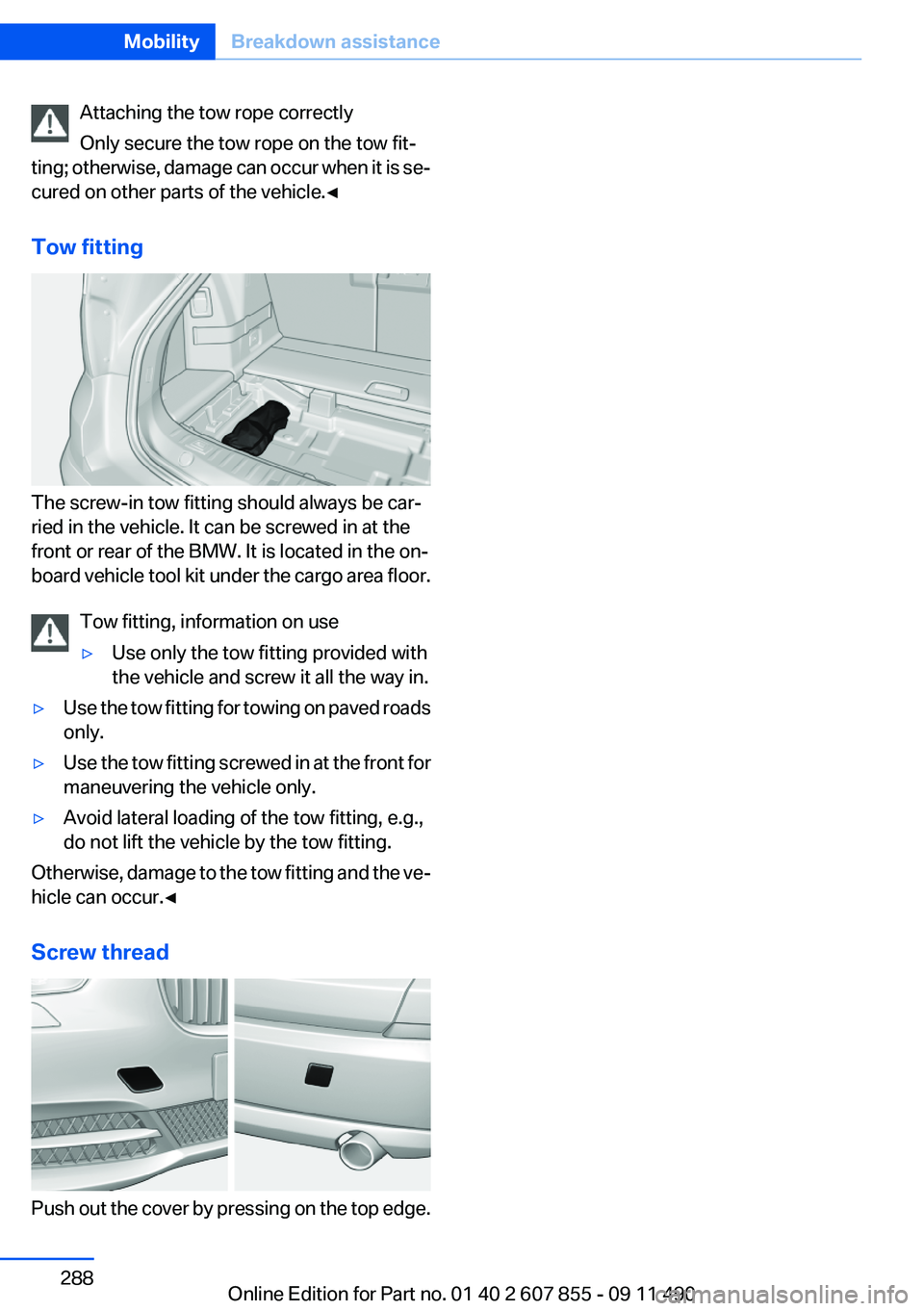
Attaching the tow rope correctly
Only secure the tow rope on the tow fit‐
ting; otherwise, damage can occur when it is se‐
cured on other parts of the vehicle.◀
Tow fitting
The screw-in tow fitting should always be car‐
ried in the vehicle. It can be screwed in at the
front or rear of the BMW. It is located in the on‐
board vehicle tool kit under the cargo area floor.
Tow fitting, information on use
▷Use only the tow fitting provided with
the vehicle and screw it all the way in.▷Use the tow fitting for towing on paved roads
only.▷Use the tow fitting screwed in at the front for
maneuvering the vehicle only.▷Avoid lateral loading of the tow fitting, e.g.,
do not lift the vehicle by the tow fitting.
Otherwise, damage to the tow fitting and the ve‐
hicle can occur.◀
Screw thread
Push out the cover by pressing on the top edge.
Seite 288MobilityBreakdown assistance288
Online Edition for Part no. 01 40 2 607 855 - 09 11 490
Page 313 of 321
Engine oil additives 274
Engine oil change 274
Engine oil filler neck 273
Engine oil temperature 81
Engine oil types, alterna‐ tive 274
Engine oil types, ap‐ proved 274
Engine start during malfunc‐ tion 31
Engine start, refer to Starting the engine 68
Engine start, Starting aid 285
Engine stop 68
Engine temperature 81
Entering a car wash 289
Equalizer 186
Equipment, interior 143
ESP Electronic Stability Pro‐ gram, refer to DSC 106
Exchanging wheels/tires 267
Exhaust system 158
Exterior mirror, automatic dim‐ ming feature 61
Exterior mirrors 60
External devices 208
External start 285
External temperature dis‐ play 82
External temperature warn‐ ing 82
Eyes for securing cargo 162
F
Fader 186
Failure message, refer to Check Control 79
False alarm, refer to Uninten‐ tional alarm 44
Fan, refer to Air volume 137
Fault displays, refer to Check Control 79
Filler neck for engine oil 273
Fine wood, care 291
First aid kit 285 Fitting for towing, refer to Tow
fitting 288
Flat tire, changing wheels 282
Flat Tire Monitor FTM 100
Flat tire, Tire Pressure Monitor TPM 97
Flat tire, warning lamp 98, 101
Flooding 159
Floor carpet, care 291
Floor mats, care 291
FM/AM station 188
Fold-out position, windshield wipers 74
Foot brake 159
Front airbags 94
Front fog lamps 92
Front fog lamps, front, bulb re‐ placement 280
Front lamps 279
Front passenger airbags, au‐ tomatic deactivation 96
Front passenger airbags, indi‐ cator lamp 96
FTM Flat Tire Monitor 100
Fuel cap 258
Fuel consumption, current 83
Fuel consumption, refer to Average fuel consump‐
tion 85
Fuel filler flap 258
Fuel gauge 81
Fuel quality 260
Fuel, tank capacity 299
Fuse 283
G
Garage door opener, refer to Integrated universal remote
control 143
Gas station recommenda‐ tion 178
Gear change, automatic trans‐ mission 75
General driving notes 158 Glass sunroof, refer to Panor‐
amic glass sunroof 46
Glove compartment 150
Gong, volume equaliza‐ tion 187
GPS navigation, refer to Navi‐ gation system 168
Gray display of the map 181
Gross vehicle weight, ap‐ proved 298
Gross weight, permissible for trailer towing 298
H
Hand brake, refer to Parking brake 69
Hand-held transmitter, alter‐ nating code 144
Hazard warning flashers 284
HDC Hill Descent Control 108
HD Radio 189
Head airbags 94
Headlamp control, auto‐ matic 90
Headlamp courtesy delay fea‐ ture 90
Headlamp courtesy delay fea‐ ture via remote control 35
Headlamp flasher 73
Headlamp glass 279
Headlamps 279
Headlamps, care 290
Headlamp washer system 73
Headliner 15
Headphones, rear entertain‐ ment 221
Head restraints 49
Head restraints, front 57
Head restraints, rear 58
Head-up Display 134
Head-up Display, care 292
Heavy cargo, stowing 162
Height with roof-mounted aer‐ ial, vehicle 296
High-beam Assistant 91 Seite 313Everything from A to ZReference313
Online Edition for Part no. 01 40 2 607 855 - 09 11 490
Page 315 of 321
Locking/unlocking with re‐mote control 34
Locking, automatic 37
Locking, central 33
Locking via tailgate 39
Lock, power window 45
Locks, doors, and win‐ dows 66
Low beams 89
Low beams, automatic, refer to High-beam Assistant 91
Lower back support 51
Luggage rack, refer to Roof- mounted luggage rack 162
Lumbar support 51
M
Maintenance 276
Maintenance require‐ ments 276
Maintenance, service require‐ ments 83
Maintenance system, BMW 276
Malfunction displays, refer to Check Control 79
Malfunction, self-leveling sus‐ pension 110
Manual air distribution 137
Manual air volume 137
Manual brake, refer to Parking brake 69
Manual mode, transmis‐ sion 76
Manual operation, backup camera 128
Manual operation, door lock 37
Manual operation, exterior mir‐ rors 60
Manual operation, fuel filler flap 258
Manual operation, Park Dis‐ tance Control PDC 124 Manual operation, parking
brake 69
Manual operation, Side View 130
Manual operation, Top View 126
Map, destination entry 173
Map in split screen 180
Map view 178
Marking on approved tires 268
Marking, run-flat tires 269
Massage seat, front 52
Master key, refer to Remote control 30
Maximum cooling 138
Maximum speed, winter tires 268
Measure, units of 88
Medical kit 285
Memory for seat, mirrors, steering wheel 59
Menu in instrument cluster 84
Menus, operating, iDrive 16
Menus, refer to iDrive operat‐ ing concept 17
Message list, traffic bulle‐ tins 180
Messages 241
Messages, refer to Check Control 79
Microfilter 139
Minimum tread, tires 266
Mirror 60
Mirror memory 59
Mobile communication devi‐ ces in the vehicle 159
Mobile phone 226
Modifications, technical, refer to Safety 6
Moisture in headlamp 279
Monitor, refer to Control Dis‐ play 16
Mounting of child restraint fix‐ ing systems 63
MP3 player 208 Multi-function hook 153
Multifunction steering wheel, buttons 12
Multimedia 196
Music collection 203
Music search 205
Music, storing 203
N
Navigation 168
Navigation data 182
Neck restraints, front, refer to Head restraints 57
Neck restraints, rear, refer to Head restraints 58
New wheels and tires 267
Night Vision with pedestrian detection 131
Notes 245
Nylon rope for tow-starting/ towing 287
O
OBD Onboard Diagnos‐ tics 277
Obstacle marking, backup camera 129
Odometer 82
Office 238
Oil 273
Oil, adding 273
Oil additives 274
Oil change 274
Oil change interval, service re‐ quirements 83
Oil filler neck 273
Oil level check 273
Oil types, alternative 274
Oil types, approved 274
Old batteries, disposal 282
Onboard Diagnostics OBD 277
Onboard monitor, refer to Control Display 16 Seite 315Everything from A to ZReference315
Online Edition for Part no. 01 40 2 607 855 - 09 11 490
Page 318 of 321
Switch, refer to Cockpit 12
Symbols 6
T
Tachometer 81
Tail and brake lamps 281
Tailgate 38
Tailgate, automatic 39
Tailgate, emergency unlock‐ ing 41
Tailgate, hotel function 41
Tailgate via remote control 35
Tail lamps 281
Tail lamps, bulb replace‐ ment 281
Tasks 244
Technical changes, refer to Safety 6
Technical data 296
TeleService 250
Temperature, automatic cli‐ mate control 137
Temperature display, external temperature 82
Temperature, engine oil 81
Tempomat, refer to Active Cruise Control 114
Terminal, starting aid 286
Text messages 241
Text message, supplemen‐ tary 81
Theft alarm system, refer to Alarm system 43
Theft protection, refer to Cen‐ tral locking system 33
Thermal camera, refer to Night Vision 131
Through-loading system 147
Tilt alarm sensor 44
Time of arrival 85
Tire damage 266
Tire identification marks 265
Tire inflation pressure 261
Tire inflation pressure monitor, refer to FTM 100 Tire Pressure Monitor
TPM 97
Tires, changing 267
Tires, everything on wheels and tires 261
Tires, run-flat tires 269
Tire tread 266
Toll roads, route 176
Tone 186
Tools 278
Top View 126
Total vehicle weight 298
Tow fitting 288
Towing 287
Town/city, navigation 169
Tow-starting 287
TPM Tire Pressure Moni‐ tor 97
Traction control 107
TRACTION program, Dynamic Driving Control 111
Traffic bulletins, naviga‐ tion 180
Transmission, automatic 75
Transporting children safely 63
Tread, tires 266
Treble, tone 186
Trip computer 86
Triple turn signal activa‐ tion 72
Trip odometer 82
Trunk cover 146
Trunk lid 38
Trunk lid, automatic 39
Trunk lid, emergency unlock‐ ing 41
Trunk lid, hotel function 41
Trunk lid via remote con‐ trol 35
Turning circle 297
Turning circle lines, backup camera 128
Turn signals, operation 72
Turn signals, rear, bulb re‐ placement 281 U
Unintentional alarm 44
Units of measure 88
Universal remote control 143
Unlock button, automatic transmission 76
Unlocking/locking from in‐ side 37
Unlocking/locking via door lock 36
Unlocking/locking with remote control 34
Updates made after the edito‐ rial deadline 6
Updating software 215
Upholstery care 290
USB audio interface 209
USB interface 150
V
Variable steering, Integral Ac‐ tive Steering 109
Vehicle battery 282
Vehicle battery, replacing 282
Vehicle, breaking in 158
Vehicle care 290
Vehicle equipment 6
Vehicle identification number, refer to Identification number
in the engine compart‐
ment 271
Vehicle jack 282
Vehicle paint 290
Vehicle storage 292
Vehicle wash 289
Ventilation 139
Ventilation, refer to Parked-car ventilation 141
Version of the navigation data 182
Video playback 198
Video playback, iPhone 211
Video playback, snap-in adapter 211 Seite 318ReferenceEverything from A to Z318
Online Edition for Part no. 01 40 2 607 855 - 09 11 490