towing BMW 6 SERIES CONVERTIBLE 2014 F12 Owner's Manual
[x] Cancel search | Manufacturer: BMW, Model Year: 2014, Model line: 6 SERIES CONVERTIBLE, Model: BMW 6 SERIES CONVERTIBLE 2014 F12Pages: 255, PDF Size: 5.37 MB
Page 48 of 255
Pinch hazard when moving back the seat
If this function is used, first make sure
that the footwell behind the driver's seat is
empty. Otherwise, people might get injured or
objects damaged when the seat is moved
back.◀
The adjustment procedure is interrupted:▷When a seat position reel is pressed.▷When a button of the seat, mirror, and
steering wheel memory is pressed briefly.
Activating the setting
1."Settings"2."Doors/key"3."Last seat position autom."
Alarm system
The conceptWhen the vehicle is locked, the vehicle alarm
system responds to:
▷Opening a door, the hood or the trunk lid.▷Movements in the interior.▷Changes in the vehicle tilt, e. g., during at‐
tempts at stealing a wheel or when towing
the car.▷Disconnected battery voltage.
The alarm system briefly signals tampering:
▷By sounding an acoustic alarm.▷By switching on the hazard warning sys‐
tem.▷By flashing the daytime running lights.
Arming and disarming the alarm
system
When you unlock or lock the vehicle, either
with the remote control, Comfort Access or at
the door lock the alarm system is disarmed or
armed at the same time.
Door lock and armed alarm system
Unlocking via the door lock will trigger the
alarm on some country-specific versions.
Trunk lid and armed alarm system The trunk lid can be opened even when the
alarm system is armed.
After the trunk lid is closed, it is locked and
monitored again when the doors are locked.
The hazard warning system flashes once.
Panic mode
You can trigger the alarm system if you find
yourself in a dangerous situation.
Press button on the remote control for
at least 3 seconds.
To reel off the alarm: press any button.
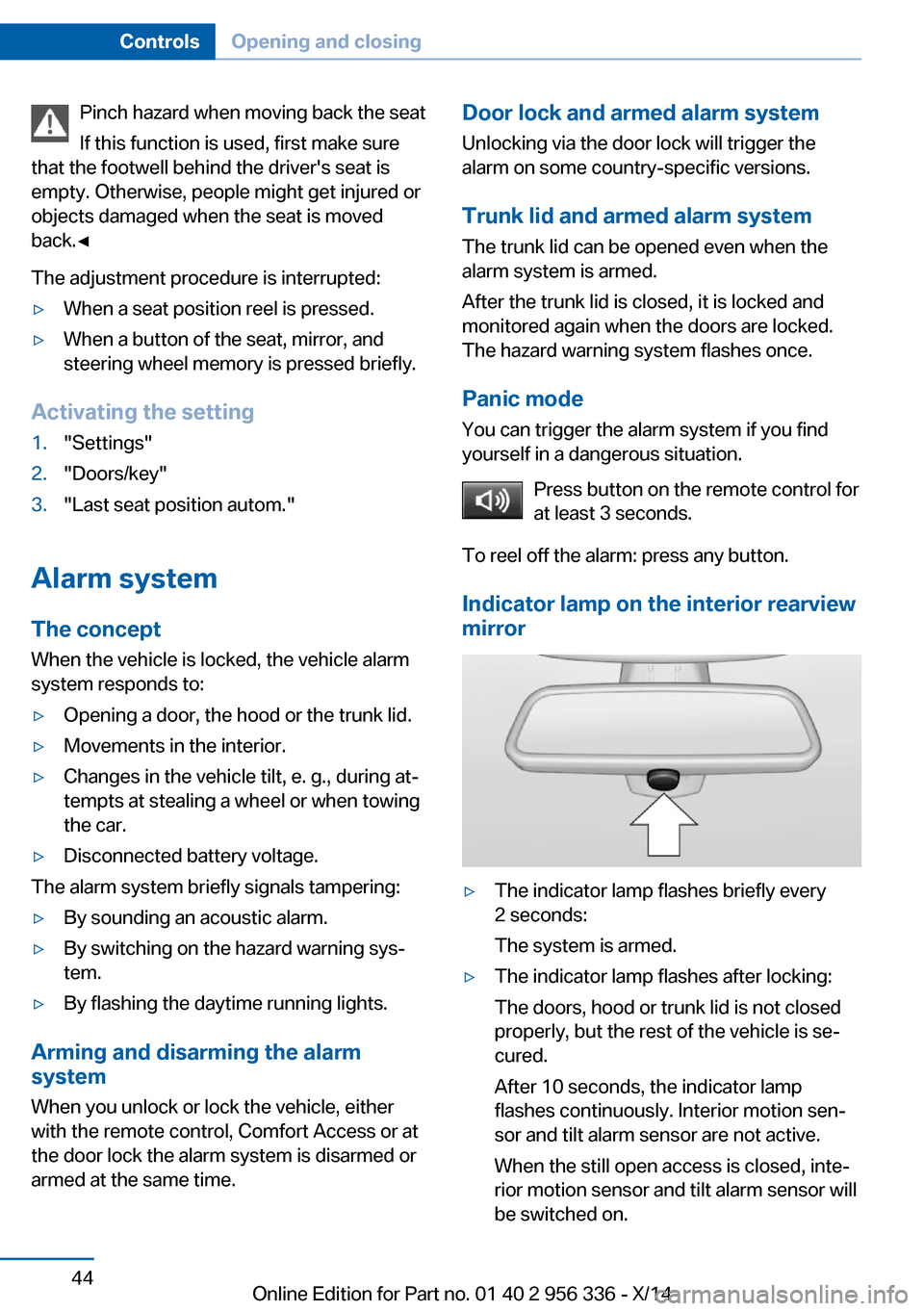
Indicator lamp on the interior rearview
mirror▷The indicator lamp flashes briefly every
2 seconds:
The system is armed.▷The indicator lamp flashes after locking:
The doors, hood or trunk lid is not closed
properly, but the rest of the vehicle is se‐
cured.
After 10 seconds, the indicator lamp
flashes continuously. Interior motion sen‐
sor and tilt alarm sensor are not active.
When the still open access is closed, inte‐
rior motion sensor and tilt alarm sensor will
be switched on.Seite 44ControlsOpening and closing44
Online Edition for Part no. 01 40 2 956 336 - X/14
Page 122 of 255
Setting the warning timeThe warning time can be set via iDrive.1."Settings"2."Frontal Coll. Warning"3.Activate the desired time on the Control
Display.
The selected time is stored for the profile cur‐
rently in use.
Warning with braking function
Note Adapting your speed and driving style
The warning does not relieve the driver
of the responsibility to adapt his or her driving
speed and style to the traffic conditions.◀
Display
If a collision with a recognized vehicle is immi‐
nent a warning symbol appears in the instru‐
ment cluster and in the Head-Up Display.
SymbolMeasureThe vehicle lights up red: prewarn‐
ing.
Brake and increase distance.The vehicle flashes red and an
acoustic signal sounds: acute warn‐
ing.
You are requested to intervene by
braking or make an evasive maneu‐
ver.
Prewarning
This warning is issued, e.g., when there is the
impending danger of a collision or the distance
to the vehicle ahead is too small.
The driver must intervene actively when there
is a prewarning.
Acute warning with braking function
Warning of the imminent danger of a collision
when the vehicle approaches another object at
a relatively high differential speed.
The driver must intervene actively when there
is an acute warning. If necessary, the driver is
assisted by an automatic braking intervention
in a possible risk of collision.
Acute warnings can also be triggered without
previous prewarning.
Braking intervention
The warning prompts the driver himself/herself
to react. During a warning, the maximum brak‐
ing force is used. Premise for the brake boos‐
ter is sufficiently quick and hard stepping on
the brake pedal. The system can assist with
automatic braking intervention if there is risk of
a collision. The intervention can bring the vehi‐
cle to a complete stop.
The braking intervention is executed only if
DSC Dynamic Stability Control is switched on
and Dynamic Traction Control DTC is acti‐
vated.
Above approx. 130 mph/210 km/h the braking
intervention occurs as a brief braking pressure.
No automatic delay occurs.
The braking intervention can be interrupted by
stepping on the accelerator pedal or by ac‐
tively moving the steering wheel.
Object detection can be restricted. Limitations
of the detection range and functional restric‐
tions are to be considered.
Tow-starting and towing
For towing the vehicle turn, switch off the
Intelligent Safety systems; otherwise malfunc‐
tions of the individual braking systems might
lead to accidents.◀Seite 118ControlsSafety118
Online Edition for Part no. 01 40 2 956 336 - X/14
Page 125 of 255
SymbolMeasureThe vehicle lights up red: prewarn‐
ing.
Brake and increase distance.The vehicle flashes red and an
acoustic signal sounds: acute warn‐
ing.
You are requested to intervene by
braking or make an evasive maneu‐
ver.
Prewarning
This warning is issued, e.g., when there is the
impending danger of a collision or the distance
to the vehicle ahead is too small.
The driver must intervene actively when there
is a prewarning.
Acute warning with braking function
Warning of the imminent danger of a collision
when the vehicle approaches another object at
a relatively high differential speed.
The driver must intervene actively when there
is an acute warning. If necessary, the driver is
assisted by a minor automatic braking inter‐
vention in a possible risk of collision.
Acute warnings can also be triggered without
previous prewarning.
Braking intervention The warning prompts the driver himself/herself
to react. During a warning, the maximum brak‐
ing force is used. Premise for the brake boos‐
ter is sufficiently quick and hard stepping on
the brake pedal. The system can assist with
some braking intervention if there is risk of a
collision. At low speeds vehicles may thus
come to a complete stop.
The braking intervention is executed only if
DSC Dynamic Stability Control is switched on
and Dynamic Traction Control DTC is acti‐
vated.
The braking intervention can be interrupted by
stepping on the accelerator pedal or by ac‐
tively moving the steering wheel.
Object detection can be restricted. Limitations
of the detection range and functional restric‐
tions are to be considered.
Tow-starting and towing
For towing the vehicle turn, switch off the
Intelligent Safety systems; otherwise malfunc‐
tions of the individual braking systems might
lead to accidents.◀
System limits Be alert
Due to system limitations, warnings may
be not issued at all, or may be issued late or
improperly. Therefore, always be alert and
ready to intervene; otherwise, there is the risk
of an accident.◀
Detection range The system's detection potential is limited.
Thus a warning might not be issued or be is‐
sued late.
E. g. the following situations may not be de‐
tected:▷Slow moving vehicles when you approach
them at high speed.▷Vehicles that suddenly swerve in front of
you, or sharply decelerating vehicles.▷Vehicles with an unusual rear appearance.▷Two-wheeled vehicles ahead of you.
Functional limitations
The system may not be fully functional in the
following situations:
▷In heavy fog, rain, sprayed water or snow‐
fall.▷In tight curves.▷If the driving stability control systems are
limited or deactivated, e.g., DSC OFF.Seite 121SafetyControls121
Online Edition for Part no. 01 40 2 956 336 - X/14
Page 128 of 255
Tow-starting and towing
For towing the vehicle turn, switch off the
Intelligent Safety systems; otherwise malfunc‐
tions of the individual braking systems might
lead to accidents.◀
System limits Be alert
Due to system limitations, warnings may
be not issued at all, or may be issued late or
improperly. Therefore, always be alert and
ready to intervene; otherwise, there is the risk
of an accident.◀
Detection range
The detection potential of the camera is lim‐
ited.
Thus a warning might not be issued or be is‐
sued late.
E. g. the following situations may not be de‐
tected:▷Partially covered pedestrians.▷Pedestrians that are not detected as such
because of the viewing angle or contour.▷Pedestrians outside of the detection range.▷Pedestrians having a body size less than
32 in/80 cm.
Functional limitations
The system may not be fully functional or may
not be available in the following situations:
▷In heavy fog, rain, sprayed water or snow‐
fall.▷In tight curves.▷If the driving stability control systems are
deactivated, e.g. DSC OFF.▷If the camera viewing field or the front
windshield are dirty or covered.▷Up to 10 seconds after the start of the en‐
gine, via the Start/Stop knob.▷During calibration of the camera immedi‐
ately after vehicle shipment.▷If there is constant blinding effects be‐
cause of oncoming light, e.g., from the sun
low in the sky.▷When it is dark outside.
Night Vision with Pedestrian
and Animal Detection
The concept Night Vision with pedestrian and animal detec‐
tion is a night vision system.
An infrared camera scans the area in front of
the vehicle and issues a warning if it detects
pedestrians and animals on the street. Warm
objects that are similar in shape to human be‐
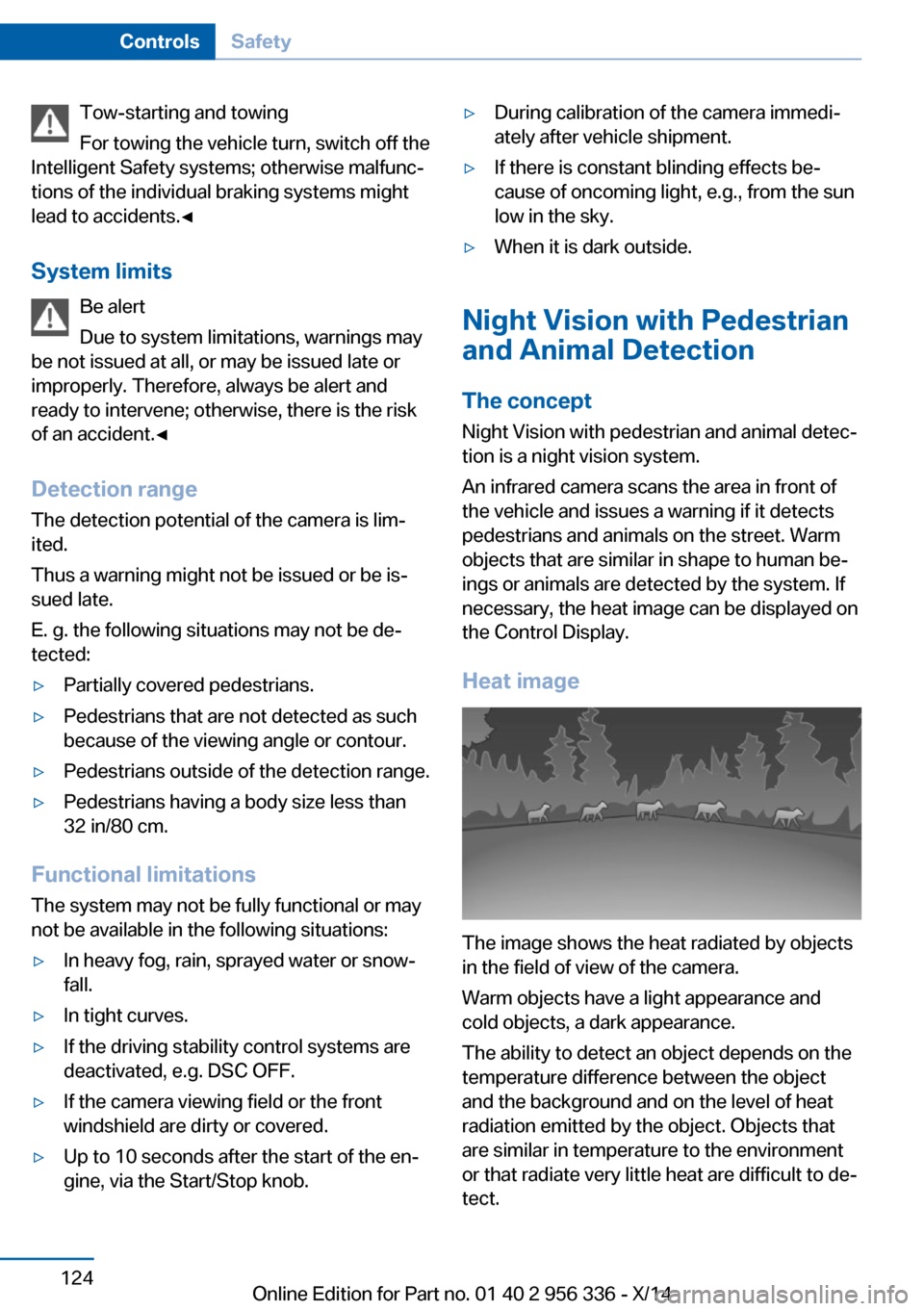
ings or animals are detected by the system. If necessary, the heat image can be displayed on
the Control Display.
Heat image
The image shows the heat radiated by objects
in the field of view of the camera.
Warm objects have a light appearance and
cold objects, a dark appearance.
The ability to detect an object depends on the
temperature difference between the object
and the background and on the level of heat
radiation emitted by the object. Objects that
are similar in temperature to the environment
or that radiate very little heat are difficult to de‐
tect.
Seite 124ControlsSafety124
Online Edition for Part no. 01 40 2 956 336 - X/14
Page 176 of 255
Ski bag
Capacity The ski bag makes it possible to transport two
pairs of skis up to a length of 6 ft/2.10 m.
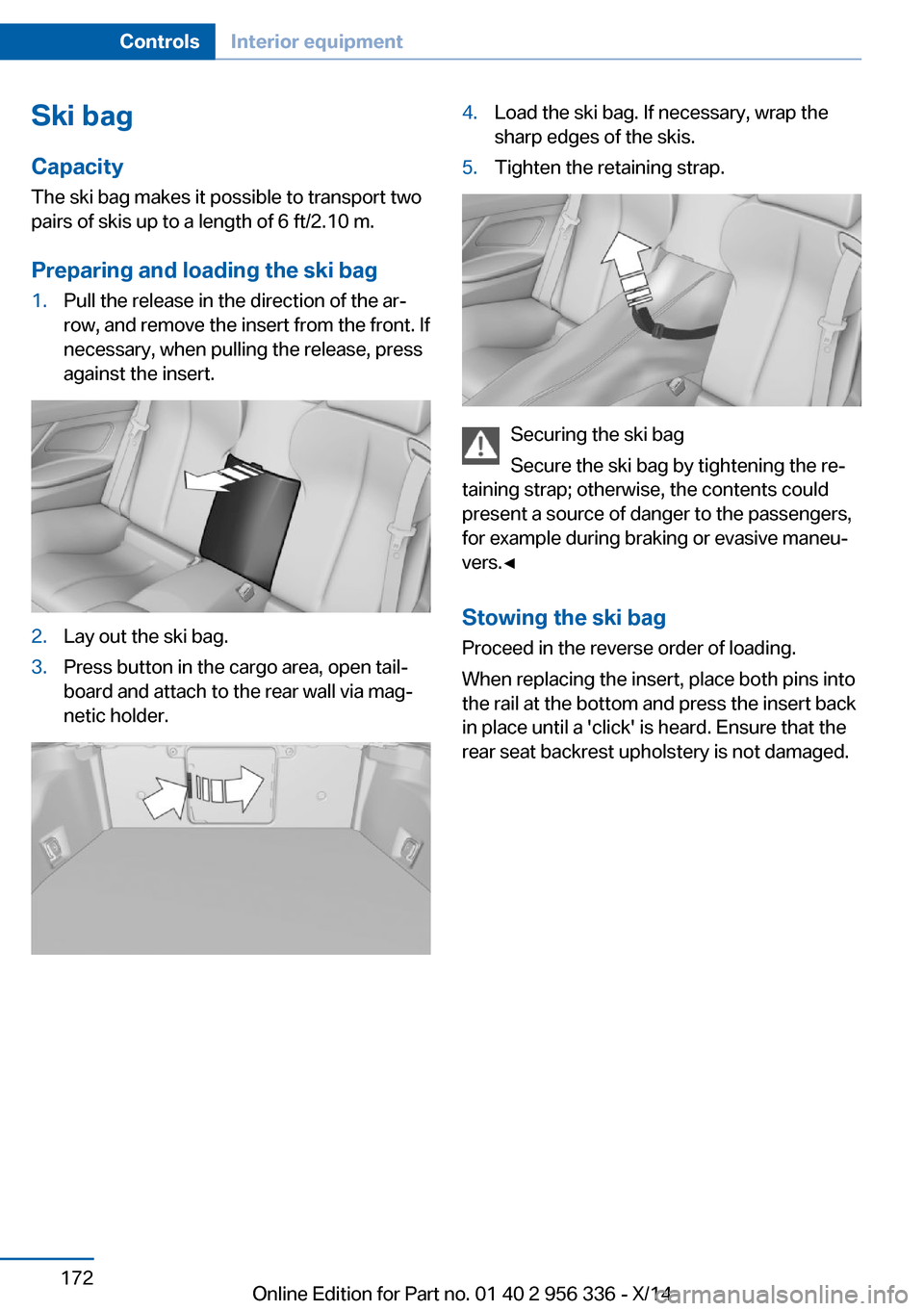
Preparing and loading the ski bag1.Pull the release in the direction of the ar‐
row, and remove the insert from the front. If
necessary, when pulling the release, press
against the insert.2.Lay out the ski bag.3.Press button in the cargo area, open tail‐
board and attach to the rear wall via mag‐
netic holder.4.Load the ski bag. If necessary, wrap the
sharp edges of the skis.5.Tighten the retaining strap.
Securing the ski bag
Secure the ski bag by tightening the re‐
taining strap; otherwise, the contents could
present a source of danger to the passengers,
for example during braking or evasive maneu‐
vers.◀
Stowing the ski bag Proceed in the reverse order of loading.
When replacing the insert, place both pins into
the rail at the bottom and press the insert back
in place until a 'click' is heard. Ensure that the
rear seat backrest upholstery is not damaged.
Seite 172ControlsInterior equipment172
Online Edition for Part no. 01 40 2 956 336 - X/14
Page 186 of 255
Load
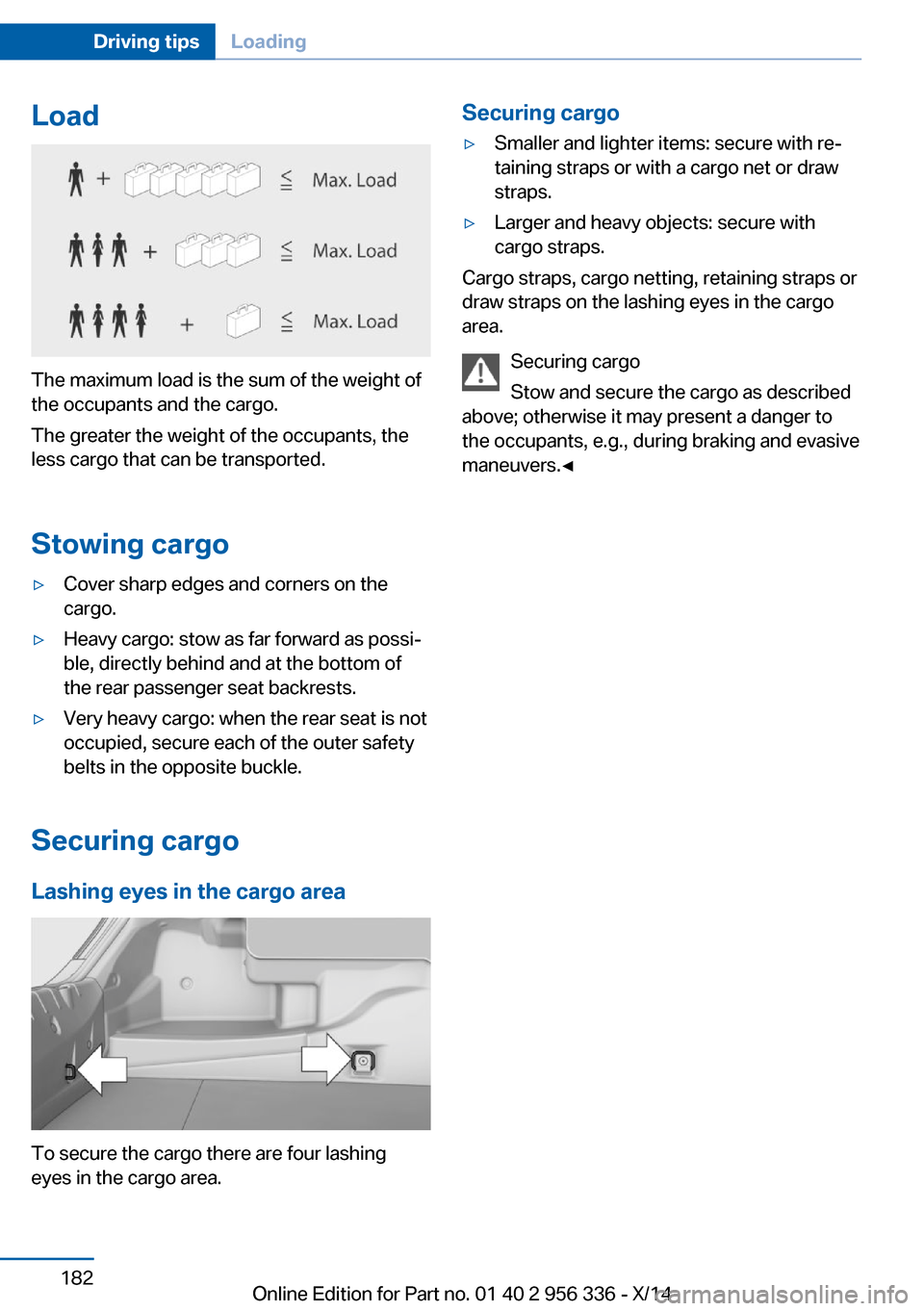
The maximum load is the sum of the weight of
the occupants and the cargo.
The greater the weight of the occupants, the
less cargo that can be transported.
Stowing cargo
▷Cover sharp edges and corners on the
cargo.▷Heavy cargo: stow as far forward as possi‐
ble, directly behind and at the bottom of
the rear passenger seat backrests.▷Very heavy cargo: when the rear seat is not
occupied, secure each of the outer safety
belts in the opposite buckle.
Securing cargo
Lashing eyes in the cargo area
To secure the cargo there are four lashing
eyes in the cargo area.
Securing cargo▷Smaller and lighter items: secure with re‐
taining straps or with a cargo net or draw
straps.▷Larger and heavy objects: secure with
cargo straps.
Cargo straps, cargo netting, retaining straps or
draw straps on the lashing eyes in the cargo
area.
Securing cargo
Stow and secure the cargo as described
above; otherwise it may present a danger to
the occupants, e.g., during braking and evasive
maneuvers.◀
Seite 182Driving tipsLoading182
Online Edition for Part no. 01 40 2 956 336 - X/14
Page 230 of 255
corresponding engine or body ground of
the vehicle to be started.
Starting the engine
Never use spray fluids to start the engine.
1.Start the engine of the assisting vehicle
and let it run for several minutes at an in‐
creased idle speed.2.Start the engine of the vehicle that is to be
started in the usual way.
If the first starting attempt is not success‐
ful, wait a few minutes before making an‐
other attempt in order to allow the dis‐
charged battery to recharge.3.Let both engines run for several minutes.4.Disconnect the jumper cables in the re‐
verse order.
Check the battery and recharge if needed.
Tow-starting and towing Note Tow-starting and towing
For towing the vehicle turn, switch off the
Intelligent Safety systems; otherwise malfunc‐
tions of the individual braking systems might
lead to accidents.◀
Steptronic transmission: transporting
your vehicle
Note Your vehicle is not permitted to be towed.
Therefore, contact a service center in the
event of a breakdown.
Do not have the vehicle towedHave your vehicle transported on a load‐
ing platform only; otherwise, damage may oc‐
cur.◀
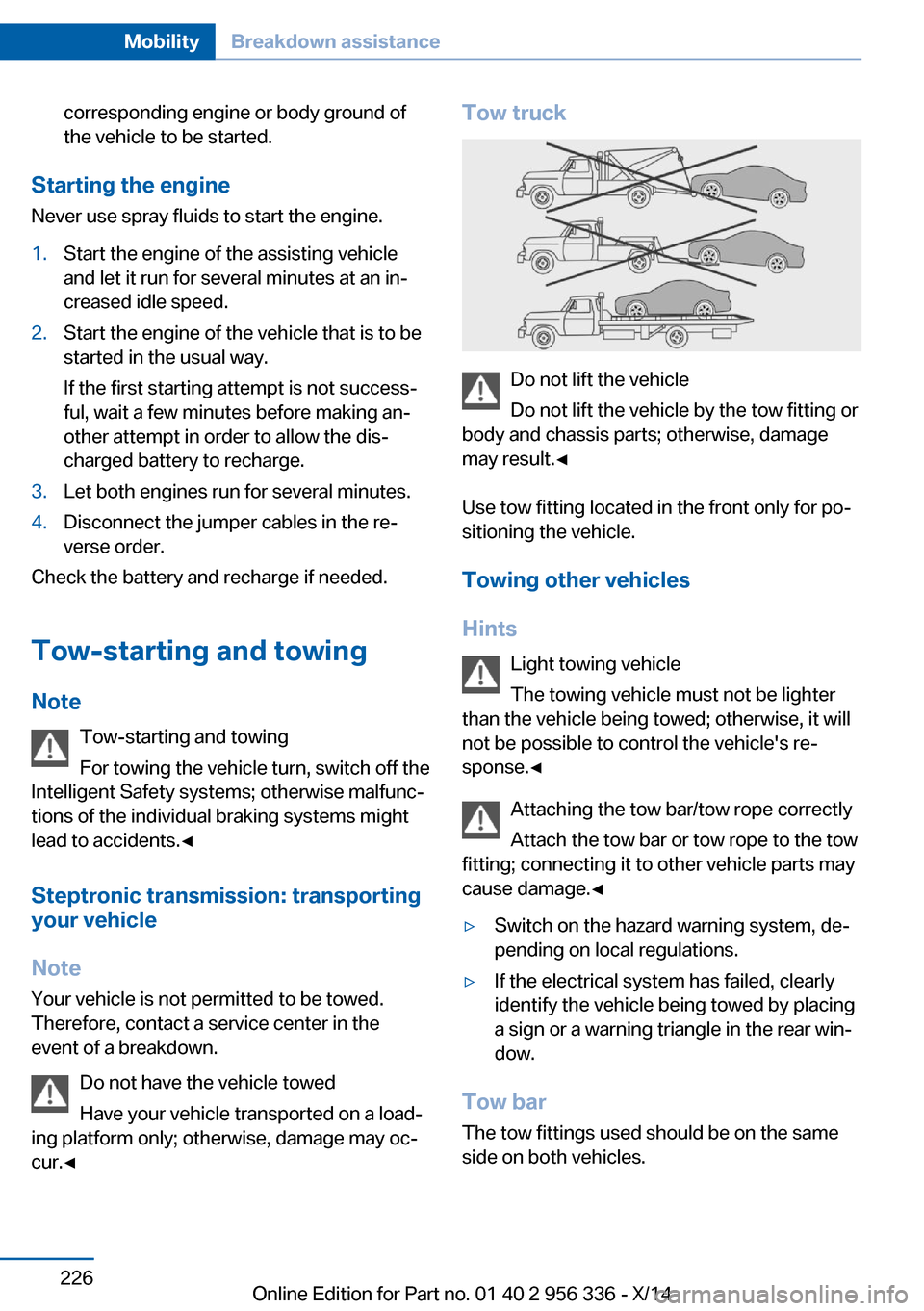
Tow truck
Do not lift the vehicle
Do not lift the vehicle by the tow fitting or
body and chassis parts; otherwise, damage
may result.◀
Use tow fitting located in the front only for po‐
sitioning the vehicle.
Towing other vehicles
Hints Light towing vehicle
The towing vehicle must not be lighter
than the vehicle being towed; otherwise, it will
not be possible to control the vehicle's re‐
sponse.◀
Attaching the tow bar/tow rope correctly
Attach the tow bar or tow rope to the tow
fitting; connecting it to other vehicle parts may
cause damage.◀
▷Switch on the hazard warning system, de‐
pending on local regulations.▷If the electrical system has failed, clearly
identify the vehicle being towed by placing
a sign or a warning triangle in the rear win‐
dow.
Tow bar
The tow fittings used should be on the same
side on both vehicles.
Seite 226MobilityBreakdown assistance226
Online Edition for Part no. 01 40 2 956 336 - X/14
Page 231 of 255
Should it prove impossible to avoid mounting
the tow bar at an offset angle, please observe
the following:▷Maneuvering capability is limited going
around corners.▷The tow bar will generate lateral forces if it
is secured with an offset.
Tow rope
When starting to tow the vehicle, make sure
that the tow rope is taut.
To avoid jerking and the associated stresses
on the vehicle components when towing, al‐
ways use nylon ropes or nylon straps.
Tow fitting
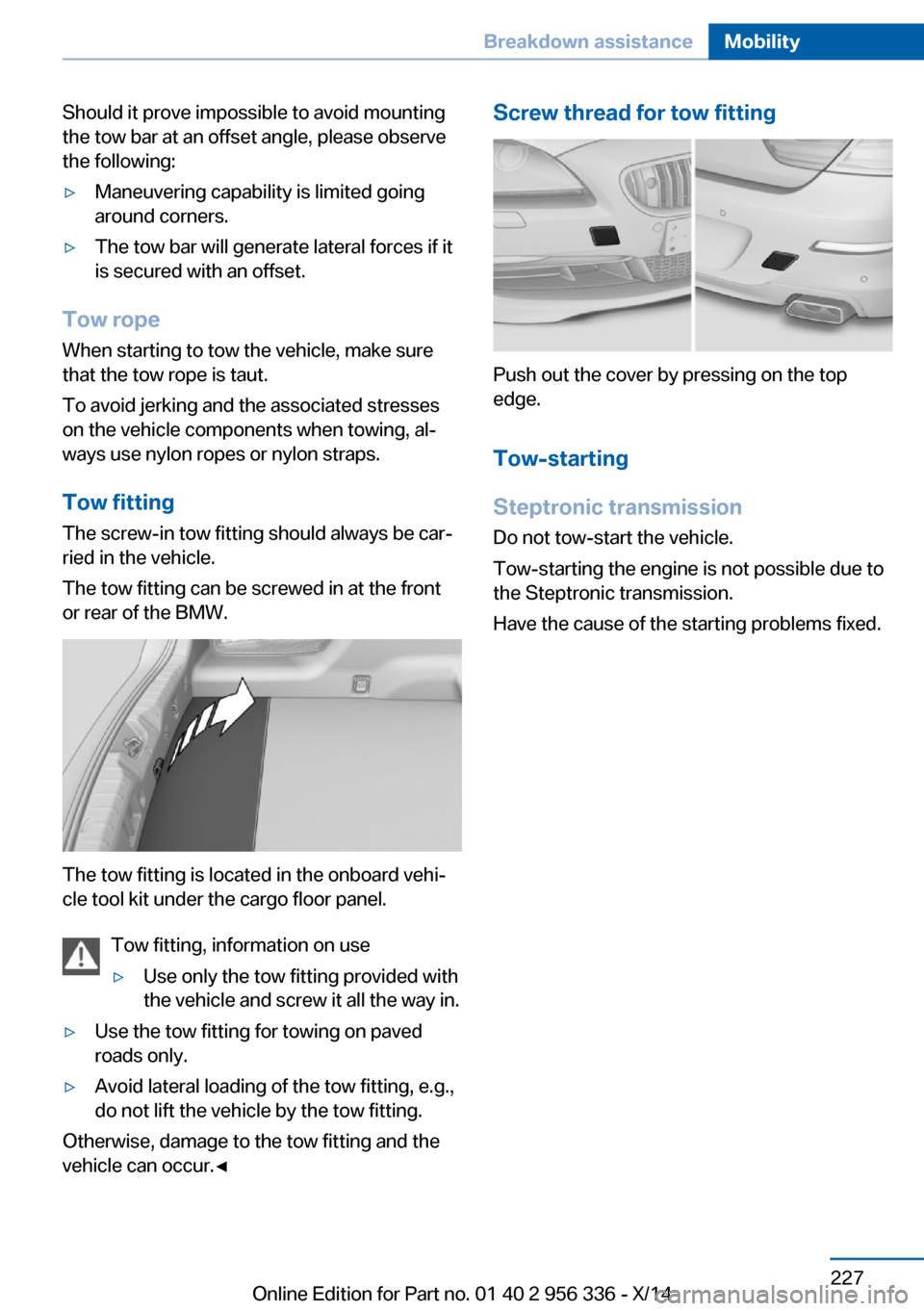
The screw-in tow fitting should always be car‐
ried in the vehicle.
The tow fitting can be screwed in at the front
or rear of the BMW.
The tow fitting is located in the onboard vehi‐
cle tool kit under the cargo floor panel.
Tow fitting, information on use
▷Use only the tow fitting provided with
the vehicle and screw it all the way in.▷Use the tow fitting for towing on paved
roads only.▷Avoid lateral loading of the tow fitting, e.g.,
do not lift the vehicle by the tow fitting.
Otherwise, damage to the tow fitting and the
vehicle can occur.◀
Screw thread for tow fitting
Push out the cover by pressing on the top
edge.
Tow-starting
Steptronic transmission Do not tow-start the vehicle.
Tow-starting the engine is not possible due to
the Steptronic transmission.
Have the cause of the starting problems fixed.
Seite 227Breakdown assistanceMobility227
Online Edition for Part no. 01 40 2 956 336 - X/14
Page 244 of 255
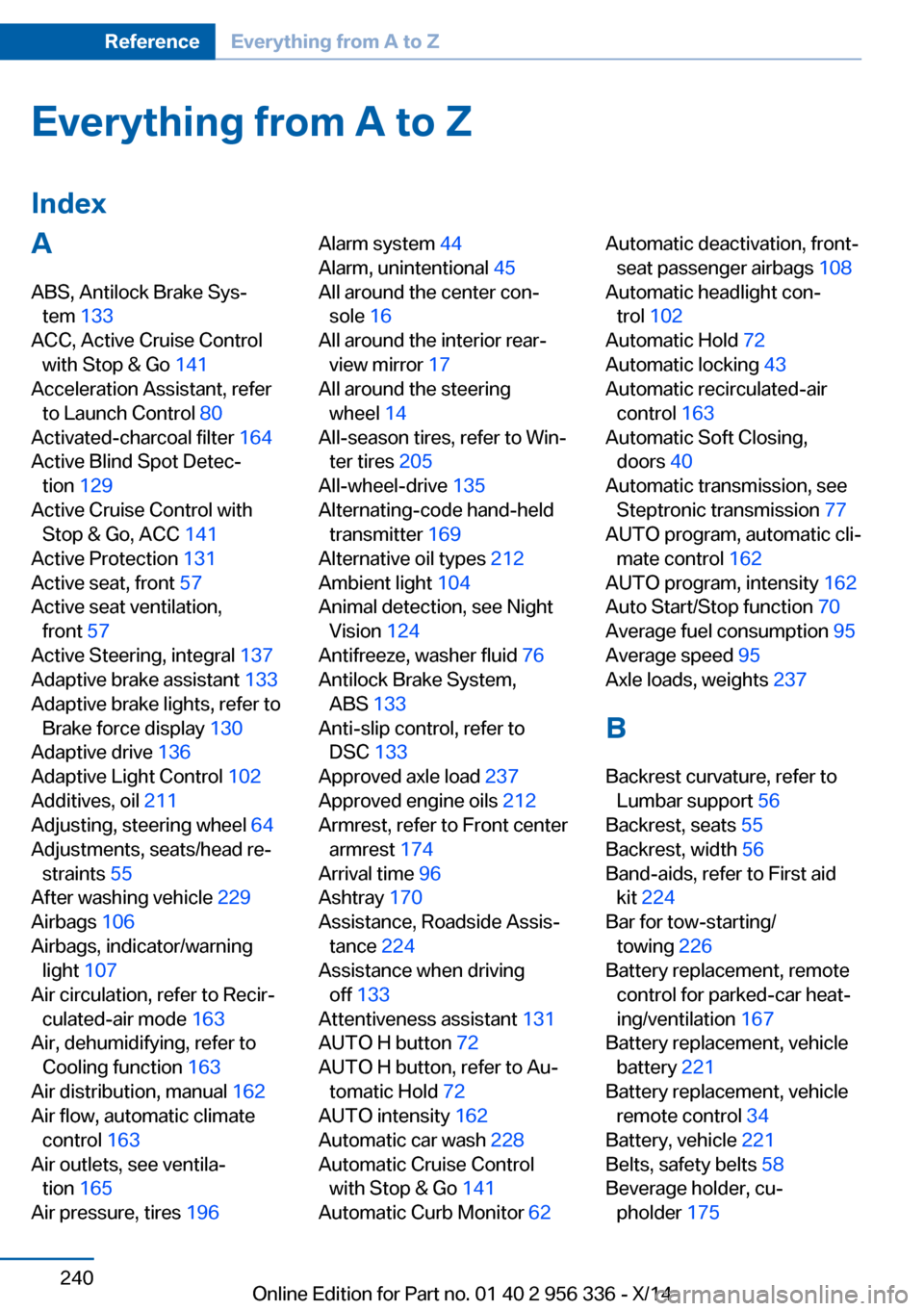
Everything from A to Z
IndexA ABS, Antilock Brake Sys‐ tem 133
ACC, Active Cruise Control with Stop & Go 141
Acceleration Assistant, refer to Launch Control 80
Activated-charcoal filter 164
Active Blind Spot Detec‐ tion 129
Active Cruise Control with Stop & Go, ACC 141
Active Protection 131
Active seat, front 57
Active seat ventilation, front 57
Active Steering, integral 137
Adaptive brake assistant 133
Adaptive brake lights, refer to Brake force display 130
Adaptive drive 136
Adaptive Light Control 102
Additives, oil 211
Adjusting, steering wheel 64
Adjustments, seats/head re‐ straints 55
After washing vehicle 229
Airbags 106
Airbags, indicator/warning light 107
Air circulation, refer to Recir‐ culated-air mode 163
Air, dehumidifying, refer to Cooling function 163
Air distribution, manual 162
Air flow, automatic climate control 163
Air outlets, see ventila‐ tion 165
Air pressure, tires 196 Alarm system 44
Alarm, unintentional 45
All around the center con‐ sole 16
All around the interior rear‐ view mirror 17
All around the steering wheel 14
All-season tires, refer to Win‐ ter tires 205
All-wheel-drive 135
Alternating-code hand-held transmitter 169
Alternative oil types 212
Ambient light 104
Animal detection, see Night Vision 124
Antifreeze, washer fluid 76
Antilock Brake System, ABS 133
Anti-slip control, refer to DSC 133
Approved axle load 237
Approved engine oils 212
Armrest, refer to Front center armrest 174
Arrival time 96
Ashtray 170
Assistance, Roadside Assis‐ tance 224
Assistance when driving off 133
Attentiveness assistant 131
AUTO H button 72
AUTO H button, refer to Au‐ tomatic Hold 72
AUTO intensity 162
Automatic car wash 228
Automatic Cruise Control with Stop & Go 141
Automatic Curb Monitor 62 Automatic deactivation, front-
seat passenger airbags 108
Automatic headlight con‐ trol 102
Automatic Hold 72
Automatic locking 43
Automatic recirculated-air control 163
Automatic Soft Closing, doors 40
Automatic transmission, see Steptronic transmission 77
AUTO program, automatic cli‐ mate control 162
AUTO program, intensity 162
Auto Start/Stop function 70
Average fuel consumption 95
Average speed 95
Axle loads, weights 237
B Backrest curvature, refer to Lumbar support 56
Backrest, seats 55
Backrest, width 56
Band-aids, refer to First aid kit 224
Bar for tow-starting/ towing 226
Battery replacement, remote control for parked-car heat‐
ing/ventilation 167
Battery replacement, vehicle battery 221
Battery replacement, vehicle remote control 34
Battery, vehicle 221
Belts, safety belts 58
Beverage holder, cu‐ pholder 175 Seite 240ReferenceEverything from A to Z240
Online Edition for Part no. 01 40 2 956 336 - X/14
Page 247 of 255
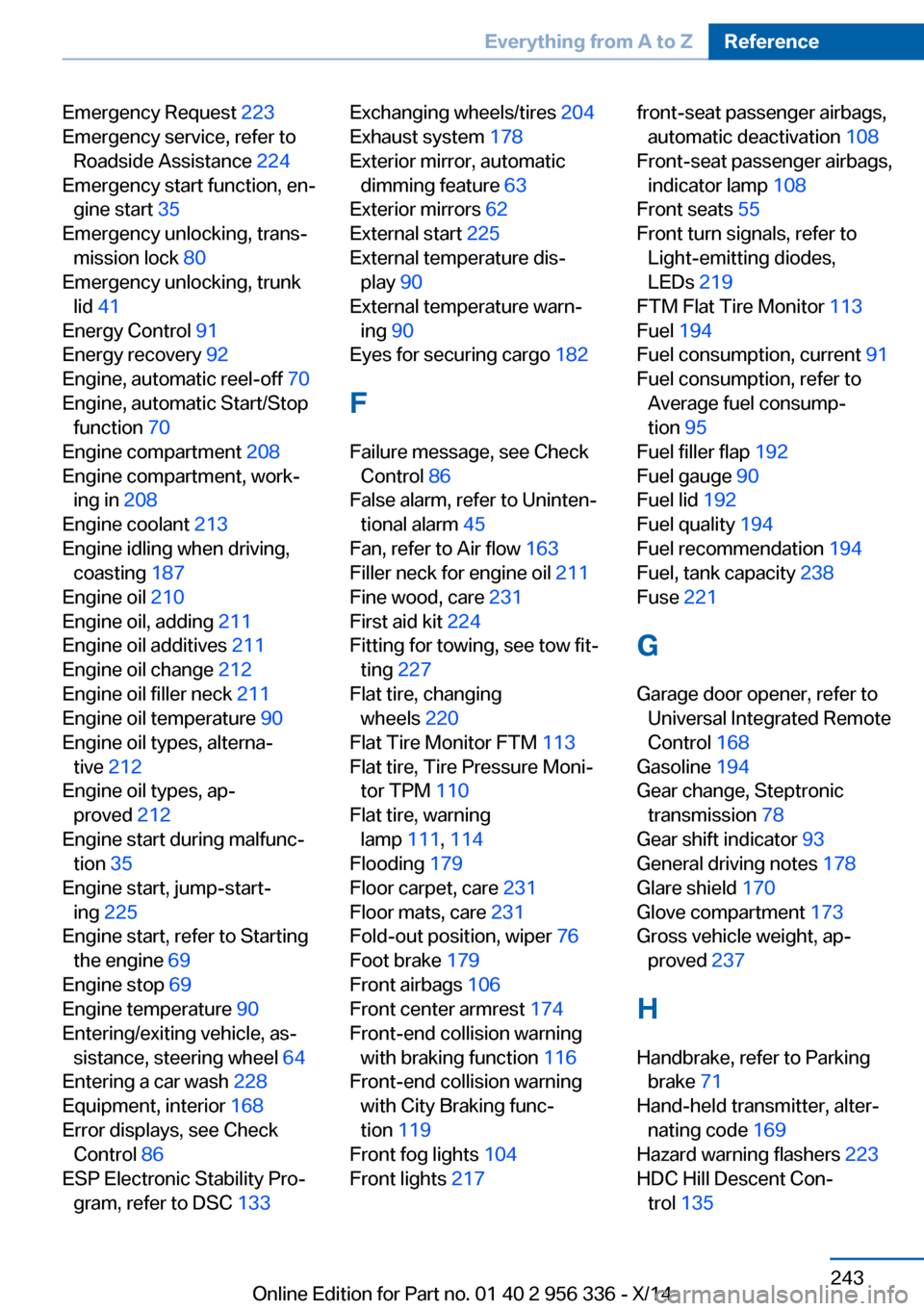
Emergency Request 223
Emergency service, refer to Roadside Assistance 224
Emergency start function, en‐ gine start 35
Emergency unlocking, trans‐ mission lock 80
Emergency unlocking, trunk lid 41
Energy Control 91
Energy recovery 92
Engine, automatic reel-off 70
Engine, automatic Start/Stop function 70
Engine compartment 208
Engine compartment, work‐ ing in 208
Engine coolant 213
Engine idling when driving, coasting 187
Engine oil 210
Engine oil, adding 211
Engine oil additives 211
Engine oil change 212
Engine oil filler neck 211
Engine oil temperature 90
Engine oil types, alterna‐ tive 212
Engine oil types, ap‐ proved 212
Engine start during malfunc‐ tion 35
Engine start, jump-start‐ ing 225
Engine start, refer to Starting the engine 69
Engine stop 69
Engine temperature 90
Entering/exiting vehicle, as‐ sistance, steering wheel 64
Entering a car wash 228
Equipment, interior 168
Error displays, see Check Control 86
ESP Electronic Stability Pro‐ gram, refer to DSC 133 Exchanging wheels/tires 204
Exhaust system 178
Exterior mirror, automatic dimming feature 63
Exterior mirrors 62
External start 225
External temperature dis‐ play 90
External temperature warn‐ ing 90
Eyes for securing cargo 182
F
Failure message, see Check Control 86
False alarm, refer to Uninten‐ tional alarm 45
Fan, refer to Air flow 163
Filler neck for engine oil 211
Fine wood, care 231
First aid kit 224
Fitting for towing, see tow fit‐ ting 227
Flat tire, changing wheels 220
Flat Tire Monitor FTM 113
Flat tire, Tire Pressure Moni‐ tor TPM 110
Flat tire, warning lamp 111, 114
Flooding 179
Floor carpet, care 231
Floor mats, care 231
Fold-out position, wiper 76
Foot brake 179
Front airbags 106
Front center armrest 174
Front-end collision warning with braking function 116
Front-end collision warning with City Braking func‐
tion 119
Front fog lights 104
Front lights 217 front-seat passenger airbags,
automatic deactivation 108
Front-seat passenger airbags, indicator lamp 108
Front seats 55
Front turn signals, refer to Light-emitting diodes,
LEDs 219
FTM Flat Tire Monitor 113
Fuel 194
Fuel consumption, current 91
Fuel consumption, refer to Average fuel consump‐
tion 95
Fuel filler flap 192
Fuel gauge 90
Fuel lid 192
Fuel quality 194
Fuel recommendation 194
Fuel, tank capacity 238
Fuse 221
G
Garage door opener, refer to Universal Integrated Remote
Control 168
Gasoline 194
Gear change, Steptronic transmission 78
Gear shift indicator 93
General driving notes 178
Glare shield 170
Glove compartment 173
Gross vehicle weight, ap‐ proved 237
H
Handbrake, refer to Parking brake 71
Hand-held transmitter, alter‐ nating code 169
Hazard warning flashers 223
HDC Hill Descent Con‐ trol 135 Seite 243Everything from A to ZReference243
Online Edition for Part no. 01 40 2 956 336 - X/14