trunk BMW 640I COUPE 2014 User Guide
[x] Cancel search | Manufacturer: BMW, Model Year: 2014, Model line: 640I COUPE, Model: BMW 640I COUPE 2014Pages: 237, PDF Size: 7.53 MB
Page 138 of 237
▷Due to other ultrasound sources, e.g.,
sweeping machines, high pressure steam
cleaners or neon lights.
Malfunction
A Check Control message is displayed.
The range of the sensors is shown as a shaded
area on the Control Display.
PDC has failed. Have the system checked.
To ensure full operability:
▷Keep the sensors clean and free of ice.▷When using high-pressure washers, do not
spray the sensors for long periods and
maintain a distance of at least 12 in/30 cm.
Surround View
The concept Surround View comprises various camera as‐
sistance systems that help the driver when
parking, maneuvering, and at complex exits
and intersections.
▷Rearview camera, refer to page 138▷Side View, refer to page 142.▷Top View, refer to page 140.
Backup camera
The concept
The backup camera provides assistance in
parking and maneuvering backwards. The area
behind the vehicle is shown on the Control
Display.
Hints Check the traffic situation as well
Check the traffic situation around the ve‐
hicle with your own eyes. Otherwise, an acci‐
dent could result from road users or objects lo‐
cated outside the picture area of the backup
camera.◀
At a glance
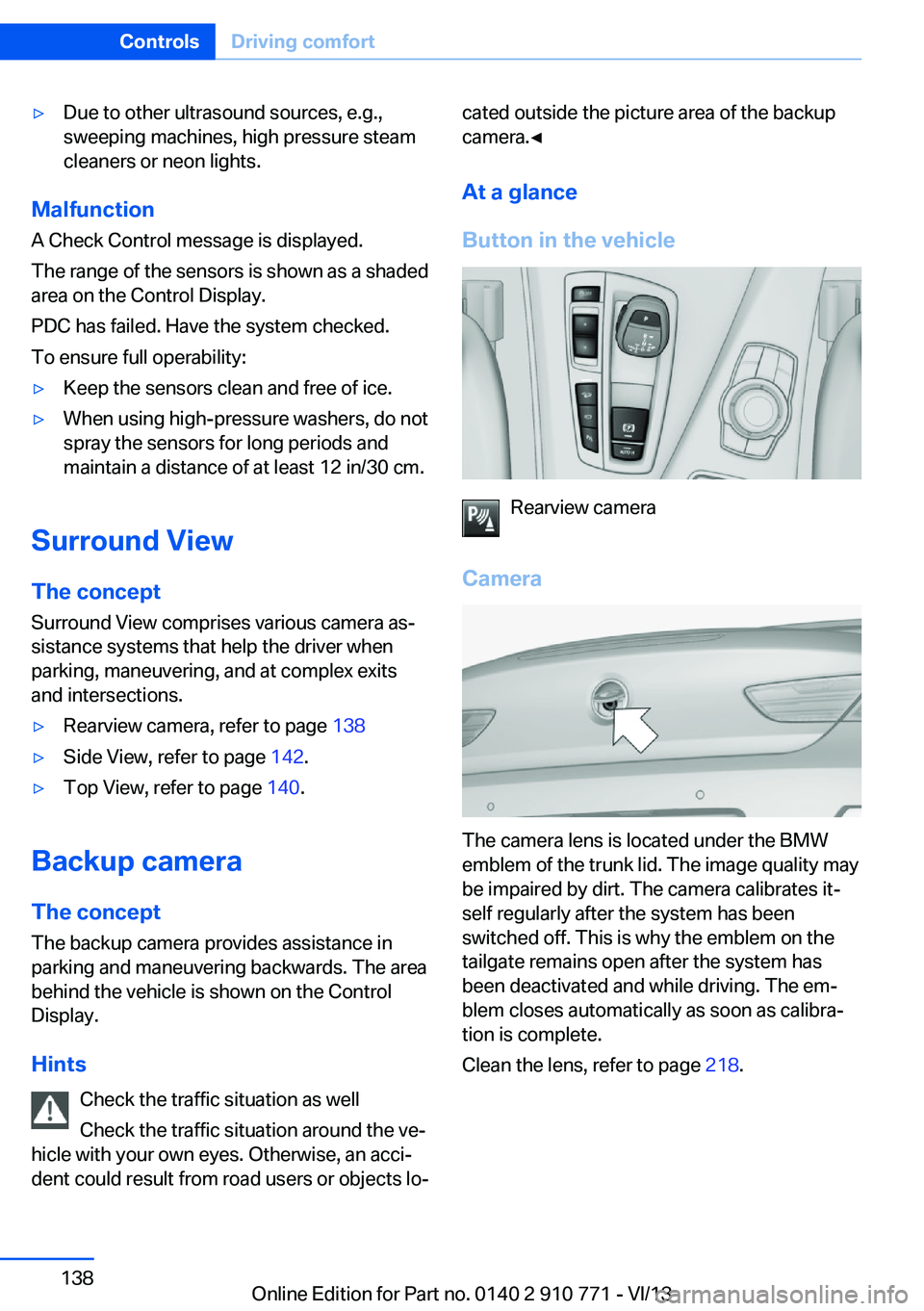
Button in the vehicle
Rearview camera
Camera
The camera lens is located under the BMW
emblem of the trunk lid. The image quality may
be impaired by dirt. The camera calibrates it‐
self regularly after the system has been
switched off. This is why the emblem on the
tailgate remains open after the system has
been deactivated and while driving. The em‐
blem closes automatically as soon as calibra‐
tion is complete.
Clean the lens, refer to page 218.
Seite 138ControlsDriving comfort138
Online Edition for Part no. 0140 2 910 771 - VI/13
Page 139 of 237
Switching on/off
Switching on automatically Select transmission position R with the engine
running.
The backup camera image is displayed if the
system was switched on via the iDrive.
Automatic deactivation during forward
travel
The system switches off when a certain driving
distance or speed is exceeded.
Switch the system back on if necessary.
Switching on/off manually Press the button.▷On: the LED lights up.▷Off: the LED goes out.
The PDC is shown on the Control Display.
Switching on the rearview camera via
the iDrive
With PDC activated or Top View switched on:
"Rear view camera"
The rearview camera image is displayed. The
setting is stored for the remote control cur‐
rently in use.
Display on the Control Display
Functional requirement
▷The rearview camera is switched on.▷The trunk lid is fully closed.
Activating the assistance functions
More than one assistance function can be ac‐
tive at the same time.
▷Parking aid lines
"Parking aid lines"
Pathway and turning circle lines are dis‐
played.▷Obstacle marking
"Obstacle marking"
Spatially-shaped markings are displayed.
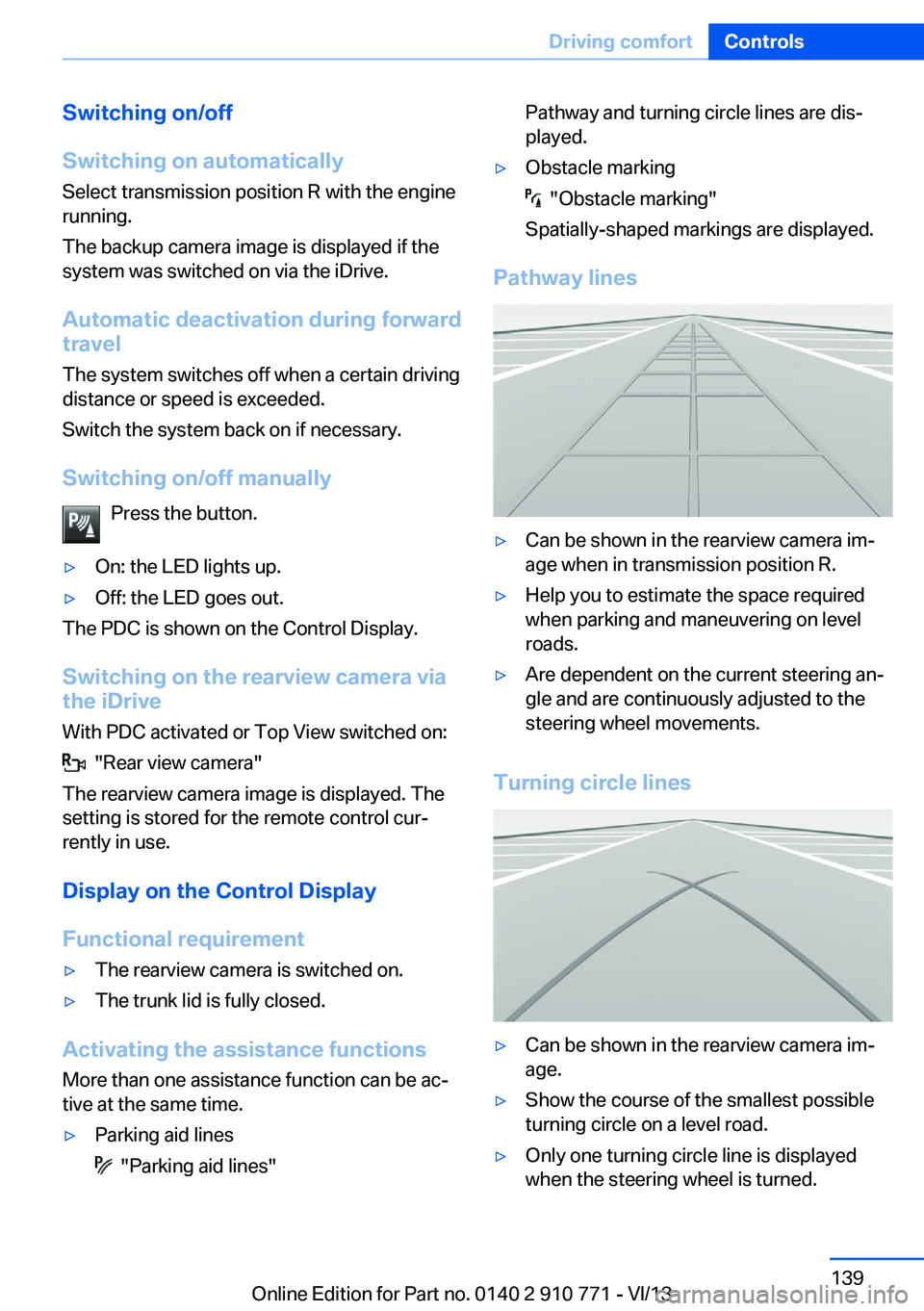
Pathway lines
▷Can be shown in the rearview camera im‐
age when in transmission position R.▷Help you to estimate the space required
when parking and maneuvering on level
roads.▷Are dependent on the current steering an‐
gle and are continuously adjusted to the
steering wheel movements.
Turning circle lines
▷Can be shown in the rearview camera im‐
age.▷Show the course of the smallest possible
turning circle on a level road.▷Only one turning circle line is displayed
when the steering wheel is turned.Seite 139Driving comfortControls139
Online Edition for Part no. 0140 2 910 771 - VI/13
Page 142 of 237
The backup camera image is displayed. The
setting is stored for the remote control cur‐
rently in use.
Display
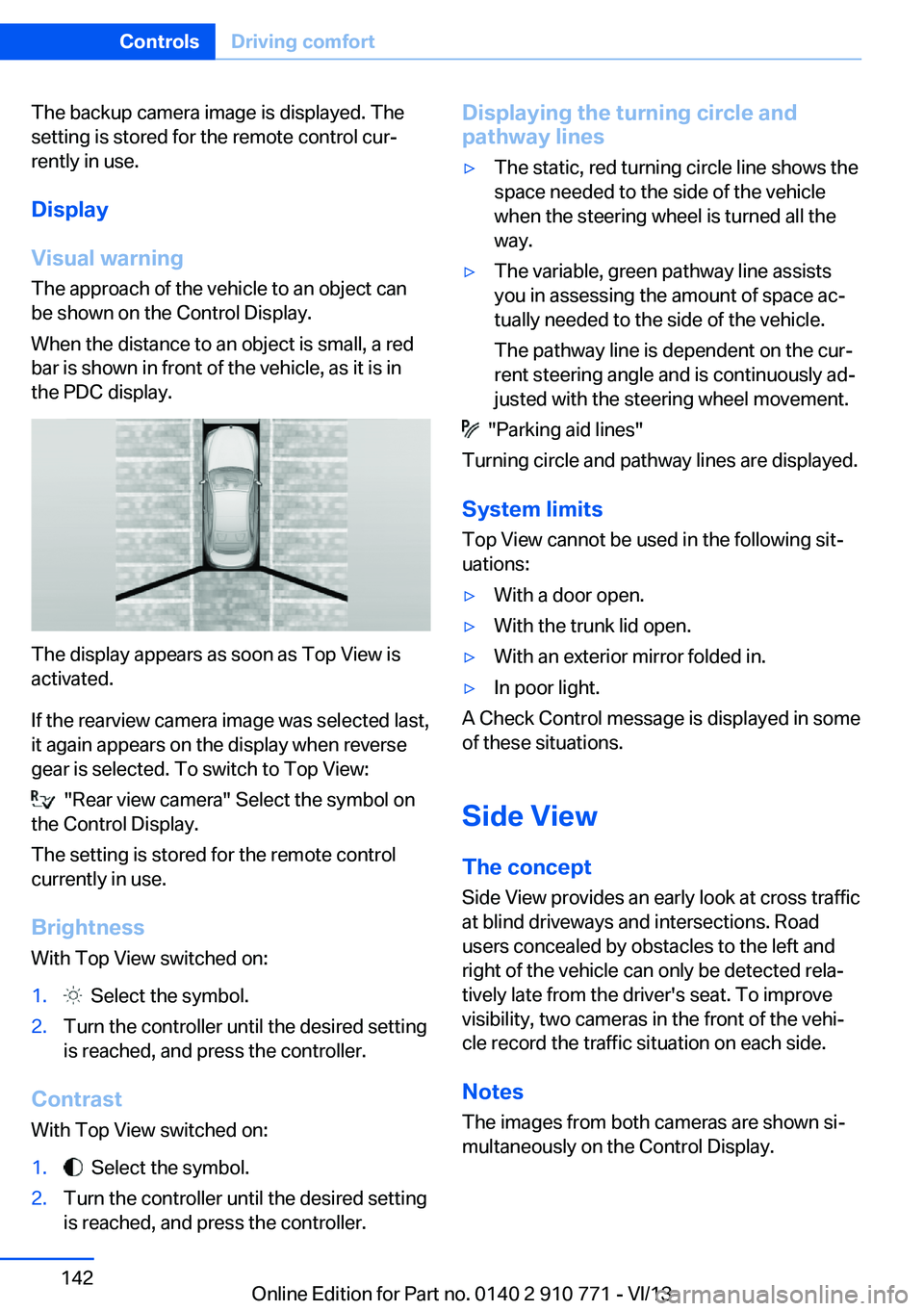
Visual warning The approach of the vehicle to an object can
be shown on the Control Display.
When the distance to an object is small, a red
bar is shown in front of the vehicle, as it is in
the PDC display.
The display appears as soon as Top View is
activated.
If the rearview camera image was selected last,
it again appears on the display when reverse
gear is selected. To switch to Top View:
"Rear view camera" Select the symbol on
the Control Display.
The setting is stored for the remote control
currently in use.
Brightness
With Top View switched on:
1. Select the symbol.2.Turn the controller until the desired setting
is reached, and press the controller.
Contrast
With Top View switched on:
1. Select the symbol.2.Turn the controller until the desired setting
is reached, and press the controller.Displaying the turning circle and
pathway lines▷The static, red turning circle line shows the
space needed to the side of the vehicle
when the steering wheel is turned all the
way.▷The variable, green pathway line assists
you in assessing the amount of space ac‐
tually needed to the side of the vehicle.
The pathway line is dependent on the cur‐
rent steering angle and is continuously ad‐
justed with the steering wheel movement.
"Parking aid lines"
Turning circle and pathway lines are displayed.
System limits
Top View cannot be used in the following sit‐
uations:
▷With a door open.▷With the trunk lid open.▷With an exterior mirror folded in.▷In poor light.
A Check Control message is displayed in some
of these situations.
Side View The concept Side View provides an early look at cross traffic
at blind driveways and intersections. Road
users concealed by obstacles to the left and
right of the vehicle can only be detected rela‐
tively late from the driver's seat. To improve
visibility, two cameras in the front of the vehi‐
cle record the traffic situation on each side.
Notes
The images from both cameras are shown si‐
multaneously on the Control Display.
Seite 142ControlsDriving comfort142
Online Edition for Part no. 0140 2 910 771 - VI/13
Page 163 of 237
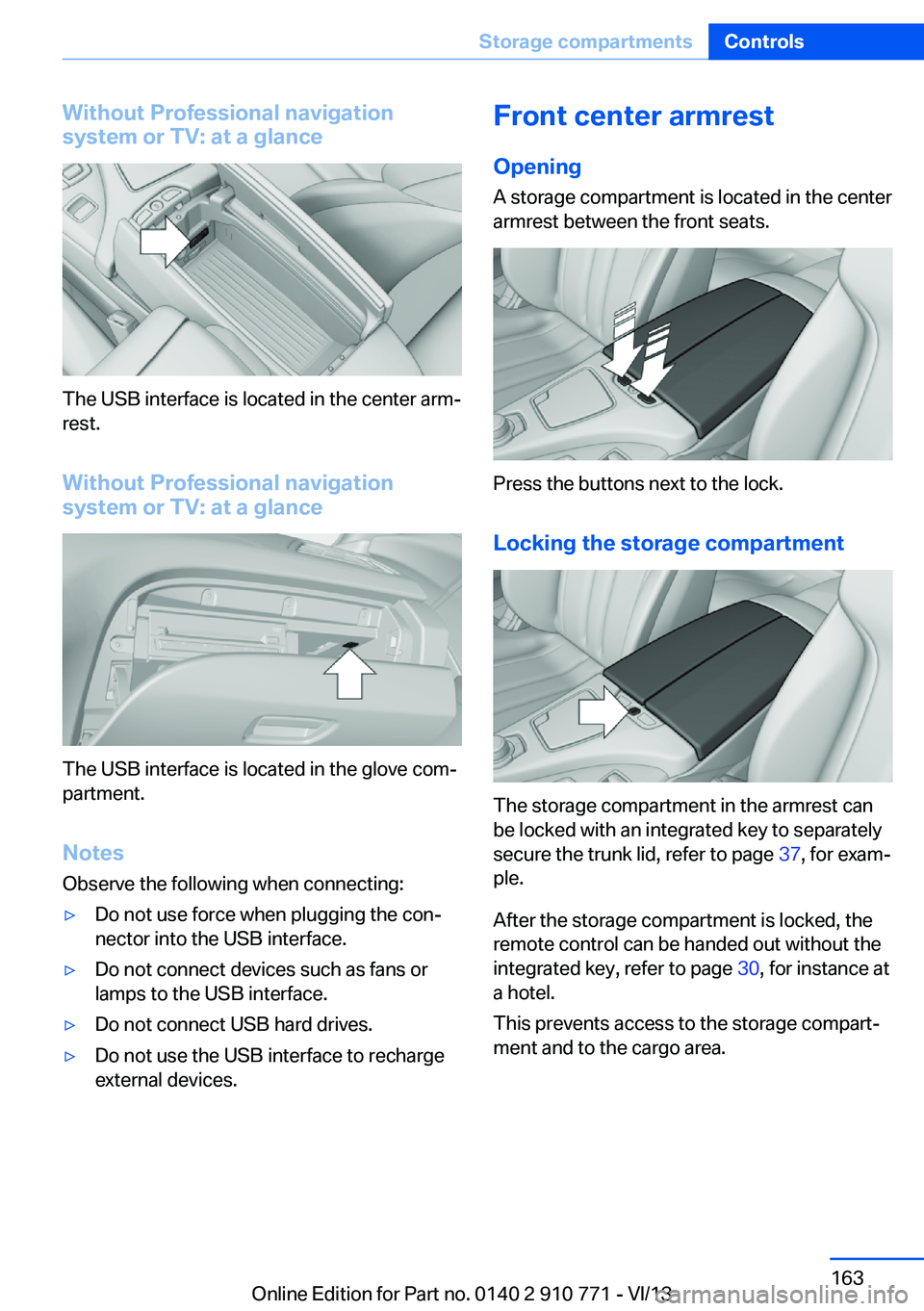
Without Professional navigation
system or TV: at a glance
The USB interface is located in the center arm‐
rest.
Without Professional navigation
system or TV: at a glance
The USB interface is located in the glove com‐
partment.
Notes
Observe the following when connecting:
▷Do not use force when plugging the con‐
nector into the USB interface.▷Do not connect devices such as fans or
lamps to the USB interface.▷Do not connect USB hard drives.▷Do not use the USB interface to recharge
external devices.Front center armrest
Opening A storage compartment is located in the center
armrest between the front seats.
Press the buttons next to the lock.
Locking the storage compartment
The storage compartment in the armrest can
be locked with an integrated key to separately
secure the trunk lid, refer to page 37, for exam‐
ple.
After the storage compartment is locked, the
remote control can be handed out without the
integrated key, refer to page 30, for instance at
a hotel.
This prevents access to the storage compart‐
ment and to the cargo area.
Seite 163Storage compartmentsControls163
Online Edition for Part no. 0140 2 910 771 - VI/13
Page 168 of 237
Things to remember when drivingVehicle equipment
All standard, country-specific and optional
equipment that is offered in the model series is
described in this chapter. Therefore, equip‐
ment is also described that is not available in a
vehicle, e. g., because of the selected optional
equipment or country variant. This also applies
for safety-related functions and systems.
Breaking-in period General information Moving parts need to be broken in to adjust to
each other.
The following instructions will help achieve a
long vehicle life and good economy.
Engine and differential Always obey the official speed limit.
Up to 1,200 miles/2,000 km
Do not exceed the maximum engine and road
speed:▷For gasoline engine 4,500 rpm and
100 mph/160 km/h.
Avoid full load or kickdown under all circum‐
stances.
From 1,200 miles/2,000 km The engine and vehicle speed can gradually be
increased.
Tires
Due to technical factors associated with their
manufacture, tires do not achieve their full
traction potential until after an initial breaking-
in period.
Drive conservatively for the first
200 miles/300 km.
Brake system
Brakes require an initial break-in period of ap‐
prox. 300 miles/500 km to achieve optimized
contact and wear patterns between brake
discs and brake pads. Drive moderately during
this break-in period.
Following part replacement
The same breaking in procedures should be
observed if any of the components mentioned
above have to be renewed in the course of the
vehicle's operating life.
General driving notes
Closing the trunk lid Drive with the trunk lid closed
Only drive with the tailgate closed; other‐
wise, in the event of an accident or braking and
evasive maneuvers, passengers and other road
users may be injured, and the vehicle may be
damaged. In addition, exhaust fumes may en‐
ter the passenger compartment.◀
If driving with the tailgate open cannot be
avoided:▷Close all windows and the glass sunroof.▷Greatly increase the blower speed.▷Drive moderately.
Hot exhaust system
Hot exhaust system
High temperatures are generated in the
exhaust system.
Do not remove the heat shields installed and
never apply undercoating to them. Make sure
that flammable materials, e. g. hay, leaves,
grass, etc. do not come in contact with the hot
exhaust system during driving, while in idle po‐
Seite 168Driving tipsThings to remember when driving168
Online Edition for Part no. 0140 2 910 771 - VI/13
Page 171 of 237
LoadingVehicle equipment
All standard, country-specific and optional
equipment that is offered in the model series is
described in this chapter. Therefore, equip‐
ment is also described that is not available in a
vehicle, e. g., because of the selected optional
equipment or country variant. This also applies
for safety-related functions and systems.
Hints Overloading the vehicle
To avoid exceeding the approved carry‐
ing capacity of the tires, never overload the ve‐
hicle. Overloading can lead to overheating and
increases the rate at which damage develops
inside the tires. This could result in a sudden
loss of tire inflation pressure.◀
No fluids in the trunk
Make sure that fluids do not leak into the
trunk; otherwise, the vehicle may be dam‐
aged.◀
Determining the load limit1.Locate the following statement on your ve‐
hicle’s placard:▷The combined weight of occupants
and cargo should never exceed XXX kg
or YYY lbs. Otherwise, damage to thevehicle and unstable driving situations
may result.2.Determine the combined weight of the
driver and passengers that will be riding in
your vehicle.3.Subtract the combined weight of the driver
and passengers from XXX kilograms or
YYY pounds.4.The resulting figure equals the available
amount of cargo and luggage load ca‐
pacity.
For example, if the YYY amount equals
1,000 lbs and there will be four 150 lbs
passengers in your vehicle, the amount of
available cargo and luggage load capacity
is 400 lbs: 1,000 lbs minus 600 lbs =
400 lbs.5.Determine the combined weight of lug‐
gage and cargo being loaded on the vehi‐
cle. That weight may not safely exceed the
available cargo and luggage load capacity
calculated in Step 4.
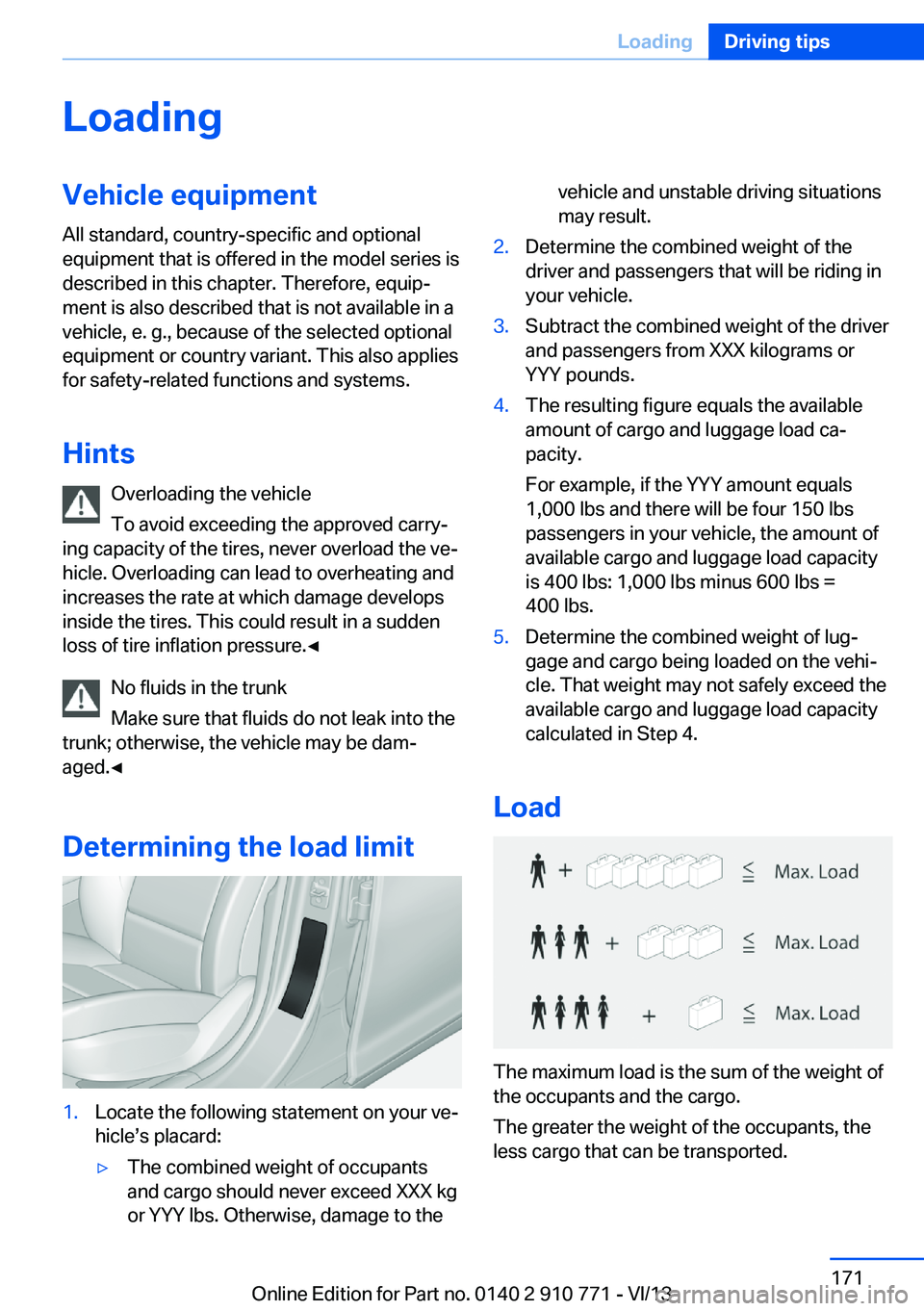
Load
The maximum load is the sum of the weight of
the occupants and the cargo.
The greater the weight of the occupants, the
less cargo that can be transported.
Seite 171LoadingDriving tips171
Online Edition for Part no. 0140 2 910 771 - VI/13
Page 207 of 237
These lights feature LED technology.
Contact your service center in the event of a
malfunction.
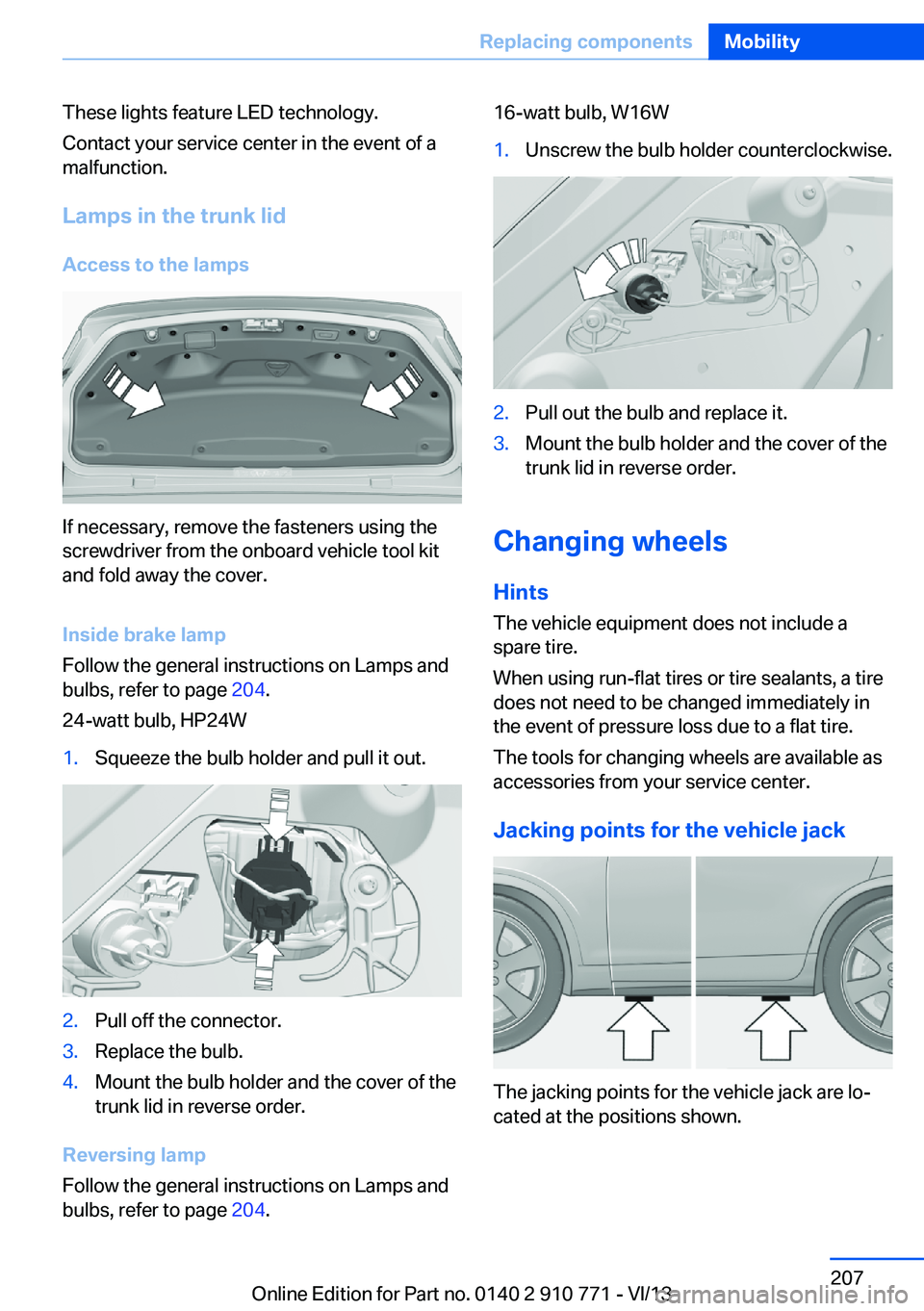
Lamps in the trunk lidAccess to the lamps
If necessary, remove the fasteners using the
screwdriver from the onboard vehicle tool kit
and fold away the cover.
Inside brake lamp
Follow the general instructions on Lamps and
bulbs, refer to page 204.
24-watt bulb, HP24W
1.Squeeze the bulb holder and pull it out.2.Pull off the connector.3.Replace the bulb.4.Mount the bulb holder and the cover of the
trunk lid in reverse order.
Reversing lamp
Follow the general instructions on Lamps and
bulbs, refer to page 204.
16-watt bulb, W16W1.Unscrew the bulb holder counterclockwise.2.Pull out the bulb and replace it.3.Mount the bulb holder and the cover of the
trunk lid in reverse order.
Changing wheels
Hints
The vehicle equipment does not include a
spare tire.
When using run-flat tires or tire sealants, a tire
does not need to be changed immediately in
the event of pressure loss due to a flat tire.
The tools for changing wheels are available as
accessories from your service center.
Jacking points for the vehicle jack
The jacking points for the vehicle jack are lo‐
cated at the positions shown.
Seite 207Replacing componentsMobility207
Online Edition for Part no. 0140 2 910 771 - VI/13
Page 211 of 237
if it can be established, are transmitted to
the BMW Response Center.▷If the LED is flashing, but the BMW Re‐
sponse Center can no longer be heard via
the speaker, you can nevertheless still be
heard for the BMW Response Center.
Initiating an Emergency Request
automatically
Under certain conditions, an Emergency Re‐
quest is automatically initiated immediately af‐
ter a severe accident. Automatic Collision Noti‐
fication is not affected by pressing the SOS
button.
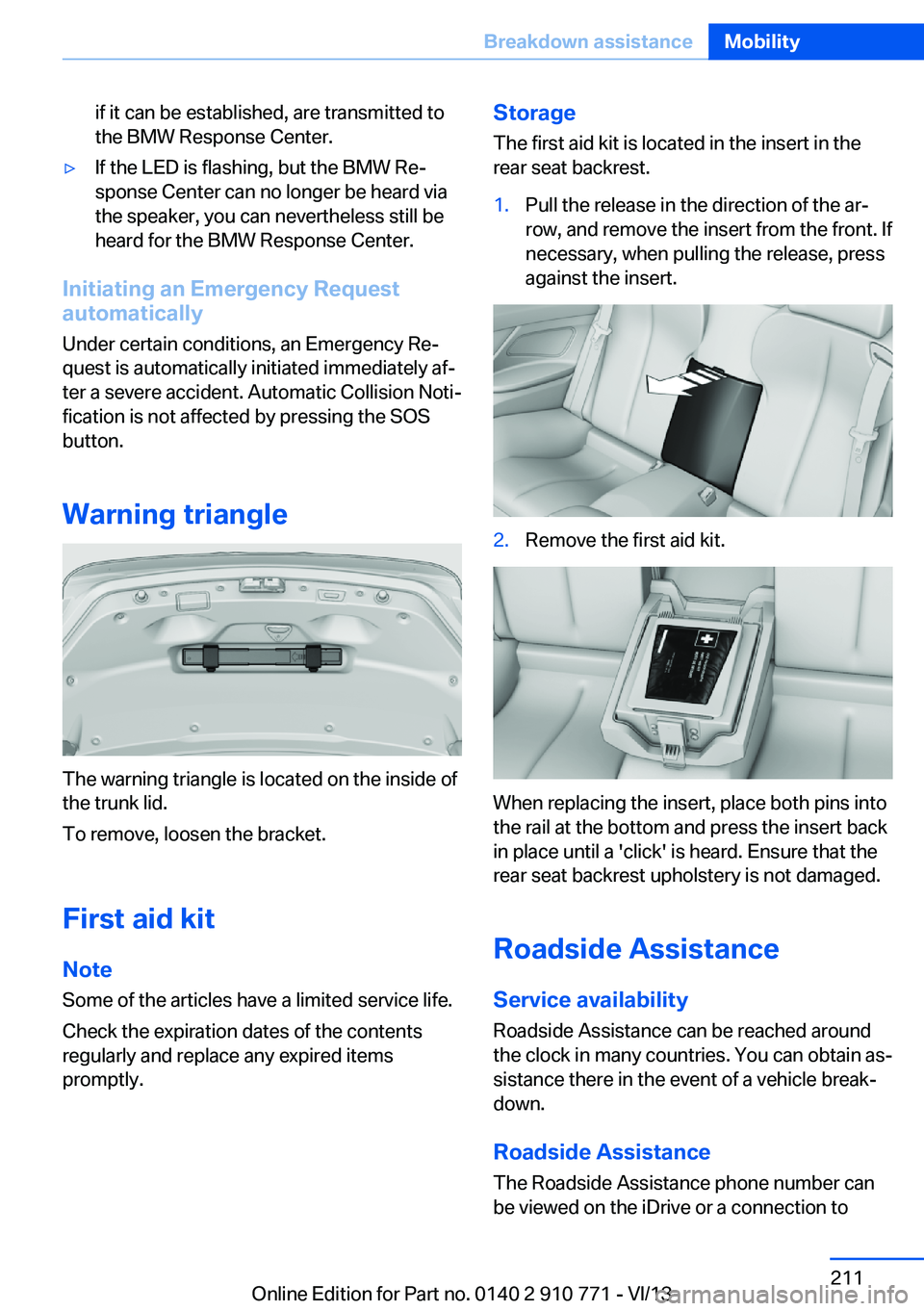
Warning triangle
The warning triangle is located on the inside of
the trunk lid.
To remove, loosen the bracket.
First aid kit NoteSome of the articles have a limited service life.
Check the expiration dates of the contents
regularly and replace any expired items
promptly.
Storage
The first aid kit is located in the insert in the
rear seat backrest.1.Pull the release in the direction of the ar‐
row, and remove the insert from the front. If
necessary, when pulling the release, press
against the insert.2.Remove the first aid kit.
When replacing the insert, place both pins into
the rail at the bottom and press the insert back
in place until a 'click' is heard. Ensure that the
rear seat backrest upholstery is not damaged.
Roadside Assistance
Service availability Roadside Assistance can be reached around
the clock in many countries. You can obtain as‐
sistance there in the event of a vehicle break‐
down.
Roadside Assistance The Roadside Assistance phone number can
be viewed on the iDrive or a connection to
Seite 211Breakdown assistanceMobility211
Online Edition for Part no. 0140 2 910 771 - VI/13
Page 228 of 237
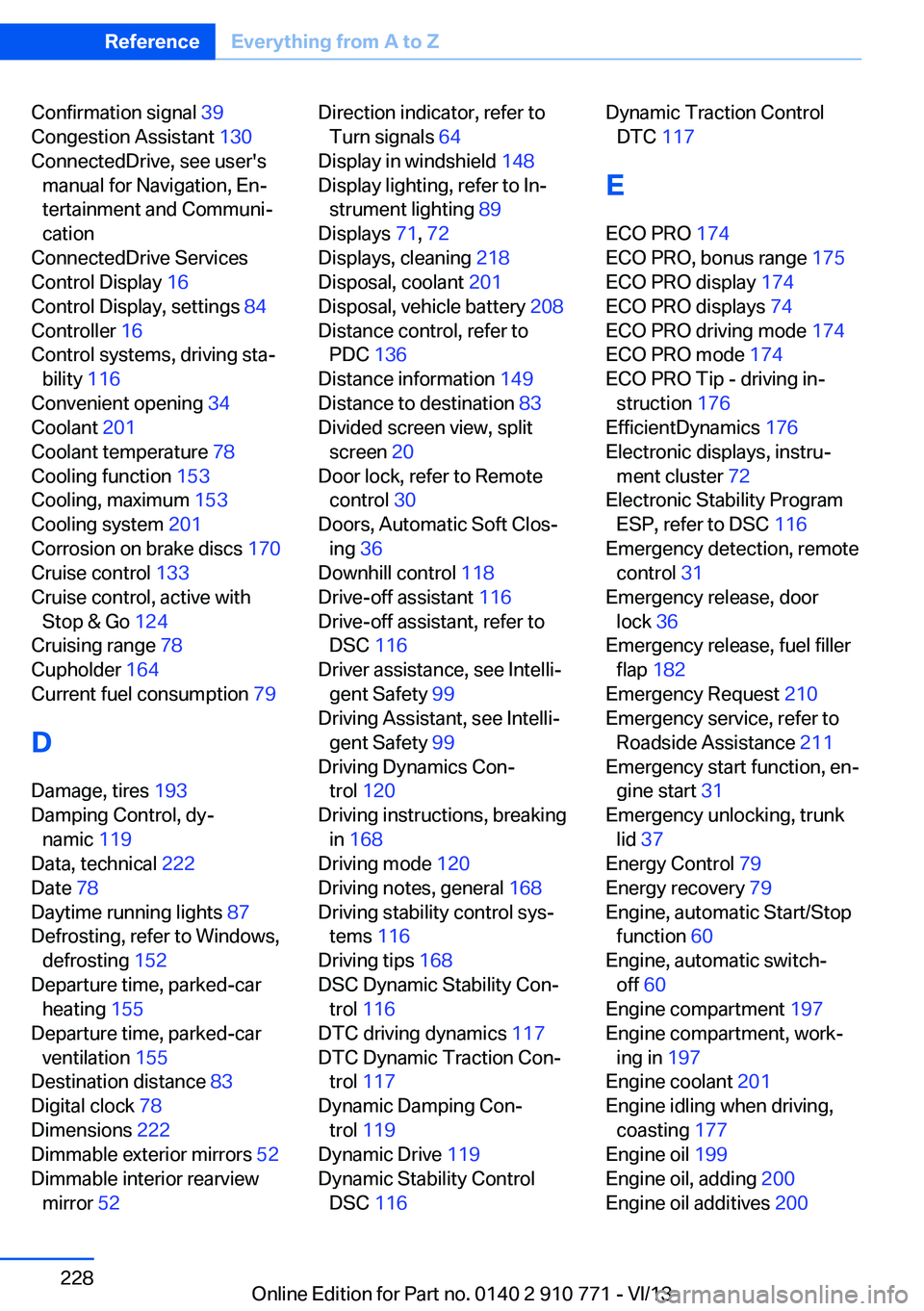
Confirmation signal 39
Congestion Assistant 130
ConnectedDrive, see user's manual for Navigation, En‐
tertainment and Communi‐
cation
ConnectedDrive Services
Control Display 16
Control Display, settings 84
Controller 16
Control systems, driving sta‐ bility 116
Convenient opening 34
Coolant 201
Coolant temperature 78
Cooling function 153
Cooling, maximum 153
Cooling system 201
Corrosion on brake discs 170
Cruise control 133
Cruise control, active with Stop & Go 124
Cruising range 78
Cupholder 164
Current fuel consumption 79
D
Damage, tires 193
Damping Control, dy‐ namic 119
Data, technical 222
Date 78
Daytime running lights 87
Defrosting, refer to Windows, defrosting 152
Departure time, parked-car heating 155
Departure time, parked-car ventilation 155
Destination distance 83
Digital clock 78
Dimensions 222
Dimmable exterior mirrors 52
Dimmable interior rearview mirror 52 Direction indicator, refer to
Turn signals 64
Display in windshield 148
Display lighting, refer to In‐ strument lighting 89
Displays 71, 72
Displays, cleaning 218
Disposal, coolant 201
Disposal, vehicle battery 208
Distance control, refer to PDC 136
Distance information 149
Distance to destination 83
Divided screen view, split screen 20
Door lock, refer to Remote control 30
Doors, Automatic Soft Clos‐ ing 36
Downhill control 118
Drive-off assistant 116
Drive-off assistant, refer to DSC 116
Driver assistance, see Intelli‐ gent Safety 99
Driving Assistant, see Intelli‐ gent Safety 99
Driving Dynamics Con‐ trol 120
Driving instructions, breaking in 168
Driving mode 120
Driving notes, general 168
Driving stability control sys‐ tems 116
Driving tips 168
DSC Dynamic Stability Con‐ trol 116
DTC driving dynamics 117
DTC Dynamic Traction Con‐ trol 117
Dynamic Damping Con‐ trol 119
Dynamic Drive 119
Dynamic Stability Control DSC 116 Dynamic Traction Control
DTC 117
E ECO PRO 174
ECO PRO, bonus range 175
ECO PRO display 174
ECO PRO displays 74
ECO PRO driving mode 174
ECO PRO mode 174
ECO PRO Tip - driving in‐ struction 176
EfficientDynamics 176
Electronic displays, instru‐ ment cluster 72
Electronic Stability Program ESP, refer to DSC 116
Emergency detection, remote control 31
Emergency release, door lock 36
Emergency release, fuel filler flap 182
Emergency Request 210
Emergency service, refer to Roadside Assistance 211
Emergency start function, en‐ gine start 31
Emergency unlocking, trunk lid 37
Energy Control 79
Energy recovery 79
Engine, automatic Start/Stop function 60
Engine, automatic switch- off 60
Engine compartment 197
Engine compartment, work‐ ing in 197
Engine coolant 201
Engine idling when driving, coasting 177
Engine oil 199
Engine oil, adding 200
Engine oil additives 200 Seite 228ReferenceEverything from A to Z228
Online Edition for Part no. 0140 2 910 771 - VI/13
Page 230 of 237
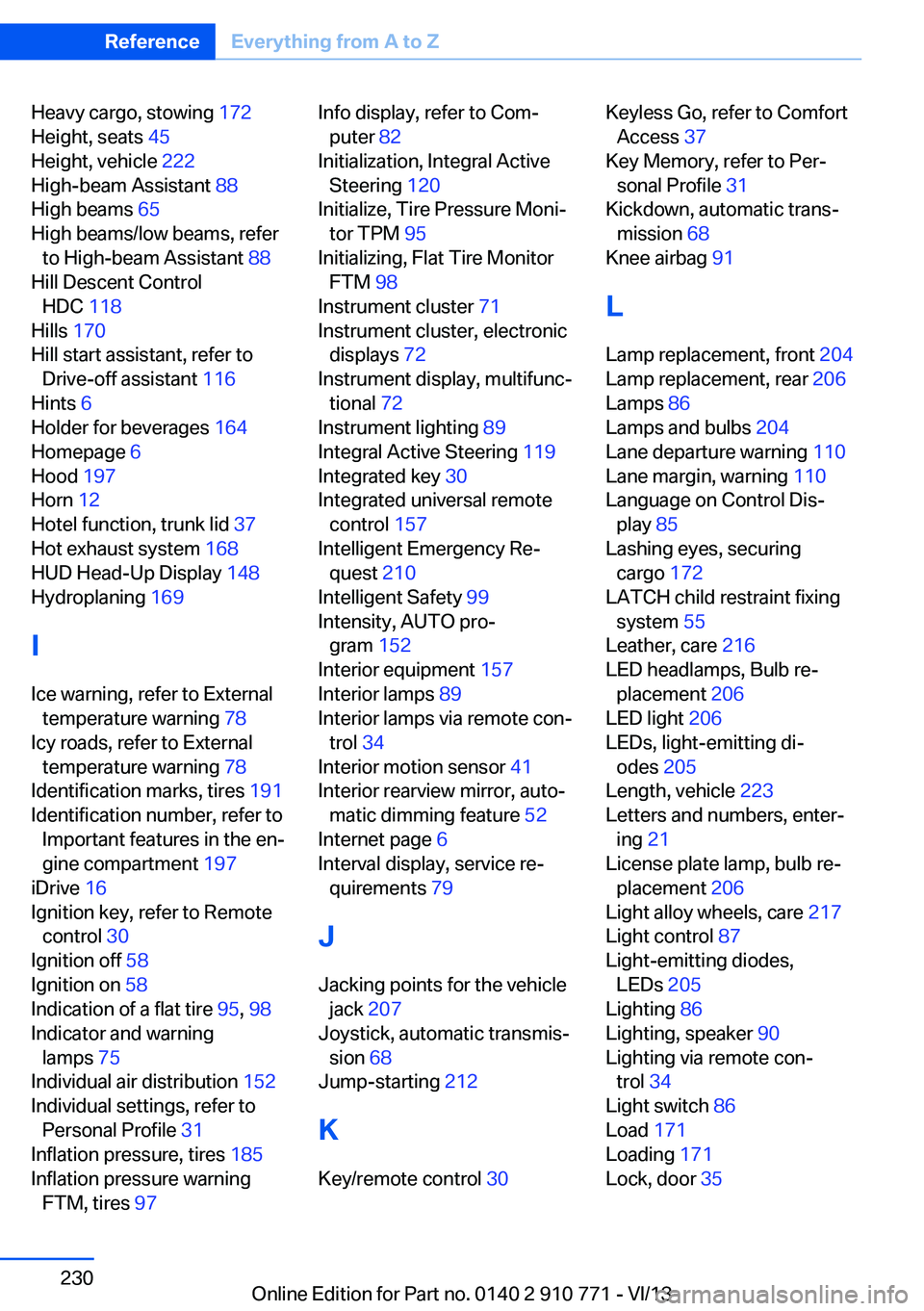
Heavy cargo, stowing 172
Height, seats 45
Height, vehicle 222
High-beam Assistant 88
High beams 65
High beams/low beams, refer to High-beam Assistant 88
Hill Descent Control HDC 118
Hills 170
Hill start assistant, refer to Drive-off assistant 116
Hints 6
Holder for beverages 164
Homepage 6
Hood 197
Horn 12
Hotel function, trunk lid 37
Hot exhaust system 168
HUD Head-Up Display 148
Hydroplaning 169
I Ice warning, refer to External temperature warning 78
Icy roads, refer to External temperature warning 78
Identification marks, tires 191
Identification number, refer to Important features in the en‐
gine compartment 197
iDrive 16
Ignition key, refer to Remote control 30
Ignition off 58
Ignition on 58
Indication of a flat tire 95, 98
Indicator and warning lamps 75
Individual air distribution 152
Individual settings, refer to Personal Profile 31
Inflation pressure, tires 185
Inflation pressure warning FTM, tires 97 Info display, refer to Com‐
puter 82
Initialization, Integral Active Steering 120
Initialize, Tire Pressure Moni‐ tor TPM 95
Initializing, Flat Tire Monitor FTM 98
Instrument cluster 71
Instrument cluster, electronic displays 72
Instrument display, multifunc‐ tional 72
Instrument lighting 89
Integral Active Steering 119
Integrated key 30
Integrated universal remote control 157
Intelligent Emergency Re‐ quest 210
Intelligent Safety 99
Intensity, AUTO pro‐ gram 152
Interior equipment 157
Interior lamps 89
Interior lamps via remote con‐ trol 34
Interior motion sensor 41
Interior rearview mirror, auto‐ matic dimming feature 52
Internet page 6
Interval display, service re‐ quirements 79
J Jacking points for the vehicle jack 207
Joystick, automatic transmis‐ sion 68
Jump-starting 212
K
Key/remote control 30 Keyless Go, refer to Comfort
Access 37
Key Memory, refer to Per‐ sonal Profile 31
Kickdown, automatic trans‐ mission 68
Knee airbag 91
L Lamp replacement, front 204
Lamp replacement, rear 206
Lamps 86
Lamps and bulbs 204
Lane departure warning 110
Lane margin, warning 110
Language on Control Dis‐ play 85
Lashing eyes, securing cargo 172
LATCH child restraint fixing system 55
Leather, care 216
LED headlamps, Bulb re‐ placement 206
LED light 206
LEDs, light-emitting di‐ odes 205
Length, vehicle 223
Letters and numbers, enter‐ ing 21
License plate lamp, bulb re‐ placement 206
Light alloy wheels, care 217
Light control 87
Light-emitting diodes, LEDs 205
Lighting 86
Lighting, speaker 90
Lighting via remote con‐ trol 34
Light switch 86
Load 171
Loading 171
Lock, door 35 Seite 230ReferenceEverything from A to Z230
Online Edition for Part no. 0140 2 910 771 - VI/13