ESP BMW 640I COUPE 2014 Workshop Manual
[x] Cancel search | Manufacturer: BMW, Model Year: 2014, Model line: 640I COUPE, Model: BMW 640I COUPE 2014Pages: 237, PDF Size: 7.53 MB
Page 205 of 237
the service center if you are unfamiliar with
them or they are not described here.
You can obtain a selection of replacement
bulbs at the service center.
Danger of burns
Only change bulbs when they are cool;
otherwise, there is the danger of getting
burned.◀
Working on the lighting system
When working on the lighting system,
you should always switch off the lights af‐
fected to prevent short circuits.
To avoid possible injury or equipment damage
when replacing bulbs, observe any instructions
provided by the bulb manufacturer.◀
Do not perform work/bulb replacement
on xenon headlamps
Have any work on the xenon lighting system,
including bulb replacement, performed only by
a service center. Due to the high voltage
present in the system, there is the danger of
fatal injuries if work is carried out improperly.◀
Do not touch the bulbs
Do not touch the glass of new bulbs with
your bare hands, as even minute amounts of
contamination will burn into the bulb's surface
and reduce its service life.
Use a clean tissue, cloth or something similar,
or hold the bulb by its base.◀
Light-emitting diodes (LEDs)
Light-emitting diodes installed behind a cover
serve as the light source for controls, display
elements and other equipment.
These light-emitting diodes, which are related
to conventional lasers, are officially designated as Class 1 light-emitting diodes.Do not remove the covers
Do not remove the covers, and never
stare into the unfiltered light for several hours;
otherwise, irritation of the retina could result.◀
Headlamp glass
Condensation can form on the inside of the ex‐
ternal lamps in cool or humid weather. When
driving with the light switched on, the conden‐
sation evaporates after a short time. The head‐
lamp glasses do not need to be changed.
If the headlamps do not dim despite driving
with the light switched on, increasing humidity
forms, e. g. water droplets in the light, have the
service center check this.
Headlamp setting
The headlamp adjustments can be affected by
changing lamps and bulbs. Therefore after a
change, have the headlamp setting checked
and corrected by Service.
Xenon headlamps
Hints
Because of the long life of these bulbs, the
likelihood of failure is very low. Switching the
lamps on and off frequently shortens their life.
If a bulb fails, switch on the front fog lamps and
continue the trip with great care. Comply with
local regulations.
Do not perform work/bulb replacement
on xenon headlamps
Have any work on the xenon lighting system,
including bulb replacement, performed only by
a service center. Due to the high voltage
present in the system, there is the danger of
fatal injuries if work is carried out improperly.◀
For checking and adjusting headlamp aim,
please contact your BMW center.Seite 205Replacing componentsMobility205
Online Edition for Part no. 0140 2 910 771 - VI/13
Page 210 of 237
Breakdown assistanceVehicle equipment
All standard, country-specific and optional
equipment that is offered in the model series is
described in this chapter. Therefore, equip‐
ment is also described that is not available in a
vehicle, e. g., because of the selected optional
equipment or country variant. This also applies
for safety-related functions and systems.
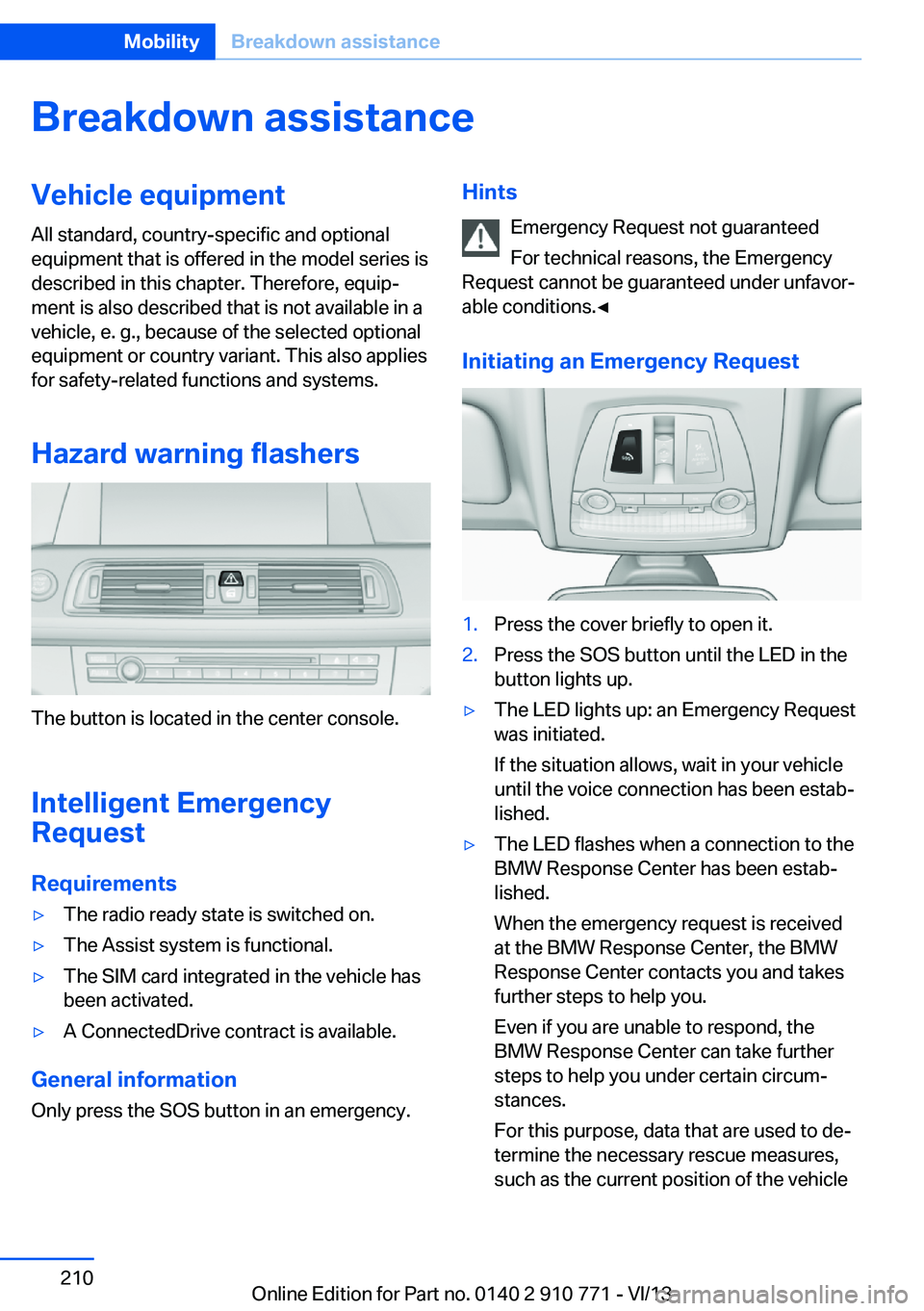
Hazard warning flashers
The button is located in the center console.
Intelligent Emergency
Request
Requirements
▷The radio ready state is switched on.▷The Assist system is functional.▷The SIM card integrated in the vehicle has
been activated.▷A ConnectedDrive contract is available.
General information
Only press the SOS button in an emergency.
Hints
Emergency Request not guaranteed
For technical reasons, the Emergency
Request cannot be guaranteed under unfavor‐
able conditions.◀
Initiating an Emergency Request1.Press the cover briefly to open it.2.Press the SOS button until the LED in the
button lights up.▷The LED lights up: an Emergency Request
was initiated.
If the situation allows, wait in your vehicle
until the voice connection has been estab‐
lished.▷The LED flashes when a connection to the
BMW Response Center has been estab‐
lished.
When the emergency request is received
at the BMW Response Center, the BMW
Response Center contacts you and takes
further steps to help you.
Even if you are unable to respond, the
BMW Response Center can take further
steps to help you under certain circum‐
stances.
For this purpose, data that are used to de‐
termine the necessary rescue measures,
such as the current position of the vehicleSeite 210MobilityBreakdown assistance210
Online Edition for Part no. 0140 2 910 771 - VI/13
Page 211 of 237
if it can be established, are transmitted to
the BMW Response Center.▷If the LED is flashing, but the BMW Re‐
sponse Center can no longer be heard via
the speaker, you can nevertheless still be
heard for the BMW Response Center.
Initiating an Emergency Request
automatically
Under certain conditions, an Emergency Re‐
quest is automatically initiated immediately af‐
ter a severe accident. Automatic Collision Noti‐
fication is not affected by pressing the SOS
button.
Warning triangle
The warning triangle is located on the inside of
the trunk lid.
To remove, loosen the bracket.
First aid kit NoteSome of the articles have a limited service life.
Check the expiration dates of the contents
regularly and replace any expired items
promptly.
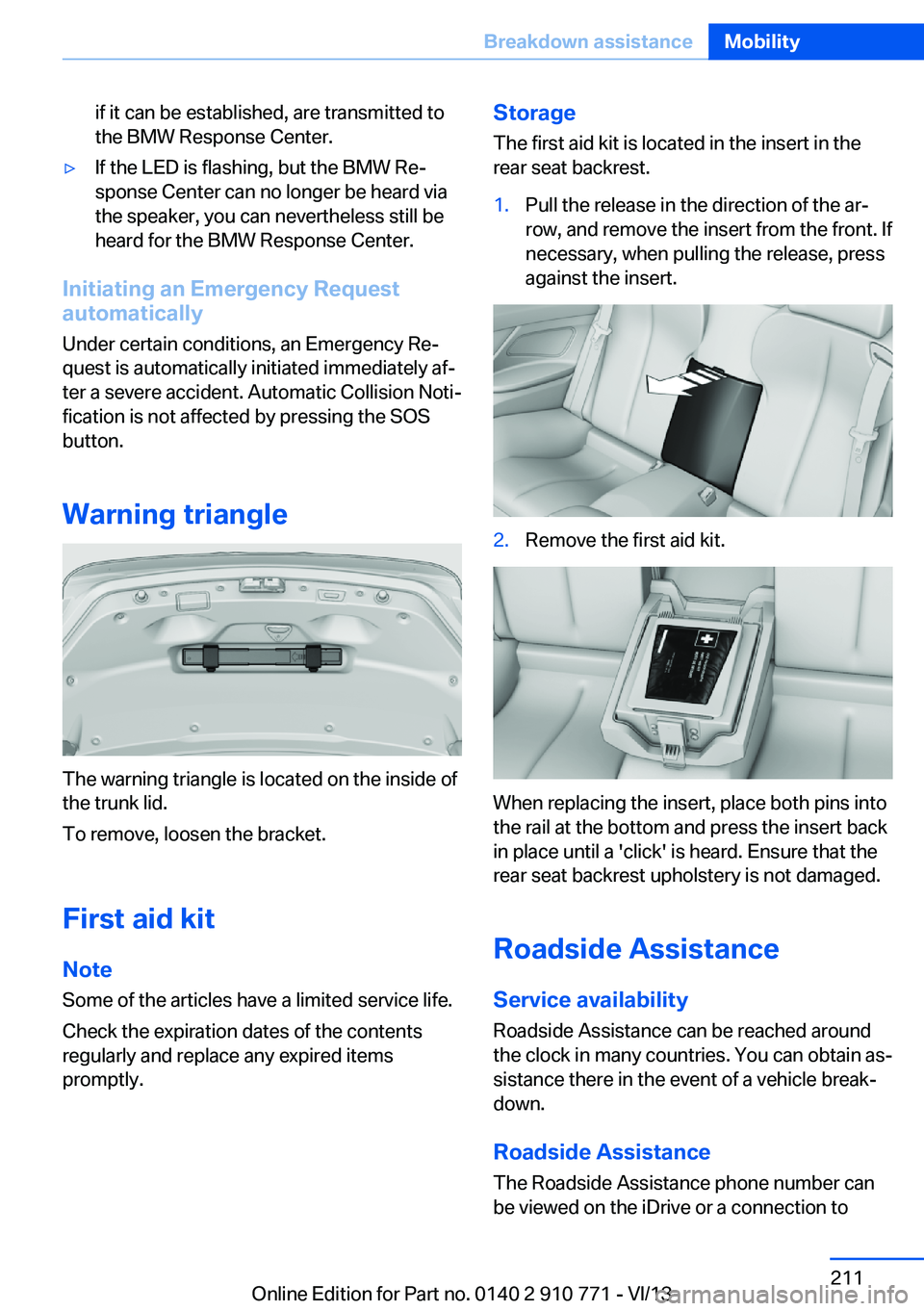
Storage
The first aid kit is located in the insert in the
rear seat backrest.1.Pull the release in the direction of the ar‐
row, and remove the insert from the front. If
necessary, when pulling the release, press
against the insert.2.Remove the first aid kit.
When replacing the insert, place both pins into
the rail at the bottom and press the insert back
in place until a 'click' is heard. Ensure that the
rear seat backrest upholstery is not damaged.
Roadside Assistance
Service availability Roadside Assistance can be reached around
the clock in many countries. You can obtain as‐
sistance there in the event of a vehicle break‐
down.
Roadside Assistance The Roadside Assistance phone number can
be viewed on the iDrive or a connection to
Seite 211Breakdown assistanceMobility211
Online Edition for Part no. 0140 2 910 771 - VI/13
Page 212 of 237
Roadside Assistance can be established di‐
rectly.
Jump-starting
Notes If the battery is discharged, an engine can be
started using the battery of another vehicle
and two jumper cables. Only use jumper ca‐
bles with fully insulated clamp handles.
To prevent personal injury or damage to both
vehicles, adhere strictly to the following proce‐
dure.
Do not touch live parts
To avoid the risk of potentially fatal in‐
jury, always avoid all contact with electrical
components while the engine is running.◀
Preparation1.Check whether the battery of the other ve‐
hicle has a voltage of 12 volts. This infor‐
mation can be found on the battery.2.Switch off the engine of the assisting vehi‐
cle.3.Switch off any electronic systems/power
consumers in both vehicles.
Bodywork contact between vehicles
Make sure that there is no contact be‐
tween the bodywork of the two vehicles; other‐
wise, there is the danger of short circuits.◀
Starting aid terminals Connecting order
Connect the jumper cables in the correct
order; otherwise, there is the danger of injury
from sparking.◀
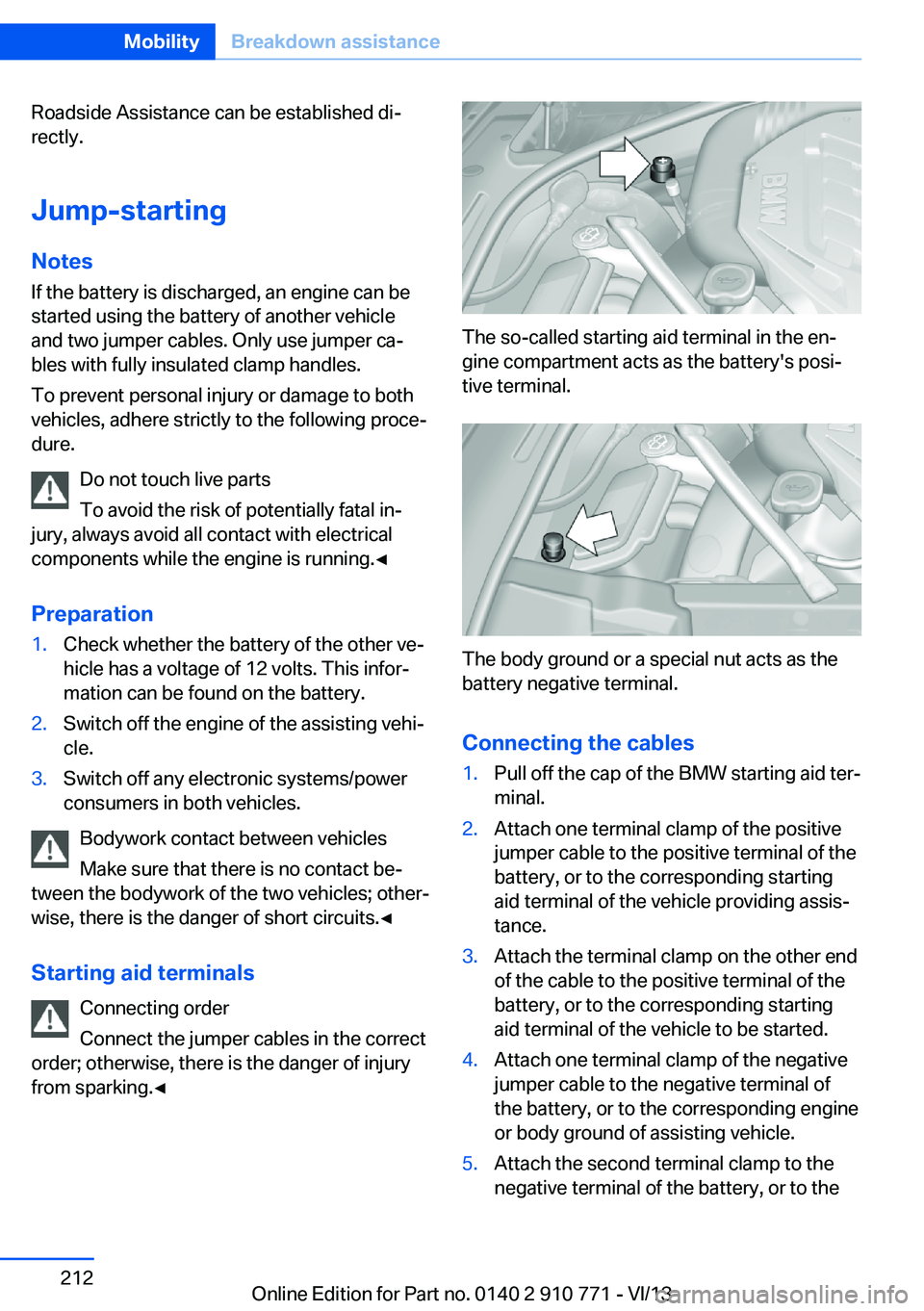
The so-called starting aid terminal in the en‐
gine compartment acts as the battery's posi‐
tive terminal.
The body ground or a special nut acts as the
battery negative terminal.
Connecting the cables
1.Pull off the cap of the BMW starting aid ter‐
minal.2.Attach one terminal clamp of the positive
jumper cable to the positive terminal of the
battery, or to the corresponding starting
aid terminal of the vehicle providing assis‐
tance.3.Attach the terminal clamp on the other end
of the cable to the positive terminal of the
battery, or to the corresponding starting
aid terminal of the vehicle to be started.4.Attach one terminal clamp of the negative
jumper cable to the negative terminal of
the battery, or to the corresponding engine
or body ground of assisting vehicle.5.Attach the second terminal clamp to the
negative terminal of the battery, or to theSeite 212MobilityBreakdown assistance212
Online Edition for Part no. 0140 2 910 771 - VI/13
Page 213 of 237
corresponding engine or body ground of
the vehicle to be started.
Starting the engine
Never use spray fluids to start the engine.
1.Start the engine of the assisting vehicle
and let it run for several minutes at an in‐
creased idle speed.2.Start the engine of the vehicle being
started in the usual way.
If the first starting attempt is not success‐
ful, wait a few minutes before making an‐
other attempt in order to allow the dis‐
charged battery to recharge.3.Let both engines run for several minutes.4.Disconnect the jumper cables in the re‐
verse order.
Check the battery and recharge if necessary.
Tow-starting and towing Automatic transmission: transporting
your vehicle
Note
Your vehicle is not permitted to be towed.
Therefore, contact a service center in the
event of a breakdown.
Do not have the vehicle towed
Have your vehicle transported on a load‐
ing platform only; otherwise, damage may oc‐
cur.◀
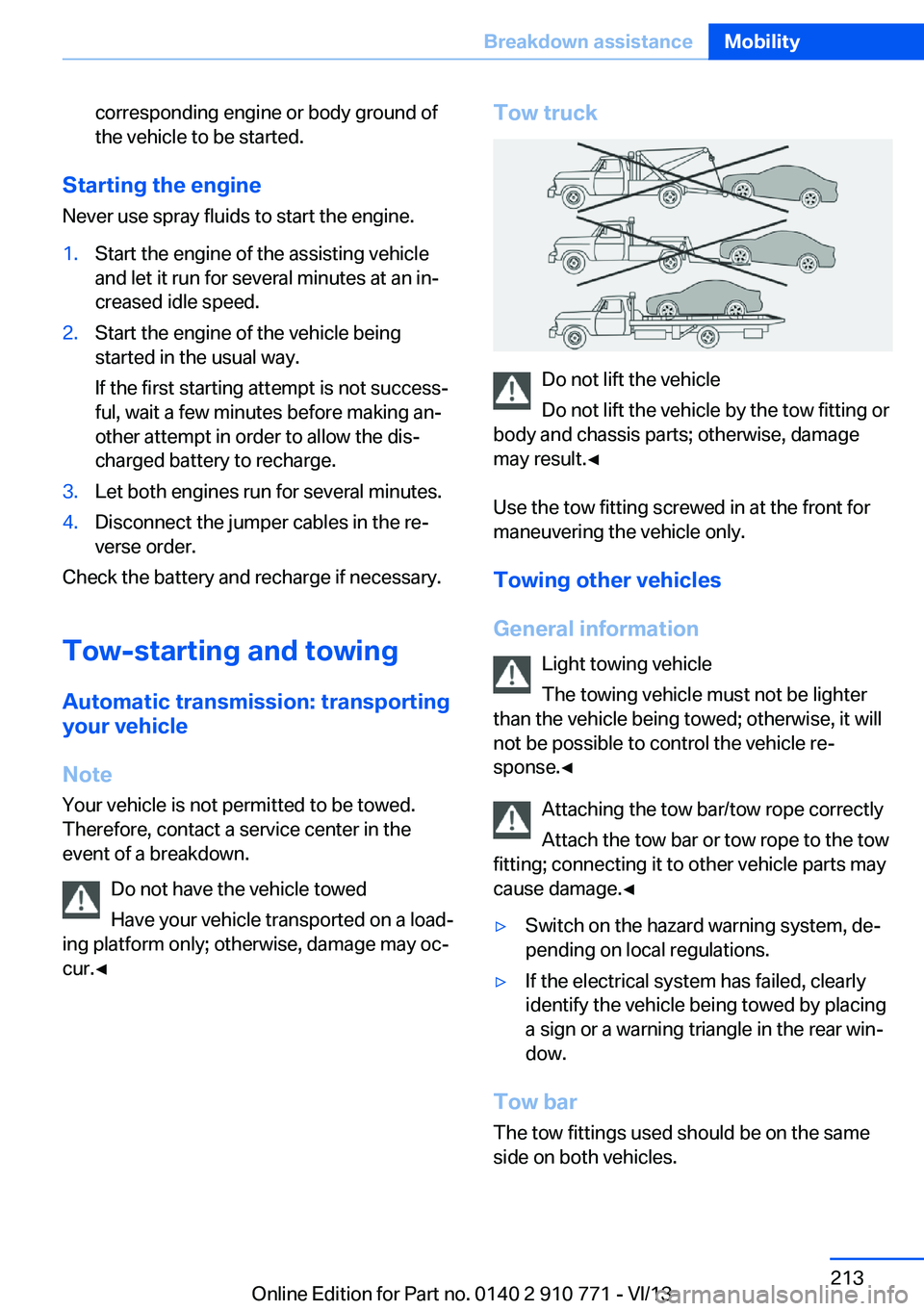
Tow truck
Do not lift the vehicle
Do not lift the vehicle by the tow fitting or
body and chassis parts; otherwise, damage
may result.◀
Use the tow fitting screwed in at the front for
maneuvering the vehicle only.
Towing other vehicles
General information Light towing vehicle
The towing vehicle must not be lighter
than the vehicle being towed; otherwise, it will
not be possible to control the vehicle re‐
sponse.◀
Attaching the tow bar/tow rope correctly
Attach the tow bar or tow rope to the tow
fitting; connecting it to other vehicle parts may
cause damage.◀
▷Switch on the hazard warning system, de‐
pending on local regulations.▷If the electrical system has failed, clearly
identify the vehicle being towed by placing
a sign or a warning triangle in the rear win‐
dow.
Tow bar
The tow fittings used should be on the same
side on both vehicles.
Seite 213Breakdown assistanceMobility213
Online Edition for Part no. 0140 2 910 771 - VI/13
Page 228 of 237
Confirmation signal 39
Congestion Assistant 130
ConnectedDrive, see user's manual for Navigation, En‐
tertainment and Communi‐
cation
ConnectedDrive Services
Control Display 16
Control Display, settings 84
Controller 16
Control systems, driving sta‐ bility 116
Convenient opening 34
Coolant 201
Coolant temperature 78
Cooling function 153
Cooling, maximum 153
Cooling system 201
Corrosion on brake discs 170
Cruise control 133
Cruise control, active with Stop & Go 124
Cruising range 78
Cupholder 164
Current fuel consumption 79
D
Damage, tires 193
Damping Control, dy‐ namic 119
Data, technical 222
Date 78
Daytime running lights 87
Defrosting, refer to Windows, defrosting 152
Departure time, parked-car heating 155
Departure time, parked-car ventilation 155
Destination distance 83
Digital clock 78
Dimensions 222
Dimmable exterior mirrors 52
Dimmable interior rearview mirror 52 Direction indicator, refer to
Turn signals 64
Display in windshield 148
Display lighting, refer to In‐ strument lighting 89
Displays 71, 72
Displays, cleaning 218
Disposal, coolant 201
Disposal, vehicle battery 208
Distance control, refer to PDC 136
Distance information 149
Distance to destination 83
Divided screen view, split screen 20
Door lock, refer to Remote control 30
Doors, Automatic Soft Clos‐ ing 36
Downhill control 118
Drive-off assistant 116
Drive-off assistant, refer to DSC 116
Driver assistance, see Intelli‐ gent Safety 99
Driving Assistant, see Intelli‐ gent Safety 99
Driving Dynamics Con‐ trol 120
Driving instructions, breaking in 168
Driving mode 120
Driving notes, general 168
Driving stability control sys‐ tems 116
Driving tips 168
DSC Dynamic Stability Con‐ trol 116
DTC driving dynamics 117
DTC Dynamic Traction Con‐ trol 117
Dynamic Damping Con‐ trol 119
Dynamic Drive 119
Dynamic Stability Control DSC 116 Dynamic Traction Control
DTC 117
E ECO PRO 174
ECO PRO, bonus range 175
ECO PRO display 174
ECO PRO displays 74
ECO PRO driving mode 174
ECO PRO mode 174
ECO PRO Tip - driving in‐ struction 176
EfficientDynamics 176
Electronic displays, instru‐ ment cluster 72
Electronic Stability Program ESP, refer to DSC 116
Emergency detection, remote control 31
Emergency release, door lock 36
Emergency release, fuel filler flap 182
Emergency Request 210
Emergency service, refer to Roadside Assistance 211
Emergency start function, en‐ gine start 31
Emergency unlocking, trunk lid 37
Energy Control 79
Energy recovery 79
Engine, automatic Start/Stop function 60
Engine, automatic switch- off 60
Engine compartment 197
Engine compartment, work‐ ing in 197
Engine coolant 201
Engine idling when driving, coasting 177
Engine oil 199
Engine oil, adding 200
Engine oil additives 200 Seite 228ReferenceEverything from A to Z228
Online Edition for Part no. 0140 2 910 771 - VI/13
Page 229 of 237
Engine oil change 200
Engine oil filler neck 200
Engine oil temperature 77
Engine oil types, alterna‐ tive 200
Engine oil types, ap‐ proved 200
Engine start during malfunc‐ tion 31
Engine start, jump-start‐ ing 212
Engine start, refer to Starting the engine 59
Engine stop 59
Engine temperature 77
Entering/exiting vehicle, as‐ sistance, steering wheel 53
Entering a car wash 215
Equipment, interior 157
ESP Electronic Stability Pro‐ gram, refer to DSC 116
Exchanging wheels/tires 193
Exhaust system 168
Exterior mirror, automatic dimming feature 52
Exterior mirrors 51
External start 212
External temperature dis‐ play 78
External temperature warn‐ ing 78
Eyes for securing cargo 172
F
Failure message, refer to Check Control 75
False alarm, refer to Uninten‐ tional alarm 41
Fan, refer to Air flow 152
Fault displays, refer to Check Control 75
Filler neck for engine oil 200
Fine wood, care 217
First aid kit 211 Fitting for towing, refer to
Tow fitting 214
Flat tire, changing wheels 207
Flat Tire Monitor FTM 97
Flat tire, Tire Pressure Moni‐ tor TPM 94
Flat tire, warning lamp 95, 98
Flooding 169
Floor carpet, care 218
Floor mats, care 218
Fold-out position, windshield wipers 66
Foot brake 169
For the headliner, refer to All around the interior rearview
mirror 15
Front airbags 91
Front center armrest 163
Front fog lamps 89
Front lamps 204
Front passenger airbags, au‐ tomatic deactivation 93
Front passenger airbags, indi‐ cator lamp 93
Front seats 45
Front turn signals, refer to Light-emitting diodes,
LEDs 206
FTM Flat Tire Monitor 97
Fuel 184
Fuel cap 182
Fuel consumption, current 79
Fuel consumption, refer to Average fuel consump‐
tion 83
Fuel filler flap 182
Fuel gauge 77
Fuel quality 184
Fuel recommendation 184
Fuel, tank capacity 224
Fuse 208 G
Garage door opener, refer to Integrated universal remote
control 157
Gasoline 184
Gasoline quality 184
Gear change, automatic transmission 68
Gear shift indicator 80
General driving notes 168
Glass sunroof, powered with tilt function 42
Glove compartment 162
Gross vehicle weight, ap‐ proved 223
Gross weight, permissible for trailer towing 223
H
Handbrake, refer to Parking brake 62
Hand-held transmitter, alter‐ nating code 158
Hazard warning flashers 210
HDC Hill Descent Con‐ trol 118
Head airbags 91
Headlamp control, auto‐ matic 87
Headlamp courtesy delay fea‐ ture 86
Headlamp courtesy delay fea‐ ture via remote control 34
Headlamp flasher 65
Headlamp glass 205
Headlamps 204
Headlamps, care 216
Headlamp washer system 65
Head restraints 45
Head restraints, front 49
Head-Up Display 148
Head-up Display, care 218
Heating, refer to Parked-car heating 154 Seite 229Everything from A to ZReference229
Online Edition for Part no. 0140 2 910 771 - VI/13