heating BMW 650I GRAN COUPE 2013 User Guide
[x] Cancel search | Manufacturer: BMW, Model Year: 2013, Model line: 650I GRAN COUPE, Model: BMW 650I GRAN COUPE 2013Pages: 232, PDF Size: 9.31 MB
Page 143 of 232
Switching off
At the lowest fan speed, press the left side of the
button on the driver's side.
on the display of the automatic climate control
goes out.
Switching the system on/off
Switching off
▷Complete system:
Press and hold the left button on
the driver's side until the control
clicks off.
▷On the front passenger side:
Press and hold the left button on
the front passenger side.
Switching on
Press any button except:
▷ALL program.▷Rear window defroster.▷Left side of Air volume button.▷Seat heating.▷Seat ventilation.
Microfilter/activated-charcoal filter
The microfilter removes dust and pollen from
the incoming air.
The activated-charcoal filter removes gaseous
pollutants from the outside air that enters the
vehicle.
This combined filter should be replaced during
scheduled maintenance, refer to page 189, of
your vehicle.
Ventilation
Front ventilation
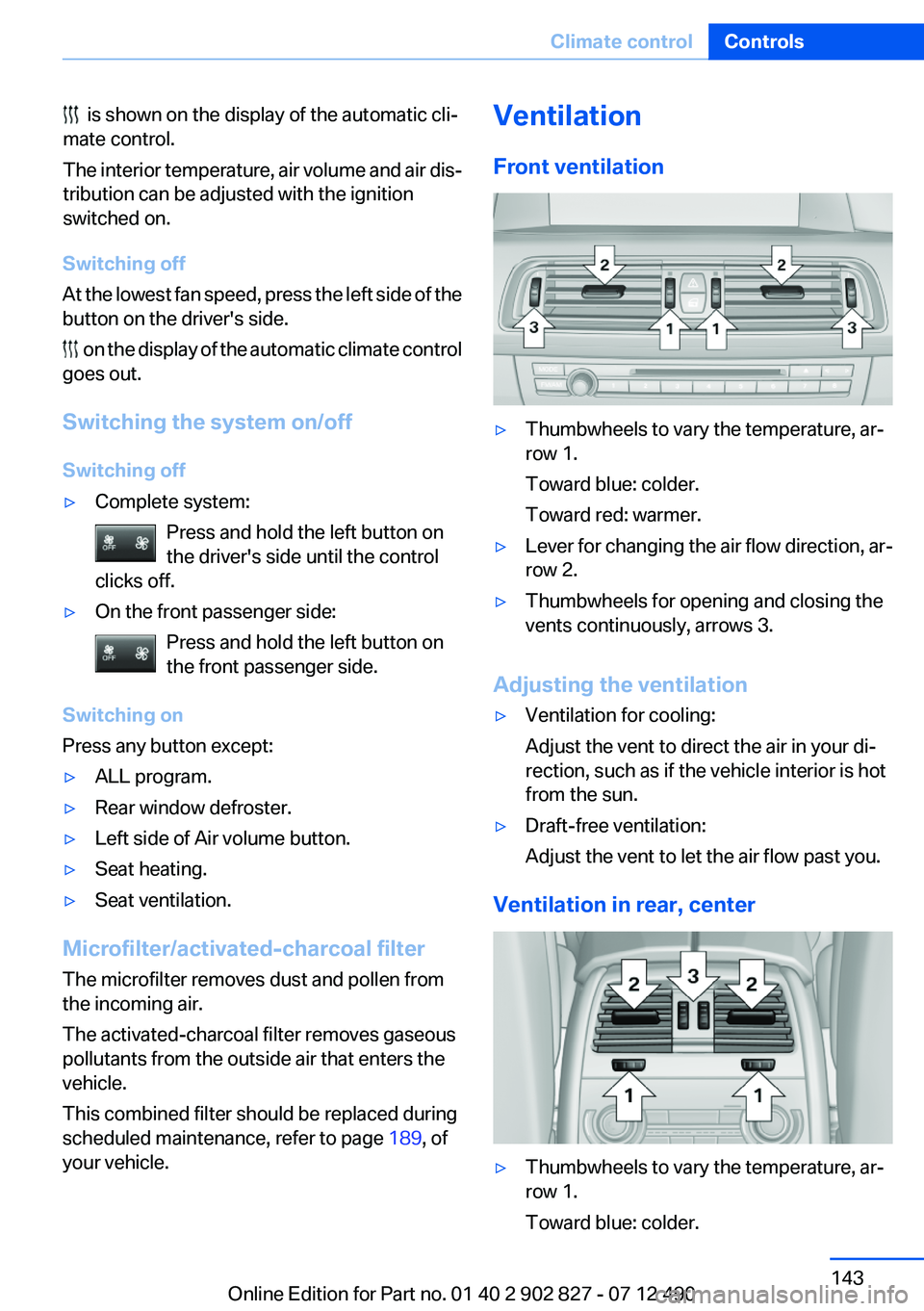
▷Thumbwheels to vary the temperature, ar‐
row 1.
Toward blue: colder.
Toward red: warmer.
▷Lever for changing the air flow direction, ar‐
row 2.
▷Thumbwheels for opening and closing the
vents continuously, arrows 3.
Adjusting the ventilation
▷Ventilation for cooling:
Adjust the vent to direct the air in your di‐
rection, such as if the vehicle interior is hot
from the sun.
▷Draft-free ventilation:
Adjust the vent to let the air flow past you.
Ventilation in rear, center
▷Thumbwheels to vary the temperature, ar‐
row 1.
Toward blue: colder.
Seite 143Climate controlControls143
Online Edition for Part no. 01 40 2 902 827 - 07 12 490
is shown on the display of the automatic cli‐
mate control.
The interior temperature, air volume and air dis‐
tribution can be adjusted with the ignition
switched on.
Page 161 of 232
LoadingVehicle equipment
All standard, country-specific and optional
equipment that is offered in the model series is
described in this chapter. Therefore, equipment
is also described that is not available in a vehicle,
e. g., because of the selected optional equip‐
ment or country variant. This also applies for
safety-related functions and systems.
General information Overloading the vehicle
To avoid exceeding the approved carrying
capacity of the tires, never overload the vehicle.
Overloading can lead to overheating and in‐
creases the rate at which damage develops in‐
side the tires. This could result in a sudden loss
of tire inflation pressure.◀
No fluids in the trunk
Make sure that fluids do not leak into the
trunk; otherwise, the vehicle may be damaged. ◀
Determining the load limit1.Locate the following statement on your ve‐
hicle’s placard:▷The combined weight of occupants and
cargo should never exceed XXX kg or
YYY lbs. Otherwise, damage to the ve‐hicle and unstable driving situations may
result.2.Determine the combined weight of the
driver and passengers that will be riding in
your vehicle.3.Subtract the combined weight of the driver
and passengers from XXX kilograms or YYY
pounds.4.The resulting figure equals the available
amount of cargo and luggage load capacity.
For example, if the YYY amount equals
1,000 lbs and there will be four 150 lbs pas‐
sengers in your vehicle, the amount of avail‐
able cargo and luggage load capacity is
400 lbs: 1,000 lbs minus 600 lbs = 400 lbs.5.Determine the combined weight of luggage
and cargo being loaded on the vehicle. That
weight may not safely exceed the available
cargo and luggage load capacity calculated
in Step 4.
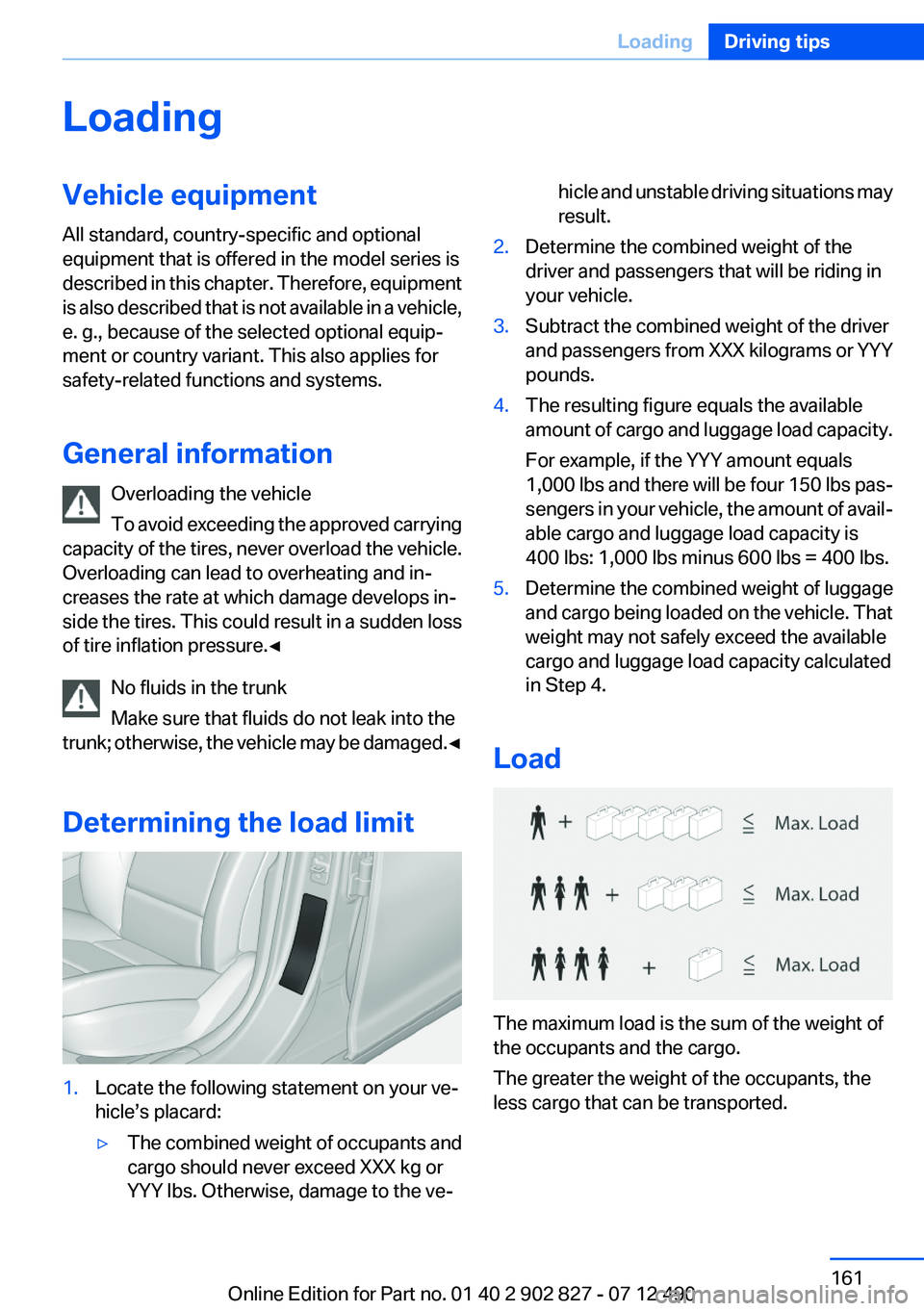
Load
The maximum load is the sum of the weight of
the occupants and the cargo.
The greater the weight of the occupants, the
less cargo that can be transported.
Seite 161LoadingDriving tips161
Online Edition for Part no. 01 40 2 902 827 - 07 12 490
Page 164 of 232
Switch off the engine during
longer stops
Switch off the engine during longer stops, e.g.,
at traffic lights, railroad crossings or in traffic
congestion.
Auto Start/Stop function
The Auto Start/Stop function of your vehicle au‐
tomatically switches off the engine during a
stop.
If the engine is switched off and then restarted
rather than leaving the engine running con‐
stantly, fuel consumption and emissions are re‐
duced. Savings can begin within a few seconds
of switching off the engine.
Using this system can cause certain compo‐
nents of the vehicle to become worn prema‐
turely.
Iin addition, fuel consumption is also determined
by other factors, such as driving style, road con‐
ditions, maintenance or environmental factors.
Switch off any functions that
are not currently needed
Functions such as seat heating and the rear win‐
dow defroster require a lot of energy and con‐
sume additional fuel, especially in city and stop-
and-go traffic.
Therefore, switch off these functions if they are
not actually needed.
Have maintenance carried out
Have vehicles maintained regularly to achieve
optimal vehicle economy and operating life.
Have the maintenance carried out by your serv‐
ice center.
Please also note the BMW Maintenance Sys‐
tem, refer to page 189.ECO PRO
The concept
ECO PRO supports a driving style that saves on
fuel consumption. For this purpose, the engine
control and comfort functions, e. g. the climate
control output, are adjusted.
The extension of the range that is achieved as a
result can be displayed in the instrument cluster.
Activating ECO PRO Press button repeatedly until ECO PRO
is displayed in the instrument cluster.
Display in the instrument cluster
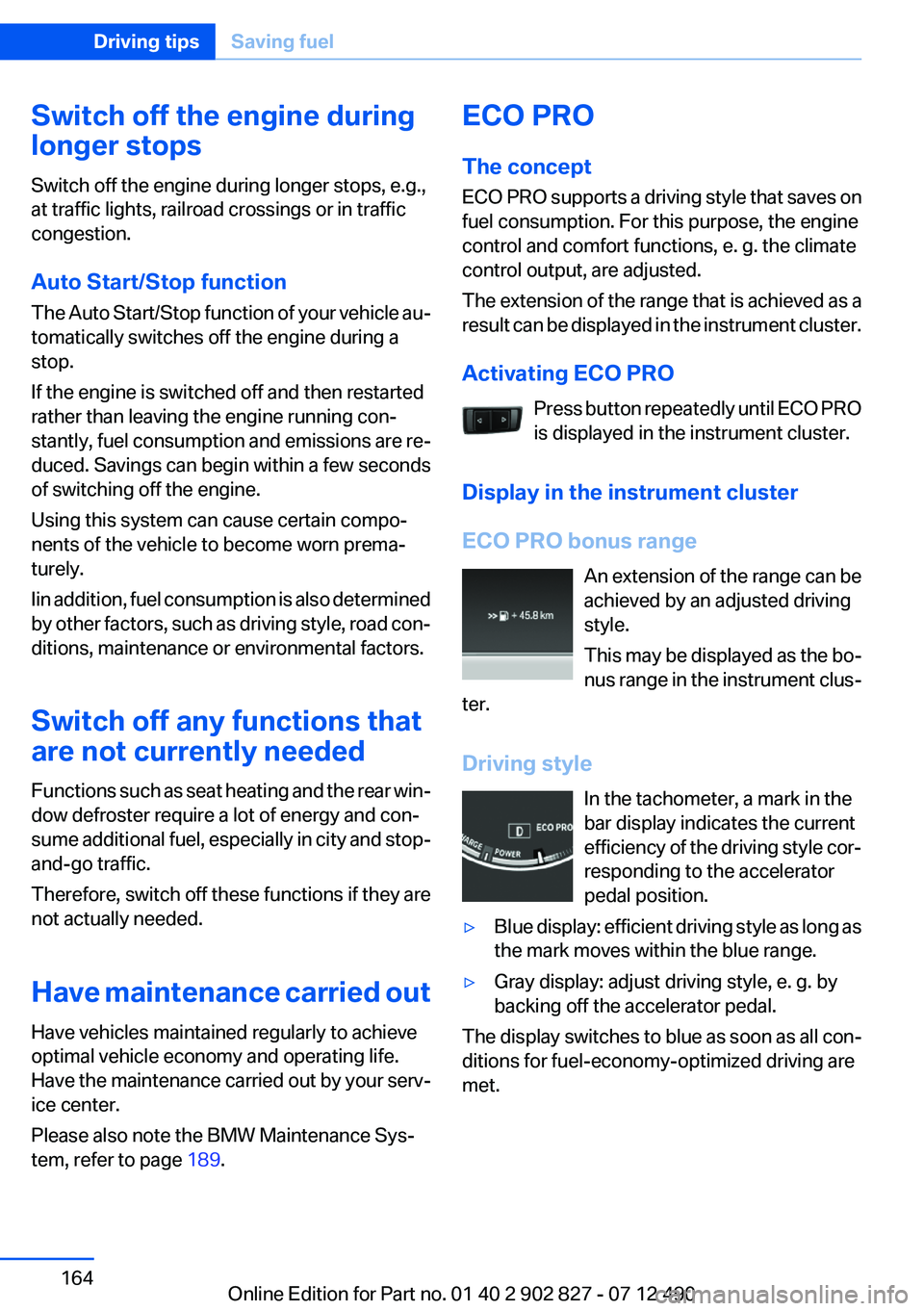
ECO PRO bonus range An extension of the range can be
achieved by an adjusted driving
style.
This may be displayed as the bo‐
nus range in the instrument clus‐
ter.
Driving style In the tachometer, a mark in the
bar display indicates the current
efficiency of the driving style cor‐
responding to the accelerator
pedal position.▷Blue display: efficient driving style as long as
the mark moves within the blue range.▷Gray display: adjust driving style, e. g. by
backing off the accelerator pedal.
The display switches to blue as soon as all con‐
ditions for fuel-economy-optimized driving are
met.
Seite 164Driving tipsSaving fuel164
Online Edition for Part no. 01 40 2 902 827 - 07 12 490
Page 165 of 232
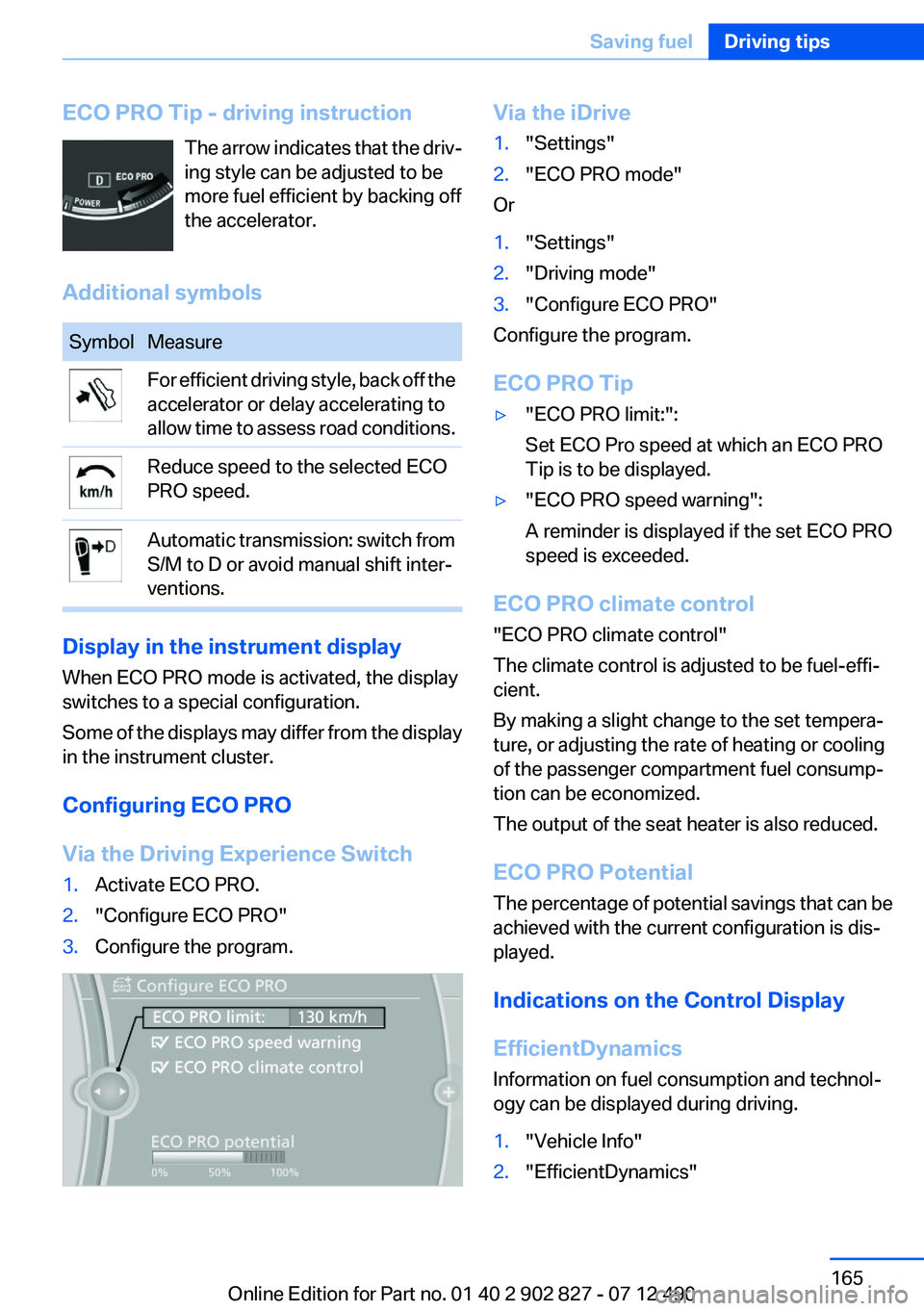
ECO PRO Tip - driving instructionThe arrow indicates that the driv‐
ing style can be adjusted to be
more fuel efficient by backing off
the accelerator.
Additional symbolsSymbolMeasureFor efficient driving style, back off the
accelerator or delay accelerating to
allow time to assess road conditions.Reduce speed to the selected ECO
PRO speed.Automatic transmission: switch from
S/M to D or avoid manual shift inter‐
ventions.
Display in the instrument display
When ECO PRO mode is activated, the display
switches to a special configuration.
Some of the displays may differ from the display
in the instrument cluster.
Configuring ECO PRO
Via the Driving Experience Switch
1.Activate ECO PRO.2."Configure ECO PRO"3.Configure the program.Via the iDrive1."Settings"2."ECO PRO mode"
Or
1."Settings"2."Driving mode"3."Configure ECO PRO"
Configure the program.
ECO PRO Tip
▷"ECO PRO limit:":
Set ECO Pro speed at which an ECO PRO
Tip is to be displayed.▷"ECO PRO speed warning":
A reminder is displayed if the set ECO PRO
speed is exceeded.
ECO PRO climate control
"ECO PRO climate control"
The climate control is adjusted to be fuel-effi‐
cient.
By making a slight change to the set tempera‐
ture, or adjusting the rate of heating or cooling
of the passenger compartment fuel consump‐
tion can be economized.
The output of the seat heater is also reduced.
ECO PRO Potential
The percentage of potential savings that can be
achieved with the current configuration is dis‐
played.
Indications on the Control Display
EfficientDynamics
Information on fuel consumption and technol‐
ogy can be displayed during driving.
1."Vehicle Info"2."EfficientDynamics"Seite 165Saving fuelDriving tips165
Online Edition for Part no. 01 40 2 902 827 - 07 12 490
Page 227 of 232
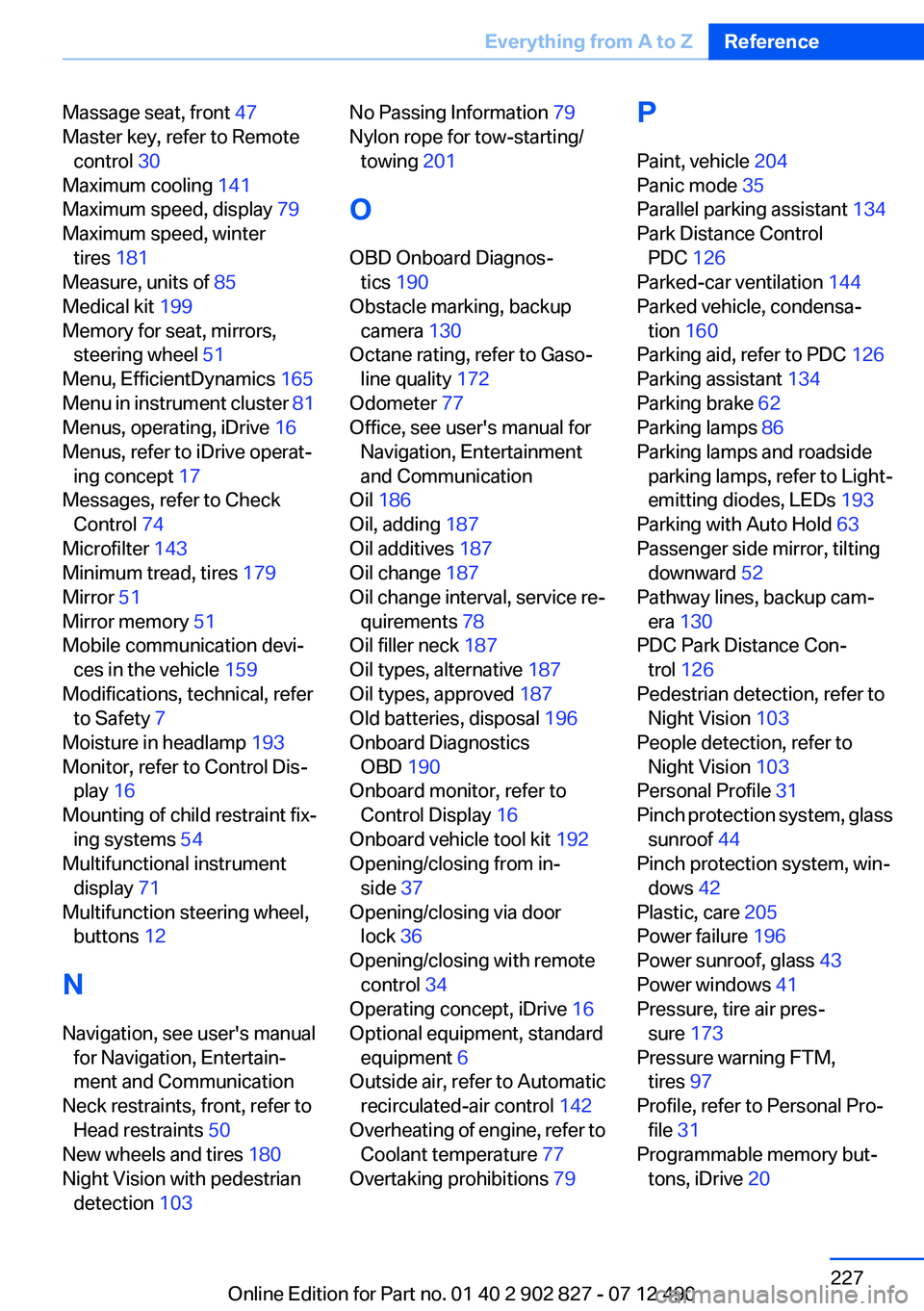
Massage seat, front 47
Master key, refer to Remote control 30
Maximum cooling 141
Maximum speed, display 79
Maximum speed, winter tires 181
Measure, units of 85
Medical kit 199
Memory for seat, mirrors, steering wheel 51
Menu, EfficientDynamics 165
Menu in instrument cluster 81
Menus, operating, iDrive 16
Menus, refer to iDrive operat‐ ing concept 17
Messages, refer to Check Control 74
Microfilter 143
Minimum tread, tires 179
Mirror 51
Mirror memory 51
Mobile communication devi‐ ces in the vehicle 159
Modifications, technical, refer to Safety 7
Moisture in headlamp 193
Monitor, refer to Control Dis‐ play 16
Mounting of child restraint fix‐ ing systems 54
Multifunctional instrument display 71
Multifunction steering wheel, buttons 12
N
Navigation, see user's manual for Navigation, Entertain‐
ment and Communication
Neck restraints, front, refer to Head restraints 50
New wheels and tires 180
Night Vision with pedestrian detection 103 No Passing Information 79
Nylon rope for tow-starting/ towing 201
O
OBD Onboard Diagnos‐ tics 190
Obstacle marking, backup camera 130
Octane rating, refer to Gaso‐ line quality 172
Odometer 77
Office, see user's manual for Navigation, Entertainment
and Communication
Oil 186
Oil, adding 187
Oil additives 187
Oil change 187
Oil change interval, service re‐ quirements 78
Oil filler neck 187
Oil types, alternative 187
Oil types, approved 187
Old batteries, disposal 196
Onboard Diagnostics OBD 190
Onboard monitor, refer to Control Display 16
Onboard vehicle tool kit 192
Opening/closing from in‐ side 37
Opening/closing via door lock 36
Opening/closing with remote control 34
Operating concept, iDrive 16
Optional equipment, standard equipment 6
Outside air, refer to Automatic recirculated-air control 142
Overheating of engine, refer to Coolant temperature 77
Overtaking prohibitions 79 P
Paint, vehicle 204
Panic mode 35
Parallel parking assistant 134
Park Distance Control PDC 126
Parked-car ventilation 144
Parked vehicle, condensa‐ tion 160
Parking aid, refer to PDC 126
Parking assistant 134
Parking brake 62
Parking lamps 86
Parking lamps and roadside parking lamps, refer to Light-
emitting diodes, LEDs 193
Parking with Auto Hold 63
Passenger side mirror, tilting downward 52
Pathway lines, backup cam‐ era 130
PDC Park Distance Con‐ trol 126
Pedestrian detection, refer to Night Vision 103
People detection, refer to Night Vision 103
Personal Profile 31
Pinch protection system, glass sunroof 44
Pinch protection system, win‐ dows 42
Plastic, care 205
Power failure 196
Power sunroof, glass 43
Power windows 41
Pressure, tire air pres‐ sure 173
Pressure warning FTM, tires 97
Profile, refer to Personal Pro‐ file 31
Programmable memory but‐ tons, iDrive 20 Seite 227Everything from A to ZReference227
Online Edition for Part no. 01 40 2 902 827 - 07 12 490
Page 228 of 232
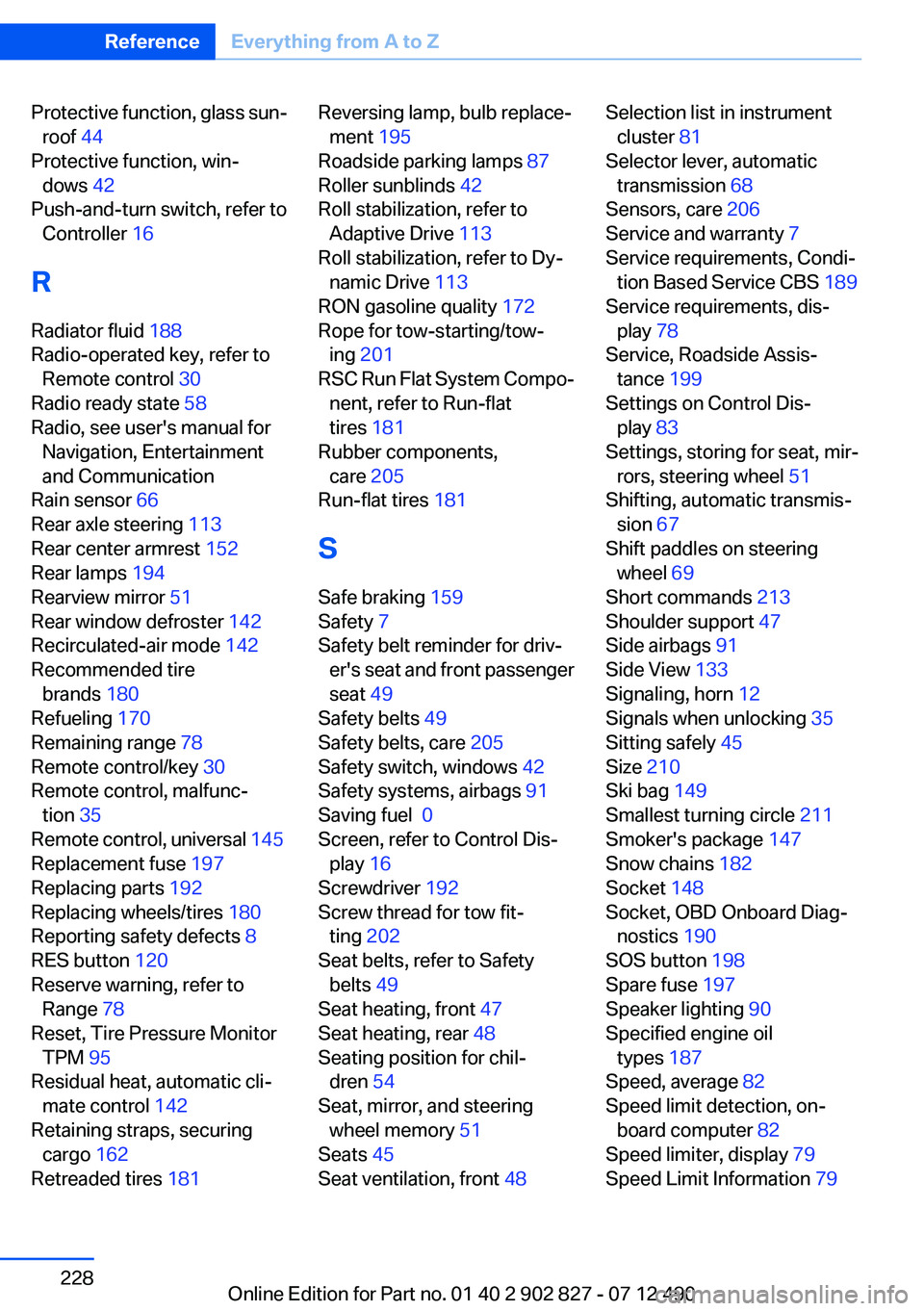
Protective function, glass sun‐roof 44
Protective function, win‐ dows 42
Push-and-turn switch, refer to Controller 16
R
Radiator fluid 188
Radio-operated key, refer to Remote control 30
Radio ready state 58
Radio, see user's manual for Navigation, Entertainment
and Communication
Rain sensor 66
Rear axle steering 113
Rear center armrest 152
Rear lamps 194
Rearview mirror 51
Rear window defroster 142
Recirculated-air mode 142
Recommended tire brands 180
Refueling 170
Remaining range 78
Remote control/key 30
Remote control, malfunc‐ tion 35
Remote control, universal 145
Replacement fuse 197
Replacing parts 192
Replacing wheels/tires 180
Reporting safety defects 8
RES button 120
Reserve warning, refer to Range 78
Reset, Tire Pressure Monitor TPM 95
Residual heat, automatic cli‐ mate control 142
Retaining straps, securing cargo 162
Retreaded tires 181 Reversing lamp, bulb replace‐
ment 195
Roadside parking lamps 87
Roller sunblinds 42
Roll stabilization, refer to Adaptive Drive 113
Roll stabilization, refer to Dy‐ namic Drive 113
RON gasoline quality 172
Rope for tow-starting/tow‐ ing 201
RSC Run Flat System Compo‐ nent, refer to Run-flat
tires 181
Rubber components, care 205
Run-flat tires 181
S
Safe braking 159
Safety 7
Safety belt reminder for driv‐ er's seat and front passenger
seat 49
Safety belts 49
Safety belts, care 205
Safety switch, windows 42
Safety systems, airbags 91
Saving fuel 0
Screen, refer to Control Dis‐ play 16
Screwdriver 192
Screw thread for tow fit‐ ting 202
Seat belts, refer to Safety belts 49
Seat heating, front 47
Seat heating, rear 48
Seating position for chil‐ dren 54
Seat, mirror, and steering wheel memory 51
Seats 45
Seat ventilation, front 48 Selection list in instrument
cluster 81
Selector lever, automatic transmission 68
Sensors, care 206
Service and warranty 7
Service requirements, Condi‐ tion Based Service CBS 189
Service requirements, dis‐ play 78
Service, Roadside Assis‐ tance 199
Settings on Control Dis‐ play 83
Settings, storing for seat, mir‐ rors, steering wheel 51
Shifting, automatic transmis‐ sion 67
Shift paddles on steering wheel 69
Short commands 213
Shoulder support 47
Side airbags 91
Side View 133
Signaling, horn 12
Signals when unlocking 35
Sitting safely 45
Size 210
Ski bag 149
Smallest turning circle 211
Smoker's package 147
Snow chains 182
Socket 148
Socket, OBD Onboard Diag‐ nostics 190
SOS button 198
Spare fuse 197
Speaker lighting 90
Specified engine oil types 187
Speed, average 82
Speed limit detection, on‐ board computer 82
Speed limiter, display 79
Speed Limit Information 79 Seite 228ReferenceEverything from A to Z228
Online Edition for Part no. 01 40 2 902 827 - 07 12 490
Page 229 of 232
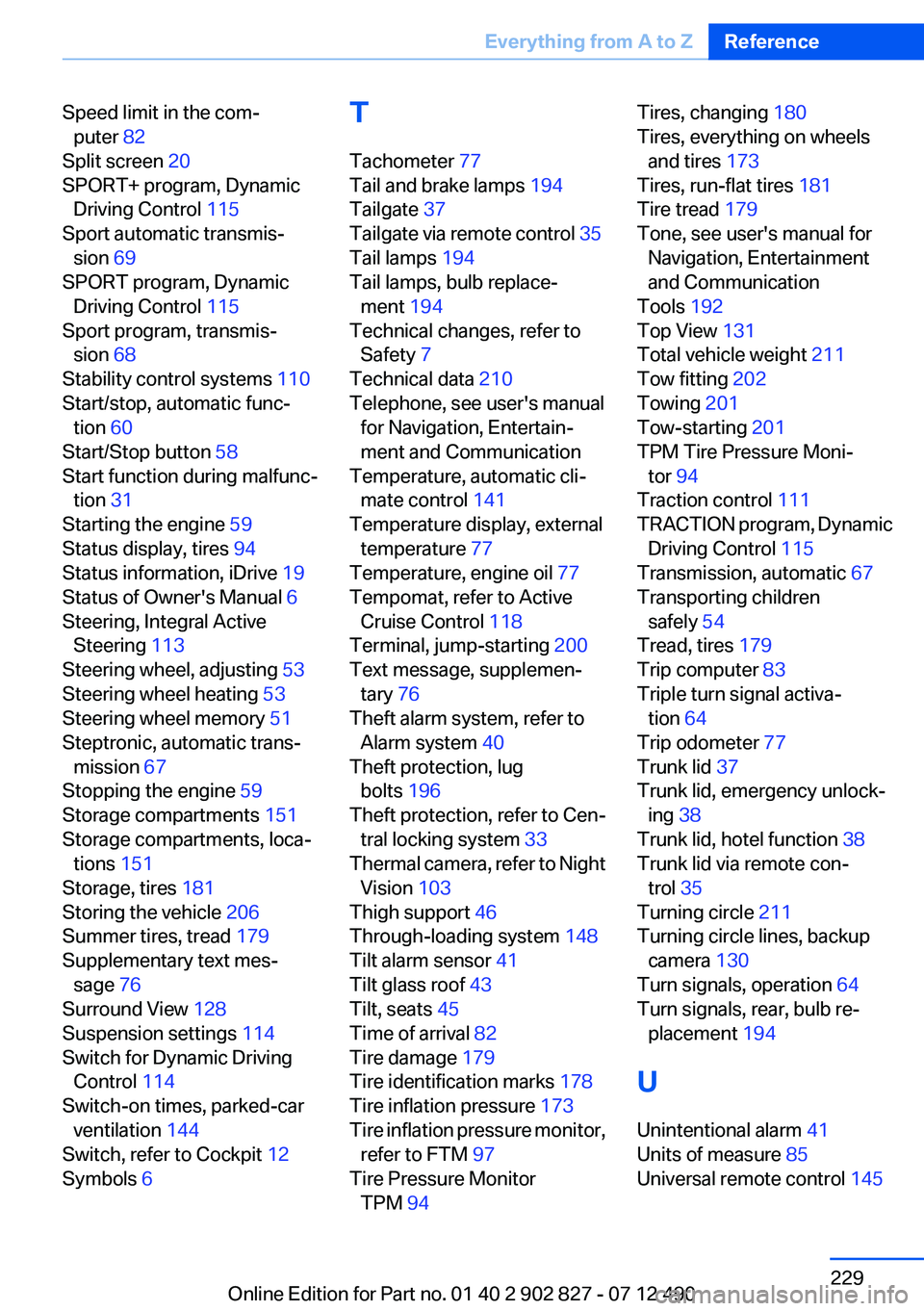
Speed limit in the com‐puter 82
Split screen 20
SPORT+ program, Dynamic Driving Control 115
Sport automatic transmis‐ sion 69
SPORT program, Dynamic Driving Control 115
Sport program, transmis‐ sion 68
Stability control systems 110
Start/stop, automatic func‐ tion 60
Start/Stop button 58
Start function during malfunc‐ tion 31
Starting the engine 59
Status display, tires 94
Status information, iDrive 19
Status of Owner's Manual 6
Steering, Integral Active Steering 113
Steering wheel, adjusting 53
Steering wheel heating 53
Steering wheel memory 51
Steptronic, automatic trans‐ mission 67
Stopping the engine 59
Storage compartments 151
Storage compartments, loca‐ tions 151
Storage, tires 181
Storing the vehicle 206
Summer tires, tread 179
Supplementary text mes‐ sage 76
Surround View 128
Suspension settings 114
Switch for Dynamic Driving Control 114
Switch-on times, parked-car ventilation 144
Switch, refer to Cockpit 12
Symbols 6 T
Tachometer 77
Tail and brake lamps 194
Tailgate 37
Tailgate via remote control 35
Tail lamps 194
Tail lamps, bulb replace‐ ment 194
Technical changes, refer to Safety 7
Technical data 210
Telephone, see user's manual for Navigation, Entertain‐
ment and Communication
Temperature, automatic cli‐ mate control 141
Temperature display, external temperature 77
Temperature, engine oil 77
Tempomat, refer to Active Cruise Control 118
Terminal, jump-starting 200
Text message, supplemen‐ tary 76
Theft alarm system, refer to Alarm system 40
Theft protection, lug bolts 196
Theft protection, refer to Cen‐ tral locking system 33
Thermal camera, refer to Night Vision 103
Thigh support 46
Through-loading system 148
Tilt alarm sensor 41
Tilt glass roof 43
Tilt, seats 45
Time of arrival 82
Tire damage 179
Tire identification marks 178
Tire inflation pressure 173
Tire inflation pressure monitor, refer to FTM 97
Tire Pressure Monitor TPM 94 Tires, changing 180
Tires, everything on wheels and tires 173
Tires, run-flat tires 181
Tire tread 179
Tone, see user's manual for Navigation, Entertainment
and Communication
Tools 192
Top View 131
Total vehicle weight 211
Tow fitting 202
Towing 201
Tow-starting 201
TPM Tire Pressure Moni‐ tor 94
Traction control 111
TRACTION program, Dynamic Driving Control 115
Transmission, automatic 67
Transporting children safely 54
Tread, tires 179
Trip computer 83
Triple turn signal activa‐ tion 64
Trip odometer 77
Trunk lid 37
Trunk lid, emergency unlock‐ ing 38
Trunk lid, hotel function 38
Trunk lid via remote con‐ trol 35
Turning circle 211
Turning circle lines, backup camera 130
Turn signals, operation 64
Turn signals, rear, bulb re‐ placement 194
U
Unintentional alarm 41
Units of measure 85
Universal remote control 145 Seite 229Everything from A to ZReference229
Online Edition for Part no. 01 40 2 902 827 - 07 12 490