sensor BMW 740I 1998 User Guide
[x] Cancel search | Manufacturer: BMW, Model Year: 1998, Model line: 740I, Model: BMW 740I 1998Pages: 211, PDF Size: 1.68 MB
Page 125 of 211

124n
Catalytic converterThe catalytic converter reduces harmful
exhaust emissions, and is designed for
use with unleaded fuel only.
Even minute quantities of lead would be
enough to permanently damage both
the catalytic converter and the system's
oxygen sensor.
To ensure efficient, trouble-free engine
operation and avoid potential damage:
>Be sure to comply with the scheduled
maintenance requirements
>Fill the fuel tank well before it is
empty
>If you have problems starting the en-
gine, use jumper cables (you cannot
tow-start the vehicle with an auto-
matic transmission)>Avoid other situations in which the
fuel is not burned, or burns incom-
pletely, such as engaging the starter
frequently or for extended periods, or
repeated start attempts in which the
engine does not start (stopping and
restarting an engine which is running
properly does not present a problem).
Never let the engine run with any of
the spark plug cables disconnected.Be sure to comply with the in-
structions above to prevent un-
burned fuel from reaching the catalytic
converter. Otherwise there is danger of
overheating and damage to the cata-
lytic converter.
Extreme temperatures occur at the
catalytic converter on this and every
catalyst-equipped vehicle. Heat shields
are installed adjacent to some sections
of the exhaust system. Never remove
these shields; do not apply undercoat-
ing to their surfaces. When driving,
standing at idle, and parking the vehi-
cle, take care to avoid contact between
the exhaust system and flammable ma-
terials (grass, hay, leaves, etc.). Such
contact could lead to a fire, resulting in
personal injury and property damage.<
Page 151 of 211

150n
Caring for your carWashing your carYou can have your new BMW washed
in an automatic car wash. Car wash
systems that do not employ brushes are
preferable.
Wipe away tough dirt and loosen and
remove dead insects before washing
the car.
To prevent spots, avoid washing when
the hood is still warm, or immediately
after and during exposure to strong
sunlight.
When using an automatic car wash, be
sure that:
>The car wash system is suited for the
dimensions of your vehicle
>No damage will occur on vehicles
with attached body accessories (such
as spoilers or antennas). If you are
uncertain, consult the manager of the
car wash
>The wheels and tires of your vehicle
cannot be damaged by the convey-
ance devices of the car wash system
>The vehicle is cleaned with minimum
brush pressure, and that ample water
is available for washing and rinsing.Vehicles with rain sensor
*:
Clean the windshield regularly. Wax
from automatic car washes or insects,
for example, can cause malfunctions in
the function of the rain sensor.
Turn the rain sensor off in auto-
matic car washes. If you do not,
damage may occur if the wipers switch
on unintentionally.<
Parts of the car which are inaccessible
to the automatic washer - such as door
sills, door and hood edges, etc. -
should be cleaned by hand.
In the winter months, it is especially im-
portant to ensure that the car is washed
on a regular basis. Large quantities of
dirt and road salt are difficult to remove,
and they also cause damage to the ve-
hicle.
If spray wands or high-pressure
washers are used, be sure to
maintain an adequate distance between
the spray source and the vehicle's sur-
face.
Inadequate distance and excessive
pressure can damage or weaken the
finish, making it more susceptible to
subsequent attack. In addition, mois-
ture could penetrate to vehicle compo-
nents, leading to long-term damage.<
When cleaning the headlamps,
please observe the following:
>Do not clean by wiping with a dry
cloth (scratches). Never use abra-
sives or strong solvents to clean the
covers
>Remove dirt and contamination
(such as insects) by soaking with
BMW Car Shampoo and then rinsing
with plenty of water
>Always use a deicer spray to remove
accumulated ice and snow – never
use a scraper.<
After washing the car, apply the
brakes briefly to dry them. Braking
efficiency might otherwise be reduced
by the moisture, and the brake rotors
could also be corroded.<
Page 185 of 211
184n
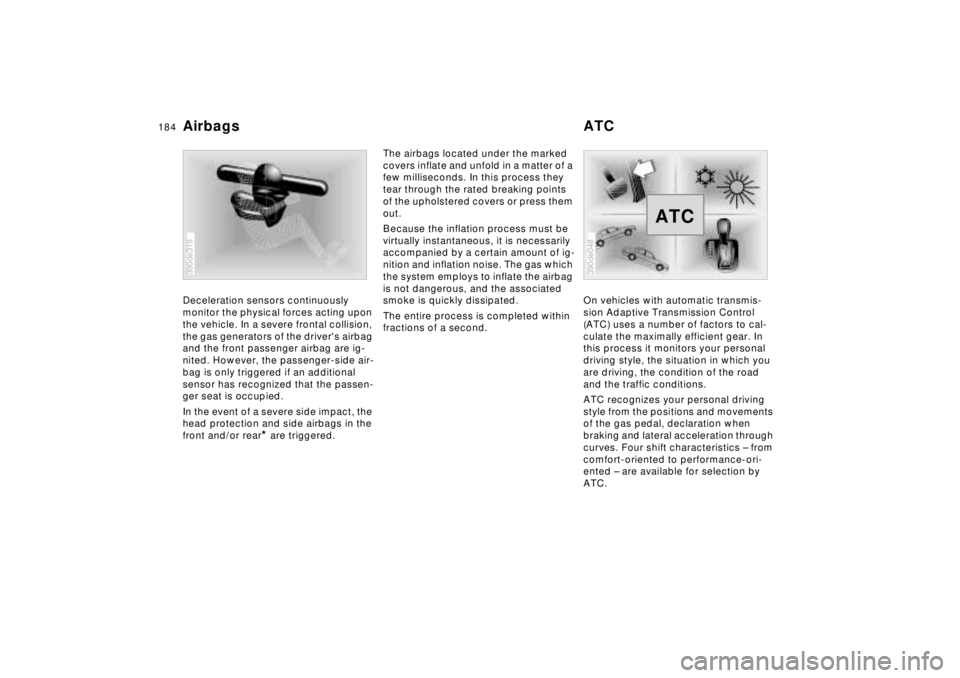
Deceleration sensors continuously
monitor the physical forces acting upon
the vehicle. In a severe frontal collision,
the gas generators of the driver's airbag
and the front passenger airbag are ig-
nited. However, the passenger-side air-
bag is only triggered if an additional
sensor has recognized that the passen-
ger seat is occupied.
In the event of a severe side impact, the
head protection and side airbags in the
front and/or rear
* are triggered.
390de319
The airbags located under the marked
covers inflate and unfold in a matter of a
few milliseconds. In this process they
tear through the rated breaking points
of the upholstered covers or press them
out.
Because the inflation process must be
virtually instantaneous, it is necessarily
accompanied by a certain amount of ig-
nition and inflation noise. The gas which
the system employs to inflate the airbag
is not dangerous, and the associated
smoke is quickly dissipated.
The entire process is completed within
fractions of a second.On vehicles with automatic transmis-
sion Adaptive Transmission Control
(ATC) uses a number of factors to cal-
culate the maximally efficient gear. In
this process it monitors your personal
driving style, the situation in which you
are driving, the condition of the road
and the traffic conditions.
ATC recognizes your personal driving
style from the positions and movements
of the gas pedal, declaration when
braking and lateral acceleration through
curves. Four shift characteristics – from
comfort-oriented to performance-ori-
ented – are available for selection by
ATC.
390de048
ATC
Airbags ATC
Page 186 of 211

185n
RepairsIndexOverview Controls Car care Technology Data
In order to take driving conditions into
account, ATC registers corners and
both uphill and downhill gradients. For
example, if you maintain speed through
a curve, the transmission does not up-
shift.
On uphill gradients, it shifts only when
the engine speed increases in order to
make more efficient use of power re-
serves. On downhill gradients ATC
downshifts when the speed of the vehi-
cles increases causing the driver to
step on the brakes.
With respect to road conditions, ATC
monitors the friction between the tires
and the road. The system responds to
slippery road surfaces (snow and ice)
by activating the winter program.
Second gear is used when moving
away from a standstill, upshifts occur
sooner, and on descents downshifting
does not occur in spite of the applica-
tion of brakes. This enables you to
"feel" the road as you drive and pro-
duces greater dynamic stability. If the
friction between the tires and the road
is adequate, the normal system is again
activated. The system also leaves the
winter program when you shift from
drive position "D" to "S," "3" or "2," or if
the ASC+T/DSC
* is deactivated.By recognizing traffic conditions, ATC
can retain maximum driving comfort.
For instance, the system recognizes
stop-and-go traffic and then proceeds
only in second gear until it encounters
higher starting loads.
Of course the selector lever can still be
used to select specific gear ratios. Per-
formance-oriented driving is enabled by
shifting from drive position "D" to "S,"
"3" or "2." Positions "3" and "2" each
limit upshifts to the next gear. Position
"2" is best for driving on steep mountain
slopes with a heavy load.Precision sensors monitor the number
of revolutions of the wheels. When
equipped with DSC, they also monitor
steering angle, lateral acceleration,
brake pressure and the movement of
the vehicle around its vertical axis.
If differences in the wheel speeds oc-
cur, the system counteracts the danger
of wheelspin by reducing torque. If nec-
essary, the system also responds with
additional applications of the brakes at
the rear wheels.
If the system detects an instability in the
vehicle's condition, the braking action
can also be directed to the front wheels
by the DSC in order to stabilize the ve-
hicle.
You may need some time to become
accustomed to this system intervention.
However, it helps provide optimum pro-
pulsive force and driving stability.
The braking intervention may be ac-
companied by a certain degree of
noise.
ATC ASC+T/DSC
*
Page 189 of 211
188n
Rearview mirror with automatic dimmerThe interior rearview mirror with auto-
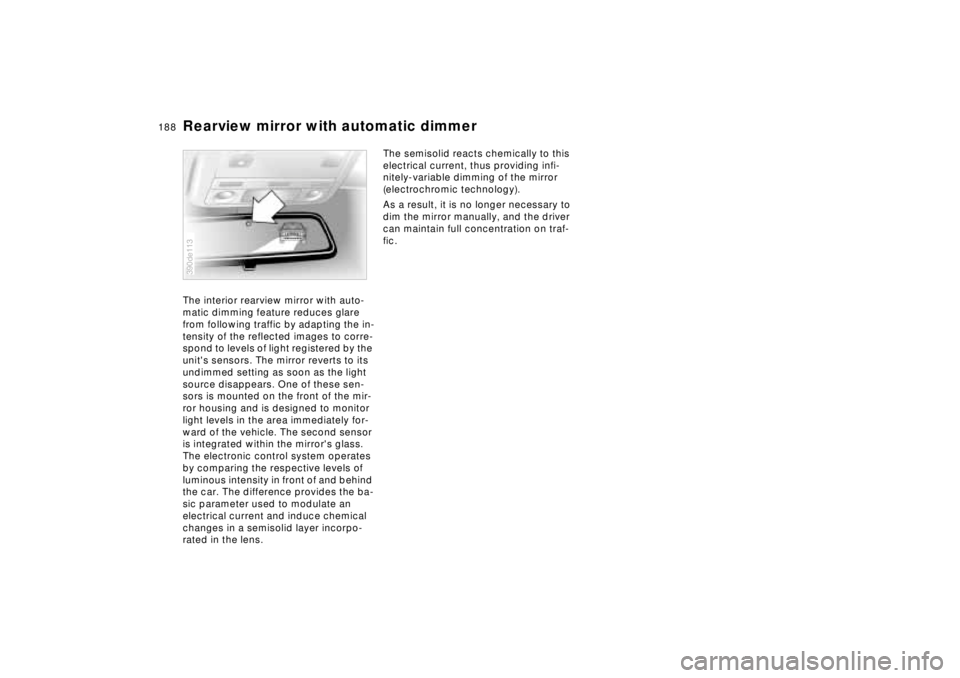
matic dimming feature reduces glare
from following traffic by adapting the in-
tensity of the reflected images to corre-
spond to levels of light registered by the
unit's sensors. The mirror reverts to its
undimmed setting as soon as the light
source disappears. One of these sen-
sors is mounted on the front of the mir-
ror housing and is designed to monitor
light levels in the area immediately for-
ward of the vehicle. The second sensor
is integrated within the mirror's glass.
The electronic control system operates
by comparing the respective levels of
luminous intensity in front of and behind
the car. The difference provides the ba-
sic parameter used to modulate an
electrical current and induce chemical
changes in a semisolid layer incorpo-
rated in the lens. 390de113
The semisolid reacts chemically to this
electrical current, thus providing infi-
nitely-variable dimming of the mirror
(electrochromic technology).
As a result, it is no longer necessary to
dim the mirror manually, and the driver
can maintain full concentration on traf-
fic.
Page 190 of 211
189n
RepairsIndexOverview Controls Car care Technology Data
Tire Pressure Control (RDC)
*
The Tire Pressure Control system as-
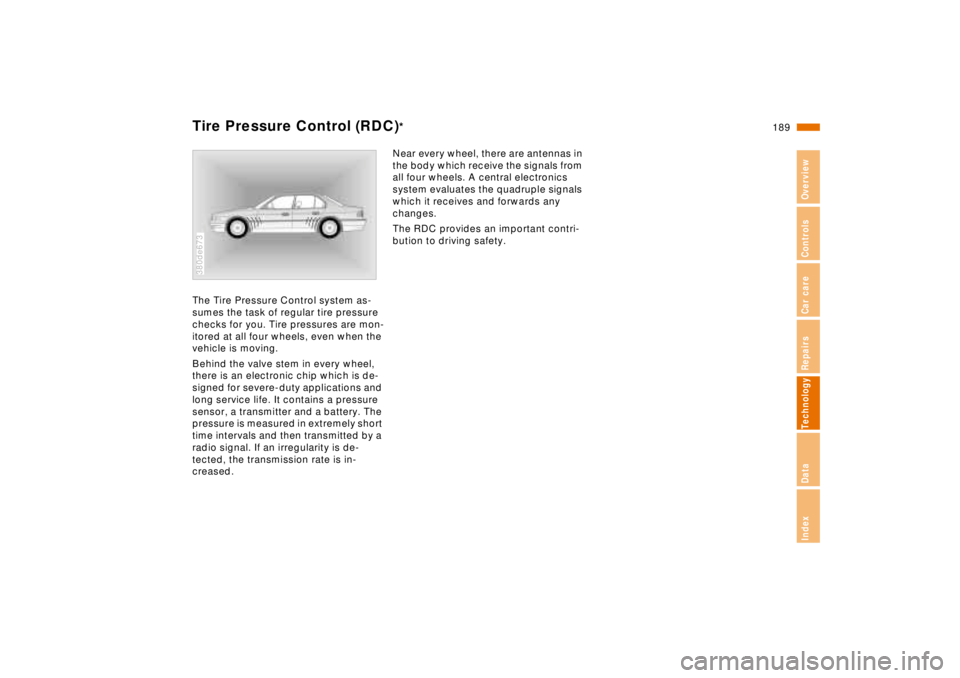
sumes the task of regular tire pressure
checks for you. Tire pressures are mon-
itored at all four wheels, even when the
vehicle is moving.
Behind the valve stem in every wheel,
there is an electronic chip which is de-
signed for severe-duty applications and
long service life. It contains a pressure
sensor, a transmitter and a battery. The
pressure is measured in extremely short
time intervals and then transmitted by a
radio signal. If an irregularity is de-
tected, the transmission rate is in-
creased.380de673
Near every wheel, there are antennas in
the body which receive the signals from
all four wheels. A central electronics
system evaluates the quadruple signals
which it receives and forwards any
changes.
The RDC provides an important contri-
bution to driving safety.
Page 205 of 211

Everything from A to ZHeadlamp flasher68
Headlamp washer
system142
Headlamp washers69
Heated seats106
Heated steering wheel106
Heating and ventilation100
Heating during a stop104
Height195
HiFi system187
High beam headlamps,
bulb replacement164
High beams68
Hood release137
Horn23IIce warning72
Ignition key30
Ignition switch59
Independent ventilation
system107
Indicator lamps20
Inflation pressures26,132
INSPECTION74
Instrument cluster18
Instrument lighting96
Integrated Universal Remote
Control108
Interior door handles,
lighted36,96
Interior lamps32,97Interior lamps, bulb
replacement167
Interior lamps,
radio remote control34
Interior motion sensor40
Interior rearview mirror,
automatic dimming50
Intermittent wipe switch68
JJump starting179KKey Memory53
Keys30
Kickdown63,66LLashing eyes39,118
Leather care154
Length195
Level control system148
License plate lamps, bulb
replacement166
Light switch96
Lighted exterior door handles
32,33
Lighted interior door handles
36,96
LIGHTS ON warning96
Limit87
Loading118Load-securing devices118
Locking and unlocking the
doors32
Locks, care128
Low beam headlamps, bulb
replacement164
Low beams96
Low-fuel warning lamp73
Lug bolts171
Luggage compartment 37, 39
Nets39
Luggage compartment
lamps, bulb
replacement167
Luggage compartment lid 37
Luggage compartment lid,
Automatic Soft-Close38
Luggage compartment lid,
manual operation37
Luggage compartment
nets39
Luggage compartment,
emergency release37
Luggage compartment,
locking separately37
Luggage compartment, radio
remote control34
Luggage rack118
Luggage straps39
Lumbar support47
MMaintenance74,149
Malfunction displays75
Manually controlled
recirculated-air103
Master key30
Memory51,53
MFL (Multi-function steering
wheel)23
Microfilter105
MID (Multi-Information
Display)78
Mirror defrosting50
Mirror memory51
Mirrors50
Modifications,
technical6,157
Multi-function armrest112
Multi-function steering wheel
(MFL)23
Multi-Information Display
(MID)78NNew transmitter, radio
remote control168
Nozzles100OOBD connector158
Odometer72
Oil additives143
Page 206 of 211

RepairsIndexOverview Controls Car care Technology Data
Everything from A to Z
205n
Oil consumption143
Oil level check143
Oil pressure,
indicator lamp20
Oil specifications144
Oil, Engine oil
Capacities197
OILSERVICE74
Onboard computer84
Onboard tool kit162
Opening the luggage
compartment from the
inside38
Outside mirrors50
Outside temperature
display72
PPaint blemishes,
exterior dirt152
Park Distance Control
(PDC)90
Parking aid90
Parking brake61
Parking in winter130
PDC (Park Distance
Control)90
Playing cassettes
Refer to the
Radio Owner's ManuelPlaying CDs
Refer to the
Radio Owner's Manuel
Pocket light111
Power seat adjustment46
Power steering130
Power steering fluid148
Power windows42
Pressure, tires26,132
Pushbutton for central
locking system36
RRadio
Car radio
Refer to the separate
Owner's Manuel
Radio reception131,186
Radio remote control33
Radio remote control,
battery change168
Radio remote control,
new transmitter168
Rain sensor68,150
RDC (Tire Pressure
Control)94
Reading lamps98
Rear passenger-area air
conditioning105
Rear seat adjustment,
electric48
Rear seat heating106Rear window blind107
Rear window defroster70
Rear-seat control
Front passenger's seat 112
Onboard computer112
Radio112
Rear window blind112
Telephone112
Rearview mirrors50
Refueling25
Remote control for onboard
computer89
Removing condensation,
windows102
Replacement keys30
Replacing tires133
Residual heat104
Roof luggage rack118
Roof weight rating196
Rubber seals and
components154
SSafety belt tensioner187
Safety belts54
Safety lock buttons36
Screw-on valve stem
caps134
Seat adjustment46
Seat heating106
Seat memory51
Seat, power46Securing cargo118
Selector lever, automatic
transmission62,65
Service and Warranty
Information Booklet149
Service Interval Display
74,149
Servotronic130
Shoulder support47
Shutting off the engine60
Ski bag116
Skid control130
Sliding/Tilt sunroof44
Sliding/Tilt sunroof with glass
moonroof45
Sliding/Tilt sunroof, closing
after electrical fault178
Sliding/Tilt sunroof,
convenience operating
mode32
Sliding/Tilt sunroof, radio
remote control33
Slippery roads129
Snow chains129,135
Socket115
Spare key30
Spare tire171
Spark plugs198
Speaker113
Special oils144
Speed limit warning87
Speedometer19
Page 208 of 211

Repairs
Index
Overview
Controls
Car care
Technology
Data
Owner service procedures from A to Z207 n
A
Adding brake fluid 147
Adding engine coolant 146
Adding engine oil 143
Adding fluid, power steering 148
Air pressure 26
B
Backup lamps, bulb
replacement 166
Battery change, radio remote control 168
Battery, checking charge condition 174
Battery, discharged 179
Brake lamps, bulb replacement 166
Brakes, brake faults 128
Bulb replacement 163
C
Changing a wheel 170
Charging the battery 174
Check Control 75
Checking the engine oil 143
Checking tire pressure 26
D
Defrosting, windows102
Difficult steering 130
Doors, manual operation 32
E
Electrical accessories,
failure 176
Electrical fault fuel filler door 178
Sliding/Tilt sunroof 178
Emergency release Doors 32
Fuel filler door 178
Luggage compartment
lid 37
Sliding/Tilt sunroof 178
Engine oil specifications 144
F
Failure messages75
Filling the windshield washer fluid reservoir 142
First-aid kit 24
Fittings, tow-starting and towing 180
Fog lamp,
replace the bulb 165
Footwell lamps, bulb replacement 167 Fuel filler door,
manual release after
electrical fault 178
Fuses, replacing 176
G
Glove compartment lamp,
bulb replacement 167
H
Hazard warning flashers 24
Hazard warning triangle 24
High beam headlamps, bulb replacement 164,165
Hood release 137
I
Indicator lamps 20
Interior lamps, bulb replacement 167
Interior motion sensor, deactivation 41
J
Jump starting 179
L
License plate lamps, bulb
replacement 166
Low beam headlamps, bulb
replacement 164 Luggage compartment
lamps, bulb
replacement 167
Luggage compartment lid, emergency release 37
M
Maintenance74,149
Malfunction displays 75
N
New transmitter, radio re-
mote control 168
O
Oil level check 143
Oil specifications 144
Onboard tool kit 162
P
Power steering,
adding fluid 148
Pressure, tires 26
R
Radio remote control,
battery change 168
Radio remote control, new transmitter 168
Rear lamp assembly 166
Removing condensation, windows 102
Page 209 of 211

Owner service procedures from A to ZSSecurity glass, care153
Sliding/tilt sunroof, closing
after electrical fault178
Sliding/tilt sunroof, power
supply interruption45
Snow chains135
Spare tire171
Starting assistance179
Starting problems
59,124,179,180TTail lamps, bulb
replacement166
Tilt sensor alarm system,
deactivation41
Tire damage132
Tire failure170
Tire inflation pressure26
Tools162
Towing180
Towing eyes180
Tow-starting180
Turn signal,
replace the bulb165UUse of antifreeze,
radiator146
WWarning lamps20
Warnings75
Washer fluid reservoir,
filling142
Wheel change170
Windows, demisting102
Windshield washer nozzle
adjustment142
Wiper blades, replacing162
Work in the engine
compartment137