parking brake BMW 740I 2013 User Guide
[x] Cancel search | Manufacturer: BMW, Model Year: 2013, Model line: 740I, Model: BMW 740I 2013Pages: 243, PDF Size: 5.37 MB
Page 134 of 243
The selected distance, refer to page 134, is dis‐
played in the instrument cluster.
Calling up the desired speed and
distance
While driving Press the button with the system
switched on.
In the following cases, the stored speed value is
deleted and cannot be called up again:▷When the system is switched off.▷When the ignition is switched off.
While standing
Before leaving the vehicle, secure it
against rolling.
Before leaving the vehicle with the engine run‐
ning, engage position P of the automatic trans‐
mission and apply the parking brake. Otherwise,
the vehicle may begin to roll.◀
The system brought the vehicle to a complete
standstill.
▷Green mark in the speedometer during a
brief idle phase:
The vehicle ahead of you drives away while
the mark is green: your vehicle accelerates
without anything having to be done.▷Switch to orange of the mark in the speed‐
ometer after approx. 2 sec.:
The vehicle ahead of you drives away, while
the mark is orange: in order to accelerate,
briefly press the gas pedal or press the RES
button or SET button.
Rolling bars in the distance indicator mean that
the vehicle ahead of you has driven off.
You actively braked your vehicle to a halt by
pressing on the brake pedal and it is standing
behind another vehicle:1. Press the button to call up a stored
desired speed.2.Release the brake pedal.3.Press on the accelerator briefly, or press the
RES button or the rocker switch when the
vehicle ahead of you drives away.
Displays in the instrument cluster
Desired speed
▷The marking lights up green:
the system is active.▷The marking lights up or‐
ange: the system has been
interrupted.▷The marking does not light up: the system is
switched off.
With instrument display: the symbol is
displayed in the speedometer similarly
to the mark for the desired speed.
Brief status display Selected desired speed.
If --- appears briefly on the display for Check
Control messages, it is possible that the system
requirements for operation are currently not
met.
Distance to vehicle ahead of you
The selected distance to the vehicle driving
ahead of you is shown.
Seite 134ControlsDriving comfort134
Online Edition for Part no. 01 40 2 916 693 - X/12
Page 137 of 243
Radar sensor
For US owners only
The transmitter and receiver units comply with
part 15 of the FCC/Federal Communication
Commission regulations. Operation is governed
by the following:
FCC ID:▷OAYARS3-A
Compliance statement:
This device complies with part 15 of the FCC
Rules. Operation is subject to the following two
conditions:
▷This device may not cause harmful interfer‐
ence, and▷this device must accept any interference re‐
ceived, including interference that may
cause undesired operation.
Any unauthorized modifications or changes to
these devices could void the user's authority to
operate this equipment.
Malfunction
The system cannot be activated if the radar sen‐
sor is not aligned correctly. This may be caused
by damage incurred during parking, for example.
A Check Control message is displayed if the
system fails.
If the camera fails or becomes dirty, the system
cannot detect stationary vehicles. A Check Con‐
trol message is displayed.
Cruise control
The concept
The system is functional at speeds beginning at
approx. 20 mph/30 km/h.
It maintains the speed that was set using the
control elements on the steering wheel.
The system brakes on downhill gradients if en‐
gine braking action is insufficient.
Unfavorable conditions
Do not use the system if unfavorable con‐
ditions make it impossible to drive at a constant
speed, for instance:▷On curvy roads.▷In heavy traffic.▷On slippery roads, in fog, snow or rain, or on
a loose road surface.
Otherwise, you could lose control of the vehicle
and cause an accident.◀
General information
When ECO PRO is activated, cruise control is
also set to a driving style that saves on fuel con‐
sumption.
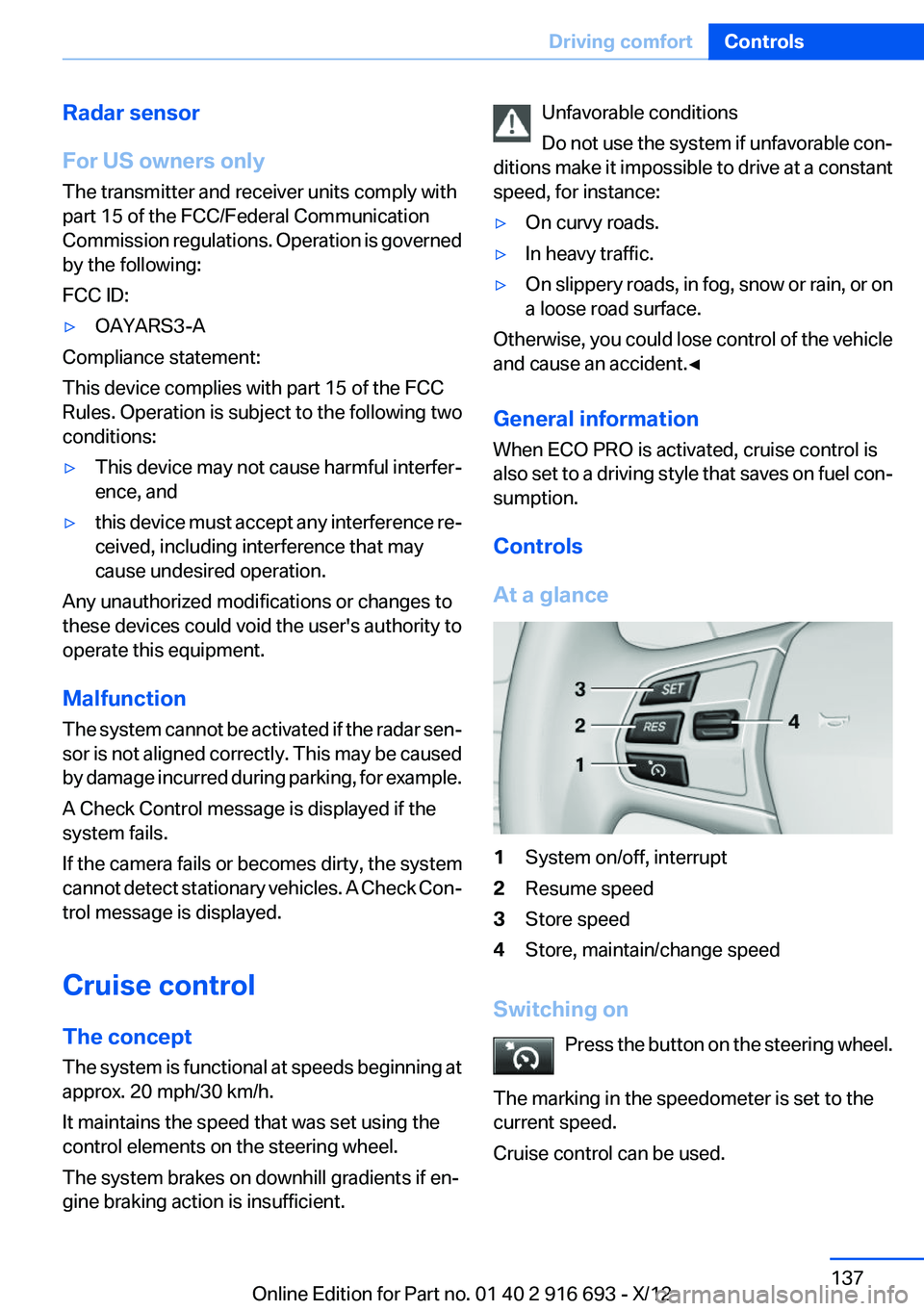
Controls
At a glance
1System on/off, interrupt2Resume speed3Store speed4Store, maintain/change speed
Switching on Press the button on the steering wheel.
The marking in the speedometer is set to the
current speed.
Cruise control can be used.
Seite 137Driving comfortControls137
Online Edition for Part no. 01 40 2 916 693 - X/12
Page 174 of 243
Things to remember when drivingVehicle equipment
All standard, country-specific and optional
equipment that is offered in the model series is
described in this chapter. Therefore, equipment
is also described that is not available in a vehicle,
e. g., because of the selected optional equip‐
ment or country variant. This also applies for
safety-related functions and systems.
Breaking-in period
General information
Moving parts need to be broken in to adjust to
each other.
The following instructions will help achieve a
long vehicle life and good economy.
Engine and differential
Always obey the official speed limit.
Up to 1,200 miles/2,000 km
Do not exceed the maximum engine and road
speed:▷For gasoline engine, 4,500 rpm and
100 mph/160 km/h.
Avoid full load or kick-down under all circum‐
stances.
From 1,200 miles/2,000 km
The engine and vehicle speed can gradually be
increased.
Tires
Due to technical factors associated with their
manufacture, tires do not achieve their full trac‐
tion potential until after an initial breaking-in pe‐
riod.
Drive conservatively for the first
200 miles/300 km.
Brake system
Brakes require an initial break-in period of ap‐
prox. 300 miles/500 km to achieve optimized
contact and wear patterns between brake discs
and brake pads. Drive moderately during this
break-in period.
Following part replacement
The same breaking in procedures should be ob‐
served if any of the components mentioned
above have to be renewed in the course of the
vehicle's operating life.
General driving notes
Closing the trunk lid Drive with the trunk lid closed
Only drive with the tailgate closed; other‐
wise, in the event of an accident or braking or
evasive maneuvers, passengers or other road
users may be injured or the vehicle may be dam‐
aged. In addition, exhaust fumes may enter the
passenger compartment.◀
If driving with the tailgate open cannot be
avoided:▷Close all windows and the glass sunroof.▷Greatly increase the blower speed.▷Drive moderately.
Hot exhaust system
Hot exhaust system
High temperatures are generated in the
exhaust system.
Do not remove the heat shields installed and
never apply undercoating to them. When driv‐
ing, standing at idle and while parking, take care
to avoid possible contact between the hot ex‐
haust system and any highly flammable materi‐
Seite 174Driving tipsThings to remember when driving174
Online Edition for Part no. 01 40 2 916 693 - X/12
Page 222 of 243
CareVehicle equipment
All standard, country-specific and optional
equipment that is offered in the model series is
described in this chapter. Therefore, equipment
is also described that is not available in a vehicle,
e. g., because of the selected optional equip‐
ment or country variant. This also applies for
safety-related functions and systems.
Car washes
Hints Steam jets or high-pressure washers
When using steam jets or high-pressure
washers, hold them a sufficient distance away
and use a maximum temperature of
140 ℉/60 ℃.
Ensure that a distance of at least 31.5 in‐
ches/50 cm is maintained at all times. Holding
them too close or using excessively high pres‐
sures or temperatures can cause damage or
preliminary damage that may then lead to long-
term damage.
Follow the operating instructions for the high-
pressure washer.◀
Cleaning sensors/cameras with high-
pressure washers
When using high-pressure washers, do not
spray the exterior sensors and cameras, e.g.,
Park Distance Control, for extended periods of
time and only from a distance of at least
12 in/30 cm.◀
Regularly remove foreign items such as leaves
in the area below the windshield when the hood
is raised.
Wash your vehicle frequently, particularly in win‐
ter.Intense soiling and road salt can damage the ve‐
hicle.
Automatic car washes
Notes
Note the following:▷Give preference to cloth car washes or those
that use soft brushes in order to avoid paint
damage.▷Make sure that the wheels and tires are not
damaged by the transport mechanisms.▷Fold in the exterior mirrors; otherwise, they
may be damaged, depending on the width of
the vehicle.▷Deactivate the rain sensor, refer to
page 75,to avoid unintentional wiper activa‐
tion.▷In some cases, an unintentional alarm can be
triggered by the interior motion sensor of the
alarm system. Follow the instructions on
avoiding an unintentional alarm, refer to
page 43.
Guide rails in car washes
Avoid car washes with guide rails higher
than 4 in/10 cm; otherwise, the vehicle body
could be damaged.◀
Before driving into a car wash
In order to ensure that the vehicle can roll in a car
wash, take the following steps:
1.Release parking brake, refer to page 70, and
deactivate Automatic Hold, refer to
page 72.2.Drive into the car wash.3.Depress the brake pedal as needed.Seite 222MobilityCare222
Online Edition for Part no. 01 40 2 916 693 - X/12
Page 234 of 243
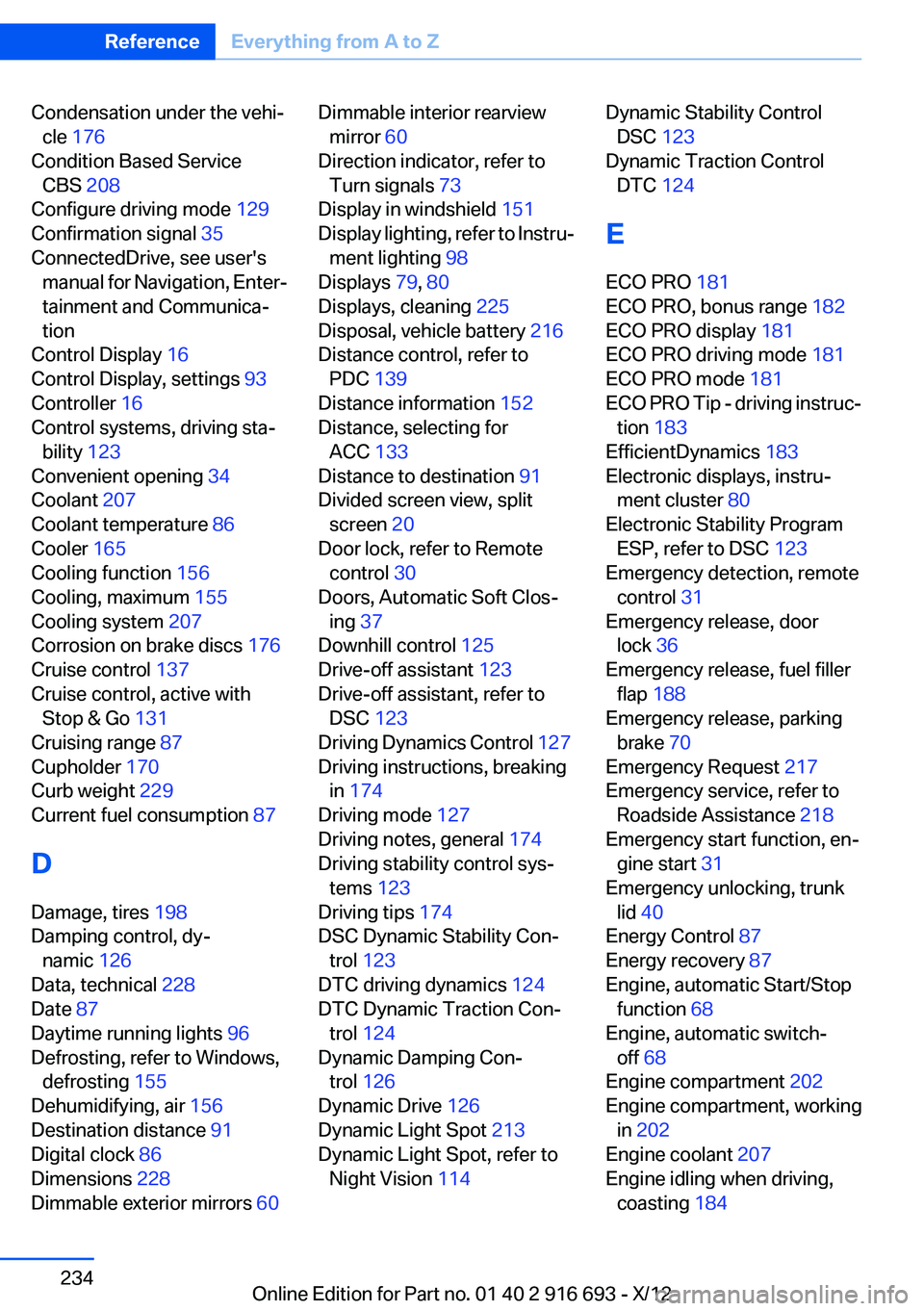
Condensation under the vehi‐cle 176
Condition Based Service CBS 208
Configure driving mode 129
Confirmation signal 35
ConnectedDrive, see user's manual for Navigation, Enter‐
tainment and Communica‐
tion
Control Display 16
Control Display, settings 93
Controller 16
Control systems, driving sta‐ bility 123
Convenient opening 34
Coolant 207
Coolant temperature 86
Cooler 165
Cooling function 156
Cooling, maximum 155
Cooling system 207
Corrosion on brake discs 176
Cruise control 137
Cruise control, active with Stop & Go 131
Cruising range 87
Cupholder 170
Curb weight 229
Current fuel consumption 87
D
Damage, tires 198
Damping control, dy‐ namic 126
Data, technical 228
Date 87
Daytime running lights 96
Defrosting, refer to Windows, defrosting 155
Dehumidifying, air 156
Destination distance 91
Digital clock 86
Dimensions 228
Dimmable exterior mirrors 60 Dimmable interior rearview
mirror 60
Direction indicator, refer to Turn signals 73
Display in windshield 151
Display lighting, refer to Instru‐ ment lighting 98
Displays 79, 80
Displays, cleaning 225
Disposal, vehicle battery 216
Distance control, refer to PDC 139
Distance information 152
Distance, selecting for ACC 133
Distance to destination 91
Divided screen view, split screen 20
Door lock, refer to Remote control 30
Doors, Automatic Soft Clos‐ ing 37
Downhill control 125
Drive-off assistant 123
Drive-off assistant, refer to DSC 123
Driving Dynamics Control 127
Driving instructions, breaking in 174
Driving mode 127
Driving notes, general 174
Driving stability control sys‐ tems 123
Driving tips 174
DSC Dynamic Stability Con‐ trol 123
DTC driving dynamics 124
DTC Dynamic Traction Con‐ trol 124
Dynamic Damping Con‐ trol 126
Dynamic Drive 126
Dynamic Light Spot 213
Dynamic Light Spot, refer to Night Vision 114 Dynamic Stability Control
DSC 123
Dynamic Traction Control DTC 124
E
ECO PRO 181
ECO PRO, bonus range 182
ECO PRO display 181
ECO PRO driving mode 181
ECO PRO mode 181
ECO PRO Tip - driving instruc‐ tion 183
EfficientDynamics 183
Electronic displays, instru‐ ment cluster 80
Electronic Stability Program ESP, refer to DSC 123
Emergency detection, remote control 31
Emergency release, door lock 36
Emergency release, fuel filler flap 188
Emergency release, parking brake 70
Emergency Request 217
Emergency service, refer to Roadside Assistance 218
Emergency start function, en‐ gine start 31
Emergency unlocking, trunk lid 40
Energy Control 87
Energy recovery 87
Engine, automatic Start/Stop function 68
Engine, automatic switch- off 68
Engine compartment 202
Engine compartment, working in 202
Engine coolant 207
Engine idling when driving, coasting 184 Seite 234ReferenceEverything from A to Z234
Online Edition for Part no. 01 40 2 916 693 - X/12
Page 235 of 243
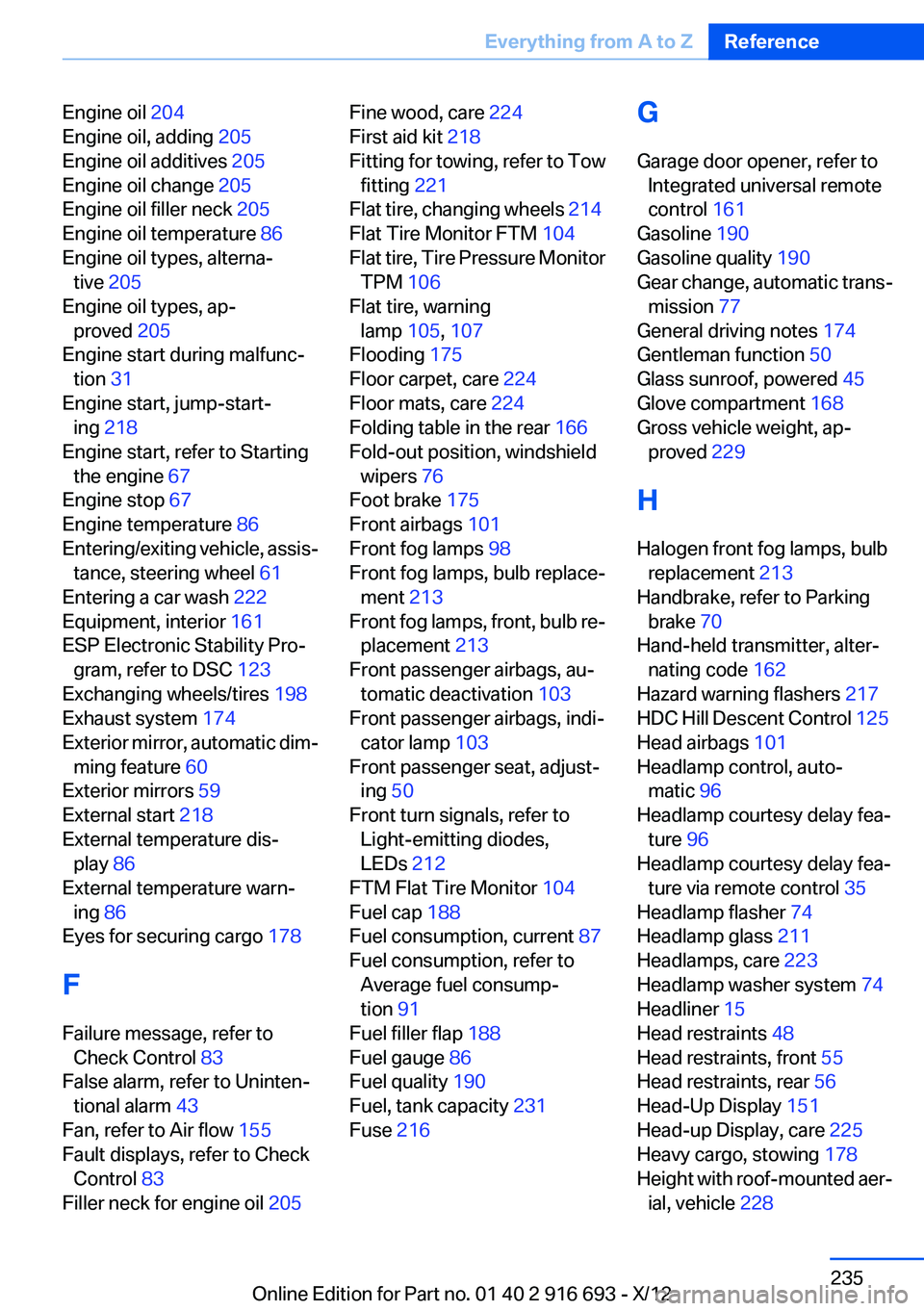
Engine oil 204
Engine oil, adding 205
Engine oil additives 205
Engine oil change 205
Engine oil filler neck 205
Engine oil temperature 86
Engine oil types, alterna‐ tive 205
Engine oil types, ap‐ proved 205
Engine start during malfunc‐ tion 31
Engine start, jump-start‐ ing 218
Engine start, refer to Starting the engine 67
Engine stop 67
Engine temperature 86
Entering/exiting vehicle, assis‐ tance, steering wheel 61
Entering a car wash 222
Equipment, interior 161
ESP Electronic Stability Pro‐ gram, refer to DSC 123
Exchanging wheels/tires 198
Exhaust system 174
Exterior mirror, automatic dim‐ ming feature 60
Exterior mirrors 59
External start 218
External temperature dis‐ play 86
External temperature warn‐ ing 86
Eyes for securing cargo 178
F
Failure message, refer to Check Control 83
False alarm, refer to Uninten‐ tional alarm 43
Fan, refer to Air flow 155
Fault displays, refer to Check Control 83
Filler neck for engine oil 205 Fine wood, care 224
First aid kit 218
Fitting for towing, refer to Tow fitting 221
Flat tire, changing wheels 214
Flat Tire Monitor FTM 104
Flat tire, Tire Pressure Monitor TPM 106
Flat tire, warning lamp 105, 107
Flooding 175
Floor carpet, care 224
Floor mats, care 224
Folding table in the rear 166
Fold-out position, windshield wipers 76
Foot brake 175
Front airbags 101
Front fog lamps 98
Front fog lamps, bulb replace‐ ment 213
Front fog lamps, front, bulb re‐ placement 213
Front passenger airbags, au‐ tomatic deactivation 103
Front passenger airbags, indi‐ cator lamp 103
Front passenger seat, adjust‐ ing 50
Front turn signals, refer to Light-emitting diodes,
LEDs 212
FTM Flat Tire Monitor 104
Fuel cap 188
Fuel consumption, current 87
Fuel consumption, refer to Average fuel consump‐
tion 91
Fuel filler flap 188
Fuel gauge 86
Fuel quality 190
Fuel, tank capacity 231
Fuse 216 G
Garage door opener, refer to Integrated universal remote
control 161
Gasoline 190
Gasoline quality 190
Gear change, automatic trans‐ mission 77
General driving notes 174
Gentleman function 50
Glass sunroof, powered 45
Glove compartment 168
Gross vehicle weight, ap‐ proved 229
H
Halogen front fog lamps, bulb replacement 213
Handbrake, refer to Parking brake 70
Hand-held transmitter, alter‐ nating code 162
Hazard warning flashers 217
HDC Hill Descent Control 125
Head airbags 101
Headlamp control, auto‐ matic 96
Headlamp courtesy delay fea‐ ture 96
Headlamp courtesy delay fea‐ ture via remote control 35
Headlamp flasher 74
Headlamp glass 211
Headlamps, care 223
Headlamp washer system 74
Headliner 15
Head restraints 48
Head restraints, front 55
Head restraints, rear 56
Head-Up Display 151
Head-up Display, care 225
Heavy cargo, stowing 178
Height with roof-mounted aer‐ ial, vehicle 228 Seite 235Everything from A to ZReference235
Online Edition for Part no. 01 40 2 916 693 - X/12
Page 237 of 243
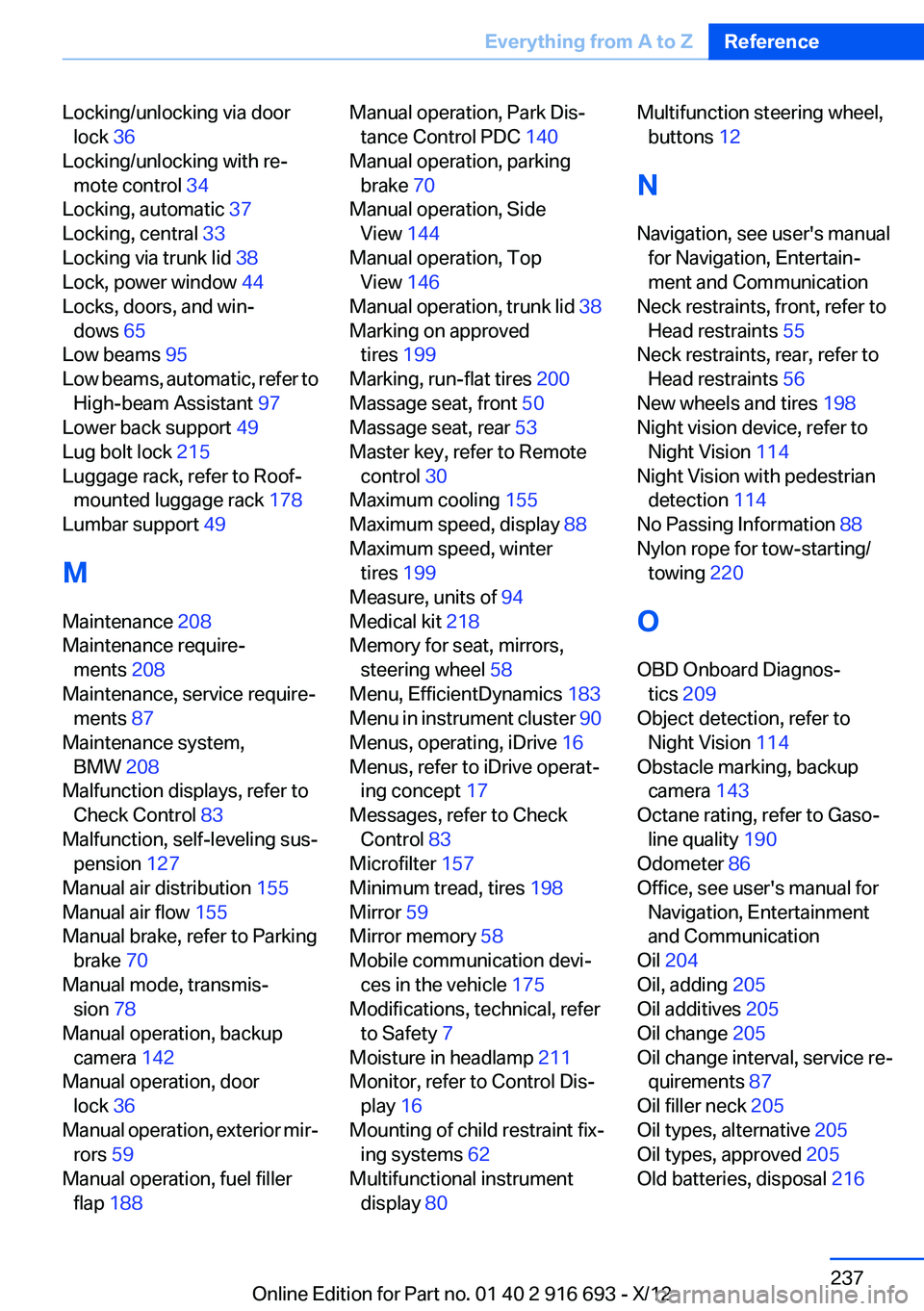
Locking/unlocking via doorlock 36
Locking/unlocking with re‐ mote control 34
Locking, automatic 37
Locking, central 33
Locking via trunk lid 38
Lock, power window 44
Locks, doors, and win‐ dows 65
Low beams 95
Low beams, automatic, refer to High-beam Assistant 97
Lower back support 49
Lug bolt lock 215
Luggage rack, refer to Roof- mounted luggage rack 178
Lumbar support 49
M
Maintenance 208
Maintenance require‐ ments 208
Maintenance, service require‐ ments 87
Maintenance system, BMW 208
Malfunction displays, refer to Check Control 83
Malfunction, self-leveling sus‐ pension 127
Manual air distribution 155
Manual air flow 155
Manual brake, refer to Parking brake 70
Manual mode, transmis‐ sion 78
Manual operation, backup camera 142
Manual operation, door lock 36
Manual operation, exterior mir‐ rors 59
Manual operation, fuel filler flap 188 Manual operation, Park Dis‐
tance Control PDC 140
Manual operation, parking brake 70
Manual operation, Side View 144
Manual operation, Top View 146
Manual operation, trunk lid 38
Marking on approved tires 199
Marking, run-flat tires 200
Massage seat, front 50
Massage seat, rear 53
Master key, refer to Remote control 30
Maximum cooling 155
Maximum speed, display 88
Maximum speed, winter tires 199
Measure, units of 94
Medical kit 218
Memory for seat, mirrors, steering wheel 58
Menu, EfficientDynamics 183
Menu in instrument cluster 90
Menus, operating, iDrive 16
Menus, refer to iDrive operat‐ ing concept 17
Messages, refer to Check Control 83
Microfilter 157
Minimum tread, tires 198
Mirror 59
Mirror memory 58
Mobile communication devi‐ ces in the vehicle 175
Modifications, technical, refer to Safety 7
Moisture in headlamp 211
Monitor, refer to Control Dis‐ play 16
Mounting of child restraint fix‐ ing systems 62
Multifunctional instrument display 80 Multifunction steering wheel,
buttons 12
N
Navigation, see user's manual for Navigation, Entertain‐
ment and Communication
Neck restraints, front, refer to Head restraints 55
Neck restraints, rear, refer to Head restraints 56
New wheels and tires 198
Night vision device, refer to Night Vision 114
Night Vision with pedestrian detection 114
No Passing Information 88
Nylon rope for tow-starting/ towing 220
O
OBD Onboard Diagnos‐ tics 209
Object detection, refer to Night Vision 114
Obstacle marking, backup camera 143
Octane rating, refer to Gaso‐ line quality 190
Odometer 86
Office, see user's manual for Navigation, Entertainment
and Communication
Oil 204
Oil, adding 205
Oil additives 205
Oil change 205
Oil change interval, service re‐ quirements 87
Oil filler neck 205
Oil types, alternative 205
Oil types, approved 205
Old batteries, disposal 216 Seite 237Everything from A to ZReference237
Online Edition for Part no. 01 40 2 916 693 - X/12
Page 238 of 243
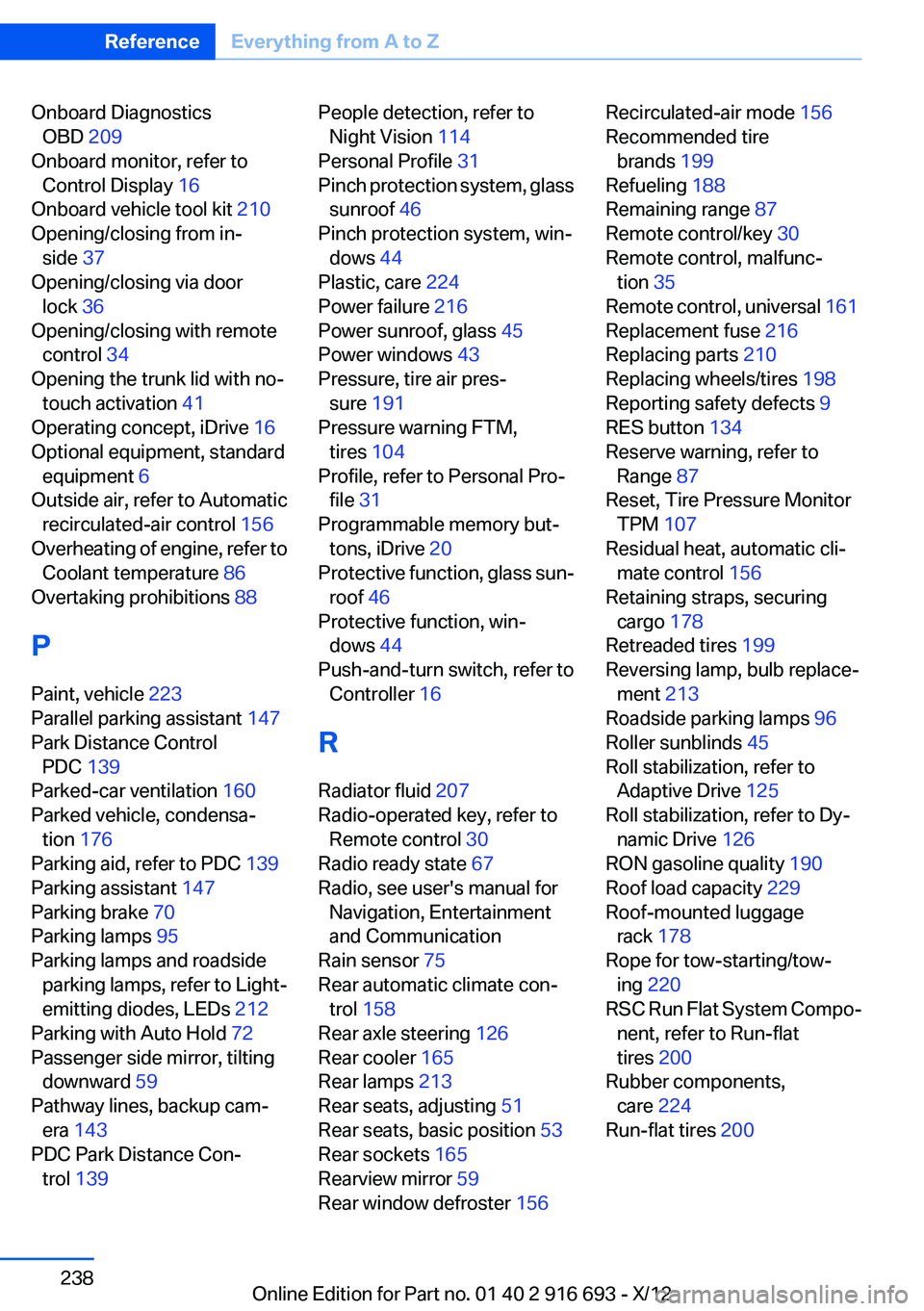
Onboard DiagnosticsOBD 209
Onboard monitor, refer to Control Display 16
Onboard vehicle tool kit 210
Opening/closing from in‐ side 37
Opening/closing via door lock 36
Opening/closing with remote control 34
Opening the trunk lid with no- touch activation 41
Operating concept, iDrive 16
Optional equipment, standard equipment 6
Outside air, refer to Automatic recirculated-air control 156
Overheating of engine, refer to Coolant temperature 86
Overtaking prohibitions 88
P
Paint, vehicle 223
Parallel parking assistant 147
Park Distance Control PDC 139
Parked-car ventilation 160
Parked vehicle, condensa‐ tion 176
Parking aid, refer to PDC 139
Parking assistant 147
Parking brake 70
Parking lamps 95
Parking lamps and roadside parking lamps, refer to Light-
emitting diodes, LEDs 212
Parking with Auto Hold 72
Passenger side mirror, tilting downward 59
Pathway lines, backup cam‐ era 143
PDC Park Distance Con‐ trol 139 People detection, refer to
Night Vision 114
Personal Profile 31
Pinch protection system, glass sunroof 46
Pinch protection system, win‐ dows 44
Plastic, care 224
Power failure 216
Power sunroof, glass 45
Power windows 43
Pressure, tire air pres‐ sure 191
Pressure warning FTM, tires 104
Profile, refer to Personal Pro‐ file 31
Programmable memory but‐ tons, iDrive 20
Protective function, glass sun‐ roof 46
Protective function, win‐ dows 44
Push-and-turn switch, refer to Controller 16
R
Radiator fluid 207
Radio-operated key, refer to Remote control 30
Radio ready state 67
Radio, see user's manual for Navigation, Entertainment
and Communication
Rain sensor 75
Rear automatic climate con‐ trol 158
Rear axle steering 126
Rear cooler 165
Rear lamps 213
Rear seats, adjusting 51
Rear seats, basic position 53
Rear sockets 165
Rearview mirror 59
Rear window defroster 156 Recirculated-air mode 156
Recommended tire brands 199
Refueling 188
Remaining range 87
Remote control/key 30
Remote control, malfunc‐ tion 35
Remote control, universal 161
Replacement fuse 216
Replacing parts 210
Replacing wheels/tires 198
Reporting safety defects 9
RES button 134
Reserve warning, refer to Range 87
Reset, Tire Pressure Monitor TPM 107
Residual heat, automatic cli‐ mate control 156
Retaining straps, securing cargo 178
Retreaded tires 199
Reversing lamp, bulb replace‐ ment 213
Roadside parking lamps 96
Roller sunblinds 45
Roll stabilization, refer to Adaptive Drive 125
Roll stabilization, refer to Dy‐ namic Drive 126
RON gasoline quality 190
Roof load capacity 229
Roof-mounted luggage rack 178
Rope for tow-starting/tow‐ ing 220
RSC Run Flat System Compo‐ nent, refer to Run-flat
tires 200
Rubber components, care 224
Run-flat tires 200 Seite 238ReferenceEverything from A to Z238
Online Edition for Part no. 01 40 2 916 693 - X/12