towing BMW ACTIVEHYBRID X6 2010 Owners Manual
[x] Cancel search | Manufacturer: BMW, Model Year: 2010, Model line: ACTIVEHYBRID X6, Model: BMW ACTIVEHYBRID X6 2010Pages: 54, PDF Size: 3.16 MB
Page 40 of 54
Giving and receiving assistance
38 5.Attach the second end of the cable to the
negative terminal of the battery or to the
engine or body ground of the vehicle to be
started.
Charging: 12 Volt battery
1.Start the engine on the assisting vehicle
and activate drive readiness, allowing the
assisting vehicle to run at idle for several
minutes at slightly increased speed.
2.Start the engine on your vehicle in the usual
way.
If the first starting attempt is not successful,
wait a few minutes before another attempt
in order to allow the discharged battery to
recharge.
3.Let the engines run for a few minutes.
4.Disconnect the jumper cables by reversing
the connection sequence.
Have the battery checked if necessary.
Never use spray fluids to start the
engine.<
Charging: High-voltage battery
1.Start the engine on the assisting vehicle
and activate drive readiness, allowing the
assisting vehicle to run at idle for several
minutes at slightly increased speed.
2.Switch on the ignition of your vehicle when
prompted by the corresponding message
on the Control Display. The charging
begins.
3.The charging is concluded when this is
prompted by a corresponding message on
the Control Display.
4.Start the combustion engine of your own
vehicle.
5.Disconnect the jumper cables by reversing
the connection sequence.
Have the hybrid system checked if necessary.
Never use spray fluids to start the
engine.<
Charging interrupted
The charging may be interrupted, for example if
the battery power of the assisting vehicle is
insufficient.
Disconnect the jumper cables in the reverse of
the sequence described above and contact
your BMW Sports Activity Vehicle Center.
Tow-starting and towing
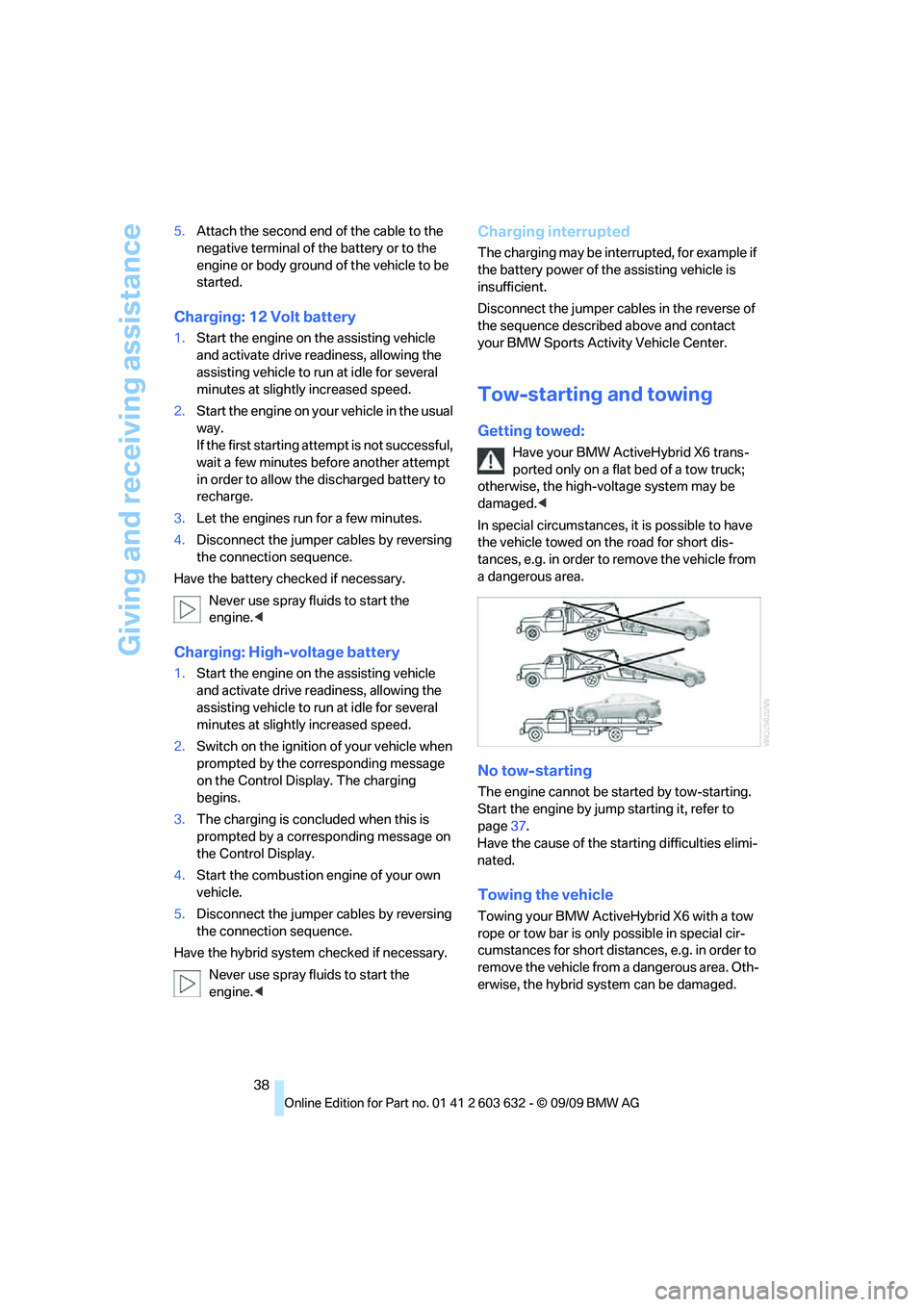
Getting towed:
Have your BMW ActiveHybrid X6 trans-
ported only on a flat bed of a tow truck;
otherwise, the high-voltage system may be
damaged.<
In special circumstances, it is possible to have
the vehicle towed on the road for short dis-
tances, e.g. in order to remove the vehicle from
a dangerous area.
No tow-starting
The engine cannot be started by tow-starting.
Start the engine by jump starting it, refer to
page37.
Have the cause of the starting difficulties elimi-
nated.
Towing the vehicle
Towing your BMW ActiveHybrid X6 with a tow
rope or tow bar is only possible in special cir-
cumstances for short distances, e.g. in order to
remove the vehicle from a dangerous area. Oth-
erwise, the hybrid system can be damaged.
Page 41 of 54
Reference
At a glance
Controls
Driving tips
Mobility
39
Using a tow fitting
The screw-in tow-fitting should always be car-
ried in the vehicle. It can be screwed in at the
front or rear of the BMW.
It is located in the onboard toolkit under the
floor panel flap in the cargo bay.
Use only the tow fitting provided with the
vehicle and screw it all the way in. Use the
tow fitting for towing only on roads. Avoid lateral
loading of the tow fitting, e.g. do not lift the vehi-
cle by the tow fitting. Otherwise damage to the
tow fitting and the vehicle can occur.<
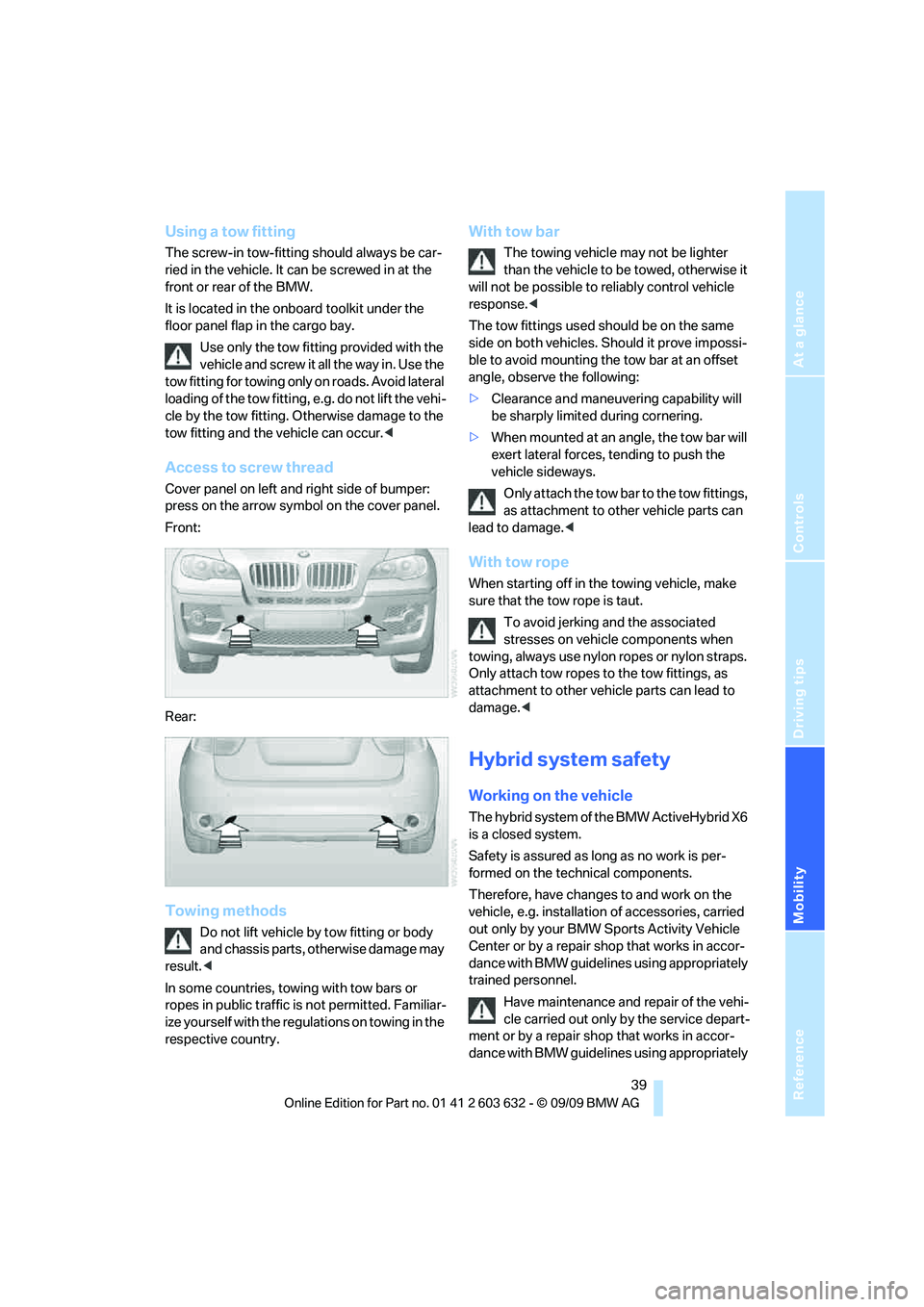
Access to screw thread
Cover panel on left and right side of bumper:
press on the arrow symbol on the cover panel.
Front:
Rear:
Towing methods
Do not lift vehicle by tow fitting or body
and chassis parts, otherwise damage may
result.<
In some countries, towing with tow bars or
ropes in public traffic is not permitted. Familiar-
ize yourself with the regulations on towing in the
respective country.
With tow bar
The towing vehicle may not be lighter
than the vehicle to be towed, otherwise it
will not be possible to reliably control vehicle
response.<
The tow fittings used should be on the same
side on both vehicles. Should it prove impossi-
ble to avoid mounting the tow bar at an offset
angle, observe the following:
>Clearance and maneuvering capability will
be sharply limited during cornering.
>When mounted at an angle, the tow bar will
exert lateral forces, tending to push the
vehicle sideways.
Only attach the tow bar to the tow fittings,
as attachment to other vehicle parts can
lead to damage.<
With tow rope
When starting off in the towing vehicle, make
sure that the tow rope is taut.
To avoid jerking and the associated
stresses on vehicle components when
towing, always use nylon ropes or nylon straps.
Only attach tow ropes to the tow fittings, as
attachment to other vehicle parts can lead to
damage.<
Hybrid system safety
Working on the vehicle
The hybrid system of the BMW ActiveHybrid X6
is a closed system.
Safety is assured as long as no work is per-
formed on the technical components.
Therefore, have changes to and work on the
vehicle, e.g. installation of accessories, carried
out only by your BMW Sports Activity Vehicle
Center or by a repair shop that works in accor-
dance with BMW guidelines using appropriately
trained personnel.
Have maintenance and repair of the vehi-
cle carried out only by the service depart-
ment or by a repair shop that works in accor-
dance with BMW guidelines using appropriately
Page 50 of 54
Everything from A to Z
48
Everything from A to Z
Index
A
Accident, what to do after40
After an accident40
AKI, refer to Fuel
specifications33
Alterations, technical, refer to
For your own safety5
Approved axle weights, refer
to Weights46
Approved gross vehicle
weight, refer to Weights46
Axle weights, refer to
Weights46
B
Battery
– 12 V battery36
– charging36
– high-voltage battery36
Battery disposal
– vehicle battery36
BMW homepage4
BMW website4
Brake rotors28
Brakes
– breaking-in26
– refer to Braking safely27
Brake system
– breaking-in26
– disk brakes28
Braking safely27
Breaking-in rear axle
differential26
Break-in period26
Button for starting engine13
C
Capacities46
Capacity of cargo bay46Cargo bay
– capacity46
Car wash
– before driving in15
Changes, technical, refer to
For your own safety5
CHARGE, Energy recovery16
Charge state display21
Charging high-voltage
battery37
Checking the air pressure,
refer to Tire inflation
pressure34
Climate23
Closing fuel filler cap32
Cockpit8
Components, high-voltage
system12
Consumption display
– charge state display21
Copyright2
Cruise control19
Cylinders, refer to Drive
system44
D
Data
– capacities46
– dimensions45
– engine44
– high-voltage system44
– hybrid system44
– technical data44
– weights46
Dimensions45
Displacement, refer to Drive
system44
Displays, refer to Instrument
panel8
Disposal
– vehicle battery36DRIVE, Driving with
combustion engine16
Drive readiness14
Driving through water27
Driving tips, refer to General
driving notes26
E
eBOOST16
eDRIVE, Electric driving15
Electrical malfunction
– fuel filler door32
Electric drive readiness14
Electric driving, eDRIVE15
Emergency operation, refer to
Manually operating fuel filler
door32
Energy recovery, CHARGE16
Engine
– breaking-in26
– data44
– speed44
– starting14
Engine compartment35
Engine output, refer to Drive
system44
Engine speed44
Eye for tow-starting and
towing, refer to Tow
fitting39
F
Footbrake, refer to Braking
safely27
For your own safety5
Page 51 of 54
Reference
At a glance
Controls
Driving tips
Mobility
49
Fuel33
– capacity46
– display22
– high-quality brands33
– quality33
– saving26
– specifications33
Fuel clock, refer to Fuel
gauge22
Fuel display, refer to Fuel
gauge22
Fuel filler door32
– closing32
– releasing manually32
G
Gasoline, refer to Required
fuel33
Gasoline display, refer to Fuel
gauge22
General driving notes26,27
Getting towed38
Gross vehicle weight, refer to
Weights46
H
Height, refer to
Dimensions45
High-voltage battery36
High-voltage system
– components12
High water, refer to Driving
through water27
Hills27
Homepage4
Hybrid system
– air-conditioning
functions23
– components12
– contact with water40
– deactivation40
– display21
– functions13
– safety39
Hybrid system safety39
I
Ignition13
– switched on13
Ignition key position 1, refer to
Radio readiness13
Ignition key position 2, refer to
Ignition on13
Imprint2
Inflation pressure, refer to Tire
inflation pressure34
Instrument cluster, refer to
Instrument panel8
Instrument panel8
J
Jumpering, refer to Jump
starting37
Jump starting37
K
Knock control33
L
Length, refer to
Dimensions45
Luggage compartment
capacity, refer to Cargo bay
capacity46
M
Malfunction
– fuel filler door32
Manual operation
– fuel filler door32
N
Noises, refer to Cooling of the
high-voltage system23
Nylon rope, refer to Tow-
starting and towing38
O
Octane ratings, refer to Fuel
specifications33
P
Power, refer to Drive
system44
Pressure, tires34
Pressure compensation,
refueling32
R
Radio position, refer to Radio
readiness13
Radio readiness13
– switched on13
Refueling32
– preparation32
– pressure compensation32
Regeneration, refer to Energy
recovery16
Reserve warning, refer to Fuel
gauge22
Roof load capacity46
Rope, refer to Tow-starting
and towing38
S
Safety5
Screw thread for tow fitting39
Silent start14
Speedometer8
Sport program, manual mode
M/S18
Start/Stop button13
Starting, refer to Starting
engine14
Starting assistance, refer to
Jump starting37
Starting difficulties, jump
starting37
Status of this Owner's Manual
at time of printing5
Summer tires, refer to Wheels
and tires34
Page 52 of 54
Everything from A to Z
50 Symbols4
T
Tank contents, refer to
Capacities46
Technical alterations, refer to
For your own safety5
Technical data44
Teleservice Report5
Tempomat, refer to Cruise
control19
The individual vehicle5
Tire inflation pressures34
Tires
– inflation pressure34
Torque
– engine44
Tow fitting39
Towing38
– tow fitting39
Tow-starting38
Turning circle, refer to
Dimensions45
Turn signals
– indicator lamp8
Two-Mode Active
Transmission16
U
Used batteries
– refer to Disposal36
V
Vehicle
– breaking-in26
– measurements, refer to
Dimensions45
– weights46
Vehicle battery, refer to
12 Volt batteries36
W
Water on roads, refer to
Driving through water27
Website4Weights46
What to do after an
accident40
Wheelbase, refer to
Dimensions45
Wheels and tires34
Width, refer to Dimensions45