technical data BMW ACTIVEHYBRID5 2013 Owners Manual
[x] Cancel search | Manufacturer: BMW, Model Year: 2013, Model line: ACTIVEHYBRID5, Model: BMW ACTIVEHYBRID5 2013Pages: 224, PDF Size: 4.96 MB
Page 5 of 224
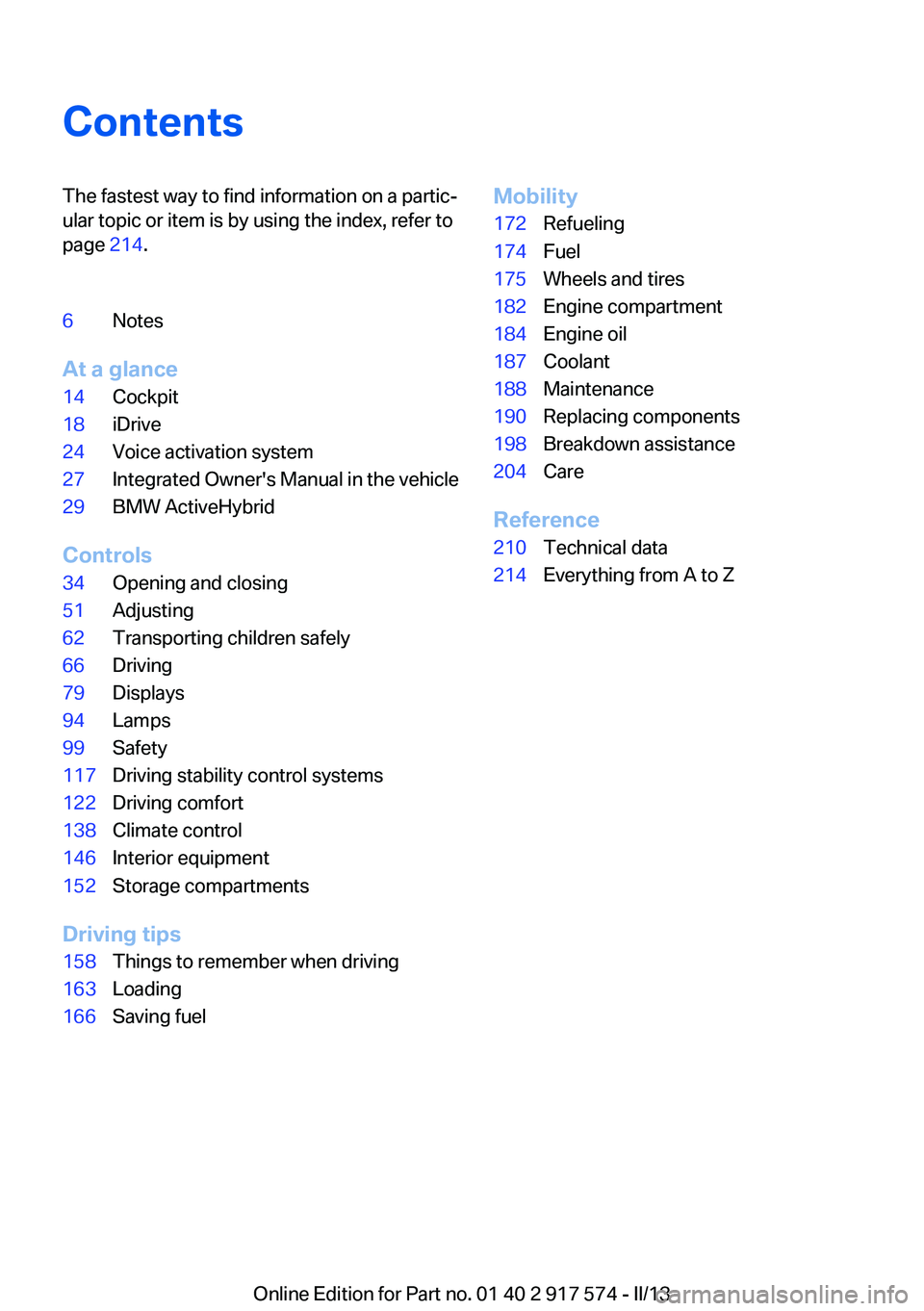
ContentsThe fastest way to find information on a partic‐
ular topic or item is by using the index, refer to
page 214.6Notes
At a glance
14Cockpit18iDrive24Voice activation system27Integrated Owner's Manual in the vehicle29BMW ActiveHybrid
Controls
34Opening and closing51Adjusting62Transporting children safely66Driving79Displays94Lamps99Safety117Driving stability control systems122Driving comfort138Climate control146Interior equipment152Storage compartments
Driving tips
158Things to remember when driving163Loading166Saving fuelMobility172Refueling174Fuel175Wheels and tires182Engine compartment184Engine oil187Coolant188Maintenance190Replacing components198Breakdown assistance204Care
Reference
210Technical data214Everything from A to Z
Online Edition for Part no. 01 40 2 917 574 - II/13
Page 8 of 224
productive harm. In addition, certain fluids
contained in vehicles and certain products of
component wear contain or emit chemicals
known to the State of California to cause cancer
and birth defects or other reproductive harm.
Battery posts, terminals and related accessories
contain lead and lead compounds. Wash your
hands after handling. Used engine oil contains
chemicals that have caused cancer in laboratory
animals. Always protect your skin by washing
thoroughly with soap and water.
Service and warranty
We recommend that you read this publication
thoroughly. Your vehicle is covered by the fol‐
lowing warranties:▷New Vehicle Limited Warranty.▷Rust Perforation Limited Warranty.▷Federal Emissions System Defect Warranty.▷Federal Emissions Performance Warranty.▷California Emission Control System Limited
Warranty.
Detailed information about these warranties is
listed in the Service and Warranty Information
Booklet for US models or in the Warranty and
Service Guide Booklet for Canadian models.
Your vehicle has been specifically adapted and
designed to meet the particular operating con‐
ditions and homologation requirements in your
country and continental region in order to deliver
the full driving pleasure while the vehicle is op‐
erated under those conditions. If you wish to op‐
erate your vehicle in another country or region,
you may be required to adapt your vehicle to
meet different prevailing operating conditions
and homologation requirements. You should
also be aware of any applicable warranty limita‐
tions or exclusions for such country or region. In
such case, please contact Customer Relations
for further information.
Maintenance
Maintain the vehicle regularly to sustain the road
safety, operational reliability and the New Vehi‐
cle Limited Warranty.
Specifications for required maintenance meas‐
ures:▷BMW Maintenance system▷Service and Warranty Information Booklet
for US models▷Warranty and Service Guide Booklet for
Canadian models
If the vehicle is not maintained according to
these specifications, this could result in serious
damage to the vehicle. Such damage is not cov‐
ered by the BMW New Vehicle Limited War‐
ranty.
Data memory
Many electronic components on your vehicle
are equipped with data memories that tempo‐
rarily or permanently store technical information
about the condition of the vehicle, events and
faults. This technical information generally
documents the state of a component, a module,
a system or the environment:
▷Operating states of system components, fill
levels for instance.▷Status messages for the vehicle and from its
individual components, e.g., wheel rotation
speed/ vehicle speed, deceleration, trans‐
verse acceleration.▷Malfunctions and faults in important system
components, e.g., lights and brakes.▷Responses by the vehicle to special situa‐
tions, e.g., deployment of an airbag, engage‐
ment of stability control systems.▷Ambient conditions, such as temperature.
This data is purely technical in nature and is used
to detect and correct faults and to optimize ve‐
hicle functions. Motion profiles over routes trav‐
eled cannot be created from this data. When
Seite 8Notes8
Online Edition for Part no. 01 40 2 917 574 - II/13
Page 9 of 224
service offerings are used, e.g., repair services,
service processes, warranty claims, quality as‐
surance, this technical information can be read
out from the event and fault memories by the
service personnel, including the manufacturer,
using special diagnostic tools. You can obtain
further information there if it is needed. After a
fault is corrected, the information in the fault
memory is deleted or overwritten on a continu‐
ous basis.
When the vehicle is in use, situations are con‐
ceivable in which it might be possible to asso‐
ciate this technical data with individuals if it is
combined with other information, e.g., an acci‐
dent report, damage to the vehicle, eye witness
accounts — possibly with the assistance of an
expert.
Additional functions that are contractually
agreed with the customer, such as vehicle lo‐
cating in an emergency, enable certain vehicle
data to be transmitted from the vehicle.
Event Data Recorder EDR
This vehicle is equipped with an event data re‐
corder EDR. The main purpose of an EDR is to
record, in certain crash or near crash-like situa‐
tions, such as an air bag deployment or hitting a
road obstacle, data that will assist in under‐
standing how a vehicle’s systems performed.
The EDR is designed to record data related to
vehicle dynamics and safety systems for a short
period of time, typically 30 seconds or less.
The EDR in this vehicle is designed to record
such data as:▷How various systems in your vehicle were
operating.▷Whether or not the driver and passenger
safety belts were fastened.▷How far, if at all, the driver was depressing
the accelerator and/or brake pedal.▷How fast the vehicle was traveling.These data can help provide a better under‐
standing of the circumstances in which crashes
and injuries occur.
EDR data are recorded by your vehicle only if a
nontrivial crash situation occurs; no data are re‐
corded by the EDR under normal driving condi‐
tions and no personal data, e.g., name, gender,
age, and crash location, are recorded.
However, other parties, such as law enforce‐
ment, could combine the EDR data with the type
of personally identifying data routinely acquired
during a crash investigation.
To read data recorded by an EDR, special equip‐
ment is required, and access to the vehicle or the
EDR is needed. In addition to the vehicle manu‐
facturer, other parties, such as law enforcement,
that have the special equipment, can read the
information if they have access to the vehicle or
the EDR.
Reporting safety defects
For US customers
The following only applies to vehicles owned
and operated in the US.
If you believe that your vehicle has a defect
which could cause a crash or could cause injury
or death, you should immediately inform the Na‐
tional Highway Traffic Safety Administration
NHTSA, in addition to notifying BMW of North
America, LLC, P.O. Box 1227, Westwood, New
Jersey 07675-1227, Telephone
1-800-831-1117.
If NHTSA receives similar complaints, it may
open an investigation, and if it finds that a safety
defect exists in a group of vehicles, it may order
a recall and remedy campaign.
However, NHTSA cannot become involved in
individual problems between you, your dealer,
or BMW of North America, LLC.
To contact NHTSA, you may call the Vehicle
Safety Hotline toll-free at 1-888-327-4236
(TTY: 1-800-424-9153); go to http://www.safe‐Seite 9Notes9
Online Edition for Part no. 01 40 2 917 574 - II/13
Page 75 of 224
Avoid using the washer when the reservoir is
empty; otherwise, you could damage the
pump.◀
Windshield washer nozzles
The windshield washer nozzles are automati‐
cally heated while the ignition is switched on.
Fold-out position of the wipers
Required when changing the wiper blades or
under frosty conditions, for example.1.Switch the ignition on and off again.2.Under frosty conditions, ensure that the
wiper blades are not frozen onto the wind‐
shield.3.Press the wiper lever up beyond the point of
resistance and hold it for approx. 3 seconds,
until the wiper remains in a nearly vertical
position.
After the wipers are folded back down, the wiper
system must be reactivated.
Fold the wipers back down
Before switching the ignition on, fold the
wipers back down to the windshield; otherwise,
the wipers may become damaged when they are
switched on.◀
1.Switch on the ignition.2.Press the wiper levers down. The wipers
move to their resting position and are ready
for operation.
Washer fluid
General information Antifreeze for washer fluid
Antifreeze is flammable and can cause in‐
jury if it is used incorrectly.
Therefore, keep it away from sources of ignition.
Only keep it in the closed original container and
inaccessible to children.
Follow the notes and instructions on the con‐
tainer.
United States: The washer fluid mixture ratio is
regulated by the U.S. EPA and many individual
states; do not exceed the allowable washer fluid
dilution ratios limits that apply. Follow the usage
instructions on the washer fluid container. Use
BMW’s Windshield Washer Concentrate or the
equivalent.◀
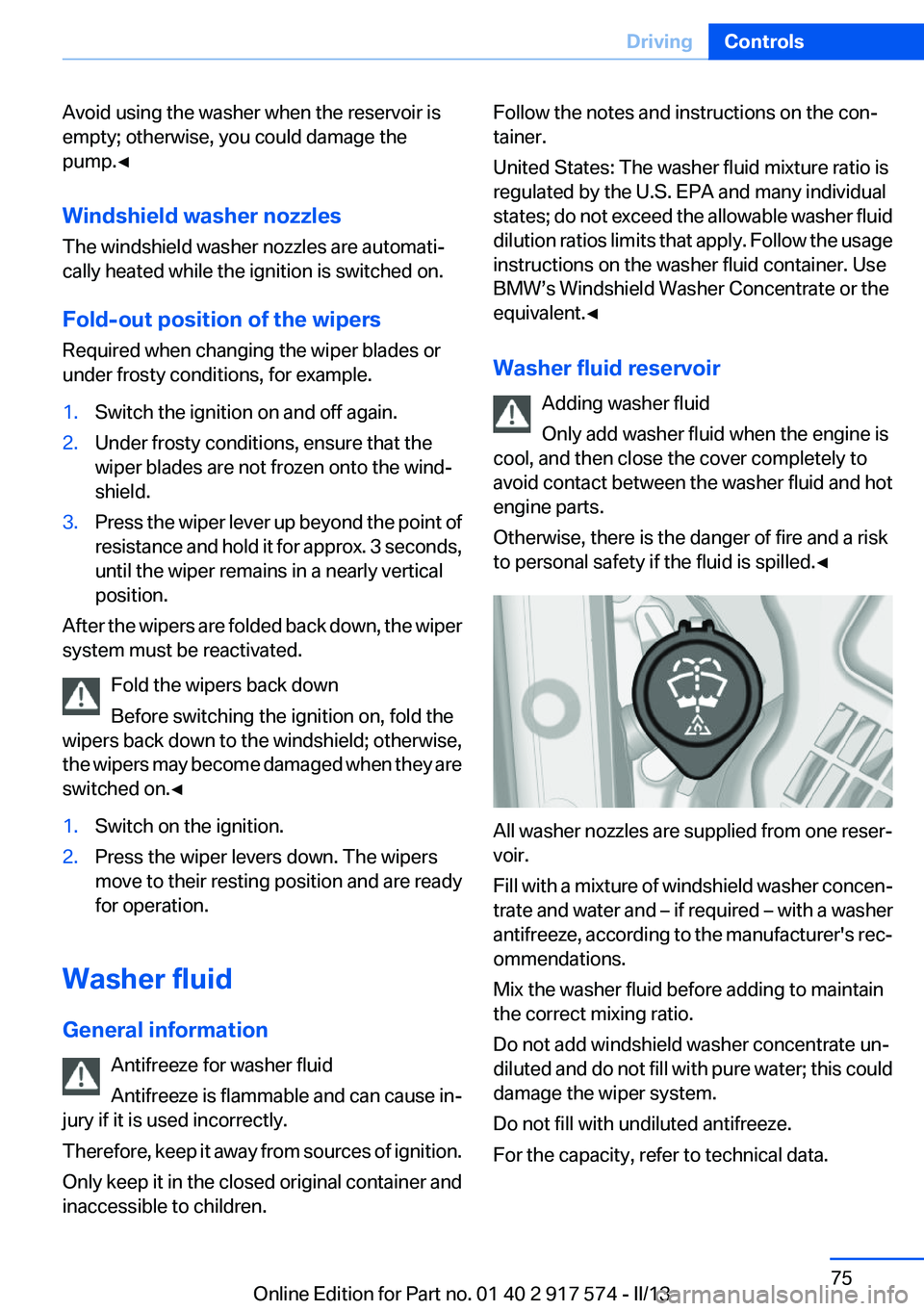
Washer fluid reservoir Adding washer fluid
Only add washer fluid when the engine is
cool, and then close the cover completely to
avoid contact between the washer fluid and hot
engine parts.
Otherwise, there is the danger of fire and a risk
to personal safety if the fluid is spilled.◀
All washer nozzles are supplied from one reser‐
voir.
Fill with a mixture of windshield washer concen‐
trate and water and – if required – with a washer
antifreeze, according to the manufacturer's rec‐
ommendations.
Mix the washer fluid before adding to maintain
the correct mixing ratio.
Do not add windshield washer concentrate un‐
diluted and do not fill with pure water; this could
damage the wiper system.
Do not fill with undiluted antifreeze.
For the capacity, refer to technical data.
Seite 75DrivingControls75
Online Edition for Part no. 01 40 2 917 574 - II/13
Page 209 of 224
Reference
This chapter contains the technical data and an
index that will quickly take you to the information you need.Online Edition for Part no. 01 40 2 917 574 - II/13
Page 210 of 224
Technical dataVehicle equipment
All standard, country-specific and optional
equipment that is offered in the model series is
described in this chapter. Therefore, equipmentis also described that is not available in a vehicle,
e. g., because of the selected optional equip‐
ment or country variant. This also applies for
safety-related functions and systems.
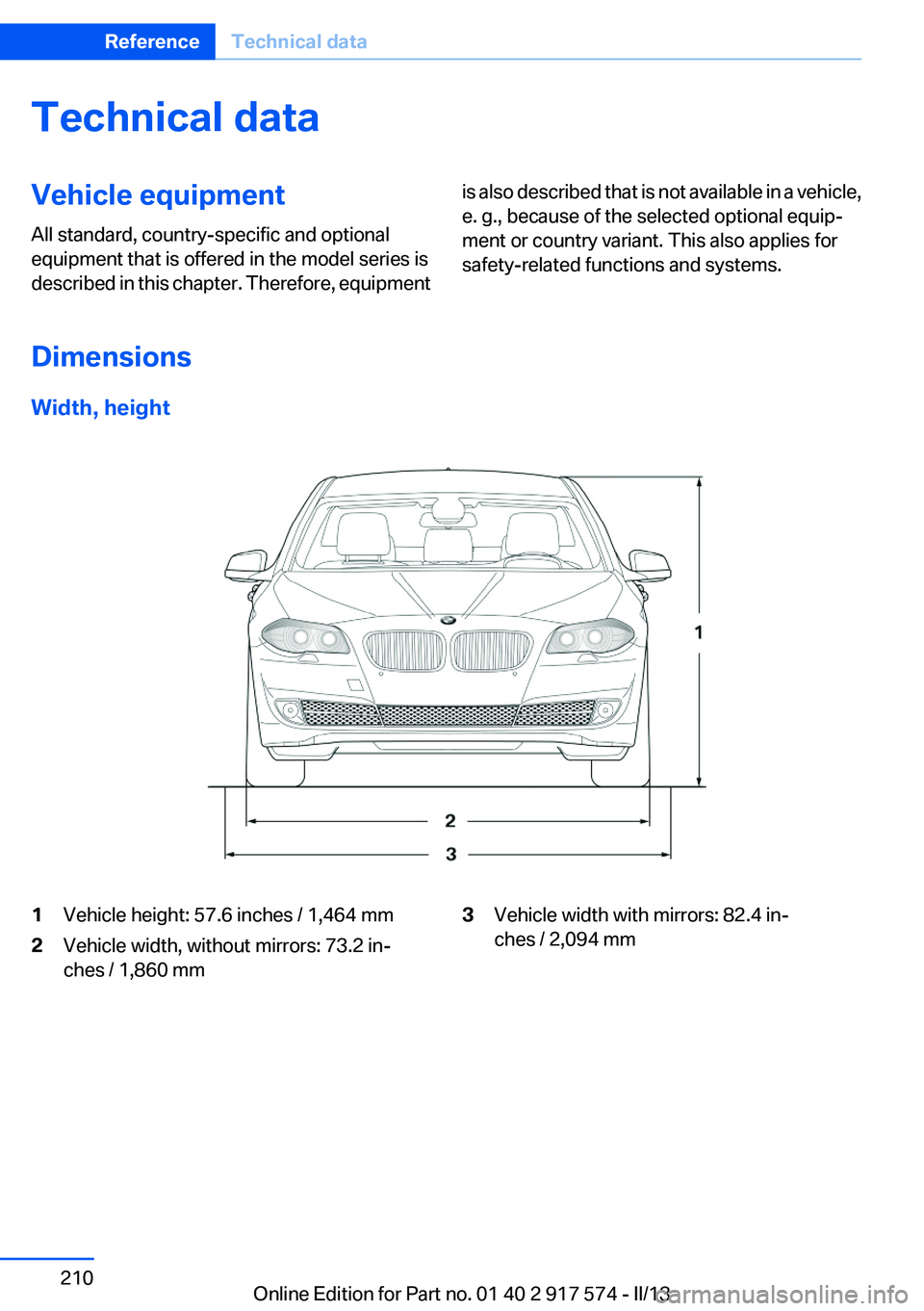
Dimensions
Width, height
1Vehicle height: 57.6 inches / 1,464 mm2Vehicle width, without mirrors: 73.2 in‐
ches / 1,860 mm3Vehicle width with mirrors: 82.4 in‐
ches / 2,094 mmSeite 210ReferenceTechnical data210
Online Edition for Part no. 01 40 2 917 574 - II/13
Page 211 of 224
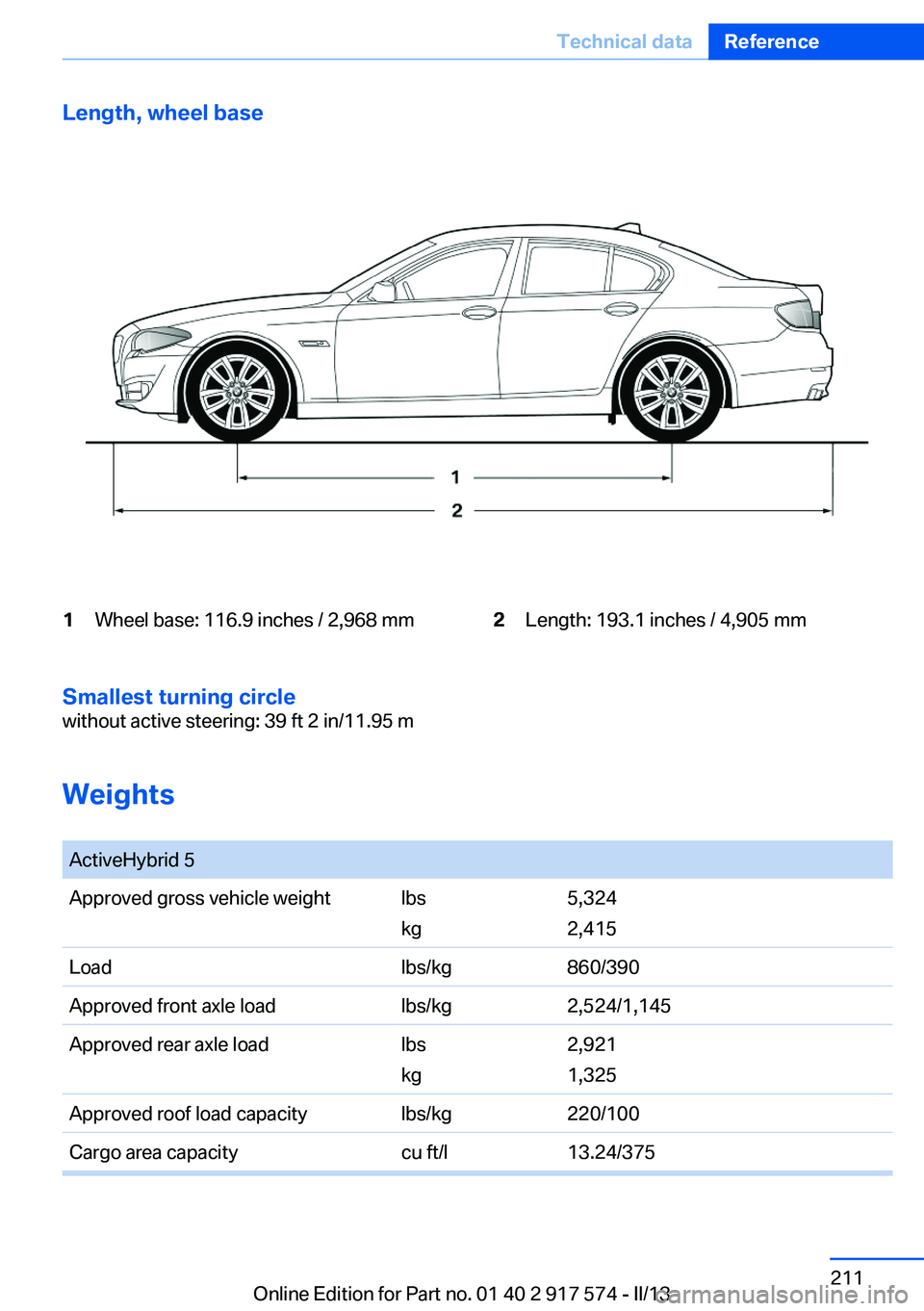
Length, wheel base1Wheel base: 116.9 inches / 2,968 mm2Length: 193.1 inches / 4,905 mm
Smallest turning circle
without active steering: 39 ft 2 in/11.95 m
Weights
ActiveHybrid 5Approved gross vehicle weightlbs
kg5,324
2,415Loadlbs/kg860/390Approved front axle loadlbs/kg2,524/1,145Approved rear axle loadlbs
kg2,921
1,325Approved roof load capacitylbs/kg220/100Cargo area capacitycu ft/l13.24/375Seite 211Technical dataReference211
Online Edition for Part no. 01 40 2 917 574 - II/13
Page 212 of 224
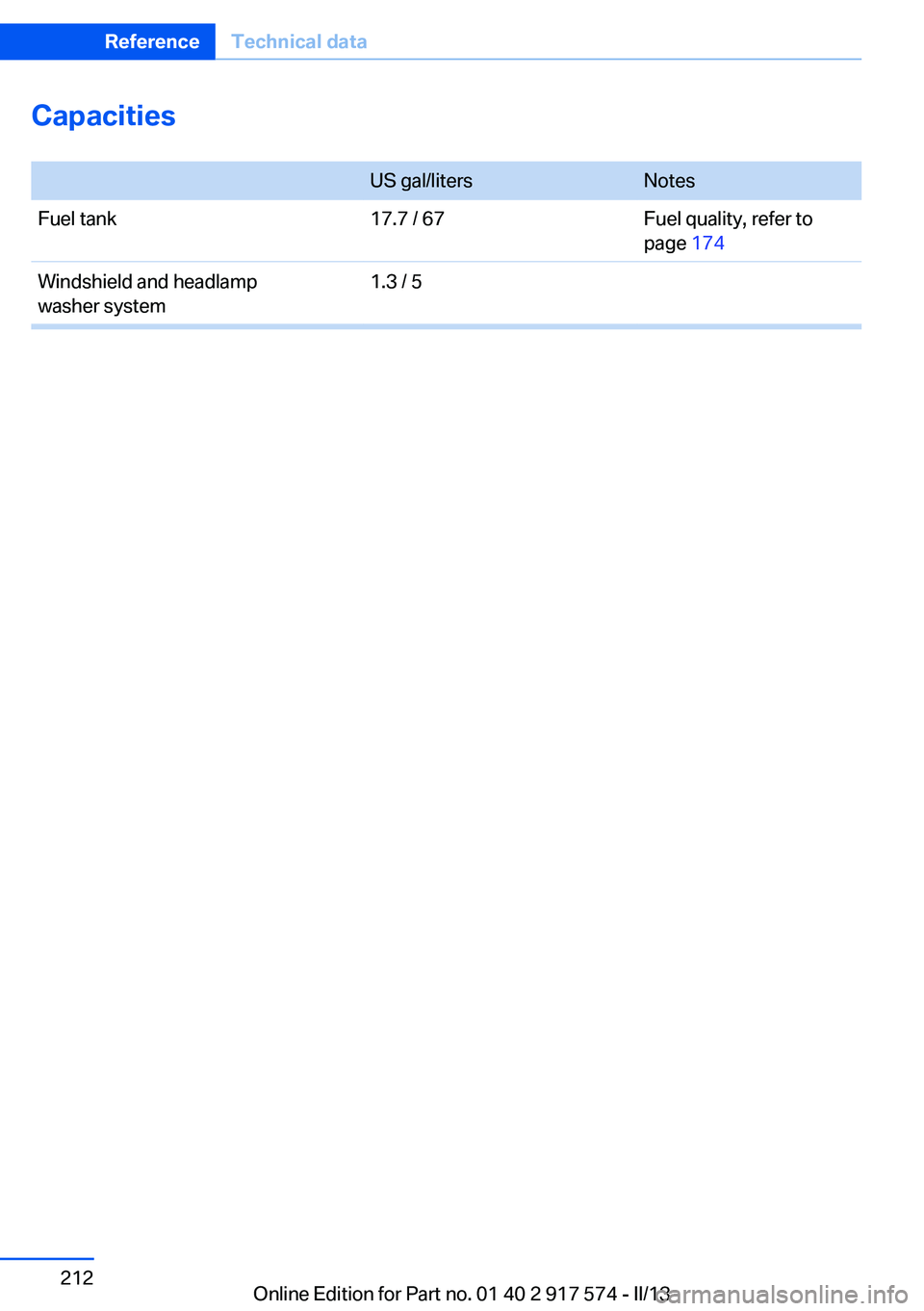
Capacities
US gal/litersNotesFuel tank17.7 / 67Fuel quality, refer to
page 174Windshield and headlamp
washer system1.3 / 5Seite 212ReferenceTechnical data212
Online Edition for Part no. 01 40 2 917 574 - II/13
Page 213 of 224

Seite 213Technical dataReference213
Online Edition for Part no. 01 40 2 917 574 - II/13
Page 216 of 224
Convenient opening 39
Coolant 187
Coolant temperature 83
Cooling function 140
Cooling, maximum 139
Cooling system 187
Corrosion on brake discs 161
Cruise control 122
Cruising range 84
Cupholder 154
D
Damage, tires 179
Damping control, dy‐ namic 118
Data, technical 210
Date 84
Daytime running lights 95
Deactivating drive readi‐ ness 68
Defrosting, refer to Windows, defrosting 139
Dehumidifying, air 140
Destination distance 90
Digital clock 83
Dimensions 210
Dimmable exterior mirrors 60
Dimmable interior rearview mirror 60
Direction indicator, refer to Turn signals 72
Display, electronic, instrument cluster 80
Display in windshield 136
Display lighting, refer to Instru‐ ment lighting 98
Displays 79
Displays, cleaning 207
Displays, hybrid system 84
Disposal, coolant 187
Disposal, vehicle battery 197
Distance control, refer to PDC 124
Distance to destination 90 Divided screen view, split
screen 22
Door lock, refer to Remote control 34
Doors, Automatic Soft Clos‐ ing 41
DRIVE 69
Drive-off assistant 117
Drive-off assistant, refer to DSC 117
Drive readiness in detail 67
Drive readiness states 66
Driving 0
Driving Dynamics Control 119
Driving instructions, breaking in 158
Driving mode 119
Driving notes, general 160
Driving stability control sys‐ tems 117
Driving tips 160
Driving tips, hybrid sys‐ tem 158
Driving with the combustion engine 69
DSC Dynamic Stability Con‐ trol 117
DTC driving dynamics 118
DTC Dynamic Traction Con‐ trol 118
Dynamic Damping Con‐ trol 118
Dynamic Stability Control DSC 117
Dynamic Traction Control DTC 118
E
eBOOST 70
ECO PRO 167
ECO PRO, bonus range 168
ECO PRO display 167
ECO PRO driving mode 167
ECO PRO mode 167 ECO PRO Tip - driving instruc‐
tion 169
eDRIVE, electric driving 29
Electric drive readiness, Silent Start 67
Electric driving, eDRIVE 29
Electronic displays, instru‐ ment cluster 80
Electronic Stability Program ESP, refer to DSC 117
Emergency detection, remote control 35
Emergency release, door lock 41
Emergency release, fuel filler flap 172
Emergency Request 198
Emergency service, refer to Roadside Assistance 199
Emergency start function, en‐ gine start 35
Emergency unlocking, trunk lid 44
Energy recovery, CHARGE 70
Engine, automatic off 68
Engine compartment 182
Engine compartment, working in 182
Engine coolant 187
Engine oil 184
Engine oil, adding 185
Engine oil additives 185
Engine oil change 185
Engine oil filler neck 185
Engine oil temperature 83
Engine oil types, alterna‐ tive 185
Engine oil types, ap‐ proved 185
Engine start during malfunc‐ tion 35
Engine start, jump-start‐ ing 199
Engine temperature 83
Entering a car wash 204
Equipment, interior 146 Seite 216ReferenceEverything from A to Z216
Online Edition for Part no. 01 40 2 917 574 - II/13