fuel BMW CONVERTIBLE 1998 User Guide
[x] Cancel search | Manufacturer: BMW, Model Year: 1998, Model line: CONVERTIBLE, Model: BMW CONVERTIBLE 1998Pages: 179, PDF Size: 3.51 MB
Page 64 of 179
63
At a glanceControls Car careRepairsTechnicalDataIndex
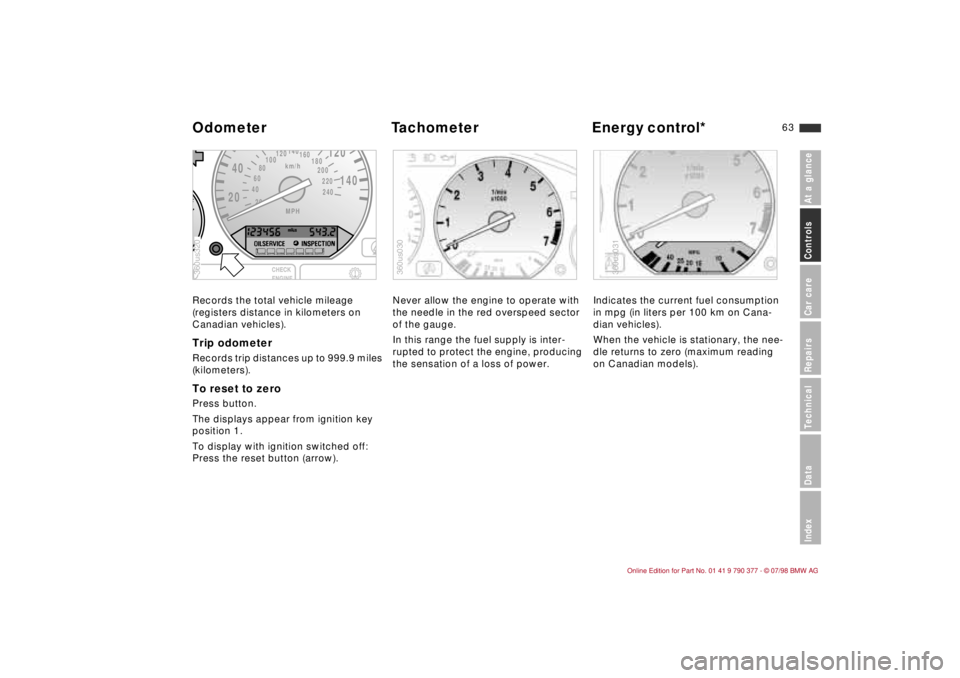
Records the total vehicle mileage
(registers distance in kilometers on
Canadian vehicles).Trip odometerRecords trip distances up to 999.9 miles
(kilometers).To reset to zeroPress button.
The displays appear from ignition key
position 1.
To display with ignition switched off:
Press the reset button (arrow).Never allow the engine to operate with
the needle in the red overspeed sector
of the gauge.
In this range the fuel supply is inter-
rupted to protect the engine, producing
the sensation of a loss of power.Indicates the current fuel consumption
in mpg (in liters per 100 km on Cana-
dian vehicles).
When the vehicle is stationary, the nee-
dle returns to zero (maximum reading
on Canadian models).
2040
120
140
km/h
240 220 200 180 160
140
120
100
80
60
40
20MPH
F360us320
360us030
360us031
Odometer Tachometer Energy control*
Page 65 of 179
64
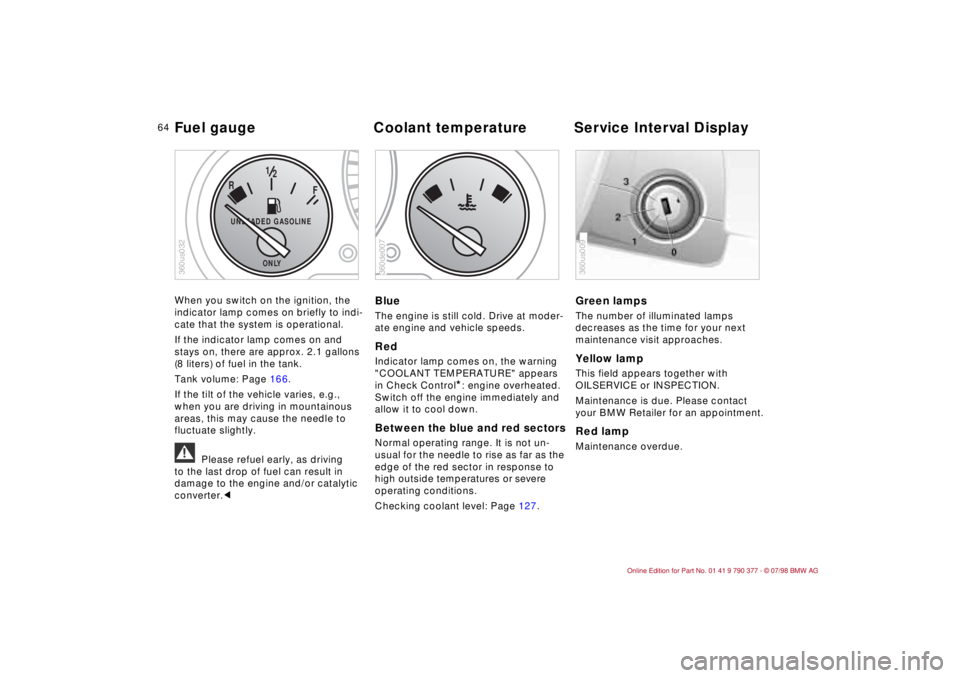
When you switch on the ignition, the
indicator lamp comes on briefly to indi-
cate that the system is operational.
If the indicator lamp comes on and
stays on, there are approx. 2.1 gallons
(8 liters) of fuel in the tank.
Tank volume: Page 166.
If the tilt of the vehicle varies, e.g.,
when you are driving in mountainous
areas, this may cause the needle to
fluctuate slightly.
a
Please refuel early, as driving
to the last drop of fuel can result in
damage to the engine and/or catalytic
converter.c
BlueThe engine is still cold. Drive at moder-
ate engine and vehicle speeds.RedIndicator lamp comes on, the warning
"COOLANT TEMPERATURE" appears
in Check Control
*: engine overheated.
Switch off the engine immediately and
allow it to cool down.
Between the blue and red sectorsNormal operating range. It is not un-
usual for the needle to rise as far as the
edge of the red sector in response to
high outside temperatures or severe
operating conditions.
Checking coolant level: Page 127.
Green lampsThe number of illuminated lamps
decreases as the time for your next
maintenance visit approaches.Yellow lamp This field appears together with
OILSERVICE or INSPECTION.
Maintenance is due. Please contact
your BMW Retailer for an appointment.Red lampMaintenance overdue.
F
R
12
UNLEADED GASOLINE
ONLY
360us032
360de007
360us009
Fuel gauge Coolant temperature Service Interval Display
Page 80 of 179
79
At a glanceControls Car careRepairsTechnicalDataIndex
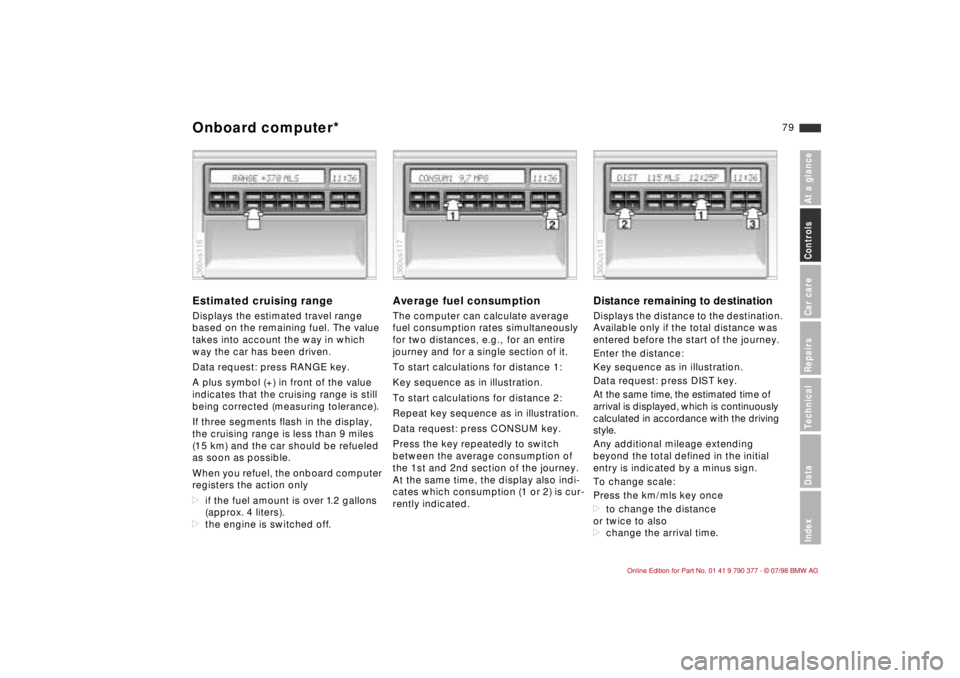
Estimated cruising rangeDisplays the estimated travel range
based on the remaining fuel. The value
takes into account the way in which
way the car has been driven.
Data request: press RANGE key.
A plus symbol (+) in front of the value
indicates that the cruising range is still
being corrected (measuring tolerance).
If three segments flash in the display,
the cruising range is less than 9 miles
(15 km) and the car should be refueled
as soon as possible.
When you refuel, the onboard computer
registers the action only
dif the fuel amount is over 1.2 gallons
(approx. 4 liters).
dthe engine is switched off.
Average fuel consumptionThe computer can calculate average
fuel consumption rates simultaneously
for two distances, e.g., for an entire
journey and for a single section of it.
To start calculations for distance 1:
Key sequence as in illustration.
To start calculations for distance 2:
Repeat key sequence as in illustration.
Data request: press CONSUM key.
Press the key repeatedly to switch
between the average consumption of
the 1st and 2nd section of the journey.
At the same time, the display also indi-
cates which consumption (1 or 2) is cur-
rently indicated.
Distance remaining to destinationDisplays the distance to the destination.
Available only if the total distance was
entered before the start of the journey.
Enter the distance:
Key sequence as in illustration.
Data request: press DIST key.
At the same time, the estimated time of
arrival is displayed, which is continuously
calculated in accordance with the driving
style.
Any additional mileage extending
beyond the total defined in the initial
entry is indicated by a minus sign.
To change scale:
Press the km/mls key once
dto change the distance
or twice to also
dchange the arrival time.
360us116
360us117
360us118
Onboard computer*
Page 84 of 179
83
At a glanceControls Car careRepairsTechnicalDataIndex
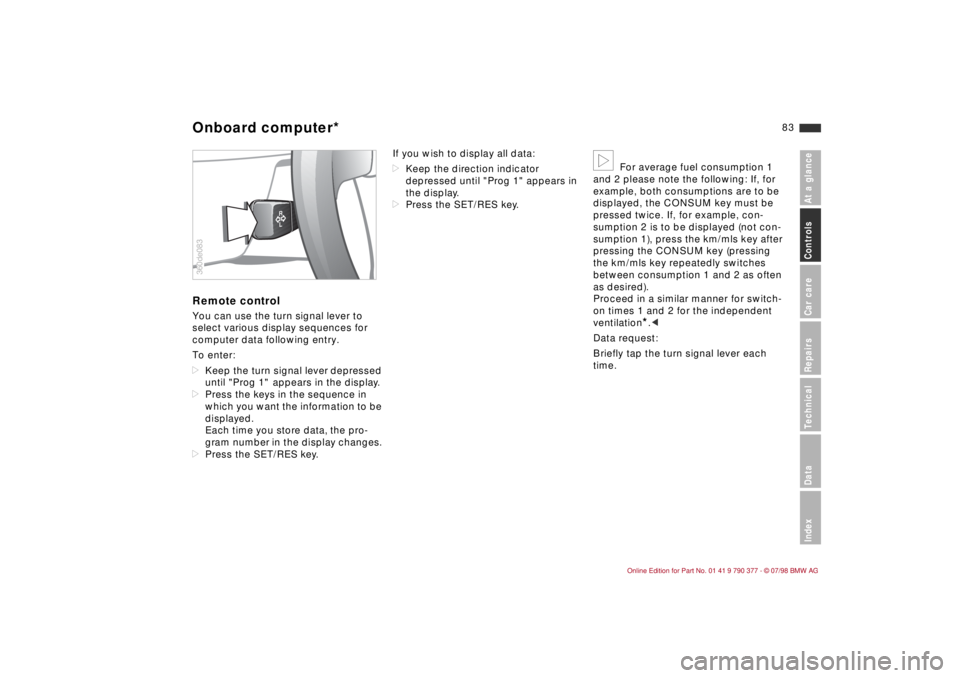
Remote controlYou can use the turn signal lever to
select various display sequences for
computer data following entry.
To enter:
dKeep the turn signal lever depressed
until "Prog 1"
appears in the display.
dPress the keys in the sequence in
which you want the information to be
displayed.
Each time you store data, the pro-
gram number in the display changes.
dPress the SET/RES key.If you wish to display all data:
dKeep the direction indicator
depressed until "Prog 1" appears in
the display.
dPress the SET/RES key.
b
For average fuel consumption 1
and 2 please note the following: If, for
example, both consumptions are to be
displayed, the CONSUM key must be
pressed twice. If, for example, con-
sumption 2 is to be displayed (not con-
sumption 1), press the km/mls key after
pressing the CONSUM key (pressing
the km/mls key repeatedly switches
between consumption 1 and 2 as often
as desired).
Proceed in a similar manner for switch-
on times 1 and 2 for the independent
ventilation
*.c
Data request:
Briefly tap the turn signal lever each
time.
R
L
360de083Onboard computer*
Page 103 of 179

10 2
The catalytic converter reduces harmful
exhaust emissions.
It is designed for use with unleaded fuel
only.
Even minute quantities of lead would be
enough to permanently damage both
the catalytic converter and the system's
oxygen sensor.
To ensure efficient, trouble-free engine
operation and avoid potential damage:
dAlways have your car serviced in
accordance with maintenance
instructions.
dNever continue driving until the fuel
tank is empty.
dRespond to engine miss by switching
off the engine at once.
dNever tow-start the car unless the
engine is cold, or else unburned fuel
may reach the catalytic converter.
Better yet: use jumper cables!
dAvoid other situations in which the
fuel would not be (completely)
burned, for instance:
Frequent, extended, or repeated
starting attempts during which the
engine fails to start. (Switching off
and restarting a healthy engine
causes no damage).
Never let the engine run with any of
the spark-plug cables disconnected.
a
Always observe the above points
to prevent unburned mixture from
entering the catalytic converter. This
could result in overheating, leading to
serious damage.
High temperatures occur on all vehicles
equipped with a catalytic converter.
Heat shields are installed adjacent to
some sections of the exhaust system.
Never remove these shields; do not
apply undercoating to their surfaces.
When driving, standing at idle or park-
ing the vehicle, take care to avoid con-
tact between the exhaust system and
flammable materials (e.g., grass, hay,
leaves, etc.). Such contact could lead to
a fire, resulting in personal injury and
property damage.c
Traveling abroadAlways make sure that unleaded fuel
meeting your engineÕs octane require-
ments will be available when planning
trips outside the country. The use of
fuel failing to meet the official octane
requirements could result in engine
damage.
If you are considering traveling to a
country in which unleaded fuel is not
readily available, please remember that
leaded fuel will destroy the lambda oxy-
gen sensor and the catalytic converter
on your BMW. After operation on
leaded fuel, your vehicle will no longer
meet American and Canadian exhaust
emission standards, and there will also
be a loss of fuel economy. Upon your
return to the US or Canada, you will be
expected to comply with legal ordi-
nances requiring that you replace both
the oxygen sensor and the catalytic
converter, and to have the fuel system
flushed to remove any traces of leaded
fuel.
Catalytic converter
Page 108 of 179

10 7
At a glanceControlsCar careRepairsTechnicalDataIndex
A special luggage system is available as
an option for your BMW. Please
observe the precautions included with
the installation instructions.
Because roof racks raise the center of
gravity of the car when loaded, they
exercise a major effect on its handling
and steering response.
You should therefore always remember
not to exceed the approved roof weight,
the approved gross vehicle weight or
the axle weights when loading the rack.
For specifications refer to "Technical
data", page 163ff.
Make sure that the load is not too heavy,
and attempt to distribute it evenly.
Always load the heaviest items first (on
the bottom).
Make sure there is sufficient space to
raise the sliding/tilt sunroof.Secure the roof luggage correctly and
securely to prevent it from shifting or
being lost during driving (danger to fol-
lowing traffic).
Drive smoothly: avoid sudden accelera-
tion and braking maneuvers; corner
gently.
The roof load increases the surface
area exposed to the wind: increased
fuel consumption and stress on the roof
are the immediate results.Roof-mounted luggage rack*
Page 115 of 179

11 4
We recommend winter tires (M+S radial
tires) for operation under inclement win-
ter driving conditions. Although all-sea-
son M+S tires provide better winter
traction than standard summer tires
with H, V, W and ZR speed ratings, they
generally fail to provide the same levels
of performance as standard snow tires
in winter driving.
If you fit winter tires, install radial tires
of the same tread configuration and
from a single manufacturer on all four
wheels (better still: on all five wheels).
This ensures safe tracking and steering
response.
Fit BMW-approved winter tires only.
Any BMW Retailer will be glad to pro-
vide you with information on the best
winter tires for your particular driving
conditions.Winter tires display a perceptible loss in
their ability to cope with winter driving
conditions once the tread wears to
below 0.16 in (4 mm), and should thus
be replaced.
Observe the specified tire inflation
pressures - and be sure to have the
wheel and tire assemblies balanced
every time you change the tires!
a
Never exceed the maximum speed
for which the tires are rated.
Unprofessional attempts by laymen to
service tires can lead to damage and ac-
cidents.
Have this work performed by skilled pro-
fessionals only. Your BMW Retailer will
be glad to assist you.c
Store tires in a cool, dry place, away
from light whenever possible. Protect
the tires from contact with oil, grease
and fuel.
Winter tires
Page 125 of 179
12 4
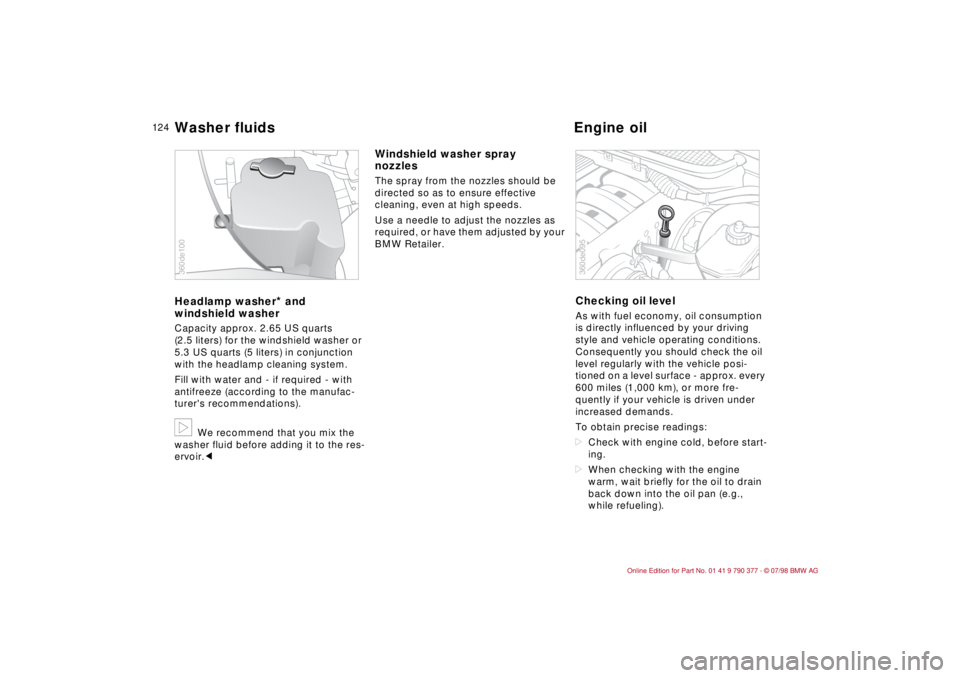
Headlamp washer
* and
windshield washer
Capacity approx. 2.65 US quarts
(2.5 liters) for the windshield washer or
5.3 US quarts (5 liters) in conjunction
with the headlamp cleaning system.
Fill with water and - if required - with
antifreeze (according to the manufac-
turer's recommendations).b
We recommend that you mix the
washer fluid before adding it to the res-
ervoir.c
Windshield washer spray
nozzles The spray from the nozzles should be
directed so as to ensure effective
cleaning, even at high speeds.
Use a needle to adjust the nozzles as
required, or have them adjusted by your
BMW Retailer.
Checking oil level As with fuel economy, oil consumption
is directly influenced by your driving
style and vehicle operating conditions.
Consequently you should check the oil
level regularly with the vehicle posi-
tioned on a level surface - approx. every
600 miles (1,000 km), or more fre-
quently if your vehicle is driven under
increased demands.
To obtain precise readings:
dCheck with engine cold, before start-
ing.
dWhen checking with the engine
warm, wait briefly for the oil to drain
back down into the oil pan (e.g.,
while refueling).
360de100
360de095
Washer fluids Engine oil
Page 133 of 179

13 2
Exterior finishTo provide effective corrosion protec-
tion, multilayer paintwork is applied at
the factory. Cataphoretic immersion
priming techniques are supplemented
using special body-cavity protectants,
with the application of specially-devel-
oped and extensively tested materials.
The entire underbody is sprayed with a
flexible PVC layer before final compre-
hensive application of a wax-based
protectant.
Regular maintenance makes an impor-
tant contribution to maintaining the
safety and value of your vehicle.
Increasing awareness of the effects of
harmful environmental factors on vehi-
cle finishes have led paint and vehicle
manufacturers to initiate ongoing pro-
grams designed to further improve the
durability of their finishes. Despite the
high quality of the resulting products,
local and regional factors can still have
a negative effect on your car's paint-
work. These should guide you in deter-
mining the frequency and extent of your
efforts to maintain the vehicle finish.
Depending upon material and type of
impact (perforation of paint layer), phys-
ical stresses from sand, road salt,
gravel, etc. can cause corrosion to start extending beneath the finish, starting at
the point of impact.
Road dirt, tar spots, dead insects, ani-
mal droppings (strong alkali effect) and
tree excretions (resins and pollen) all
contain substances capable of causing
damage when allowed to remain on
your car's finish for any period of time
(spots, etching, flaking, separation in
the top coat).
In industrial areas, deposits from ßy ash,
lime, oily soot, sulphur dioxide in pre-
cipitation (acid rain) and other environ-
mental pollutants will damage the car's
surface (usually limited to the external
horizontal surfaces) unless adequate
protection is provided.
In coastal regions, high levels of atmo-
spheric salt and humidity promote cor-
rosion.
In tropical zones, temperatures of over
100 5F (approx. 406) in the shade pre-
vail, in addition to heavy ultraviolet radi-
ation and high humidity. Under those
circumstances, light-colored paints
reach temperatures of up to 175 5F
(approx. 806) and dark paints up to
250 5F (approx. 1206).
Caring for the vehicle finishAs a precaution against damage result-
ing from exposure to aggressive sub-
stances, we recommend that you wash
the car weekly when it is used in an
area with high levels of air pollution or
aggressive natural substances (tree
resin, pollen).
Remove particularly aggressive sub-
stances immediately in order to prevent
changes to, and discoloration of, the
paint. Such substances are e.g., gaso-
line spilled during refueling, oil, grease,
brake fluid and bird droppings.
Any contamination remaining on the
surface of the vehicle will be especially
conspicuous after washing. Use clean-
ing fluid or alcohol with a clean cloth or
cotton pad to remove. You can use tar
remover to remove any spots on the fin-
ish of the vehicle, but should never
apply it or any other aggressive
cleanser to lenses or headlamp covers.
These areas should then be waxed to
maintain protection.b
A full range of car-care products is
available from your BMW Retailer.c
Caring for your car
Page 134 of 179

13 3
At a glanceControlsCar careRepairsTechnicalDataIndex
Waxing your carProtect the finish using carnauba or
synthetic-based waxes only.
The best way to determine when the
finish needs to be waxed is by noting
when water stops beading on the sur-
face.
You can use a glass cleaner to remove
any wax or silicone that may have been
left on the windows during waxing.b
A full range of car-care products is
available from your BMW Retailer.c
Paint damageYou can touch up small areas of dam-
age with BMW spray paint, a BWM
touch-up stick or BMW paint tape.
The paint color code for your car is pro-
vided on a sticker located next to the
type plate and on the first page of your
Service and Warranty Information book-
let.
Damage caused by flying stones,
scratches, etc. must be touched up
without delay to prevent rust from form-
ing.
If corrosion has started to form in an
area with paint damage, remove all rust
and clean the area, then prime the area
with a BMW Primer Stick. Finally, apply
the finish coat. Wait a few days, then
polish the repaired area. Finish by
applying a wax preservative.
More extensive paint damage should be
professionally repaired in accordance
with the manufacturer's instructions.
Your BMW Retailer uses original BMW
finish materials in accordance with offi-
cial repair procedures.
Caring for other vehicle compo-
nents and materialsLight-alloy wheels
* should be treated
with alloy wheel cleaner, particularly dur-
ing the winter months. Refrain from using
aggressive products containing acids,
strong alkalis or abrasives. Alloy wheels
should not be cleaned with a steam jet
operating at temperatures in excess of
140 5F (606) (note manufacturer's
instructions).
You can use window and glass cleaner to
clean inside window surfaces and mir-
rors without smearing and streaking.
Never use polishing pastes or abrasive
(quartz) cleansers on mirror lenses.
Clean plastic parts, imitation leather sur-
faces, the roof lining, the lenses of lamps,
the glass cover of the instrument panel
and all dull black sprayed parts with
water or products for the care of plastics.
Avoid soaking the headliner. Never use
solvents such as lacquer thinner, heavy-
duty grease remover, fuels, etc.
Rubber components should be cleaned
with water only; a rubber treatment or sil-
icone spray may also be applied.
Clean the wiper blades with soapy water.
The wiper blades should be replaced
twice a year, before and after the cold
season.
Caring for your car