roof BMW CONVERTIBLE 1998 User Guide
[x] Cancel search | Manufacturer: BMW, Model Year: 1998, Model line: CONVERTIBLE, Model: BMW CONVERTIBLE 1998Pages: 179, PDF Size: 3.51 MB
Page 96 of 179
95
At a glanceControlsCar careRepairsTechnicalDataIndex
Pull the strap to fold down the armrest.
To open drawer
*:
Unlock and pull out the drawer by pull-
ing on the drawer handle. The drawer
locks in any position. The cup holder
can be shifted as necessary.
BMW ConvertibleVehicles without ski bag
*: Storage
compartment, accessible by removing
the filler piece and releasing the trim
(refer to page 97).
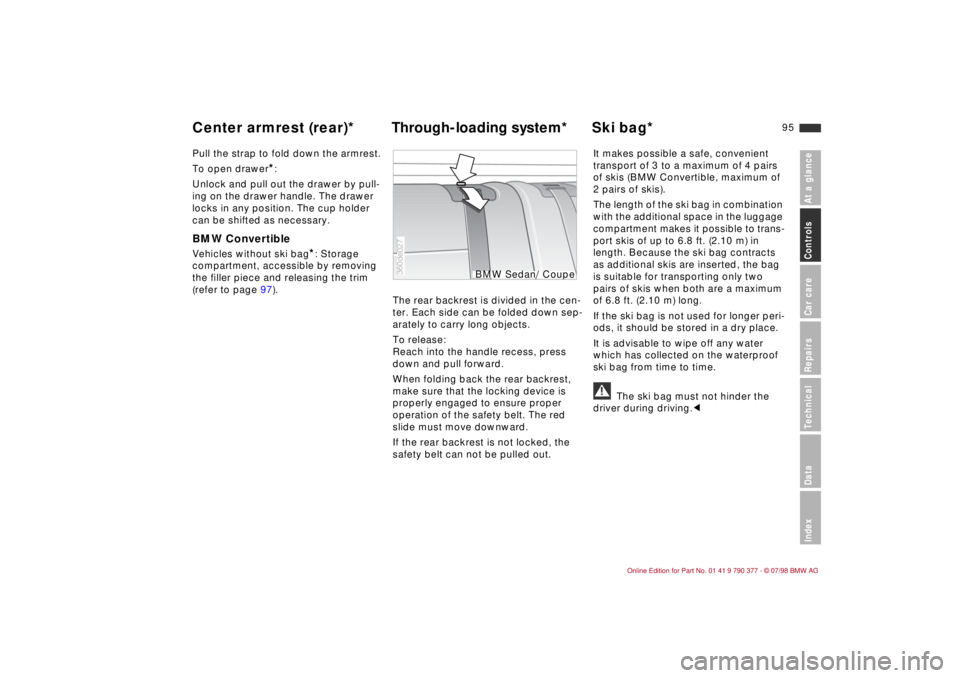
The rear backrest is divided in the cen-
ter. Each side can be folded down sep-
arately to carry long objects.
To release:
Reach into the handle recess, press
down and pull forward.
When folding back the rear backrest,
make sure that the locking device is
properly engaged to ensure proper
operation of the safety belt. The red
slide must move downward.
If the rear backrest is not locked, the
safety belt can not be pulled out.It makes possible a safe, convenient
transport of 3 to a maximum of 4 pairs
of skis (BMW Convertible, maximum of
2 pairs of skis).
The length of the ski bag in combination
with the additional space in the luggage
compartment makes it possible to trans-
port skis of up to 6.8 ft. (2.10 m) in
length. Because the ski bag contracts
as additional skis are inserted, the bag
is suitable for transporting only two
pairs of skis when both are a maximum
of 6.8 ft. (2.10 m) long.
If the ski bag is not used for longer peri-
ods, it should be stored in a dry place.
It is advisable to wipe off any water
which has collected on the waterproof
ski bag from time to time.
a
The ski bag must not hinder the
driver during driving.c
360de027
BMW Sedan/ Cou
pe
Center armrest (rear)*Through-loading system*Ski bag*
Page 100 of 179
At a glance
Controls and featuresCare and maintenanceAdvanced technology
Technical data
Owner service procedure
At a glanceControlsCar careRepairsTechnicalDataIndex
Index
99
Special operating instructions:
Break-in procedures100
Driving notes100
Catalytic converter102
Antilock Brake System (ABS)103
Disc brakes104
Brake system105
Winter driving105
Roof-mounted luggage rack107
Radio reception108
Cellular phones108
Hardtop Ð Convertible109
Technical modifications to
the vehicle110
Wheels and tires:
Tire inflation pressures111
Tire tread111
Tire replacement112
Interaxle tire changes112
The right choice113
Winter tires114
Approved wheels and tires115Under the hood:
Hood118
Engine compartment 120
Washer fluids124
Engine oil124
Coolant127
Brake fluid128
Power steering fluid128
Vehicle Identification Number118
Care and maintenance:
The BMW Maintenance
System130
Caring for your car131
Cleaning and care of the
convertible top136
Vehicle storage137
Page 108 of 179

10 7
At a glanceControlsCar careRepairsTechnicalDataIndex
A special luggage system is available as
an option for your BMW. Please
observe the precautions included with
the installation instructions.
Because roof racks raise the center of
gravity of the car when loaded, they
exercise a major effect on its handling
and steering response.
You should therefore always remember
not to exceed the approved roof weight,
the approved gross vehicle weight or
the axle weights when loading the rack.
For specifications refer to "Technical
data", page 163ff.
Make sure that the load is not too heavy,
and attempt to distribute it evenly.
Always load the heaviest items first (on
the bottom).
Make sure there is sufficient space to
raise the sliding/tilt sunroof.Secure the roof luggage correctly and
securely to prevent it from shifting or
being lost during driving (danger to fol-
lowing traffic).
Drive smoothly: avoid sudden accelera-
tion and braking maneuvers; corner
gently.
The roof load increases the surface
area exposed to the wind: increased
fuel consumption and stress on the roof
are the immediate results.Roof-mounted luggage rack*
Page 131 of 179

13 0
The BMW Maintenance System has
been designed as a reliable means of
providing the customer with maximum
vehicle safety and reliability with mini-
mum complication and expense.
Please remember that regular periodic
maintenance plays an essential part in
ensuring continued vehicle security. It
also helps maintain the resale value of
the vehicle.
Service Interval DisplayAdvanced technology is employed to
calculate the optimal maintenance
intervals, which are then indicated in
the Service Interval Display. While con-
ventional maintenance systems rely on
mileage alone to determine when ser-
vice is due, the BMW Maintenance Sys-
tem reflects the actual conditions under
which the vehicle is operated, because
mileage is not simply mileage:
From the point of view of maintenance,
62,000 miles (100,000 km) accumulated
in short-distance driving are not the
equivalent of the same distance cov-
ered in long-distance highway travel.
The BMW Maintenance System
includes the Engine Oil Service as well
as Inspections I and II.
Determining the maintenance intervals
according to the actual loads on the car
covers every kind of operating situation.
However, drivers who cover only
extremely short distances - substantially
less than 6,200 miles (10,000 km) annu-
ally - should have the engine oil changed
at least once a year, as it continues to
age whether or not the car is used on a
regular basis.
Service and Warranty Information
bookletPlease refer to the Service and War-
ranty Information booklet for additional
information on maintenance intervals
and procedures.
Depending on operating conditions, as
a precaution against rust it may be a
good idea to have the body checked for
stone damage and chips at the same
time.
Please ensure that all maintenance
operations are entered in the Service
and Warranty Information booklet upon
completion. These entries will consti-
tute your proof that the vehicle has
received regular maintenance. They
are also required for warranty claims.b
Have your BMW Retailer carry out
the maintenance and repair. Your BMW
Retailer is always informed on the latest
maintenance work and repair tech-
niques and equipped with the required
special tools. In addition, the testing of
parts known from experience to be sub-
ject to wear is a permanent part of the
maintenance specifications.c
360us009The BMW Maintenance System
Page 134 of 179

13 3
At a glanceControlsCar careRepairsTechnicalDataIndex
Waxing your carProtect the finish using carnauba or
synthetic-based waxes only.
The best way to determine when the
finish needs to be waxed is by noting
when water stops beading on the sur-
face.
You can use a glass cleaner to remove
any wax or silicone that may have been
left on the windows during waxing.b
A full range of car-care products is
available from your BMW Retailer.c
Paint damageYou can touch up small areas of dam-
age with BMW spray paint, a BWM
touch-up stick or BMW paint tape.
The paint color code for your car is pro-
vided on a sticker located next to the
type plate and on the first page of your
Service and Warranty Information book-
let.
Damage caused by flying stones,
scratches, etc. must be touched up
without delay to prevent rust from form-
ing.
If corrosion has started to form in an
area with paint damage, remove all rust
and clean the area, then prime the area
with a BMW Primer Stick. Finally, apply
the finish coat. Wait a few days, then
polish the repaired area. Finish by
applying a wax preservative.
More extensive paint damage should be
professionally repaired in accordance
with the manufacturer's instructions.
Your BMW Retailer uses original BMW
finish materials in accordance with offi-
cial repair procedures.
Caring for other vehicle compo-
nents and materialsLight-alloy wheels
* should be treated
with alloy wheel cleaner, particularly dur-
ing the winter months. Refrain from using
aggressive products containing acids,
strong alkalis or abrasives. Alloy wheels
should not be cleaned with a steam jet
operating at temperatures in excess of
140 5F (606) (note manufacturer's
instructions).
You can use window and glass cleaner to
clean inside window surfaces and mir-
rors without smearing and streaking.
Never use polishing pastes or abrasive
(quartz) cleansers on mirror lenses.
Clean plastic parts, imitation leather sur-
faces, the roof lining, the lenses of lamps,
the glass cover of the instrument panel
and all dull black sprayed parts with
water or products for the care of plastics.
Avoid soaking the headliner. Never use
solvents such as lacquer thinner, heavy-
duty grease remover, fuels, etc.
Rubber components should be cleaned
with water only; a rubber treatment or sil-
icone spray may also be applied.
Clean the wiper blades with soapy water.
The wiper blades should be replaced
twice a year, before and after the cold
season.
Caring for your car
Page 140 of 179
At a glance
Controls and featuresCare and maintenanceAdvanced technology
Technical data
Owner service procedure
At a glanceControlsCar careRepairsTechnicalDataIndex
Index
13 9
Replacement procedures:
Onboard tool kit140
Windshield wiper blades140
Lamp and bulbs141
Master key with battery lamp145
Changing tires146
Battery149
Fuses151
In case of electrical
malfunction:
Fuel filler door 152
Sliding/tilt sunroof 152
Assistance, giving and receiving:
Jump-starting153
Towing the vehicle154
Towing154
Page 153 of 179
15 2
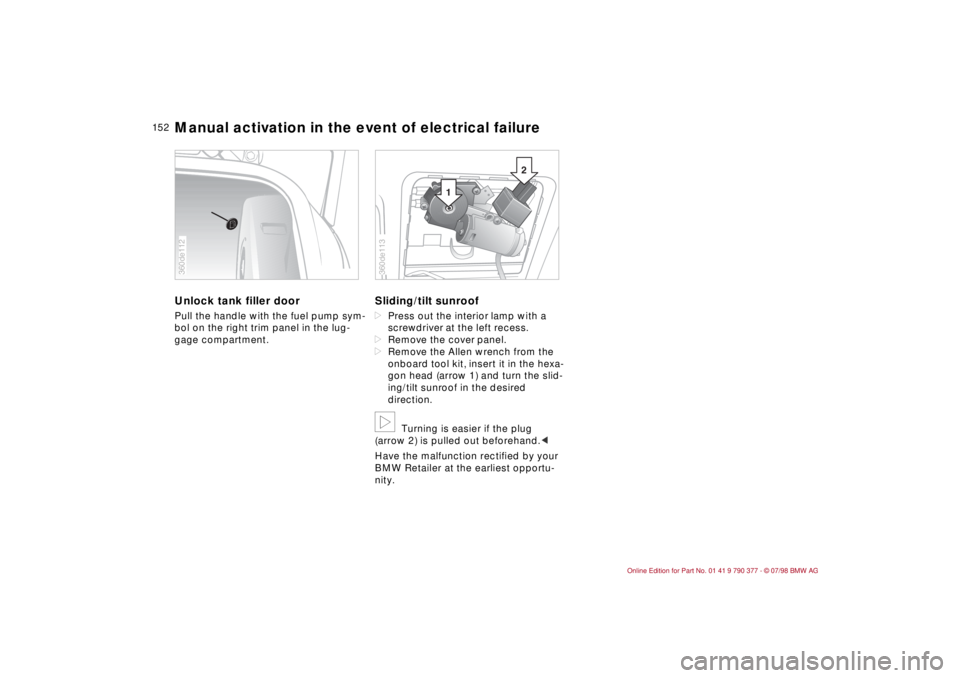
Unlock tank filler door Pull the handle with the fuel pump sym-
bol on the right trim panel in the lug-
gage compartment.
Sliding/tilt sunroof dPress out the interior lamp with a
screwdriver at the left recess.
dRemove the cover panel.
dRemove the Allen wrench from the
onboard tool kit, insert it in the hexa-
gon head (arrow 1) and turn the slid-
ing/tilt sunroof in the desired
direction.b
Turning is easier if the plug
(arrow 2) is pulled out beforehand.c
Have the malfunction rectified by your
BMW Retailer at the earliest opportu-
nity.
360de112
2
1
360de113
Manual activation in the event of electrical failure
Page 164 of 179

At a glanceControls Car careRepairsTechnicalDataIndex
16 3
BMW 318i
SedanBMW 318is
CoupeBMW 318i
Convertible
Vehicle weight empty
(including driver, ready for operation, with full tank of fuel,
options not included)
with manual transmission
with automatic transmissionlbs (kg)
lbs (kg)2,954 (1,340)
3,042 (1,380)2,987 (1,355)
3,075 (1,395)3,153 (1,430)
3,230 (1,465)
Approved gross vehicle weight
with manual transmission
with automatic transmissionlbs (kg)
lbs (kg)3,924 (1,780)
4,012 (1,820)3,957 (1,795)
4,045 (1,835)3,990 (1,810)
4,068 (1,845)
Approved front axle load lbs (kg) 1,830 (830)
1,830 (830) 1,830 (830)
Approved rear axle load lbs (kg) 2,304 (1,045) 2,337 (1,060) 2,348 (1,065)
Maximum payload lbs (kg) 970 (440) 970 (440) 838 (380)
Approved roof load capacity lbs (kg) 165 (75) 165 (75) 88 (40)
Never exceed either the approved axle weights or the gross vehicle weight.
Luggage compartment capacity cu. ft. (liter) 15.4 (435) 14.3 (405) 8.1 (230)
Weights
Page 165 of 179

16 4
BMW 323is
CoupeBMW 323i
Convertible
Vehicle weight, empty
(incl. driver, ready for operation, with full tank of fuel,
options not included)
with manual transmission
with automatic transmissionlbs (kg)
lbs (kg)3,075 (1,395)
3,175 (1,440)3,296 (1,495)
3,373 (1,530)
Approved gross vehicle weight
with manual transmission
with automatic transmissionlbs (kg)
lbs (kg)4,045 (1,835)
4,145 (1,880)4,134 (1,875)
4,211 (1,910)
Approved front axle load lbs (kg)
1,929 (875) 1,984 (900)
Approved rear axle load lbs (kg) 2,337 (1,060) 2,359 (1,070)
Maximum payload lbs (kg) 970 (440) 838 (380)
Approved roof load capacity lbs (kg) 165 (75) 88 (40)
Never exceed either the approved axle weights or the gross vehicle weight.
Luggage compartment capacity cu. ft. (liter) 14.3 (405) 8.1 (230)
Weights
Page 166 of 179

At a glanceControls Car careRepairsTechnicalDataIndex
16 5
BMW 328i
SedanBMW 328is
CoupeBMW 328i
Convertible
Vehicle weight, empty
(incl. driver, ready for operation, with full tank of fuel,
options not included)
with manual transmission
with automatic transmissionlbs (kg)
lbs (kg)3,131 (1,420)
3,208 (1,455)3,142 (1,425)
3,230 (1,465)3,395 (1,540)
3,472 (1,575)
Approved gross vehicle weight
with manual transmission
with automatic transmissionlbs (kg)
lbs (kg)4,101 (1,860)
4,178 (1,895)4,112 (1,865)
4,200 (1,905)4,233 (1,920)
4,310 (1,955)
Approved front axle load lbs (kg)
1,940 (880)1,940 (880)
1,995 (905)
Approved rear axle load lbs (kg) 2,348 (1,065) 2,370 (1,075) 2,425 (1,100)
Maximum payload lbs (kg) 970 (440) 970 (440) 838 (380)
Approved roof load capacity lbs (kg) 165 (75) 165 (75) 88 (40)
Never exceed either the approved axle weights or the gross vehicle weight.
Luggage compartment capacity cu. ft. (liter) 15.4 (435) 14.3 (405) 8.1 (230)
Weights