steering BMW CONVERTIBLE 1998 User Guide
[x] Cancel search | Manufacturer: BMW, Model Year: 1998, Model line: CONVERTIBLE, Model: BMW CONVERTIBLE 1998Pages: 179, PDF Size: 3.51 MB
Page 100 of 179
At a glance
Controls and featuresCare and maintenanceAdvanced technology
Technical data
Owner service procedure
At a glanceControlsCar careRepairsTechnicalDataIndex
Index
99
Special operating instructions:
Break-in procedures100
Driving notes100
Catalytic converter102
Antilock Brake System (ABS)103
Disc brakes104
Brake system105
Winter driving105
Roof-mounted luggage rack107
Radio reception108
Cellular phones108
Hardtop Ð Convertible109
Technical modifications to
the vehicle110
Wheels and tires:
Tire inflation pressures111
Tire tread111
Tire replacement112
Interaxle tire changes112
The right choice113
Winter tires114
Approved wheels and tires115Under the hood:
Hood118
Engine compartment 120
Washer fluids124
Engine oil124
Coolant127
Brake fluid128
Power steering fluid128
Vehicle Identification Number118
Care and maintenance:
The BMW Maintenance
System130
Caring for your car131
Cleaning and care of the
convertible top136
Vehicle storage137
Page 102 of 179

101
At a glanceControlsCar careRepairsTechnicalDataIndex
ClutchDepress the clutch throughout its com-
plete travel range to shift gears. Do not
"ride" the clutch by driving with your
foot resting against the pedal.a
Brakes:
Do not drive with your foot resting on the
brake pedal. Even light but consistent
pedal pressure can lead to high temper-
atures, brake wear and possibly even
brake failure.
Aquaplaning:
A wedge of water can form between
tires and road surface when you oper-
ate the vehicle on wet or slushy roads.
This phenomenon is referred to as
aquaplaning, or hydroplaning, and it is
characterized by a partial or complete
loss of contact between the tires and
the road surface. The ultimate results
are loss of steering and braking control.Water on the roads:
When driving through water (maximum
depth one foot = 30 cm) always drive at
walking speed, otherwise damage to
the engine, the electrical system and
the transmission can occur.
Rear window shelf:
Never use the rear window shelf to
store heavy or bulky objects. They
could pose a danger to the occupants
when the car is braked heavily.
Clothes hooks:
When suspending clothing from the
hooks, ensure that they will not obstruct
the driver's vision. Refrain from hanging
heavy objects from the hooks, as these
could cause personal injury when the
car is braked heavily.c
Driving notes
Page 104 of 179

10 3
At a glanceControlsCar careRepairsTechnicalDataIndex
ABS enhances active safety by helping
to prevent the wheels from locking under
braking. When the front wheels slide, the
driver loses steering control over the
vehicle. Traction loss at the rear wheels
can cause the rear end to break into
uncontrolled oversteer.
ABS is designed to meet two essential
requirements during every application:
dto help provide vehicle stability on all
types of road surface (asphalt,
cement, dirt, moisture, snow and ice).
dto help to retain steering and maneu-
vering capability under the same con-
ditions.
However, certain important consider-
ations must be borne in mind in connec-
tion with these requirements:
Not even ABS can suspend the normal
laws of physics. ABS alone can not pre-
vent accidents when the brakes are
applied without an adequate safety
interval between vehicles, when the car
reaches excessive rates of lateral accel-
eration in curves, or if aquaplaning
occurs. Responsibility for these types of
situations remains in the hands (and feet)
of the driver. You should never allow the
added safety of ABS to lull you into a
false sense of security, or mislead you
into taking increased risks that could
affect your own safety and that of others.
Driving with ABSThe yellow ABS warning in the instru-
ment panel goes out as soon as the
engine is started.
The system becomes operative once the
vehicle exceeds a speed of 5 mph
(8 km/h). The ABS is deactivated when-
ever the vehicle's speed drops below
approx. 2 mph (3 km/h). This means that
the wheels can lock in the Þnal phase of
a braking action - a factor of no signiÞ-
cance in actual practice.
The ABS system closed-loop control cir-
cuit cycles in fractions of a second. A
pulsation at the brake pedal indicates to
the driver that ABS is active, that is, that
the car is within its maximum braking
range. In addition, the audible pulsation
that accompanies the control operation
calls your attention to the reduced trac-
tion between tires and road surface
(marginal adhesion), and reminds you
that the vehicle's speed should be
reduced to adapt to road conditions.On road surfaces featuring a loose top
layer on a Þrmer substratum, e.g., on
gravel or snow, the braking distances
with ABS may be longer than with the
wheels locked. However, ABS continues
to provide enhanced vehicle and steer-
ing control under these conditions.
a
To ensure that the system remains
completely operational, never modify the
ABS. Service procedures on ABS are to
be performed by authorized technicians
only.c
ABS may fail to function with maximum
efÞciency when tires of different sizes
are mounted (e.g., winter tires/spare tire;
remount the correct tires at all wheels as
soon as possible).
In the event of a fault, the ABS warning
lamp in the instrument cluster lights up,
refer to page 18. The braking system
then reverts to conventional operation as
on a vehicle without ABS. However,
have the brake system checked by your
BMW Retailer as soon as possible. To
prevent undetected defects and cumu-
lative faults from adversely affecting the
brake system, refer any problems to
your authorized BMW Retailer at the
earliest opportunity.
Antilock Brake System (ABS)
Page 107 of 179

10 6
BrakesWinter road conditions substantially
reduce the amount of traction available
between the tires and the road surface;
the resulting - considerable - increases
in braking distance should be continu-
ally borne in mind.
ABS is intended to prevent the wheels
from locking under braking; to help the
vehicle to remain stable and sensitive to
steering. Should the ABS fail, with lock-
ing wheels as a result: Reduce the
pressure on the brake pedal until the
wheels just start to roll again while still
maintaining enough force to continue
braking. Then increase the pressure,
release the pressure when the wheels
lock, reapply pressure, etc.
This staggered braking procedure will
reduce stopping distances while help-
ing you maintain steering control.
It can allow you to steer around hazards
once you have reduced the pressure on
the brake pedal.
a
Never downshift to exploit engine
braking when driving on slippery road
surfaces; it could lead to loss of rear-
wheel traction and endanger vehicle
control. ABS and ASC+T can not protect
against such loss of traction, since they
have no effect on this kind of decelera-
tion.c
b
Disengage the clutch during hard
braking on road surfaces affording only
poor or uneven traction.c
Loss of lateral traction (sliding)Release the accelerator pedal and
depress the clutch pedal or push the
selector lever to position N with auto-
matic transmission. Countersteer care-
fully and attempt to regain control of the
vehicle.
ParkingSelect 1st or reverse gear. If your car is
equipped with an automatic transmis-
sion, select Park. Engage the parking
brake when parking on hills and
inclined surfaces. To prevent frost and
corrosion from locking the parking
brake liners at the drum, you can dry
them by gently pulling up the lever
while stopping (ensure that you do not
endanger following traffic).a
The brake lamps do not light up
when the parking brake is applied.c
Winter driving
Page 108 of 179

10 7
At a glanceControlsCar careRepairsTechnicalDataIndex
A special luggage system is available as
an option for your BMW. Please
observe the precautions included with
the installation instructions.
Because roof racks raise the center of
gravity of the car when loaded, they
exercise a major effect on its handling
and steering response.
You should therefore always remember
not to exceed the approved roof weight,
the approved gross vehicle weight or
the axle weights when loading the rack.
For specifications refer to "Technical
data", page 163ff.
Make sure that the load is not too heavy,
and attempt to distribute it evenly.
Always load the heaviest items first (on
the bottom).
Make sure there is sufficient space to
raise the sliding/tilt sunroof.Secure the roof luggage correctly and
securely to prevent it from shifting or
being lost during driving (danger to fol-
lowing traffic).
Drive smoothly: avoid sudden accelera-
tion and braking maneuvers; corner
gently.
The roof load increases the surface
area exposed to the wind: increased
fuel consumption and stress on the roof
are the immediate results.Roof-mounted luggage rack*
Page 112 of 179

111
At a glanceControlsCar careRepairsTechnicalDataIndex
Information for your safetyThe factory-approved radial tires have
been selected to provide optimum
safety and driving comfort on your vehi-
cle.
In a very real sense, both tire life and
your own safety are riding on correct
tire specifications and inflation pres-
sures.
Incorrect inflation pressures are a fre-
quent cause of tire damage. To a great
extent it also influences the ability of
your BMW to hold the road.a
Check the tire pressures Ð also in
the spare tire Ð at least every two weeks,
and before every extended trip.
Incorrect inflation pressures can also
lead to tire damage and accidents.c
Tire tread - tire damageInspect your tires frequently for tread
wear, signs of damage and for foreign
objects lodged in the tread. Check the
tread depth.
The tread depth should not be less than
0.12 in (3 mm). Otherwise there is an
increased risk of aquaplaning, even at
relatively moderate speeds and with
only small amounts of water on the
road.
We recommend that you always replace
the tires once the tread wears to 0.12 in
(3 mm). Once the tread has worn to
0.063 in (1.6 mm), tread depth indica-
tors appear.a
Never continue driving on a deflat-
ed (flat) tire. A flat tire greatly impairs
steering and braking response, and can
lead to complete loss of control over the
vehicle.
Avoid overloading the vehicle so that the
permitted load on the tires is not ex-
ceeded. This can cause overheating and
gradual internal damage. The ultimate
result can assume the form of a sudden
air loss.Unusual vibrations encountered during
normal vehicle operation can indicate
tire failure or some other vehicle defect,
as can variations in normal vehicle
response, such as a pronounced ten-
dency to pull to the left or right. Should
this occur, you should respond by
immediately reducing your speed and
carefully proceeding to the nearest
BMW Retailer or professional tire cen-
ter, or having the vehicle towed in to
have it and its tires inspected.
Tire damage (up to and including blow-
outs) can endanger the lives of both the
vehicle occupants and other road
users.c
Tire inflation pressures Tire tread
Page 115 of 179

11 4
We recommend winter tires (M+S radial
tires) for operation under inclement win-
ter driving conditions. Although all-sea-
son M+S tires provide better winter
traction than standard summer tires
with H, V, W and ZR speed ratings, they
generally fail to provide the same levels
of performance as standard snow tires
in winter driving.
If you fit winter tires, install radial tires
of the same tread configuration and
from a single manufacturer on all four
wheels (better still: on all five wheels).
This ensures safe tracking and steering
response.
Fit BMW-approved winter tires only.
Any BMW Retailer will be glad to pro-
vide you with information on the best
winter tires for your particular driving
conditions.Winter tires display a perceptible loss in
their ability to cope with winter driving
conditions once the tread wears to
below 0.16 in (4 mm), and should thus
be replaced.
Observe the specified tire inflation
pressures - and be sure to have the
wheel and tire assemblies balanced
every time you change the tires!
a
Never exceed the maximum speed
for which the tires are rated.
Unprofessional attempts by laymen to
service tires can lead to damage and ac-
cidents.
Have this work performed by skilled pro-
fessionals only. Your BMW Retailer will
be glad to assist you.c
Store tires in a cool, dry place, away
from light whenever possible. Protect
the tires from contact with oil, grease
and fuel.
Winter tires
Page 124 of 179

12 3
At a glanceControlsCar careRepairsTechnicalDataIndex
1 Fuse box
2 Engine oil dipstick
3 Brake ßuid reservoir
4 Power steering oil reservoir
5 Coolant expansion tank
6 Engine oil Þller neck
7 Supply tank for headlamp washer
*
and windshield washer system
8 Auxiliary terminal for jump starting
Engine compartment BMW 323i, 323is, 328i, 328is
Page 126 of 179
12 5
At a glanceControlsCar careRepairsTechnicalDataIndex
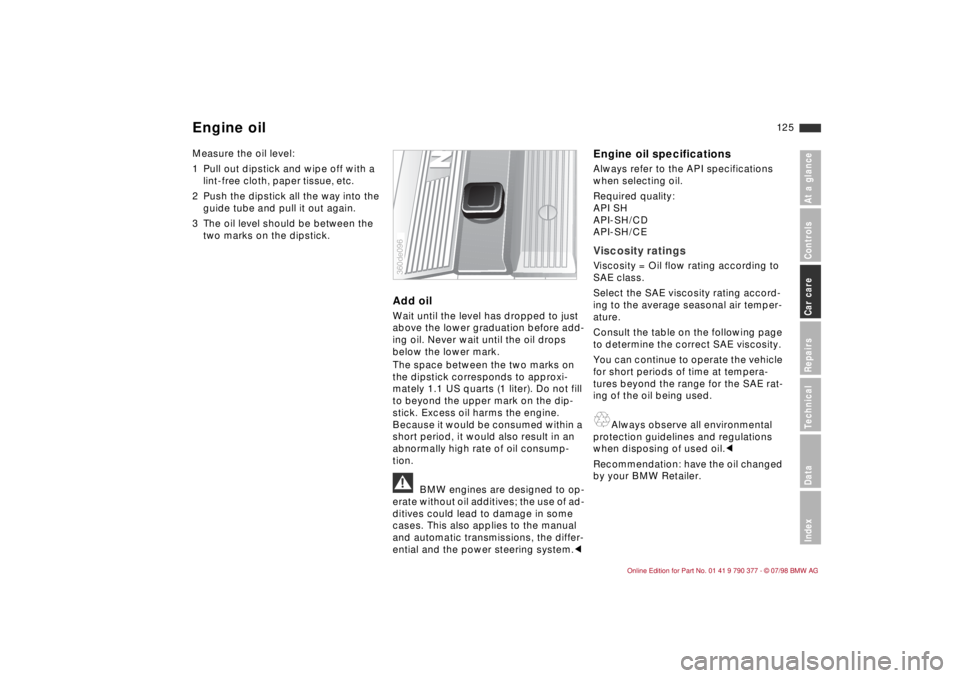
Measure the oil level:
1 Pull out dipstick and wipe off with a
lint-free cloth, paper tissue, etc.
2 Push the dipstick all the way into the
guide tube and pull it out again.
3 The oil level should be between the
two marks on the dipstick.
Add oil Wait until the level has dropped to just
above the lower graduation before add-
ing oil. Never wait until the oil drops
below the lower mark.
The space between the two marks on
the dipstick corresponds to approxi-
mately 1.1 US quarts (1 liter). Do not fill
to beyond the upper mark on the dip-
stick. Excess oil harms the engine.
Because it would be consumed within a
short period, it would also result in an
abnormally high rate of oil consump-
tion.a
BMW engines are designed to op-
erate without oil additives; the use of ad-
ditives could lead to damage in some
cases. This also applies to the manual
and automatic transmissions, the differ-
ential and the power steering system.c
Engine oil specificationsAlways refer to the API specifications
when selecting oil.
Required quality:
API SH
API-SH/CD
API-SH/CEViscosity ratingsViscosity = Oil flow rating according to
SAE class.
Select the SAE viscosity rating accord-
ing to the average seasonal air temper-
ature.
Consult the table on the following page
to determine the correct SAE viscosity.
You can continue to operate the vehicle
for short periods of time at tempera-
tures beyond the range for the SAE rat-
ing of the oil being used.A
Always observe all environmental
protection guidelines and regulations
when disposing of used oil.c
Recommendation: have the oil changed
by your BMW Retailer.
360de096
Engine oil
Page 129 of 179
12 8
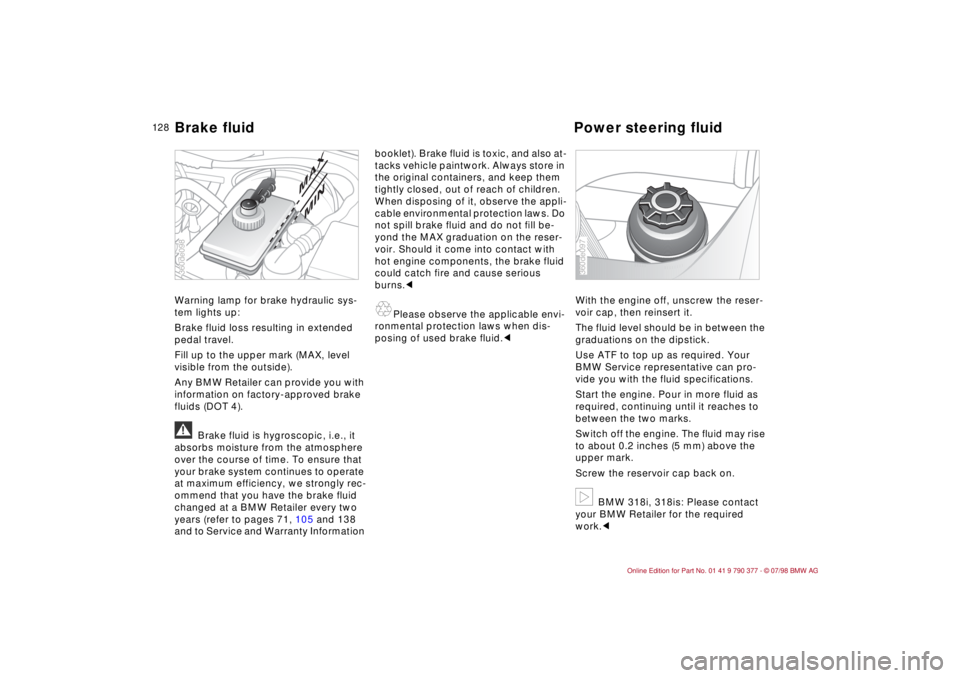
Warning lamp for brake hydraulic sys-
tem lights up:
Brake fluid loss resulting in extended
pedal travel.
Fill up to the upper mark (MAX, level
visible from the outside).
Any BMW Retailer can provide you with
information on factory-approved brake
fluids (DOT 4).
a
Brake fluid is hygroscopic, i.e., it
absorbs moisture from the atmosphere
over the course of time. To ensure that
your brake system continues to operate
at maximum efficiency, we strongly rec-
ommend that you have the brake fluid
changed at a BMW Retailer every two
years (refer to pages 71, 105 and 138
and to Service and Warranty Information booklet). Brake fluid is toxic, and also at-
tacks vehicle paintwork. Always store in
the original containers, and keep them
tightly closed, out of reach of children.
When disposing of it, observe the appli-
cable environmental protection laws. Do
not spill brake fluid and do not fill be-
yond the MAX graduation on the reser-
voir. Should it come into contact with
hot engine components, the brake fluid
could catch fire and cause serious
burns.c
A
Please observe the applicable envi-
ronmental protection laws when dis-
posing of used brake fluid.cWith the engine off, unscrew the reser-
voir cap, then reinsert it.
The fluid level should be in between the
graduations on the dipstick.
Use ATF to top up as required. Your
BMW Service representative can pro-
vide you with the fluid specifications.
Start the engine. Pour in more fluid as
required, continuing until it reaches to
between the two marks.
Switch off the engine. The fluid may rise
to about 0.2 inches (5 mm) above the
upper mark.
Screw the reservoir cap back on.
b
BMW 318i, 318is: Please contact
your BMW Retailer for the required
work.c
MAXMIN
360de098
360de097
Brake fluid Power steering fluid