service BMW CONVERTIBLE 1998 Owner's Manual
[x] Cancel search | Manufacturer: BMW, Model Year: 1998, Model line: CONVERTIBLE, Model: BMW CONVERTIBLE 1998Pages: 179, PDF Size: 3.51 MB
Page 127 of 179
12 6
a
Continuous exposure to used oil
has caused cancer in laboratory testing.
Any skin areas that come in contact with
oil should be thoroughly washed with
soap and water.
Always store oil, grease, etc., out of
reach of children. Observe all warning
labels and information on lubricant
containers.
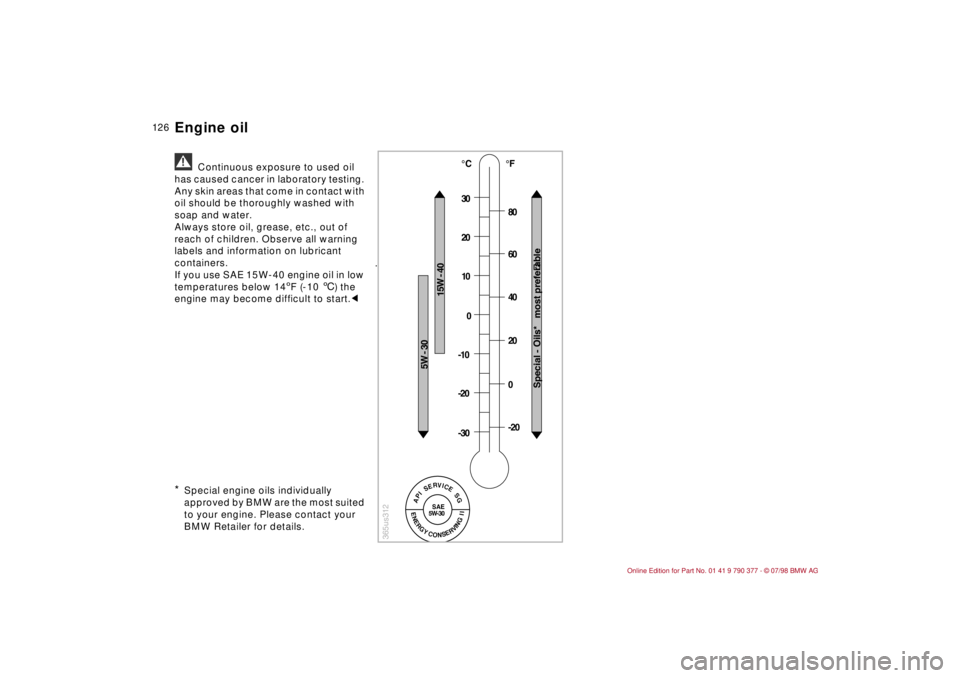
If you use SAE 15W-40 engine oil in low
temperatures below 145F (-10 6) the
engine may become difficult to start.c
*Special engine oils individually
approved by BMW are the most suited
to your engine. Please contact your
BMW Retailer for details..Engine oil
Special - Oils* most preferable
15W - 40
5W - 30
30
20
10
0
-10
-20
-30-20 0 20 40 60 80 °C°F
APISERVICESG
ENERGYCONSERVINGII
SAE
5W-30
365us312
Page 129 of 179
12 8
Warning lamp for brake hydraulic sys-
tem lights up:
Brake fluid loss resulting in extended
pedal travel.
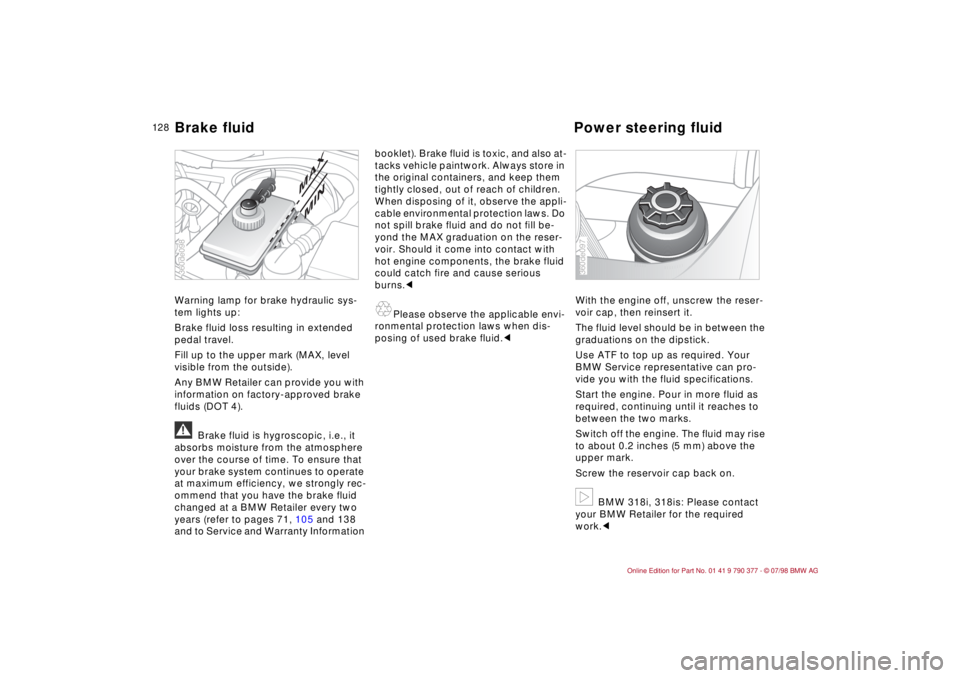
Fill up to the upper mark (MAX, level
visible from the outside).
Any BMW Retailer can provide you with
information on factory-approved brake
fluids (DOT 4).
a
Brake fluid is hygroscopic, i.e., it
absorbs moisture from the atmosphere
over the course of time. To ensure that
your brake system continues to operate
at maximum efficiency, we strongly rec-
ommend that you have the brake fluid
changed at a BMW Retailer every two
years (refer to pages 71, 105 and 138
and to Service and Warranty Information booklet). Brake fluid is toxic, and also at-
tacks vehicle paintwork. Always store in
the original containers, and keep them
tightly closed, out of reach of children.
When disposing of it, observe the appli-
cable environmental protection laws. Do
not spill brake fluid and do not fill be-
yond the MAX graduation on the reser-
voir. Should it come into contact with
hot engine components, the brake fluid
could catch fire and cause serious
burns.c
A
Please observe the applicable envi-
ronmental protection laws when dis-
posing of used brake fluid.cWith the engine off, unscrew the reser-
voir cap, then reinsert it.
The fluid level should be in between the
graduations on the dipstick.
Use ATF to top up as required. Your
BMW Service representative can pro-
vide you with the fluid specifications.
Start the engine. Pour in more fluid as
required, continuing until it reaches to
between the two marks.
Switch off the engine. The fluid may rise
to about 0.2 inches (5 mm) above the
upper mark.
Screw the reservoir cap back on.
b
BMW 318i, 318is: Please contact
your BMW Retailer for the required
work.c
MAXMIN
360de098
360de097
Brake fluid Power steering fluid
Page 130 of 179
12 9
At a glanceControlsCar careRepairsTechnicalDataIndex
High steering effort:
Check oil level, refer to previous page.
High steering effort during sudden tran-
sitions:
Please contact your BMW Retailer for
an immediate inspection.a
If the power steering fails, in-
creased effort will be required to steer
the vehicle.c
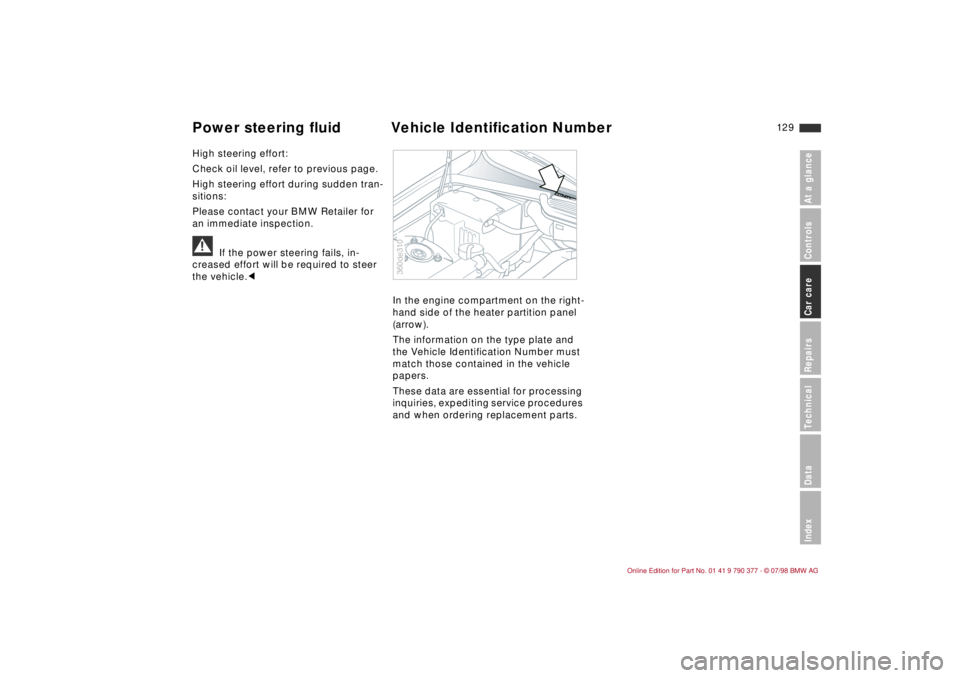
In the engine compartment on the right-
hand side of the heater partition panel
(arrow).
The information on the type plate and
the Vehicle Identification Number must
match those contained in the vehicle
papers.
These data are essential for processing
inquiries, expediting service procedures
and when ordering replacement parts.
360de310
Power steering fluid Vehicle Identification Number
Page 131 of 179

13 0
The BMW Maintenance System has
been designed as a reliable means of
providing the customer with maximum
vehicle safety and reliability with mini-
mum complication and expense.
Please remember that regular periodic
maintenance plays an essential part in
ensuring continued vehicle security. It
also helps maintain the resale value of
the vehicle.
Service Interval DisplayAdvanced technology is employed to
calculate the optimal maintenance
intervals, which are then indicated in
the Service Interval Display. While con-
ventional maintenance systems rely on
mileage alone to determine when ser-
vice is due, the BMW Maintenance Sys-
tem reflects the actual conditions under
which the vehicle is operated, because
mileage is not simply mileage:
From the point of view of maintenance,
62,000 miles (100,000 km) accumulated
in short-distance driving are not the
equivalent of the same distance cov-
ered in long-distance highway travel.
The BMW Maintenance System
includes the Engine Oil Service as well
as Inspections I and II.
Determining the maintenance intervals
according to the actual loads on the car
covers every kind of operating situation.
However, drivers who cover only
extremely short distances - substantially
less than 6,200 miles (10,000 km) annu-
ally - should have the engine oil changed
at least once a year, as it continues to
age whether or not the car is used on a
regular basis.
Service and Warranty Information
bookletPlease refer to the Service and War-
ranty Information booklet for additional
information on maintenance intervals
and procedures.
Depending on operating conditions, as
a precaution against rust it may be a
good idea to have the body checked for
stone damage and chips at the same
time.
Please ensure that all maintenance
operations are entered in the Service
and Warranty Information booklet upon
completion. These entries will consti-
tute your proof that the vehicle has
received regular maintenance. They
are also required for warranty claims.b
Have your BMW Retailer carry out
the maintenance and repair. Your BMW
Retailer is always informed on the latest
maintenance work and repair tech-
niques and equipped with the required
special tools. In addition, the testing of
parts known from experience to be sub-
ject to wear is a permanent part of the
maintenance specifications.c
360us009The BMW Maintenance System
Page 134 of 179

13 3
At a glanceControlsCar careRepairsTechnicalDataIndex
Waxing your carProtect the finish using carnauba or
synthetic-based waxes only.
The best way to determine when the
finish needs to be waxed is by noting
when water stops beading on the sur-
face.
You can use a glass cleaner to remove
any wax or silicone that may have been
left on the windows during waxing.b
A full range of car-care products is
available from your BMW Retailer.c
Paint damageYou can touch up small areas of dam-
age with BMW spray paint, a BWM
touch-up stick or BMW paint tape.
The paint color code for your car is pro-
vided on a sticker located next to the
type plate and on the first page of your
Service and Warranty Information book-
let.
Damage caused by flying stones,
scratches, etc. must be touched up
without delay to prevent rust from form-
ing.
If corrosion has started to form in an
area with paint damage, remove all rust
and clean the area, then prime the area
with a BMW Primer Stick. Finally, apply
the finish coat. Wait a few days, then
polish the repaired area. Finish by
applying a wax preservative.
More extensive paint damage should be
professionally repaired in accordance
with the manufacturer's instructions.
Your BMW Retailer uses original BMW
finish materials in accordance with offi-
cial repair procedures.
Caring for other vehicle compo-
nents and materialsLight-alloy wheels
* should be treated
with alloy wheel cleaner, particularly dur-
ing the winter months. Refrain from using
aggressive products containing acids,
strong alkalis or abrasives. Alloy wheels
should not be cleaned with a steam jet
operating at temperatures in excess of
140 5F (606) (note manufacturer's
instructions).
You can use window and glass cleaner to
clean inside window surfaces and mir-
rors without smearing and streaking.
Never use polishing pastes or abrasive
(quartz) cleansers on mirror lenses.
Clean plastic parts, imitation leather sur-
faces, the roof lining, the lenses of lamps,
the glass cover of the instrument panel
and all dull black sprayed parts with
water or products for the care of plastics.
Avoid soaking the headliner. Never use
solvents such as lacquer thinner, heavy-
duty grease remover, fuels, etc.
Rubber components should be cleaned
with water only; a rubber treatment or sil-
icone spray may also be applied.
Clean the wiper blades with soapy water.
The wiper blades should be replaced
twice a year, before and after the cold
season.
Caring for your car
Page 139 of 179

13 8
Conduct the following work immedi-
ately prior to storing the vehicle:
1 Activate the parking brake and foot-
brake to dry them; this will prevent
the brake disks and drums from cor-
roding.
2 Store the vehicle in a dry, well-venti-
lated room, shift into reverse gear or
set the selector lever to position P
and chock the wheels to prevent roll-
ing. Do not set the parking brake.
3 Remove the battery, recharge and
store in a cool, frost-free room.
During storage, recharge the battery
every three months, as otherwise it will
become unusable. Every time the bat-
tery is discharged, especially over
extended periods, its service life is
reduced.
Removing vehicle from storageRecharge the battery and replace if
necessary.
Then have Inspection I carried out by
your BMW Retailer.a
Storage periods during which the
battery is disconnected are not taken
into consideration by the Service Inter-
val Display for changing the brake fluid.
Therefore, make sure that the brake fluid
is changed every two years at the latest,
regardless of the display. Additional
notes: refer to page 128.c
Vehicle storage
Page 140 of 179
At a glance
Controls and featuresCare and maintenanceAdvanced technology
Technical data
Owner service procedure
At a glanceControlsCar careRepairsTechnicalDataIndex
Index
13 9
Replacement procedures:
Onboard tool kit140
Windshield wiper blades140
Lamp and bulbs141
Master key with battery lamp145
Changing tires146
Battery149
Fuses151
In case of electrical
malfunction:
Fuel filler door 152
Sliding/tilt sunroof 152
Assistance, giving and receiving:
Jump-starting153
Towing the vehicle154
Towing154
Page 151 of 179

15 0
Removal and installationa
Do not disconnect the battery
cable from its terminal while the engine
is running, as the resulting voltage surge
would destroy the vehicle's electronic
systems.c
When disconnecting, start with the neg-
ative terminal, then proceed to the pos-
itive side. Unscrew the battery retaining
clamp.
When installing the battery, connect the
positive terminal first, then proceed to
the negative pole.
a
When installing, always ensure that
the battery is properly mounted.
Otherwise it will not be sufficiently
secured in an accident.c
Charging the battery Always ensure that the engine is off
before recharging an installed battery. a
To avoid short circuits, always
disconnect the cable from the battery's
negative terminal before working on the
electrical system.cOn vehicles with a connecting point in
the engine compartment, it is easiest to
charge the battery by using this con-
necting point (positive pole), and a
ground in the engine compartment
(refer to "Jump-starting" on page 15 3).
If you are planning to remove the vehi-
cle from service for more than four
weeks, you should disconnect the bat-
tery at the negative terminal.
If you intend to store your car for longer
than six weeks: remove the battery,
charge it and store it in a cool (but frost-
free) room. Recharge the battery after
three months at the latest, as it will oth-
erwise be damaged beyond use. Every
time the battery is discharged, espe-
cially over extended periods, its service
life is reduced.
A
Bring used batteries to an autho-
rized collection point or a BMW Re-
tailer. Always maintain the battery in an
upright position for transport and stor-
age. Secure the battery against tilting
when transporting.c
a
Storage periods during which the
battery is disconnected are not taken
into consideration by the Service Inter-
val Display for changing the brake fluid.
Therefore, make sure that the brake fluid
is changed every two years at the latest,
regardless of the display. Additional
notes: refer to page 128.c
Battery
Page 156 of 179
At a glance
Controls and featuresCare and maintenanceAdvanced technology
Technical data
Owner service procedure
At a glanceControls Car careRepairsTechnicalDataIndex
Index
15 5
Airbags156
Automatic Stability Control
plus Traction (ASC+T)156
Radio reception157
Safety belt tensioner157
Page 160 of 179
At a glance
Controls and featuresCare and maintenanceAdvanced technology
Technical data
Owner service procedure
At a glanceControls Car careRepairsTechnicalDataIndex
Index
15 9
Engine specifications 160
Dimensions 161
Weights 163
Capacities 166
Electrical system 167
Drive belts 167