lock BMW CONVERTIBLE 1998 Workshop Manual
[x] Cancel search | Manufacturer: BMW, Model Year: 1998, Model line: CONVERTIBLE, Model: BMW CONVERTIBLE 1998Pages: 179, PDF Size: 3.51 MB
Page 99 of 179
98
Stowing a loadIf you are transporting a load in your
BMW
dStow a heavy load as far forward as
possible - directly behind the back-
rests or the front wall of the luggage
compartment - and on the ßoor.
dCover sharp edges and corners.
dDo not pile objects higher than the
top edge of the backrest.
dIf the load is heavy and the rear seat
is unoccupied, put the outer safety
belt in its lock.
Securing loaddSecure smaller, lighter items with
retaining straps or draw straps (refer
to page 34).
dFor large, heavy items, see your
BMW Retailer for load-securing
devices
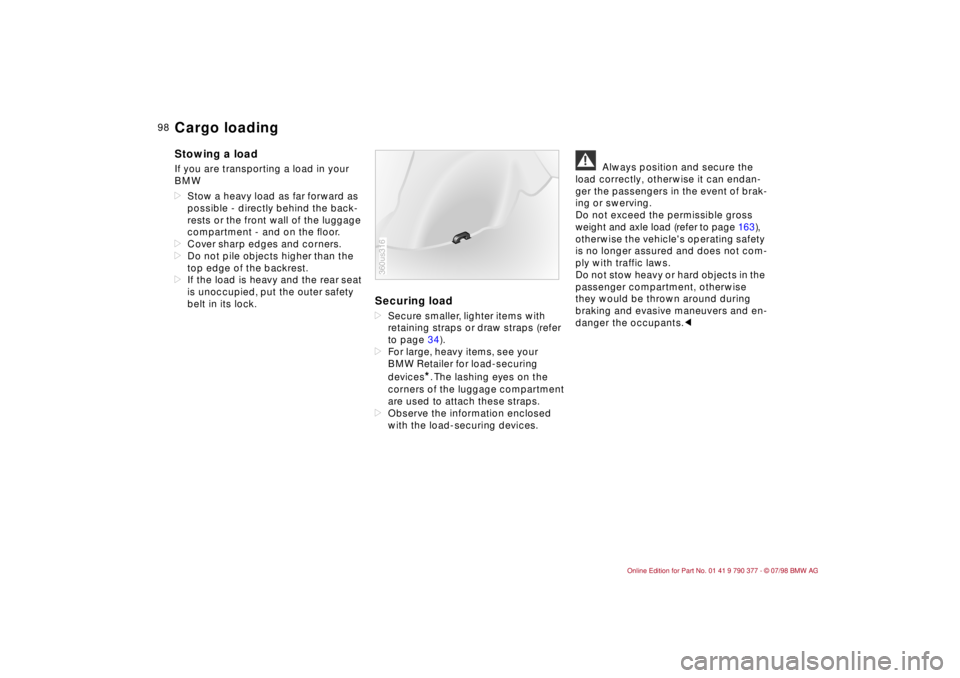
*. The lashing eyes on the
corners of the luggage compartment
are used to attach these straps.
dObserve the information enclosed
with the load-securing devices.
a
Always position and secure the
load correctly, otherwise it can endan-
ger the passengers in the event of brak-
ing or swerving.
Do not exceed the permissible gross
weight and axle load (refer to page 16 3),
otherwise the vehicle's operating safety
is no longer assured and does not com-
ply with traffic laws.
Do not stow heavy or hard objects in the
passenger compartment, otherwise
they would be thrown around during
braking and evasive maneuvers and en-
danger the occupants.c
360us316
Cargo loading
Page 100 of 179
At a glance
Controls and featuresCare and maintenanceAdvanced technology
Technical data
Owner service procedure
At a glanceControlsCar careRepairsTechnicalDataIndex
Index
99
Special operating instructions:
Break-in procedures100
Driving notes100
Catalytic converter102
Antilock Brake System (ABS)103
Disc brakes104
Brake system105
Winter driving105
Roof-mounted luggage rack107
Radio reception108
Cellular phones108
Hardtop Ð Convertible109
Technical modifications to
the vehicle110
Wheels and tires:
Tire inflation pressures111
Tire tread111
Tire replacement112
Interaxle tire changes112
The right choice113
Winter tires114
Approved wheels and tires115Under the hood:
Hood118
Engine compartment 120
Washer fluids124
Engine oil124
Coolant127
Brake fluid128
Power steering fluid128
Vehicle Identification Number118
Care and maintenance:
The BMW Maintenance
System130
Caring for your car131
Cleaning and care of the
convertible top136
Vehicle storage137
Page 104 of 179

10 3
At a glanceControlsCar careRepairsTechnicalDataIndex
ABS enhances active safety by helping
to prevent the wheels from locking under
braking. When the front wheels slide, the
driver loses steering control over the
vehicle. Traction loss at the rear wheels
can cause the rear end to break into
uncontrolled oversteer.
ABS is designed to meet two essential
requirements during every application:
dto help provide vehicle stability on all
types of road surface (asphalt,
cement, dirt, moisture, snow and ice).
dto help to retain steering and maneu-
vering capability under the same con-
ditions.
However, certain important consider-
ations must be borne in mind in connec-
tion with these requirements:
Not even ABS can suspend the normal
laws of physics. ABS alone can not pre-
vent accidents when the brakes are
applied without an adequate safety
interval between vehicles, when the car
reaches excessive rates of lateral accel-
eration in curves, or if aquaplaning
occurs. Responsibility for these types of
situations remains in the hands (and feet)
of the driver. You should never allow the
added safety of ABS to lull you into a
false sense of security, or mislead you
into taking increased risks that could
affect your own safety and that of others.
Driving with ABSThe yellow ABS warning in the instru-
ment panel goes out as soon as the
engine is started.
The system becomes operative once the
vehicle exceeds a speed of 5 mph
(8 km/h). The ABS is deactivated when-
ever the vehicle's speed drops below
approx. 2 mph (3 km/h). This means that
the wheels can lock in the Þnal phase of
a braking action - a factor of no signiÞ-
cance in actual practice.
The ABS system closed-loop control cir-
cuit cycles in fractions of a second. A
pulsation at the brake pedal indicates to
the driver that ABS is active, that is, that
the car is within its maximum braking
range. In addition, the audible pulsation
that accompanies the control operation
calls your attention to the reduced trac-
tion between tires and road surface
(marginal adhesion), and reminds you
that the vehicle's speed should be
reduced to adapt to road conditions.On road surfaces featuring a loose top
layer on a Þrmer substratum, e.g., on
gravel or snow, the braking distances
with ABS may be longer than with the
wheels locked. However, ABS continues
to provide enhanced vehicle and steer-
ing control under these conditions.
a
To ensure that the system remains
completely operational, never modify the
ABS. Service procedures on ABS are to
be performed by authorized technicians
only.c
ABS may fail to function with maximum
efÞciency when tires of different sizes
are mounted (e.g., winter tires/spare tire;
remount the correct tires at all wheels as
soon as possible).
In the event of a fault, the ABS warning
lamp in the instrument cluster lights up,
refer to page 18. The braking system
then reverts to conventional operation as
on a vehicle without ABS. However,
have the brake system checked by your
BMW Retailer as soon as possible. To
prevent undetected defects and cumu-
lative faults from adversely affecting the
brake system, refer any problems to
your authorized BMW Retailer at the
earliest opportunity.
Antilock Brake System (ABS)
Page 105 of 179

10 4
Disc brakes furnish optimum decelera-
tion and braking control as well as
greater fade resistance under heavy
use.
Limited vehicle use, extended periods
with the car parked or in storage and
light loading will increase the tendency
for corrosion to form on the rotors, and
dirt to accumulate on the pads. This
happens because the minimum pres-
sure between the pad and the disc
required for the self-cleaning function
of the disc brakes is not achieved.
If the brake rotors are corroded, they
will tend to respond to braking with a
pulsating effect which even extended
application will fail to cure.
a
Use only original BMW-approved
brake pads, as otherwise vehicle autho-
rization is no longer valid.c
Driving notes While driving in wet conditions and in
heavy rain, it is a good idea to apply
light pressure to the brake pedal every
few miles - Watch traffic conditions to
ensure that this maneuver does not
endanger other road users. The heat
generated in this braking process helps
dry the brake pads and rotors.
Maximum braking force is obtained
while the wheels continue to rotate,
peaking when the wheels remain on the
verge of locking without actually doing
so. ABS maintains this state automati-
cally. If the ABS fails, you should revert
to the staggered braking technique
described above (refer to page 106).
Extended or steep mountain descents
do not necessarily have to lead to
reduced braking efficiency; downshift
to a gear in which only minimal periodic
brake applications are required (you
can move the selector lever to the
appropriate lower range if your car is
equipped with an automatic transmis-
sion).
You can further increase the engine's
braking effect by selecting a lower gear,
downshifting as far as first gear or plac-
ing the selector lever in position 1 (2).Should engine braking prove inade-
quate, you should still avoid extended,
continuous braking. Instead of main-
taining low to moderate pressure over
an extended period of time, you should
decelerate the vehicle by applying more
substantial force at the pedal (watch for
following traffic!) and then pausing
before repeating the application. This
staggered braking technique allows the
brakes to cool in the intervals between
active braking phases, preventing over-
heating and ensuring that full braking
capacity remains available at all times.
a
Do not allow the vehicle to coast by
pressing down the clutch pedal or shift-
ing into neutral while underway. Never
drive with the engine switched
off (!). The engine provides no braking
effect when the clutch is disengaged or
the transmission is in neutral, and there
is no power-assist for brakes and steer-
ing when the engine is not running.
Never allow floor mats, carpets or other
objects to protrude into the area around
the accelerator, clutch and brake pedals
and obstruct their movement.c
Disc brakes
Page 106 of 179

10 5
At a glanceControlsCar careRepairsTechnicalDataIndex
Failure of one brake circuitPedal travel increases, more pressure is
required at the pedal.
The remaining circuit continues to pro-
vide good braking response.a
In the event of any malfunction in
the brake system, consult the nearest
BMW Retailer as soon as possible.cThe onset of winter is often accompa-
nied by rapid changes in weather.
Adaptations in driving style should be
accompanied by preparations on the
vehicle itself to ensure that your
progress through the winter remains
safe and trouble-free.
CoolantEnsure that the coolant contains the
year-round 50:50 ratio of water and
antifreeze with corrosion inhibitor. This
mixture provides protection against
freezing down to approximately -345F
(-376). Replace the coolant every
three years.Lockscan be made operative again using
BMW lock de-icer. This de-icer also
contains lubricants.
In addition, a treatment with BMW lock
cylinder grease is recommended.Rubber seals and components To prevent the weather-stripping from
freezing, apply a spray-on rubber treat-
ment or silicone spray to the door, hood
and luggage compartment lid seals.b
A complete range of car-care
products is available from any autho-
rized BMW Retailer.c
Snow chainsBMW snow chains
* can be mounted on
both summer and winter tires. Mount
them in pairs on the rear wheels only
and observe the manufacturer's safety
precautions. Do not exceed a maximum
speed of 30 mph (50 km/h). For maxi-
mum traction, deactivate ASC+T when
driving with snow chains mounted, refer
to page 84.
Starting offWhen driving off in deep snow or "rock-
ing" the vehicle to free it, you should
switch off ASC+T, refer to page 84. Driving on low-traction road
surfacesOperate the accelerator pedal sensi-
tively, avoid high engine speeds and
shift up to the next-higher gear early.
Shift down into the next lowest gear
when approaching uphill or downhill
grades. Maintain an adequate distance
between yourself and the car ahead.
Brake system Winter driving
Page 107 of 179

10 6
BrakesWinter road conditions substantially
reduce the amount of traction available
between the tires and the road surface;
the resulting - considerable - increases
in braking distance should be continu-
ally borne in mind.
ABS is intended to prevent the wheels
from locking under braking; to help the
vehicle to remain stable and sensitive to
steering. Should the ABS fail, with lock-
ing wheels as a result: Reduce the
pressure on the brake pedal until the
wheels just start to roll again while still
maintaining enough force to continue
braking. Then increase the pressure,
release the pressure when the wheels
lock, reapply pressure, etc.
This staggered braking procedure will
reduce stopping distances while help-
ing you maintain steering control.
It can allow you to steer around hazards
once you have reduced the pressure on
the brake pedal.
a
Never downshift to exploit engine
braking when driving on slippery road
surfaces; it could lead to loss of rear-
wheel traction and endanger vehicle
control. ABS and ASC+T can not protect
against such loss of traction, since they
have no effect on this kind of decelera-
tion.c
b
Disengage the clutch during hard
braking on road surfaces affording only
poor or uneven traction.c
Loss of lateral traction (sliding)Release the accelerator pedal and
depress the clutch pedal or push the
selector lever to position N with auto-
matic transmission. Countersteer care-
fully and attempt to regain control of the
vehicle.
ParkingSelect 1st or reverse gear. If your car is
equipped with an automatic transmis-
sion, select Park. Engage the parking
brake when parking on hills and
inclined surfaces. To prevent frost and
corrosion from locking the parking
brake liners at the drum, you can dry
them by gently pulling up the lever
while stopping (ensure that you do not
endanger following traffic).a
The brake lamps do not light up
when the parking brake is applied.c
Winter driving
Page 110 of 179
10 9
At a glanceControlsCar careRepairsTechnicalDataIndex
Even in winter, when the hardtop may
be in constant use, the fabric top does
not need to be removed. Before storing
the fabric top in the convertible top
compartment, it must be absolutely dry
to prevent the formation of water and
mildew spots.
Two persons are required for mounting
and removal. Use extreme care when
working to prevent paint damage and
damage to the body and hardtop.
To make it easier to mount and remove
the hardtops, you can purchase a spe-
cially developed hardtop lift
* from your
BMW Retailer.
MountingLower the side windows and remove
the rod antenna if necessary to prevent
damage.
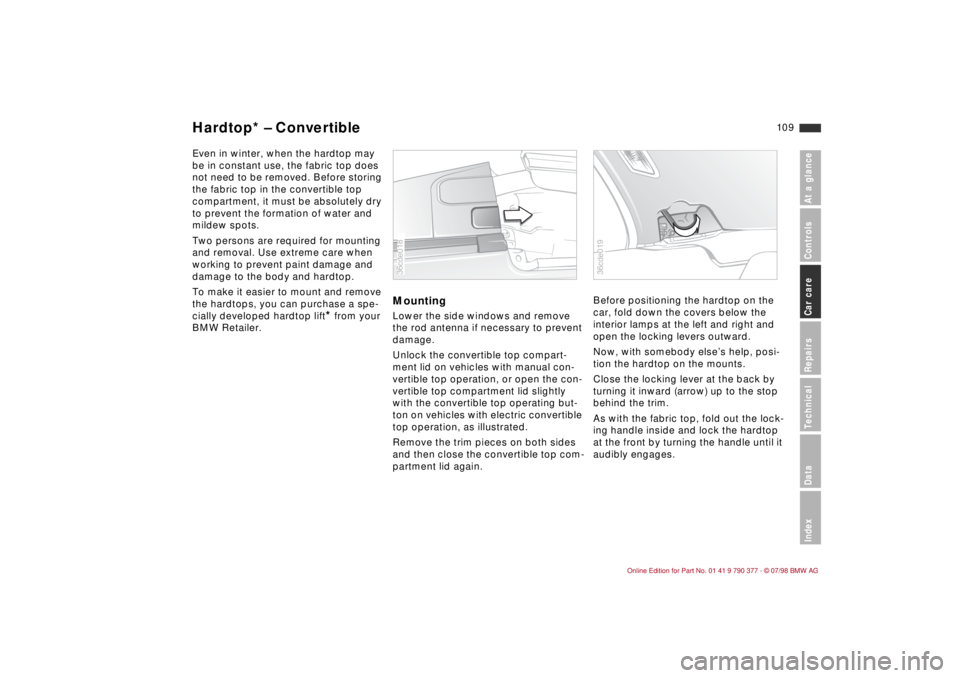
Unlock the convertible top compart-
ment lid on vehicles with manual con-
vertible top operation, or open the con-
vertible top compartment lid slightly
with the convertible top operating but-
ton on vehicles with electric convertible
top operation, as illustrated.
Remove the trim pieces on both sides
and then close the convertible top com-
partment lid again.Before positioning the hardtop on the
car, fold down the covers below the
interior lamps at the left and right and
open the locking levers outward.
Now, with somebody elseÕs help, posi-
tion the hardtop on the mounts.
Close the locking lever at the back by
turning it inward (arrow) up to the stop
behind the trim.
As with the fabric top, fold out the lock-
ing handle inside and lock the hardtop
at the front by turning the handle until it
audibly engages.36cde018
36cde019
Hardtop* Ð Convertible
Page 119 of 179
11 8
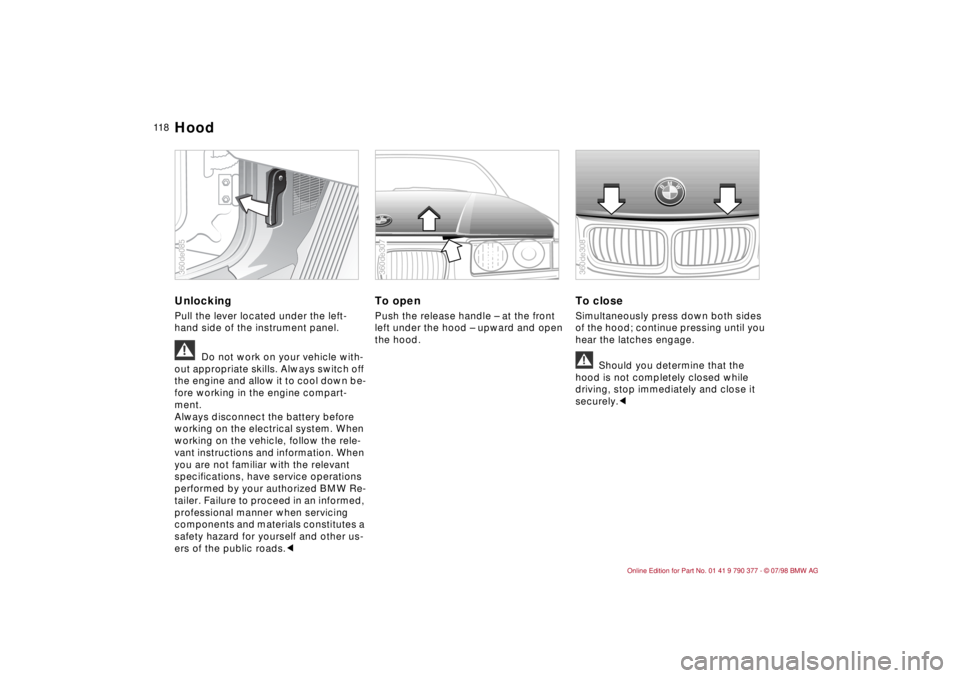
Unlocking Pull the lever located under the left-
hand side of the instrument panel.a
Do not work on your vehicle with-
out appropriate skills. Always switch off
the engine and allow it to cool down be-
fore working in the engine compart-
ment.
Always disconnect the battery before
working on the electrical system. When
working on the vehicle, follow the rele-
vant instructions and information. When
you are not familiar with the relevant
specifications, have service operations
performed by your authorized BMW Re-
tailer. Failure to proceed in an informed,
professional manner when servicing
components and materials constitutes a
safety hazard for yourself and other us-
ers of the public roads.c
To openPush the release handle Ð at the front
left under the hood Ð upward and open
the hood.
To closeSimultaneously press down both sides
of the hood; continue pressing until you
hear the latches engage.a
Should you determine that the
hood is not completely closed while
driving, stop immediately and close it
securely.c
360de085
BMW360de307
BMW
360de308
Hood
Page 128 of 179
12 7
At a glanceControlsCar careRepairsTechnicalDataIndex
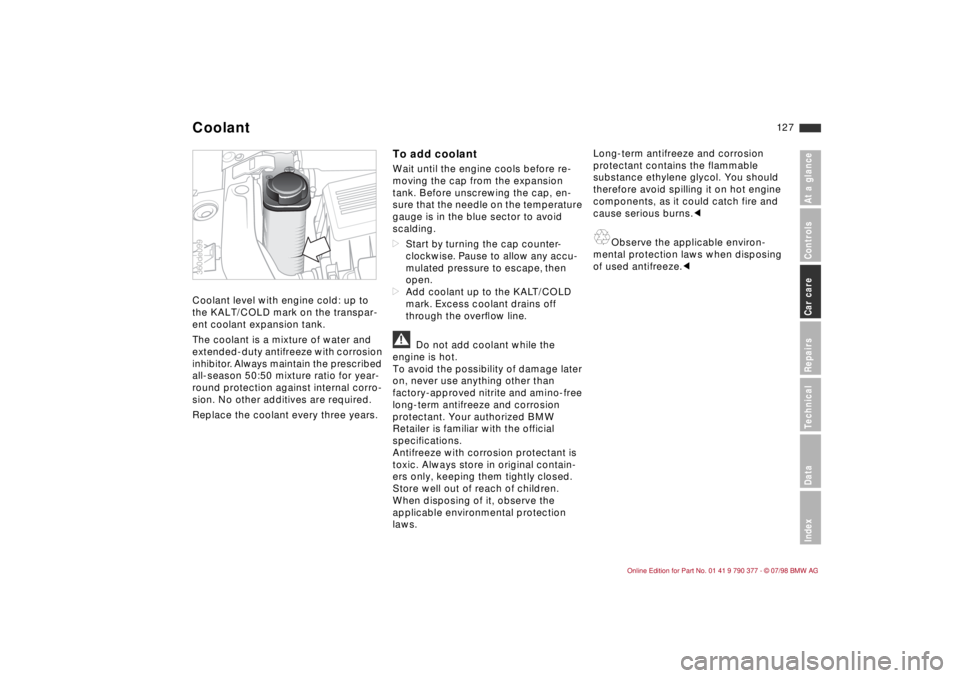
Coolant level with engine cold: up to
the KALT/COLD mark on the transpar-
ent coolant expansion tank.
The coolant is a mixture of water and
extended-duty antifreeze with corrosion
inhibitor. Always maintain the prescribed
all-season 50:50 mixture ratio for year-
round protection against internal corro-
sion. No other additives are required.
Replace the coolant every three years.
To add coolantWait until the engine cools before re-
moving the cap from the expansion
tank. Before unscrewing the cap, en-
sure that the needle on the temperature
gauge is in the blue sector to avoid
scalding.
dStart by turning the cap counter-
clockwise. Pause to allow any accu-
mulated pressure to escape, then
open.
dAdd coolant up to the KALT/COLD
mark. Excess coolant drains off
through the overßow line.a
Do not add coolant while the
engine is hot.
To avoid the possibility of damage later
on, never use anything other than
factory-approved nitrite and amino-free
long-term antifreeze and corrosion
protectant. Your authorized BMW
Retailer is familiar with the official
specifications.
Antifreeze with corrosion protectant is
toxic. Always store in original contain-
ers only, keeping them tightly closed.
Store well out of reach of children.
When disposing of it, observe the
applicable environmental protection
laws.Long-term antifreeze and corrosion
protectant contains the flammable
substance ethylene glycol. You should
therefore avoid spilling it on hot engine
components, as it could catch fire and
cause serious burns.c
A
Observe the applicable environ-
mental protection laws when disposing
of used antifreeze.c
360de099Coolant
Page 141 of 179
14 0
Under the luggage compartment lid.
Unscrew the wingnut for access.
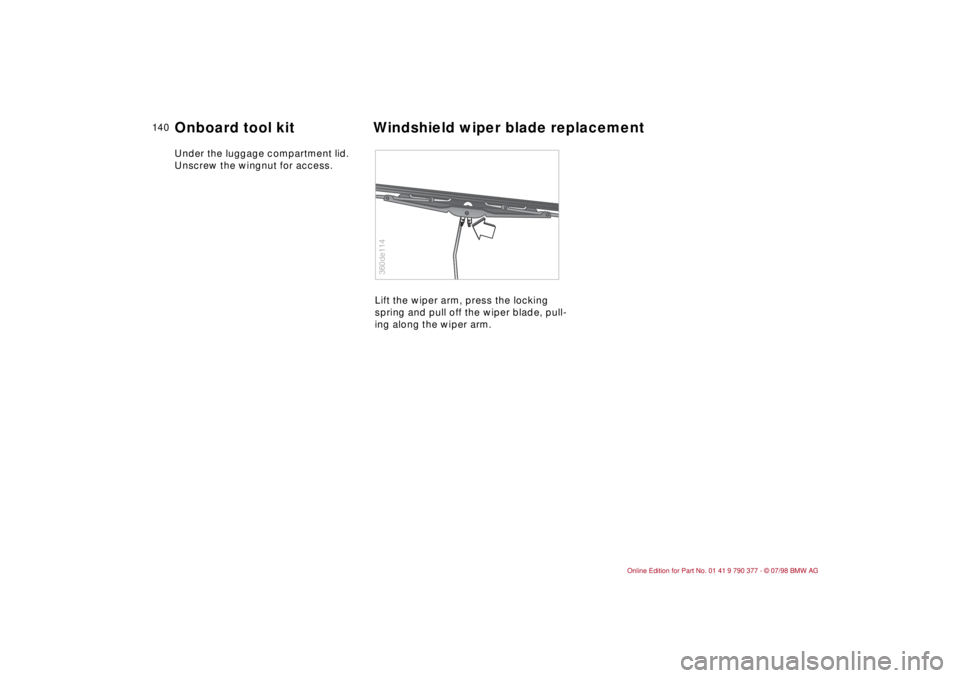
Lift the wiper arm, press the locking
spring and pull off the wiper blade, pull-
ing along the wiper arm.
360de114
Onboard tool kit Windshield wiper blade replacement