belt BMW CONVERTIBLE 1998 Owners Manual
[x] Cancel search | Manufacturer: BMW, Model Year: 1998, Model line: CONVERTIBLE, Model: BMW CONVERTIBLE 1998Pages: 179, PDF Size: 3.51 MB
Page 11 of 179
Contents
At a glance
Controls and features
Cockpit16
Instrument cluster18
Indicator and warning
lamps20
Hazard warning system22
Hazard warning triangle22
First-aid kit22
Refueling23
Fuel specification23
CARB OBD II interface24
Tire inflation pressures25
Locks and security systems:
Keys30
Electronic immobilizing device35
Doors31
Trunk lid33
Luggage compartment34
Power windows35
Sliding/tilt sunroof36
Convertible top operation37
Adjustments:
Seats43
Steering wheel45
Mirrors46
Passenger safety systems:
Safety belts47
Child restraint system48
Installing child seats49
Airbags50
Child-safety locks52
Rollover protection system Ð
convertible52
Driving:
Steering/ignition lock54
Starting the engine54
Switching off the engine55
Parking brake56
Manual transmission57
Automatic transmission58
Turn signals/high beam60
Wiper/washer system61
Cruise control62
Everything under control:
Odometer63
Tachometer63
Energy control63
Fuel gauge64
Coolant temperature gauge64
Service Interval Display64
Multi-Information Display (MID)66
Outside temperature display
and digital clock68
Check Control71
Check Control with outside
temperature display and
digital clock74
Onboard computer77
Technology for driving comfort
and safety:
Automatic stability control
plus traction (ASC+T)84
Page 13 of 179
Contents
Owner service procedure
Advanced technology
Technical data
Replacement procedures:
Onboard tool kit140
Windshield wiper blades140
Lamps and bulbs141
Master key with
battery lamp145
Changing tires146
Battery149
Fuses151
In case of electrical
malfunction:
Fuel filler door 152
Sliding/tilt sunroof 152
Assistance, giving and receiving:
Jump-starting153
Towing the vehicle154
Towing154Airbags156
Automatic Stability Control
plus Traction (ASC+T)156
Radio reception157
Safety belt tensioner157Engine specifications 160
Dimensions 161
Weights 163
Capacities 166
Electrical system 167
Drive belts 167
Page 20 of 179
Controls and features MaintenanceAt a glanceControls Car care Repairs Technical Data Index
19
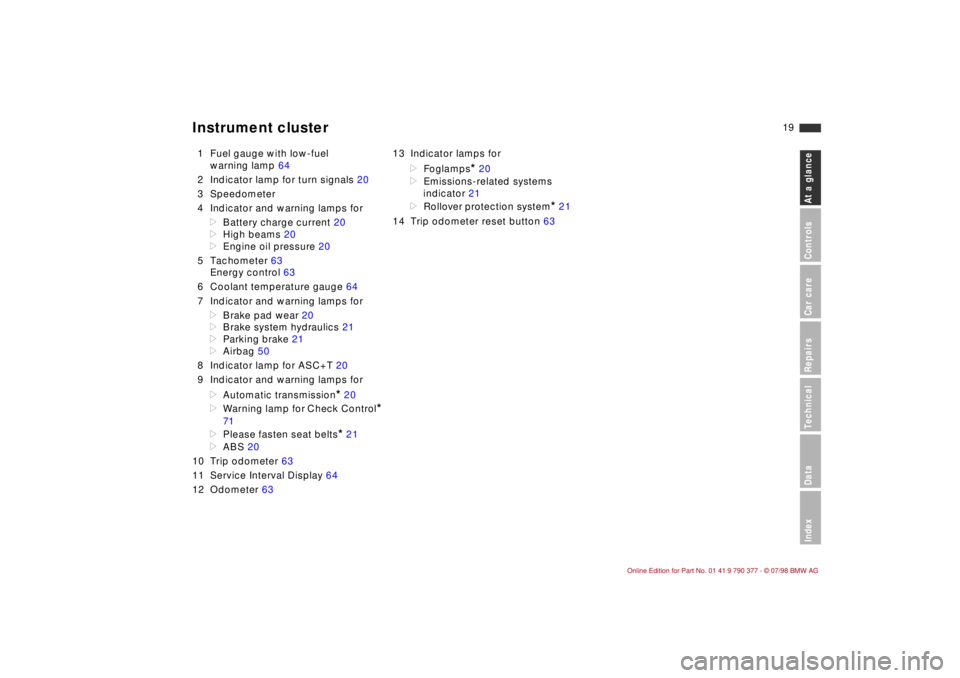
1 Fuel gauge with low-fuel
warning lamp 64
2 Indicator lamp for turn signals 20
3 Speedometer
4 Indicator and warning lamps for
d
Battery charge current 20
d
High beams 20
d
Engine oil pressure 20
5 Tachometer 63
Energy control 63
6 Coolant temperature gauge 64
7 Indicator and warning lamps for
d
Brake pad wear 20
d
Brake system hydraulics 21
d
Parking brake 21
d
Airbag 50
8 Indicator lamp for ASC+T 20
9 Indicator and warning lamps for
d
Automatic transmission
*
20
d
Warning lamp for Check Control
*
71
d
Please fasten seat belts
*
21
d
ABS 20
10 Trip odometer 63
11 Service Interval Display 64
12 Odometer 6313 Indicator lamps for
d
Foglamps
*
20
d
Emissions-related systems
indicator 21
d
Rollover protection system
*
21
14 Trip odometer reset button 63
Instrument cluster
Page 21 of 179

20
Turn signal left/right, green
k
Flashes when the turn signals
are in operation.
Battery charge current, red
v
Goes out after the engine has
started.
If the lamp comes on during
normal vehicle operation:
The battery is no longer being charged.
Indicates a defect in the generator drive
belt or the charging circuit.
a
If the V-belt is defective, do not run
the coolant pump; overheating and
potential engine damage would result.
Contact your BMW Retailer.
c
High beam, blue
l
Lights up when the high beams
are switched on or the head-
lamp flashers are activated.
Engine oil pressure, redw
Goes out after the engine has
started. May come on briefly at
idle when the engine is hot,
but must go out again at higher engine
speed.
If the lamp comes on during normal vehi-
cle operation: stop vehicle and switch off
engine immediately. Check engine oil
level; if necessary, add oil. If oil level is
correct: contact your BMW Retailer.
Foglamps
*, green
t
Lights up whenever you switch
on the foglamps.
Airbags, redp
This lamp turns on for an oper-
ational check when you turn the
ignition key to position 1. If, at
the operation check, it does not go on,
or goes on while driving, have it checked
at your BMW Retailer.
Additional notes: Page 50
Automatic transmission
*, yellow
O
Goes out after the engine has
started.
Additional notes: Page 58
ASC+T (Automatic Stability
Control plus Traction), yellows
Goes out shortly after the igni-
tion is switched on:
System OK.
Additional notes: Page 84
ABS (Antilock Brake System),
yellowo
Goes out after the engine has
started. If the lamp comes on
during normal vehicle opera-
tion: ABS has been deactivated in
response to a system malfunction. Con-
ventional braking force remains unim-
paired.
Additional notes: Page 103
Brake pad wear, yellow#
Lights up when starter is actu-
ated and goes out when the
engine is started.
If the lamp comes on during normal
vehicle operation: replace brake pads
immediately.
a
Use only original BMW-approved
brake pads otherwise the vehicle
authorization is no longer valid.c
Indicator and warning lamps
Page 22 of 179

At a glanceControls Car care Repairs Technical Data Index
21
Brake hydraulics, redn
Goes out after the engine has
started.
If the lamp comes on during
normal vehicle operation: low brake
fluid. Additional notes: Page 128
Parking brake, redm
Goes out after the engine has
started. Comes on when you
engage the parking brake.
Additional notes: Page 56
Emissions-related systemsY
Lamp goes out once engine
starts.
If this indicator lamp lights up
during normal vehicle operation, either
continuously or intermittently, this indi-
cates a fault in one of the emissions-
related electronic circuits. Although the
vehicle remains operational, you should
have the systems checked by a BMW
Retailer at the earliest possible opportu-
nity.
Please fasten safety belts
*, red
q
(With acoustic signal
if the
driverÕs belt is not buckled).
Lights up briefly when the
ignition key is turned, and then goes out
(in some models it goes out after you
fasten safety belts).
BMW Convertible
Rollover Protection System
*,
yellow
;
Goes out shortly after the igni-
tion is switched on:
System OK.
Indicator and warning lamps
Page 29 of 179

28
Locks and security systems:
Keys30
Electronic vehicle immobilizer 30
Doors31
Luggage compartment lid33
Luggage compartment34
Power windows35
Sliding/tilt sunroof36
Convertible top operation37
Adjustments:
Seats43
Steering wheel45
Mirrors46
Passenger safety systems:
Safety belts47
Child restraint system48
Installing child seats49
Airbags50
Child-safety locks52
Rollover protection system Ð
convertible52Driving:
Steering/ignition lock54
Starting the engine54
Switching off the engine55
Parking brake56
Manual transmission57
Automatic transmission58
Turn signals/high beam60
Wiper/washer system61
Cruise control62
Everything under control:
Odometer63
Tachometer63
Energy control63
Fuel gauge64
Coolant temperature gauge64
Service Interval Display64
Multi-Information Display (MID)66
Outside temperature display
and digital clock68
Check Control71
Check Control with outside
temperature display and
digital clock74
Onboard computer77
Page 45 of 179
44
a
Head restraints reduce the risk of
neck injuries. Always position the head
restraint so that it is centered roughly at
ear level.
Never try to adjust your seat while oper-
ating the vehicle. The seat could re-
spond by moving in a way that you had
not anticipated, causing you to lose
control of the vehicle which could lead
to an accident. The front passenger
should not move the backrest into the
"reclined" position during driving.
While driving, both the driver and the
front passenger should keep the back-
rest relatively upright. Otherwise there is
a danger of the occupants "sliding
through" the belt in the event of an acci-
dent, thus considerably reducing the
protective effect of the belt (see also
safety precautions in the "Safety belts"
section, page 47).c
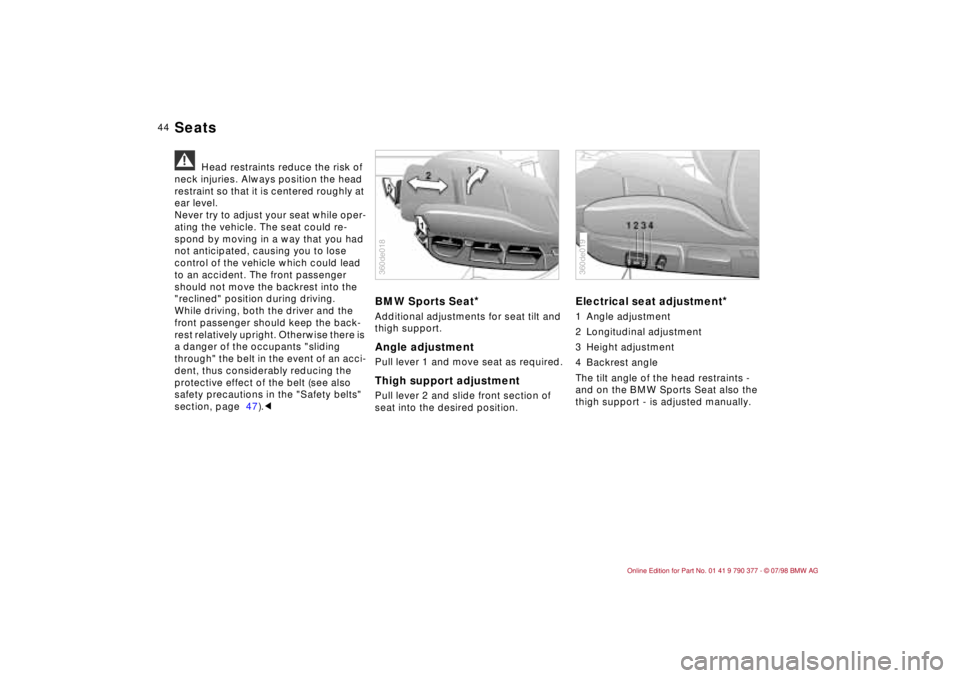
BMW Sports Seat
*
Additional adjustments for seat tilt and
thigh support. Angle adjustmentPull lever 1 and move seat as required.Thigh support adjustmentPull lever 2 and slide front section of
seat into the desired position.
Electrical seat adjustment
*
1 Angle adjustment
2 Longitudinal adjustment
3 Height adjustment
4 Backrest angle
The tilt angle of the head restraints -
and on the BMW Sports Seat also the
thigh support - is adjusted manually.
360de018
360de019
Seats
Page 46 of 179
45
At a glanceControls Car careRepairsTechnicalDataIndex
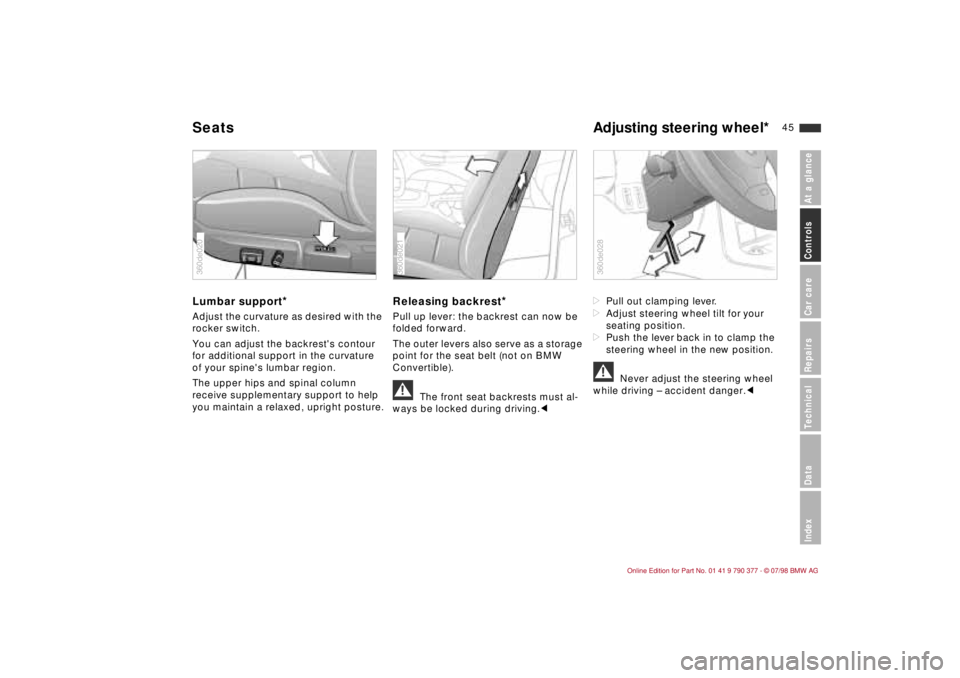
Lumbar support
*
Adjust the curvature as desired with the
rocker switch.
You can adjust the backrest's contour
for additional support in the curvature
of your spine's lumbar region.
The upper hips and spinal column
receive supplementary support to help
you maintain a relaxed, upright posture.
Releasing backrest
*
Pull up lever: the backrest can now be
folded forward.
The outer levers also serve as a storage
point for the seat belt (not on BMW
Convertible).a
The front seat backrests must al-
ways be locked during driving.cdPull out clamping lever.
dAdjust steering wheel tilt for your
seating position.
dPush the lever back in to clamp the
steering wheel in the new position.
a
Never adjust the steering wheel
while driving Ð accident danger.c
360de020
360de021
360de028
Seats Adjusting steering wheel*
Page 48 of 179
47
At a glanceControls Car careRepairsTechnicalDataIndex
Always fasten your seat belt before
starting off.
To fasten: make sure you hear the catch
engage in the belt buckle.
To release: press the red button in the
buckle, hold the belt and guide it back
into its reel.
The safety belt inertial mechanism
locks:
din a sudden stop or crash
dwhen you pull it sharply
dduring abrupt braking and
acceleration
din curves
dwhen the vehicle is at an
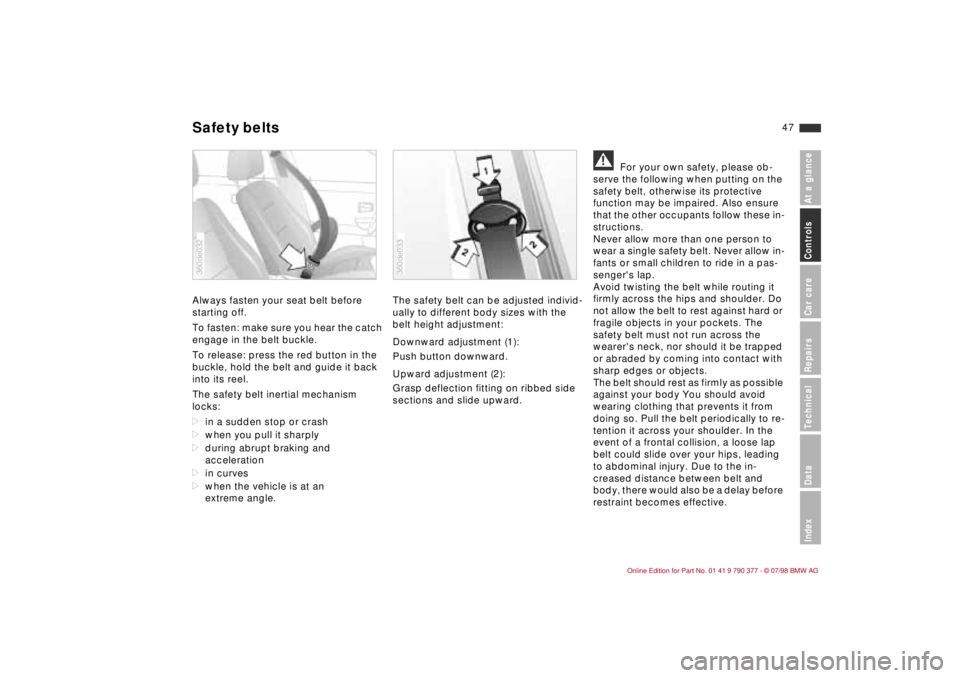
extreme angle.The safety belt can be adjusted individ-
ually to different body sizes with the
belt height adjustment:
Downward adjustment (1):
Push button downward.
Upward adjustment (2):
Grasp deflection fitting on ribbed side
sections and slide upward.
a
For your own safety, please ob-
serve the following when putting on the
safety belt, otherwise its protective
function may be impaired. Also ensure
that the other occupants follow these in-
structions.
Never allow more than one person to
wear a single safety belt. Never allow in-
fants or small children to ride in a pas-
senger's lap.
Avoid twisting the belt while routing it
firmly across the hips and shoulder. Do
not allow the belt to rest against hard or
fragile objects in your pockets. The
safety belt must not run across the
wearer's neck, nor should it be trapped
or abraded by coming into contact with
sharp edges or objects.
The belt should rest as firmly as possible
against your body You should avoid
wearing clothing that prevents it from
doing so. Pull the belt periodically to re-
tention it across your shoulder. In the
event of a frontal collision, a loose lap
belt could slide over your hips, leading
to abdominal injury. Due to the in-
creased distance between belt and
body, there would also be a delay before
restraint becomes effective.
360de032
360de033
Safety belts
Page 49 of 179
48
Expectant mothers should always wear
their safety belts, taking care to position
the lap belt against the lower hips,
where it will not exert pressure against
the abdominal area.
Never attempt to modify the safety
belts.c
For care instructions refer to page 134.Never install a rear-facing child restraint
system in the front passenger's seat!
Never attempt to modify either the
safety belts or any child restraint sys-
tem.
Should the safety belts be damaged or
stretched in an accident, the entire belt
system - including safety belt tension-
ers - must be replaced and the anchor-
ing mounts inspected at a BMW
Retailer.
If the safety belt tensioner has been
activated, a distance of roughly 0.8 in
(20 mm) will remain between the safety
belt lock and the tensioner module.
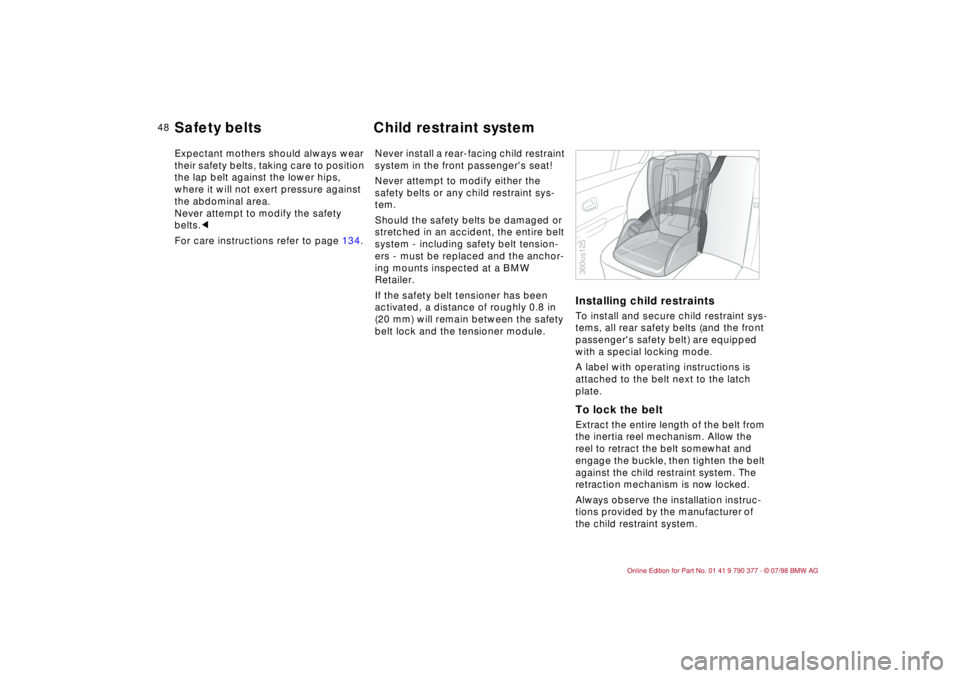
Installing child restraintsTo install and secure child restraint sys-
tems, all rear safety belts (and the front
passenger's safety belt) are equipped
with a special locking mode.
A label with operating instructions is
attached to the belt next to the latch
plate.To lock the beltExtract the entire length of the belt from
the inertia reel mechanism. Allow the
reel to retract the belt somewhat and
engage the buckle, then tighten the belt
against the child restraint system. The
retraction mechanism is now locked.
Always observe the installation instruc-
tions provided by the manufacturer of
the child restraint system.360us125
Safety belts Child restraint system