change time BMW I8 2014 I12 User Guide
[x] Cancel search | Manufacturer: BMW, Model Year: 2014, Model line: I8, Model: BMW I8 2014 I12Pages: 216, PDF Size: 12.45 MB
Page 167 of 216
Settings are stored. When you change charg‐
ing locations you also might need to change
the setting for charging.
Set the charge current strength at other
household sockets to "Low".
Stopping charging process The charging operation can be stopped at any
time by removing the charging cable and con‐
tinued at a later time by connecting the charg‐
ing cable in order to use other loads on the
power connection or to prevent simultaneous
high power from multiple loads.
The charging operation is interrupted when the
vehicle is unlocked and automatically resumed
after a brief time or when it is locked.
Continue charging operation If the charging operation is interrupted, e.g.,
through a temporary power failure, the charg‐
ing operation is automatically continued after
the interruption.
Terminating charging process1.Removing the charging cable from the ve‐
hicle, refer to page 148.2.Stow the charging cable as required.3.Close the charging port flap.4.Lock vehicle if it is unlocked.
Displays in the instrument
cluster
The charging state indicator light shows the
charging state of the high-voltage battery in
the instrument cluster, if operating readiness is
turned on. If all segments are filled, the high-
voltage battery is fully charged.
Even if no segments are filled, the high-voltage
system is still under high voltage.
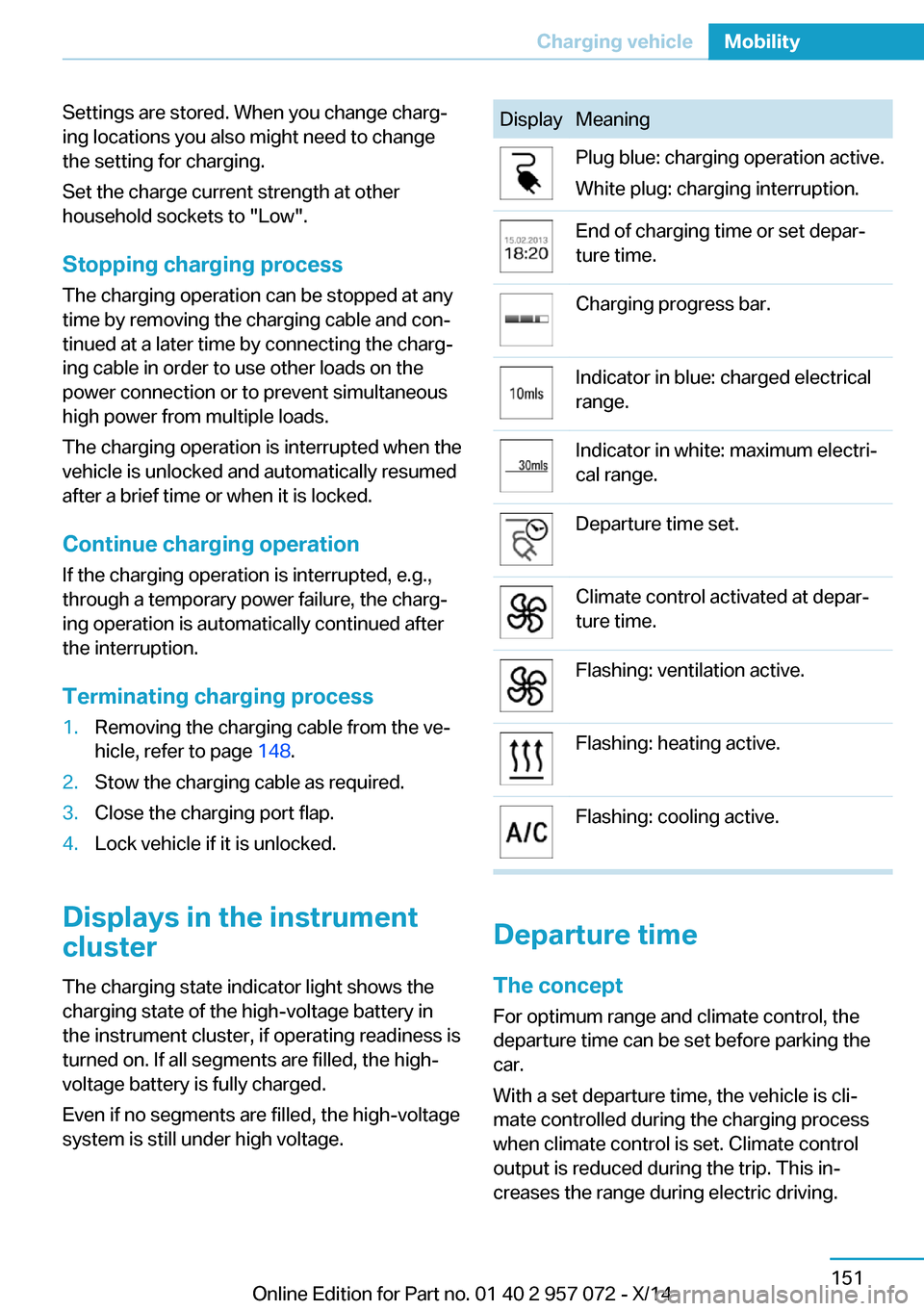
DisplayMeaningPlug blue: charging operation active.
White plug: charging interruption.End of charging time or set depar‐
ture time.Charging progress bar.Indicator in blue: charged electrical
range.Indicator in white: maximum electri‐
cal range.Departure time set.Climate control activated at depar‐
ture time.Flashing: ventilation active.Flashing: heating active.Flashing: cooling active.
Departure time
The concept For optimum range and climate control, the
departure time can be set before parking the
car.
With a set departure time, the vehicle is cli‐
mate controlled during the charging process
when climate control is set. Climate control
output is reduced during the trip. This in‐
creases the range during electric driving.
Seite 151Charging vehicleMobility151
Online Edition for Part no. 01 40 2 957 072 - X/14
Page 168 of 216
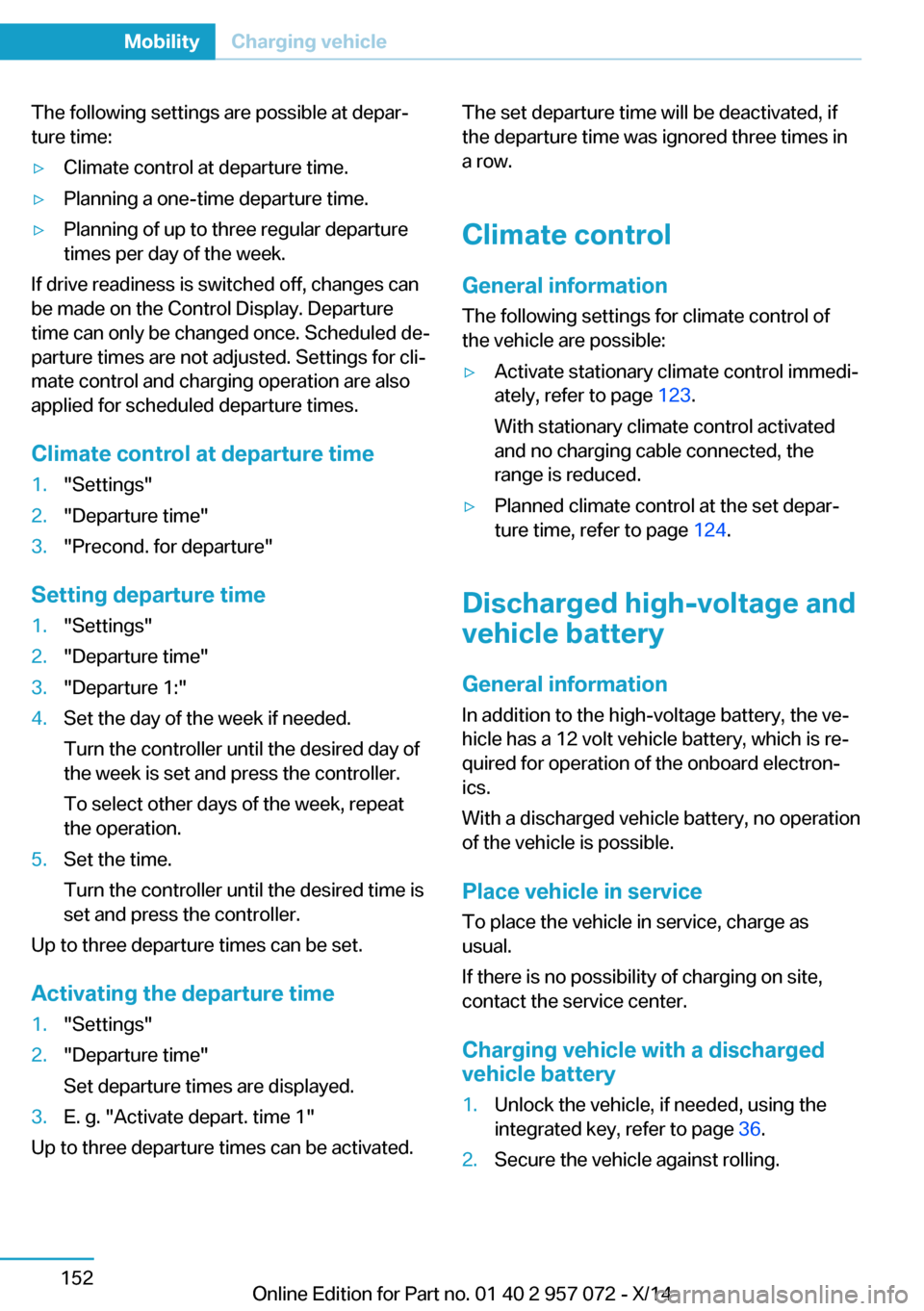
The following settings are possible at depar‐
ture time:▷Climate control at departure time.▷Planning a one-time departure time.▷Planning of up to three regular departure
times per day of the week.
If drive readiness is switched off, changes can
be made on the Control Display. Departure
time can only be changed once. Scheduled de‐
parture times are not adjusted. Settings for cli‐
mate control and charging operation are also
applied for scheduled departure times.
Climate control at departure time
1."Settings"2."Departure time"3."Precond. for departure"
Setting departure time
1."Settings"2."Departure time"3."Departure 1:"4.Set the day of the week if needed.
Turn the controller until the desired day of
the week is set and press the controller.
To select other days of the week, repeat
the operation.5.Set the time.
Turn the controller until the desired time is
set and press the controller.
Up to three departure times can be set.
Activating the departure time
1."Settings"2."Departure time"
Set departure times are displayed.3.E. g. "Activate depart. time 1"
Up to three departure times can be activated.
The set departure time will be deactivated, if
the departure time was ignored three times in
a row.
Climate control General information
The following settings for climate control of
the vehicle are possible:▷Activate stationary climate control immedi‐
ately, refer to page 123.
With stationary climate control activated
and no charging cable connected, the
range is reduced.▷Planned climate control at the set depar‐
ture time, refer to page 124.
Discharged high-voltage and
vehicle battery
General information
In addition to the high-voltage battery, the ve‐
hicle has a 12 volt vehicle battery, which is re‐
quired for operation of the onboard electron‐
ics.
With a discharged vehicle battery, no operation
of the vehicle is possible.
Place vehicle in service To place the vehicle in service, charge as
usual.
If there is no possibility of charging on site,
contact the service center.
Charging vehicle with a discharged
vehicle battery
1.Unlock the vehicle, if needed, using the
integrated key, refer to page 36.2.Secure the vehicle against rolling.Seite 152MobilityCharging vehicle152
Online Edition for Part no. 01 40 2 957 072 - X/14
Page 188 of 216
Replacing componentsVehicle features and optionsThis chapter describes all standard, country-
specific and optional features offered with the
series. It also describes features that are not
necessarily available in your car, e. g., due to
the selected options or country versions. This
also applies to safety-related functions and
systems.
Wiper blade replacement
General information Do not fold down the wipers without
wiper blades
Do not fold down the wipers if wiper blades
have not been installed; this may damage the
windshield.◀
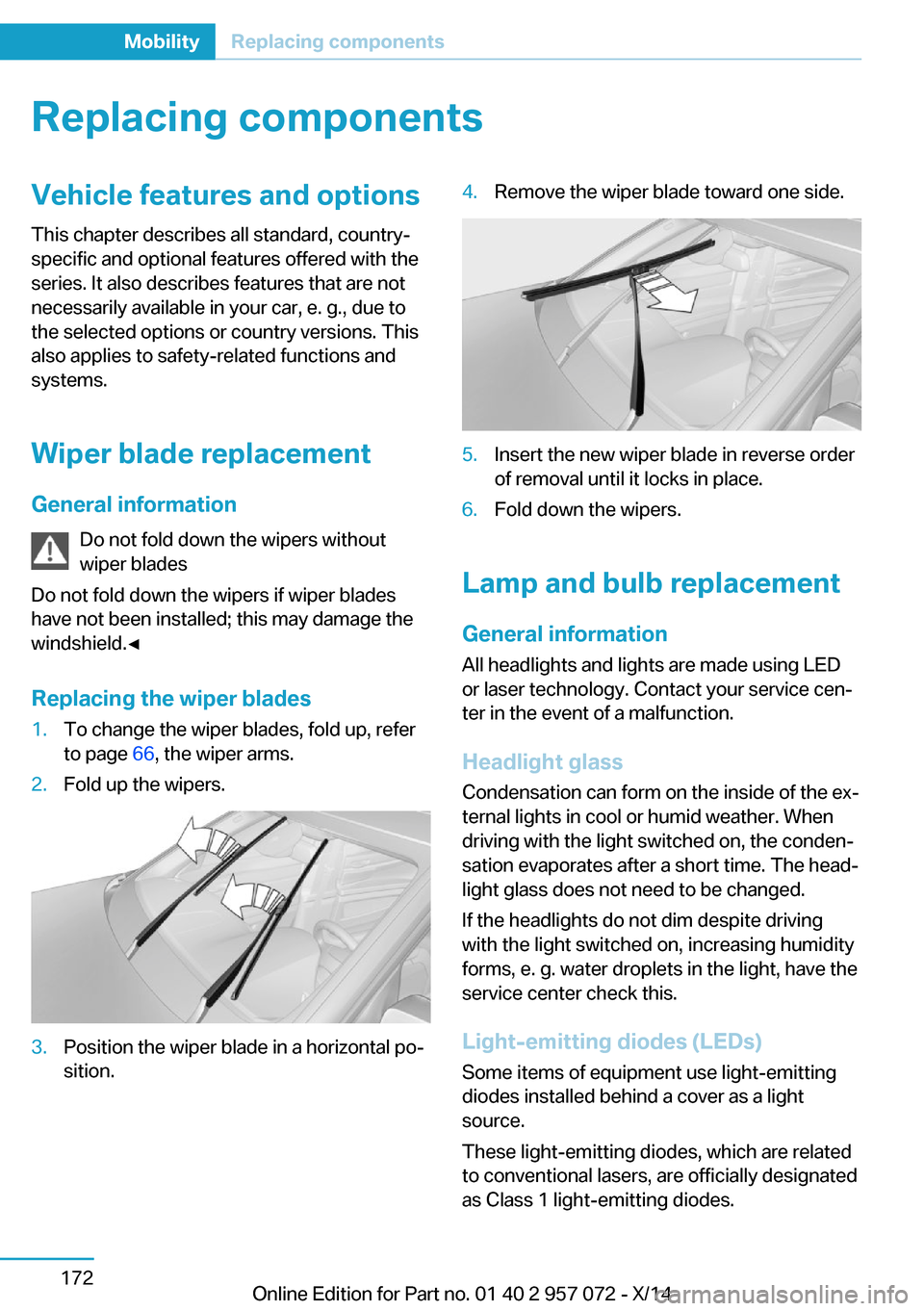
Replacing the wiper blades1.To change the wiper blades, fold up, refer
to page 66, the wiper arms.2.Fold up the wipers.3.Position the wiper blade in a horizontal po‐
sition.4.Remove the wiper blade toward one side.5.Insert the new wiper blade in reverse order
of removal until it locks in place.6.Fold down the wipers.
Lamp and bulb replacement
General information
All headlights and lights are made using LED
or laser technology. Contact your service cen‐
ter in the event of a malfunction.
Headlight glass
Condensation can form on the inside of the ex‐
ternal lights in cool or humid weather. When
driving with the light switched on, the conden‐
sation evaporates after a short time. The head‐
light glass does not need to be changed.
If the headlights do not dim despite driving
with the light switched on, increasing humidity
forms, e. g. water droplets in the light, have the
service center check this.
Light-emitting diodes (LEDs)
Some items of equipment use light-emitting
diodes installed behind a cover as a light
source.
These light-emitting diodes, which are related
to conventional lasers, are officially designated
as Class 1 light-emitting diodes.
Seite 172MobilityReplacing components172
Online Edition for Part no. 01 40 2 957 072 - X/14
Page 189 of 216
HintsDo not perform any work on the lighting
system
Have any work on the lighting system, includ‐
ing bulb replacement, performed only by a
service center. Due to the high voltage present
in the system, there is a danger of fatal injuries
if work is carried out improperly.◀
Irritation of the retina
Never look directly into the headlights or
their light sources for a lengthy period of time,
otherwise this could irritate your retinas.◀
Do not remove the covers
Do not remove the covers, and never
stare into the unfiltered light for several hours;
otherwise, irritation of the retina could result.◀
Changing wheels
Hints
When sealants are used, an immediate wheel
change when there is a loss of tire inflation
pressure in the event of a flat tire is unneces‐
sary.
Which is why no spare tire is available.
The tools for changing wheels are available as
accessories from your service center.
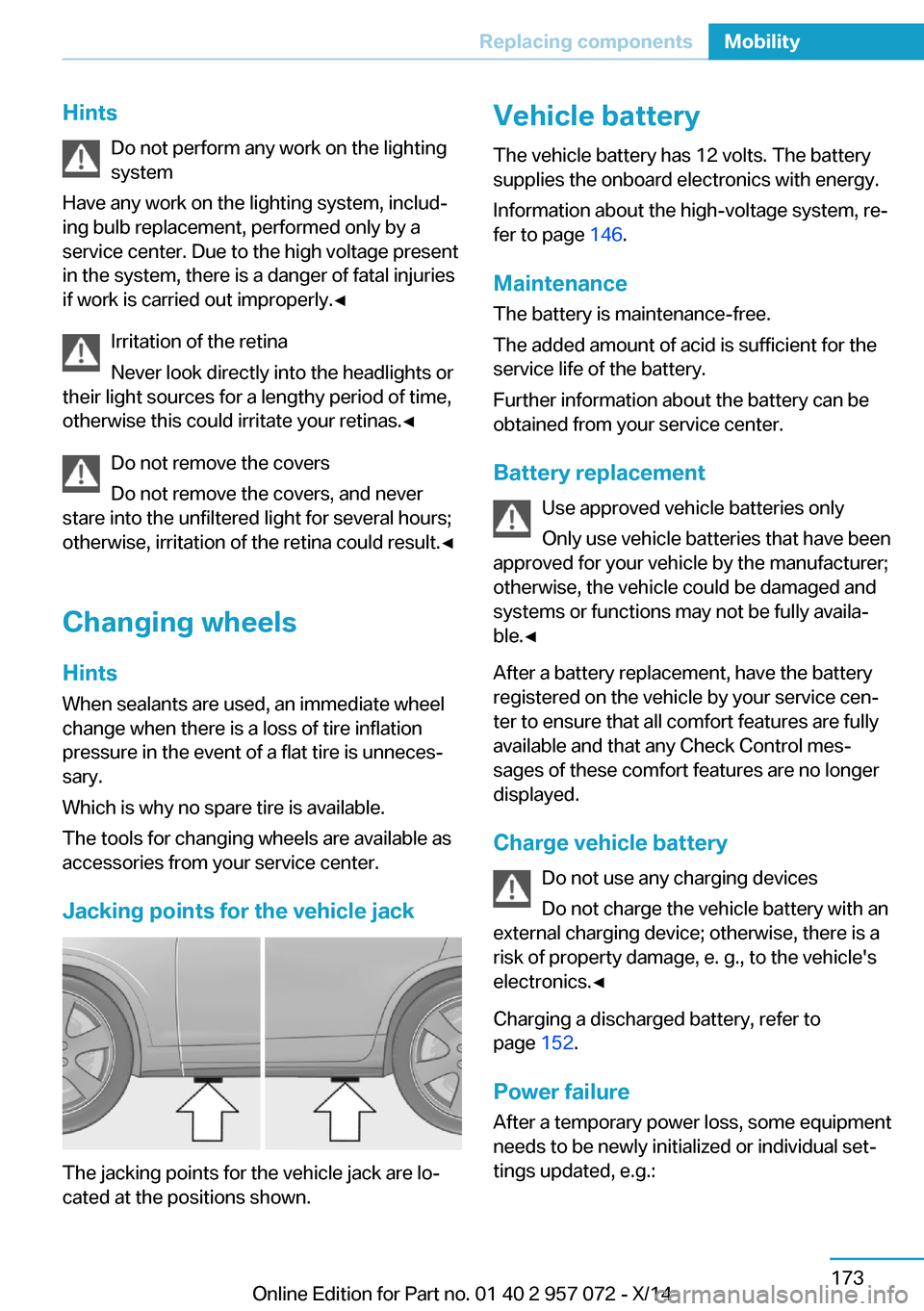
Jacking points for the vehicle jack
The jacking points for the vehicle jack are lo‐
cated at the positions shown.
Vehicle battery
The vehicle battery has 12 volts. The battery
supplies the onboard electronics with energy.
Information about the high-voltage system, re‐
fer to page 146.
Maintenance
The battery is maintenance-free.
The added amount of acid is sufficient for the
service life of the battery.
Further information about the battery can be
obtained from your service center.
Battery replacement Use approved vehicle batteries only
Only use vehicle batteries that have been
approved for your vehicle by the manufacturer;
otherwise, the vehicle could be damaged and
systems or functions may not be fully availa‐
ble.◀
After a battery replacement, have the battery
registered on the vehicle by your service cen‐
ter to ensure that all comfort features are fully
available and that any Check Control mes‐
sages of these comfort features are no longer
displayed.
Charge vehicle battery Do not use any charging devices
Do not charge the vehicle battery with an
external charging device; otherwise, there is a
risk of property damage, e. g., to the vehicle's
electronics.◀
Charging a discharged battery, refer to
page 152.
Power failure
After a temporary power loss, some equipment
needs to be newly initialized or individual set‐
tings updated, e.g.:Seite 173Replacing componentsMobility173
Online Edition for Part no. 01 40 2 957 072 - X/14
Page 207 of 216
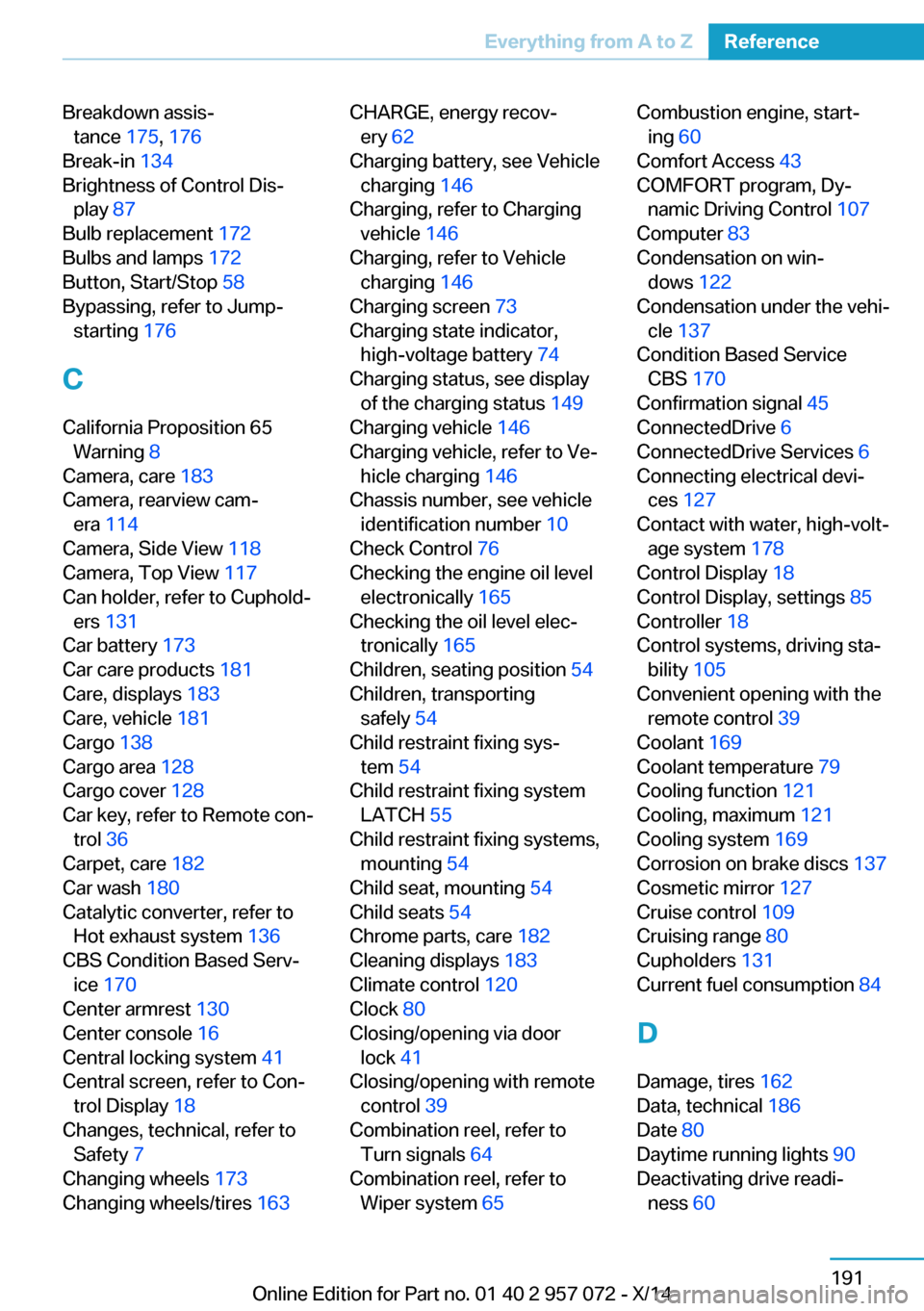
Breakdown assis‐tance 175, 176
Break-in 134
Brightness of Control Dis‐ play 87
Bulb replacement 172
Bulbs and lamps 172
Button, Start/Stop 58
Bypassing, refer to Jump- starting 176
C
California Proposition 65 Warning 8
Camera, care 183
Camera, rearview cam‐ era 114
Camera, Side View 118
Camera, Top View 117
Can holder, refer to Cuphold‐ ers 131
Car battery 173
Car care products 181
Care, displays 183
Care, vehicle 181
Cargo 138
Cargo area 128
Cargo cover 128
Car key, refer to Remote con‐ trol 36
Carpet, care 182
Car wash 180
Catalytic converter, refer to Hot exhaust system 136
CBS Condition Based Serv‐ ice 170
Center armrest 130
Center console 16
Central locking system 41
Central screen, refer to Con‐ trol Display 18
Changes, technical, refer to Safety 7
Changing wheels 173
Changing wheels/tires 163 CHARGE, energy recov‐
ery 62
Charging battery, see Vehicle charging 146
Charging, refer to Charging vehicle 146
Charging, refer to Vehicle charging 146
Charging screen 73
Charging state indicator, high-voltage battery 74
Charging status, see display of the charging status 149
Charging vehicle 146
Charging vehicle, refer to Ve‐ hicle charging 146
Chassis number, see vehicle identification number 10
Check Control 76
Checking the engine oil level electronically 165
Checking the oil level elec‐ tronically 165
Children, seating position 54
Children, transporting safely 54
Child restraint fixing sys‐ tem 54
Child restraint fixing system LATCH 55
Child restraint fixing systems, mounting 54
Child seat, mounting 54
Child seats 54
Chrome parts, care 182
Cleaning displays 183
Climate control 120
Clock 80
Closing/opening via door lock 41
Closing/opening with remote control 39
Combination reel, refer to Turn signals 64
Combination reel, refer to Wiper system 65 Combustion engine, start‐
ing 60
Comfort Access 43
COMFORT program, Dy‐ namic Driving Control 107
Computer 83
Condensation on win‐ dows 122
Condensation under the vehi‐ cle 137
Condition Based Service CBS 170
Confirmation signal 45
ConnectedDrive 6
ConnectedDrive Services 6
Connecting electrical devi‐ ces 127
Contact with water, high-volt‐ age system 178
Control Display 18
Control Display, settings 85
Controller 18
Control systems, driving sta‐ bility 105
Convenient opening with the remote control 39
Coolant 169
Coolant temperature 79
Cooling function 121
Cooling, maximum 121
Cooling system 169
Corrosion on brake discs 137
Cosmetic mirror 127
Cruise control 109
Cruising range 80
Cupholders 131
Current fuel consumption 84
D
Damage, tires 162
Data, technical 186
Date 80
Daytime running lights 90
Deactivating drive readi‐ ness 60 Seite 191Everything from A to ZReference191
Online Edition for Part no. 01 40 2 957 072 - X/14
Page 208 of 216
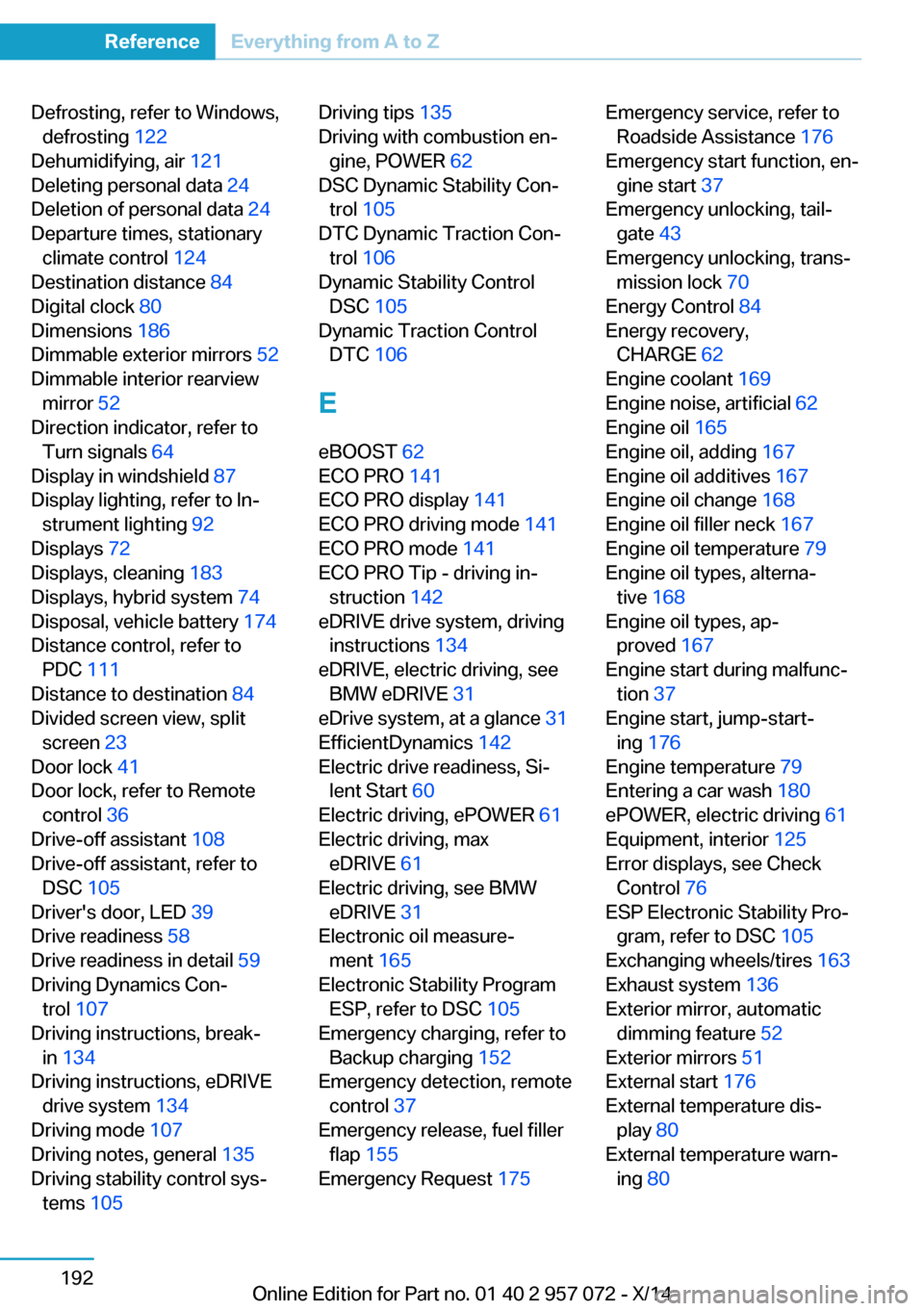
Defrosting, refer to Windows,defrosting 122
Dehumidifying, air 121
Deleting personal data 24
Deletion of personal data 24
Departure times, stationary climate control 124
Destination distance 84
Digital clock 80
Dimensions 186
Dimmable exterior mirrors 52
Dimmable interior rearview mirror 52
Direction indicator, refer to Turn signals 64
Display in windshield 87
Display lighting, refer to In‐ strument lighting 92
Displays 72
Displays, cleaning 183
Displays, hybrid system 74
Disposal, vehicle battery 174
Distance control, refer to PDC 111
Distance to destination 84
Divided screen view, split screen 23
Door lock 41
Door lock, refer to Remote control 36
Drive-off assistant 108
Drive-off assistant, refer to DSC 105
Driver's door, LED 39
Drive readiness 58
Drive readiness in detail 59
Driving Dynamics Con‐ trol 107
Driving instructions, break- in 134
Driving instructions, eDRIVE drive system 134
Driving mode 107
Driving notes, general 135
Driving stability control sys‐ tems 105 Driving tips 135
Driving with combustion en‐ gine, POWER 62
DSC Dynamic Stability Con‐ trol 105
DTC Dynamic Traction Con‐ trol 106
Dynamic Stability Control DSC 105
Dynamic Traction Control DTC 106
E
eBOOST 62
ECO PRO 141
ECO PRO display 141
ECO PRO driving mode 141
ECO PRO mode 141
ECO PRO Tip - driving in‐ struction 142
eDRIVE drive system, driving instructions 134
eDRIVE, electric driving, see BMW eDRIVE 31
eDrive system, at a glance 31
EfficientDynamics 142
Electric drive readiness, Si‐ lent Start 60
Electric driving, ePOWER 61
Electric driving, max eDRIVE 61
Electric driving, see BMW eDRIVE 31
Electronic oil measure‐ ment 165
Electronic Stability Program ESP, refer to DSC 105
Emergency charging, refer to Backup charging 152
Emergency detection, remote control 37
Emergency release, fuel filler flap 155
Emergency Request 175 Emergency service, refer to
Roadside Assistance 176
Emergency start function, en‐ gine start 37
Emergency unlocking, tail‐ gate 43
Emergency unlocking, trans‐ mission lock 70
Energy Control 84
Energy recovery, CHARGE 62
Engine coolant 169
Engine noise, artificial 62
Engine oil 165
Engine oil, adding 167
Engine oil additives 167
Engine oil change 168
Engine oil filler neck 167
Engine oil temperature 79
Engine oil types, alterna‐ tive 168
Engine oil types, ap‐ proved 167
Engine start during malfunc‐ tion 37
Engine start, jump-start‐ ing 176
Engine temperature 79
Entering a car wash 180
ePOWER, electric driving 61
Equipment, interior 125
Error displays, see Check Control 76
ESP Electronic Stability Pro‐ gram, refer to DSC 105
Exchanging wheels/tires 163
Exhaust system 136
Exterior mirror, automatic dimming feature 52
Exterior mirrors 51
External start 176
External temperature dis‐ play 80
External temperature warn‐ ing 80 Seite 192ReferenceEverything from A to Z192
Online Edition for Part no. 01 40 2 957 072 - X/14
Page 211 of 216
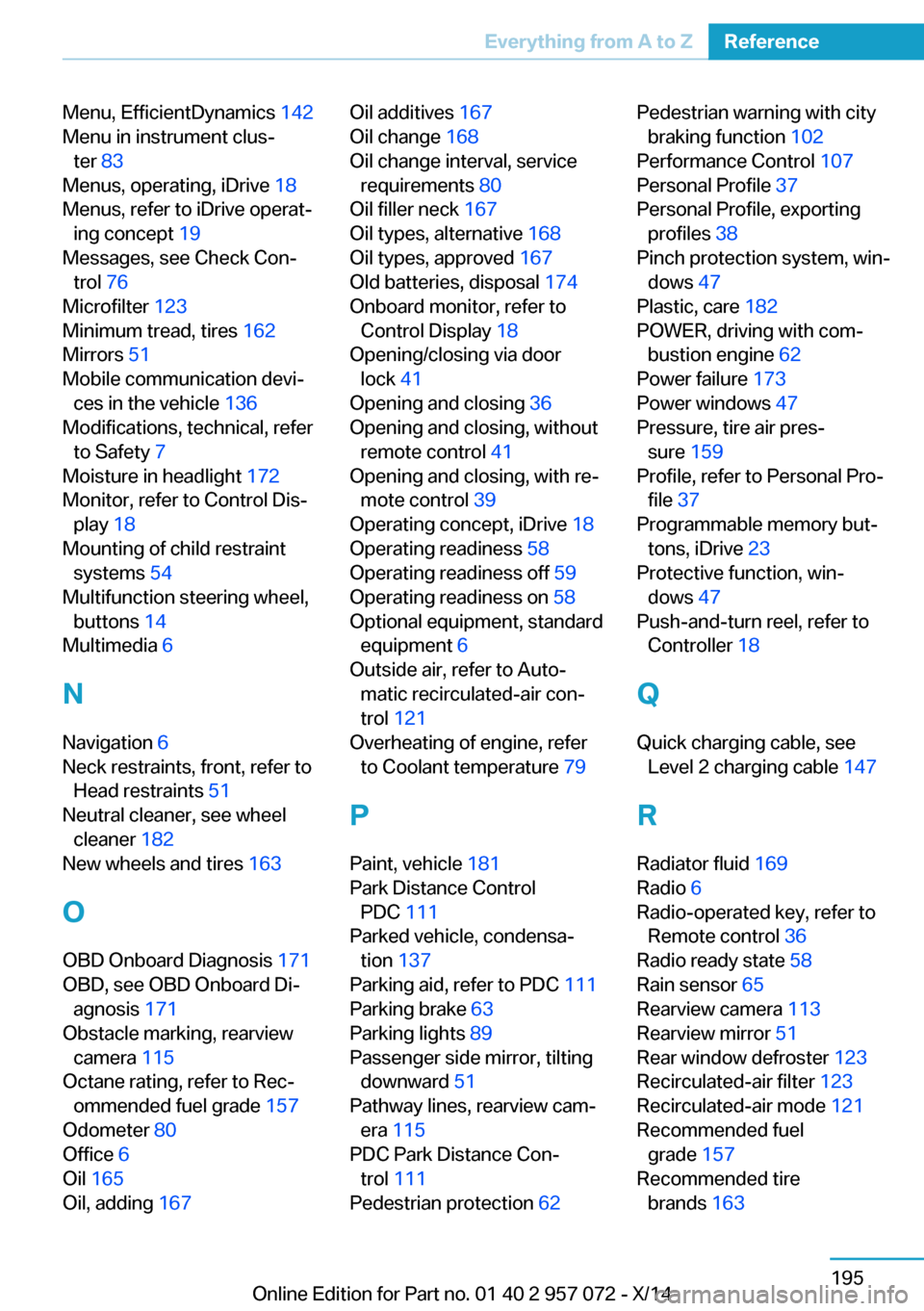
Menu, EfficientDynamics 142
Menu in instrument clus‐ ter 83
Menus, operating, iDrive 18
Menus, refer to iDrive operat‐ ing concept 19
Messages, see Check Con‐ trol 76
Microfilter 123
Minimum tread, tires 162
Mirrors 51
Mobile communication devi‐ ces in the vehicle 136
Modifications, technical, refer to Safety 7
Moisture in headlight 172
Monitor, refer to Control Dis‐ play 18
Mounting of child restraint systems 54
Multifunction steering wheel, buttons 14
Multimedia 6
N
Navigation 6
Neck restraints, front, refer to Head restraints 51
Neutral cleaner, see wheel cleaner 182
New wheels and tires 163
O OBD Onboard Diagnosis 171
OBD, see OBD Onboard Di‐ agnosis 171
Obstacle marking, rearview camera 115
Octane rating, refer to Rec‐ ommended fuel grade 157
Odometer 80
Office 6
Oil 165
Oil, adding 167 Oil additives 167
Oil change 168
Oil change interval, service requirements 80
Oil filler neck 167
Oil types, alternative 168
Oil types, approved 167
Old batteries, disposal 174
Onboard monitor, refer to Control Display 18
Opening/closing via door lock 41
Opening and closing 36
Opening and closing, without remote control 41
Opening and closing, with re‐ mote control 39
Operating concept, iDrive 18
Operating readiness 58
Operating readiness off 59
Operating readiness on 58
Optional equipment, standard equipment 6
Outside air, refer to Auto‐ matic recirculated-air con‐
trol 121
Overheating of engine, refer to Coolant temperature 79
P Paint, vehicle 181
Park Distance Control PDC 111
Parked vehicle, condensa‐ tion 137
Parking aid, refer to PDC 111
Parking brake 63
Parking lights 89
Passenger side mirror, tilting downward 51
Pathway lines, rearview cam‐ era 115
PDC Park Distance Con‐ trol 111
Pedestrian protection 62 Pedestrian warning with city
braking function 102
Performance Control 107
Personal Profile 37
Personal Profile, exporting profiles 38
Pinch protection system, win‐ dows 47
Plastic, care 182
POWER, driving with com‐ bustion engine 62
Power failure 173
Power windows 47
Pressure, tire air pres‐ sure 159
Profile, refer to Personal Pro‐ file 37
Programmable memory but‐ tons, iDrive 23
Protective function, win‐ dows 47
Push-and-turn reel, refer to Controller 18
Q Quick charging cable, see Level 2 charging cable 147
R Radiator fluid 169
Radio 6
Radio-operated key, refer to Remote control 36
Radio ready state 58
Rain sensor 65
Rearview camera 113
Rearview mirror 51
Rear window defroster 123
Recirculated-air filter 123
Recirculated-air mode 121
Recommended fuel grade 157
Recommended tire brands 163 Seite 195Everything from A to ZReference195
Online Edition for Part no. 01 40 2 957 072 - X/14
Page 213 of 216
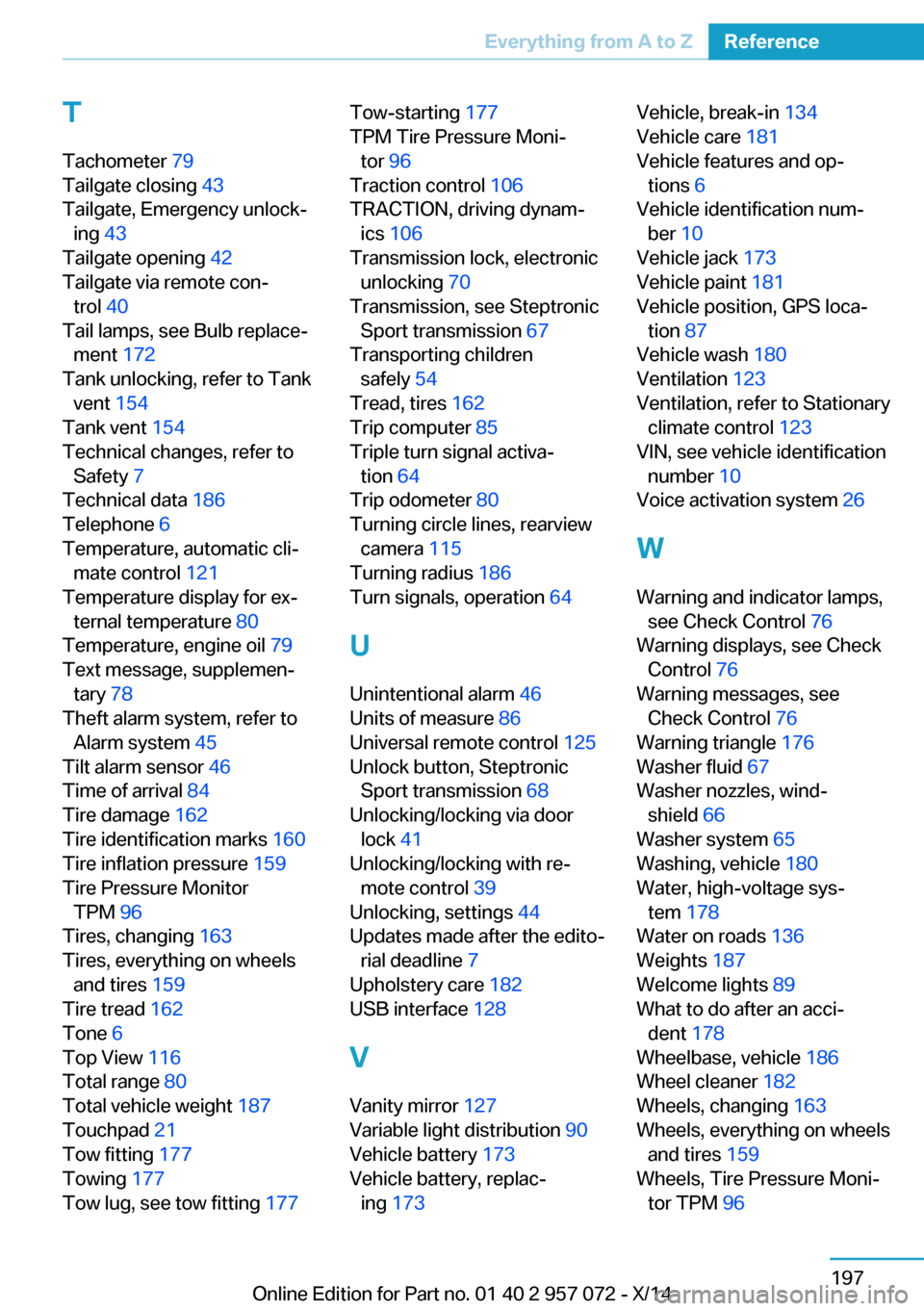
T
Tachometer 79
Tailgate closing 43
Tailgate, Emergency unlock‐ ing 43
Tailgate opening 42
Tailgate via remote con‐ trol 40
Tail lamps, see Bulb replace‐ ment 172
Tank unlocking, refer to Tank vent 154
Tank vent 154
Technical changes, refer to Safety 7
Technical data 186
Telephone 6
Temperature, automatic cli‐ mate control 121
Temperature display for ex‐ ternal temperature 80
Temperature, engine oil 79
Text message, supplemen‐ tary 78
Theft alarm system, refer to Alarm system 45
Tilt alarm sensor 46
Time of arrival 84
Tire damage 162
Tire identification marks 160
Tire inflation pressure 159
Tire Pressure Monitor TPM 96
Tires, changing 163
Tires, everything on wheels and tires 159
Tire tread 162
Tone 6
Top View 116
Total range 80
Total vehicle weight 187
Touchpad 21
Tow fitting 177
Towing 177
Tow lug, see tow fitting 177 Tow-starting 177
TPM Tire Pressure Moni‐ tor 96
Traction control 106
TRACTION, driving dynam‐ ics 106
Transmission lock, electronic unlocking 70
Transmission, see Steptronic Sport transmission 67
Transporting children safely 54
Tread, tires 162
Trip computer 85
Triple turn signal activa‐ tion 64
Trip odometer 80
Turning circle lines, rearview camera 115
Turning radius 186
Turn signals, operation 64
U Unintentional alarm 46
Units of measure 86
Universal remote control 125
Unlock button, Steptronic Sport transmission 68
Unlocking/locking via door lock 41
Unlocking/locking with re‐ mote control 39
Unlocking, settings 44
Updates made after the edito‐ rial deadline 7
Upholstery care 182
USB interface 128
V Vanity mirror 127
Variable light distribution 90
Vehicle battery 173
Vehicle battery, replac‐ ing 173 Vehicle, break-in 134
Vehicle care 181
Vehicle features and op‐ tions 6
Vehicle identification num‐ ber 10
Vehicle jack 173
Vehicle paint 181
Vehicle position, GPS loca‐ tion 87
Vehicle wash 180
Ventilation 123
Ventilation, refer to Stationary climate control 123
VIN, see vehicle identification number 10
Voice activation system 26
W Warning and indicator lamps, see Check Control 76
Warning displays, see Check Control 76
Warning messages, see Check Control 76
Warning triangle 176
Washer fluid 67
Washer nozzles, wind‐ shield 66
Washer system 65
Washing, vehicle 180
Water, high-voltage sys‐ tem 178
Water on roads 136
Weights 187
Welcome lights 89
What to do after an acci‐ dent 178
Wheelbase, vehicle 186
Wheel cleaner 182
Wheels, changing 163
Wheels, everything on wheels and tires 159
Wheels, Tire Pressure Moni‐ tor TPM 96 Seite 197Everything from A to ZReference197
Online Edition for Part no. 01 40 2 957 072 - X/14