ECO mode BMW M ROADSTER COUPE 2001 User Guide
[x] Cancel search | Manufacturer: BMW, Model Year: 2001, Model line: M ROADSTER COUPE, Model: BMW M ROADSTER COUPE 2001Pages: 171, PDF Size: 1.98 MB
Page 65 of 171
65n
IndexDataTechnologyRepairsCar careControlsOverview
The conceptDSC helps maintain vehicle stability,
even in critical driving situations.
The system optimizes vehicle stability
during acceleration and when starting
from a full stop, as well as optimizing
traction. In addition, it recognizes
unstable vehicle conditions, such as
understeering or oversteering, and, as
far as is possible within the laws of
physics, helps keep the vehicle on a
steady course by reducing the engine
speed and brake applications to the
individual wheels.
The DSC is operational every time you
start the engine.
Indicator lamp
The indicator lamp in the instru-
ment cluster goes out shortly
after you switch on the ignition.
Refer to page 22.
The indicator lamp flashes:
DSC is active and controls the drive
and braking forces.
If the indicator lamp fails to go out after
the engine has been started, or if it
comes on during normal driving and
stays on: the DSC has been switched
off via the button or there is a malfunc-
tion. You can continue to drive the
vehicle normally, but without DSC.
In the event of a malfunction, please
consult your BMW center.
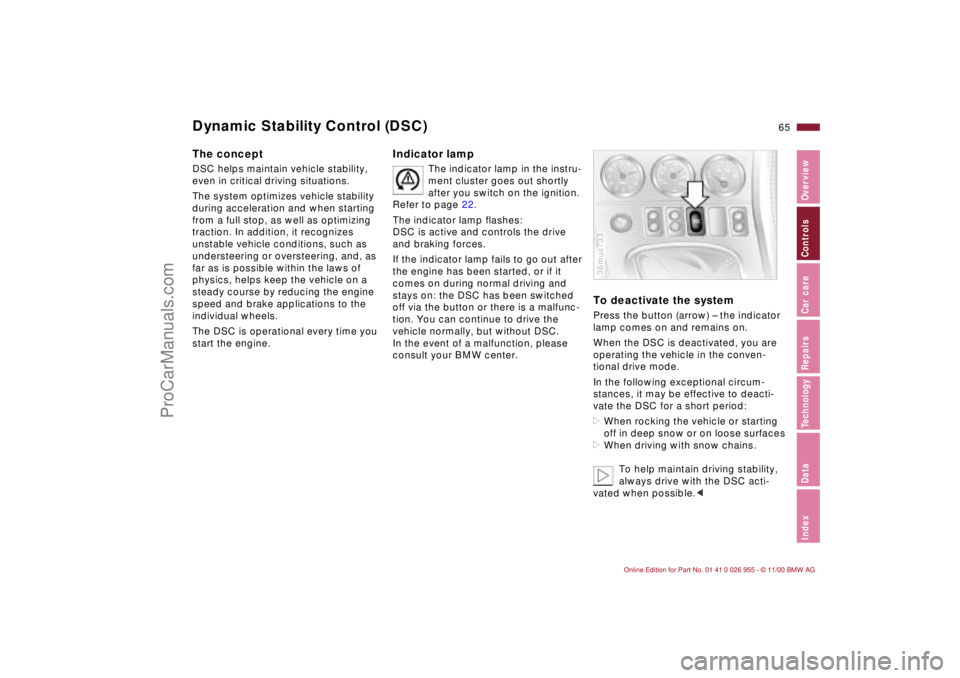
To deactivate the systemPress the button (arrow) – the indicator
lamp comes on and remains on.
When the DSC is deactivated, you are
operating the vehicle in the conven-
tional drive mode.
In the following exceptional circum-
stances, it may be effective to deacti-
vate the DSC for a short period:
>When rocking the vehicle or starting
off in deep snow or on loose surfaces
>When driving with snow chains.
To help maintain driving stability,
always drive with the DSC acti-
vated when possible.< 36mus733
Dynamic Stability Control (DSC)
ProCarManuals.com
Page 73 of 171

73n
IndexDataTechnologyRepairsCar careControlsOverview
Heating and ventilation/Air conditioner 1 Airflow toward the windshield and
side windows
2 Airflow toward upper body
The rotary dials allow infinitely vari-
able regulation of the air supply. You
can change the airflow direction with
the lever in the center of the vent or
by rotating the vent grille75
3 Front footwell ventilation
4 Air distribution onto the
>windows
>upper body
>footwell
All intermediate settings are
possible74
5 Temperature74
6 Air supply
The heating and ventilation are oper-
ational beginning with position 174
7 Air conditioner74
8 Recirculated air mode74
ProCarManuals.com
Page 74 of 171
74n
Heating and ventilation/Air conditionerAir distribution
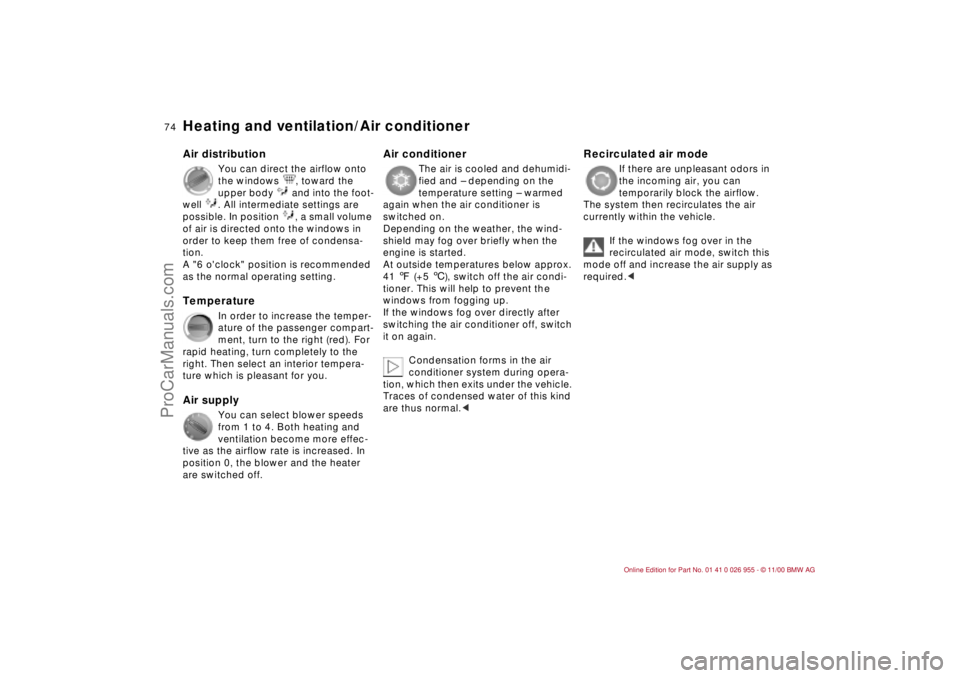
You can direct the airflow onto
the windows , toward the
upper body and into the foot-
well . All intermediate settings are
possible. In position , a small volume
of air is directed onto the windows in
order to keep them free of condensa-
tion.
A "6 o'clock" position is recommended
as the normal operating setting.
Temperature
In order to increase the temper-
ature of the passenger compart-
ment, turn to the right (red). For
rapid heating, turn completely to the
right. Then select an interior tempera-
ture which is pleasant for you.
Air supply
You can select blower speeds
from 1 to 4. Both heating and
ventilation become more effec-
tive as the airflow rate is increased. In
position 0, the blower and the heater
are switched off.
Air conditioner
The air is cooled and dehumidi-
fied and – depending on the
temperature setting – warmed
again when the air conditioner is
switched on.
Depending on the weather, the wind-
shield may fog over briefly when the
engine is started.
At outside temperatures below approx.
41 7 (+5 6), switch off the air condi-
tioner. This will help to prevent the
windows from fogging up.
If the windows fog over directly after
switching the air conditioner off, switch
it on again.
Condensation forms in the air
conditioner system during opera-
tion, which then exits under the vehicle.
Traces of condensed water of this kind
are thus normal.<
Recirculated air mode
If there are unpleasant odors in
the incoming air, you can
temporarily block the airflow.
The system then recirculates the air
currently within the vehicle.
If the windows fog over in the
recirculated air mode, switch this
mode off and increase the air supply as
required.<
ProCarManuals.com
Page 90 of 171

90n
Antilock Brake System (ABS)Information for your safetyNot even ABS can suspend the laws
of physics. ABS alone cannot prevent
accidents if the brakes are applied
without an adequate, safe distance
between vehicles or if the speed limit
has been exceeded. Nor can it prevent
the hazards of aquaplaning. Responsi-
bility for these types of situations
remains in the hands (and at the feet) of
the driver. You should never allow the
added safety of ABS to lull you into a
false sense of security, or mislead you
into taking increased risks that could
affect your own safety and that of
others.
Do not make any modifications to
the ABS system.
Service procedures on ABS are to be
performed by authorized technicians
only.< Antilock Brake System (ABS)/
Cornering Brake Control (CBC)CBC is an advanced engineering
feature of the ABS. When braking while
cornering at high speed or braking
during high lateral acceleration, or
when braking during a lane change,
vehicle stability is improved and
steering response is enhanced.
In the event of a malfunction
The ABS warning lamp comes
on, refer to page 22. The brake
system then reverts to conven-
tional operation as on vehicles
without ABS. However, have the
brake system checked by your
BMW center as soon as possible. To
prevent undetected defects and cumu-
lative faults from adversely affecting the
brake system, refer any problems to
your BMW center at the earliest oppor-
tunity.
If the red warning lamp for the
brake hydraulic system comes
on together with the yellow indi-
cator lamps for ABS and DSC
(refer to page 21), the entire
ABS, CBC and DSC control
system has failed. Continue to
drive cautiously and defensively.
Avoid full brake applications
because the vehicle could become
unstable and go out of control.
Have the system checked by your BMW
center as soon as possible.
Warning lamps for Canadian
models.
ProCarManuals.com
Page 91 of 171

91n
IndexDataTechnologyRepairsCar careControlsOverview
Disc brakesDisc brakes furnish optimum decelera-
tion and braking control and greater
fade resistance under heavy use.
When the vehicle is driven only occa-
sionally, during extended periods when
the vehicle is not used at all, or in oper-
ating conditions where brake applica-
tions are less frequent, there is an
increased tendency for corrosion of the
discs and accumulation of contamina-
tion on the brake pads. This occurs
because the minimal pressure which
must be exerted by the pads to clean
the discs by brake applications is not
reached.
If the brake discs are corroded, they will
tend to respond to braking with a
pulsating effect which even extended
application will fail to cure.
For your own safety: use only
brake pads that BMW has
approved for your specific vehicle
model. BMW cannot evaluate non-
approved brake pads to determine if
they are suited for use, and therefore
cannot ensure the operating safety of
the vehicle in the event of their use.<
Driving notesWhile driving in wet conditions and in
heavy rain, it is advisable to apply light
pressure to the brake pedal every few
miles – watch traffic conditions to
ensure that this maneuver does not
endanger other road users. The heat
generated in this braking process helps
dry the brake pads and discs.
Maximum braking force is obtained
while the wheels continue to rotate,
peaking when the wheels remain on the
verge of locking without actually doing
so. ABS maintains this state automati-
cally. If the ABS fails, you should revert
to the staggered braking technique
described on page 94.
Extended or steep mountain descents
should be driven in the gear in which
only minimal periodic brake application
is required. This avoids excessive strain
on the brakes and possible impairment
of the braking effect.
You can increase the engine's braking
effect by selecting progressively lower
gears, downshifting into first gear, if
necessary. Should engine braking prove inade-
quate, you should still avoid extended,
continuous braking. Instead, decelerate
the vehicle with increased pressure on
the brake pedal (watch for following
traffic!), release the pedal and then
repeat the brake application (staggered
braking). This staggered braking tech-
nique allows the brakes to cool in the
intervals between active braking
phases, preventing overheating and
ensuring that full braking capacity
remains available at all times.
Do not drive the vehicle with the
clutch depressed, with the shift
lever in neutral or with the engine shut
off. The engine provides no braking
control when the transmission is in
neutral and there is no power assist for
braking and steering when the engine is
shut off.
Never allow floor mats, carpets or any
other objects to protrude into the area
around the accelerator, clutch and
brake pedals and obstruct their move-
ment.<
ProCarManuals.com
Page 101 of 171

101n
IndexDataTechnologyRepairsCar careControlsOverview
Wheel and tire combinationsThe right choice
Use only wheels and tires
approved by BMW for the corre-
sponding vehicle model, as otherwise
the tires may make contact with the
body as the result of tolerances despite
the same nominal size being used,
leading to serious accidents. If non-
approved wheels and tires are used,
BMW cannot evaluate their suitability,
and therefore cannot be held liable for
driving safety.<
For wheel and tire specifications
approved by BMW, refer to the informa-
tion on page 103.
The correct wheel and tire combi-
nation affects different systems
such as ABS, DSC and RDW. The func-
tion of these systems is impaired if
improper wheel and tire combinations
are used.
For this reason, use only tires of the
same brand and tread pattern on the
vehicle and, for example, restore the
approved wheel and tire combination
following a flat tire as soon as
possible.<
Codes on tires and wheelsThe code on tires has the following
meaning.
Codes on radial tires:
The speed rating indicates the
approved maximum speed for the tire.
Summer tires:
S = up to 112 mph (180 km/h)
T = up to 118 mph (190 km/h)
H = up to 130 mph (210 km/h)
V = up to 149 mph (240 km/h)
W = up to 167 mph (270 km/h)
Y = up to 186 mph (300 km/h)
ZR = over 149 mph (240 km/h) Example:
Nominal width
in mm
Aspect ratio in %
Belt rating ID code
for radial tires
Wheel diameter in inches
Load rating
(not on ZR tires)
Speed rating
(before R on ZR tires)
205/60 R 15 91 H
All season and winter tires:
Q M+S = up to 100 mph (160 km/h)
T M+S = up to 118 mph (190 km/h)
H M+S = up to 130 mph (210 km/h)
Codes on light-alloy wheels:
Protect valve inserts against dirt by
using screw-on valve caps.
Dirt in the valves frequently leads to
slow leaks.Storage Store tires in a cool, dry place,
protecting them against light whenever
possible. Protect the tires against
contact with oil, grease and fuel. Example:
Rim width
in inches
Code letter for
flange type
Symbol for full-drop
center rim
Rim diameter in inches
Extended hump on
the 2 rim shoulders
7x15EH2
J
ProCarManuals.com
Page 112 of 171
112n
Coolant Brake fluid Checking coolant levelThe correct coolant level when the
engine is cold (approx. +68 7/+20 6).
Unscrew the cap from the expansion
tank.
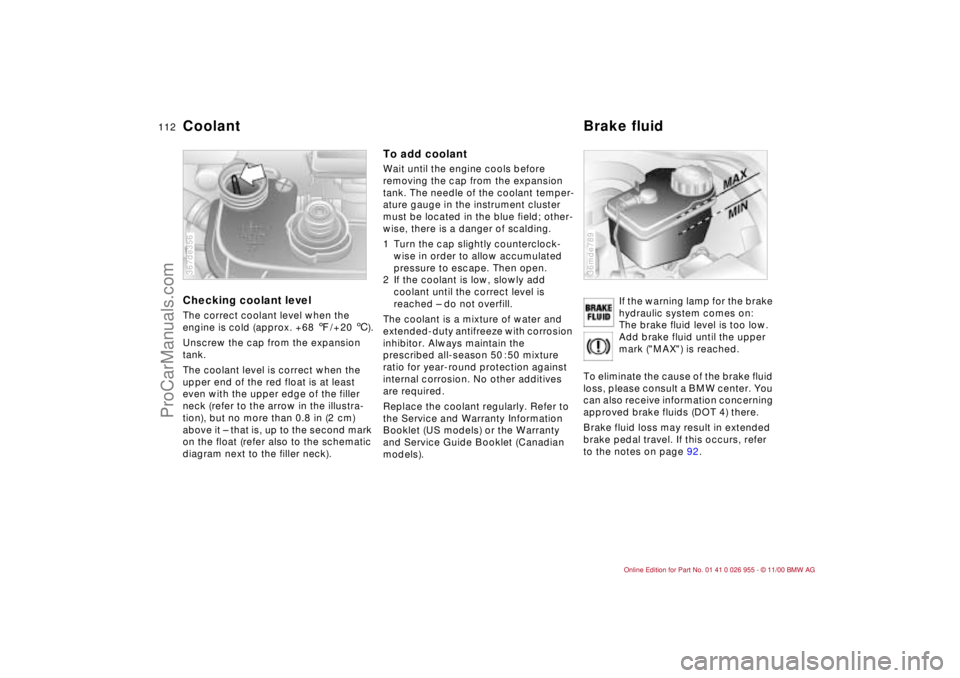
The coolant level is correct when the
upper end of the red float is at least
even with the upper edge of the filler
neck (refer to the arrow in the illustra-
tion), but no more than 0.8 in (2 cm)
above it – that is, up to the second mark
on the float (refer also to the schematic
diagram next to the filler neck).367de356
To add coolantWait until the engine cools before
removing the cap from the expansion
tank. The needle of the coolant temper-
ature gauge in the instrument cluster
must be located in the blue field; other-
wise, there is a danger of scalding.
1 Turn the cap slightly counterclock-
wise in order to allow accumulated
pressure to escape. Then open.
2 If the coolant is low, slowly add
coolant until the correct level is
reached – do not overfill.
The coolant is a mixture of water and
extended-duty antifreeze with corrosion
inhibitor. Always maintain the
prescribed all-season 50 : 50 mixture
ratio for year-round protection against
internal corrosion. No other additives
are required.
Replace the coolant regularly. Refer to
the Service and Warranty Information
Booklet (US models) or the Warranty
and Service Guide Booklet (Canadian
models).If the warning lamp for the brake
hydraulic system comes on:
The brake fluid level is too low.
Add brake fluid until the upper
mark ("MAX") is reached.
To eliminate the cause of the brake fluid
loss, please consult a BMW center. You
can also receive information concerning
approved brake fluids (DOT 4) there.
Brake fluid loss may result in extended
brake pedal travel. If this occurs, refer
to the notes on page 92.
36mde789
ProCarManuals.com
Page 113 of 171
113n
IndexDataTechnologyRepairsCar careControlsOverview
Brake fluid Vehicle Identification Number
Brake fluid is hygroscopic, that is,
it absorbs moisture from the air
over time.
In order to ensure the operating safety
and reliability of the brake system, have
the brake fluid changed every two years
by a BMW center. Refer also to the
Service and Warranty Information
Booklet (US models) or the Warranty
and Service Guide Booklet (Canadian
models).
Brake fluid is hazardous to health and
will damage the vehicle's paint. You
should always store it in its original
container and in a location which is
inaccessible to children. Avoid brake
fluid spills. Do not fill brake fluid beyond
the "MAX" mark in the reservoir. The
brake fluid could ignite upon contact
with hot engine parts and cause serious
burns.<
Comply with the applicable envi-
ronmental laws regulating the
disposal of brake fluid.<
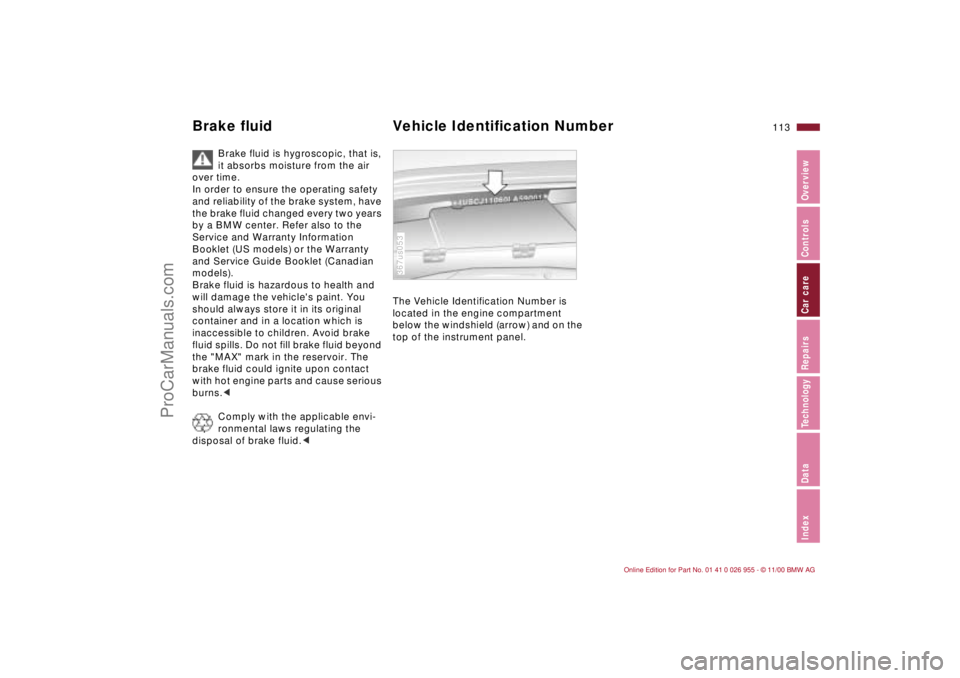
The Vehicle Identification Number is
located in the engine compartment
below the windshield (arrow) and on the
top of the instrument panel. 367us053
ProCarManuals.com
Page 115 of 171

115n
IndexDataTechnologyRepairsCar careControlsOverview
The BMW Maintenance System Caring for your vehicleService and Warranty Information
Booklet (US models)/Warranty
and Service Guide Booklet
(Canadian models)For detailed information on required
maintenance items and the work
involved, please refer to the Service
and Warranty Information Booklet (US
models) or to the Warranty and Service
Guide Booklet (Canadian models).
Depending upon operating conditions,
it may be advisable to have the body
checked for damage from rocks or
gravel at the same time as a precaution
against rust.Have your BMW center do the
maintenance and repair.
Your BMW center is always informed on
the latest maintenance work and repair
techniques and is equipped with the
required special tools. In addition,
checking parts known from experience
to be subject to wear is a permanent
part of the maintenance specifications.
Be sure that all maintenance work is
confirmed in the Service and Warranty
Information Booklet (US models) or the
Warranty and Service Guide Booklet
(Canadian models). These entries will
constitute your proof that the vehicle
has received regular maintenance. They
are also required for warranty claims.<
Washing your vehicleYou can wash your BMW by hand or in
an automatic car wash – even when it is
new. Car wash systems that do not
employ brushes are preferable.
Loosen and remove tough dirt and
dead insects before washing the
vehicle.
To prevent spots, avoid washing when
the hood is still warm, or immediately
after and during exposure to strong
sunlight.
If a brushless car wash is unavailable
and a brush car wash must be used,
modern systems with soft brushes are
preferable. In order to protect the
convertible top, special waxing
programs may not be selected for the
M roadster. The small amount of
beading wax always used in automatic
car washes will not harm your vehicle's
finish.
ProCarManuals.com
Page 119 of 171

119n
IndexDataTechnologyRepairsCar careControlsOverview
Caring for your vehicleCaring for the vehicle finishRegular washing is a preventive
measure against long-term effects from
substances which are harmful to the
vehicle's finish, especially if you drive
your vehicle in areas with high levels of
air pollution or aggressive natural
substances (tree resins, pollen).
Nevertheless, you should immediately
remove especially aggressive
substances. Failure to do so can lead to
changes in the paint's chemical struc-
ture or to discoloration. Gasoline spilled
during refueling, oil, grease and brake
fluid should always be cleaned away
immediately, as should bird droppings
(finish damage).
Any contamination remaining on the
surface of the vehicle will be especially
conspicuous after washing. Use
cleaning fluid or alcohol with a clean
cloth or cotton pad to remove. Remove
tar spots with tar remover. After
cleaning, the affected areas should be
waxed to ensure continued protection.
Use the cleaning and car-care
products that you can obtain at
your BMW center.<
Waxing your vehicleProtect the finish using carnauba or
synthetic-based waxes only.
The best way to determine when the
finish needs to be waxed is by noting
when water stops beading on the
surface.
You can use a glass cleaner to remove
any wax or silicone that may have been
left on the windows during waxing.
Use the cleaning and car-care
products that you can obtain at
your BMW center.<
Paint damageYou can touch up minor paint flaws with
BMW spray paint or a BMW touchup
stick.
The color code for your vehicle is
provided on a tag located near the
vehicle data plate and on the first page
of the Service and Warranty Information
Booklet (US models) or the Warranty
and Service Guide Booklet (Canadian
models).
Damage caused by flying stones,
scratches, etc., must be touched up
without delay to prevent rust from
forming.
If corrosion has started to form in an
area with paint damage, remove all rust
and clean the area. Finally, apply the
finish coat. Wait a few days, then polish
the repaired area. Finish by applying a
wax preservative.
More extensive paint damage should
be repaired professionally in accor-
dance with the manufacturer's instruc-
tions. Your BMW center uses original
BMW finish materials in accordance
with approved repair procedures.
Use the cleaning and car-care
products that you can obtain at
your BMW center.<
ProCarManuals.com