engine BMW M ROADSTER COUPE 2001 User Guide
[x] Cancel search | Manufacturer: BMW, Model Year: 2001, Model line: M ROADSTER COUPE, Model: BMW M ROADSTER COUPE 2001Pages: 171, PDF Size: 1.98 MB
Page 31 of 171

31n
IndexDataTechnologyRepairsCar careControlsOverview
Electronic vehicle immobilizerThe key to securityThe electronic vehicle immobilization
unit increases the anti-theft protection
of your BMW – you do not have to
adjust or activate anything. This elec-
tronic immobilization system is
designed to reduce the susceptibility of
the vehicle to theft by making it impos-
sible to start the engine using any
means other than the special keys
furnished with the vehicle.
Your BMW center can cancel the elec-
tronic system authorization for indi-
vidual keys (in the event a key is lost,
for instance). A deactivated key can no
longer be used to start the engine.
How the electronics workAt the heart of this system is an elec-
tronic chip which is integrated into the
key. The lock mechanism itself is actu-
ally a dual-function device, simulta-
neously serving as a communications
interface designed to allow the security
system to maintain a continuous stream
of variable, vehicle-specific signals with
the electronic circuitry in the key. The
system will not release the ignition, fuel
injection and starter unless it recog-
nizes an "authorized" key.
Force applied to the key can
damage the integrated electronic
circuitry. A damaged key can no longer
be used to start the engine.<
For US owners onlyThe transmitter and receiver units
comply with part 15 of the FCC (Federal
Communications Commission) regula-
tions. Operation is governed by the
following:
FCC ID: LX8EWS
Compliance statement:
This device complies with part 15 of the
FCC Rules. Operation is subject to the
following two conditions:
>This device may not cause harmful
interference, and
>this device must accept any interfer-
ence received, including interference
that may cause undesired operation.
Any unauthorized modifications
to these devices could void the
user's authority to operate the equip-
ment.<
ProCarManuals.com
Page 41 of 171
41n
IndexDataTechnologyRepairsCar careControlsOverview
Power convertible top
* – roadster
Weather protectionThe convertible top combines reliable
protection from the elements with
simple, convenient operation. Here are
a few tips to ensure that you have plea-
sure with your roadster.
It is advisable to close the convertible
top when the vehicle is parked. The
closed convertible top not only protects
the passenger compartment from
unforeseeable damage from the
weather, it also provides a certain
degree of theft protection. In addition,
keep valuables only in the locked
luggage compartment, even with the
convertible top closed.
Never mount a roof-mounted luggage
rack on the convertible top. Please
contact your BMW center for suitable
securing devices and additional acces-
sories.
To prevent damage, do not operate the
convertible top at temperatures at or
below the freezing point.
To conserve the battery, it is advisable
to operate the top only with the engine
running.Operate the convertible top only
when the vehicle is stationary.
Do not lay objects on the convertible
top, since they would fall off when the
convertible top is operated and cause
damage or injuries.
Do not reach into the convertible top
mechanism during opening and closing.
Keep children away from the moving
parts of the convertible top during
operation.
The automatic sequence is interrupted
immediately if the button for actuating
the top (pages 42 and 45) is released.
The sequence can be continued in the
desired direction by pressing the
button.<
To open 1 With the doors closed, lower the side
windows a few inches (centimeters).
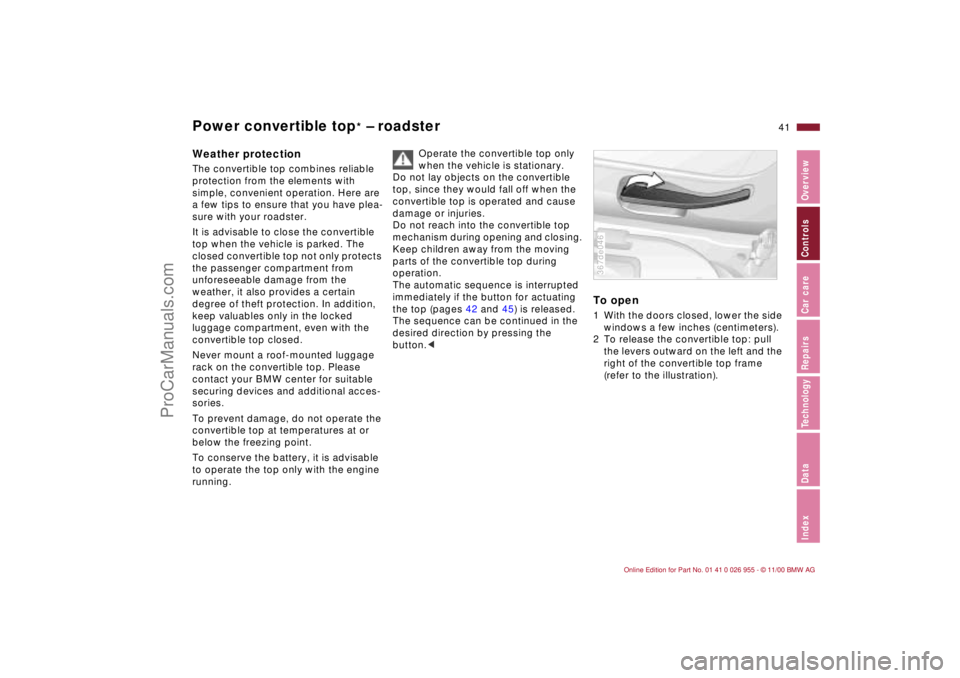
2 To release the convertible top: pull
the levers outward on the left and the
right of the convertible top frame
(refer to the illustration).367de046
ProCarManuals.com
Page 55 of 171
55n
IndexDataTechnologyRepairsCar careControlsOverview
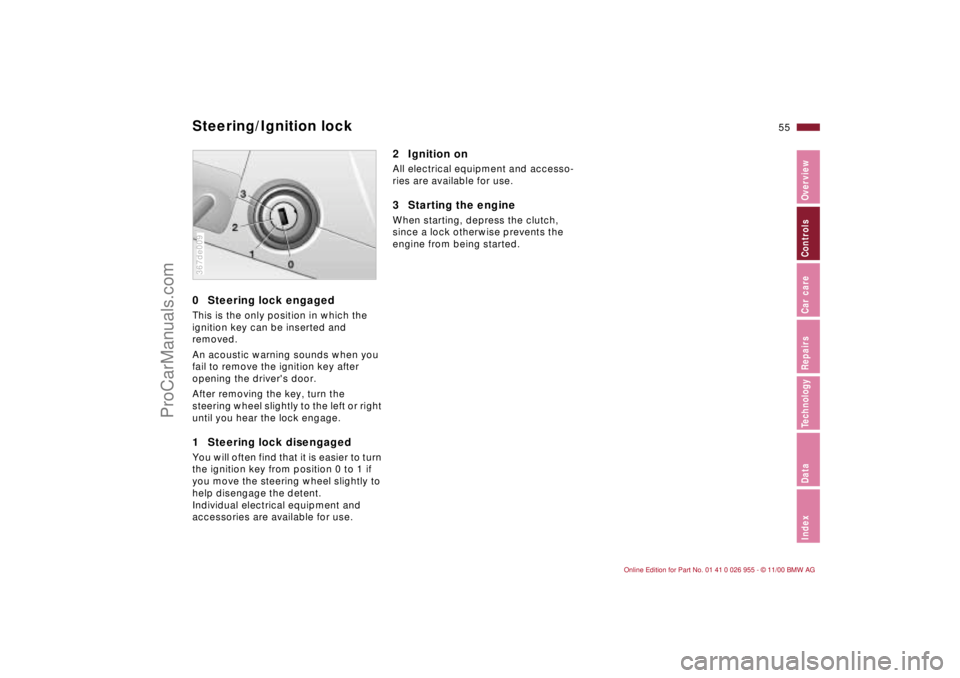
0 Steering lock engagedThis is the only position in which the
ignition key can be inserted and
removed.
An acoustic warning sounds when you
fail to remove the ignition key after
opening the driver's door.
After removing the key, turn the
steering wheel slightly to the left or right
until you hear the lock engage.1 Steering lock disengagedYou will often find that it is easier to turn
the ignition key from position 0 to 1 if
you move the steering wheel slightly to
help disengage the detent.
Individual electrical equipment and
accessories are available for use.367de009
2 Ignition onAll electrical equipment and accesso-
ries are available for use.3 Starting the engineWhen starting, depress the clutch,
since a lock otherwise prevents the
engine from being started.
Steering/Ignition lock
ProCarManuals.com
Page 56 of 171

56n
Starting the engineBefore starting>Engage the parking brake.
>Put manual-shift gear lever in idling
position.
>Depress the clutch pedal.
Do not run the engine in enclosed
spaces. The exhaust gases
contain carbon monoxide, an odorless
and colorless, but highly toxic gas.
Breathing the exhaust gases poses an
extreme health risk, and can lead to
unconsciousness and death.
Do not leave the vehicle unattended
with the engine running. An unattended
vehicle with a running engine repre-
sents a potential safety hazard.<
Starting the engineStart the engine. Do not press the
accelerator pedal.
Do not actuate the starter for too
short a time. Do not turn it for
more than approx. 20 seconds. Release
the ignition key immediately after the
engine starts.<
Do not allow the engine to warm up by
allowing it to run while the vehicle
remains stationary. Instead, begin
driving immediately at a moderate
engine speed.
Should the engine fail to start on the
first attempt (if it is very hot or cold, for
instance):
>Press the accelerator pedal halfway
down while engaging the starter.
Cold starts at very low temperatures,
from approx. +5 7 (–15 6) and at
altitudes above approx. 3,300 ft
(1,000 meters):
>On the first start attempt, engage the
starter for a longer period (approx.
10 seconds).
>Press the accelerator pedal halfway
down while engaging the starter.
Usually, it is not necessary to depress
the accelerator pedal. However, at high
altitudes or in very hot or very cold
weather, depress the pedal halfway
down when starting the engine.
Engine idle speed is controlled by the
engine computer system. Increased
speeds at start-up are normal and
should decrease as the engine warms
up. If engine speed does not decrease,
service is required.
To prevent the battery from
discharging, always switch off any
accessories which are not required.
Switch off the ignition when the vehicle
is not being driven.
ProCarManuals.com
Page 57 of 171
57n
IndexDataTechnologyRepairsCar careControlsOverview
Switching off the engine Parking brakeTurn the ignition key to position 1 or 0.
Never remove the ignition key
while the vehicle is rolling. The
steering locks and it is impossible to
steer the vehicle.
Always remove the ignition key and
engage the steering lock before leaving
the vehicle.
Always engage the parking brake when
parking on slopes and inclined
surfaces, since even placing the lever in
1st gear or reverse may not provide
adequate resistance to rolling.<
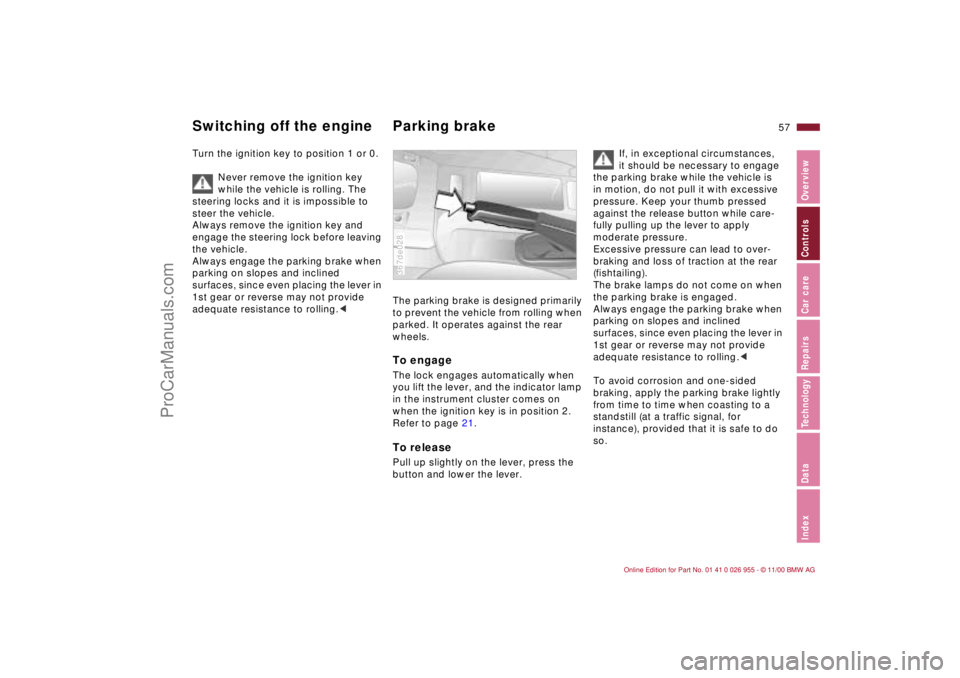
The parking brake is designed primarily
to prevent the vehicle from rolling when
parked. It operates against the rear
wheels.To engageThe lock engages automatically when
you lift the lever, and the indicator lamp
in the instrument cluster comes on
when the ignition key is in position 2.
Refer to page 21.To releasePull up slightly on the lever, press the
button and lower the lever.367de028
If, in exceptional circumstances,
it should be necessary to engage
the parking brake while the vehicle is
in motion, do not pull it with excessive
pressure. Keep your thumb pressed
against the release button while care-
fully pulling up the lever to apply
moderate pressure.
Excessive pressure can lead to over-
braking and loss of traction at the rear
(fishtailing).
The brake lamps do not come on when
the parking brake is engaged.
Always engage the parking brake when
parking on slopes and inclined
surfaces, since even placing the lever in
1st gear or reverse may not provide
adequate resistance to rolling.<
To avoid corrosion and one-sided
braking, apply the parking brake lightly
from time to time when coasting to a
standstill (at a traffic signal, for
instance), provided that it is safe to do
so.
ProCarManuals.com
Page 58 of 171
58n
Manual transmission Turn signals/High beamsPress the clutch pedal all the way down
each time you shift, pressing the
manual-shift gear lever into its proper
end position.
Depress the clutch when starting the
vehicle, too, otherwise, lockout will
prevent the engine from starting.
The shift lever's neutral plane is located
between 3rd and 4th gear.
When shifting from each gear into
"Neutral," the shift lever returns auto-
matically to this neutral position
because of its spring loading.36mde746
ReverseSelect reverse only when the vehicle is
stationary. Press the shift lever to the
left to overcome the resistance.
As you do this, the backup lamps will
turn on automatically when the ignition
key is in position 2.
Do not hold the vehicle in place on
slopes by slipping or "riding" the
clutch. Use the parking brake instead,
otherwise, the ensuing friction to the
clutch plates will cause a great deal of
wear and tear on the clutch.<
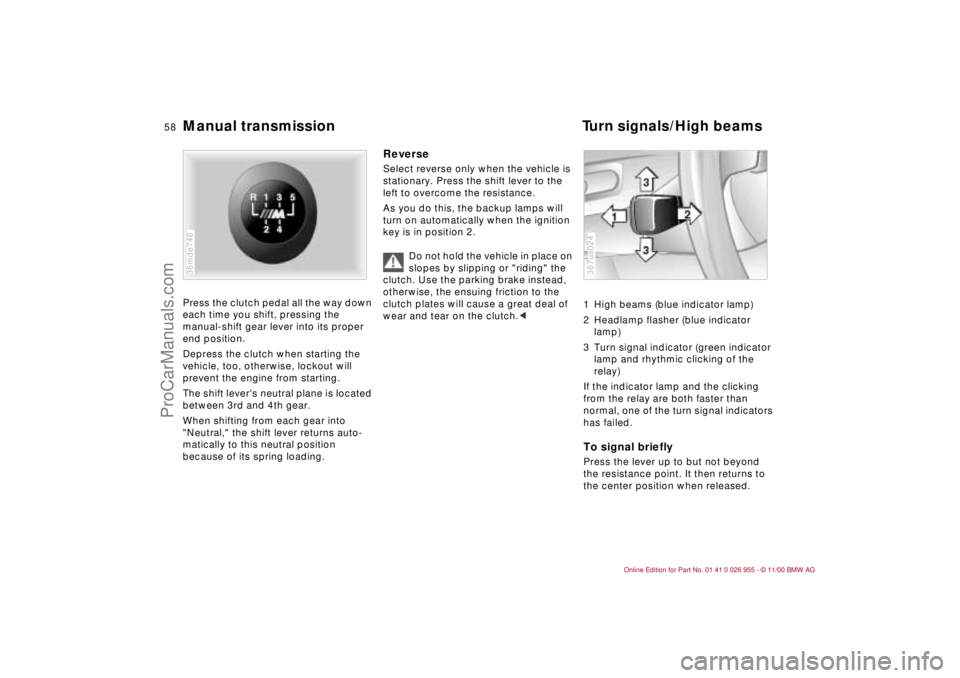
1 High beams (blue indicator lamp)
2 Headlamp flasher (blue indicator
lamp)
3 Turn signal indicator (green indicator
lamp and rhythmic clicking of the
relay)
If the indicator lamp and the clicking
from the relay are both faster than
normal, one of the turn signal indicators
has failed.To signal brieflyPress the lever up to but not beyond
the resistance point. It then returns to
the center position when released.367us024
ProCarManuals.com
Page 61 of 171
61n
IndexDataTechnologyRepairsCar careControlsOverview
Cruise control
*
You can store and automatically main-
tain any desired vehicle speed above
approx. 25 mph (40 km/h).
The system is switched off and the
stored speed deleted from its memory
when you turn the ignition key to posi-
tion 0.
Do not use the cruise control on
winding roads, when high traffic
density prevents driving at a constant
speed, when the road surface is slick
(snow, rain, ice) or when the road
surface is loose (rocks or gravel,
sand).< 365us059
To store and maintain speed/
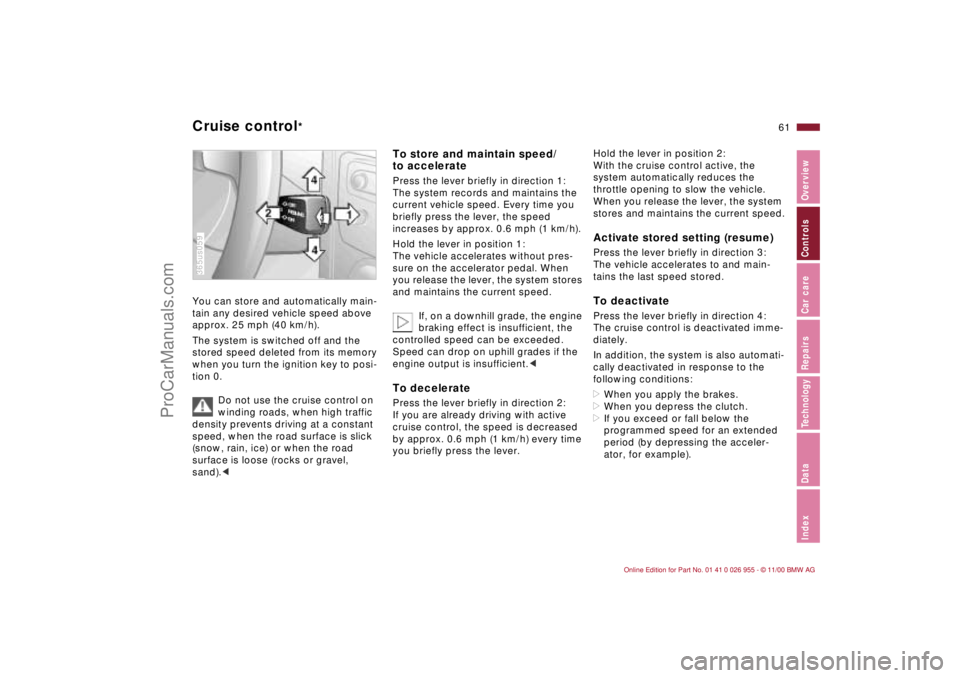
to acceleratePress the lever briefly in direction 1:
The system records and maintains the
current vehicle speed. Every time you
briefly press the lever, the speed
increases by approx. 0.6 mph (1 km/h).
Hold the lever in position 1:
The vehicle accelerates without pres-
sure on the accelerator pedal. When
you release the lever, the system stores
and maintains the current speed.
If, on a downhill grade, the engine
braking effect is insufficient, the
controlled speed can be exceeded.
Speed can drop on uphill grades if the
engine output is insufficient.< To deceleratePress the lever briefly in direction 2:
If you are already driving with active
cruise control, the speed is decreased
by approx. 0.6 mph (1 km/h) every time
you briefly press the lever.
Hold the lever in position 2:
With the cruise control active, the
system automatically reduces the
throttle opening to slow the vehicle.
When you release the lever, the system
stores and maintains the current speed.Activate stored setting (resume)Press the lever briefly in direction 3:
The vehicle accelerates to and main-
tains the last speed stored.To deactivatePress the lever briefly in direction 4:
The cruise control is deactivated imme-
diately.
In addition, the system is also automati-
cally deactivated in response to the
following conditions:
>When you apply the brakes.
>When you depress the clutch.
>If you exceed or fall below the
programmed speed for an extended
period (by depressing the acceler-
ator, for example).
ProCarManuals.com
Page 62 of 171
62n
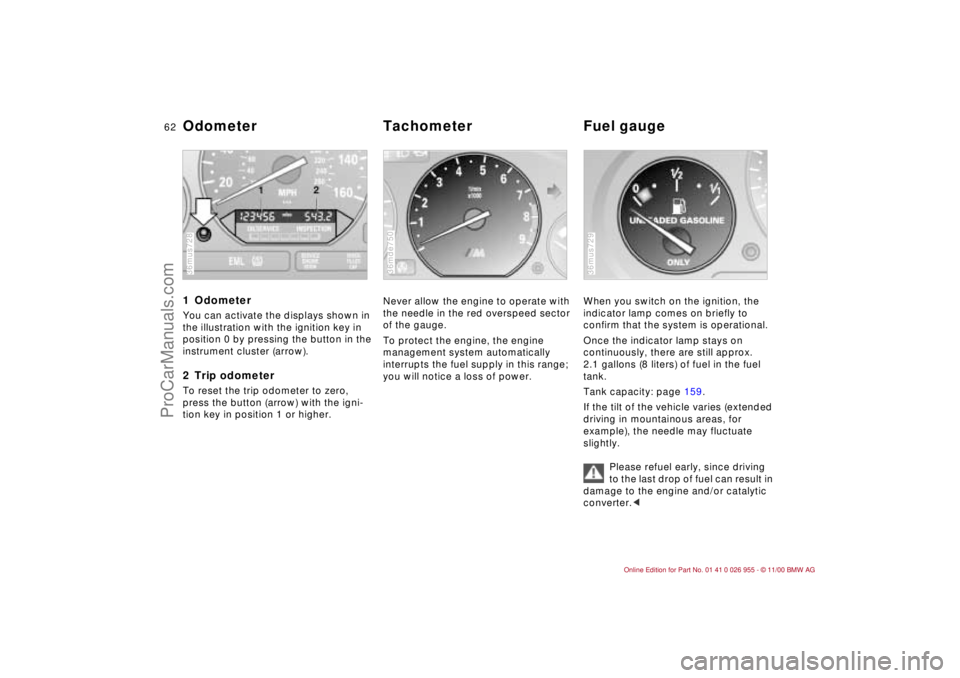
1 OdometerYou can activate the displays shown in
the illustration with the ignition key in
position 0 by pressing the button in the
instrument cluster (arrow).2 Trip odometerTo reset the trip odometer to zero,
press the button (arrow) with the igni-
tion key in position 1 or higher.36mus728
Never allow the engine to operate with
the needle in the red overspeed sector
of the gauge.
To protect the engine, the engine
management system automatically
interrupts the fuel supply in this range;
you will notice a loss of power.36mde750
When you switch on the ignition, the
indicator lamp comes on briefly to
confirm that the system is operational.
Once the indicator lamp stays on
continuously, there are still approx.
2.1 gallons (8 liters) of fuel in the fuel
tank.
Tank capacity: page 159.
If the tilt of the vehicle varies (extended
driving in mountainous areas, for
example), the needle may fluctuate
slightly.
Please refuel early, since driving
to the last drop of fuel can result in
damage to the engine and/or catalytic
converter.< 36mus729
Odometer Tachometer Fuel gauge
ProCarManuals.com
Page 63 of 171
63n
IndexDataTechnologyRepairsCar careControlsOverview
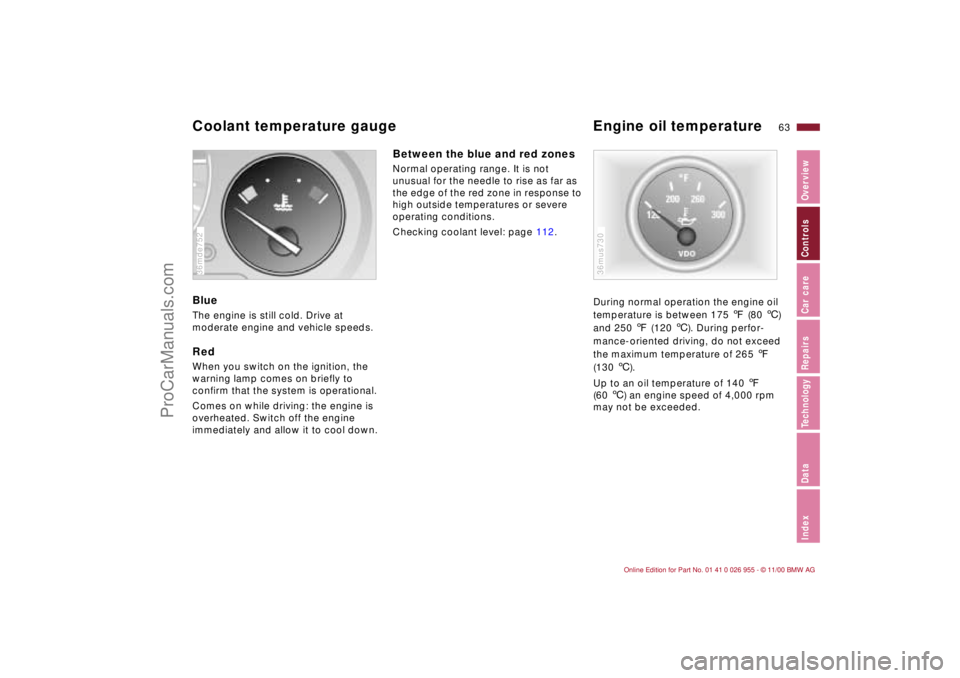
Coolant temperature gauge Engine oil temperatureBlueThe engine is still cold. Drive at
moderate engine and vehicle speeds.RedWhen you switch on the ignition, the
warning lamp comes on briefly to
confirm that the system is operational.
Comes on while driving: the engine is
overheated. Switch off the engine
immediately and allow it to cool down.36mde752
Between the blue and red zonesNormal operating range. It is not
unusual for the needle to rise as far as
the edge of the red zone in response to
high outside temperatures or severe
operating conditions.
Checking coolant level: page 112.
During normal operation the engine oil
temperature is between 175 7 (80 6)
and 250 7 (120 6). During perfor-
mance-oriented driving, do not exceed
the maximum temperature of 265 7
(130 6).
Up to an oil temperature of 140 7
(60 6) an engine speed of 4,000 rpm
may not be exceeded.
36mus730
ProCarManuals.com
Page 65 of 171
65n
IndexDataTechnologyRepairsCar careControlsOverview
The conceptDSC helps maintain vehicle stability,
even in critical driving situations.
The system optimizes vehicle stability
during acceleration and when starting
from a full stop, as well as optimizing
traction. In addition, it recognizes
unstable vehicle conditions, such as
understeering or oversteering, and, as
far as is possible within the laws of
physics, helps keep the vehicle on a
steady course by reducing the engine
speed and brake applications to the
individual wheels.
The DSC is operational every time you
start the engine.
Indicator lamp
The indicator lamp in the instru-
ment cluster goes out shortly
after you switch on the ignition.
Refer to page 22.
The indicator lamp flashes:
DSC is active and controls the drive
and braking forces.
If the indicator lamp fails to go out after
the engine has been started, or if it
comes on during normal driving and
stays on: the DSC has been switched
off via the button or there is a malfunc-
tion. You can continue to drive the
vehicle normally, but without DSC.
In the event of a malfunction, please
consult your BMW center.
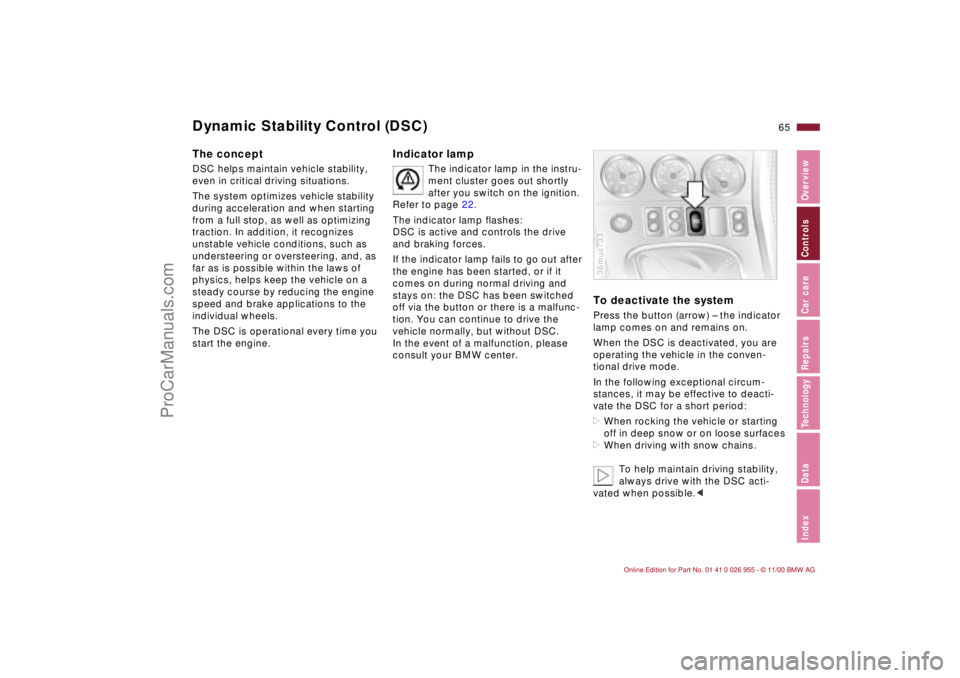
To deactivate the systemPress the button (arrow) – the indicator
lamp comes on and remains on.
When the DSC is deactivated, you are
operating the vehicle in the conven-
tional drive mode.
In the following exceptional circum-
stances, it may be effective to deacti-
vate the DSC for a short period:
>When rocking the vehicle or starting
off in deep snow or on loose surfaces
>When driving with snow chains.
To help maintain driving stability,
always drive with the DSC acti-
vated when possible.< 36mus733
Dynamic Stability Control (DSC)
ProCarManuals.com