warning BMW M ROADSTER COUPE 2001 User Guide
[x] Cancel search | Manufacturer: BMW, Model Year: 2001, Model line: M ROADSTER COUPE, Model: BMW M ROADSTER COUPE 2001Pages: 171, PDF Size: 1.98 MB
Page 25 of 171
25n
IndexDataTechnologyRepairsCar careControlsOverview
First-aid kit
*
Refueling
M coupeIn the luggage compartment at the left
rear. Release the Velcro
® fasteners.
M roadsterIn the luggage compartment on the left
in a storage area; swing retaining strap
upward.
Some of the articles in the first-aid
kit may be used within a limited
time only. For this reason, check the
expiration dates of each of the items
regularly, and replace any whose expi-
ration dates have passed. You can
acquire replacements in any drugstore
or pharmacy.
Comply with legal requirements which
cover availability of a first-aid kit in the
vehicle.<
Before filling the tank, shut off the
engine, as otherwise fuel cannot
flow into the tank and the Service
Engine Soon warning lamp may come
on. Refer to page 22.<
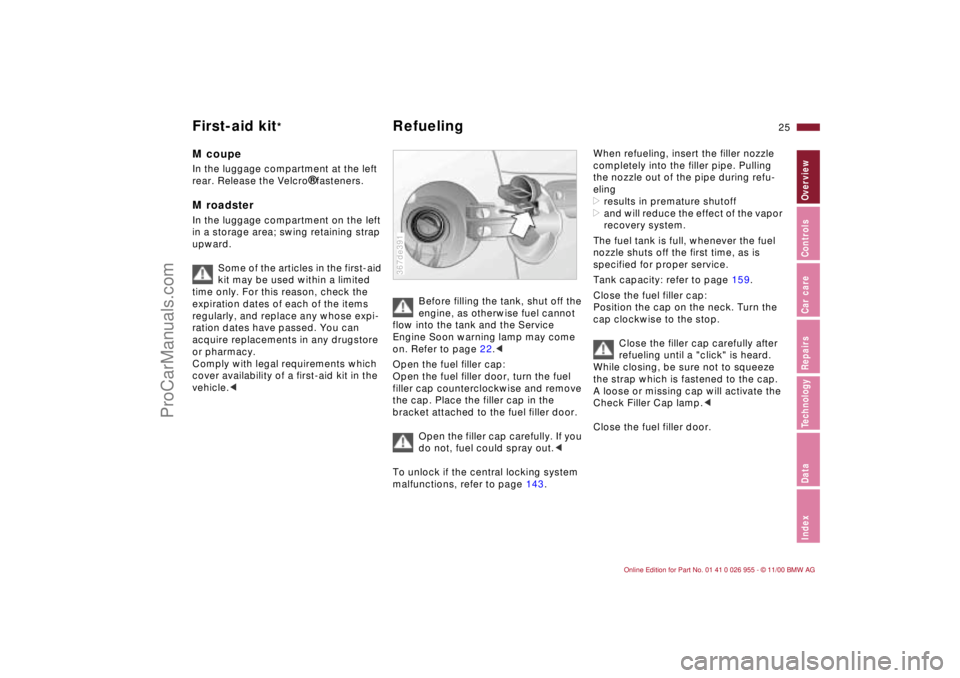
Open the fuel filler cap:
Open the fuel filler door, turn the fuel
filler cap counterclockwise and remove
the cap. Place the filler cap in the
bracket attached to the fuel filler door.
Open the filler cap carefully. If you
do not, fuel could spray out.<
To unlock if the central locking system
malfunctions, refer to page 143.
367de391
When refueling, insert the filler nozzle
completely into the filler pipe. Pulling
the nozzle out of the pipe during refu-
eling
>results in premature shutoff
>and will reduce the effect of the vapor
recovery system.
The fuel tank is full, whenever the fuel
nozzle shuts off the first time, as is
specified for proper service.
Tank capacity: refer to page 159.
Close the fuel filler cap:
Position the cap on the neck. Turn the
cap clockwise to the stop.
Close the filler cap carefully after
refueling until a "click" is heard.
While closing, be sure not to squeeze
the strap which is fastened to the cap.
A loose or missing cap will activate the
Check Filler Cap lamp.<
Close the fuel filler door.
ProCarManuals.com
Page 26 of 171
26n
Refueling Fuel specifications Tire inflation pressure
When handling fuels, comply with
all of the applicable safety precau-
tions displayed at gas stations.
Never carry spare fuel containers in
your vehicle. Whether they are empty or
full, these containers can leak, cause an
explosion, or lead to fire in the event of
a collision.<
The engine uses lead-free gasoline
only.
Required fuel:
>Premium Unleaded Gasoline,
min. 91 AKI.
AKI = Anti Knock Index
Do not use leaded fuels. The use
of leaded fuels will cause perma-
nent damage to the system's oxygen
sensor and the catalytic converter.<
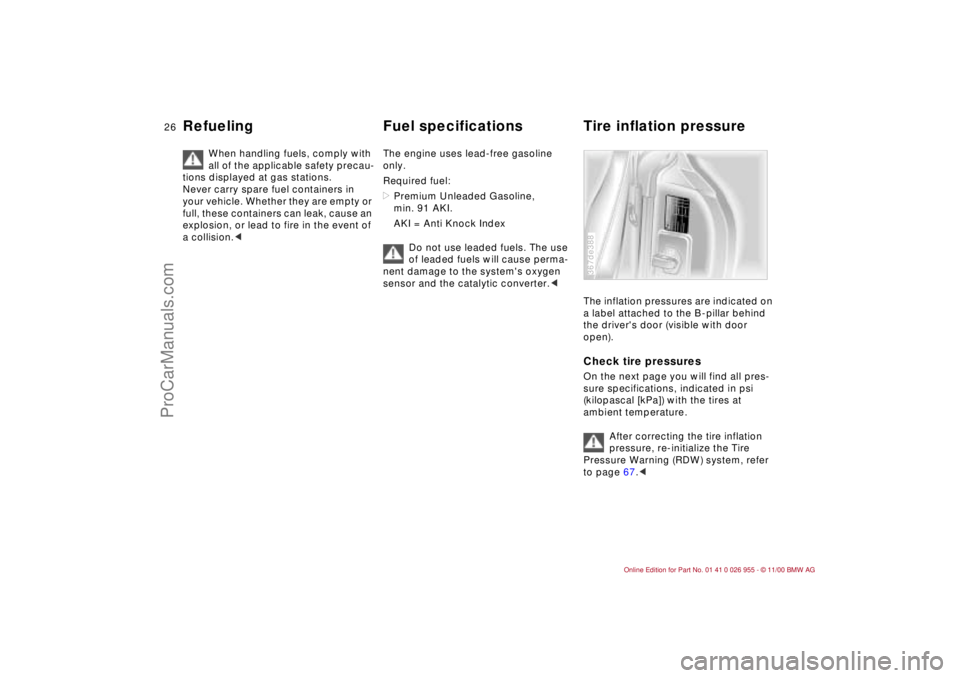
The inflation pressures are indicated on
a label attached to the B-pillar behind
the driver's door (visible with door
open).Check tire pressuresOn the next page you will find all pres-
sure specifications, indicated in psi
(kilopascal [kPa]) with the tires at
ambient temperature.
After correcting the tire inflation
pressure, re-initialize the Tire
Pressure Warning (RDW) system, refer
to page 67.<367de388
ProCarManuals.com
Page 29 of 171
Overview
Controls and features
Operation, care
and maintenance
Owner service procedures
Technical data
Index Advanced technology
29n
IndexDataTechnologyRepairsCar careControlsOverview
Everything under control:
Odometer62
Tachometer62
Fuel gauge62
Coolant temperature gauge63
Engine oil temperature gauge63
Service Interval Display64
Outside temperature64
Clock64
Technology for safety and
driving convenience:
Dynamic Stability Control
(DSC)65
Tire Pressure Warning (RDW)67
Lamps:
Parking lamps/Low beams69
Interior lamps70
Reading lamps71Controlling the climate
for pleasant driving:
Heating and ventilation/
Air conditioner72
Seat heating77
Cabin convenience:
Glove compartment78
Storage compartments78
Storage boxes78
Beverage holder79
Ashtray79
Cigarette lighter80
Loading and transporting
cargo:
coupe:
Roll-up cover81
Partition net81
Cargo loading82
Roof-mounted luggage
rack83
ProCarManuals.com
Page 32 of 171
32n
Central locking system Opening and closing from the outsideThe conceptThe central locking system becomes
operational when the doors are closed.
The system simultaneously engages
and releases the locks on the
>doors
>luggage compartment
>fuel filler door.
The central locking system can be
operated
>from outside via the door locks and
the luggage compartment lock
(M coupe: open only)
>from inside via the safety lock
buttons (locks doors only).
When the system is actuated from
outside the vehicle, the anti-theft
protection is simultaneously activated.
It prevents the doors from being
unlocked with the lock buttons or
release handles.
The central locking system unlocks
automatically in the event of an acci-
dent. In addition, the hazard warning
flashers and interior lamps come on.
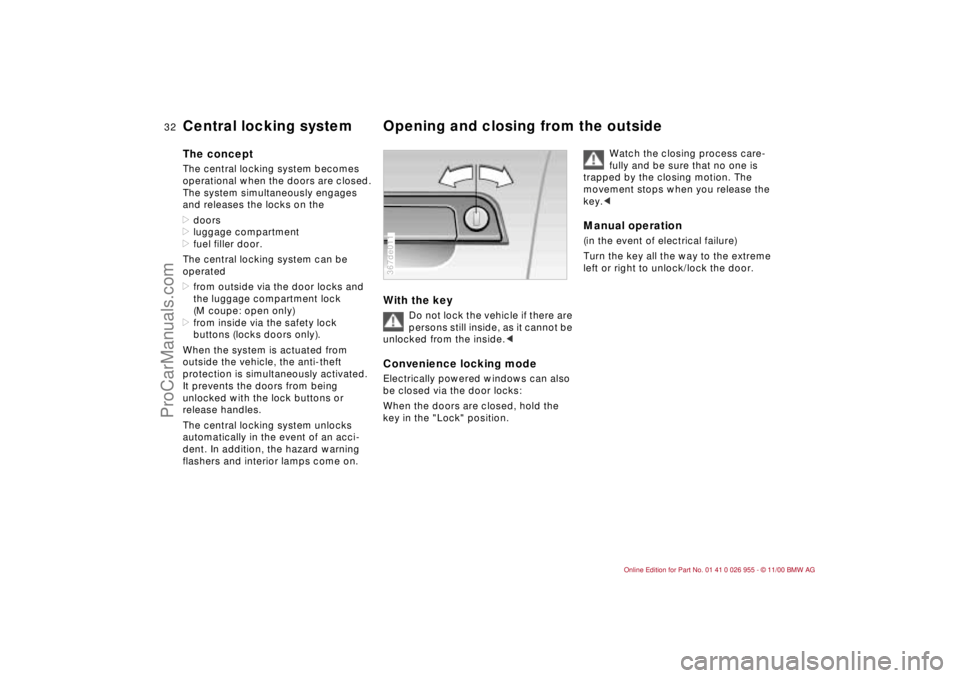
With the key
Do not lock the vehicle if there are
persons still inside, as it cannot be
unlocked from the inside.<
Convenience locking modeElectrically powered windows can also
be closed via the door locks:
When the doors are closed, hold the
key in the "Lock" position.367de011
Watch the closing process care-
fully and be sure that no one is
trapped by the closing motion. The
movement stops when you release the
key.<
Manual operation(in the event of electrical failure)
Turn the key all the way to the extreme
left or right to unlock/lock the door.
ProCarManuals.com
Page 55 of 171
55n
IndexDataTechnologyRepairsCar careControlsOverview
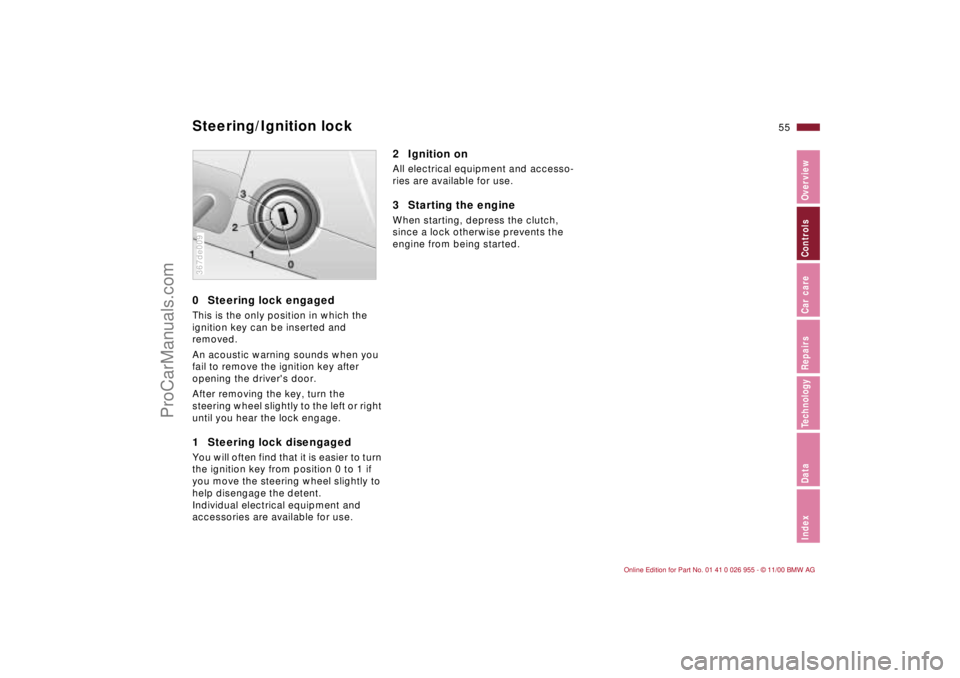
0 Steering lock engagedThis is the only position in which the
ignition key can be inserted and
removed.
An acoustic warning sounds when you
fail to remove the ignition key after
opening the driver's door.
After removing the key, turn the
steering wheel slightly to the left or right
until you hear the lock engage.1 Steering lock disengagedYou will often find that it is easier to turn
the ignition key from position 0 to 1 if
you move the steering wheel slightly to
help disengage the detent.
Individual electrical equipment and
accessories are available for use.367de009
2 Ignition onAll electrical equipment and accesso-
ries are available for use.3 Starting the engineWhen starting, depress the clutch,
since a lock otherwise prevents the
engine from being started.
Steering/Ignition lock
ProCarManuals.com
Page 63 of 171
63n
IndexDataTechnologyRepairsCar careControlsOverview
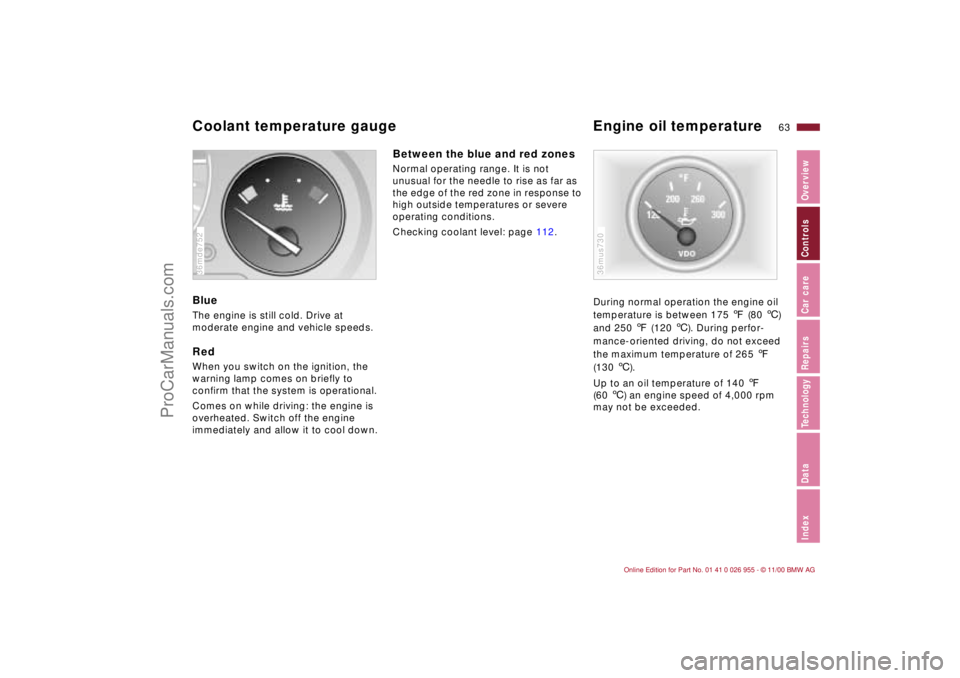
Coolant temperature gauge Engine oil temperatureBlueThe engine is still cold. Drive at
moderate engine and vehicle speeds.RedWhen you switch on the ignition, the
warning lamp comes on briefly to
confirm that the system is operational.
Comes on while driving: the engine is
overheated. Switch off the engine
immediately and allow it to cool down.36mde752
Between the blue and red zonesNormal operating range. It is not
unusual for the needle to rise as far as
the edge of the red zone in response to
high outside temperatures or severe
operating conditions.
Checking coolant level: page 112.
During normal operation the engine oil
temperature is between 175 7 (80 6)
and 250 7 (120 6). During perfor-
mance-oriented driving, do not exceed
the maximum temperature of 265 7
(130 6).
Up to an oil temperature of 140 7
(60 6) an engine speed of 4,000 rpm
may not be exceeded.
36mus730
ProCarManuals.com
Page 67 of 171
67n
IndexDataTechnologyRepairsCar careControlsOverview
Tire Pressure Warning (RDW)The conceptThe Tire Pressure Warning (RDW) moni-
tors the tire pressure in all four wheels
while driving. The system is designed to
detect whenever the inflation pressure
in a tire drops significantly, monitoring
the speed of the tires relative to each
other. A flat tire can be detected and
reported because its speed suddenly
deviates drastically from that of the
other tires.
Initializing the systemInitializing is necessary to familiarize the
system with the correct inflation pres-
sure.
Repeat this process after any changes
in tire inflation pressure, tire rotation or
replacement. Do not carry out further
system initialization after correcting the
inflation pressure and letting the system
"learn" what condition is required.
1 Check the tire inflation pressure in all
the tires, comparing them with the
inflation pressure table (page 27),
and adjusting their pressure if neces-
sary.
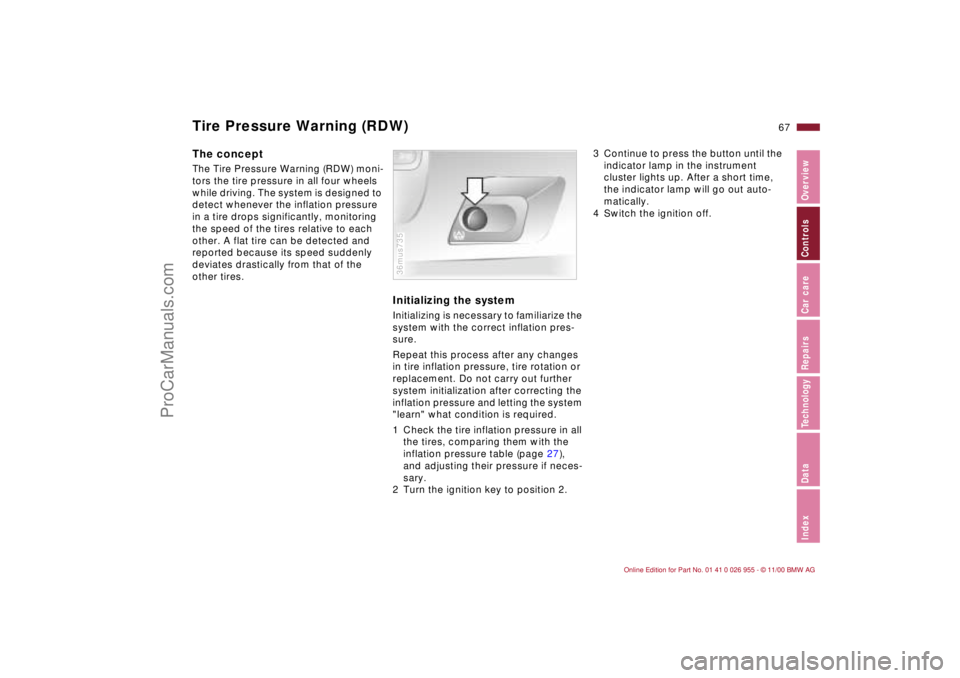
2 Turn the ignition key to position 2.36mus735
3 Continue to press the button until the
indicator lamp in the instrument
cluster lights up. After a short time,
the indicator lamp will go out auto-
matically.
4 Switch the ignition off.
ProCarManuals.com
Page 68 of 171
68n
Tire Pressure Warning (RDW)Activating/deactivating the
systemThe system is automatically active in
ignition key position 2 and is therefore
always on during driving.
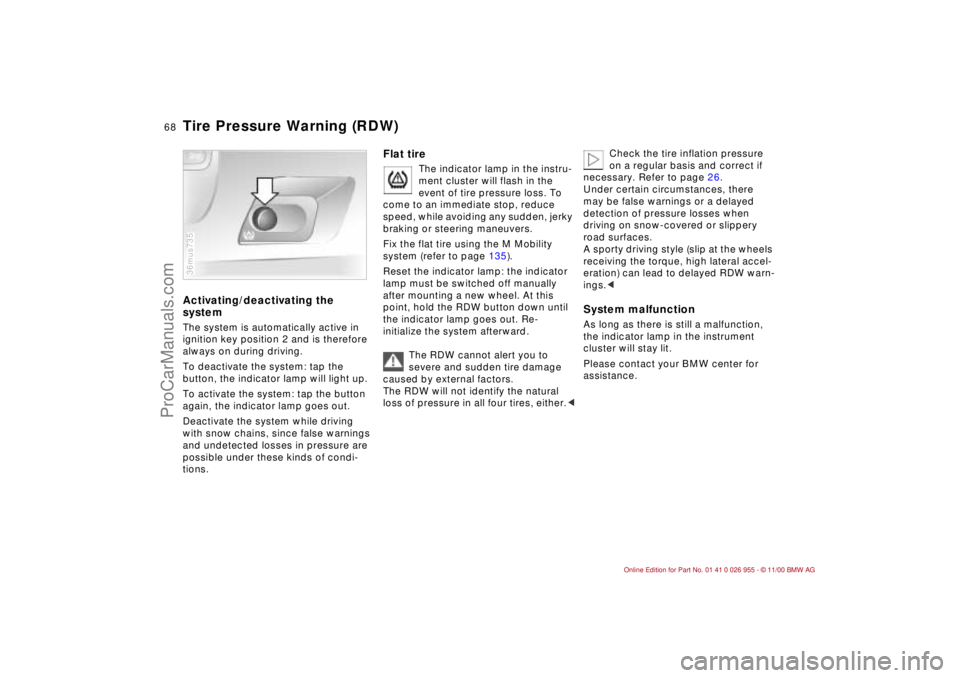
To deactivate the system: tap the
button, the indicator lamp will light up.
To activate the system: tap the button
again, the indicator lamp goes out.
Deactivate the system while driving
with snow chains, since false warnings
and undetected losses in pressure are
possible under these kinds of condi-
tions. 36mus735
Flat tire
The indicator lamp in the instru-
ment cluster will flash in the
event of tire pressure loss. To
come to an immediate stop, reduce
speed, while avoiding any sudden, jerky
braking or steering maneuvers.
Fix the flat tire using the M Mobility
system (refer to page 135).
Reset the indicator lamp: the indicator
lamp must be switched off manually
after mounting a new wheel. At this
point, hold the RDW button down until
the indicator lamp goes out. Re-
initialize the system afterward.
The RDW cannot alert you to
severe and sudden tire damage
caused by external factors.
The RDW will not identify the natural
loss of pressure in all four tires, either.<
Check the tire inflation pressure
on a regular basis and correct if
necessary. Refer to page 26.
Under certain circumstances, there
may be false warnings or a delayed
detection of pressure losses when
driving on snow-covered or slippery
road surfaces.
A sporty driving style (slip at the wheels
receiving the torque, high lateral accel-
eration) can lead to delayed RDW warn-
ings.<
System malfunctionAs long as there is still a malfunction,
the indicator lamp in the instrument
cluster will stay lit.
Please contact your BMW center for
assistance.
ProCarManuals.com
Page 69 of 171
69n
IndexDataTechnologyRepairsCar careControlsOverview
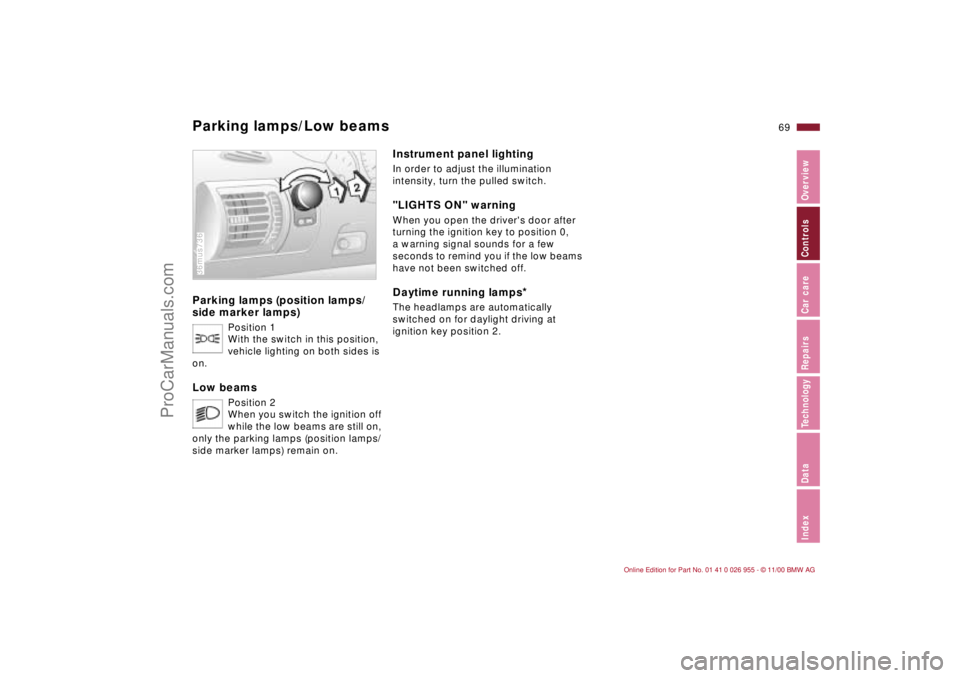
Parking lamps/Low beamsParking lamps (position lamps/
side marker lamps)
Position 1
With the switch in this position,
vehicle lighting on both sides is
on.
Low beams
Position 2
When you switch the ignition off
while the low beams are still on,
only the parking lamps (position lamps/
side marker lamps) remain on.
36mus736
Instrument panel lightingIn order to adjust the illumination
intensity, turn the pulled switch. "LIGHTS ON" warningWhen you open the driver's door after
turning the ignition key to position 0,
a warning signal sounds for a few
seconds to remind you if the low beams
have not been switched off.Daytime running lamps
*
The headlamps are automatically
switched on for daylight driving at
ignition key position 2.
ProCarManuals.com
Page 85 of 171
Overview
Controls and features
Operation, care
and maintenance
Owner service procedures
Technical data
Index Advanced technology
85n
IndexDataTechnologyRepairsCar careControlsOverview
Special operating instructions:
Break-in procedure86
Driving notes87
Catalytic converter88
Antilock Brake System (ABS)89
Disc brakes91
Brake system92
Winter operation93
Power steering94
Cellular phone95
Radio reception95
Hardtop – roadster96
Wheels and tires:
Notes on tire inflation
pressure98
Tire condition98
Tire replacement99
Tire rotation100
Wheel and tire
combinations101
Special features of winter
tires102
Snow chains102
Approved wheel and tire
specifications103Under the hood:
Hood104
Engine compartment106
Fluids for the washer
systems108
Washer nozzles108
Engine oil109
Coolant111
Brake fluid112
Vehicle Identification
Number113
Care and maintenance:
The BMW Maintenance
System114
Caring for your vehicle115
Airbags122
Storing your vehicle123
Laws and regulations:
Technical modifications124
California Proposition
65 Warning124
OBD connector125
Car care
ProCarManuals.com