catalytic converter BMW M ROADSTER COUPE 2001 Owners Manual
[x] Cancel search | Manufacturer: BMW, Model Year: 2001, Model line: M ROADSTER COUPE, Model: BMW M ROADSTER COUPE 2001Pages: 171, PDF Size: 1.98 MB
Page 11 of 171

11n
Controls and features
Operation, care and maintenance
Cabin convenience:
Glove compartment78
Storage compartments78
Storage boxes78
Beverage holder79
Ashtray79
Cigarette lighter80
Loading and transporting:
coupe:
Roll-up cover81
Partition net81
Cargo loading82
Roof-mounted luggage
rack83
Special operating instructions:
Break-in procedure86
Driving notes87
Catalytic converter88
Antilock Brake System (ABS)89
Disc brakes91
Brake system92
Winter operation93
Power steering94
Cellular phone95
Radio reception95
Hardtop – roadster96
Wheels and tires:
Notes on tire inflation
pressure98
Tire condition98
Tire replacement99
Tire rotation100
Wheel and tire
combinations101
Special features of winter
tires102
Snow chains102
Approved wheel and tire
specifications103
Under the hood:
Hood104
Engine compartment106
Fluids for the washer
systems108
Washer nozzles108
Engine oil109
Coolant111
Brake fluid112
Vehicle Identification
Number113
Care and maintenance:
The BMW Maintenance
System114
Caring for your vehicle115
Airbags122
Storing your vehicle123
Laws and regulations:
Technical modifications124
California Proposition
65 Warning124
OBD connector125
ProCarManuals.com
Page 26 of 171
26n
Refueling Fuel specifications Tire inflation pressure
When handling fuels, comply with
all of the applicable safety precau-
tions displayed at gas stations.
Never carry spare fuel containers in
your vehicle. Whether they are empty or
full, these containers can leak, cause an
explosion, or lead to fire in the event of
a collision.<
The engine uses lead-free gasoline
only.
Required fuel:
>Premium Unleaded Gasoline,
min. 91 AKI.
AKI = Anti Knock Index
Do not use leaded fuels. The use
of leaded fuels will cause perma-
nent damage to the system's oxygen
sensor and the catalytic converter.<
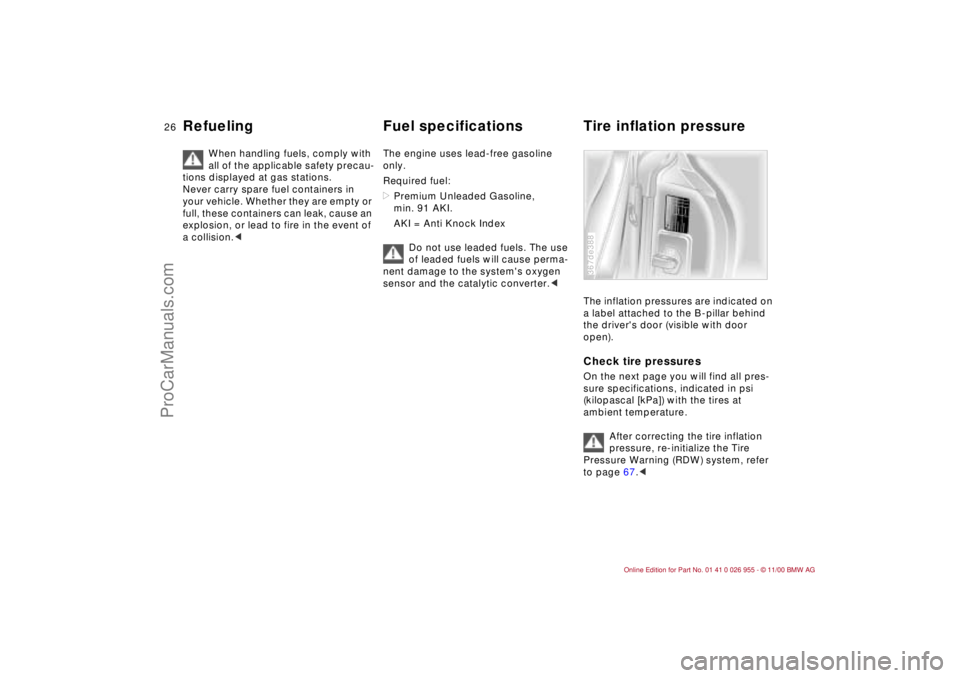
The inflation pressures are indicated on
a label attached to the B-pillar behind
the driver's door (visible with door
open).Check tire pressuresOn the next page you will find all pres-
sure specifications, indicated in psi
(kilopascal [kPa]) with the tires at
ambient temperature.
After correcting the tire inflation
pressure, re-initialize the Tire
Pressure Warning (RDW) system, refer
to page 67.<367de388
ProCarManuals.com
Page 62 of 171
62n
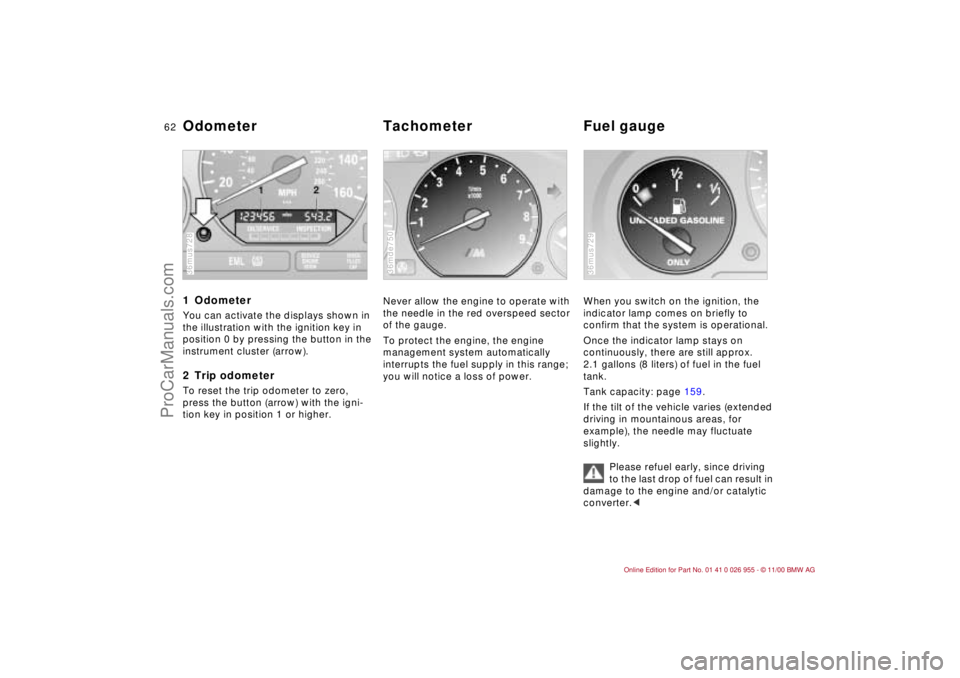
1 OdometerYou can activate the displays shown in
the illustration with the ignition key in
position 0 by pressing the button in the
instrument cluster (arrow).2 Trip odometerTo reset the trip odometer to zero,
press the button (arrow) with the igni-
tion key in position 1 or higher.36mus728
Never allow the engine to operate with
the needle in the red overspeed sector
of the gauge.
To protect the engine, the engine
management system automatically
interrupts the fuel supply in this range;
you will notice a loss of power.36mde750
When you switch on the ignition, the
indicator lamp comes on briefly to
confirm that the system is operational.
Once the indicator lamp stays on
continuously, there are still approx.
2.1 gallons (8 liters) of fuel in the fuel
tank.
Tank capacity: page 159.
If the tilt of the vehicle varies (extended
driving in mountainous areas, for
example), the needle may fluctuate
slightly.
Please refuel early, since driving
to the last drop of fuel can result in
damage to the engine and/or catalytic
converter.< 36mus729
Odometer Tachometer Fuel gauge
ProCarManuals.com
Page 85 of 171
Overview
Controls and features
Operation, care
and maintenance
Owner service procedures
Technical data
Index Advanced technology
85n
IndexDataTechnologyRepairsCar careControlsOverview
Special operating instructions:
Break-in procedure86
Driving notes87
Catalytic converter88
Antilock Brake System (ABS)89
Disc brakes91
Brake system92
Winter operation93
Power steering94
Cellular phone95
Radio reception95
Hardtop – roadster96
Wheels and tires:
Notes on tire inflation
pressure98
Tire condition98
Tire replacement99
Tire rotation100
Wheel and tire
combinations101
Special features of winter
tires102
Snow chains102
Approved wheel and tire
specifications103Under the hood:
Hood104
Engine compartment106
Fluids for the washer
systems108
Washer nozzles108
Engine oil109
Coolant111
Brake fluid112
Vehicle Identification
Number113
Care and maintenance:
The BMW Maintenance
System114
Caring for your vehicle115
Airbags122
Storing your vehicle123
Laws and regulations:
Technical modifications124
California Proposition
65 Warning124
OBD connector125
Car care
ProCarManuals.com
Page 88 of 171

88n
Catalytic converterThe catalytic converter reduces harmful
exhaust emissions.
It is designed for use with unleaded fuel
only. Even minute quantities of lead
would be enough to permanently
damage both the catalytic converter
and the system's oxygen sensor.
To ensure efficient, trouble-free engine
operation and to avoid potential
damage:
>Be sure to comply with the scheduled
maintenance requirements.
>Fill the fuel tank well before it is
empty.
>Tow-start the vehicle only when the
engine is cold. Tow-starting when the
engine is warm could cause unburned
fuel to ignite to the catalytic converter,
resulting in significant damage. It is
better to start the vehicle with an
outside starting aid.>Avoid any other situations in which
the fuel would not be (completely)
burned, for instance:
Frequent or consecutive extended
starting attempts or repeated starting
attempts when the engine fails to
start. (Shutting down and restarting
an engine which is running properly
does not present a problem.)
Never let the engine run with any of
the spark plug connectors discon-
nected.Be sure to comply with the
instructions above to prevent
unburned fuel from reaching the cata-
lytic converter. This could cause over-
heating, leading to serious damage to
the catalytic converter.
Extreme temperatures occur at the
catalytic converter on this and every
catalyst-equipped vehicle. Heat shields
are installed adjacent to some sections
of the exhaust system. Never remove
these shields; do not apply under-
coating to their surfaces.
When driving, standing while the engine
is idling, or when parking, be careful to
avoid contact between the hot exhaust
system and easily-flammable materials
(hay, dry grass, leaves, etc.). Such
contact could cause a fire, resulting in
personal injuries and property
damage.<
ProCarManuals.com
Page 125 of 171
125n
IndexDataTechnologyRepairsCar careControlsOverview
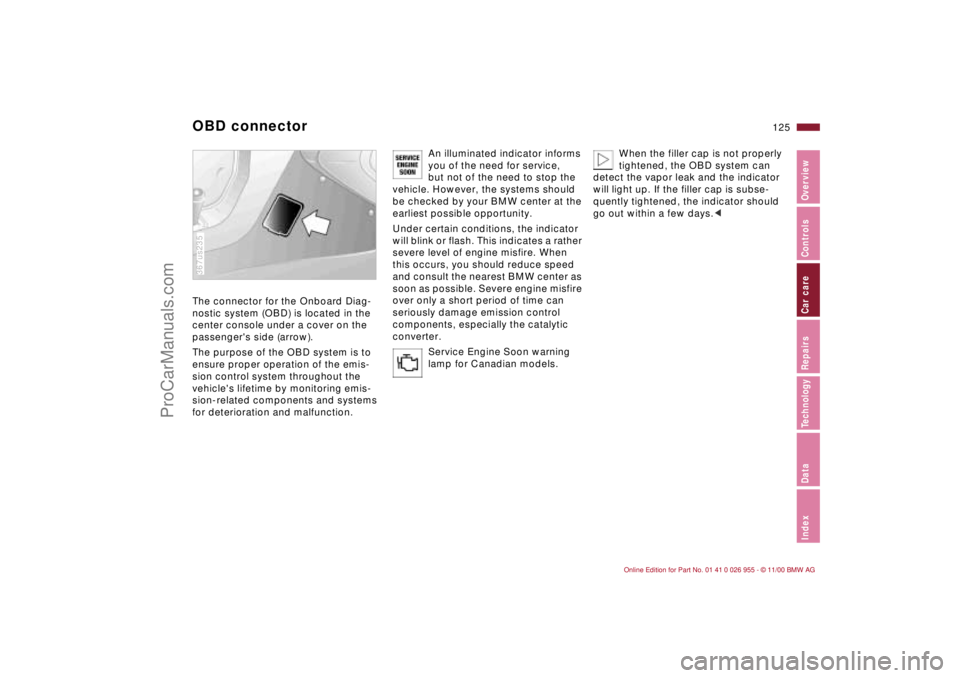
OBD connectorThe connector for the Onboard Diag-
nostic system (OBD) is located in the
center console under a cover on the
passenger's side (arrow).
The purpose of the OBD system is to
ensure proper operation of the emis-
sion control system throughout the
vehicle's lifetime by monitoring emis-
sion-related components and systems
for deterioration and malfunction.367us235
An illuminated indicator informs
you of the need for service,
but not of the need to stop the
vehicle. However, the systems should
be checked by your BMW center at the
earliest possible opportunity.
Under certain conditions, the indicator
will blink or flash. This indicates a rather
severe level of engine misfire. When
this occurs, you should reduce speed
and consult the nearest BMW center as
soon as possible. Severe engine misfire
over only a short period of time can
seriously damage emission control
components, especially the catalytic
converter.
Service Engine Soon warning
lamp for Canadian models.
When the filler cap is not properly
tightened, the OBD system can
detect the vapor leak and the indicator
will light up. If the filler cap is subse-
quently tightened, the indicator should
go out within a few days.<
ProCarManuals.com
Page 164 of 171
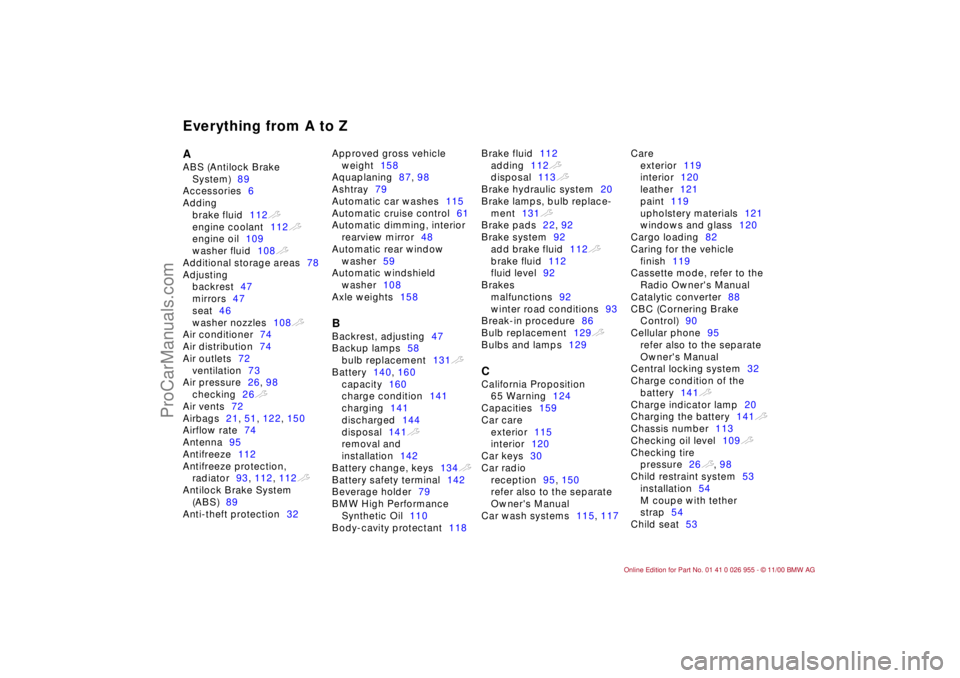
Everything from A to ZAABS (Antilock Brake
System)89
Accessories6
Adding
brake fluid112t
engine coolant112t
engine oil109
washer fluid108t
Additional storage areas78
Adjusting
backrest47
mirrors47
seat46
washer nozzles108t
Air conditioner74
Air distribution74
Air outlets72
ventilation73
Air pressure26, 98
checking26t
Air vents72
Airbags21, 51, 122, 150
Airflow rate74
Antenna95
Antifreeze112
Antifreeze protection,
radiator93, 112, 112t
Antilock Brake System
(ABS)89
Anti-theft protection32Approved gross vehicle
weight158
Aquaplaning87, 98
Ashtray79
Automatic car washes115
Automatic cruise control61
Automatic dimming, interior
rearview mirror48
Automatic rear window
washer59
Automatic windshield
washer108
Axle weights158
BBackrest, adjusting47
Backup lamps58
bulb replacement131t
Battery140, 160
capacity160
charge condition141
charging141
discharged144
disposal141t
removal and
installation142
Battery change, keys134t
Battery safety terminal142
Beverage holder79
BMW High Performance
Synthetic Oil110
Body-cavity protectant118Brake fluid112
adding112t
disposal113t
Brake hydraulic system20
Brake lamps, bulb replace-
ment131t
Brake pads22, 92
Brake system92
add brake fluid112t
brake fluid112
fluid level92
Brakes
malfunctions92
winter road conditions93
Break-in procedure86
Bulb replacement129t
Bulbs and lamps129
CCalifornia Proposition
65 Warning124
Capacities159
Car care
exterior115
interior120
Car keys30
Car radio
reception95, 150
refer also to the separate
Owner's Manual
Car wash systems115, 117Care
exterior119
interior120
leather121
paint119
upholstery materials121
windows and glass120
Cargo loading82
Caring for the vehicle
finish119
Cassette mode, refer to the
Radio Owner's Manual
Catalytic converter88
CBC (Cornering Brake
Control)90
Cellular phone95
refer also to the separate
Owner's Manual
Central locking system32
Charge condition of the
battery141t
Charge indicator lamp20
Charging the battery141t
Chassis number113
Checking oil level109t
Checking tire
pressure26t, 98
Child restraint system53
installation54
M coupe with tether
strap54
Child seat53
ProCarManuals.com