check engine BMW M ROADSTER COUPE 2001 Owners Manual
[x] Cancel search | Manufacturer: BMW, Model Year: 2001, Model line: M ROADSTER COUPE, Model: BMW M ROADSTER COUPE 2001Pages: 171, PDF Size: 1.98 MB
Page 19 of 171

19n
IndexDataTechnologyRepairsCar careControlsOverview
Instrument cluster
1 Fuel gauge with indicator lamp
for reserve range62
2 Indicator lamp for turn signals23
3 Speedometer
4 Indicator and warning lamps for:
>
Battery charge current20
>
High beams23
>
Engine oil pressure20
5 Tachometer62
6 Coolant temperature gauge63
Also refer to Engine oil temperature
gauge on page63
7 Indicator and warning lamps for:
>
Brake pad wear22
>
Brake hydraulic
system/Cornering Brake Control
(CBC)20, 21
>
Parking brake21
>
Airbags21
8 Indicator and warning lamps for:
>
Service Engine Soon22
>
Check Filler Cap22
>
Safety belts21
>
Engine oil level22
>
Antilock Brake System (ABS)22
9 Indicator lamp for Dynamic Stability
Control (DSC)21, 2210 Trip odometer62
11 Service Interval Display64, 114
12 Odometer62
13 Indicator and warning lamps for:
>
Engine electronics22
>
Tire Pressure Warning
(RDW)21, 22
14 Trip odometer reset button62
The illustration shows the instrument
cluster in the US version. In the Cana-
dian models, some of the indicator and
warning lamps have a different appear-
ance. Refer to pages 20 to 23.
ProCarManuals.com
Page 20 of 171
20n
Indicator and warning lamps
Technology that monitors itself
Many of the systems of your BMW
monitor themselves automatically, both
during engine starts and while you are
driving. Indicator and warning lamps
that are identified by "
l
" are tested for
proper functioning whenever the igni-
tion key is turned. They each light up
once for different periods of time.
If a fault should occur in one of these
systems, the corresponding lamp does
not go out after the engine is started or
it lights up while the vehicle is moving.
You will see how to react to this below.
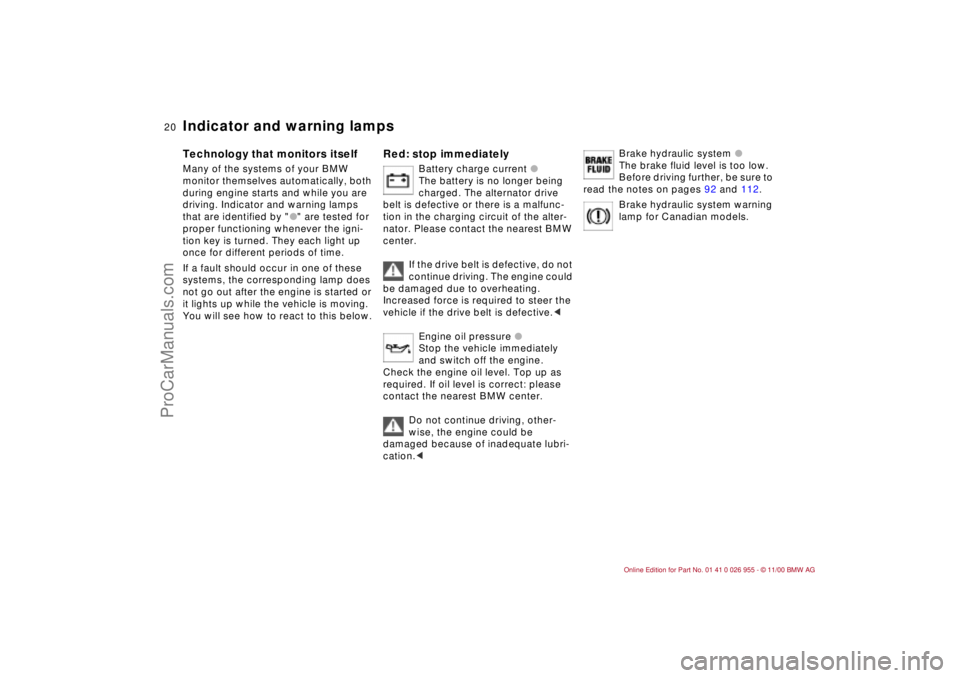
Red: stop immediately
Battery charge current
l
The battery is no longer being
charged. The alternator drive
belt is defective or there is a malfunc-
tion in the charging circuit of the alter-
nator. Please contact the nearest BMW
center.
If the drive belt is defective, do not
continue driving. The engine could
be damaged due to overheating.
Increased force is required to steer the
vehicle if the drive belt is defective.
<
Engine oil pressure
l
Stop the vehicle immediately
and switch off the engine.
Check the engine oil level. Top up as
required. If oil level is correct: please
contact the nearest BMW center.
Do not continue driving, other-
wise, the engine could be
damaged because of inadequate lubri-
cation.
<
Brake hydraulic system
l
The brake fluid level is too low.
Before driving further, be sure to
read the notes on pages 92 and 112.
Brake hydraulic system warning
lamp for Canadian models.
ProCarManuals.com
Page 22 of 171
22n
Indicator and warning lamps
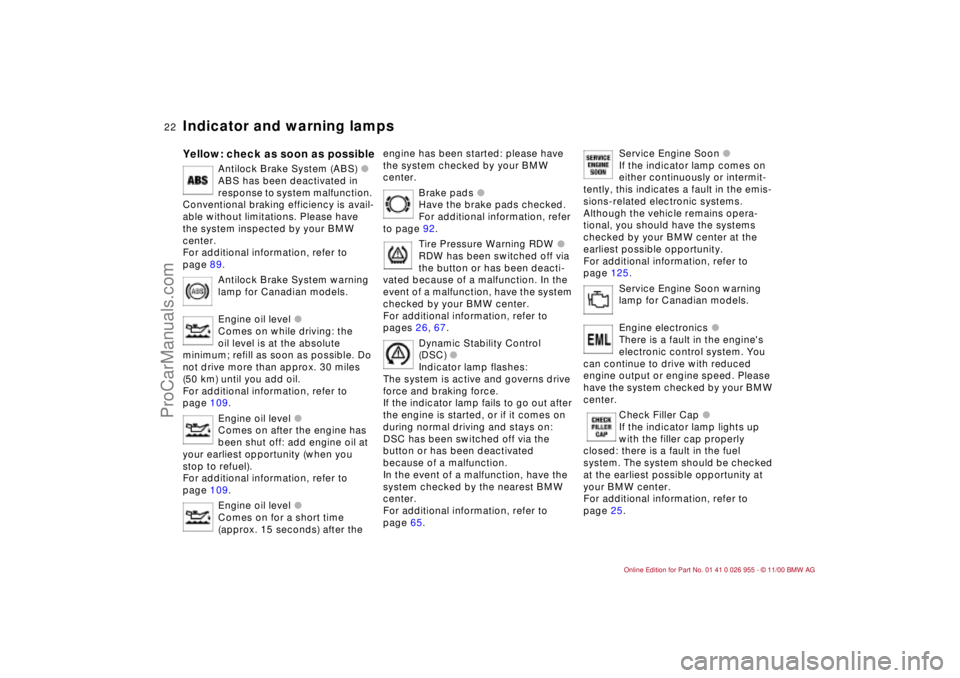
Yellow: check as soon as possible
Antilock Brake System (ABS)
l
ABS has been deactivated in
response to system malfunction.
Conventional braking efficiency is avail-
able without limitations. Please have
the system inspected by your BMW
center.
For additional information, refer to
page 89.
Antilock Brake System warning
lamp for Canadian models.
Engine oil level
l
Comes on while driving: the
oil level is at the absolute
minimum; refill as soon as possible. Do
not drive more than approx. 30 miles
(50 km) until you add oil.
For additional information, refer to
page 109.
Engine oil level
l
Comes on after the engine has
been shut off: add engine oil at
your earliest opportunity (when you
stop to refuel).
For additional information, refer to
page 109.
Engine oil level
l
Comes on for a short time
(approx. 15 seconds) after the
engine has been started: please have
the system checked by your BMW
center.
Brake pads
l
Have the brake pads checked.
For additional information, refer
to page 92.
Tire Pressure Warning RDW
l
RDW has been switched off via
the button or has been deacti-
vated because of a malfunction. In the
event of a malfunction, have the system
checked by your BMW center.
For additional information, refer to
pages 26, 67.
Dynamic Stability Control
(DSC)
l
Indicator lamp flashes:
The system is active and governs drive
force and braking force.
If the indicator lamp fails to go out after
the engine is started, or if it comes on
during normal driving and stays on:
DSC has been switched off via the
button or has been deactivated
because of a malfunction.
In the event of a malfunction, have the
system checked by the nearest BMW
center.
For additional information, refer to
page 65.
Service Engine Soon
l
If the indicator lamp comes on
either continuously or intermit-
tently, this indicates a fault in the emis-
sions-related electronic systems.
Although the vehicle remains opera-
tional, you should have the systems
checked by your BMW center at the
earliest possible opportunity.
For additional information, refer to
page 125.
Service Engine Soon warning
lamp for Canadian models.
Engine electronics
l
There is a fault in the engine's
electronic control system. You
can continue to drive with reduced
engine output or engine speed. Please
have the system checked by your BMW
center.
Check Filler Cap
l
If the indicator lamp lights up
with the filler cap properly
closed: there is a fault in the fuel
system. The system should be checked
at the earliest possible opportunity at
your BMW center.
For additional information, refer to
page 25.
ProCarManuals.com
Page 25 of 171
25n
IndexDataTechnologyRepairsCar careControlsOverview
First-aid kit
*
Refueling
M coupeIn the luggage compartment at the left
rear. Release the Velcro
® fasteners.
M roadsterIn the luggage compartment on the left
in a storage area; swing retaining strap
upward.
Some of the articles in the first-aid
kit may be used within a limited
time only. For this reason, check the
expiration dates of each of the items
regularly, and replace any whose expi-
ration dates have passed. You can
acquire replacements in any drugstore
or pharmacy.
Comply with legal requirements which
cover availability of a first-aid kit in the
vehicle.<
Before filling the tank, shut off the
engine, as otherwise fuel cannot
flow into the tank and the Service
Engine Soon warning lamp may come
on. Refer to page 22.<
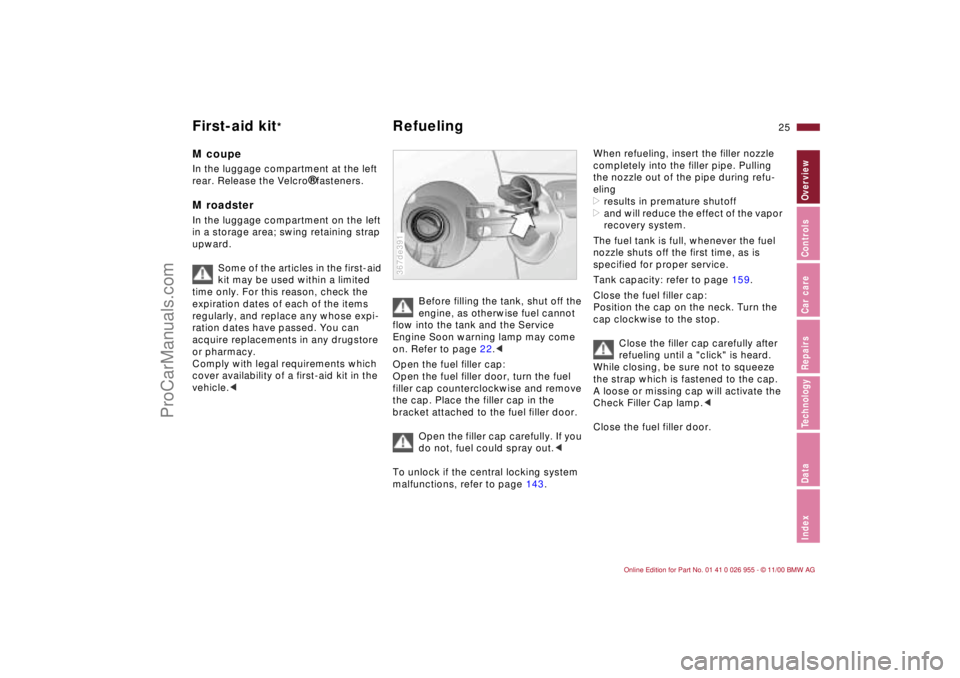
Open the fuel filler cap:
Open the fuel filler door, turn the fuel
filler cap counterclockwise and remove
the cap. Place the filler cap in the
bracket attached to the fuel filler door.
Open the filler cap carefully. If you
do not, fuel could spray out.<
To unlock if the central locking system
malfunctions, refer to page 143.
367de391
When refueling, insert the filler nozzle
completely into the filler pipe. Pulling
the nozzle out of the pipe during refu-
eling
>results in premature shutoff
>and will reduce the effect of the vapor
recovery system.
The fuel tank is full, whenever the fuel
nozzle shuts off the first time, as is
specified for proper service.
Tank capacity: refer to page 159.
Close the fuel filler cap:
Position the cap on the neck. Turn the
cap clockwise to the stop.
Close the filler cap carefully after
refueling until a "click" is heard.
While closing, be sure not to squeeze
the strap which is fastened to the cap.
A loose or missing cap will activate the
Check Filler Cap lamp.<
Close the fuel filler door.
ProCarManuals.com
Page 26 of 171
26n
Refueling Fuel specifications Tire inflation pressure
When handling fuels, comply with
all of the applicable safety precau-
tions displayed at gas stations.
Never carry spare fuel containers in
your vehicle. Whether they are empty or
full, these containers can leak, cause an
explosion, or lead to fire in the event of
a collision.<
The engine uses lead-free gasoline
only.
Required fuel:
>Premium Unleaded Gasoline,
min. 91 AKI.
AKI = Anti Knock Index
Do not use leaded fuels. The use
of leaded fuels will cause perma-
nent damage to the system's oxygen
sensor and the catalytic converter.<
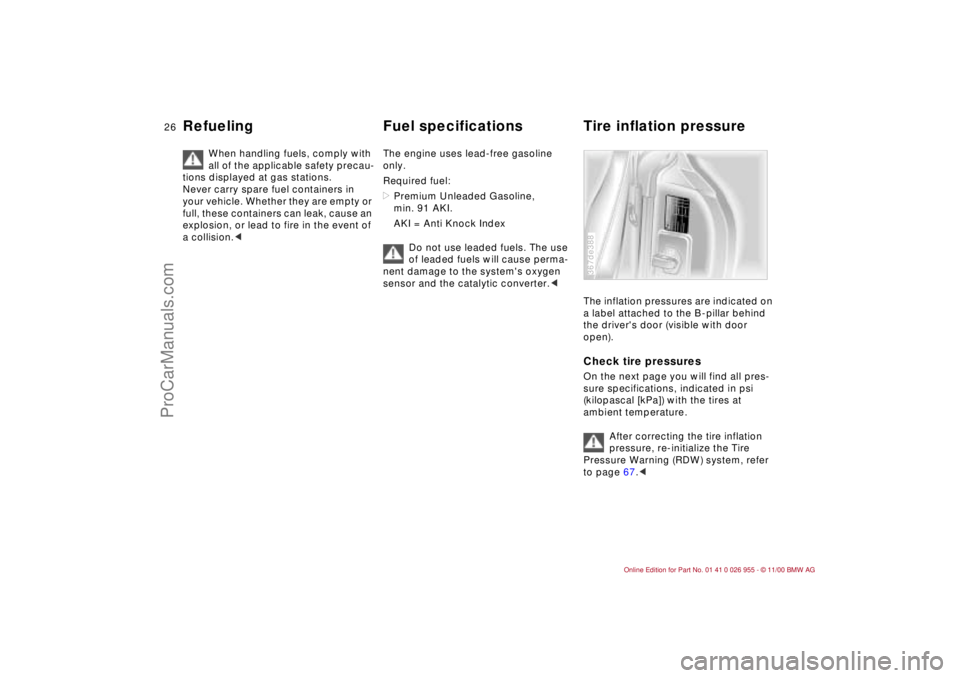
The inflation pressures are indicated on
a label attached to the B-pillar behind
the driver's door (visible with door
open).Check tire pressuresOn the next page you will find all pres-
sure specifications, indicated in psi
(kilopascal [kPa]) with the tires at
ambient temperature.
After correcting the tire inflation
pressure, re-initialize the Tire
Pressure Warning (RDW) system, refer
to page 67.<367de388
ProCarManuals.com
Page 63 of 171
63n
IndexDataTechnologyRepairsCar careControlsOverview
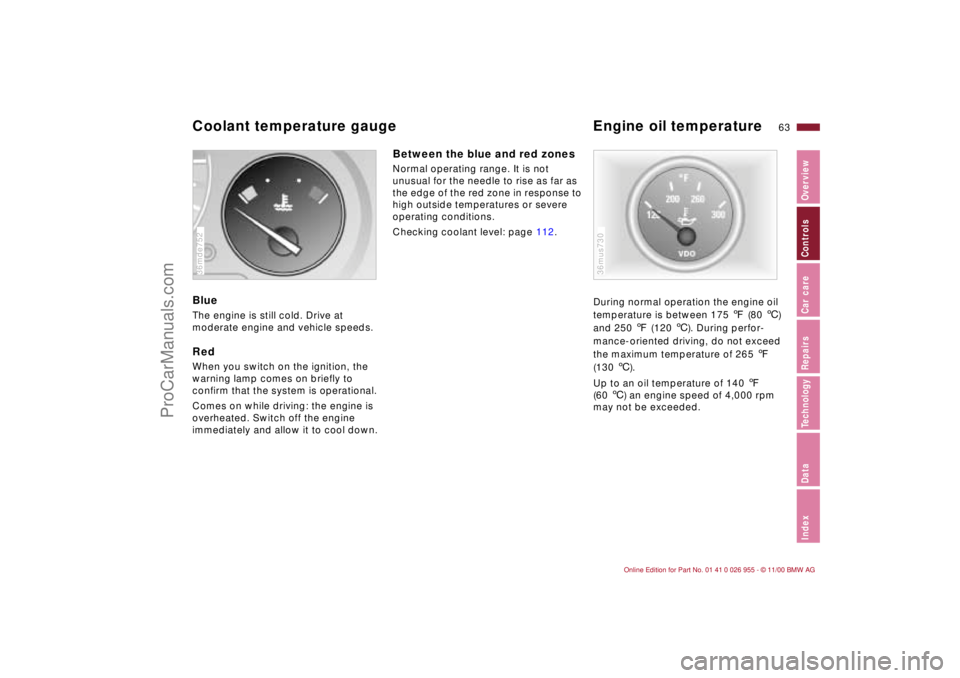
Coolant temperature gauge Engine oil temperatureBlueThe engine is still cold. Drive at
moderate engine and vehicle speeds.RedWhen you switch on the ignition, the
warning lamp comes on briefly to
confirm that the system is operational.
Comes on while driving: the engine is
overheated. Switch off the engine
immediately and allow it to cool down.36mde752
Between the blue and red zonesNormal operating range. It is not
unusual for the needle to rise as far as
the edge of the red zone in response to
high outside temperatures or severe
operating conditions.
Checking coolant level: page 112.
During normal operation the engine oil
temperature is between 175 7 (80 6)
and 250 7 (120 6). During perfor-
mance-oriented driving, do not exceed
the maximum temperature of 265 7
(130 6).
Up to an oil temperature of 140 7
(60 6) an engine speed of 4,000 rpm
may not be exceeded.
36mus730
ProCarManuals.com
Page 90 of 171
90n
Antilock Brake System (ABS)Information for your safetyNot even ABS can suspend the laws
of physics. ABS alone cannot prevent
accidents if the brakes are applied
without an adequate, safe distance
between vehicles or if the speed limit
has been exceeded. Nor can it prevent
the hazards of aquaplaning. Responsi-
bility for these types of situations
remains in the hands (and at the feet) of
the driver. You should never allow the
added safety of ABS to lull you into a
false sense of security, or mislead you
into taking increased risks that could
affect your own safety and that of
others.
Do not make any modifications to
the ABS system.
Service procedures on ABS are to be
performed by authorized technicians
only.< Antilock Brake System (ABS)/
Cornering Brake Control (CBC)CBC is an advanced engineering
feature of the ABS. When braking while
cornering at high speed or braking
during high lateral acceleration, or
when braking during a lane change,
vehicle stability is improved and
steering response is enhanced.
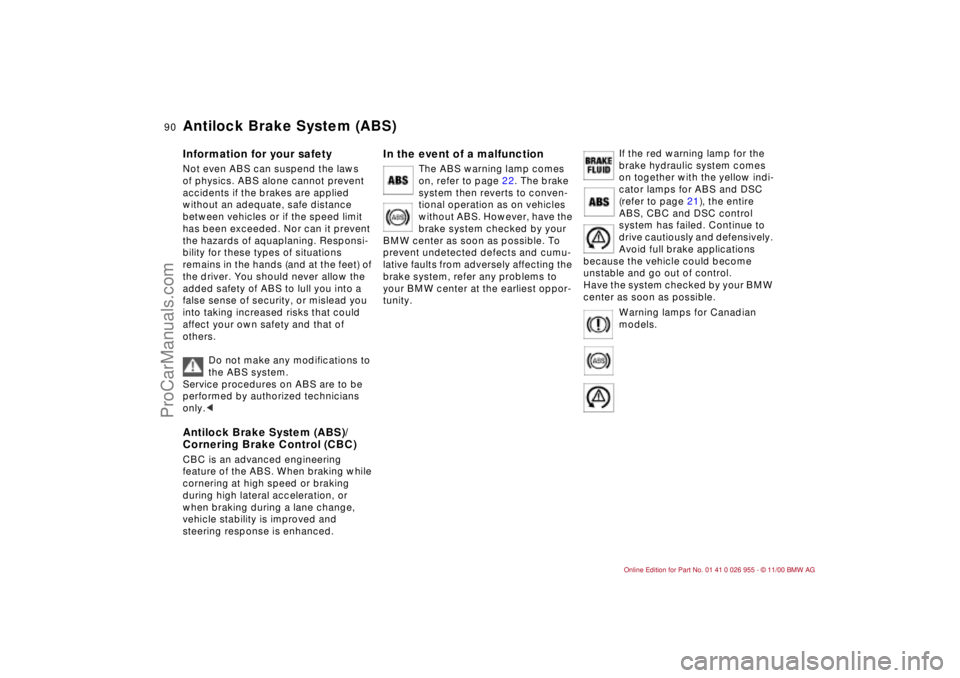
In the event of a malfunction
The ABS warning lamp comes
on, refer to page 22. The brake
system then reverts to conven-
tional operation as on vehicles
without ABS. However, have the
brake system checked by your
BMW center as soon as possible. To
prevent undetected defects and cumu-
lative faults from adversely affecting the
brake system, refer any problems to
your BMW center at the earliest oppor-
tunity.
If the red warning lamp for the
brake hydraulic system comes
on together with the yellow indi-
cator lamps for ABS and DSC
(refer to page 21), the entire
ABS, CBC and DSC control
system has failed. Continue to
drive cautiously and defensively.
Avoid full brake applications
because the vehicle could become
unstable and go out of control.
Have the system checked by your BMW
center as soon as possible.
Warning lamps for Canadian
models.
ProCarManuals.com
Page 109 of 171
109n
IndexDataTechnologyRepairsCar careControlsOverview
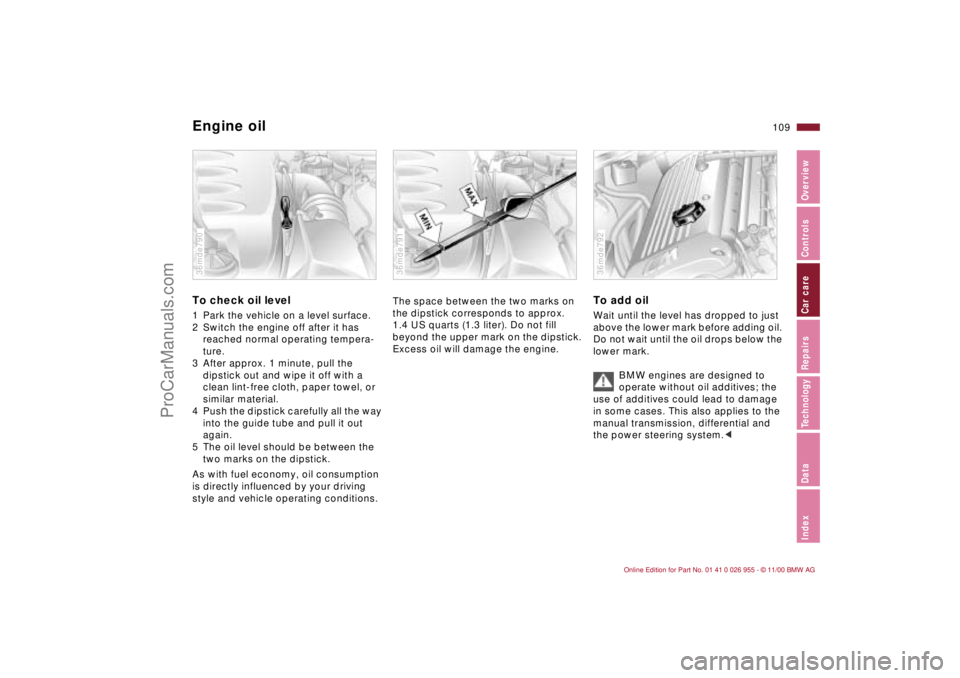
Engine oil To check oil level1 Park the vehicle on a level surface.
2 Switch the engine off after it has
reached normal operating tempera-
ture.
3 After approx. 1 minute, pull the
dipstick out and wipe it off with a
clean lint-free cloth, paper towel, or
similar material.
4 Push the dipstick carefully all the way
into the guide tube and pull it out
again.
5 The oil level should be between the
two marks on the dipstick.
As with fuel economy, oil consumption
is directly influenced by your driving
style and vehicle operating conditions.36mde790
The space between the two marks on
the dipstick corresponds to approx.
1.4 US quarts (1.3 liter). Do not fill
beyond the upper mark on the dipstick.
Excess oil will damage the engine.36mde791
To add oilWait until the level has dropped to just
above the lower mark before adding oil.
Do not wait until the oil drops below the
lower mark.
BMW engines are designed to
operate without oil additives; the
use of additives could lead to damage
in some cases. This also applies to the
manual transmission, differential and
the power steering system.< 36mde792
ProCarManuals.com
Page 112 of 171
112n
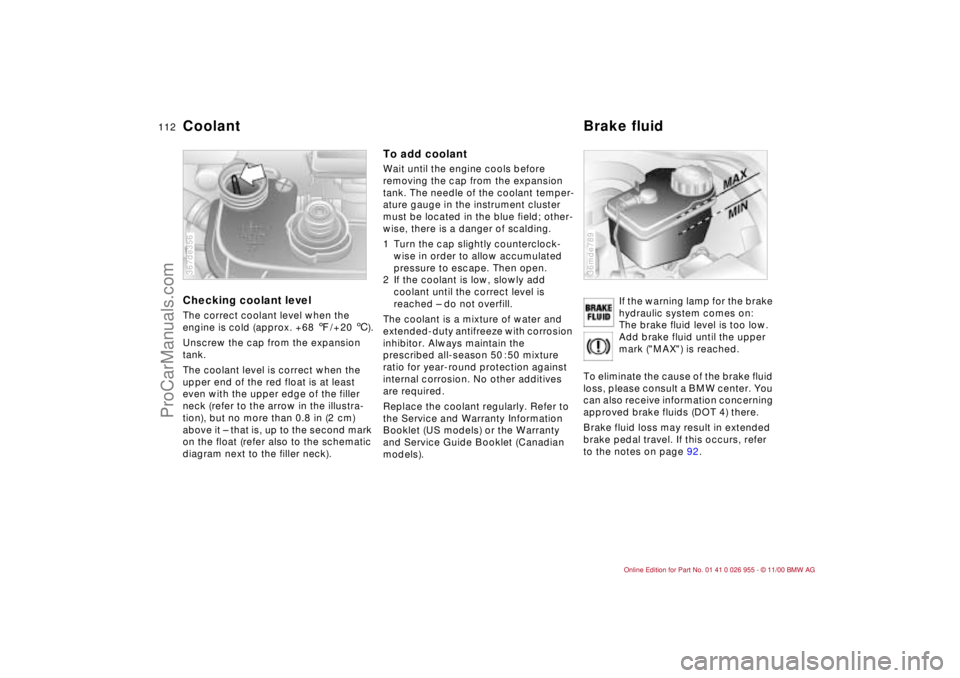
Coolant Brake fluid Checking coolant levelThe correct coolant level when the
engine is cold (approx. +68 7/+20 6).
Unscrew the cap from the expansion
tank.
The coolant level is correct when the
upper end of the red float is at least
even with the upper edge of the filler
neck (refer to the arrow in the illustra-
tion), but no more than 0.8 in (2 cm)
above it – that is, up to the second mark
on the float (refer also to the schematic
diagram next to the filler neck).367de356
To add coolantWait until the engine cools before
removing the cap from the expansion
tank. The needle of the coolant temper-
ature gauge in the instrument cluster
must be located in the blue field; other-
wise, there is a danger of scalding.
1 Turn the cap slightly counterclock-
wise in order to allow accumulated
pressure to escape. Then open.
2 If the coolant is low, slowly add
coolant until the correct level is
reached – do not overfill.
The coolant is a mixture of water and
extended-duty antifreeze with corrosion
inhibitor. Always maintain the
prescribed all-season 50 : 50 mixture
ratio for year-round protection against
internal corrosion. No other additives
are required.
Replace the coolant regularly. Refer to
the Service and Warranty Information
Booklet (US models) or the Warranty
and Service Guide Booklet (Canadian
models).If the warning lamp for the brake
hydraulic system comes on:
The brake fluid level is too low.
Add brake fluid until the upper
mark ("MAX") is reached.
To eliminate the cause of the brake fluid
loss, please consult a BMW center. You
can also receive information concerning
approved brake fluids (DOT 4) there.
Brake fluid loss may result in extended
brake pedal travel. If this occurs, refer
to the notes on page 92.
36mde789
ProCarManuals.com
Page 123 of 171

123n
IndexDataTechnologyRepairsCar careControlsOverview
Storing your vehicle
If you intend to store the vehicle
for longer than three months, have
the maintenance operations described
on this page performed.<
Preparation for storageHave the following operations
performed by your BMW center:
1 Clean and apply a rustproofing agent
or other treatment to the engine,
engine compartment, undercarriage,
axles and major components in
accordance with approved repair
procedures. Wash the vehicle, clean
the interior and treat painted and
chromed parts. Clean the rubber
seals around the hood, luggage
compartment and doors.
2 Change the engine oil and oil filter
with the engine at operating tempera-
ture. As an additional corrosion
protection measure, a corrosion
inhibitor can be added to the engine
in accordance with the manufac-
turer's instructions.
3 Check the coolant level and concen-
tration and top up if necessary.
4 Check the fluid level of the wind-
shield washer fluid reservoir; top up if
necessary.
5 Fill the fuel tank completely to
prevent the formation of condensa-
tion.
6 Increase the tire inflation pressure to
51 psi (350 kPa).Before parking the vehicle for
storage1 Dry the parking brake and footbrake
by brake applications to prevent the
brake discs and drums from
corroding.
2 Park the vehicle in a covered, dry,
and well-ventilated room. Place the
transmission in 1st gear. Chock the
wheels to prevent the vehicle from
rolling if necessary. Do not apply the
parking brake.
3 Remove the battery, charge it
completely and store it in a cool (but
frost-free) room.
M roadster:
4 Remove the hardtop
* and store it
separately. Refer to page 97.
5 Close the convertible top.
During storageRecharge the battery every six months.
If it is not recharged, it will not be
serviceable. Every time the battery is
discharged, especially over extended
periods, its service life is reduced.Removing the vehicle from
storageRecharge the battery if the "Magic Eye"
turns black. Refer to page 141.
Then have Inspection I performed by
your BMW center, including a brake
fluid replacement if necessary. Refer to
the Service Manual.
ProCarManuals.com