towing BMW M ROADSTER COUPE 2001 Owners Manual
[x] Cancel search | Manufacturer: BMW, Model Year: 2001, Model line: M ROADSTER COUPE, Model: BMW M ROADSTER COUPE 2001Pages: 171, PDF Size: 1.98 MB
Page 12 of 171

Contents
Owner service procedures
Advanced technology
Technical data
Replacement procedures:
Onboard tool kit128
Windshield wiper blades128
Lamps and bulbs129
Master key with battery-
powered lamp134
Changing a wheel135
Repairing a flat tire135
Battery140
Fuses142
In case of electrical
malfunction:
Power convertible top143
Fuel filler door143
Assistance, giving and
receiving:
Jump-starting144
Towing the vehicle145Airbags150
Radio reception150
Dynamic Stability Control
(DSC)151
Safety belt tensioner151
Interior rearview mirror with
automatic dimming
feature152
Limited slip differential153Engine specifications156
Dimensions157
Weights158
Capacities159
Electrical system160
Drive belts160
ProCarManuals.com
Page 82 of 171
82n
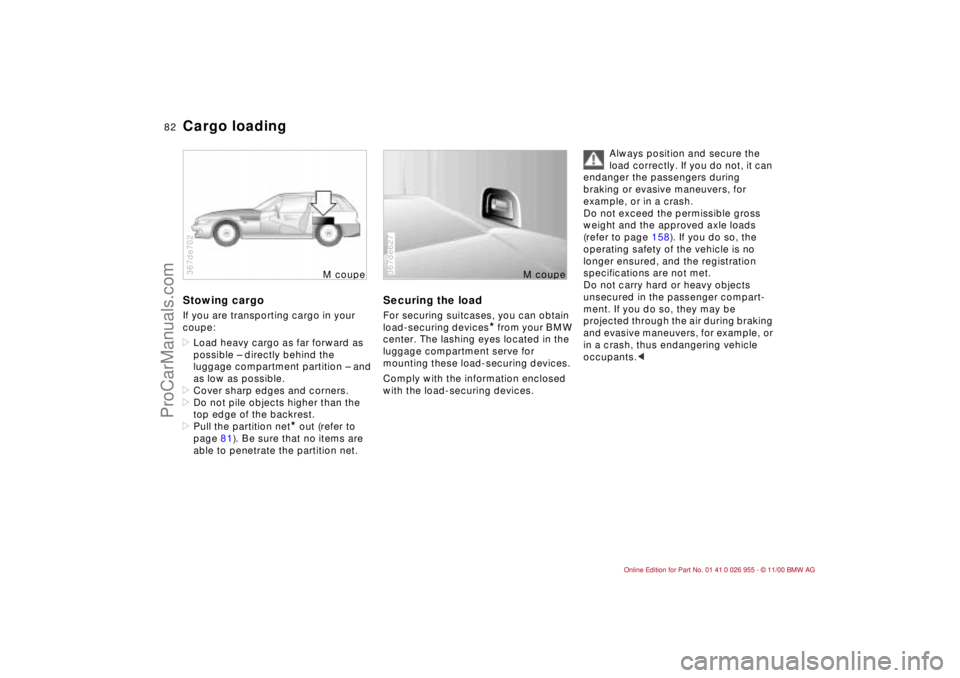
Cargo loadingStowing cargoIf you are transporting cargo in your
coupe:
>Load heavy cargo as far forward as
possible – directly behind the
luggage compartment partition – and
as low as possible.
>Cover sharp edges and corners.
>Do not pile objects higher than the
top edge of the backrest.
>Pull the partition net
* out (refer to
page 81). Be sure that no items are
able to penetrate the partition net.
367de702
M cou
pe
Securing the loadFor securing suitcases, you can obtain
load-securing devices
* from your BMW
center. The lashing eyes located in the
luggage compartment serve for
mounting these load-securing devices.
Comply with the information enclosed
with the load-securing devices.
367de627
M cou
pe
Always position and secure the
load correctly. If you do not, it can
endanger the passengers during
braking or evasive maneuvers, for
example, or in a crash.
Do not exceed the permissible gross
weight and the approved axle loads
(refer to page 158). If you do so, the
operating safety of the vehicle is no
longer ensured, and the registration
specifications are not met.
Do not carry hard or heavy objects
unsecured in the passenger compart-
ment. If you do so, they may be
projected through the air during braking
and evasive maneuvers, for example, or
in a crash, thus endangering vehicle
occupants.<
ProCarManuals.com
Page 86 of 171

86n
To ensure that your vehicle provides
maximum economy throughout a long
service life, we request that you
observe the following:
Engine and differentialUp to 1,200 miles (2,000 km):
Drive with varying engine and road
speeds, but do not exceed 4,500 rpm
or 100 mph (150 km/h).
Comply with local and state maximum
speed limits.
Refrain from using full throttle and avoid
pressing the accelerator beyond the
"Kickdown" point.
After you have driven 1,200 miles
(2,000 km), you can gradually increase
the engine and road speeds.
You should also comply with these
break-in procedures if the engine or
differential is replaced later in the
course of the vehicle's service life.
TiresDue to technical factors associated with
their manufacture, tires do not achieve
their full traction potential until an initial
break-in period has elapsed. You should
therefore drive with extra caution during
the initial 200 miles (300 km).
Comply with local and state maximum
speed limits.
When the vehicle is operated on
wet or slushy roads, a wedge of
water may form between the tire and
the road surface. This phenomenon is
referred to as aquaplaning or hydro-
planing, and can lead to partial or
complete loss of traction, vehicle
control and braking effectiveness.
Reduce your speed on wet roads.<
Brake systemApprox. 300 miles (500 km) must
elapse before the brake pads and discs
achieve the optimal surface and wear
pattern.
To break-in the separate parking brake
drums, apply the parking brake lightly
when coasting to a standstill (at a traffic
signal, for instance), provided that
traffic conditions allow you to do so.
To avoid corrosion, repeat this proce-
dure from time to time.
The brake lamps do not light up
when the parking brake is applied.
Vacuum for the brake system booster
on your BMW is available only when the
engine is running. When you move the vehicle with the engine off – for instance
,
by towing – substantially higher levels
of pedal force will be required to brake
the vehicle.<
ClutchThe clutch will reach optimal function
after approx. 300 miles (500 km). Shift
gears carefully during the break-in
period.
Break-in procedure
ProCarManuals.com
Page 127 of 171
Overview
Controls and features
Operation, care
and maintenance
Owner service procedures
Technical data
Index Advanced technology
127n
IndexDataTechnologyRepairsCar careControlsOverview
Replacement procedures:
Onboard tool kit128
Windshield wiper blades128
Lamps and bulbs129
Master key with battery-
powered lamp134
Changing a wheel135
Repairing a flat tire135
Battery140
Fuses142
In case of electrical
malfunction:
Power convertible top143
Fuel filler door143
Assistance, giving and
receiving:
Jump-starting144
Towing the vehicle145
Repairs
ProCarManuals.com
Page 145 of 171
145n
IndexDataTechnologyRepairsCar careControlsOverview
Jump-starting Towing the vehicle6 Start the support vehicle's engine
and let it run.
7 Start the engine on the vehicle
needing the jump-start, and allow it
to run as usual. If the first start
attempt is not successful, wait a few
minutes before another attempt in
order to allow the discharged battery
to recharge.
8 Before disconnecting the jumper
cables from your BMW, turn on the
lamps, set the blower at the highest
speed and run the engine for at least
10 seconds. This will prevent a
voltage surge at the voltage regulator
to the electrical accessories.
9 Then disconnect the jumper cables in
reverse sequence.
If necessary recharge the battery.
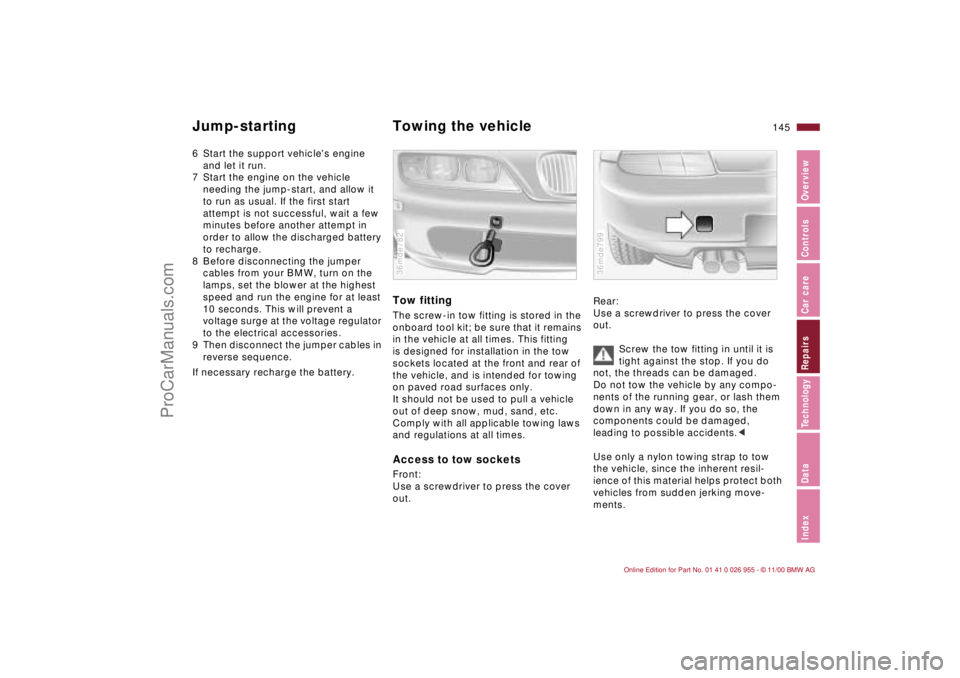
Tow fittingThe screw-in tow fitting is stored in the
onboard tool kit; be sure that it remains
in the vehicle at all times. This fitting
is designed for installation in the tow
sockets located at the front and rear of
the vehicle, and is intended for towing
on paved road surfaces only.
It should not be used to pull a vehicle
out of deep snow, mud, sand, etc.
Comply with all applicable towing laws
and regulations at all times.Access to tow socketsFront:
Use a screwdriver to press the cover
out.36mde782
Rear:
Use a screwdriver to press the cover
out.
Screw the tow fitting in until it is
tight against the stop. If you do
not, the threads can be damaged.
Do not tow the vehicle by any compo-
nents of the running gear, or lash them
down in any way. If you do so, the
components could be damaged,
leading to possible accidents.<
Use only a nylon towing strap to tow
the vehicle, since the inherent resil-
ience of this material helps protect both
vehicles from sudden jerking move-
ments.36mde799
ProCarManuals.com
Page 146 of 171
146n
Towing the vehicle
The towed vehicle should always
be the lighter of the two vehicles.
If this is not the case, it will not be
possible to control vehicle handling.<
Tow-startingFor instructions on jump-starting, refer
to page 144.
Never attempt to use your vehicle to
push another vehicle, since damage to
the energy-absorbing bumpers could
result.
Towing a vehicle 1 Put the manual-shift gear lever in
neutral.
2 Towing speed:
45 mph (70 km/h) maximum.
3 Towing distance:
95 miles (150 km) maximum.
4 Leave the ignition key at position 1 to
ensure that brake lamps, turn signal
indicators, horn and windshield
wipers remain operative, and to
prevent the steering lock from
engaging.
5 Switch on the hazard warning
flashers (observe applicable legal
regulations).
Find some means of identifying the
vehicle in tow, for instance, place a sign
or warning triangle in the rear window.
Make sure that the ignition key
remains in position 1 even when
the electrical system has failed to
prevent the steering lock from
engaging.
The steering and brakes are without
power assist when the engine is off.
This means that increased effort is
required for steering and braking.<
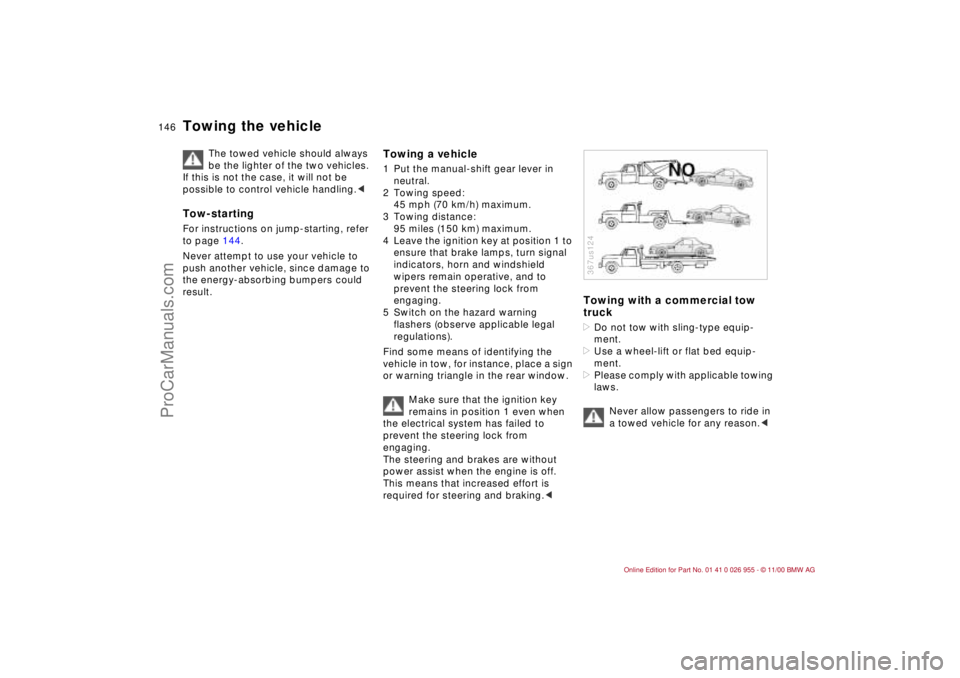
Towing with a commercial tow
truck>Do not tow with sling-type equip-
ment.
>Use a wheel-lift or flat bed equip-
ment.
>Please comply with applicable towing
laws.
Never allow passengers to ride in
a towed vehicle for any reason.< 367us124
ProCarManuals.com
Page 165 of 171

Everything from A to Z
165n
IndexDataTechnologyRepairsCar careControlsOverview
Cigarette lighter80
Cleaning the headlamps60
Cleaning the rear
window60
Cleaning the windshield59
Cockpit16
Code, refer to the Radio
Owner's Manual
Coin box79
Cold start56
Compartments78
Connecting a car vacuum
cleaner80
Controls, cockpit16
Convertible top
care117
electrical defect143t
operation37, 41
weather protection41
Coolant93, 112
antifreeze protection93
Coolant temperature63
Copyright4
Cornering Brake Control
(CBC)90
Cover, convertible
top38, 43
Cruise control61
Cup holder, refer to
beverage holder79
Curb weight158
DDashboard16
Data link connector for
Onboard Diagnostics125
Date, refer to the Radio
Owner's Manual
Daytime running lamps69
Deep water87
Defrost the windows and
remove condensation76
Defrosting
rear window60
mirrors47
Difficult steering94t
Dimensions157
Dipstick, engine oil109
Dirty spots on
paintwork118
Disc brakes91
Displacement156
Display lighting69
Displays18
Disposal
batteries141t
brake fluid113t
engine oil111t
Door key30
Doors
manual operation32
unlocking and locking32
DOT Quality Grades99
Drive belts160Driving notes87
Driving through water87
DSC (Dynamic Stability
Control)65, 151
Dynamic Stability Control
(DSC)65, 151
EElectric convertible top
operation41
Electric power windows35
Electrical defect
convertible top143t
fuel filler door143t
Electrical system160
Electronic immobilizer31
Emergency operation
convertible top143t
doors32t
fuel filler door143t
luggage compartment
lid34t
Engine compartment107
Engine coolant112
adding112t
Engine oil109
adding109t
dipstick109
disposal111t
grades110
level22, 109t
pressure20
viscosity110Engine output156
Engine specifications156
Exterior finish118
FFailure of an electrical
accessory142t
Fan74
Filler cap cover25
Filling the washer
reservoir108t
First-aid kit25
Fittings, tow-starting and
towing145t
Flasher, headlamp58
Flat tire98
Z3 roadster,
Z3 coupe135t
Folding top37
Footbrake91
Front airbags51, 122
Frost protection, radiator93
Fuel26
Fuel filler door
electrical defect143t
emergency
operation143t
Fuel gauge62
Fuel tank capacity159
Fuses142
ProCarManuals.com
Page 168 of 171

Everything from A to ZStarting problems
56, 88, 144, 145
Starting the engine56
Steering94
Steering wheel lock55
Storage boxes78
Storage trays78
Storing the vehicle123
Summer tires101
Sunroof36
Switching off the engine57
Symbols4, 140TTachometer62
Tail lamp assembly, bulb
replacement131t
Tail lamps131
bulb replacement131t
Tank capacity159
Technical Data155
Technical
modifications6, 124
Telephone, refer to the
separate Owner's Manual
Temperature display
engine coolant63
Temperature layering75
Tire condition98
Tire damage98t
Tire inflation
pressures26t, 98Tire Quality Grading99
Tire replacement99, 100
Tire rotation between front
and rear100
Tire specifications103
Tire tread98
Tires, identification101
Tools128t
Torque156
Tow fittings145t
Towing the vehicle145t
Track width157
Traction Control System,
refer to ASC+T/DSC
Transmission58
Tread depth, tires98
Trip odometer62
Turn signals23, 58
bulb replace-
ment130t, 131t
Turning circle157
Two-way radios95
UUniform Tire Quality
Grading99
Upholstery care121
Use of antifreeze112t
Used batteries141t
VVacuum cleaner,
connecting80
Valve caps101
Vanity mirrors48
Vehicle battery140, 160
Vehicle care
exterior115
interior120
Vehicle Identification
Number113
Vehicle immobilizer31
Vehicle storage123
Velour care121
Ventilation72
outlets72
Ventilation, draft-free75
Vents72
Vinyl upholstery, care120
Viscosity110WWarm feet – cool head75
Warning lamps20
Warning triangle24
Warranty and Service Guide
Booklet (Canadian
models)115
Washer fluid, adding108t
Washer nozzles,
adjusting108tWasher reservoir,
filling108t
Washers, headlamp60
Washing your vehicle115
Weights158
Wheelbase157
Wheels and tires101
Width157
Windows, convenience
closing mode32
Windshield washer108
filling reservoir108t
nozzles108
Windshield wipers59
blade replacement128t
Winter driving93
Winter tires102
Wiper blade
replacement128t
Wiper/Washer system59
Wipers59
Working in the engine
compartment104t
ProCarManuals.com