head BMW M3 1995 E36 Workshop Manual
[x] Cancel search | Manufacturer: BMW, Model Year: 1995, Model line: M3, Model: BMW M3 1995 E36Pages: 759
Page 245 of 759
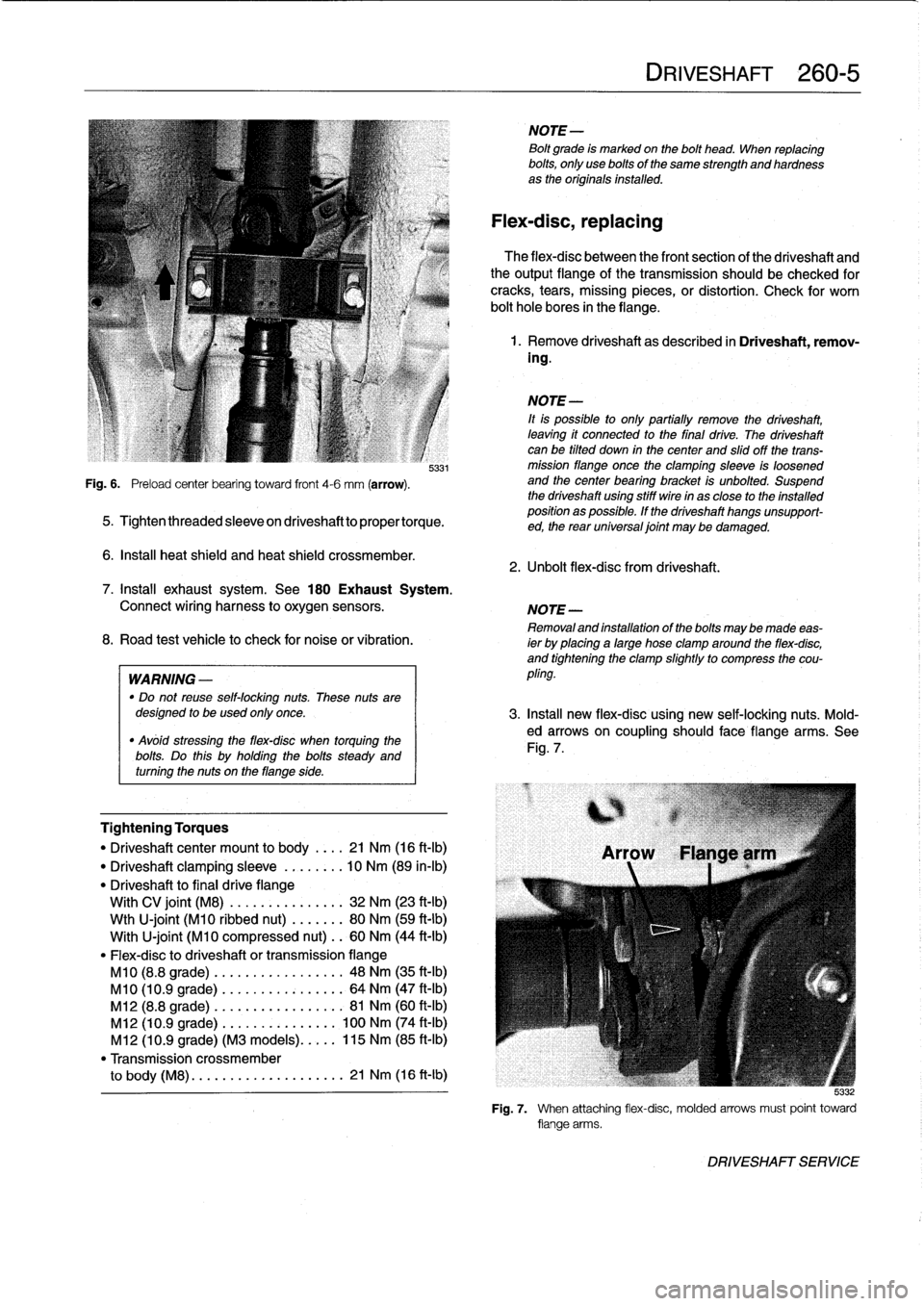
Fig
.
6
.
Preload
center
bearing
toward
front
4-6
mm
(arrow)
.
5331
5
.
Tightenthreadedsleeveondriveshafttopropertorque
.
6
.
Insta¡¡
heat
shield
and
heat
shield
crossmember
.
Tightening
Torques
"
Driveshaftcenter
mount
to
body
.
.
..
21
Nm
(16
ft-Ib)
"
Driveshaft
clamping
sleeve
.....
.
.
.
10
Nm
(89
in-lb)
"
Driveshaft
to
final
drive
flange
With
CV
joint
(M8)
............
...
32
Nm
(23
ft-Ib)
Wth
U-joint
(M10
ribbed
nut)
....
...
80
Nm
(59
ft-Ib)
With
U-joint
(M10
compressed
nut)
..
60
Nm
(44
ft-Ib)
"
Flex-disc
to
driveshaft
or
transmissionflange
M10
(8.8
grade)
.........
.
....
..
.
48
Nm
(35
ft-Ib)
M10
(10
.9
grade)
........
.
....
...
64
Nm
(47
ft-Ib)
M12
(8.8
grade)
........
.....
..
.
.
81
Nm
(60
ft-Ib)
M12
(10
.9
grade)
.
.
....
......
...
100
Nm
(74
ft-Ib)
M12
(10
.9
grade)
(M3
models)
..
.
.
.
115
Nm
(85
ft-Ib)
"
Transmission
crossmember
to
body
(M8)
.
....
...........
....
21
Nm
(16
ft-Ib)
NOTE-
Bolt
grade
is
markedon
the
bolt
head
.
When
replacing
bolts,
only
use
bolts
of
the
same
strength
and
hardnessas
the
originalsinstalled
.
Flex-disc,
replacing
The
flex-disc
between
the
front
section
of
the
driveshaft
and
theoutputflange
of
the
transmission
should
be
checked
for
cracks,
tears,
missing
pieces,
or
distortion
.
Check
for
worn
bolt
hole
bores
in
theflange
.
1
.
Remove
driveshaft
as
described
in
Driveshaft,
remov-
ing
.
NOTE-
¡t
is
possible
to
only
partially
remove
the
driveshaft,
leaving
it
connected
to
the
final
drive
.
The
driveshaft
canbe
tilted
down
in
thecenter
and
slidoff
the
trans-
mission
flange
once
the
clamping
sleeve
is
loosened
and
the
center
bearing
bracket
is
unbolted
.
Suspend
the
driveshaft
using
stiff
wire
in
as
close
to
the
installed
position
as
possible
.
If
the
driveshaft
hangs
unsupport-
ed,
the
rear
universal
joint
may
be
damaged
.
2
.
Unbolt
flex-dísc
from
driveshaft
.
DRIVESHAFT
260-
5
7
.
Install
exhaust
system
.
See
180
Exhaust
System
.
Connect
wiring
harness
to
oxygen
sensors
.
NOTE-
Removaland
installation
of
the
boltsmaybe
made
eas-
8
.
Road
test
vehicle
to
check
for
noiseor
vibration
.
ier
by
placing
a
large
hose
clamp
around
the
flex-disc,
and
tightening
the
clamp
slightlyto
compress
the
cou
WARNING
-
pling
.
"
Do
not
reuse
self-locking
nuts
.
These
nuts
aredesigned
to
beused
only
once
.
3
.
Insta¡¡
new
flex-disc
using
new
self-locking
nuts
.
Mold-
"
Avóid
stressing
the
flex-disc
when
torquing
the
ed
arrows
on
coupling
should
face
flange
arms
.
See
bolts
Do
this
holding
the
bolts
Fig
.
7
.
steady
and
.
uy
turning
the
nuts
on
theflange
side
.
5
:132
Fig
.
7
.
When
attaching
flex-disc,
molded
arrows
must
point
toward
flange
arms
.
DRIVESHAFT
SERVICE
Page 246 of 759
260-
6
DRIVESHAFT
4
.
Insta¡¡
driveshaft
as
described
in
Driveshaft,
install-
ing
.
Tightening
Torques
"
Driveshaft
center
mount
to
body
.
...
21
Nm
(16
ft-Ib)
"
Driveshaft
clamping
sleeve
.....
...
10
Nm
(89
in-lb)
"
Driveshaft
to
final
drive
flange
With
CV
joint
(M8)
............
...
32
Nm
(23
ft-Ib)
Wth
U-joint
(M10
ribbed
nut)
......
.
80
Nm
(59
ft-Ib)
With
U-joint
(M10
compressed
nut)
.
.
60
Nm
(44
ft-Ib)
"
Flex-disc
to
driveshaft
or
transmission
flange
M10
(8
.8
grade)
.
...
.............
48
Nm
(35
ft-Ib)
M10
(10
.9
grade
.
...
.............
64
Nm
(47
ft-Ib)
M12
(8
.8
grade)
..
..
.............
81
Nm
(60
ft-Ib)
M12
(10
.9
grade)
.
..
............
100
Nm
(74
ft-Ib)
M12
(10
.9
grade)
(M3
models)
.....
115
Nm
(85
ft-Ib)
"
Transmission
crossmember
to
body
(M8)
......
...
.
..
........
21
Nm
(16
ft-Ib)
5
.
Remove
center
bearing
circlip
and
dust
guard
.
See
Fig
.
Center
bearing
assembly,
replacing
10
.
Remove
bearing
from
driveshaft
using
puller
.
To
replace
thecenter
bearing
assembly,
the
driveshaft
must
be
removed
from
thecar
.
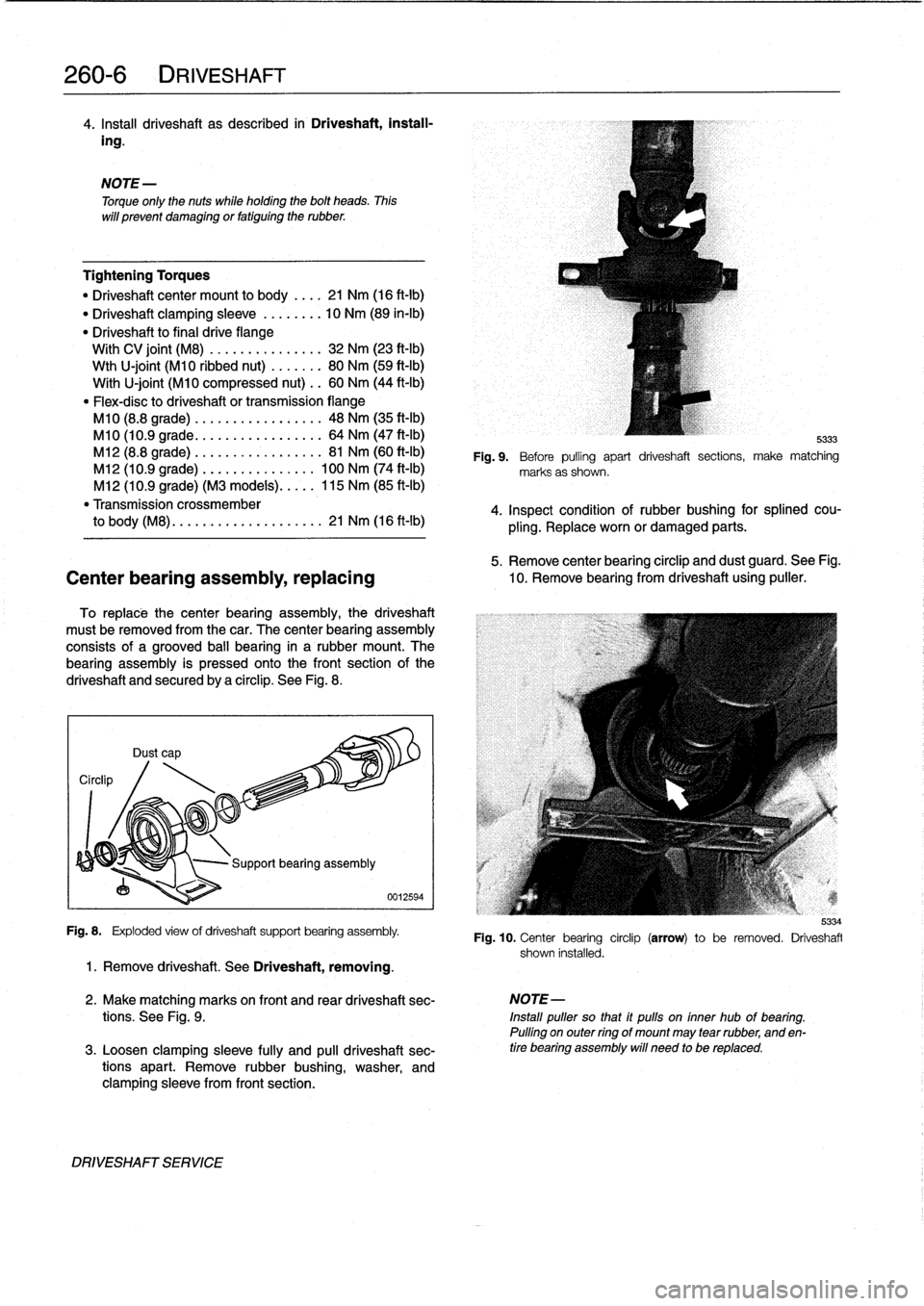
The
center
bearing
assembly
consists
of
a
grooved
ball
bearing
in
a
rubber
mount
.
The
bearing
assembly
is
pressed
onto
the
front
section
of
the
driveshaft
and
securedby
a
circlip
.
See
Fig
.
8
.
Circlip
NOTE
-
Torque
only
the
nuts
while
holding
the
bolt
heads
.
Thís
will
prevent
damaging
or
fatiguing
the
rubber
.
Dust
cap
Fig
.
8
.
Exploded
view
of
driveshaft
support
bearing
assembly
.
1
.
Remove
driveshaft
.
See
Driveshaft,
removing
.
DRIVESHAFT
SERVICE
0012594
5333
Fig
.
9
.
Before
pulling
apart
driveshaft
sections,
make
matching
marks
as
shown
.
4
.
Inspect
condition
of
rubber
bushing
for
splined
cou-
pling
.
Replace
worn
or
damaged
parts
.
2
.
Make
matching
marks
on
front
and
rear
driveshaft
sec-
NOTE-
tions
.
See
Fig
.
9
.
Install
puller
so
that
it
pulls
on
inner
hub
of
bearing
.
Pulling
on
outer
ring
of
mount
may
tear
rubber,
and
en
3
.
Loosen
clamping
sleeve
fully
and
pull
driveshaft
sec-
tire
bearing
assembly
will
need
to
be
replaced
.
tions
apart
.
Remove
rubber
bushing,
washer,
and
clamping
sleeve
from
front
section
.
5334
Fig
.
10
.
Center
bearing
circlip
(arrow)
to
be
removed
.
Driveshafl
shown
installed
.
Page 253 of 759
NOTE-
The
traction
control
system
referred
to
as
AST
(all
sea-
son
traction)
may
also
be
referred
to
as
ASC
(Automat-
ic
Stability
Control)
and
ASC+T
(Automatic
Stability
Control+Traction)
.
The
AST
system
improves
traction
by
electronically
apply-
ing
the
rear
brakes
when
therear
drive
wheels
are
spinning
at
a
faster
rate
than
the
front
wheels
.
The
combined
ABS/AST
control
module,
operating
through
the
ABS
hydraulic
control
unit,
modulates
braking
force
at
therear
wheels
.
In
addition,
AST
uses
retarded
ignition
timing
and
an
auxil-iary
engine
throttle
plate
to
reduceengine
torque
and
maintain
vehicle
stability
.
The
auxiliary
throttle
plate
is
held
open
by
spring
pressure
.
The
AST
system
actívates
the
auxiliary
throttie
position
motor
(ADS)
to
cose
the
AST
throttle
as
needed
.
This
reduces
the
volume
of
engine
intake
air
.
Due
to
the
throttle
closing
very
rapidly
during
AST
operationthe
driver
cannot
increase
theengine
power
output
regardless
of
how
far
theaccelerator
pedal
is
pushed
to
the
floor
.
The
auxiliary
throttle
plate
is
placed
ahead
of
the
conven-
tional
throttle
plate
in
the
throttle
body
.
Traction
control
also
comes
into
operationduringdecelera-
tion
.
Decelerating
on
snowy
or
icy
road
surfaces
can
lead
to
rear
wheel
slip
.
If
a
rear
wheel
startsto
drag
or
lock
up
when
the
throttle
is
closed
rapidly
orduringdownshifting,the
AST
system
can
limit
the
problem
by
advancing
the
ignition
timing
.
A
switch
on
the
center
console
is
used
to
togglethe
AST
on
or
off
.
The
AST
system
is
designed
to
be
maintenance
free
.
There
are
no
adjustments
that
can
be
made
.
Repair
and
trouble-
shooting
of
the
AST
system
requires
special
test
equipment
andknowledgeand
should
be
performed
only
by
an
autho-
rized
BMW
dealer
.
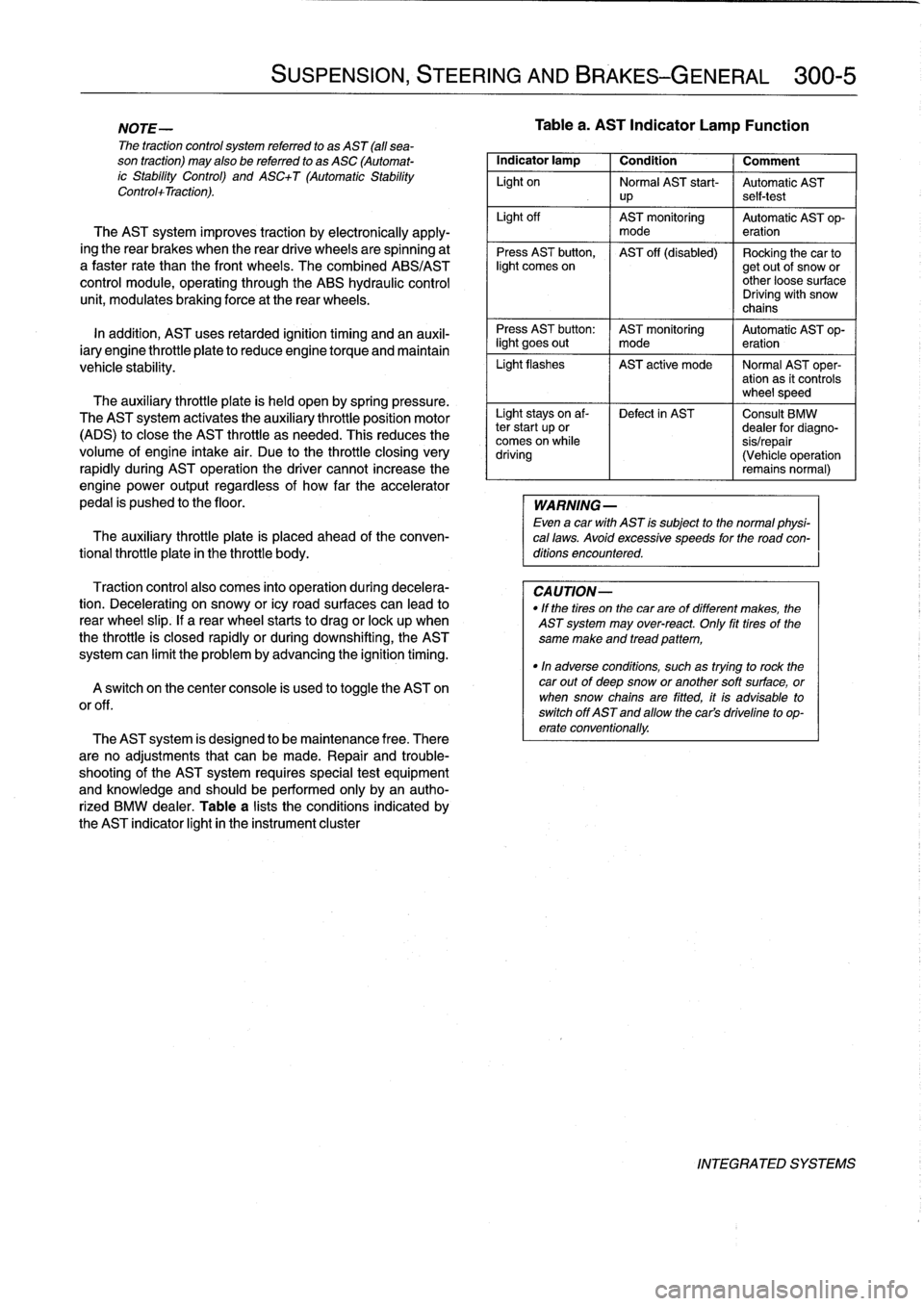
Table
a
lists
theconditions
indicated
by
the
AST
indicator
light
in
the
instrument
cluster
SUSPENSION,
STEERING
AND
BRAKES-GENERAL
300-5
Tablea
.
AST
Indicator
Lamp
Function
Indicator
lamp
1
Condition
1
Comment
Light
on
Normal
AST
start-
Automatic
AST
up
self-test
Light
off
AST
monitoring
Automatic
AST
op-
mode
eration
Press
AST
button,
AST
off
(disabled)
Rocking
the
car
tolight
comes
on
getout
of
snow
or
other
loose
surface
Driving
with
snow
chains
Press
AST
button
:
AST
monitoring
Automatic
AST
op-
light
goes
out
I
mode
eration
Light
flashes
AST
active
mode
I
Normal
AST
oper-
ation
as
it
controls
wheel
speed
Light
stays
on
af-
Defect
in
AST
Consult
BMW
ter
start
up
or
dealer
for
diagno-
comes
on
while
sis/repair
driving
(Vehicle
operation
remains
normal)
WARNING
-
Even
a
car
with
AST
is
subject
to
the
normal
physi-
cal
laws
.
Avoid
excessive
speeds
for
the
road
con-
ditions
encountered
.
CAUTION-
"
If
the
tires
on
the
carare
of
different
makes,
the
AST
system
may
over-react
.
Only
fit
tires
of
the
same
make
and
tread
pattem,
"In
adverse
conditions,
such
as
trying
to
rock
the
car
outof
deep
snow
or
another
soft
surface,
or
when
snow
chainsare
fitted,
it
is
advisable
to
switch
off
AST
and
allow
the
cars
driveline
to
op-
erate
conventionally
.
INTEGRATED
SYSTEMS
Page 267 of 759
320
Steering
and
Wheel
Alignment
GENERAL
...
.
.
.
...
.
....
.
.
.
.
.
.
.
.
.
...
.
.
320-1
Outer
tie
rod
end,
replacing
.
...
.
.
.
.
.
.
.
...
.
320-4
Tie
rod,
replacing
.
.
.
.
.
.
.
.......
.
.
.
.
.
...
.
320-5
STEERING
WHEEL
320-1
Steering
wheel,
removing
and
installing
.....
320-1
WHEEL
ALIGNMENT
.
.
.
.........
.
.....
.320-5
POWER
STEERING
SYSTEM
.
.
.
.
.
.
.....
320-2
Front
Toe-in
and
Toe
Difference
Angle
.
.
...
.
320-6
Power
steering
pump,
Rear
Toe-in
.
.
.
.
.
.
.
...
.
................
320-6
removing
and
installing
..
.
.
.
.
.
.
.
.
.
.....
320-2
Wheel
Alignment
Specifications
.....
.
......
320-6
Power
steering
system,
bleeding
and
filling
.
.
320-3
STEERING
GEAR
.
.
.
.
...
.
.
.
.
.
.
.
.
.
.....
320-3
Steering
gear
rack,
removing
and
installing
.
...
.
..
.
..
..
..
.
..
.
320-3
GENERAL
STEERING
WHEEL
This
repair
group
covers
servicing
of
the
mechanical
and
The
BMW
E36
is
equipped
with
an
SRS
airbag
mounted
in
hydraulic
components
of
the
steering
system,
including
wheel
the
steering
wheel
.
Improper
handling
of
the
airbag
could
alignment
information
.
cause
serious
injury
.
The
airbag
is
an
explosivedevice
and
should
be
treated
with
extreme
caution
.
Always
follow
the
air-
The
variable-assist
power
steering
system
consistsof
an
bag
removal
procedure
as
outlined
in
721
Airbag
System
engine-driven
hydraulic
pump,
a
rack-and-pinion
steering
(SRS)
.
gear
assembly
with
an
integral
hydraulic
control
valve,
and
connecting
linkage
to
the
road
wheels
.
WARNING-
"
The
BMW
Supplemental
Restraint
System
(SRS)
At
lowspeeds,
maximum
power
assist
is
provided
to
ease
is
complex
and
special
precautions
must
be
ob-
parking
and
city
driving
.
At
high
speeds,
assist
is
reduced
to
served
when
servicing
.
Serious
injury
may
result
ensure
stability
.
The
power
steering
system
varies
assist
if
system
service
is
attempted
by
persons
unfa-
based
on
engine
speed
.
miliar
with
the
BMW
SRS
and
its
approved
ser-
vice
procedures
.
BMW
specifies
that
all
ING-
inspection
and
service
shouldbe
performed
by
WARN
an
authorized
BMW
dealer
.
"
Do
not
reuse
self-locking
nuts
.
They
are
de-signed
to
beused
only
once
and
may
failif
re-
"
BMW
Supplemental
Restraint
Systems
(SRS)
used
.
Always
replace
them
with
new
locking
nuts
.
are
equipped
with
a
back-up
power
supply
inside
the
SRS
control
module
.
A
10minute
waiting
"
Do
not
ínstall
bolts
and
nuts
coated
with
under-
shouldbe
observed
after
the
battery
cable
has
coating
wax,
as
correct
tightening
torque
cannot
been
disconnected
.
This
will
allow
the
reserve
be
assured
.
Always
clean
the
threads
with
sol-
power
supply
to
discharge
.
vent
before
installation,
or
install
new
parts
.
"
Do
not
attempt
to
weldor
straighten
any
steering
components
.
Always
replace
damaged
parts
.
NOTE-
For
information
on
steering
column-mounted
switches
and
the
ignition
lock,
see
612
Switches
and
Electrical
Accessories
.
STEERING
AND
WHEEL
ALIGNMENT
320-1
Caster
and
Camber
.
.
.
.
.
...........
.
....
320-5
TABLES
a
.
Front
Wheel
Alignment
Specifications
.
...
.......
320-6
b
.
Rear
Wheel
Alignment
Specifications
.
...
.......
320-6
Steering
wheel,
removing
and
installing
1
.
Center
steering
wheel
.
Make
sure
front
wheelsare
pointed
straight
ahead
.
2
.
Disconnect
negative
(-)
cable
from
battery
and
cover
terminal
with
insulating
material
.
CAUTION-
Prior
to
disconnectiog
the
battery,
read
the
battery
disconnection
cautions
given
at
the
front
of
this
manual
on
page
viii
.
STEERING
WHEEL
Page 269 of 759
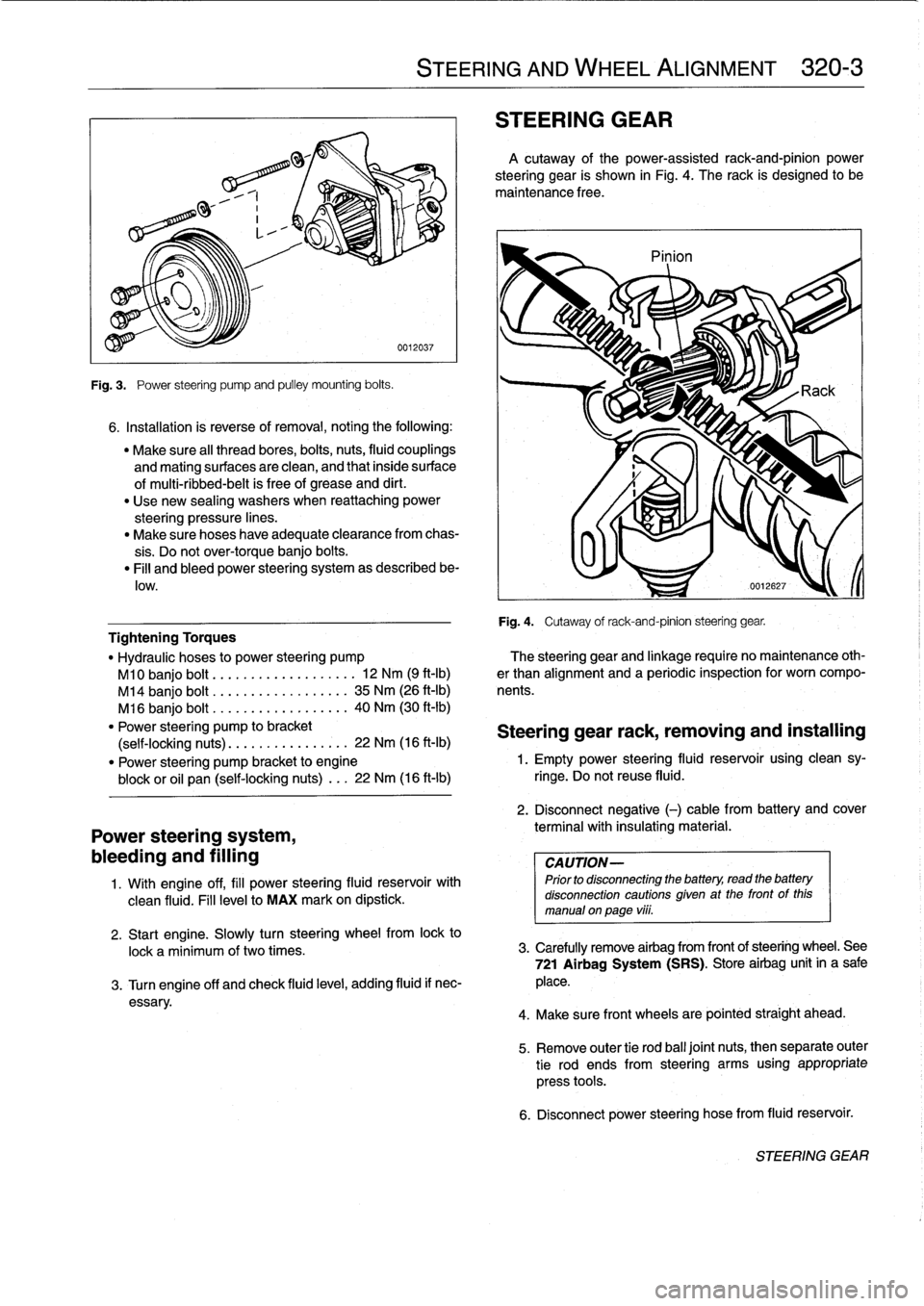
Fig
.
3
.
Power
steering
pump
and
pulley
mounting
bolts
.
6
.
Installation
is
reverse
of
removal,
noting
the
following
:
"
Make
sure
al¡
thread
bores,
bolts,
nuts,
fluid
couplings
and
mating
surfaces
are
clean,
and
that
inside
surface
of
multi-ribbed-belt
is
free
of
grease
and
dirt
.
"
Use
new
sealing
washers
when
reattaching
power
steering
pressure
lines
.
"
Make
sure
hoses
have
adequate
clearance
from
chas-
sis
.
Do
not
over-torque
banjo
bolts
.
"
Fill
and
bleed
power
steering
system
as
described
be-
low
.
Power
steering
system,
bleeding
and
filling
1
.
Wíth
engine
off,
fill
power
steering
fluid
reservoir
with
clean
fluid
.
Fill
levelto
MAX
mark
on
dipstick
.
STEERING
AND
WHEEL
ALIGNMENT
320-
3
STEERING
GEAR
A
cutaway
of
the
power-assisted
rack-and-pinion
power
steering
gear
is
shown
in
Fig
.
4
.
The
rack
is
designed
to
be
maintenance
free
.
Pinion
Fig
.
4
.
Cutaway
of
rack-and-pinion
steering
gear
.
Tightening
Torques
"
Hydraulic
hoses
to
power
steering
pump
?he
steering
gear
and
linkage
require
no
maintenance
oth-
M10
banjo
bolt
.........
..
.
...
...
.
12
Nm
(9
ft-Ib)
er
than
alignment
and
a
periodic
inspection
for
worn
compo
M14
banjo
bolt
..............
..
..
35
Nm
(26
ft-Ib)
nents
.
M16
banjo
bolt
..............
...
.
40
Nm
(30
ft-Ib)
"
Power
steering
pump
to
bracket
Steering
gear
rack,
removing
and
installing
(self-locking
nuts)
.............
..
.
22
Nm
(16
ft-Ib)
"
Power
steering
pump
bracket
to
engine
1
.
Empty
power
steering
fluid
reservoir
using
clean
sy-
block
or
oil
pan
(self-locking
nuts)
...
22
Nm
(16
ft-lb)
ringe
.
Do
not
reuse
fluid
.
2
.
Disconnect
negative
(-)
cable
from
battery
and
cover
terminal
with
insulating
material
.
CAUTION-
Prior
to
disconnectiog
the
battery,
read
the
battery
disconnection
cautions
given
at
the
front
of
this
manual
on
page
viii
.
2
.
Start
engine
.
Slowly
turn
steering
wheelfrom
lock
to
lock
a
minimum
of
two
times
.
3
.
Carefully
remove
airbag
from
frontof
steering
wheel
.
See
721
Airbag
System
(SRS)
.
Store
airbag
unit
in
a
sale
3
.
Turn
engine
off
and
check
fluid
leve¡,
adding
fluid
if
nec-
place
.
essary
.
4
.
Make
sure
front
wheelsare
pointed
straight
ahead
.
5
.
Remove
outer
tie
rod
ball
joínt
nuts,
thenseparate
outer
tie
rod
ends
from
steering
arms
using
appropriate
press
tools
.
6
.
Disconnect
power
steering
hose
from
fluid
reservoir
.
STEERING
GEAR
Page 270 of 759
320-
4
STEERING
AND
WHEEL
ALIGNMENT
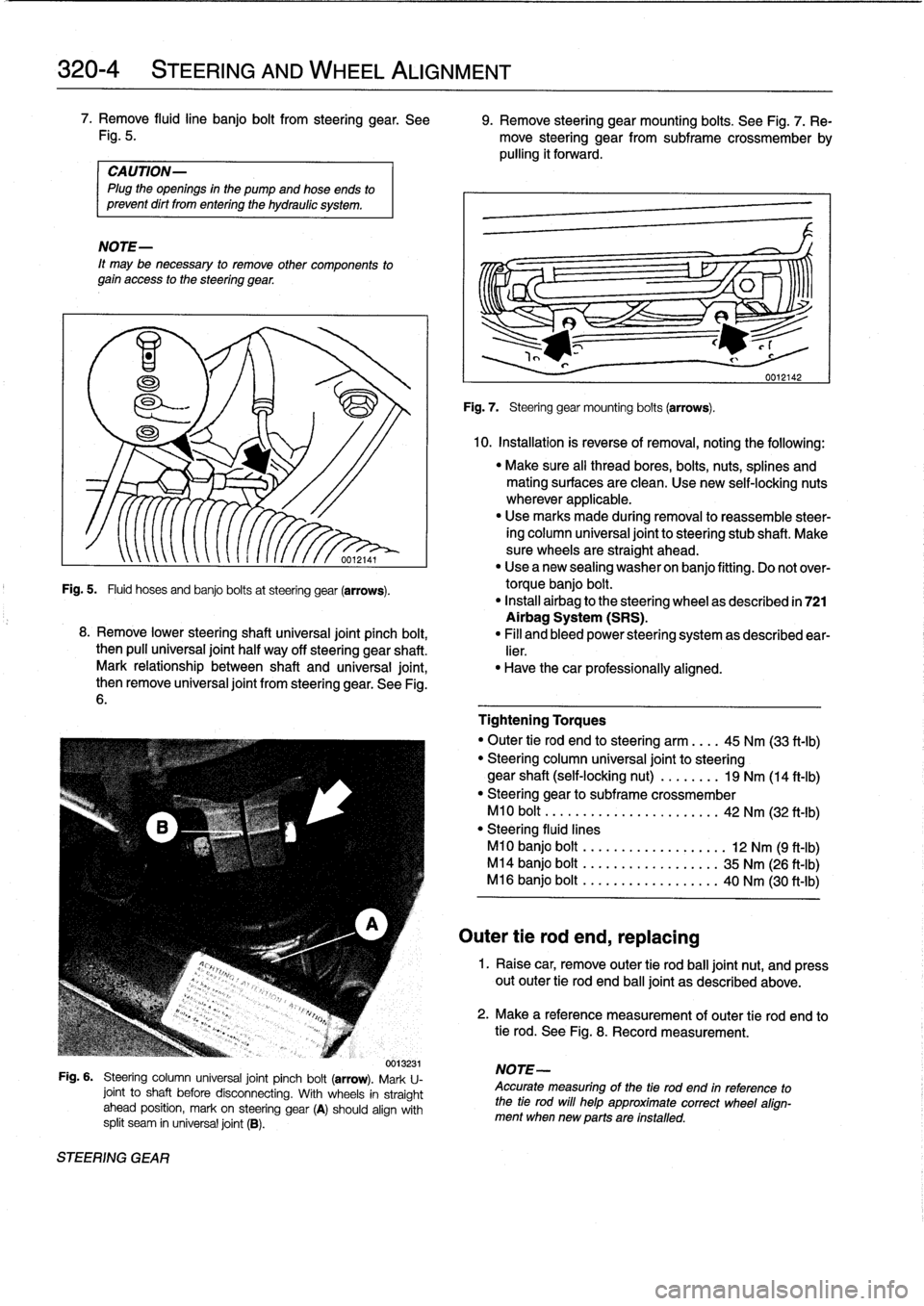
7
.
Remove
fluidline
banjo
bolt
from
steering
gear
.
See
9
.
Remove
steering
gearmounting
bolts
.
See
Fig
.
7
.
Re
Fig
.
5
.
move
steering
gear
from
subframe
crossmember
by
pulling
it
forward
.
CAUTION-
Plug
the
openings
in
the
pump
and
hoseends
to
prevent
dirt
from
entering
the
hydraulic
system
.
NOTE-
It
may
be
necessary
to
remove
other
components
to
gain
access
to
the
steering
gear
.
"
Make
sure
al¡
thread
bores,
bolts,
nuts,
splines
and
mating
surfaces
are
clean
.
Use
new
self-locking
nuts
wherever
applicable
.
"
Use
marks
made
during
removal
to
reassemble
steer-
ing
column
universal
jointto
steering
stub
shaft
.
Make
sure
wheels
are
straight
ahead
.
"
Use
a
new
sealing
washer
on
banjo
fitting
.
Do
not
over-
Fig
.
5
.
Fluid
hoses
and
banjo
bolts
at
steering
gear
(arrows)
.
torque
banjo
bolt
.
"
Install
airbag
to
the
steering
wheel
as
described
in
721
Airbag
System
(SRS)
.
8
.
Remove
lower
steeringshaft
universal
joint
pinch
bolt,
"
Fill
and
bleed
power
steering
system
as
described
ear-
then
pull
universal
joint
half
way
off
steering
gear
shaft
.
lier
.
Mark
relationship
between
shaft
and
universal
joint,
"
Have
thecar
professionally
aligned
.
then
remove
universal
joint
from
steering
gear
.
See
Fig
.
6
.
0013231
Fig
.
6
.
Steering
column
universal
joint
pinch
bolt
(arrow)
.
Mark
U-
joint
to
shaft
before
disconnecting
.
With
wheels
in
straight
ahead
position,
mark
on
steering
gear
(A)
should
align
with
split
seam
in
universal
joint
(B)
.
STEERING
GEAR
Fig
.
7
.
Steering
gear
mounting
bolts
(arrows)
.
Outer
tie
rod
end,
replacing
10
.
Installation
is
reverse
of
removal,
noting
the
following
:
Tightening
Torques
"
Outer
tie
rod
end
to
steering
arm
.
.
..
45
Nm
(33
ft-Ib)
"
Steering
column
universal
joint
to
steering
gear
shaft
(self-locking
nut)
....
..
..
19
Nm
(14
ft-Ib)
"
Steering
gear
to
subframe
crossmember
M10
bolt
..............
.
...
.....
42
Nm
(32
ft-Ib)
"
Steering
fluíd
lines
M10
banjo
bolt
..
..
..
........
.....
12
Nm
(9
ft-Ib)
M14
banjo
bolt
..
..
..
...
..
...
....
35
Nm
(26
ft-lb)
M16
banjo
bolt
..
.......
..
..
.....
40
Nm
(30
ft-Ib)
1
.
Raise
car,
remove
outer
tie
rod
ball
joint
nut,
and
press
out
outer
tie
rod
end
ball
joint
as
described
above
.
2
.
Make
a
reference
measurement
of
outer
tie
rod
end
to
tie
rod
.
See
Fig
.
8
.
Record
measurement
.
NOTE-
Accurate
measuring
of
the
tie
rod
end
in
reference
to
the
tie
rod
will
help
approximate
correct
wheel
align-
mentwhen
new
parts
are
installed
.
Page 297 of 759
Brake
rotor,
removing
and
installing
Brake
rotors
shouldalways
be
replaced
in
pairs
.
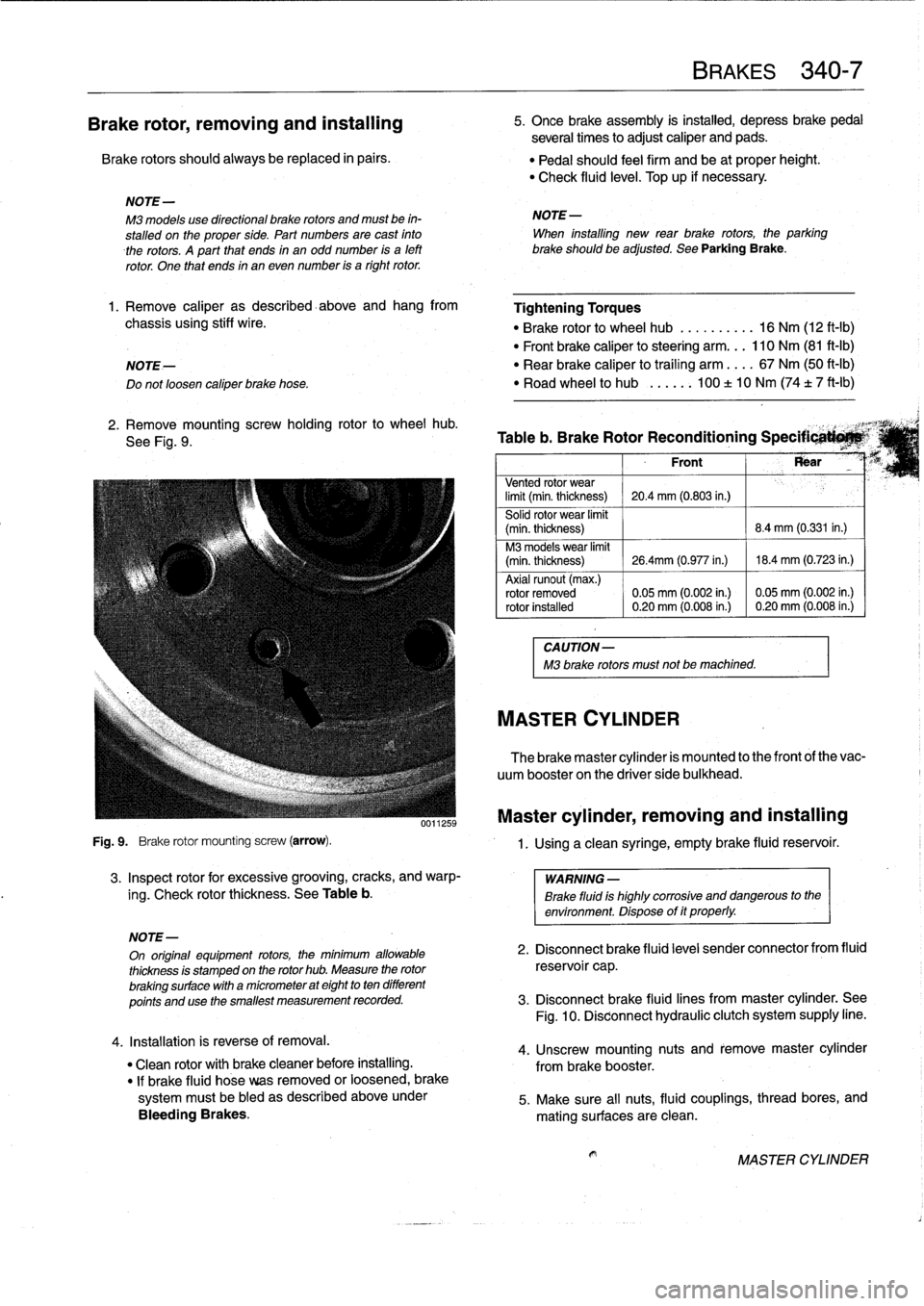
Fig
.
9
.
Brake
rotor
mounting
screw
(arrow)
.
3
.
Inspect
rotor
for
excessive
grooving,
cracks,
and
warp-
ing
.
Check
rotor
thickness
.
See
Table
b
.
4
.
Installation
is
reverse
of
removal
.
"
Clean
rotor
with
brakecleaner
before
installing
.
"
If
brake
fluid
hose
veas
removed
or
loosened,
brake
systemmustbe
bled
as
described
aboveunder
Bleeding
Brakes
.
BRAKES
340-
7
5
.
Once
brake
assembly
is
instalind,
depress
brakepedal
several
times
to
adjust
caliper
and
pads
.
"
Pedal
should
feel
firm
and
be
at
proper
height
.
"
Check
fluid
leve¡
.
Top
up
if
necessary
.
NOTE-
M3
models
use
directional
brake
rotors
and
mustbe
in-
NOTE-
stalled
on
the
proper
side
.
Part
numbes
are
cast
finto
When
installing
new
rear
brake
rotors,
the
parking
therotors
.
A
part
that
ends
in
an
odd
number
is
a
left
brakeshouldbe
adjusted
.
See
Parking
Brake
.
rotor
.
One
that
ends
in
an
even
number
is
a
right
rotor
.
1.
Remove
caliper
as
described-above
and
hang
from
Tightening
Torques
chassis
using
stiff
wire
.
"
Brake
rotor
to
wheel
hub
..........
16
Nm
(12
ft-Ib)
"
Front
brake
caliper
to
steering
arm
...
110
Nm
(81
ft-Ib)
NOTE-
"
Rear
brake
caliper
to
traíling
arm
....
67
Nm
(50
ft-Ib)
Do
notloosen
caliper
brake
hose
.
"
Road
wheel
to
hub
...
..
.
100
±
10
Nm
(74
t
7
ft-Ib)
2
.
Remove
mountingscrew
holding
rotor
to
wheel
hub
.
,
See
Fig
.
9
.
Table
b
.
Brake
Rotor
Reconditioning
Specificati*M`
Front
Rear
Vented
rotor
wear
limit
(min
.
thickness)
20
.4
mm
(0
.803
in.)
Solid
rotor
wear
limit
(min
.
thickness)
8
.4
mm
(0.331
in
.)
M3
models
wear
limit
(min
.
thickness)
26
.4mm
(0
.977
in
.)
18
.4
mm
(0
.723
in
.)
Axial
runout
(max
.)
rotor
removed
0
.05
mm
(0
.002
in
.)
0
.05
mm
(0
.002
in
.)
rotor
installed
0
.20
mm
(0
.008
in
.)
0
.20
mm
(0
.008
in
.)
CAUTION-
M3
brake
rotors
must
not
be
machined
.
MASTER
CYLINDER
The
brake
master
cylinder
is
mounted
to
the
front
of
the
vac-
uum
booster
on
the
driver
side
bulkhead
.
Master
cylinder,
removing
and
installing
1
.
Using
a
clean
syringe,
empty
brake
fluid
reservoir
.
WARNING
-
Brake
fluid
is
highly
corrosive
and
dangerous
to
the
environment
.
Dispose
of
it
properly
.
NOTE-
On
original
equipment
rotors,
the
mínimum
allowable
2
.
Disconnect
brake
fluid
leve¡
sender
connector
from
fluid
thickness
is
stamped
on
the
rotor
hub
.
Measure
the
rotor
reservoi
r
cap
.
brakingsurface
with
a
micrometer
at
eight
to
ten
different
points
and
use
the
smallest
measurement
recorded
.
3
.
Disconnect
brake
fluid
lines
frommaster
cylinder
.
See
Fig
.
10
.
Disconnect
hydraulic
clutch
system
supply
line
.
4
.
Unscrew
mounting
nuts
and
remove
master
cylinder
from
brake
booster
.
5
.
Make
sure
all
nuts,
fluid
couplings,
thread
bores,
and
mating
surfaces
are
clean
.
MASTER
CYLINDER
Page 298 of 759
340-
8
BRAKES
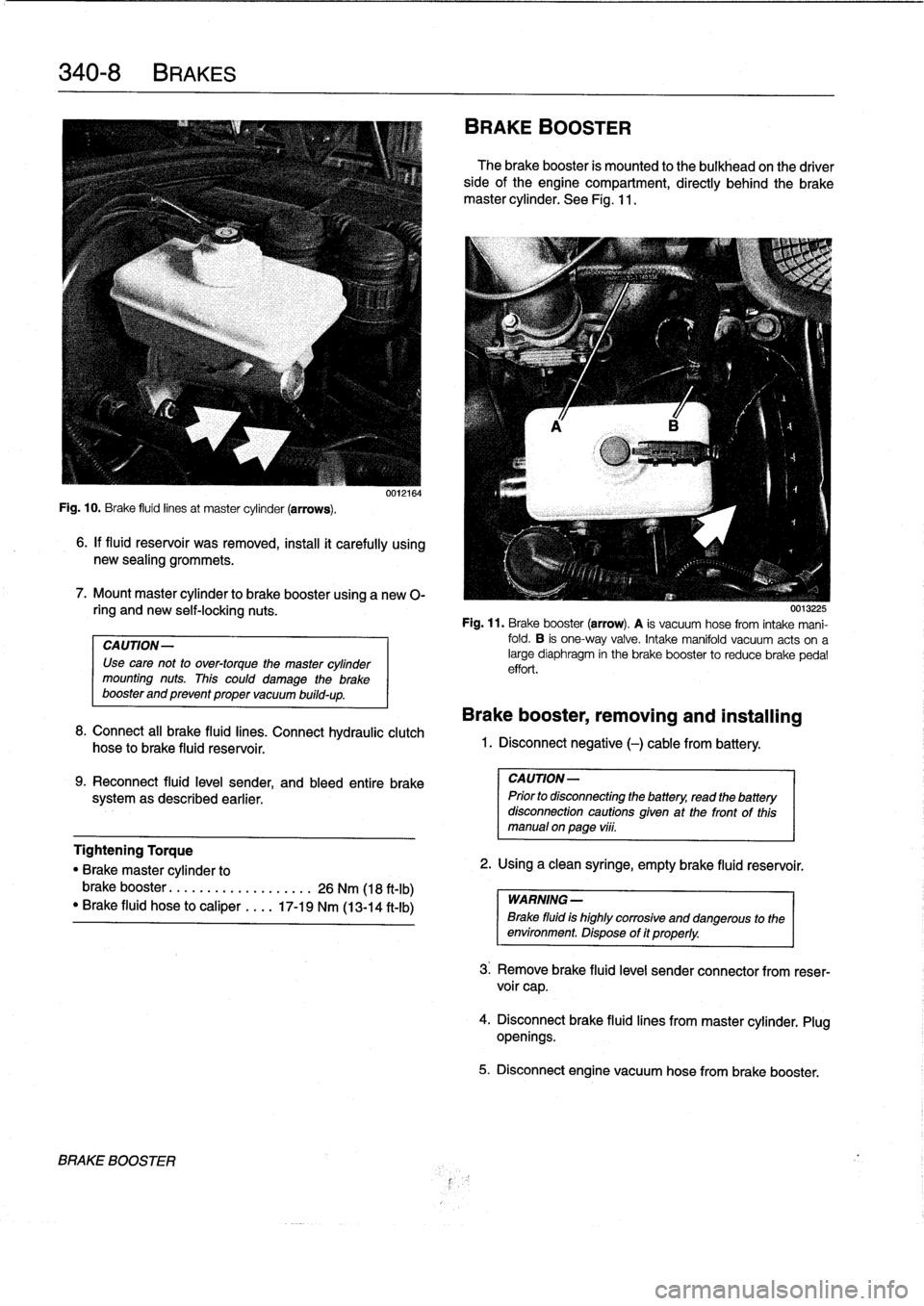
Fig
.
10
.
Brake
fluid
linesat
master
cylinder
(arrows)
.
6
.
If
fluid
reservoir
was
removed,
install
it
carefully
using
new
sealing
grommets
.
7
.
Mount
master
cylinder
to
brake
booster
using
a
new
0-
ring
and
new
self-locking
nuts
.
CAUTION-
Use
cave
not
to
over-torque
the
master
cylinder
mounting
nuts
.
This
could
damage
the
brake
booster
and
prevent
proper
vacuum
build-up
.
0012164
8
.
Connect
all
brake
fluid
lines
.
Connect
hydraulic
clutch
hose
to
brake
fluid
reservoir
.
9
.
Reconnect
fluid
leve¡
sender,
and
bleed
entire
brake
systemas
described
earlier
.
BRAKE
BOOSTER
BRAKE
BOOSTER
The
brake
booster
is
mounted
to
the
bulkhead
on
the
driver
sideofthe
engine
compartment,
directly
behind
the
brake
master
cylinder
.
See
Fig
.
11
.
0015225
Fig
.
11
.
Brake
booster
(arrow)
.
A
is
vacuum
hose
from
intake
mani-
fold
.
B
is
one-way
valve
.
Intake
manifold
vacuum
acts
ona
large
diaphragm
in
the
brake
booster
to
reducebrake
pedal
effort
.
Brake
booster,
removing
and
installing
1
.
Disconnect
negative
(-)
cable
from
battery
.
CAUTION-
Prior
to
disconnecting
the
battery,
read
the
battery
disconnection
cautions
given
at
the
front
of
this
manual
onpage
vi¡¡
.
Tightening
Torque
"
Brake
master
cylinder
to
2
.
Using
a
clean
syringe,
empty
brake
(luid
reservoir
.
brake
booster
.....
..
.
..
.........
26
Nm
(18
ft-Ib)
WARNING-
"
Brake
fluid
hose
to
caliper
....
17-19
Nm
(13-14
ft-Ib)
Brake
fluid
is
highly
corroslve
and
dangerous
to
the
environment
.
Dispose
of
it
properly
.
3
.
Remove
brake
fluid
level
sender
connector
from
reser-
voir
cap
.
4
.
Disconnectbrake
fluid
lines
from
master
cylinder
.
Plug
openings
.
5
.
Disconnect
engine
vacuum
hose
from
brake
booster
.
Page 299 of 759
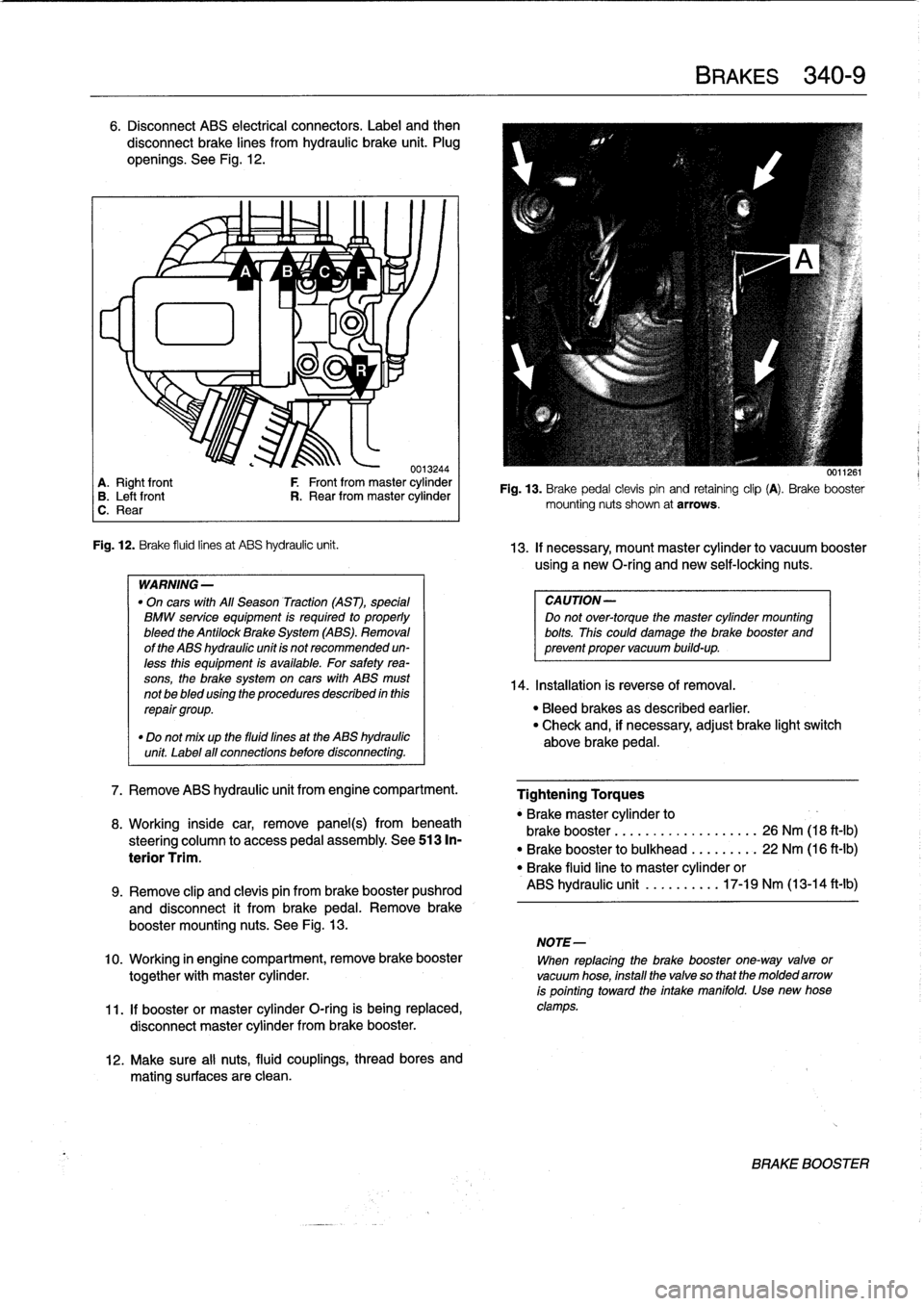
6
.
Disconnect
ABS
electrical
connectors
.
Label
and
then
disconnect
brake
lines
from
hydraulic
brake
unit
.
Plug
openíngs
.
See
Fig
.
12
.
~
~
A
1/
B
'1v
C
~
F
lu
11
-ri
J
.
0013244
A
.
Right
front
F
Front
from
master
cylinder
B
.
Leftfront
R
.
Rear
from
master
cylinder
C
.
Rear
Fig
.
12
.
Brake
fluid
linesat
ABS
hydraulic
unit
.
WARNING
-
"
On
cars
with
All
Season
Traction
(AST),
special
BMW
service
equipment
is
required
to
properly
bleed
the
Antilock
Brake
System
(ABS)
.
Removal
of
the
ABS
hydraulic
unit
is
not
recommended
un-
less
this
equipment
is
available
.
For
safetyrea-
sons,
the
brake
system
on
cars
with
ABS
must
not
be
bled
using
the
procedures
described
inthis
repair
group
.
"
Do
not
mix
up
the
fluid
fines
at
the
ABS
hydraulic
unit
Label
all
connections
before
disconnecting
.
7
.
Remove
ABS
hydraulic
unit
from
engine
compartment
.
8
.
Working
inside
car,
remove
panel(s)
frombeneath
steering
column
to
access
pedal
assembly
.
See513
In-
terior
Trim
.
12
.
Make
sure
al¡
nuts,
fluid
couplings,
thread
bores
and
mating
surfaces
are
clean
.
BRAKES
340-
9
0011261
Fig
.
13
.
Brake
pedal
clevispin
and
retaining
clip
(A)
.
Brake
booster
mounting
nuts
shown
at
arrows
.
13
.
If
necessary,
mount
master
cylinder
to
vacuum
booster
using
a
new
O-ríng
and
newself-locking
nuts
.
CAUTION-
Do
not
over-torque
the
master
cylinder
mounting
bolts
.
This
could
damage
the
brake
booster
and
prevent
proper
vacuum
build-up
.
14
.
Installation
is
reverse
of
Rmoval
.
"
Bleed
brakes
as
described
earlier
.
"
Check
and,
if
necessary,
adjust
brake
light
switch
above
brake
pedal
.
Tightening
Torques
"
Brakemaster
cylinder
to
brake
booster
...........
.
..
..
...
26
Nm
(18
ft-Ib)
"
Brake
booster
to
bulkhead
.
.
..
..
...
22
Nm
(16
ft-Ib)
"
Brake
fluidline
to
master
cylinder
or
ABS
hydraulic
unit
.......
.
..
17-19
Nm
(13-14
ft-lb)
9
.
Remove
clip
and
clevis
pin
from
brake
booster
pushrod
and
disconnect
it
from
brakepedal
.
Remove
brake
booster
mounting
nuts
.
See
Fig
.
13
.
NOTE-
10
.
Working
in
engine
compartment,
remove
brake
booster
When
replacing
the
brake
booster
one-way
valve
or
together
with
master
cylinder
.
vacuum
hose,
install
the
valve
so
that
the
molded
arrow
is
pointing
toward
the
intake
manifold
.
Use
new
hose
11
.
If
booster
or
master
cylinder
O-ring
is
being
replaced,
clamps
.
disconnect
master
cylinder
from
brake
booster
.
BRAKE
BOOSTER
Page 304 of 759
400-2
BODY-GENERAL
4-door
Sedan
Coupe
-
saas3
.7""
351
/
37
.3
O
I
x
`-193
267
o
oa
'3281
model
"M3
model
Convertible
BODYASSEMBLY
55
ass
.e
iss
""
-
66
.9
-
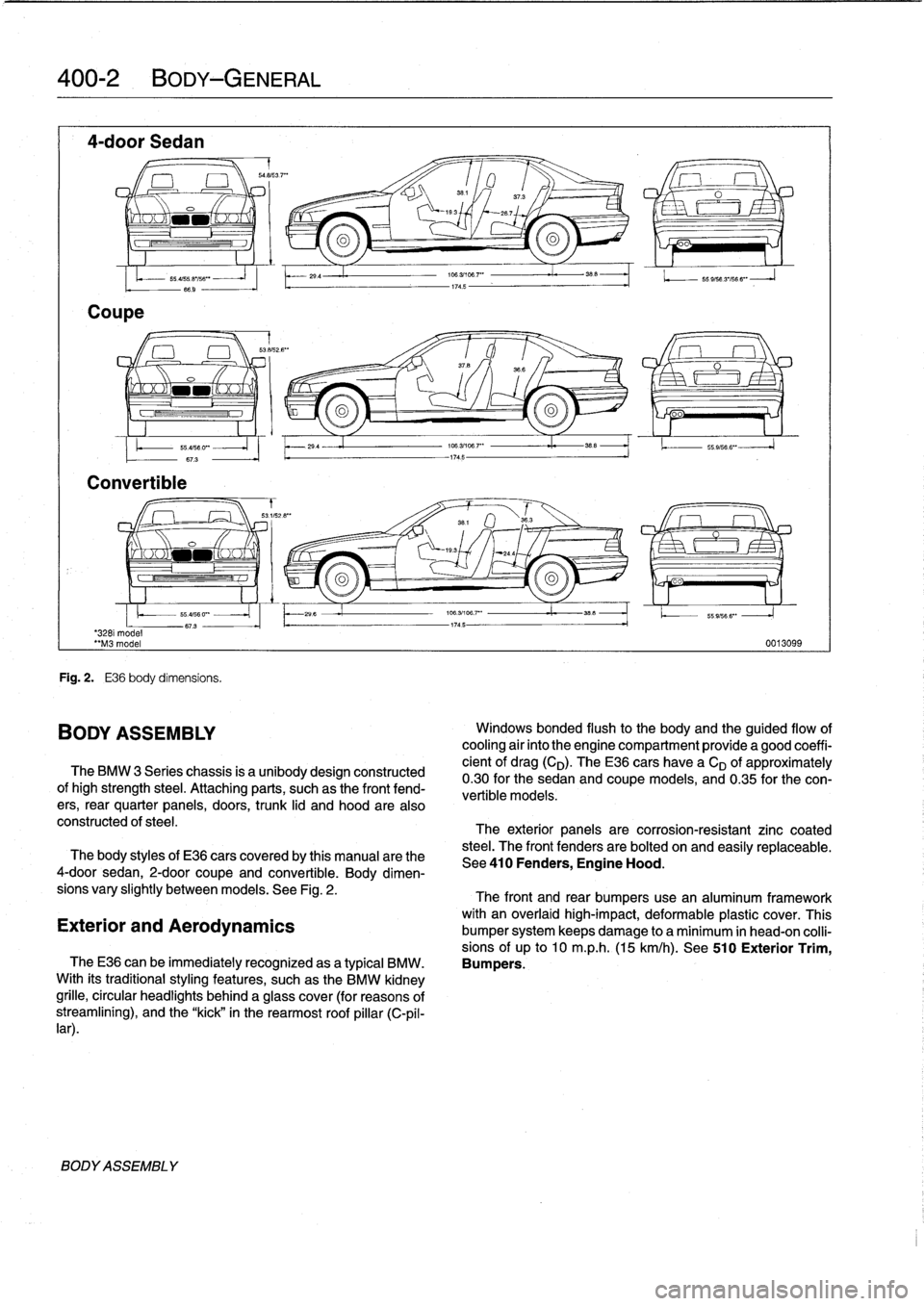
Fig
.
2
.
E36
body
dimensíons
.
BODY
ASSEMBLY
29
.4
29
4
The
BMW
3
Series
chassis
is
a
unibodydesign
constructed
ofhigh
strength
steel
.
Attaching
parts,
suchas
the
front
fend-
ers,
rear
quarter
panels,
doors,
trunk
lid
and
hood
are
also
constructed
of
steel
.
706
.31108
.7"
I
38
.5
174
.5
174
.5
O
oo
196
.3/106
.7'
"
35_5
1.
.
55
.9,566
".
106
.3/196
.7""
i.
358
-1745-
55
9/56
3'/56
6"
-
J
0013099
Windows
bonded
flush
to
the
body
and
the
guided
flow
of
cooling
air
into
the
engine
compartment
provide
a
good
coeffi-
cient
of
drag(CD)
.
TheE36
cars
have
a
CD
of
approximately
0
.30for
the
sedan
and
coupe
models,
and
0
.35
for
the
con-
vertible
models
:
The
exterior
panels
are
corrosion-resistant
zinc
coated
steel
.
The
front
fenders
are
bolted
on
and
easily
replaceabie
.
The
body
styles
of
E36
cars
coveredby
this
manual
arethe
See410
Fenders,
Engine
Hood
.
4-door
sedan,
2-door
coupe
and
convertible
.
Body
dimen-
sions
vary
slightly
betweenmodels
.
See
Fig
.
2
.
The
front
and
rear
bumpers
use
an
aluminum
framework
with
an
overlaid
high-impact,
deformable
plastic
cover
.
This
Exterior
and
Aerodynamics
bumper
system
keeps
damage
to
a
minimum
in
head-on
colli-
sions
of
up
to
10
m
.p
.h
.
(15
km/h)
.
See
510
Exterior
Trim,
TheE36
can
be
immediatelyrecognized
asa
typical
BMW
.
Bumpers
.
With
its
traditionalstyling
features,
suchas
the
BMW
kidney
grille,
circular
headlights
behind
a
glass
cover
(for
reasons
of
streamliníng),
and
the
"kick"
in
the
rearmost
roof
pillar
(C-pil-
lar)
.