capacity BMW M3 1995 E36 Workshop Manual
[x] Cancel search | Manufacturer: BMW, Model Year: 1995, Model line: M3, Model: BMW M3 1995 E36Pages: 759
Page 17 of 759
Solt
Diameter
and
Wrench
Size
"
M5
.
...
............
....
......
.
.......
8
mm
"
M6
.
.
..............
.
.
...
...........
.10
mm
"
M8
.
.
..............
.
.
..
.....
12mmor13mm
"
M10
..
.............
.
.
...
...........
.17
mm
"
M12
...
...........
..
.
..
............
.19
mm
"
M14
.
..:
.
.........
..
.
..
.............
22
mm
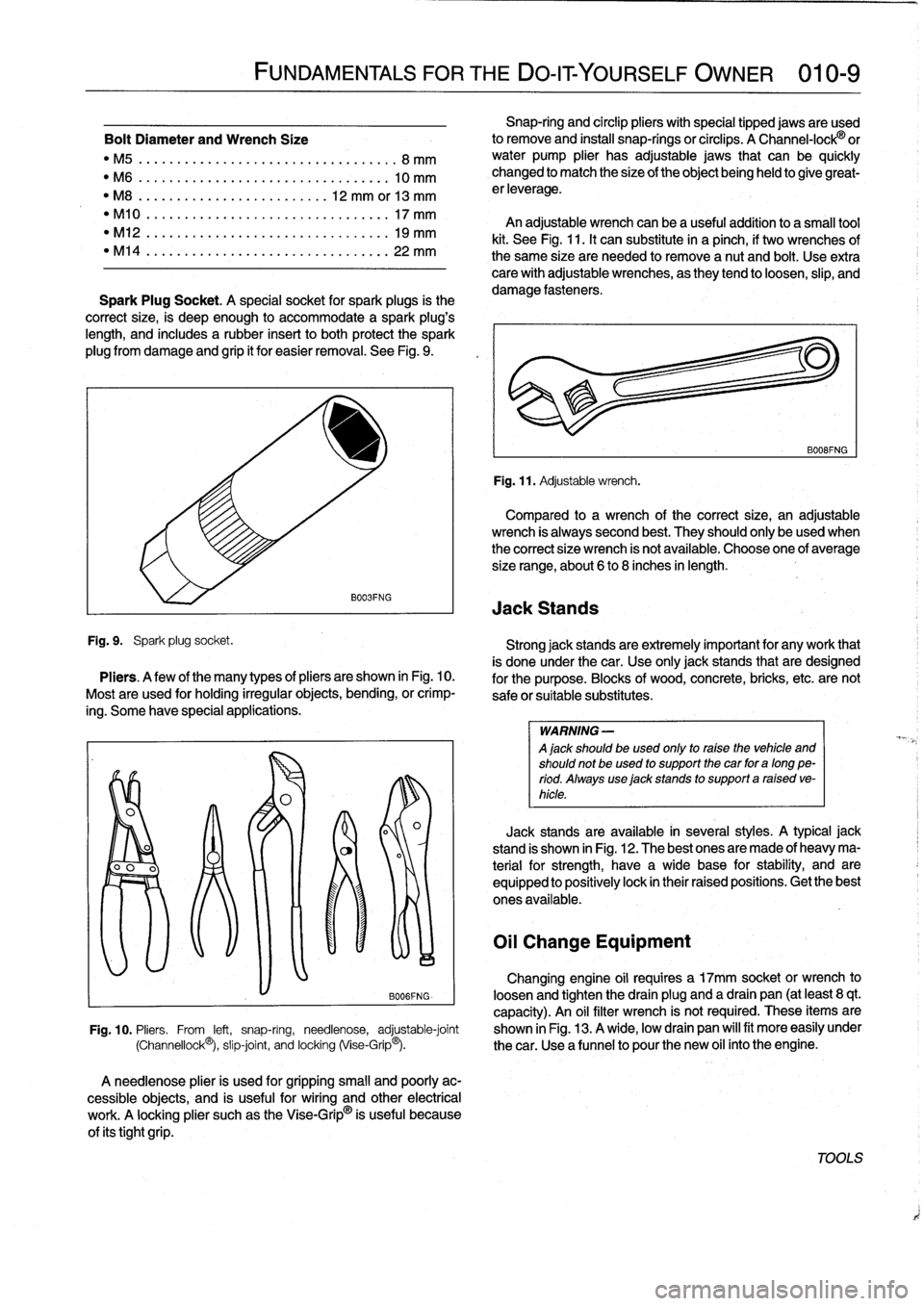
Spark
Plug
Socket
.
A
special
socket
for
spark
plugs
is
the
correct
size,
is
deep
enough
to
accommodate
a
spark
plug's
length,
and
includes
a
rubber
insertto
both
protect
the
spark
plug
from
damage
and
grip
it
for
easier
removal
.
See
Fig
.
9
.
Fig
.
9
.
Spark
plug
socket
.
FUNDAMENTALS
FOR
THEDO-ITYOURSELF
OWNER
010-
9
B003FNG
Pliers
.
A
few
of
the
many
types
ofpliers
are
shown
in
Fig
.
10
.
Mostare
used
for
holding
irregularobjects,
bending,or
crimp-
ing
.
Some
have
special
applications
.
A
needlenose
plier
is
used
for
gripping
small
and
poorly
ac-
cessible
objects,
and
is
useful
for
wiring
and
other
electrical
work
.
A
locking
plier
suchas
theVise-Grip
®
is
useful
because
of
its
tightgrip
.
Snap-ring
and
circlip
pliers
withspecial
tipped
jacas
areused
lo
remove
and
install
snap-ringsor
circlips
.
A
Channel-lock®
or
water
pump
plier
has
adjustable
jacas
that
can
be
quickly
changed
to
match
the
size
of
the
object
being
held
to
give
great-
erleverage
.
An
adjustable
wrench
canbea
useful
addition
to
a
small
tool
kit
.
See
Fig
.
11
.
It
can
substitute
in
a
pinch,
if
two
wrenches
of
the
same
size
are
needed
lo
remove
a
nut
and
bolt
.
Use
extra
care
with
adjustable
wrenches,
as
they
tend
to
loosen,
slip,
and
damage
fasteners
.
Fig
.
11
.
Adjustable
wrench
.
B008FNG
Compared
to
a
wrench
of
the
correct
size,
an
adjustable
wrench
is
always
second
best
.
They
shouldonly
beused
when
the
correct
size
wrench
is
not
available
.
Choose
one
of
average
size
range,
about
6
to
8
inches
in
length
.
Jack
Stands
Strong
jack
stands
are
extremely
important
for
any
work
that
is
done
under
thecar
.
Use
onlyjack
stands
that
are
designed
for
the
purpose
.
Blocks
of
wood,
concrete,
bricks,
etc
.
arenot
safeor
suitable
substitutes
.
WARNING
-
A
jack
should
be
used
only
to
raise
the
vehicle
and
shouldnot
beused
to
support
the
car
for
a
long
pe-
riod
.
Always
use
jack
stands
to
support
a
raised
ve-
hicle
.
Jack
standsare
available
1n
severa¡
styles
.
A
typical
jack
stand
is
shown
in
Fig
.
12
.
The
best
ones
are
made
of
heavy
ma-
terial
for
strength,
have
a
wide
base
for
stability,
and
are
equipped
lo
positively
lock
in
their
raised
positions
.
Get
the
best
ones
available
.
Oil
Change
Equipment
Changing
engine
oil
requires
a
17mm
socket
or
wrench
to
BOO6FNG-
loosen
and
tighten
the
drain
plug
and
a
drain
pan
(at
least
8
qt
.
capacity)
.
An
oil
filter
wrench
is
not
required
.
These
items
are
Fig
.
10
.
Pliers
.
From
left,
snap-ring,
needlenose,
adjustable-joint
shown
in
Fig
.
13
.
A
wide,
loca
drain
pan
wíll
fit
more
easily
under
(Channellock©),
slip-joint,
and
locking(Vise-Grip®)
.
the
car
.
Use
a
funnel
lo
pour
the
new
oil
into
theengine
.
TOOLS
Page 18 of 759
010-10
FUNDAMENTALS
FOR
THE
DO-IT
YOURSELF
OWNER
TOOLS
Torque
Wrench
B021FNG
Fig
.
12
.
Jack
stand
for
safely
supporting
car
to
work
underneath
.
B022FNG
Fig
.
13
.
Oil
change
equipment
includesdrainplug
wrench
(17mm),
8
qt
.
drain
pan,
and
funnel
.
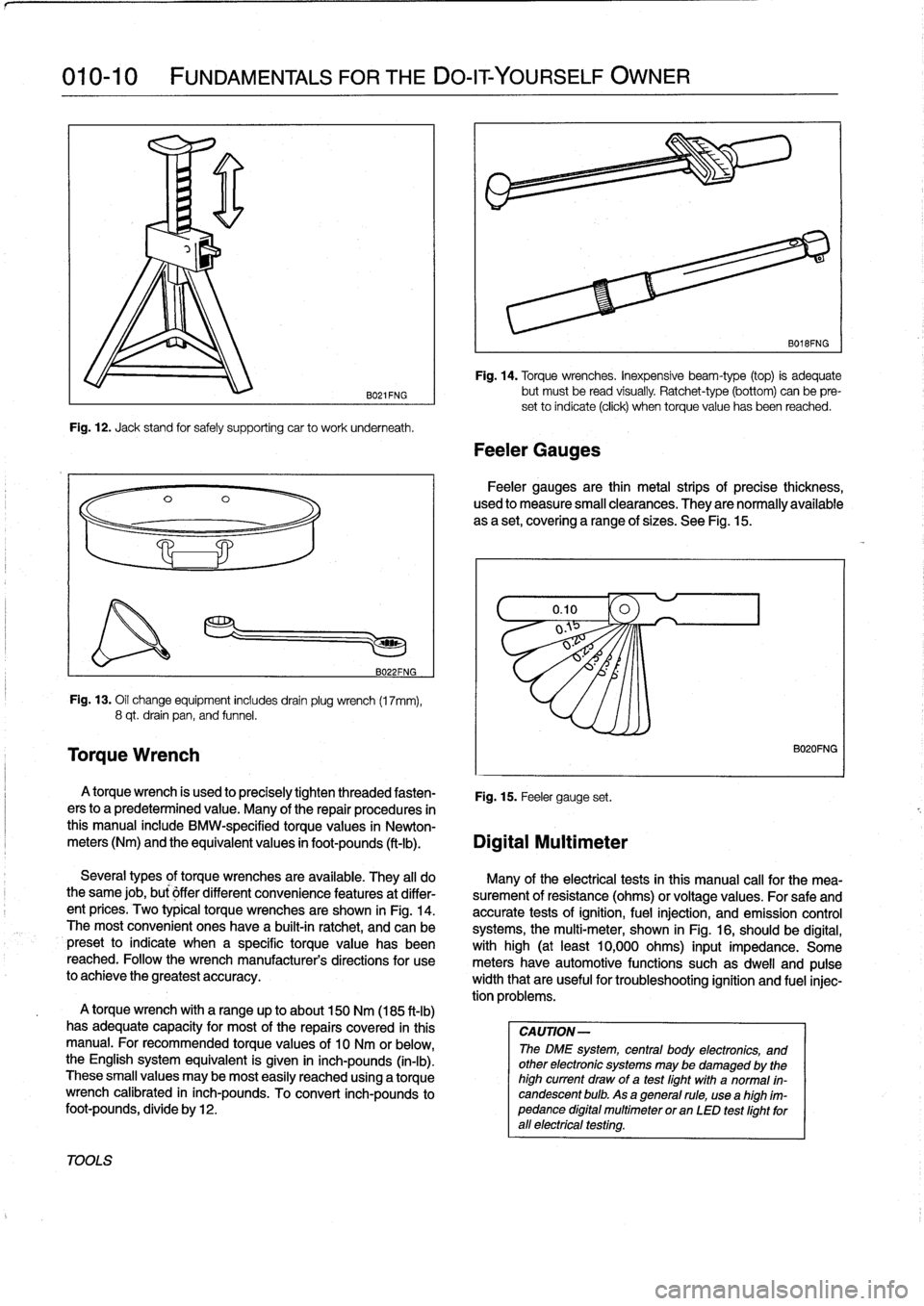
A
torque
wrench
is
used
to
precisely
tighten
threaded
fasten-
Fig
.
15
.
Feeler
gauge
set
.
ers
to
a
predetermined
value
.
Many
of
the
repair
procedures
in
this
manual
include
BMW-specified
torquevalues
in
Newton-
meters
(Nm)
and
the
equivalent
values
in
foot-pounds
(ft-Ib)
.
Digital
Multimeter
A
torque
wrench
with
a
range
up
to
about
150
Nm
(185
ft-lb)
has
adequate
capacity
for
most
of
the
repairs
covered
in
this
manual
.
For
recommended
torque
values
of
10
Nm
or
below,the
English
system
equivalent
is
given
in
inch-pounds
(in-lb)
.
These
small
values
may
be
most
easily
reached
using
a
torque
wrench
calibrated
in
inch-pounds
.
To
convert
inch-pounds
to
foot-pounds,
divide
by12
.
Fig
.
14
.
Torque
wrenches
.
Inexpensive
beam-type
(top)
is
adequate
but
must
be
read
visually
.
Ratchet-type
(bottom)
can
be
pre-
set
to
índicate
(click)
when
torquevalue
has
been
reached
.
Feeler
Gauges
B018FNG
Feeler
gauges
are
thin
metal
strips
of
precise
thickness,
used
to
measure
small
clearances
.
They
are
normally
available
as
a
set,
covering
a
range
of
sizes
.
See
Fig
.
15
.
Several
types
of
torque
wrenches
are
available
.
They
al¡
do
Many
of
the
electrical
tests
in
Chis
manual
cal¡
for
the
mea-
the
same
job,
bu¡
óffer
different
convenience
features
at
differ-
surement
of
resistance
(ohms)
or
voltage
values
.
For
safe
and
ent
prices
.
Two
typical
torque
wrenches
are
shown
in
Fig
.
14
.
accurate
tests
of
ignition,
fuel
injection,
and
emission
control
The
most
convenient
ones
have
a
built-in
ratchet,
and
can
be
systems,
the
multi-meter,
shown
in
Fig
.
16,
should
be
digital,
preset
to
indicate
when
a
specific
torque
value
has
been
with
high
(at
least
10,000
ohms)
input
impedance
.
Some
reached
.
Followthe
wrench
manufacturer's
directions
for
use
meters
have
automotive
functions
suchas
dweil
and
pulse
to
achieve
the
greatest
accuracy
.
width
that
are
useful
fortroubleshooting
ignition
and
fuel
injec-
tion
problems
.
CAUTION-
The
DME
system,
central
body
electronics,
and
other
electronic
systems
may
be
damaged
by
the
high
current
draw
of
a
test
fight
with
a
normal
in-
candescent
bulb
.
As
a
general
rule,
usea
high
ím-
pedance
digital
multimeter
or
an
LED
test
fightforall
electrfcal
testfng
.
B020FNG
Page 30 of 759
020-
8
MAINTENANCE
PROGRAM
FLUID
AND
LUBRICANT
SPECIFICATIONS
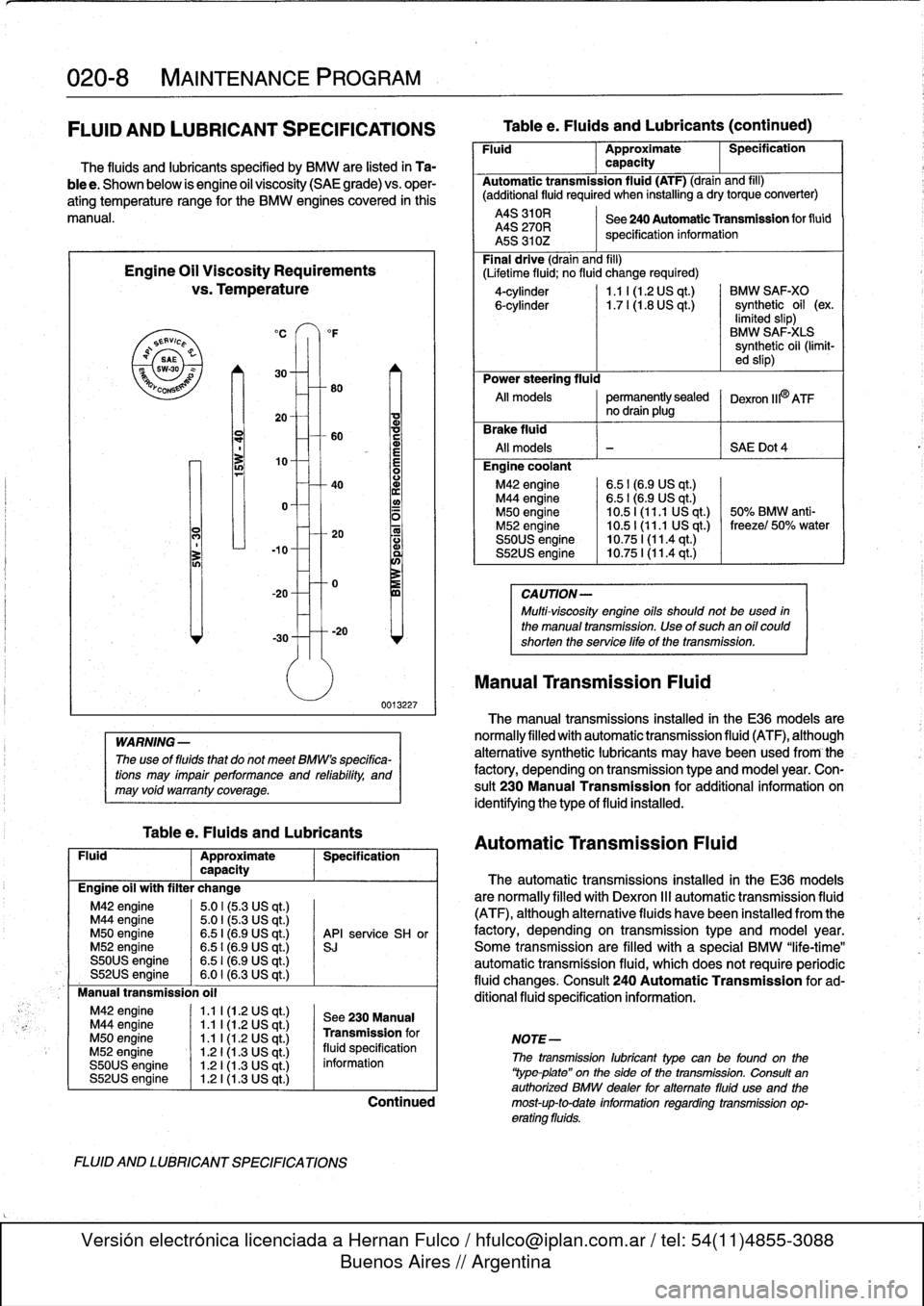
The
fluids
and
lubricante
specified
by
BMW
are
listed
in
Ta-
ble
e
.
Shown
below
is
engine
oil
viscosity
(SAE
grade)
vs
.
oper-
ating
temperature
range
for
the
BMW
enginescovered
in
this
manual
.
Engine
Oil
Viscosity
Requirements
vs
.
Temperature
`S
EAVic
P
Q
SAE
swao
YCO
0
N
M42
engine
1
.1
I
(1
.2
US
qt
.)
M44
engine
1
.1
l(1.2
US
qt
.)
M50
engine
1
.1
1(1.2
US
qt
.)
M52
engine
1
.21(1.3
US
qt
.)
S50US
engine
1
.21(1.3
US
qt
.)
S52US
engine
1
.21(1.3
US
qt
.)
°F
80
-
1o-0
-
30
-----20
WARNING
-
The
use
of
fluids
that
do
not
meet
BMWs
specifica-
tions
may
impair
performance
and
refability,
and
may
void
warranty
coverage
.
Tablee
.
Fluids
and
Lubricants
0013227
Fluid
Approximate
Specification
capacity
Engine
oil
with
filter
change
M42
engine
5
.01
(5
.3
US
qt
.)
M44
engine
5
.0
I
(5
.3
US
qt
.)
M50
engine
6
.5
I
(6.9
US
qt
.)
API
service
SH
or
M52
engine
6
.51
(6.9
US
qt
.)
si
S50US
engine
6
.51
(6.9
US
qt
.)
S52US
engine
6.0
I
(6.3
US
qt
.)
Manual
transmission
oil
FLUID
AND
LUBRICANT
SPECIFICATIONS
See
230Manual
Transmission
for
NOTE-
fluid
specification
Tablee
.
Fluids
and
Lubricants
(continued)
Fluid
Approximate
Specification
capacity
Automatic
transmission
fluid
(ATF)
(drain
and
fill)
(additional
fluid
required
when
installing
a
drytorque
converter)
A4S
310R
See240
AutomaticTransmission
for
fluid
A4S
270R
specification
information
A5S
310Z
Final
drive
(drain
and
fill)
(Lifetime
fluid
;
no
fluid
change
required)
4-cylinder
1
.1
I
(1.2
US
qt
.)
BMW
SAF-XO
6-cylinder
1.7
l(1
.8
US
qt
.)
synthetic
oil
(ex
.
limited
slip)
BMW
SAF-X1-S
synthetic
oil
(limit-
ed
slip)
Power
steering
fluid
Al¡
modeis
permanentlysealed
Dexron
IIPATFno
drain
plug
rake
fluid
All
modeis
-
~
S
AE
Dot4
Engine
coolant
M42
engine
6
.51(6
.9
US
qt
.)
M44
engine
6
.51(6
.9
US
qt
.)
M50
engine
10
.51
(11
.1
US
qt
.)
50%
BMW
anti-
M52
engine
10
.5
1
(11
.1
US
qt
.)
freezel
50%
water
S50US
engine
10
.75
1(11
.4
qt
.)
S52US
engine
10
.75
I
(11
.4
qt
.)
CA
UTION-
Multi-viscosity
engine
oils
should
not
beused
in
the
manual
transmission
.
Use
of
such
an
oil
could
shorten
the
service
life
of
thetransmission
.
Manual
Transmission
Fluid
The
manual
transmissions
installed
in
the
E36
modeis
are
normallyfilled
with
automatic
transmission
fluid
(ATF),
although
alternative
synthetic
lubricants
may
havebeen
used
from
-
the
factory,
depending
on
transmission
type
and
model
year
.
Con-
sult
230
Manual
Transmission
for
additional
information
on
identifying
the
type
of
fluid
installed
.
Automatic
Transmission
Fluid
The
automatic
transmissions
installed
in
the
E36
modeis
are
normally
filled
with
Dexron
111
automatic
transmission
fluid
(ATF),
although
alternative
fluids
havebeen
installed
from
the
factory,
depending
on
transmission
type
and
model
year
.
Some
transmission
are
filled
with
a
special
BMW
"life-time"
automatic
transmission
fluid,
whích
does
not
requireperiodic
fluid
changes
.
Consult
240
Automatic
Transmission
for
ad-
ditional
fluid
specification
information
.
information
1
The
11-
11
lubrican
type
canbefound
on
ti
¡e
`Yype
plate"
on
the
side
of
the
transmission
.
Consult
an
authorized
BMW
dealer
foralternate
fluid
use
and
the
Continued
most-up-to-date
information
regarding
transmission
op-
erating
fluids
.
Page 31 of 759
Final
Drive
Gear
Oil
BMW
recommends
using
only
a
specially
formulatedsyn-
thetic
gear
oil
that
is
available
through
an
authorized
BMW
dealer
parts
department
.
For
additional
information
on
this
¡u-
bricant
andany
other
lubricants
that
may
be
compatible,
con-
tact
an
authorized
BMW
dealer
senrice
department
.
See
331
Final
Drive
.
Brake
Fluid
Brake
fluid
absorbs
moisture
easily,
and
moisture
in
the
fluid
affects
brake
performance
and
reliability
.
This
is
why
brake
fluid
should
be
flushed
from
the
system
every
two
years
.
When
re-
placing
or
adding
brake
fluid,
use
only
new
(luid
from
previously
unopened
containers
.
Do
not
use
brake
fluid
that
has
been
bled
from
the
system,
even
ifit
is
brand
new
.
Use
only
DOT
4
brake
fluid
.
See340
Brakes
for
more
information
.
Engine
Coolant
(Anti-freeze)
BMW
recommends
coolant
that
is
a
50/50
mixture
of
distilled
water
and
phosphate/nítrate
freeanti-freeze
containing
ethyl-
ene
glycol
.
Anti-freezeraises
the
boiling
point
and
lowersthe
freezingpoint
of
the
coolant
.
It
alsocontains
additives
that
help
prevent
cooling
system
corrosion
.
Power
Steering
Fluid
The
power
steering
fluid
is
Dexron
II]®
ATF,
or
equivalent
.
The
system
is
permanently
filled
and
does
not
have
a
drain
.
Routinely
adding
ATF
is
not
required
unlessthe
system
is
leak-
i
n
g,
WARNING
-
Be
sure
to
check
the
fluid
specifications
on
the
pow-
er
steering
reservoir
to
confirm
the
fluid
type
in-
stalled
in
the
system
.
In
some
instances,
the
power
steering
system
may
be
filled
with
an
alternative
hy-
draulic
fluid
designated
CHF
7
.1
.
MAINTENANCE
PROGRAM
020-
ENGINE
OIL
SERVICE
Engine
oil
and
fiiter,
changing
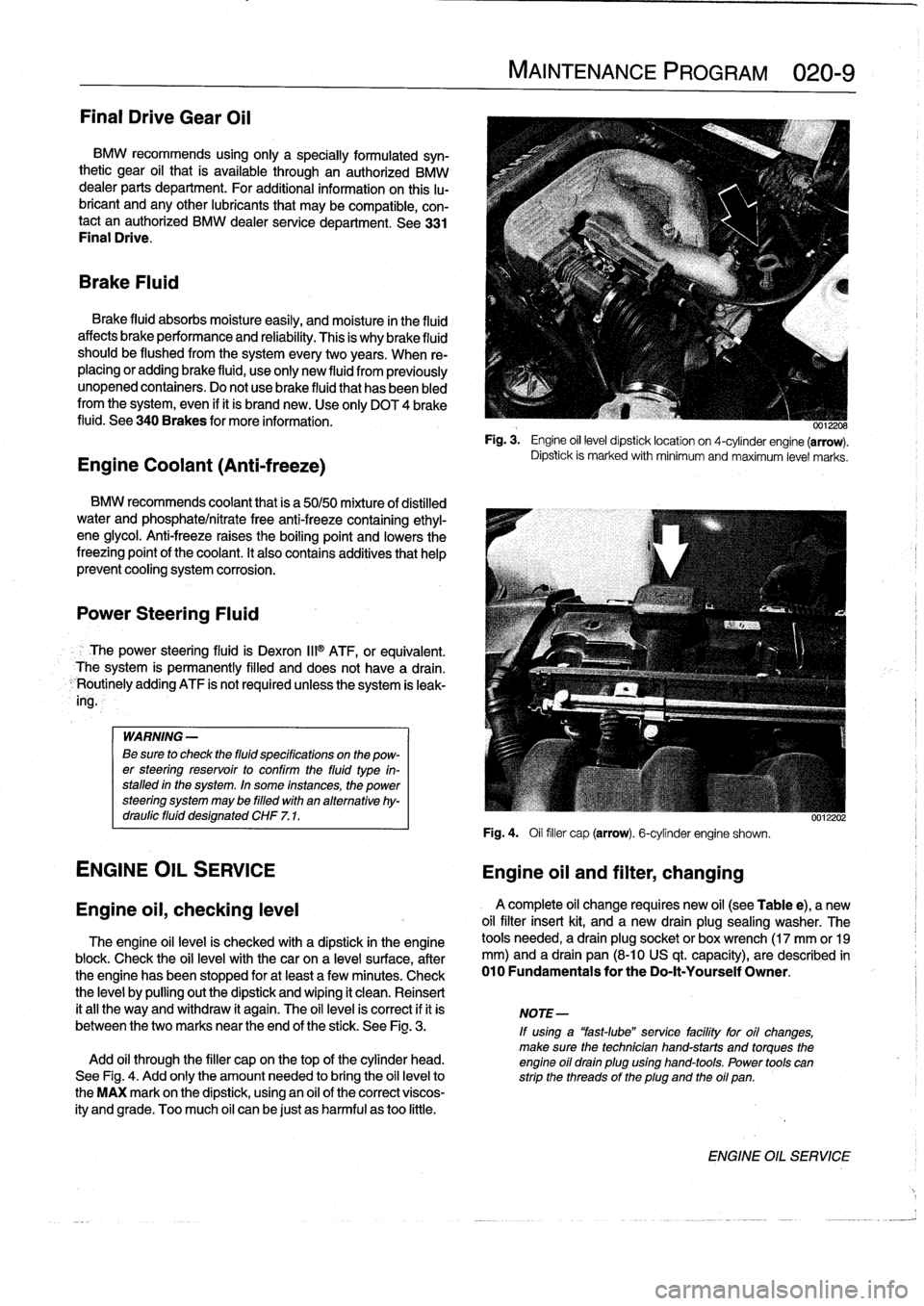
Fig
.
3
.
Engine
oil
level
dipsticklocation
on
4-cylinder
engine
(arrow)
.
Dipsfck
is
marked
with
mínimum
and
maximum
level
marks
.
Fig
.
4
.
Oil
filler
cap
(arrow)
.
6-cylinder
engine
shown
.
0012202
Engine
oii,
checking
leve¡
A
complete
oil
change
requires
new
oil
(see
Table
e),
a
new
oil
filter
insert
kit,
and
a
new
drain
plug
sealing
washer
.
The
The
engine
oil
leve]
is
checked
with
a
dipstick
in
the
engine
tools
needed,
a
drain
plug
socket
or
box
wrench
(17
mm
or19
block
.
Check
the
oii
leve¡
with
the
canon
a
level
surface,
after
mm)
and
a
drain
pan
(8-10
US
qt
.
capacity),
are
described
in
the
engine
has
been
stopped
for
atleast
a
few
minutes
.
Check
010
Fundamentals
for
the
Do-It-Yourself
Owner
.
the
leve¡
by
pulling
outthe
dipstick
and
wiping
it
clean
.
Reinsert
it
all
the
way
and
withdraw
it
again
.
The
oil
leve¡
is
correct
if
it
is
NOTE-
between
the
two
marks
near
the
end
of
the
stick
.
See
Fig
.
3
.
If
using
a
"fast-lube"
service
facility
for
oil
changes,
make
sure
the
technician
hand-starts
and
torques
the
Add
oil
through
the
filler
cap
on
thetop
of
the
cylinder
head
.
engine
oil
drain
plug
using
hand-tools
.
Power
tools
can
See
Fig
.
4
.
Add
only
the
amount
needed
to
bring
the
oil
leve¡to
strip
the
threads
of
the
plug
and
the
oil
pan
.
the
MAX
mark
on
the
dipstick,
using
an
oil
of
the
correctviscos-
ity
andgrade
.
Too
much
oil
canbe
just
as
harmful
as
too
little
.
ENGINE
OIL
SERVICE
Page 32 of 759
020-
1
0
MAINTENANCE
PROGRAM
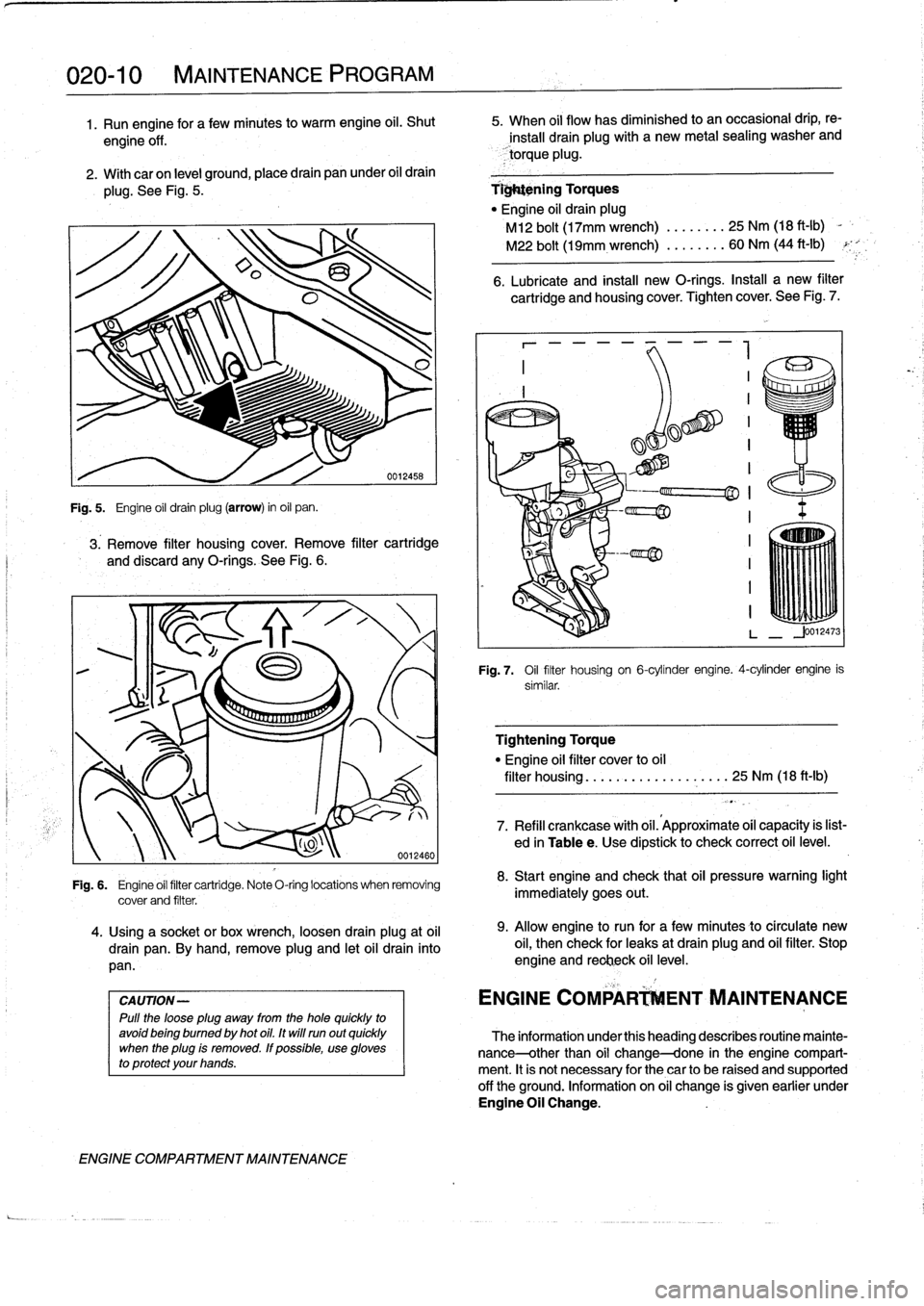
1.
Run
engine
for
afewminutes
to
warm
engine
oil
.
Shut
5
.
When
oil
flow
has
diminished
to
an
occasional
drip,
re-
engine
off
.
install
drain
plugwith
a
new
metal
sealing
washerand
torque
plug
.
2
.
With
car
on
level
ground,
place
drain
pan
under
oil
drain
plug
.
See
Fig
.
5
.
Tightening
Torques
"
Engine
oil
drain
plug
M12
bolt
(17mm
wrench)
.
...
.
..
.
25
Nm
(18
ft-Ib)
-
M22
bolt
(19mm
.
wrench)
...
.
...
.
60
Nm
(44
ft-Ib)
Fig
.
5
.
Engine
oil
drain
plug(arrow)
in
oil
pan
.
3
.
Remove
filter
housingcover
.
Remove
filter
cartridge
and
discard
any
O-rings
.
See
Fig
.
6
.
CAUTION-
Pulí
the
loose
plug
away
from
the
hole
quickly
to
avoidbeing
bumed
by
hot
oil
.
It
wíll
runout
quickly
when
the
plug
ís
removed
.
If
possible,
use
gloves
to
protect
your
hands
.
ENGINE
COMPARTMENT
MAINTENANCE
0012460
Fig
.
6
.
Engine
oil
filter
cartridge
.
Note
O-ring
locations
when
removing
cover
and
filter
.
4
.
Using
a
socket
or
box
wrench,
loosen
drain
plug
at
oil
drain
pan
.
By
hand,
remove
plug
and
letoil
drain
into
pan
.
6
.
Lubricate
and
install
new
O-rings
.
Install
a
new
filter
cartridge
and
housingcover
.
Tighten
cover
.
See
Fig
.
7
.
7
«
a~
.~~
fT~
iII~IIIi~
.
Fig
.
7
.
Oil
flter
housing
on
6-cylínder
engine
.
4-cylinder
engine
is
similar
.
Tightening
Torque
"
Engine
oil
filter
cover
to
oil
filter
housing
...................
25
Nm
(18
ft-Ib)
7
.
Refill
crankcase
with
oil
.'Approximate
oil
capacity
is
list-
ed
in
Tablee
.
Use
dipstick
to
check
correct
oil
level
.
8
.
Start
engine
and
check
that
oil
pressure
warning
light
immediately
goes
out
.
9
.
Allow
engine
to
run
for
a
few
minutes
to
círculate
new
oil,
then
check
for
leaks
at
drain
plug
and
oil
filter
.
Stop
engine
and
reclieck
oil
level
.
ENGINE
COMPAR
ENT
MAINTENANCE
The
information
underthis
heading
describes
routine
mainte-
nance-other
than
oil
change-done
in
the
engine
compart-
ment
.
It
is
not
necessary
for
the
car
to
be
raised
and
supported
off
the
ground
.
Information
on
oil
change
is
given
earlier
under
Engine
Oil
Change
.
Page 139 of 759
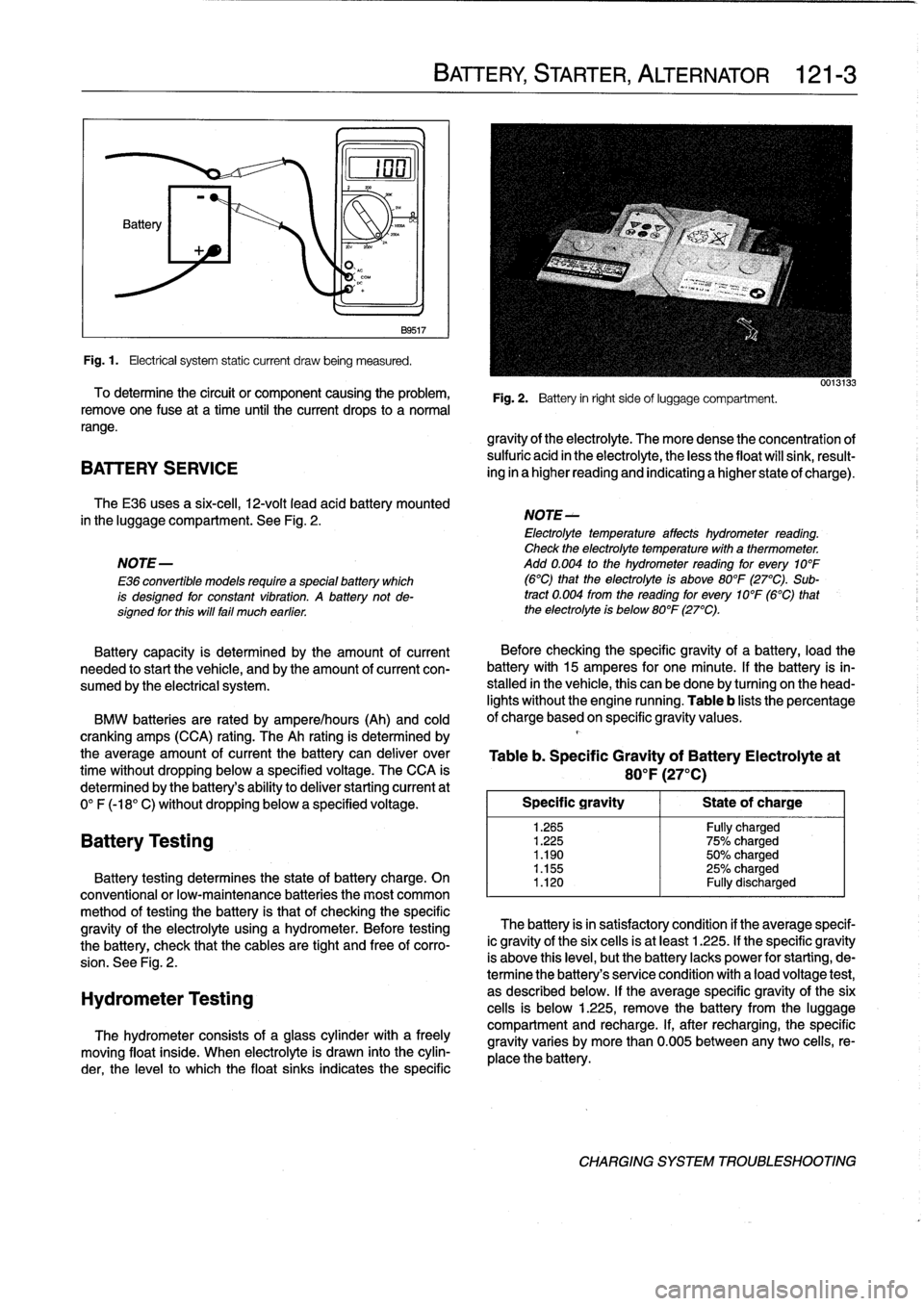
Fig
.1.
Electrical
system
static
current
draw
being
measured
.
To
determine
the
circuit
or
component
causing
the
problem,
remove
one
Puse
at
a
time
until
the
current
drops
to
a
normal
range
.
BATTERY
SERVICE
The
E36
uses
a
six-cell,
12-volt
leadacid
battery
mounted
in
the
luggage
compartment
.
See
Fig
.
2
.
NOTE-
E36
convertible
models
require
a
specialbattery
which
is
designed
for
constant
vibratfon
.
A
battery
not
de-signed
for
this
will
fail
much
earlier
.
Battery
capacity
is
determined
by
the
amount
of
current
needed
tostart
the
vehicle,
and
by
the
amount
of
current
con-
sumed
by
the
electrical
system
.
BMW
batteries
are
rated
by
ampere/hours
(Ah)
and
cold
cranking
amps
(CCA)
rating
.
The
Ah
rating
is
determined
by
the
average
amount
of
current
the
battery
can
deliver
over
time
without
dropping
below
a
specified
voltage
.
The
CCA
is
determined
by
the
battery's
ability
to
deliver
starting
current
at
0°
F
(-18°
C)
without
dropping
below
a
specified
voltage
.
Battery
Testing
noN~A
B9517
Battery
testing
determines
the
state
of
battery
charge
.
On
conventional
or
low-maintenance
batteries
the
most
common
method
of
testing
the
battery
is
that
of
checking
the
specific
gravity
of
the
electrolyte
using
a
hydrometer
.
Before
testing
the
battery,
check
that
the
cables
are
tight
and
free
of
corro-
sion
.
See
Fig
.
2
.
Hydrometer
Testing
The
hydrometer
consists
of
a
glass
cylinder
with
a
freely
moving
float
inside
.
When
electrolyte
is
drawn
into
the
cylin-
der,
the
levelto
which
the
float
sinks
indicates
the
specific
BATTERY,
STARTER,
ALTERNATOR
121-
3
Fig
.
2
.
Battery
in
right
sideof
luggage
compartment
.
gravity
of
the
electrolyte
.
The
more
dense
the
concentration
of
sulfuric
acid
in
the
electrolyte,
the
less
the
float
will
sink,
result-
ing
in
a
higher
reading
and
indicating
a
higher
state
of
charge)
.
NOTE-
Electrolyte
temperature
affects
hydrometer
reading
.
Check
the
electrolyte
temperaturewith
a
thermometer
.
Add
0
.004
to
the
hydrometer
reading
for
every
10°F
(6°C)
that
the
electrolyte
is
above
80°F
(27°C)
.
Sub-
tract
0
.004
from
the
reading
for
every
10°F
(6°C)
that
the
electrolyte
is
below
80°F
(27°C)
.
Before
checking
the
specificgravity
of
a
battery,
load
the
battery
with
15
amperes
for
one
minute
.
lf
the
battery
is
in-
stalled
in
the
vehicle,
this
can
be
done
by
turning
on
the
head-
lights
without
the
engine
running
.
Table
b
lists
the
percentage
of
charge
based
on
specific
gravity
values
.
Table
b
.
Specific
Gravity
of
Battery
Electrolyteat
80
°
F
(27°C)
Specific
gravity
1
Stateof
charge
1
.265
Fully
charged
1
.225
75%
charged
1
.190
50%
charged
1
.155
25%
charged
1
.120
Fully
discharged
The
battery
isin
satisfactory
condition
if
theaverage
specif-
ic
gravity
of
the
six
cells
is
at
least
1
.225
.
If
the
specific
gravity
is
above
this
leve¡,
butthe
battery
lacks
power
for
starting,
de-
termine
the
battery's
senrice
condition
with
a
load
voltage
test,
as
described
below
.
If
the
average
specific
gravity
of
the
six
cells
is
below
1
.225,
remove
the
battery
from
the
luggage
compartment
and
recharge
.
If,
after
recharging,
the
specific
gravity
varies
by
more
than
0
.005
between
any
two
celis,
re-
place
the
battery
.
CHARGING
SYSTEM
TROUBLESHOOTING
Page 186 of 759
160-2
FUEL
TANK
AND
FUEL
PUMP
0011943
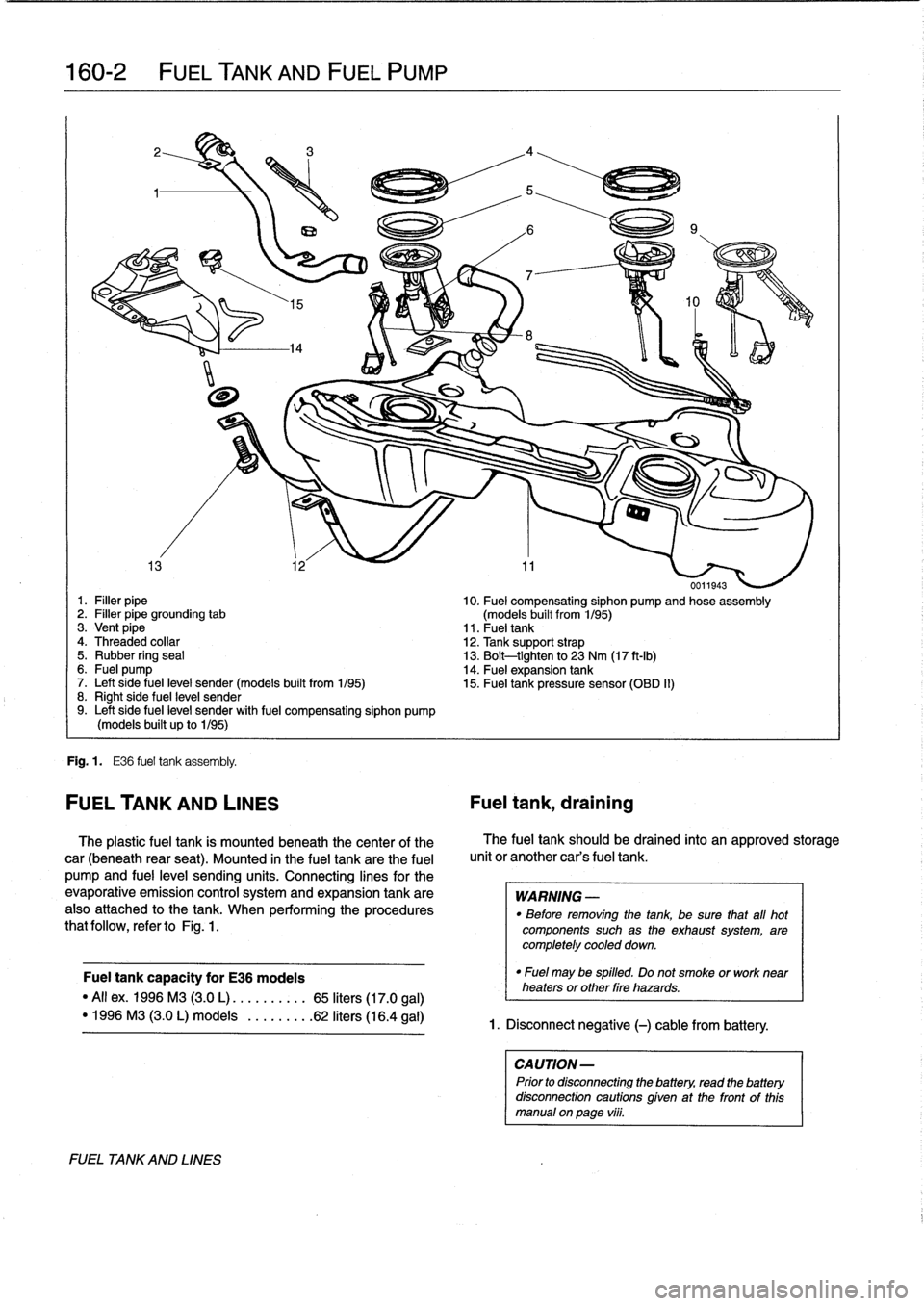
1
.
Filler
pipe
10
.
Fuel
compensating
siphon
pump
and
hose
assembly
2
.
Filler
pipe
grounding
tab
(models
built
from
1/95)
3
.
Vent
pipe
11
.
Fueltank
4
.
Threaded
collar
12
.
Tank
support
strap
5
.
Rubber
ring
seal
13
.
Bolt-tighten
to
23
Nm
(17
ft-Ib)
6
.
Fuel
pump
14
.
Fuel
expansion
tank
7
.
Left
side
fuel
leve¡
sender(models
built
from
1/95)
15
.
Fuel
tank
pressure
sensor
(OBD
II)
8
.
Right
side
fuel
leve¡
sender9
.
Left
side
fuel
leve¡
sender
with
fuel
compensating
siphon
pump
(models
built
up
to
1/95)
Fig
.
1
.
E36
fuel
tank
assembly
.
FUEL
TANK
AND
LINES
Fuel
tank,
draining
The
plastic
fuel
tank
is
mounted
beneath
the
center
of
the
car
(beneath
rear
seat)
.
Mounted
in
the
fuel
tank
are
the
fuel
pump
and
fuel
leve¡
sending
units
.
Connecting
lines
for
the
evaporative
emission
control
systemand
expansion
tank
are
also
attached
to
the
tank
.
When
performing
the
procedures
that
follow,
refer
toFig
.
1
.
Fuel
tank
capacity
for
E36
modeis
"All
ex
.
1996
M3
(3
.0
L)
.....
.
..
..
65
liters
(17
.0
gal)
"
1996
M3
(3.0L)
modeis
.
...
.
..
.
.62
liters
(16
.4
gal)
FUEL
TA
NKAND
LINES
The
fuel
tank
should
be
drained
into
an
approved
storage
unit
or
another
car's
fuel
tank
.
WARNING
-
"
Before
removing
the
tank,
be
sure
that
afl
hot
components
such
as
the
exhaust
system,
are
completely
cooled
down
.
"
Fuel
may
be
spilled
.
Do
not
smoke
or
worknear
heaters
or
other
Pire
hazards
.
1
.
Disconnect
negative
(-)
cable
from
battery
.
CAUTION-
Prior
to
disconnectiog
the
battery,
read
the
battery
disconnection
cautions
given
at
the
front
of
this
manual
on
paga
vi¡¡
.
Page 194 of 759
160-
1
0
FUEL
TANK
AND
FUEL
PUMP
3
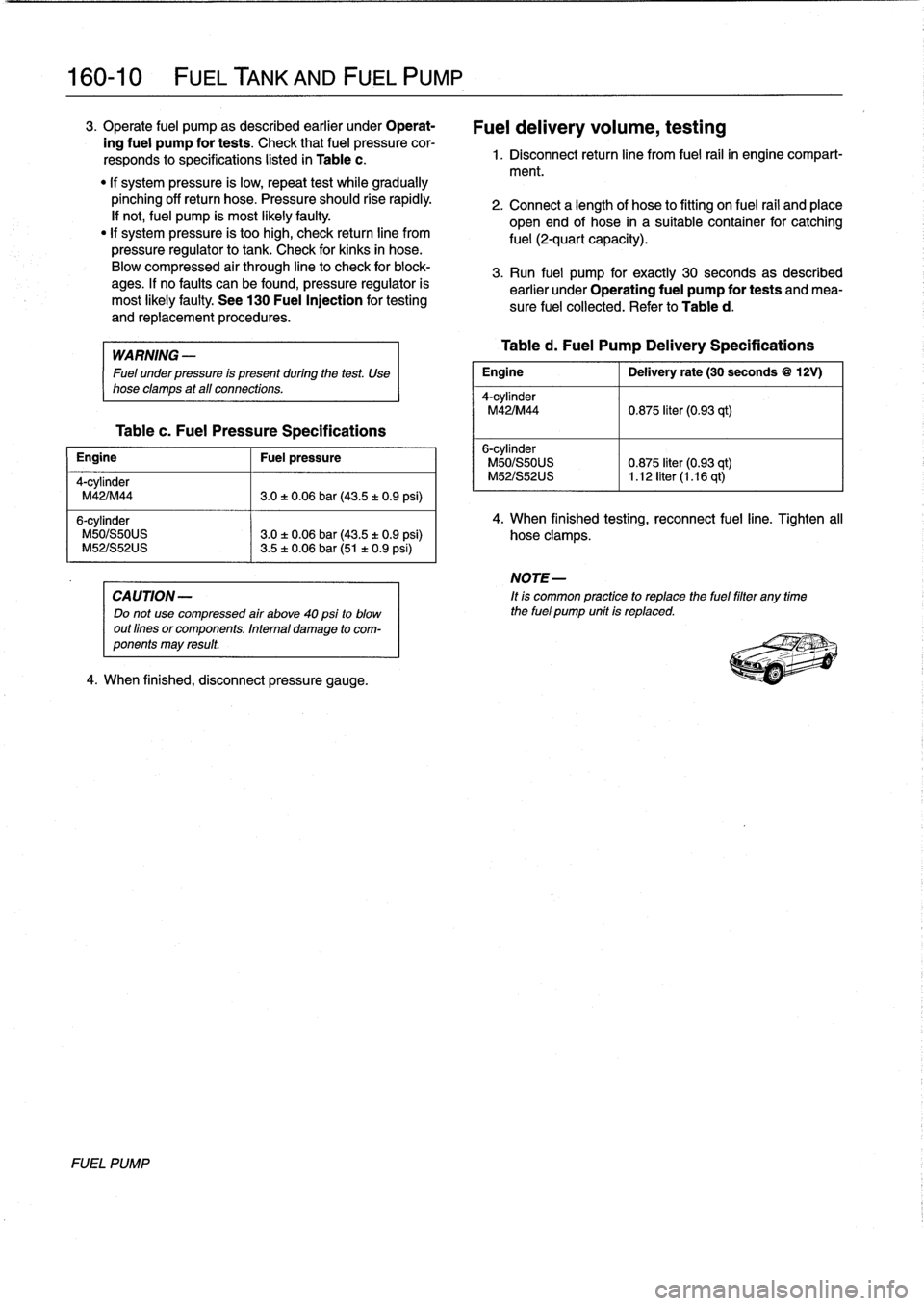
.
Operate
fuel
pump
as
described
earlier
under
Operat-
ing
fuel
pump
for
tests
.
Check
that
fuel
pressure
cor-
responds
to
specifications
listed
in
Table
c
.
"
If
system
pressure
is
low,
repeat
test
whilegradually
pinching
off
return
hose
.
Pressure
should
rise
rapidly
.
If
not,fuel
pump
is
most
likely
faulty
.
"
If
system
pressure
is
too
high,
check
return
line
from
pressure
regulator
to
tank
.
Check
for
kinks
in
hose
.
Blow
compressed
air
through
line
to
check
for
block-
ages
.
If
no
faulty
canbe
found,
pressure
regulator
is
most
likely
faulty
.
See
130
Fuel
Injection
for
testing
and
replacementprocedures
.
Table
c
.
Fuel
Pressure
Specifications
Engine
1
Fuel
pressure
4-cylinder
M42/M44
3
.0
:e
0
.06
bar(43
.5
±0
.9
psi)
6-cylinder
M50/S50US
3
.0
:j-
0
.06bar(43
.5
t0
.9
psi)
M52/S52US
3
.5
t
0
.06
bar
(51
t0
.9psi)
CA
UTION-
Do
not
use
compressed
air
above
40
psi
to
blow
out
fines
or
components
.
Interna¡
damage
to
com-
ponents
may
result
.
4
.
When
finished,
disconnect
pressure
gauge
.
FUEL
PUMP
Fuel
delivery
volume,
testing
1
.
Disconnect
return
line
from
fuel
rail
in
engine
compart-
ment
.
2
.
Connect
a
length
of
hose
to
fitting
on
fuel
rail
and
place
open
end
of
hose
in
a
suitable
container
for
catching
fuel
(2-quart
capacity)
.
3
.
Run
fuel
pump
for
exactly
30
seconds
as
described
earlier
under
Operating
fuel
pump
for
tests
and
mea-
sure
fuel
collected
.
Refer
to
Table
d
.
WARNING-
Table
d
.
Fuel
Pump
Delivery
Specifications
Fuel
under
pressure
is
present
duringthe
test
.
Use
I
Engine
Delivery
rate
(30
seconds
@
12V)
hose
clamps
at
all
connections
.
4-cylinder
M42/M44
0
.875
fter
(0
.93
qt)
6-cylinder
M50/S50US
0
.875
fter(0
.93
qt)
M52/S52US
~
1
.12
liter
(1
.16
qt)
4
.
When
finished
testing,
reconnect
fuel
line
.
Tighten
all
hose
clamps
.
NOTE-
It
is
common
practice
to
replace
the
fuel
filter
any
time
the
fuel
pump
unit
is
replaced
.
Page 200 of 759
170-6
RADIATOR
AND
COOLING
SYSTEM
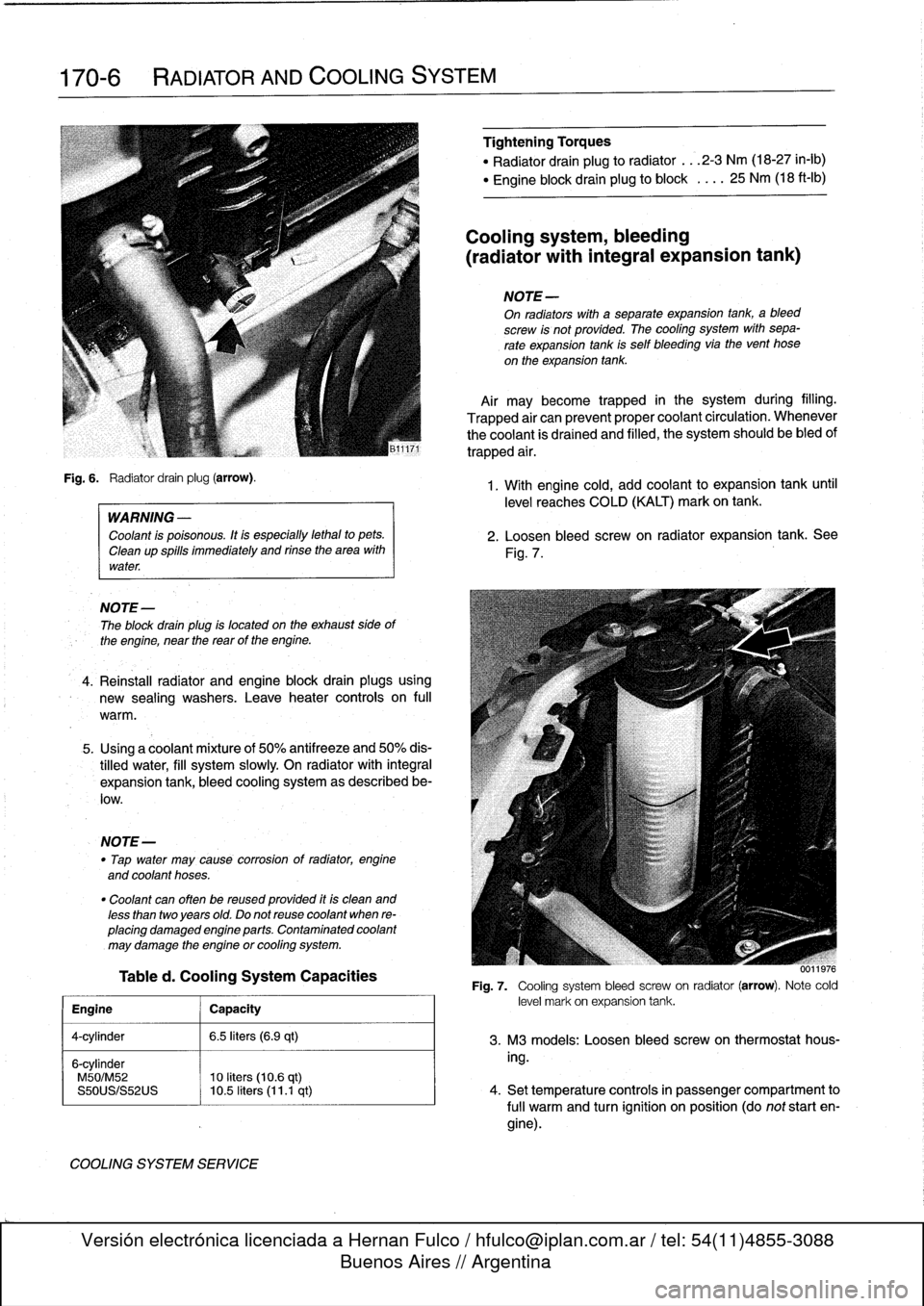
Fig
.
6
.
Radiator
drain
plug
(arrow)
.
WARNING
-
Coolant
is
poisonous
.
Itis
especially
lethal
to
pets
.
Cleanup
spills
immediately
and
rinse
the
area
with
water
.
NOTE
-
The
block
drain
plug
is
located
on
the
exhaust
side
of
the
engine,
near
the
reas
of
the
engine
.
4
.
Reinstall
radiator
and
engine
block
drain
plugsusing
new
sealing
washers
.
Leave
heater
controis
on
full
warm
.
5
.
Using
a
coolantmixture
of
50%
antifreeze
and
50%
dis-
tilled
water,
fill
system
slowly
On
radiator
with
integral
expansion
tank,
bleed
cooling
system
as
described
be-
low
.
NOTE-
"
Tap
water
may
cause
corrosion
of
radiator,
engine
and
coolant
hoses
.
"
Coolant
can
often
be
reused
provided
itis
clean
and
less
than
twoyears
old
.
Do
not
reuse
coolant
when
re-
placing
damaged
engine
parts
.
Contaminated
coolant
may
damage
the
engine
or
cooling
system
.
Tabled
.
Cooling
System
Capacities
Engine
j
Capacity
4-cylinder
1
6
.5
liters
(6.9
qt)
6-cylinder
M50/M52
10
liters
(10
.6
qt)
S50US/S52US
10
.5
liters
(11
.1
qt)
COOLING
SYSTEM
SERVICE
Tightehing
Torques
"
Radiator
drain
plug
to
radiator
...
2-3
Nm
(18-27
in-lb)
"
Engine
block
drain
plug
to
block
.
.
..
25
Nm
(18
ft-Ib)
Cooling
system,
bleeding
(radiator
with
integral
expansion
tank)
NOTE
-
On
radiators
with
a
separate
expansion
tank,
ableed
screw
is
not
provided
.
The
cooling
system
with
sepa-
rate
expansion
tank
is
self
bleeding
via
the
vent
hose
on
the
expansion
tank
.
Air
maybecome
trapped
in
the
system
during
filling
.
Trapped
air
can
prevent
proper
coolant
circulation
.
Whenever
the
coolant
is
drained
and
filled,
the
system
should
be
bled
of
trapped
air
.
1
.
With
engine
cold,
add
coolant
to
expansion
tank
until
level
reaches
COLD
(KALT)
mark
on
tank
.
2
.
Loosen
bleed
screw
on
radiator
expansion
tank
.
See
Fig
.
7
.
0011976
Fig
.
7
.
Cooling
system
bleed
screwon
radiator
(arrow)
.
Note
cold
level
mark
on
expansion
tank
.
3
.
M3
models
:
Loosen
bleed
screw
on
thermostathous-
ing
.
4
.
Set
temperature
controls
in
passenger
compartment
to
fui¡
warm
and
turn
ignition
on
position
(do
not
start
en-
gine)
.
Page 222 of 759
230-2
MANUAL
TRANSMISSION
Transmission
fluidleve¡,
checking
Checking
thetransmission
oil
level
involves
simply
remov-
ing
the
side
drain
plug
and
inserting
a
finger
into
the
holeto
check
the
fluid
leve¡
.
lf
the
fluid
leve¡
is
up
to
the
bottom
of
the
drain
hole
(finger
is
wetted
by
transmission
fluid),
the
leve¡
is
correct
.
Transmission
fluid,
replacing
NOTE-
Manual
transmission
fluid
type
should
be
printed
ona
label
on
the
side
of
the
transmission
.
If
in
doubt,
consult
an
authorized
BMW
dealer
for
the
up-to-dateinforma-
tion
on
operating
fluids
.
1
.
Drive
vehicle
for
afew
miles
to
warm
transmission
.
2
.
Raise
and
safely
support
vehicle
to
access
drain
plug
.
WARNING
-
"
When
raising
the
car
uslng
a
floor
jack
or
a
hy-
draulic
lift,
carefully
position
the
jack
pad
to
pre-
vent
damaging
the
car
body
.
A
suitable
liner
(wood,
rubber,
etc
.)
should
be
placed
between
the
jack
and
the
car
to
prevent
body
damage
.
"
Watch
the
jack
closely
.
Make
sure
it
stays
stable
and
does
not
shíít
or
tilt
.
As
the
car
is
raised,
the
car
may
roll
slightly
and
the
jack
may
shift
.
3
.
Place
a
drain
pan
under
transmission
andremove
drain
plug
at
bottom
of
transmission
.
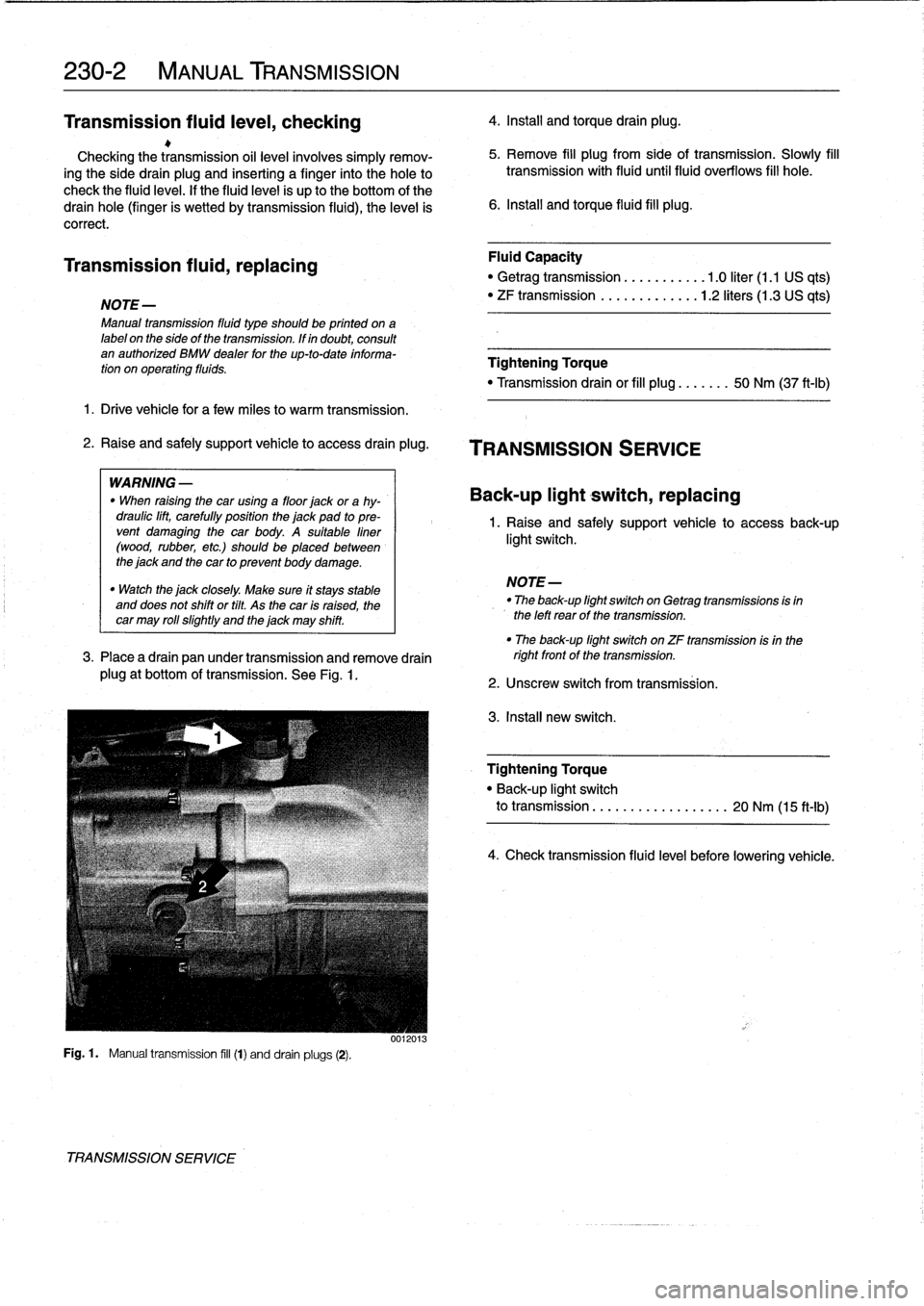
See
Fig
.
1
.
Fig
.
1
.
Manual
transmission
fill
(1)
and
drain
plugs
(2)
.
TRANSMISSION
SERVICE
4
.
Install
and
torque
drain
plug
.
5
.
Remove
fill
plug
from
side
of
transmission
.
Slowly
fill
transmission
with
fluiduntilfluid
overflows
fill
hole
.
6
.
Install
and
torque
fluid
fill
plug
.
Fluid
Capacity
"
Getrag
transmission
...........
1
.0
liter
(1.1
US
qts)
"
ZF
transmission
.............
1
.2
liters(1
.3
US
qts)
Tightening
Torque
"
Transmission
drain
or
fill
plug
.......
50
Nm
(37
ft-Ib)
TRANSMISSION
SERVICE
Back-up
light
switch,
replacing
1
.
Raise
and
safely
support
vehicle
to
accessback-up
light
switch
.
NOTE-
"
The
back-up
light
switch
on
Getrag
transmissions
is
in
the
left
rearof
the
transmission
.
"
Theback-up
light
switch
on
ZF
transmission
isin
the
rightfront
of
thetransmission
.
2
.
Unscrew
switch
from
transmission
.
3
.
Install
new
switch
.
Tightening
Torque
"
Back-up
light
switch
to
transmission
..
..
.
.....
.
..
.....
20
Nm
(15
ft-ib)
4
.
Check
transmission
fluid
leve¡
before
lowering
vehicle
.