belt BMW M3 2010 User Guide
[x] Cancel search | Manufacturer: BMW, Model Year: 2010, Model line: M3, Model: BMW M3 2010Pages: 196, PDF Size: 5.78 MB
Page 101 of 196
Reference
At a glance
Controls
Driving tips
Mobility
99
Raising the roller cover
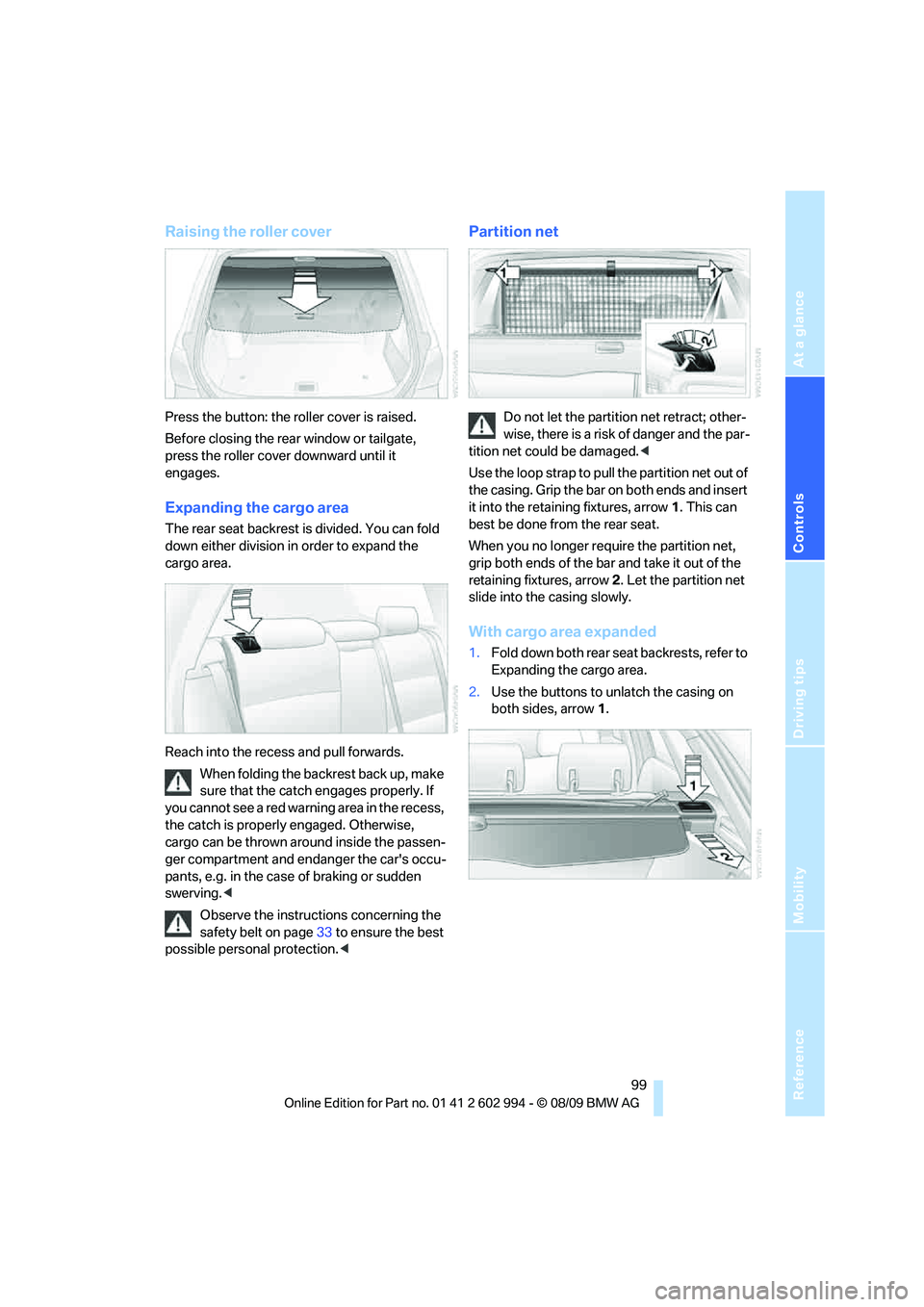
Press the button: the roller cover is raised.
Before closing the rear window or tailgate,
press the roller cover downward until it
engages.
Expanding the cargo area
The rear seat backrest is divided. You can fold
down either division in order to expand the
cargo area.
Reach into the recess and pull forwards.
When folding the backrest back up, make
sure that the catch engages properly. If
you cannot see a red warning area in the recess,
the catch is properly engaged. Otherwise,
cargo can be thrown around inside the passen-
ger compartment and endanger the car's occu-
pants, e.g. in the case of braking or sudden
swerving.<
Observe the instructions concerning the
safety belt on page33 to ensure the best
possible personal protection.<
Partition net
Do not let the partition net retract; other-
wise, there is a risk of danger and the par-
tition net could be damaged.<
Use the loop strap to pull the partition net out of
the casing. Grip the bar on both ends and insert
it into the retaining fixtures, arrow 1. This can
best be done from the rear seat.
When you no longer require the partition net,
grip both ends of the bar and take it out of the
retaining fixtures, arrow 2. Let the partition net
slide into the casing slowly.
With cargo area expanded
1.Fold down both rear seat backrests, refer to
Expanding the cargo area.
2.Use the buttons to unlatch the casing on
both sides, arrow 1.
Page 103 of 196
Reference
At a glance
Controls
Driving tips
Mobility
101
>Insertable dividers* and removable storage
tray for the storage compartment under the
floor panel
Folding up the floor panel
Do not exceed the maximum permissible
load of 55 lbs/25 kg for the storage com-
partment under the floor panel; otherwise, dam-
age could result.<
Sedan
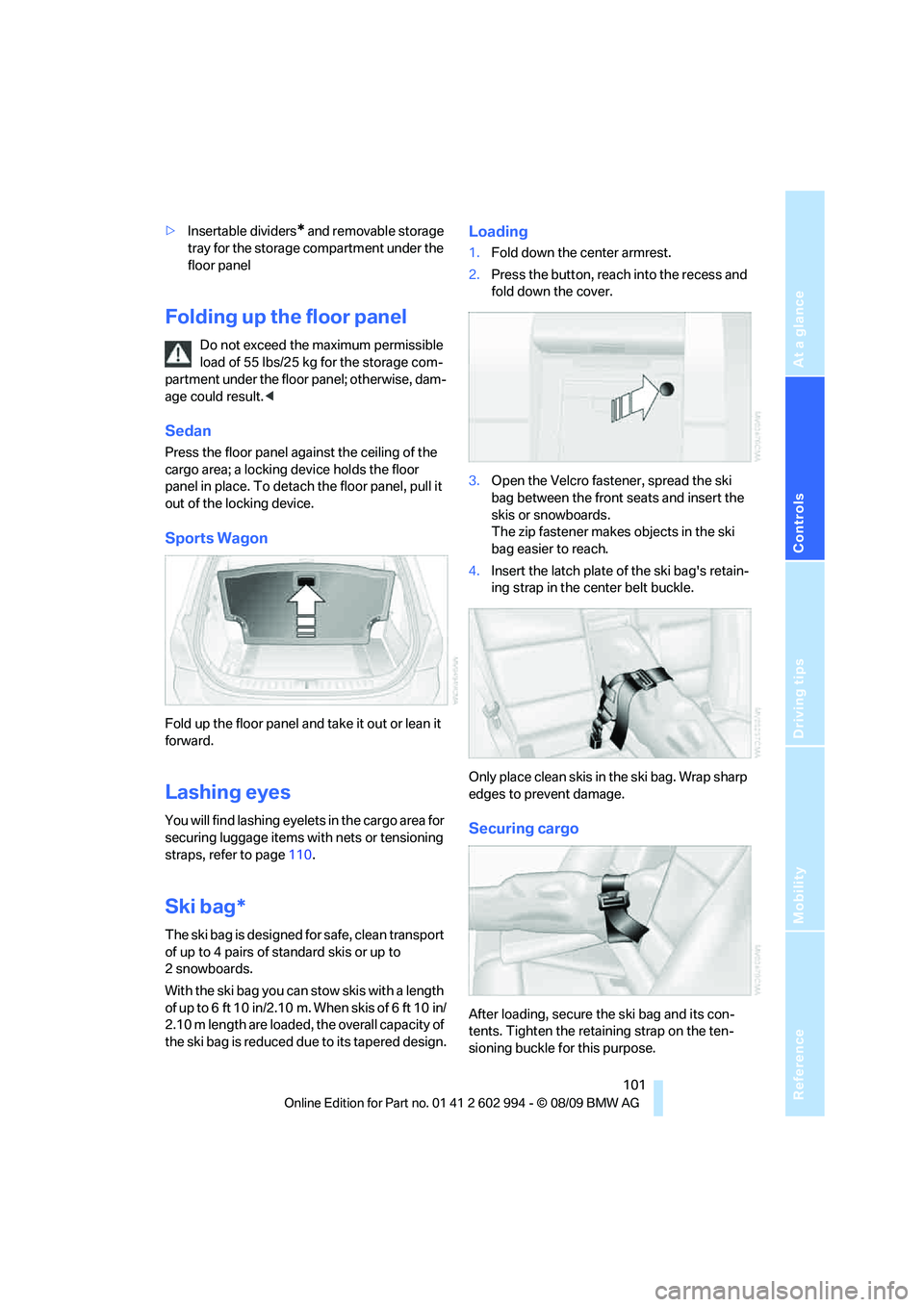
Press the floor panel against the ceiling of the
cargo area; a locking device holds the floor
panel in place. To detach the floor panel, pull it
out of the locking device.
Sports Wagon
Fold up the floor panel and take it out or lean it
forward.
Lashing eyes
You will find lashing eyelets in the cargo area for
securing luggage items with nets or tensioning
straps, refer to page110.
Ski bag*
The ski bag is designed for safe, clean transport
of up to 4 pairs of standard skis or up to
2snowboards.
With the ski bag you can stow skis with a length
of up to 6ft 10in/2.10m. When skis of 6ft 10in/
2.10 m length are loaded, the overall capacity of
the ski bag is reduced due to its tapered design.
Loading
1.Fold down the center armrest.
2.Press the button, reach into the recess and
fold down the cover.
3.Open the Velcro fastener, spread the ski
bag between the front seats and insert the
skis or snowboards.
The zip fastener makes objects in the ski
bag easier to reach.
4.Insert the latch plate of the ski bag's retain-
ing strap in the center belt buckle.
Only place clean skis in the ski bag. Wrap sharp
edges to prevent damage.
Securing cargo
After loading, secure the ski bag and its con-
tents. Tighten the retaining strap on the ten-
sioning buckle for this purpose.
Page 111 of 196
Reference
At a glance
Controls
Driving tips
Mobility
109
When the vehicle is parked
Condensation forms while the automatic cli-
mate control is in operation, and then exits
under the vehicle. Traces of condensed water
under the vehicle are therefore normal.
Cargo loading
To avoid loading the tires beyond their
approved carrying capacity, never over-
load the vehicle. Overloading can lead to over-
heating and increases the rate at which damage
develops inside the tires. This can ultimately
result in a sudden blowout.<
Make sure that no liquids are spilled or
leak from their containers in the cargo
area, as this could result in damage to the vehi-
cle.<
Determining loading limit
1.Locate the following statement on your
vehicle's placard
*:
The combined weight of occupants
and cargo should never exceed
XXX kg or YYY lbs. Otherwise, overloading
can result in damage to the vehicle and
unstable driving conditions.<
2.Determine the combined weight of the
driver and passengers that will be riding in
your vehicle.
3.Subtract the combined weight of the driver
and passengers from XXX kilograms or YYY
pounds.
4.The resulting figure equals the available
amount of cargo and luggage load capacity.
For example, if the YYY amount equals 1,400 lbs. and there will be five 150-lb. pas-
sengers in your vehicle, the amount of avail-
able cargo and luggage load capacity is
650 lbs:
1,400 lbs. minus 750 lbs. = 650 lbs.
5.Determine the combined weight of luggage
and cargo being loaded on the vehicle. That
weight may not safely exceed the available
cargo and luggage load capacity calculated
in step 4.
6.If your vehicle will be towing a trailer, part of
the load from your trailer will be transferred
to your vehicle. Consult the manual for
transporting a trailer to determine how this
may reduce the available cargo and luggage
load capacity of your vehicle.
Load
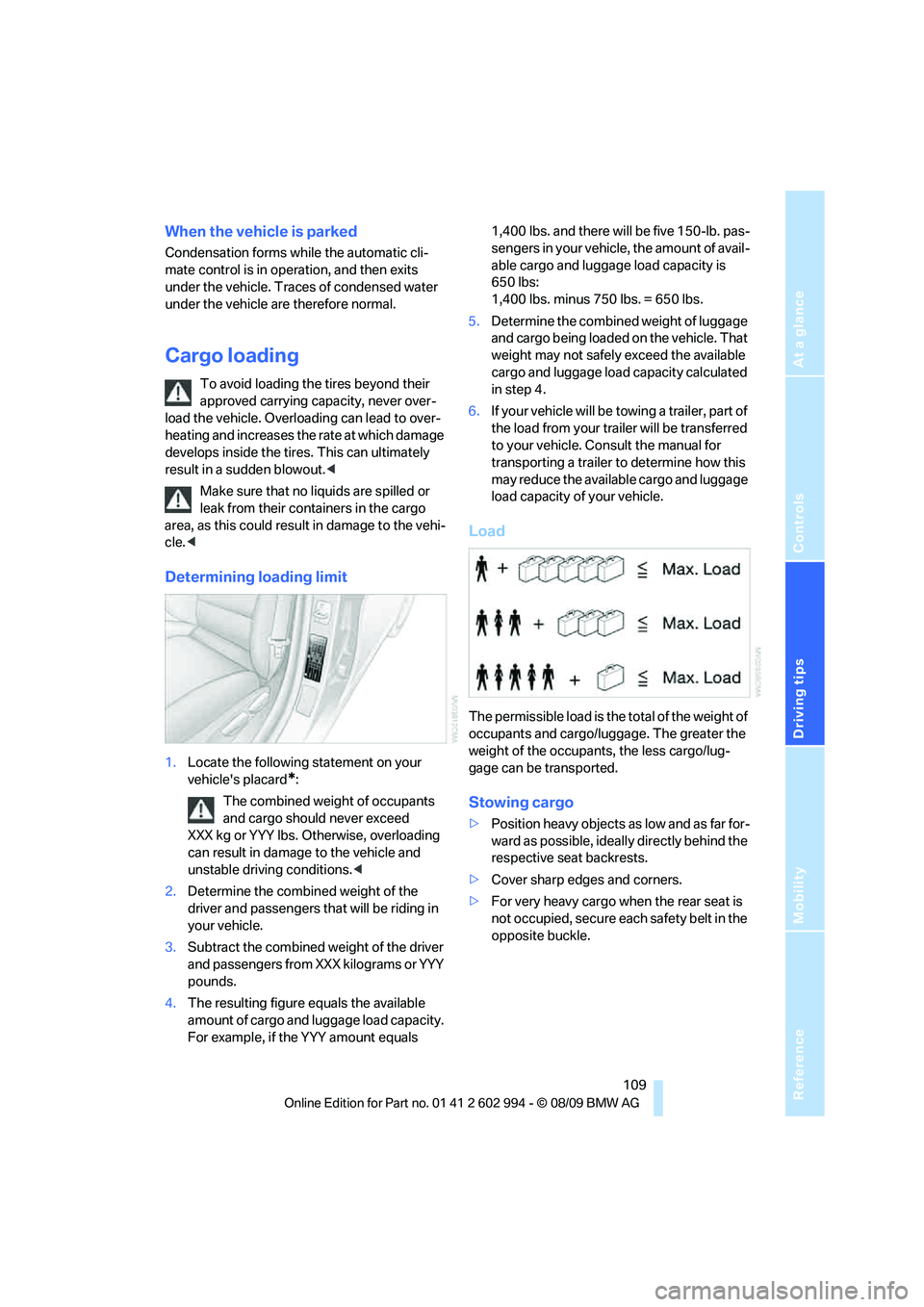
The permissible load is the total of the weight of
occupants and cargo/luggage. The greater the
weight of the occupants, the less cargo/lug-
gage can be transported.
Stowing cargo
>Position heavy objects as low and as far for-
ward as possible, ideally directly behind the
respective seat backrests.
>Cover sharp edges and corners.
>For very heavy cargo when the rear seat is
not occupied, secure each safety belt in the
opposite buckle.
Page 134 of 196
Wheels and tires
132
Tire identification marks
Knowledge of the labeling on the side of the tire
makes it easier to identify and choose the right
tires.
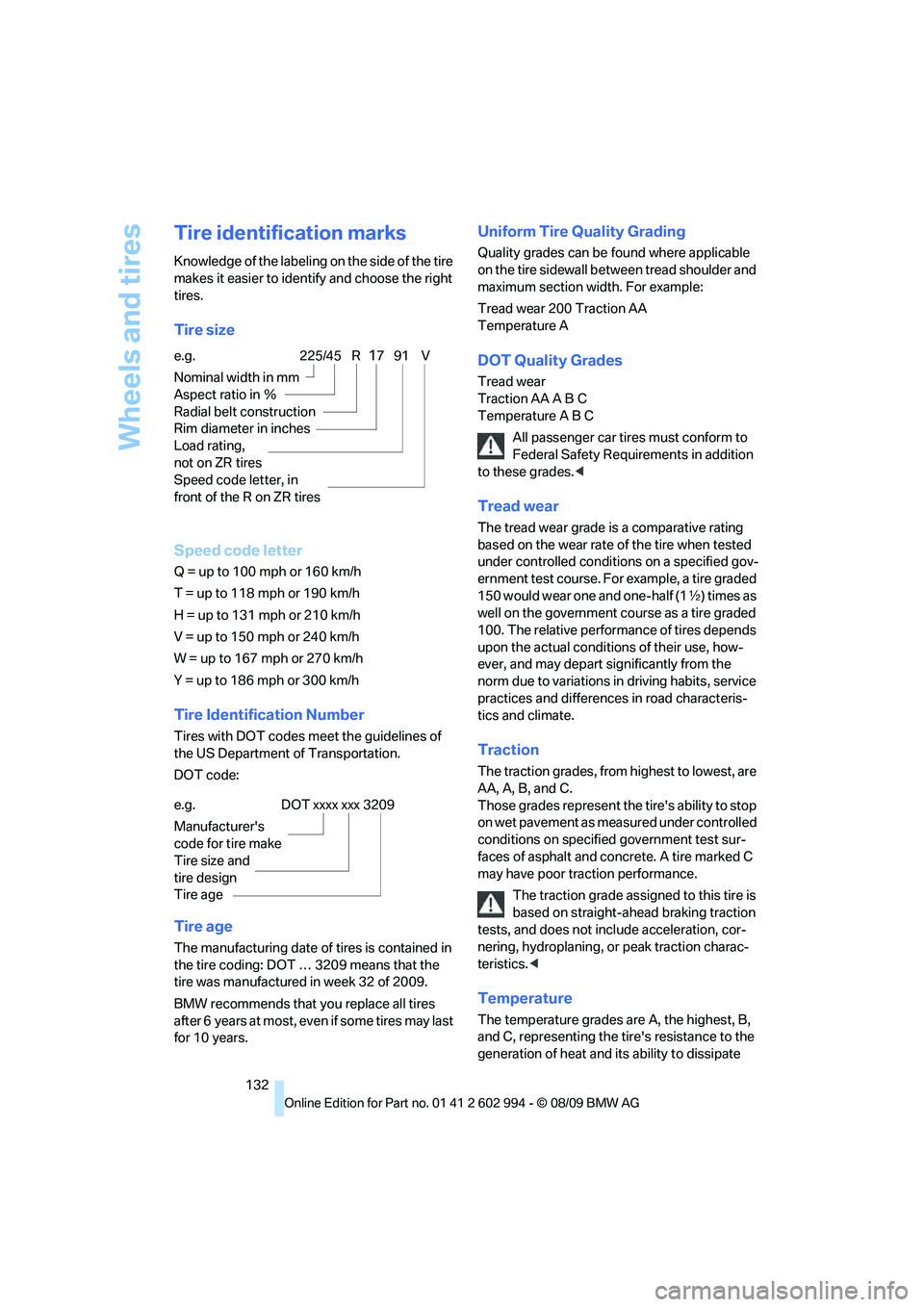
Tire size
Speed code letter
Q = up to 100 mph or 160 km/h
T = up to 118 mph or 190 km/h
H = up to 131 mph or 210 km/h
V = up to 150 mph or 240 km/h
W = up to 167 mph or 270 km/h
Y = up to 186 mph or 300 km/h
Tire Identification Number
Tires with DOT codes meet the guidelines of
the US Department of Transportation.
DOT code:
Tire age
The manufacturing date of tires is contained in
the tire coding: DOT … 3209 means that the
tire was manufactured in week 32 of 2009.
BMW recommends that you replace all tires
after 6 years at most, even if some tires may last
for 10 years.
Uniform Tire Quality Grading
Quality grades can be found where applicable
on the tire sidewall between tread shoulder and
maximum section width. For example:
Tread wear 200 Traction AA
Temperature A
DOT Quality Grades
Tread wear
Traction AA A B C
Temperature A B C
All passenger car tires must conform to
Federal Safety Requirements in addition
to these grades.<
Tread wear
The tread wear grade is a comparative rating
based on the wear rate of the tire when tested
under controlled conditions on a specified gov-
ernment test course. For example, a tire graded
150 would wear one and one-half (1γ) times as
well on the government course as a tire graded
100. The relative performance of tires depends
upon the actual conditions of their use, how-
ever, and may depart significantly from the
norm due to variations in driving habits, service
practices and differences in road characteris-
tics and climate.
Traction
The traction grades, from highest to lowest, are
AA, A, B, and C.
Those grades represent the tire's ability to stop
on wet pavement as measured under controlled
conditions on specified government test sur-
faces of asphalt and concrete. A tire marked C
may have poor traction performance.
The traction grade assigned to this tire is
based on straight-ahead braking traction
tests, and does not include acceleration, cor-
nering, hydroplaning, or peak traction charac-
teristics.<
Temperature
The temperature grades are A, the highest, B,
and C, representing the tire's resistance to the
generation of heat and its ability to dissipate e.g.
Nominal width in mm
Aspect ratio in Ξ
Radial belt construction
Rim diameter in inches
Load rating,
not on ZR tires
Speed code letter, in
front of the R on ZR tires
225/45 R1791 V
e.g.
Manufacturer's
code for tire make
Tire size and
tire design
Tire ageDOT xxxx xxx 3209
Page 147 of 196
Reference
At a glance
Controls
Driving tips
Mobility
145
Outside sensors/cameras
Keep the sensors and cameras on the
outside of the vehicle, e.g. those for Park
Distance Control, clean and free of ice to ensure
that they remain fully functional.<
Interior care
Upholstery fabrics/cloth trims/
Alcantara fabrics
Vacuum regularly with a vacuum cleaner to
remove superficial dirt.
To remove severe spots such as stains from
beverages, use a soft sponge or lint-free
microfiber cloth and suitable interior cleaners.
Follow the instructions on the packaging.
Clean the upholstery down to the seams
using a sweeping motion. Avoid strong
rubbing.<
Opened Velcro fasteners on pants or
other articles of clothing can damage the
seat covers. Ensure that Velcro fasteners are
closed.<
Leather/leather trim
The leather used by BMW is a high quality
natural product. Slight irregularities in the
leather are a typical characteristic of natural
leather.<
Dust and road grit in the pores and folds of the
leather have an abrasive effect, leading to
increased wear and causing the leather surface
to become brittle prematurely. Therefore, fre-
quently clean the leather of dust using a cloth or
vacuum cleaner.
Clean light-colored leather more frequently as
dust and dirt are more noticeable.
Treat the leather at least once every two
months using a leather lotion as dirt and grease
will gradually attack the leather's protective
layer.
Carpets/cargo area
You can vacuum the carpets and floor mats or
clean them with interior cleaner if heavily soiled.The floor mats can be removed for cleaning.
When replacing the mats, ensure that the seat
rails do not extend over the floor mats, as this
may damage the mats.
Lint on the floor mats occurs for technical rea-
sons and can be removed by vacuuming
repeatedly.
Interior plastic parts
>Imitation leather surfaces
>Lamp glasses
>Display pane of instrument cluster
>Matte parts
Clean with water and solvent-free plastic
cleaner if necessary.
Fine wood parts
Clean fine wood trim and fine wood parts with a
damp cloth. Wipe dry with a soft cloth.
Safety belts
Dirty belt straps impede the reeling action and
thus have a negative impact on safety.
Do not clean chemically, as this may
destroy the webbing.<
Interior sensors/cameras
To clean interior sensors and cameras, use a
lint-free cloth moistened with glass cleaner.
Displays
To clean displays, e.g. of the radio or instrument
cluster, use a cleaning cloth for displays or a
soft, non-abrasive, lint-free cloth.
Avoid applying excessive pressure when
cleaning the displays; otherwise, damage
may occur.<
Do not use chemical or abrasive house-
hold cleaning agents. Keep all types of
fluid away from the device. Otherwise, surfaces
or electrical components may be corroded or
damaged.<
Page 162 of 196
Indicator and warning lamps
160
Indicator and warning lamps
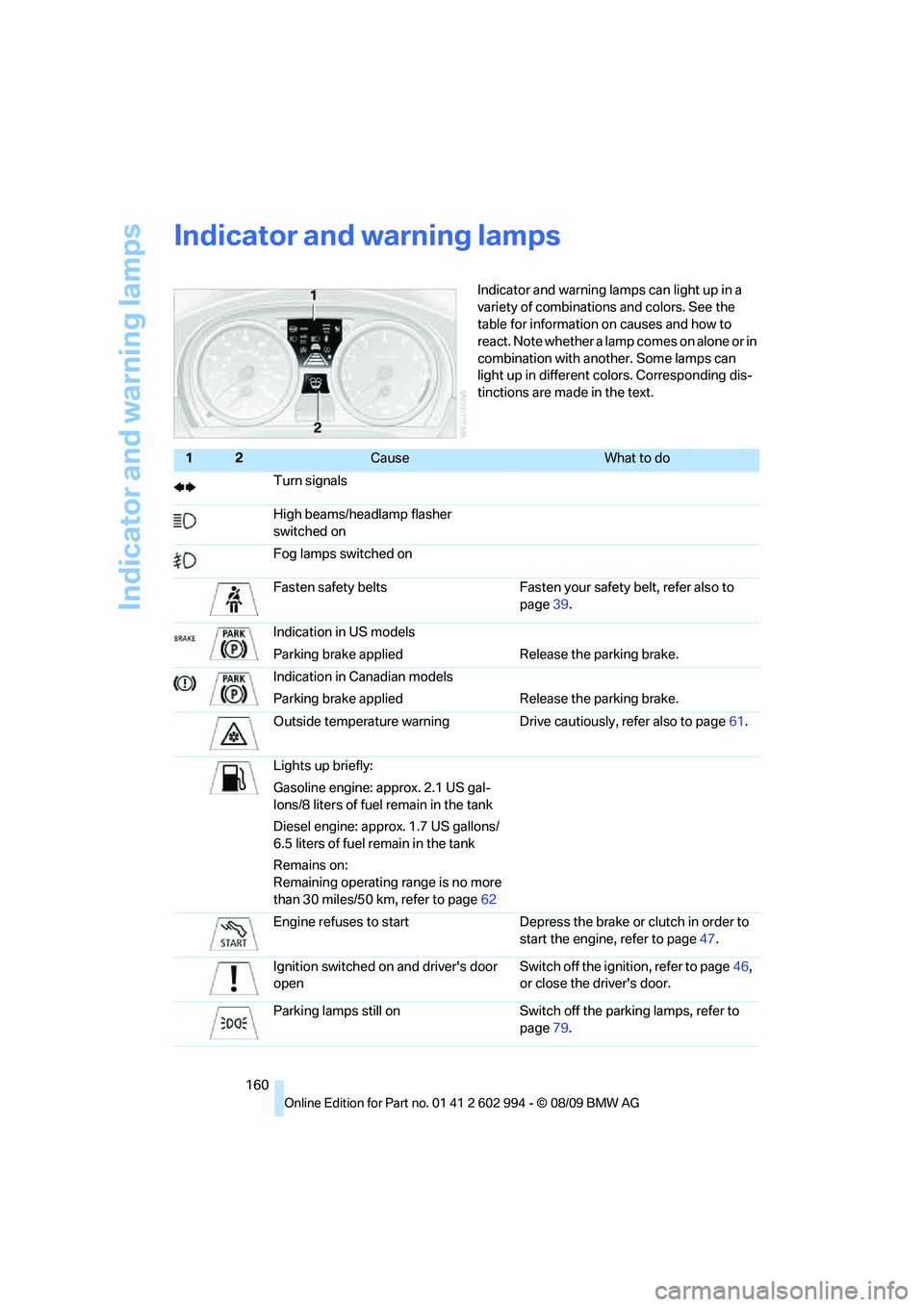
Indicator and warning lamps can light up in a
variety of combinations and colors. See the
table for information on causes and how to
react. Note whether a lamp comes on alone or in
combination with another. Some lamps can
light up in different colors. Corresponding dis-
tinctions are made in the text.
12Cause What to do
Turn signals
High beams/headlamp flasher
switched on
Fog lamps switched on
Fasten safety belts Fasten your safety belt, refer also to
page39.
Indication in US models
Parking brake applied Release the parking brake.
Indication in Canadian models
Parking brake applied Release the parking brake.
Outside temperature warning Drive cautiously, refer also to page61.
Lights up briefly:
Gasoline engine: approx. 2.1 US gal-
lons/8 liters of fuel remain in the tank
Diesel engine: approx. 1.7 US gallons/
6.5 liters of fuel remain in the tank
Remains on:
Remaining operating range is no more
than 30 miles/50 km, refer to page62
Engine refuses to start Depress the brake or clutch in order to
start the engine, refer to page47.
Ignition switched on and driver's door
openSwitch off the ignition, refer to page46,
or close the driver's door.
Parking lamps still on Switch off the parking lamps, refer to
page79.
Page 163 of 196
Reference
At a glance
Controls
Driving tips
Mobility
161
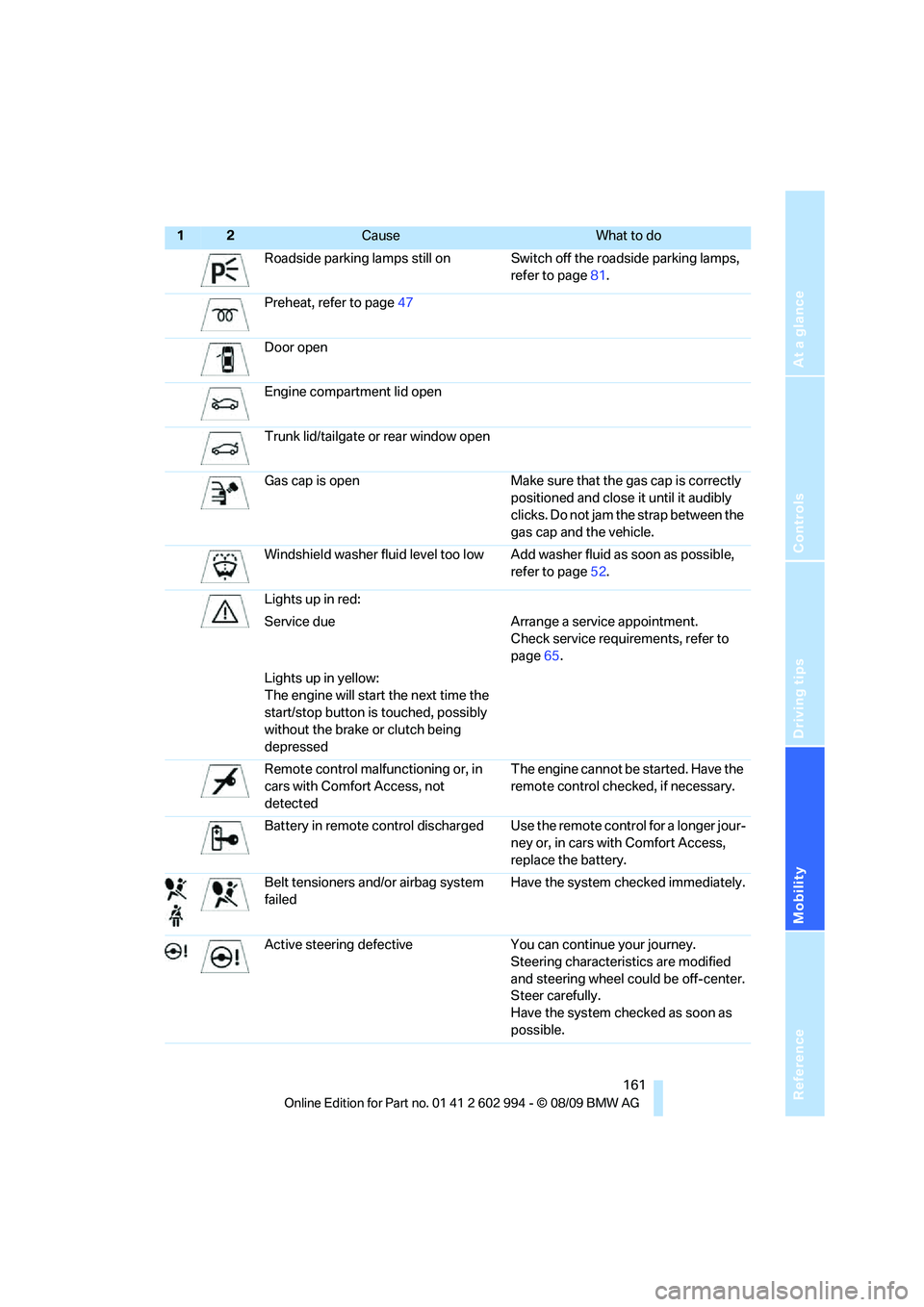
Roadside parking lamps still on Switch off the roadside parking lamps,
refer to page81.
Preheat, refer to page47
Door open
Engine compartment lid open
Trunk lid/tailgate or rear window open
Gas cap is open Make sure that the gas cap is correctly
positioned and close it until it audibly
clicks. Do not jam the strap between the
gas cap and the vehicle.
Windshield washer fluid level too low Add washer fluid as soon as possible,
refer to page52.
Lights up in red:
Service due Arrange a service appointment.
Check service requirements, refer to
page65.
Lights up in yellow:
The engine will start the next time the
start/stop button is touched, possibly
without the brake or clutch being
depressed
Remote control malfunctioning or, in
cars with Comfort Access, not
detectedThe engine cannot be started. Have the
remote control checked, if necessary.
Battery in remote control discharged Use the remote control for a longer jour-
ney or, in cars with Comfort Access,
replace the battery.
Belt tensioners and/or airbag system
failedHave the system checked immediately.
Active steering defective You can continue your journey.
Steering characteristics are modified
and steering wheel could be off-center.
Steer carefully.
Have the system checked as soon as
possible.
12Cause What to do
Page 183 of 196
Reference
At a glance
Controls
Driving tips
Mobility
181
B
Backrest contour, refer to
Lumbar support35
Backrests, refer to Seat
adjustment34
Backrest width adjustment35
Back seats
– refer to Rear seats36
Backup lamps
– replacing bulb151,152
Band-aids, refer to First aid
pouch155
Bar, refer to Towing
methods158
Base plate for telephone or
mobile phone
– refer to Snap-in adapter in
the center armrest storage
compartment95
Battery153
– charging153
– disposal28,153
– jump-starting156
– remote control18
– replacing153
– temporary power failure153
Battery renewal
– remote control28
– remote control for vehicle28
Being towed158
Belts, refer to Safety belts38
Belt tensioner, refer to Safety
belts38
Beverage holders, refer to
Cupholders95
Blower, refer to Air
volume85,88
Bluetooth, refer to separate
Owner's Manual
BMW
– car shampoo145
BMW Advanced Diesel116
BMW Homepage4
BMW Maintenance
System141
BMW webpage4
Bottle holders, refer to
Cupholders95Brake Assist, refer to Dynamic
Brake Control DBC70
Brake fluid, refer to Service
requirements65
Brake Force Display76
Brake lamps
– Brake Force Display76
– replacing bulb151,152
Brake pads106
– breaking in106
Brake rotors108
– brakes
106
– breaking in106
Brakes
– ABS70
– BMW Maintenance
System141
– Brake Force Display76
– breaking in106
– parking brake48
– service requirements65
Brakes, refer to Braking
safely108
Brake system106
– BMW Maintenance
System141
– breaking in106
– disc brakes108
Breakdown services, refer to
Roadside Assistance155
Breaking in the clutch106
Breaking in the differential,
refer to Engine and
differential106
Break-in period106
Bulb changing, refer to Lamps
and bulbs147
Button for starting the engine,
refer to Start/stop button46
Buttons on the steering
wheel11
C
California Proposition 65
warning5
Can holders, refer to
Cupholders95
Capacities178Capacity of the cargo area177
Car battery, refer to Vehicle
battery153
Car care, refer to Care143
Care143
– automatic car washes143
– care products143
– carpets145
– CD/DVD drives146
– chrome parts144
– displays145
– exterior143
– fine wood parts145
– headlamps144
– high-pressure washer143
– interior145
– leather145
– light-alloy wheels144
– paintwork144
– plastic parts145
– rubber seals144
– safety belts145
– sensors and cameras145
– upholstery and cloth
trim145
– washing the car
manually144
– windows144
Cargo, securing110
Cargo area98
– capacity177
– Comfort Access27
– folding up the floor
panel101
– lamp, refer to Interior
lamps83
– opening from inside23
– opening from outside23
– partition net99
– roller cover98
Cargo area lid, refer to Trunk
lid/tailgate23
Cargo area net, refer to
Partition net99
Cargo loading109
– securing cargo110
– stowing cargo109
– vehicle109
Page 186 of 196
Everything from A to Z
184 Engine oil
– adding139
– alternative oil types139
– BMW Maintenance
System141
– capacity178
– checking level137
– dipstick137
– intervals between changes,
refer to Service
requirements65
Engine output, refer to Engine
data174
Engine speed, refer to Engine
data174
Engine starting, refer to
Starting the engine47
Entry lamps, refer to Interior
lamps83
Environmentally friendly
driving, refer to Energy
Control62
Error messages, refer to
Check Control67
ESP Electronic Stability
Program, refer to Dynamic
Stability Control DSC70
Event data recorders142
Exhaust system, refer to Hot
exhaust system107
Expanding the cargo area99
Exterior mirrors39
– adjusting39
– automatic dimming
feature40
– automatic heating40
– folding in and out39
External audio device95
Eyes
– for tow-starting and towing
away157
– for tying down loads110
F
Failure messages, refer to
Check Control67
Failure of an electrical
consumer154False alarm
– avoiding unintentional
alarm26
– switching off an alarm26
Fastening safety belts, refer to
Safety belts38
Filter
– refer to Microfilter/activated-
charcoal filter for automatic
climate control90
– refer to Microfilter for air
conditioner86
First aid pouch155
Fixture for remote control,
refer to Ignition lock46
Flash when locking/
unlocking20
Flat tire
– run-flat tires134
– Tire Pressure Monitor
TPM73
Flat Tire Monitor FTM72
– indicating a flat tire73
– indicator/warning lamp73
– initializing the system72
– snow chains72,135
– system limits72
Flat tires, refer to Tire
condition133
Fluid reservoir, refer to
Washer fluid reservoir53
Fog lamps82
– indicator lamp82,160
Folding rear seat backrest99
Folding up the floor panel101
Footbrake, refer to Braking
safely108
Footwell lamps, refer to
Interior lamps83
For your own safety5
Four-wheel drive, refer to
xDrive71
Front airbags77
FTM, refer to Flat Tire
Monitor72Fuel115
– additives116
– average consumption63
– gauge62
– high-quality brands115
– quality115
– specifications115
– tank contents, refer to
Capacities178
Fuel clock, refer to Fuel
gauge62
Fuel display, refer to Fuel
gauge62
Fuel-efficient driving, refer to
Energy Control62
Fuel filler flap114
– releasing in the event of
electrical malfunction114
Fuses154
G
Garage door opener, refer to
Integrated universal remote
control91
Gasoline
– refer to Average
consumption63
Gasoline, refer to Required
fuel115
Gasoline display, refer to Fuel
gauge62
Gear indicator, automatic
transmission with
Steptronic48
Gearshift lever
– automatic transmission with
Steptronic49
– manual transmission48
Gearshifts
– automatic transmission with
Steptronic49
– manual transmission48
General driving notes107
Page 188 of 196
Everything from A to Z
186 Jump-starting156
K
Key, refer to Integrated key/
remote control18
Keyless go, refer to Comfort
Access26
Keyless opening and closing,
refer to Comfort Access26
Key Memory, refer to Personal
Profile18
Kickdown49
– automatic transmission with
Steptronic49
Knock control115
L
Lamps
– automatic headlamp
control79
– parking lamps/low beams79
Lamps and bulbs, replacing
bulbs147
Lap-and-shoulder belt, refer
to Safety belts38
Lashing eyes, refer to
Securing cargo110
LATCH child restraint fixing
system43
Leather care145
LED Light-emitting
diodes148
Length, refer to
Dimensions175
License plate lamp, replacing
bulb152
Light
– high-beam assistant81
Light-alloy wheels144
Light-emitting diodes
LED148
Lighter96
– connecting electrical
appliances96Lighting
– instruments82
– lamps and bulbs147
– vehicle, refer to Lamps79
Light switch79
Load109
Load securing equipment,
refer to Securing cargo110
Lock buttons, doors, refer to
Locking23
Locking
– adjusting confirmation
signal20
– from inside23
– from outside20
– without remote control, refer
to Comfort Access26
Locking and unlocking doors
– confirmation signals20
– from inside22
– from outside19
Low beam control, refer to
High-beam assistant81
Low-beam headlamps79
– automatic79
– indicator lamp, defective
bulb169
– replacing bulbs149
Lower back support, refer to
Lumbar support35
Luggage rack, refer to Roof-
mounted luggage rack110
Lumbar support35
M
M+S tires, refer to Winter
tires135
Maintenance, refer to Service
Booklet
Maintenance system141
Malfunction
– automatic transmission with
Steptronic50
– tires73
– trunk lid24
Malfunction warnings, refer to
Check Control67
Manual air distribution85Manual car wash144
Manual mode, automatic
transmission with
Steptronic49
Manual operation
– door lock22
– driver's door22
– fuel filler flap114
– glass roof30
– panorama glass roof32
– transmission lock, automatic
transmission50
– trunk lid24
Manual transmission48
Master key, refer to Remote
control with integrated
key18
Maximum cooling87
Maximum speed
– with winter tires135
Measurements, refer to
Dimensions175
Memory, refer to Seat and
mirror memory37
Microfilter
– BMW Maintenance
System141
– for air conditioner86
– for automatic climate
control90
Microfilter/activated-charcoal
filter
– BMW Maintenance
System141
Microphone
– telephone14
Mirror dimming feature40
Mirrors39
– automatic curb monitor40
– exterior mirrors39
– heating40
– interior rearview mirror40
– memory, refer to Seat and
mirror memory37
Mirrors, folding in before
entering a car wash39