check oil BMW M3 2010 Owners Manual
[x] Cancel search | Manufacturer: BMW, Model Year: 2010, Model line: M3, Model: BMW M3 2010Pages: 196, PDF Size: 5.78 MB
Page 14 of 196
Cockpit
12
Instrument cluster
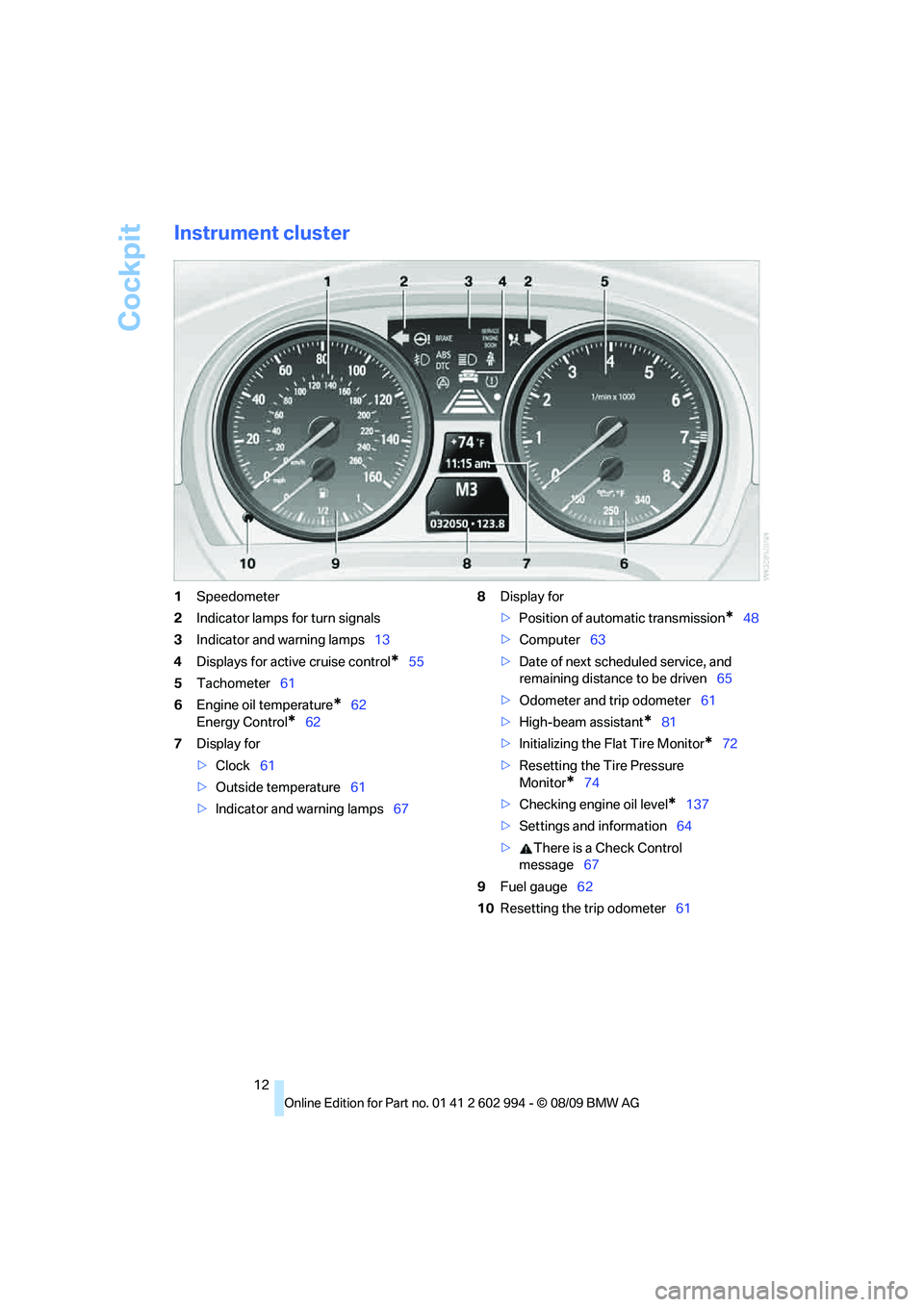
1Speedometer
2Indicator lamps for turn signals
3Indicator and warning lamps13
4Displays for active cruise control
*55
5Tachometer61
6Engine oil temperature
*62
Energy Control
*62
7Display for
>Clock61
>Outside temperature61
>Indicator and warning lamps678Display for
>Position of automatic transmission
*48
>Computer63
>Date of next scheduled service, and
remaining distance to be driven65
>Odometer and trip odometer61
>High-beam assistant
*81
>Initializing the Flat Tire Monitor
*72
>Resetting the Tire Pressure
Monitor
*74
>Checking engine oil level
*137
>Settings and information64
>There is a Check Control
message67
9Fuel gauge62
10Resetting the trip odometer61
Page 64 of 196
Controls overview
62
Coolant temperature
A warning lamp will come on if the coolant, and
therefore the engine, becomes too hot.
Check coolant level, refer to page140.
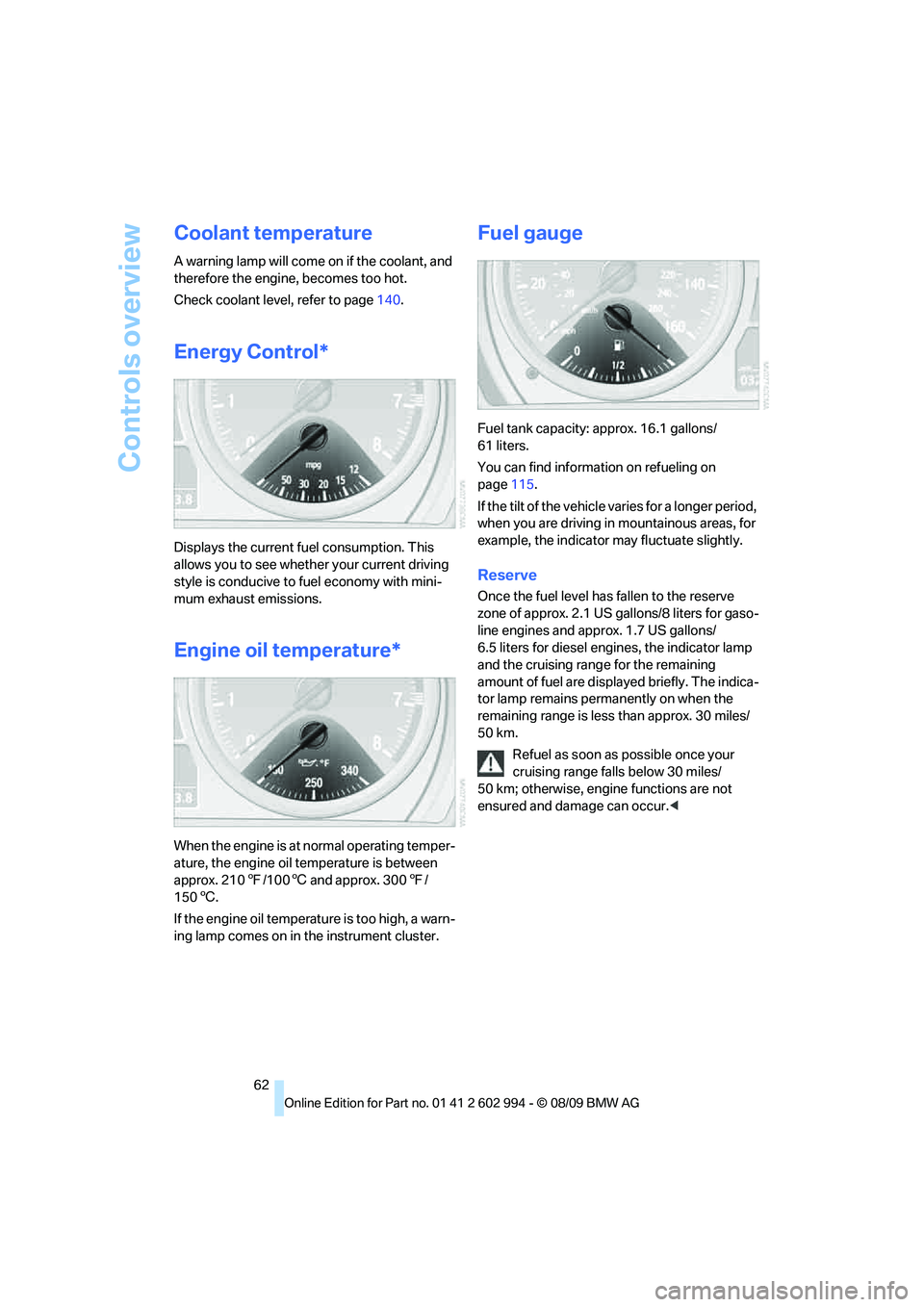
Energy Control*
Displays the current fuel consumption. This
allows you to see whether your current driving
style is conducive to fuel economy with mini-
mum exhaust emissions.
Engine oil temperature*
When the engine is at normal operating temper-
ature, the engine oil temperature is between
approx. 2107/1006 and approx. 3007/
1506.
If the engine oil temperature is too high, a warn-
ing lamp comes on in the instrument cluster.
Fuel gauge
Fuel tank capacity: approx. 16.1 gallons/
61 liters.
You can find information on refueling on
page115.
If the tilt of the vehicle varies for a longer period,
when you are driving in mountainous areas, for
example, the indicator may fluctuate slightly.
Reserve
Once the fuel level has fallen to the reserve
zone of approx. 2.1 US gallons/8 liters for gaso-
line engines and approx. 1.7 US gallons/
6.5 liters for diesel engines, the indicator lamp
and the cruising range for the remaining
amount of fuel are displayed briefly. The indica-
tor lamp remains permanently on when the
remaining range is less than approx. 30 miles/
50 km.
Refuel as soon as possible once your
cruising range falls below 30 miles/
50 km; otherwise, engine functions are not
ensured and damage can occur.<
Page 66 of 196
Controls overview
64
Settings and information
Operating principle
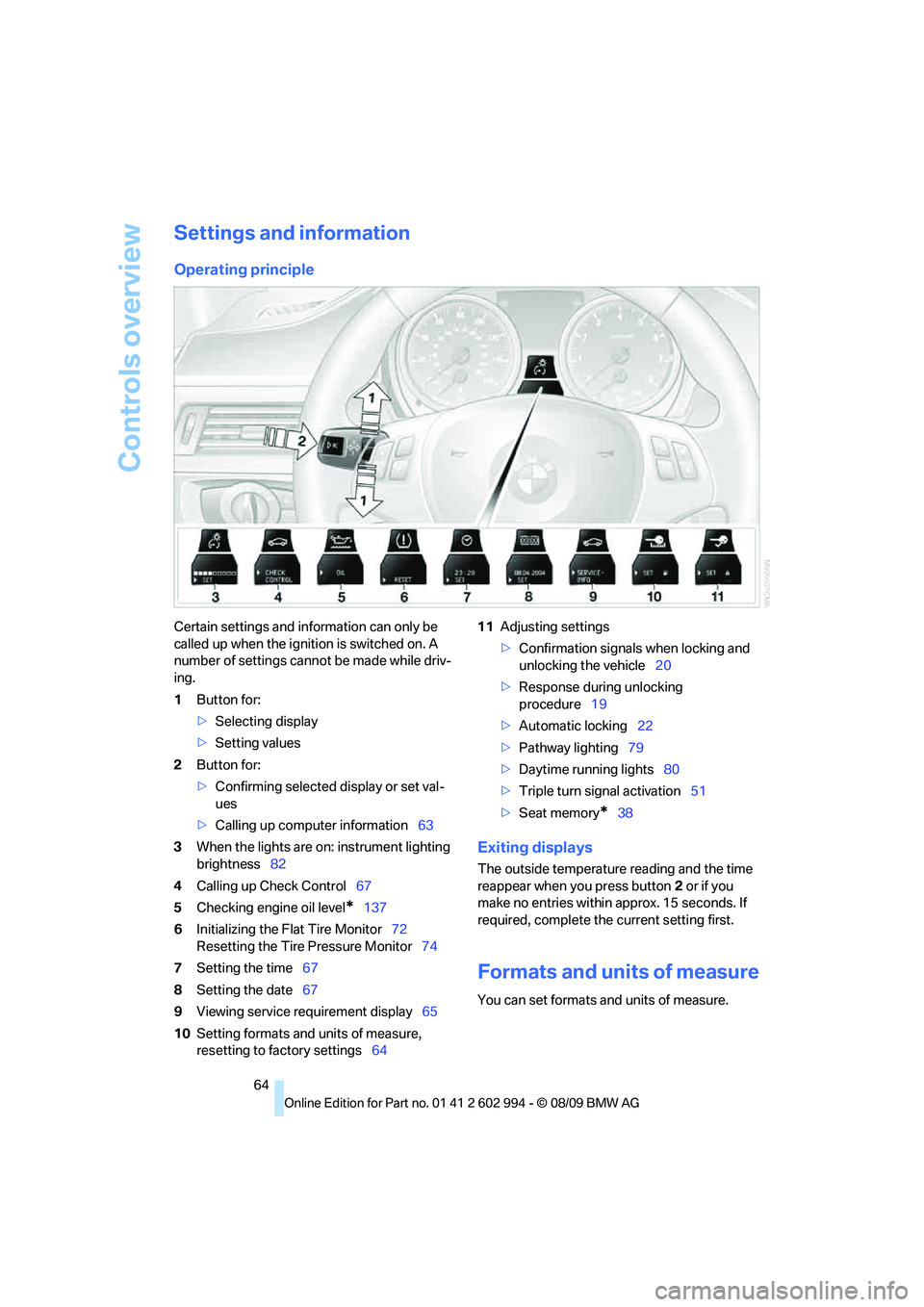
Certain settings and information can only be
called up when the ignition is switched on. A
number of settings cannot be made while driv-
ing.
1Button for:
>Selecting display
>Setting values
2Button for:
>Confirming selected display or set val-
ues
>Calling up computer information63
3When the lights are on: instrument lighting
brightness82
4Calling up Check Control67
5Checking engine oil level
*137
6Initializing the Flat Tire Monitor72
Resetting the Tire Pressure Monitor74
7Setting the time67
8Setting the date67
9Viewing service requirement display65
10Setting formats and units of measure,
resetting to factory settings6411Adjusting settings
>Confirmation signals when locking and
unlocking the vehicle20
>Response during unlocking
procedure19
>Automatic locking22
>Pathway lighting79
>Daytime running lights80
>Triple turn signal activation51
>Seat memory
*38
Exiting displays
The outside temperature reading and the time
reappear when you press button2 or if you
make no entries within approx. 15 seconds. If
required, complete the current setting first.
Formats and units of measure
You can set formats and units of measure.
Page 139 of 196
Reference
At a glance
Controls
Driving tips
Mobility
137
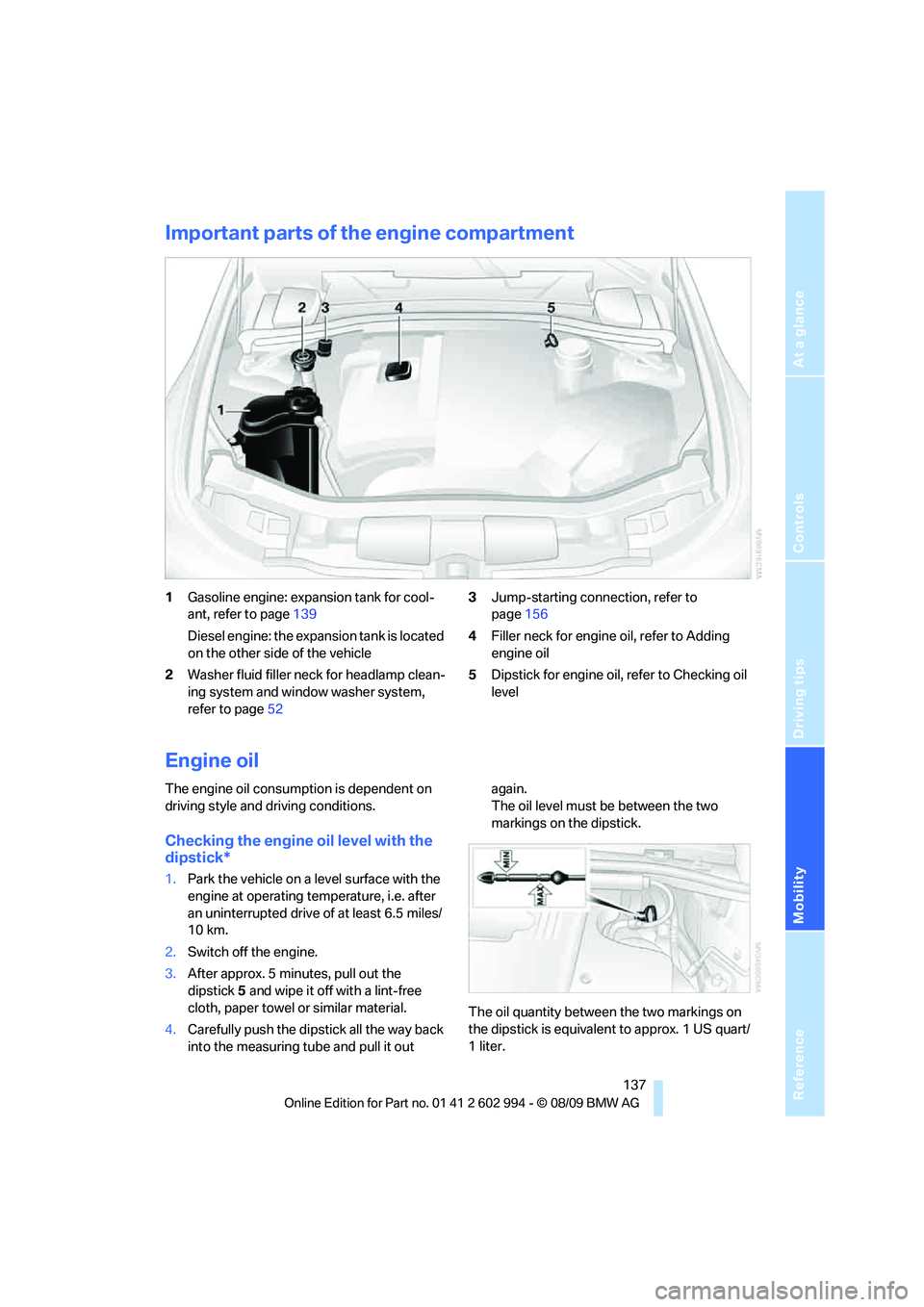
Important parts of the engine compartment
1Gasoline engine: expansion tank for cool-
ant, refer to page139
Diesel engine: the expansion tank is located
on the other side of the vehicle
2Washer fluid filler neck for headlamp clean-
ing system and window washer system,
refer to page523Jump-starting connection, refer to
page156
4Filler neck for engine oil, refer to Adding
engine oil
5Dipstick for engine oil, refer to Checking oil
level
Engine oil
The engine oil consumption is dependent on
driving style and driving conditions.
Checking the engine oil level with the
dipstick*
1.Park the vehicle on a level surface with the
engine at operating temperature, i.e. after
an uninterrupted drive of at least 6.5 miles/
10 km.
2.Switch off the engine.
3.After approx. 5 minutes, pull out the
dipstick5 and wipe it off with a lint-free
cloth, paper towel or similar material.
4.Carefully push the dipstick all the way back
into the measuring tube and pull it out again.
The oil level must be between the two
markings on the dipstick.
The oil quantity between the two markings on
the dipstick is equivalent to approx. 1 US quart/
1liter.
Page 140 of 196
Under the hood
138 The oil level must not be above the upper
marking of the dipstick. Too much oil will
harm the engine.<
Checking the engine oil level
electronically*
Your car is equipped with an electronic oil-level
monitor.
For a precise measurement and display of the
oil level, it is necessary that the engine be at
operating temperature, i.e. after uninterrupted
driving for at least approx. 6.5 miles/10 km. You
can have the oil level displayed while you are
driving, or while the vehicle is at a standstill on a
level surface and the engine is running.
You can have the oil level reading displayed in
the instrument cluster.
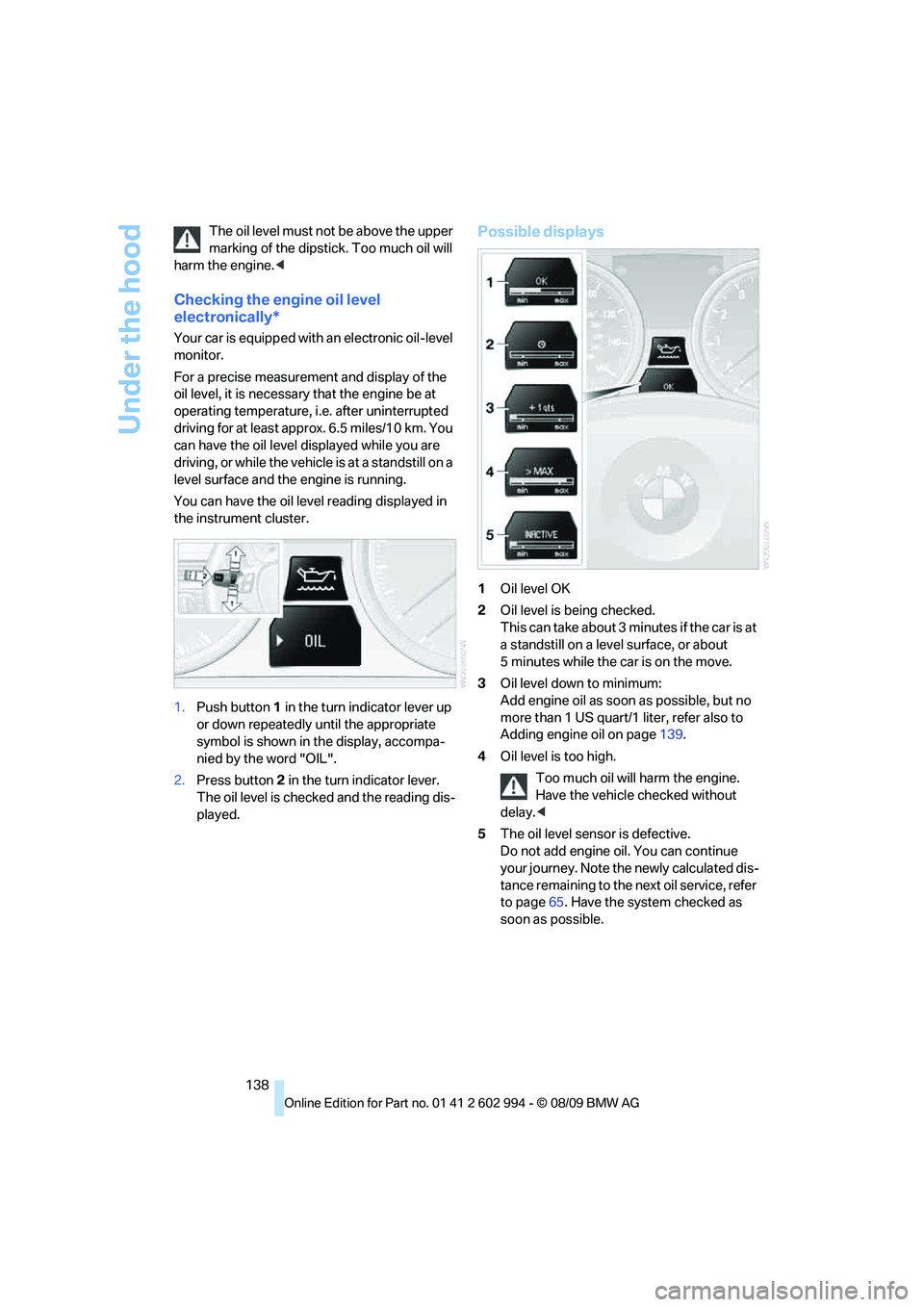
1.Push button 1 in the turn indicator lever up
or down repeatedly until the appropriate
symbol is shown in the display, accompa-
nied by the word "OIL".
2.Press button 2 in the turn indicator lever.
The oil level is checked and the reading dis-
played.
Possible displays
1Oil level OK
2Oil level is being checked.
This can take about 3 minutes if the car is at
a standstill on a level surface, or about
5 minutes while the car is on the move.
3Oil level down to minimum:
Add engine oil as soon as possible, but no
more than 1 US quart/1 liter, refer also to
Adding engine oil on page139.
4Oil level is too high.
Too much oil will harm the engine.
Have the vehicle checked without
delay.<
5The oil level sensor is defective.
Do not add engine oil. You can continue
your journey. Note the newly calculated dis-
tance remaining to the next oil service, refer
to page65. Have the system checked as
soon as possible.
Page 143 of 196
Reference
At a glance
Controls
Driving tips
Mobility
141
Maintenance
BMW Maintenance System
The BMW Maintenance System supports the
preservation of the traffic and operating safety
of your BMW. The objective is to optimize
efforts with respect to minimal vehicle mainte-
nance costs.
If and when you come to sell your BMW, a com-
prehensive record of servicing will prove a sig-
nificant benefit.
Condition Based Service CBS
Sensors and special algorithms take the differ-
ent driving conditions of your BMW into
account. Condition Based Service uses this to
determine the current and future service
requirements. By letting you define a service
and maintenance regimen that reflects your
own individual requirements, the system builds
the basis for trouble-free driving.
In the instrument cluster, you can have the
remaining times or distances for selected main-
tenance tasks and any legally prescribed dates
displayed, refer to page65:
>Engine oil
>Brake pads: separately for front and rear
>Brake fluid
>Vehicle check
>Legally mandated inspections depending
on local regulations
>Diesel particulate filter
*
Service data in the remote control
Your vehicle continuously stores service-
requirement information in the remote control
while you are driving. Your BMW Service Advi-
sor can read out this data from the remote con-
trol unit, and propose an optimized mainte-
nance approach. Whenever you take your car in
for servicing you should therefore hand your
BMW Service Advisor the remote control unit
that you last used.
Make sure that the date in the instrument
cluster is always set correctly, refer to
page67; otherwise, the effectiveness of Condi-
tion Based Service CBS is not assured.<
Service and Warranty Information
Booklet for US models and Warranty
and Service Guide Booklet for
Canadian models
Please consult your Service and Warranty Infor-
mation Booklet for US models and Warranty
and Service Guide Booklet for Canadian models
for additional information on service require-
ments.
BMW recommends that you have service
and repair operations performed at your
BMW center.
Take the time to ensure that these service pro-
cedures are confirmed by entries in your vehi-
cle's Service and Warranty Information Booklet
for US models and Warranty and Service Guide
Booklet for Canadian models. These entries
verify that your vehicle has received the speci-
fied regular maintenance.<
Page 145 of 196
Reference
At a glance
Controls
Driving tips
Mobility
143
Care
Care products
Regular cleaning and care contributes signifi-
cantly to the value retention of your BMW.
BMW recommends cleaning and caring for your
vehicle with products that are approved by
BMW for this purpose.
Your BMW center will be happy to advise you on
the products and services available for cleaning
and caring for your BMW.
Original BMW Care Products have been
material tested, laboratory checked and
proven in the field, and offer optimal care and
protection for your vehicle.<
Do not use cleaners that contain alcohol
or solvents as these may result in dam-
age.<
Cleaning agents can contain substances
that are dangerous or hazardous to your
health. Therefore, follow the warning and safety
instructions on the packaging. When cleaning
inside the vehicle, always open the doors or
windows of the vehicle. In enclosed areas, pro-
vide for sufficient ventilation. Only use products
designed for cleaning vehicles.<
Exterior care
Washing the vehicle
Especially during the winter months,
ensure that the vehicle is washed more
frequently. Heavy soiling and road salt can lead
to vehicle damage.<
After washing the vehicle, apply the
brakes briefly to dry them; otherwise,
water can reduce braking efficiency over the
short term and the brake discs can corrode.<
Automatic car washes
Preference should be given to cloth car washes.
Before driving into a car wash, ensure that it is
suitable for your BMW. Check the following:>Dimensions of your vehicle, refer to
page175.
>If necessary: fold in the exterior mirrors,
refer to page39.
>Maximum permissible tire width.
Avoid car washes with guide rail heights
over 4 in/10 cm; otherwise, there is the
danger of damaging chassis parts.<
Preparations before driving into an automatic
car wash:
>Unscrew the rod antenna
*.
>Deactivate the rain sensor
* to prevent unin-
tentional wiping.
>Sports Wagon: deactivate the rear window
wiper and protect it against damage. If nec-
essary, ask the operator of the car wash
about protective measures you should take.
>Remove additional add-on parts, e.g. spoil-
ers or phone antennas, if they could be
damaged.
Automatic transmission
Before driving into an automatic car wash, per-
form the following steps to ensure that the vehi-
cle can roll:
1.Insert the remote control into the ignition
lock, even with Comfort Access.
2.Move the selector lever to position N.
3.Release the parking brake.
4.Switch off the engine.
5.Leave the remote control in the ignition lock
so that the vehicle can roll.
Steam jets/high-pressure washers
When using steam jets or high-pressure
washers, ensure that you maintain suffi-
cient clearance to the vehicle and do not exceed
a temperature of 1407/606.
Insufficient clearance or excessive pressure or
temperature can lead to component damage or
Page 171 of 196
Reference
At a glance
Controls
Driving tips
Mobility
169
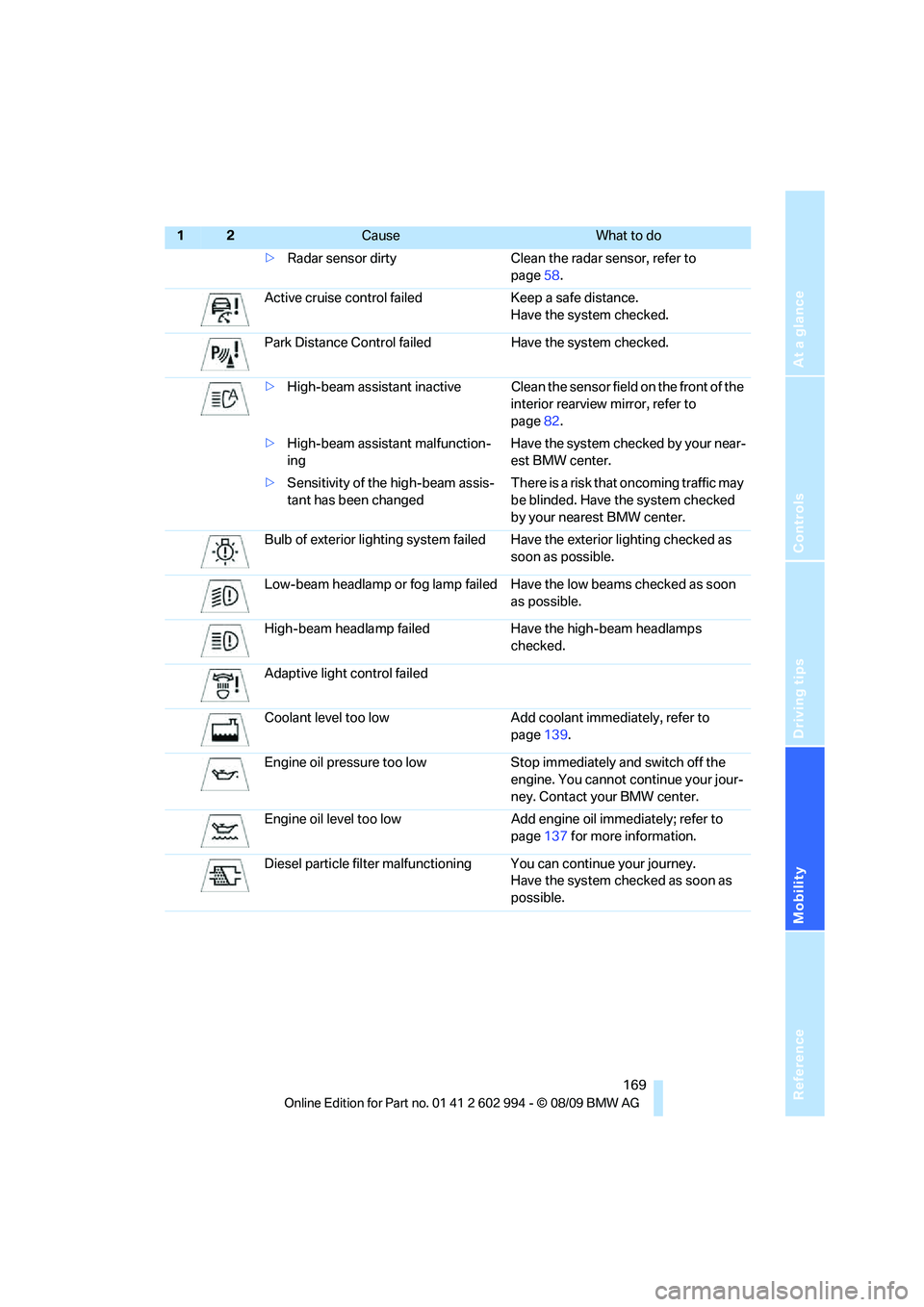
>Radar sensor dirty Clean the radar sensor, refer to
page58.
Active cruise control failed Keep a safe distance.
Have the system checked.
Park Distance Control failed Have the system checked.
>High-beam assistant inactive Clean the sensor field on the front of the
interior rearview mirror, refer to
page82.
>High-beam assistant malfunction-
ingHave the system checked by your near-
est BMW center.
>Sensitivity of the high-beam assis-
tant has been changedThere is a risk that oncoming traffic may
be blinded. Have the system checked
by your nearest BMW center.
Bulb of exterior lighting system failed Have the exterior lighting checked as
soon as possible.
Low-beam headlamp or fog lamp failed Have the low beams checked as soon
as possible.
High-beam headlamp failed Have the high-beam headlamps
checked.
Adaptive light control failed
Coolant level too low Add coolant immediately, refer to
page139.
Engine oil pressure too low Stop immediately and switch off the
engine. You cannot continue your jour-
ney. Contact your BMW center.
Engine oil level too low Add engine oil immediately; refer to
page137 for more information.
Diesel particle filter malfunctioning You can continue your journey.
Have the system checked as soon as
possible.
12Cause What to do
Page 185 of 196
Reference
At a glance
Controls
Driving tips
Mobility
183
Defect
– door lock22
– fuel filler flap114
– glass roof30
– panorama glass roof32
Defogging windows86
Defrost, windows86
Defrosting windows and
removing condensation
– air conditioner86
Defrosting windshield, refer to
Defrosting windows86
Defrost position, refer to
Defrosting windows86
Diesel exhaust fluid117
Diesel fuel115
Diesel particulate filter107
Digital clock61
Digital compass93
Dimensions175
Dipstick, engine oil137
Directional indicators, refer to
Turn signals50
Displacement, refer to Engine
data174
Display lighting, refer to
Instrument lighting82
Displays, refer to Instrument
cluster12
Displays and controls10
Disposal
– coolant139
– remote control battery28
– vehicle battery153
Distance control, refer to
Active cruise control55
Distance remaining to service,
refer to Service
requirements65
Distance warning, refer to
Park Distance Control
PDC69
Door key, refer to Remote
control with integrated
key18
Door lock21
Doors, emergency
operation22
DOT Quality Grades132Draft-free ventilation86,89
Drinks holders, refer to
Cupholders95
Drive-off assistance, refer to
Dynamic Stability Control
DSC70
Drive-off assistant72
Driving lamps, refer to Parking
lamps/low beams79
Driving notes106
Driving off on hills, refer to
Drive-off assistant72
Driving stability control
systems70
Driving through water
108
Driving tips, refer to Driving
notes106
Dry air, refer to Cooling
function89
DSC Dynamic Stability
Control70
DTC Dynamic Traction
Control70
– indicator/warning lamp70
Dynamic Brake Control
DBC70
Dynamic Stability Control
DSC70
– indicator/warning lamp70
Dynamic Traction Control
DTC
– indicator/warning lamp71
E
EBV Electronic brake-force
distribution70
Electrical malfunction
– door lock22
– driver's door22
– fuel filler flap114
– glass roof30
– panorama glass roof32
– trunk lid24
Electric seat adjustment34
Electric steering wheel lock
– with Comfort Access27
Electronic brake-force
distribution EBV70Electronic oil level check138
Electronic Stability Program
ESP, refer to Dynamic
Stability Control DSC70
Emergency actuation,
automatic transmission,
refer to Overriding selector
lever lock50
Emergency operation
– fuel filler flap, manual
release114
Emergency operation, refer to
Closing manually
– glass roof30
– panorama glass roof32
Emergency operation, refer to
Manual operation
– door lock22
Emergency release
– trunk lid from inside24
Emergency Request155
Emergency services, refer to
Roadside Assistance155
Energy, saving
– saving fuel106
Energy-conscious driving,
refer to Energy Control62
Energy Control62
Engine
– breaking in106
– data174
– overheated, refer to Coolant
temperature62
– speed174
– starting47
– starting, Comfort Access26
– switching off47
Engine compartment137
Engine coolant, refer to
Coolant139
Page 186 of 196
Everything from A to Z
184 Engine oil
– adding139
– alternative oil types139
– BMW Maintenance
System141
– capacity178
– checking level137
– dipstick137
– intervals between changes,
refer to Service
requirements65
Engine output, refer to Engine
data174
Engine speed, refer to Engine
data174
Engine starting, refer to
Starting the engine47
Entry lamps, refer to Interior
lamps83
Environmentally friendly
driving, refer to Energy
Control62
Error messages, refer to
Check Control67
ESP Electronic Stability
Program, refer to Dynamic
Stability Control DSC70
Event data recorders142
Exhaust system, refer to Hot
exhaust system107
Expanding the cargo area99
Exterior mirrors39
– adjusting39
– automatic dimming
feature40
– automatic heating40
– folding in and out39
External audio device95
Eyes
– for tow-starting and towing
away157
– for tying down loads110
F
Failure messages, refer to
Check Control67
Failure of an electrical
consumer154False alarm
– avoiding unintentional
alarm26
– switching off an alarm26
Fastening safety belts, refer to
Safety belts38
Filter
– refer to Microfilter/activated-
charcoal filter for automatic
climate control90
– refer to Microfilter for air
conditioner86
First aid pouch155
Fixture for remote control,
refer to Ignition lock46
Flash when locking/
unlocking20
Flat tire
– run-flat tires134
– Tire Pressure Monitor
TPM73
Flat Tire Monitor FTM72
– indicating a flat tire73
– indicator/warning lamp73
– initializing the system72
– snow chains72,135
– system limits72
Flat tires, refer to Tire
condition133
Fluid reservoir, refer to
Washer fluid reservoir53
Fog lamps82
– indicator lamp82,160
Folding rear seat backrest99
Folding up the floor panel101
Footbrake, refer to Braking
safely108
Footwell lamps, refer to
Interior lamps83
For your own safety5
Four-wheel drive, refer to
xDrive71
Front airbags77
FTM, refer to Flat Tire
Monitor72Fuel115
– additives116
– average consumption63
– gauge62
– high-quality brands115
– quality115
– specifications115
– tank contents, refer to
Capacities178
Fuel clock, refer to Fuel
gauge62
Fuel display, refer to Fuel
gauge62
Fuel-efficient driving, refer to
Energy Control62
Fuel filler flap114
– releasing in the event of
electrical malfunction114
Fuses154
G
Garage door opener, refer to
Integrated universal remote
control91
Gasoline
– refer to Average
consumption63
Gasoline, refer to Required
fuel115
Gasoline display, refer to Fuel
gauge62
Gear indicator, automatic
transmission with
Steptronic48
Gearshift lever
– automatic transmission with
Steptronic49
– manual transmission48
Gearshifts
– automatic transmission with
Steptronic49
– manual transmission48
General driving notes107