ESP BMW M3 CONVERTIBLE 2001 E46 User Guide
[x] Cancel search | Manufacturer: BMW, Model Year: 2001, Model line: M3 CONVERTIBLE, Model: BMW M3 CONVERTIBLE 2001 E46Pages: 195, PDF Size: 1.96 MB
Page 61 of 195
61n
IndexDataTechnologyRepairsCar careControlsOverview
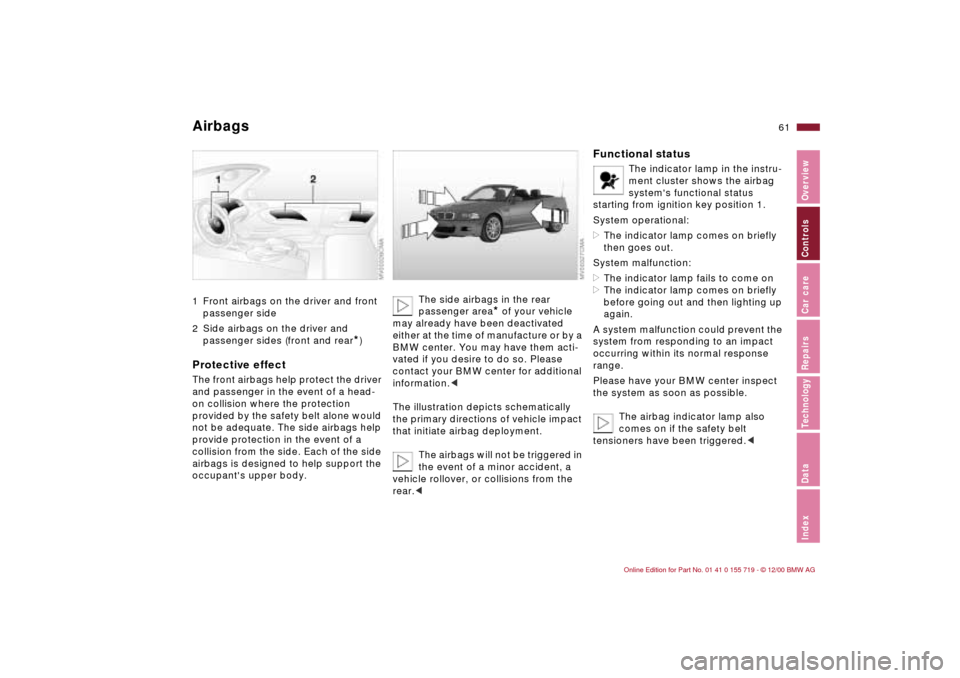
Airbags 1 Front airbags on the driver and front
passenger side
2 Side airbags on the driver and
passenger sides (front and rear
*)
Protective effectThe front airbags help protect the driver
and passenger in the event of a head-
on collision where the protection
provided by the safety belt alone would
not be adequate. The side airbags help
provide protection in the event of a
collision from the side. Each of the side
airbags is designed to help support the
occupant's upper body.
The side airbags in the rear
passenger area
* of your vehicle
may already have been deactivated
either at the time of manufacture or by a
BMW center. You may have them acti-
vated if you desire to do so. Please
contact your BMW center for additional
information.<
The illustration depicts schematically
the primary directions of vehicle impact
that initiate airbag deployment.
The airbags will not be triggered in
the event of a minor accident, a
vehicle rollover, or collisions from the
rear.<
Functional status
The indicator lamp in the instru-
ment cluster shows the airbag
system's functional status
starting from ignition key position 1.
System operational:
>The indicator lamp comes on briefly
then goes out.
System malfunction:
>The indicator lamp fails to come on
>The indicator lamp comes on briefly
before going out and then lighting up
again.
A system malfunction could prevent the
system from responding to an impact
occurring within its normal response
range.
Please have your BMW center inspect
the system as soon as possible.
The airbag indicator lamp also
comes on if the safety belt
tensioners have been triggered.<
Page 70 of 195
70n
Washer/Wiper systemRain sensor
*
When the rain sensor is activated, the
windshield wiper is controlled automati-
cally, depending on the degree of
wetness of the windshield (in both snow
and rain). You do not have to be
concerned with switching the wind-
shield wiper on or off or adjusting the
wipe interval between intermittent and
full wipe. Instead, you can concentrate
fully on the traffic conditions. This is
especially important under adverse
weather conditions.
The rain sensor is positioned on the
windshield, directly ahead of the inte-
rior rearview mirror.
To activate the rain sensor:
>From ignition key position 1 and up,
move the lever to position 1. The
wipers travel once across the wind-
shield, regardless of the weather
>You can leave the lever permanently
in position 1. It is then only necessary
to activate the rain sensor from igni-
tion key position 1 and up. To do this
give rotary dial 5 a quick turn.
To adjust the sensitivity of the rain
sensor: turn rotary dial 5.
Deactivating the rain sensor: put lever
in position 0.Deactivate the rain sensor when
passing through an automatic car
wash. Failure to do so could result in
damage caused by undesired wiper
activation.<
Normal wiper speedWhen the vehicle is stationary, the
wipers switch automatically to intermit-
tent wipe (not on vehicles with rain
sensor).Fast wiper speedWhen the vehicle is stationary, the
wipers operate at normal speed (not on
vehicles with rain sensor).
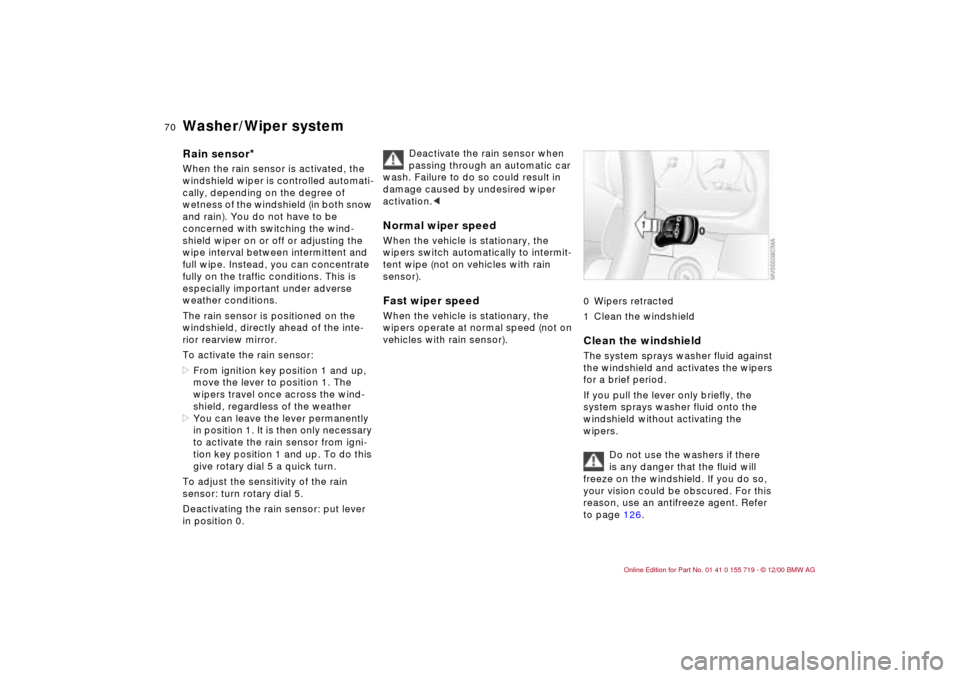
0 Wipers retracted
1 Clean the windshieldClean the windshieldThe system sprays washer fluid against
the windshield and activates the wipers
for a brief period.
If you pull the lever only briefly, the
system sprays washer fluid onto the
windshield without activating the
wipers.
Do not use the washers if there
is any danger that the fluid will
freeze on the windshield. If you do so,
your vision could be obscured. For this
reason, use an antifreeze agent. Refer
to page 126.
Page 74 of 195
74n
Fuel gauge Coolant temperature gauge Once the indicator lamp stays on
continuously, there are still approx.
2 gallons (8 liters) of fuel in the fuel
tank.
For fuel tank capacity, refer to
page 181.
If the tilt of the vehicle varies (extended
driving in mountainous areas, for
example), there may be slight fluctua-
tions of the needle.
Fill the fuel tank well before it is
empty. Driving to the last drop of
fuel can result in damage to the engine
and/or the catalytic converter.<
When the ignition is switched on, the
indicator lamp in the fuel display will
light up briefly to confirm that the
system is operational.
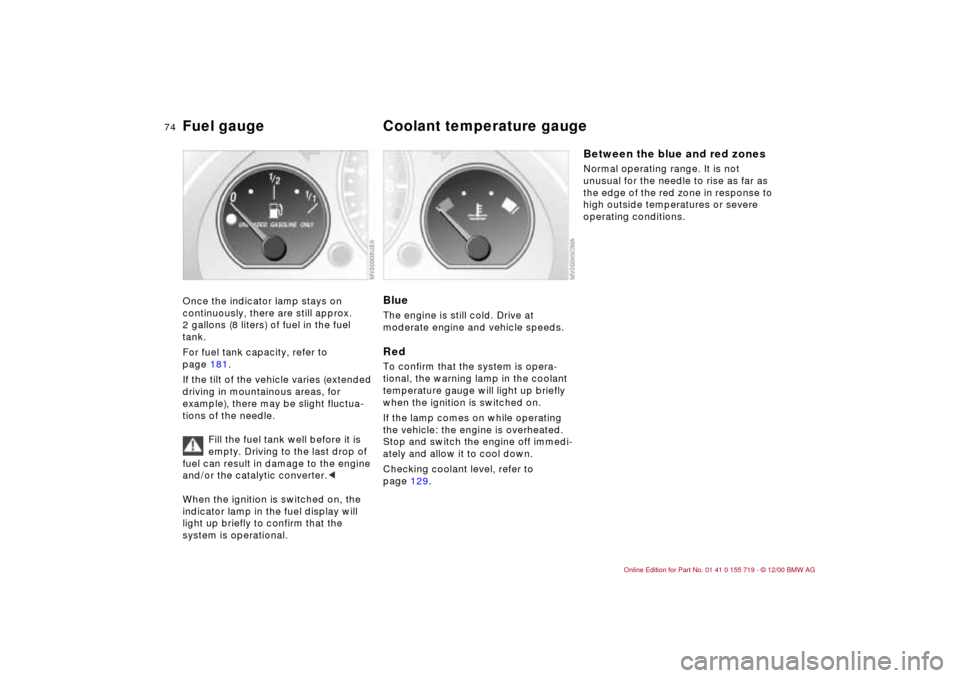
BlueThe engine is still cold. Drive at
moderate engine and vehicle speeds. RedTo confirm that the system is opera-
tional, the warning lamp in the coolant
temperature gauge will light up briefly
when the ignition is switched on.
If the lamp comes on while operating
the vehicle: the engine is overheated.
Stop and switch the engine off immedi-
ately and allow it to cool down.
Checking coolant level, refer to
page 129.
Between the blue and red zonesNormal operating range. It is not
unusual for the needle to rise as far as
the edge of the red zone in response to
high outside temperatures or severe
operating conditions.
Page 79 of 195

79n
IndexDataTechnologyRepairsCar careControlsOverview
The conceptThe PDC assists you when you back
into a parking space. A signal warns
you of the distance to an obstacle.
To do this, four ultrasonic sensors in
the rear bumper measure the distance
to the nearest object. The range for the
sensors located at both rear corners
ends approx. 2 ft. (60 cm) behind
the bumpers. The range for the two
middle sensors is approx. 4.9 feet
(1.50 meters).
The system is activated automatically
about one second after you engage
reverse with the ignition key in
position 2. PDC is deactivated when
you shift back out of reverse.
Acoustic signalsThe distance to the nearest object is
indicated by a tone sounding at various
intervals. As the distance between
vehicle and object decreases, the inter-
vals between the tones become
shorter. A continuous tone indicates the
presence of an object less than 1 ft.
(30 cm) away.
The warning signal is interrupted after
approx. three seconds if the distance to
the obstacle remains constant during
this time (if you are moving parallel to
a wall, for instance).
System malfunctions will be indicated
by a continuous high-pitched tone
when the system is activated the first
time. Please refer the problem to your
BMW center.The PDC does not remove the
driver's personal responsibility for
evaluating the distance between the
vehicle and any obstacles. Even when
sensors are involved, there is a blind
spot in which objects cannot be
detected. This applies especially in
those cases where the system
approaches the physical limits of ultra-
sonic measurement, as occurs with tow
bars and trailer couplings, and in the
vicinity of thin and painted objects.
Certain sources of sound, such as a
loud radio, could drown out the PDC
signal tone.<
Keep the sensors clean and free
of ice or snow in order to ensure
that they continue to operate effec-
tively.
Do not apply high pressure spray to the
sensors for a prolonged period of time.
Always maintain a distance of more
than 4 in (10 cm).<
Park Distance Control (PDC)
*
Page 80 of 195
80n
Dynamic Stability Control (DSC)
The concept
DSC helps maintain vehicle stability,
even in critical driving situations.
The system optimizes vehicle stability
during acceleration and when starting
from a full stop, as well as optimizing
traction. In addition, the system recog-
nizes unstable vehicle conditions
(understeering or oversteering in
curves, for example) and holds the
vehicle on course by intervening via the
engine and by braking intervention at
the individual wheels within the limits
defined by the laws of physics.
The system starts up automatically
each time you start the engine.
The laws of physics cannot be
repealed, even with DSC. The
results of driving irresponsibly rest with
the driver. We therefore urge you to
avoid using the additional safety margin
of the system as an excuse for taking
risks. Do not make any modifications to
the DSC system. Service procedures
on the system are to be performed by
authorized technicians only.<
You will find additional details
concerning DSC in the chapter
"Advanced technology" on page 170.
Indicator lamp
The indicator lamp on the instru-
ment cluster will go out shortly
after the ignition has been
switched on. Refer to page 21.
>Indicator lamp flashes: the system is
active and is controlling the drive
torque based on driving conditions
>If the indicator lamp fails to go out
after the engine has been started, or
if it comes on during normal driving
and stays on: there is a system
malfunction or the system was deac-
tivated with the button. You can
continue to drive the vehicle
normally, but without DSC. Please
consult your BMW center for repairs.
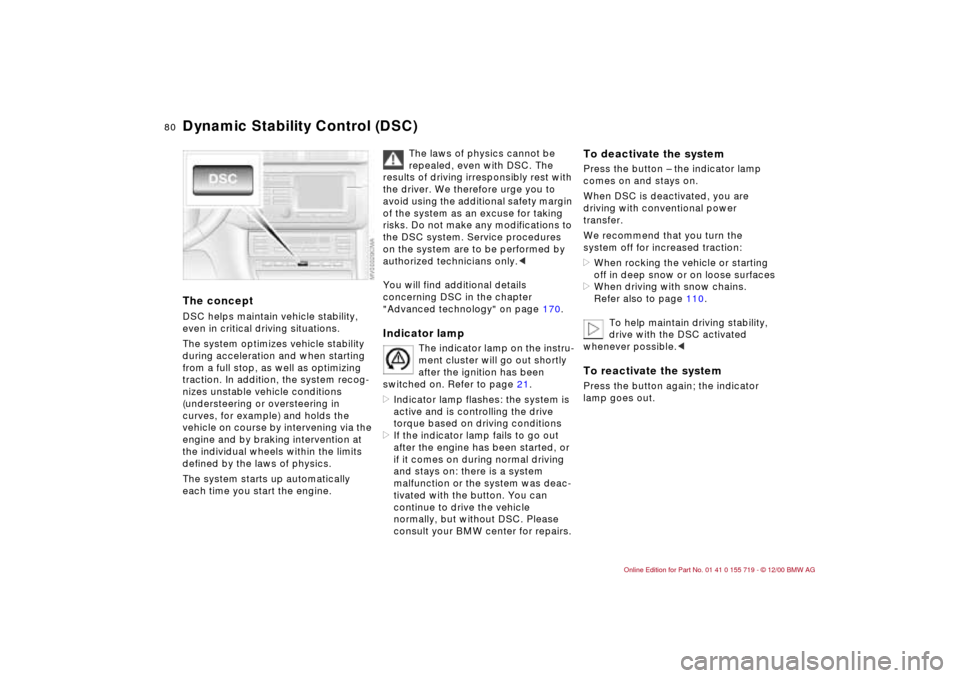
To deactivate the systemPress the button – the indicator lamp
comes on and stays on.
When DSC is deactivated, you are
driving with conventional power
transfer.
We recommend that you turn the
system off for increased traction:
>When rocking the vehicle or starting
off in deep snow or on loose surfaces
>When driving with snow chains.
Refer also to page 110.
To help maintain driving stability,
drive with the DSC activated
whenever possible.< To reactivate the systemPress the button again; the indicator
lamp goes out.
Page 83 of 195
83n
IndexDataTechnologyRepairsCar careControlsOverview
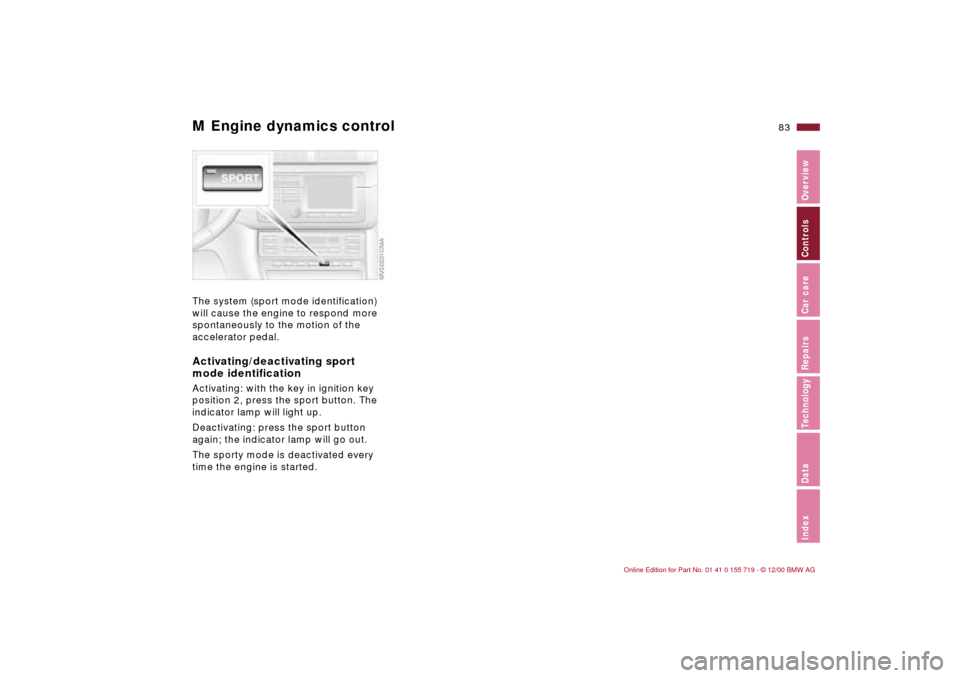
M Engine dynamics controlThe system (sport mode identification)
will cause the engine to respond more
spontaneously to the motion of the
accelerator pedal. Activating/deactivating sport
mode identificationActivating: with the key in ignition key
position 2, press the sport button. The
indicator lamp will light up.
Deactivating: press the sport button
again; the indicator lamp will go out.
The sporty mode is deactivated every
time the engine is started.
Page 89 of 195

89n
IndexDataTechnologyRepairsCar careControlsOverview
Automatic climate control 1 Air onto the windshield and onto the
side windows
2 Airflow toward the upper body
The side rotary dials allow you to
open and close the air supply
through an infinitely-variable range,
while the levers change the airflow
direction. The center rotary dial
adjusts the temperature of the
emerging air, see page 92
3 Ventilation for the front footwell
There are corresponding air vents in
the rear footwell as well
4 Recirculated air mode/Automatic
recirculated air control (AUC)91
5 Air supply (fan)91
6 Temperature90
7 Automatic air distribution90
8 Individual air distribution90
9 Air grille for interior temperature
sensor – please keep clear and
unobstructed
10 Display for temperature and air
supply90
11 To defrost the windows and remove
condensation91
12 Air conditioner91
13 Rear window defroster71, 92
Page 91 of 195
91n
IndexDataTechnologyRepairsCar careControlsOverview
Automatic climate control Air supply (fan)
By pressing the left or right half
of the button, you can vary the
air supply. By doing this, you switch off
the automatic control of the air supply.
Nevertheless, the automatic air distri-
bution remains unchanged.
When you set the lowest blower speed
by pressing the left half of the button,
all of the displays are canceled: the
blower, heating and air conditioner are
switched off, and the air supply is
stopped. You can reactivate the system
by pressing any button for the auto-
matic climate control.
Defrosting the windows and
removing condensation
This program quickly removes
ice and condensation from the
windshield and side windows.
Air conditioner
The air is cooled and dehumidi-
fied and – depending on the
temperature setting – rewarmed when
the air conditioner system is switched
on.
Depending on the weather, the wind-
shield may fog over briefly when the
engine is started.
Use the button to switch the air condi-
tioner off at outside temperatures
below approx. 41 7(+5 6). This will
help to prevent the windows from
fogging over.
If the windows fog over after switching
the air conditioner off, switch it back
on.
Condensation forms in the air
conditioner system during opera-
tion, that then exits under the vehicle.
Traces of condensed water of this kind
are thus normal.<
Automatic recirculated air control
(AUC)
If there are unpleasant odors or
pollutants in the outside air, you
can temporarily block the airflow from
the outside. The system then recircu-
lates the air already within the vehicle.
By repeated actuation of the button,
you can select one of three different
operation modes.
>Indicator lamps off: outside air always
flowing into the vehicle
>Left-hand indicator lamp on – Auto-
matic mode: the system detects
pollutants in the outside air and
responds by deactivating the outside
airflow as required. The system then
recirculates the air already within the
vehicle.
Depending on air quality require-
ments, the system automatically
switches between outside air supply
and recirculation of the air already
within the vehicle
>Right-hand indicator lamp on: the
flow of outside air is permanently
blocked. The system recirculates the
air already within the vehicle.
Page 101 of 195
101n
IndexDataTechnologyRepairsCar careControlsOverview
Cargo loading Roof-mounted luggage rack for the hardtop
*
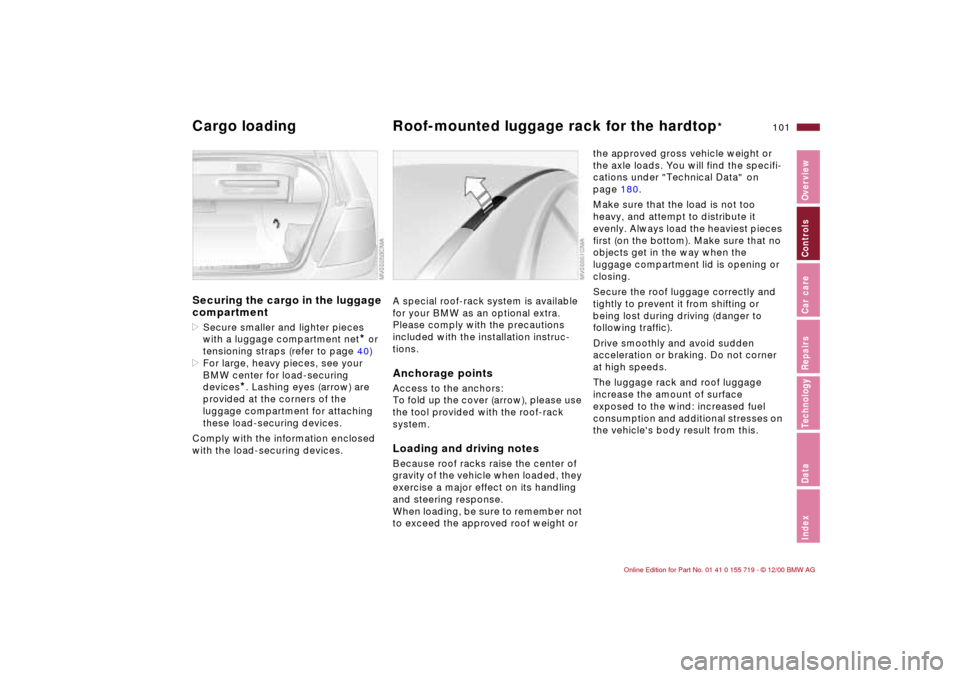
Securing the cargo in the luggage
compartment >Secure smaller and lighter pieces
with a luggage compartment net
* or
tensioning straps (refer to page 40)
>For large, heavy pieces, see your
BMW center for load-securing
devices
*. Lashing eyes (arrow) are
provided at the corners of the
luggage compartment for attaching
these load-securing devices.
Comply with the information enclosed
with the load-securing devices.
A special roof-rack system is available
for your BMW as an optional extra.
Please comply with the precautions
included with the installation instruc-
tions.Anchorage pointsAccess to the anchors:
To fold up the cover (arrow), please use
the tool provided with the roof-rack
system.Loading and driving notesBecause roof racks raise the center of
gravity of the vehicle when loaded, they
exercise a major effect on its handling
and steering response.
When loading, be sure to remember not
to exceed the approved roof weight or
the approved gross vehicle weight or
the axle loads. You will find the specifi-
cations under "Technical Data" on
page 180.
Make sure that the load is not too
heavy, and attempt to distribute it
evenly. Always load the heaviest pieces
first (on the bottom). Make sure that no
objects get in the way when the
luggage compartment lid is opening or
closing.
Secure the roof luggage correctly and
tightly to prevent it from shifting or
being lost during driving (danger to
following traffic).
Drive smoothly and avoid sudden
acceleration or braking. Do not corner
at high speeds.
The luggage rack and roof luggage
increase the amount of surface
exposed to the wind: increased fuel
consumption and additional stresses on
the vehicle's body result from this.
Page 106 of 195

106n
Antilock Brake System (ABS)The concept ABS helps prevent the wheels from
locking while braking, thereby
enhancing active driving safety. This is
because locked wheels are dangerous.
When the front wheels slide, the driver
loses steering control over the vehicle.
Traction loss at the rear wheels can
cause the rear end to break into an
uncontrolled skid.
Under any given road conditions, ABS
can brake the vehicle within the
shortest possible distance and with the
greatest possible driving stability (on
straight-aways and curves, asphalt, ice,
wet road surfaces, etc.).
ABS is designed to meet two essential
requirements during every brake appli-
cation:
>To help provide vehicle stability
>To help maintain steering control and
maneuverability – on all types of road
surfaces (asphalt, concrete, mud, wet
road surfaces, snow, ice).
Braking with ABSThe system is operative once the
vehicle exceeds a speed of approx.
6 mph (10 km/h). The ABS is deacti-
vated whenever the vehicle's speed
drops back below approx. 4 mph
(6 km/h). This means that the wheels
can lock in the final phase of a panic
stop – a factor of no significance in
actual use.
If you are in a situation that requires full
braking, you will exploit the full benefits
of the ABS system if you apply
maximum pedal pressure ("panic stop").
Do not let up on the brake pedal even
after it starts pulsating. Since the
vehicle maintains steering response,
you retain the ability to avoid obstacles
using careful steering inputs.
The ABS system's closed-loop control
circuit cycles in fractions of a second.
Pulsation at the brake pedal shows you
that ABS is active and that you are thus
approaching the limits of the brake
system's effective response range. In
addition, a pulsation – a result of the
control function cycles – indicates to
the driver that vehicle speed should be
reduced to adapt to road surface condi-
tions when there is reduced traction and grip between tires and road surface
(slippery road surface).
On road surfaces with a loose surface
layer over a firm base, e.g. on gravel or
snow, as well as when driving with
snow chains on, braking distances may
be longer than with the wheels locked.
However, ABS continues to provide
enhanced vehicle stability and steering
response under these conditions.
Information for your safetyNot even ABS can suspend the laws of
physics. The consequences of brake
applications with inadequate clear-
ances for safety between vehicles,
excessive speed or if aquaplaning
occurs are always the responsibility of
the driver. You should never allow the
added safety of ABS to lull you into a
false sense of security, or mislead you
into taking risks that could affect your
own safety and that of others.
Do not make any modifications to
the ABS system.
Service procedures on ABS are to be
performed by authorized technicians
only.<